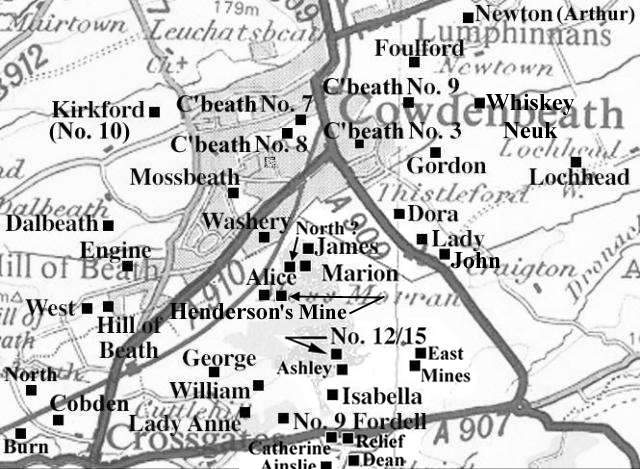
In the southern half of Moss Morran, to the south of
Cowdenbeath, these Donibristle shafts were sunk in the region of
the downthrow side of the Moss Morran "dyke". The No.
12 Pit probably sunk in the 1860s to a depth of 80 fathoms
originally, was finally to reach around 102 fathoms. The No. 15 Pit
was sunk (around 1899) to a depth of 105 fathoms, and both pits are
believed to have continued to work until the closure of the
Donibristle Colliery in 1928.
The No. 12 Pit was sunk about 300 yards to the north of the
Isabella Pit, and the later No. 15 shaft was sunk just yards to the
north-west of the No. 12.
|
 |
 |
| Source Date of Information (Owner) |
|---|
| Manager / Under-Manager / Men underground / Men above ground / Coal seams worked / Shaft Details |
| 1873 (Grieve and Nasmyth) |
| No. 12 Pit & Mine : A. Nasmyth / ------------ / --- / --- / Lochgelly Splint and Parrot / D'cast 400 ft. : U'cast 37 ft. |
| 1874/75 (Grieve and Nasmyth) |
| No. 12 Pit : Alex. Nasmyth / ------------ / 33 / 10 / Main Coal and Parrot / D'cast 240 ft. : U'cast 37 ft. |
| 1876/77 records
list No. 12 but no manpower details. 1878-82 records do
not include No. 12 Pit.
|
| 1890 (Donibristle Colliery Co.) |
| No. 12
Pit : Alex. Nasmyth / ------------ / 96 / 15 / Five
Foot; Dunfermline Splint; Lochgelly Splint and Parrot
D'cast (14 x 5) 430 ft./ (6 x 4) 30 ft : U'cast (9 x 5) 318 ft. Steam jet ventilation. |
| 1898 (Fife Coal Co. Ltd.) |
| Mr Alexander Nasmyth, manager. |
| 1908 (Fife Coal Co. Ltd.) |
| Mr Charles Carlow Reid, manager. |
| 1915 (Fife Coal Co. Ltd.) |
| Oct: Mr William Spalding, manager. Mr Charles Carlow Reid, district agent. |
| 1918 (Fife Coal Co. Ltd.) |
| Nos. 12, 15: Robert Aitchison / John Duncan / 203 / 66 |
| 1920 (Fife Coal Co. Ltd.) |
| ---------- / John Duncan / 229 / 92 Sep: Mr James Methven, James Pit, appointed undermanager in succession to Mr John Duncan. |
| 1926 (Fife Coal Co. Ltd.) |
| Mar: George Marshall, manager. |
| 1927 (Fife Coal Co. Ltd.) |
| Apr: George Marshall, manager. |
| See Central Fife Index Entry 'Donibristle Pits & Mines' for more details |
|---|
------------------------------------
Information on coals worked at, or near, the Nos. 12, 15 Pits, Donibristle
(based on reports from 1930 and 1934)
Just to the east of the pits, a section of the Dunfermline
Splint Coal contained 3 in. parrot coal, 9 in. rough coal and
4 ft. 4 in. of splint coal.
Here the Swallowdrum Coal was separated from the Lochgelly
Splint Coal by around 17 fathoms containing a thick, coarse
sandstone. The coal measured 3 ft. thick and was wrought from
both pits.
Fourteen Foot Coal, recorded at 8 ft. thick, was found
midway between these pits and the Isabella Pit, which lay a
little further to the south.
------------------------------------
| Plans of Abandoned Seams for Nos. 12, 15 Pits | Pits or Mines designated in Abandonment Plans |
|---|---|
| COAL; Splint (1850); Fourteen Feet (1919); Gorman (1920); Jewel; Wee (1921); Mynheer; Glassee; Five Feet | DONIBRISTLE
Nos. 12, 15; Catherine; Isabella; Relief |
| COAL; Five Feet (August, 1918); Mynheer (February, 1920); Lower Splint or Dunfermline Splint (29 April, 1926) | DONIBRISTLE
Nos. 12, 15; Isabella; James; Marion |
| COAL; Fourteen Feet; Gorman; Diamond; Swallowdrum;
Jewel (31 December, 1927) |
DONIBRISTLE
Nos. 12, 15 |
------------------------------------
"Dunfermline Saturday Press"
23 October, 1869
On the morning of Monday last, an accident happened in No. 12 Pit of the Donibristle Colliery, whereby a miner named George Beveridge got his collar bone broken. It appears that shortly after six o'clock Beveridge was busily engaged at the coal face, when a large quantity came rather suddenly away, and a piece of it struck him so severely that he was knocked to the ground and received the above injuries. He was, however, able to walk home, and Dr. Burt, of Aberdour, was shortly afterwards in attendance and set the fractured bone, and we understand the poor man is now progressing favourably.

"Dunfermline Saturday Press"
31 March, 1888
On Tuesday afternoon, in No. 12 Pit, Donibristle Colliery, Fifeshire, while a man named Andrew Seath was engaged at the face, an immense block of stone fell on him, crushing him beneath it. He was instantaneously killed. Deceased was 40 years of age, and has left a widow and family.
[The official Mines Report gives the age at time of
death as 36 years and we are grateful to Craig J. Seath for
confirming this. Andrew Seath was the uncle of Craig's great great grandfather.
M. Martin, Webmaster]
--------------------------------------------
"Dunfermline Saturday Press"
7 June, 1890
John Muir, miner, Crossgates, while engaged in the wheel-brae in No. 12 Pit, Donibristle, on Thursday, sustained several cuts about the head and face.
--------------------------------------------
"Dunfermline Saturday Press"
8 November, 1890
This edition carried news of a presentation arranged by the miners of No. 12 Pit who met in the house of James Cuthbert on Wednesday last to present John Ness, oversman, with a handsome time-piece on his leaving the colliery to fill a similar occupation.
--------------------------------------------
"Dunfermline Saturday Press"
12 August, 1893
An accident occurred in No. 12 Pit, Donibristle Colliery, on Tuesday, which had a fatal issue. A large mass of coal, supposed to weigh about two tons, came away from the face, and buried Robert Pryde, miner, Arthur's Place, Cowdenbeath, underneath it. Before the man could be extricated the coal had to be broken up. He was got out alive, but was so terribly injured that he lived only a few hours after being conveyed home.
--------------------------------------------
"Dunfermline Saturday Press"
7 April, 1894
George Stanley, miner, Cowdenbeath, was seriously injured yesterday by a fall from the roof in No.12 Pit, Donibristle. Several of his ribs were broken, and he sustained other injuries.
--------------------------------------------
"Dunfermline Saturday Press"
16 February, 1895
An accident of a peculiar nature, supposed to be the
result of the storm, occurred late on Sunday night at
Donibristle Colliery. James Bowman, sixty-five years of age,
who was employed as the underground engineman at No. 12 Pit,
was being lowered, when the cage, owing possibly to ice,
stuck in the slides, and a length of slack rope was given
out. The impediment in the slide wore off, and the cage, thus
freed, was precipitated down the shaft, snapping the rope as
if it had been cut by a knife. The cage was found at the
bottom of the pit, which is 80 fathoms deep, and its
condition is described as being like a concertina.
Bowman was inside, his body being in a terribly mangled
condition.
--------------------------------------------
"Dunfermline Saturday Press"
26 December, 1896
BURNING ACCIDENT
Early on Sunday morning last, James Broggan, a tramp labourer, received severe burning injuries in a lodge at No. 12 Pit, Donibristle Colliery. Broggan was sleeping on a mat in front of a fire when a piece of live coal fell from the fire. It ignited the mat, and set fire to his clothes, with the result that the poor fellow was burned from the feet to the haunches. He was removed to the Dunfermline College Hospital, but succumbed on Wednesday to his injuries. Deceased was 42 years of age, and was a native of Pollockshaws.
____________
Charles Campbell, son of Alexander Campbell, miner, Donibristle, had his right leg broken on Wednesday, while employed as a hanger-on in No. 12 pit, Donibristle Colliery. An empty hutch came down the wheel-brae upon him. Dr W. Nasmyth, Crossgates, attended to the injured lad.
--------------------------------------------
"Dunfermline Press"
11 December, 1897
James Summers, miner, Arthur Place, Cowdenbeath, sustained a fracture of the left leg while working at the coal face in No. 12 Pit, Donibristle Colliery. A piece of stone had fallen upon the unfortunate man's leg. He was attended to by Dr Nasmyth, who ordered his removal to the Dunfermline Cottage Hospital, where it was found necessary to amputate the injured limb.
--------------------------------------------
"Dunfermline Press"
26 February, 1898
FATAL RESULT OF AN ACCIDENT
George Mitchell, 19 years of age, Arthur Place, Cowdenbeath, has died from the effects of injuries sustained in the underground workings of No. 12 Pit, Donibristle Colliery, on the 15th inst. Mitchell had been filling a hutch of coal at the coal face when the roof supports gave way, and a quantity of coal, weighing about two tons, fell, part of it striking him on the left side of the head and body. Mitchell died on Wednesday morning.
[The issue of 19 March carries the Report of the Fatal Accident Inquiry into this death on 23 February, following an accident in the Parrot Seam at No. 12 Pit, Donibristle, on 15 February, 1898. Among those giving evidence were Alexander Nasmyth, manager; Robert Bald, miner, Donibristle; Thomas Rattray, Cowdenbeath, oversman; Alexander Mitchell, inspector at pit (father of deceased); and, Dr Selkirk, Cowdenbeath.]
--------------------------------------------------
"Dunfermline Journal"
13 July, 1900
... No. 12 Pit was sunk about 300 yards to the north of the
Isabella. The No. 15 is close to No. 12, and Nos. 13 and 14 (the Marion
and the James) are operating still further north, the site of the
shafts being mid-way between No. 12 Pit and the North British
Railway.
Operations have ceased in all the pits in the southern
section of the field; and now work is concentrated on the field
north of the Isabella, in Nos. 12, 13, 14, and 15 Pits.
No. 12 Pit
was up till recently only sunk to the Mynheer seam, and the
Five-Foot and the Dunfermline Splint seams were caught to the rise
by cross-cutting through the metals. Just recently No. 15 shaft,
which adjoins No. 12, was sunk to the Dunfermline Splint, a depth
of 105 fathoms, and this shaft being at a low level it is to
constitute the pumping pit of the colliery. To cope with the water
a Tanges Quadruple, direct-acting, compound, condensing ram pump,
has been erected at the bottom of the shaft, and all the fittings
are on the most modern principle. To enable the company to carry out
the plan of working No. 15 Pit as a pumping pit pure and simple, No.
12 shaft has been deepened, the Dunfermline Splint being struck
only this week.
By the change a capital hold had been got of the
Splint and Five-Foot seams in this part of the field, while the
Marion and the James Pits are operating upon all the seams from the
Lochgelly Splint
to the Dunfermline Splint from the centre of the field to the
Company's march on the north. The Marion, the James and the No.
12 Pits are fitted with coupled winding engines, and the two former
pits are kept clear of water by a pumping engine of the Worthington
type which was erected in 1888. ... The fan at the Isabella is a
"Waddle", and it ventilates the whole of the workings
connected with No. 12 and No. 15 Pits, the quantity of air being
exhausted being about 20,000 cubic feet per minute. ...
The
development of the lower seams of coal by the sinking of No. 12
and No. 15 Pits is being watched with a good deal of interest by
the miners. Satisfaction is expressed at the fact that No. 15 has
been sunk and No. 12 deepened without the occurrence of a single
accident.
[Isn't it ironic that the journalist responsible for the article from which the above extracts have been taken should boast of the safety record of No. 12 Pit when that was to be the site of the Moss Morran Disaster only a year later.]
----------------------------------------

Report into the Donibristle Nos. 12, 15 Pits
Disaster
26 August, 1901
WE MUST NEVER FORGET THIS.
H. M. Inspectors of Mines
|
|---|

The accident at Donibristle Colliery, in Fife, which occurred on the 26th August, 1901, and was caused by a flow of moss into the mine involving the loss of eight lives, has been the subject of a special report and need not be further described here, except to indicate the positions in which the bodies of five of the victims that had not been recovered at the time when the report was published were found.
 |
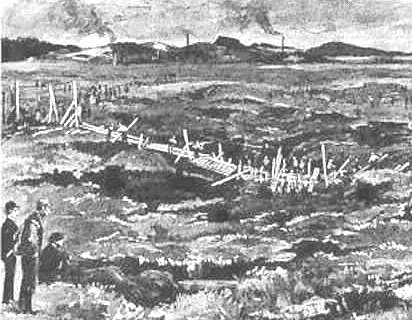 |
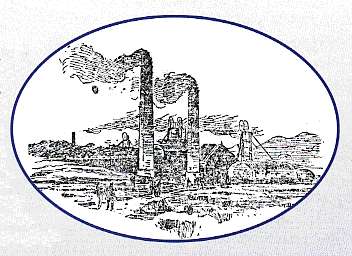
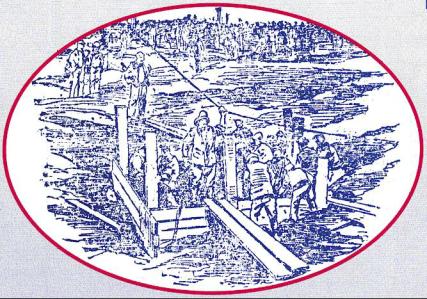
This was one of the oldest and best appointed collieries in Fife. It was operated by the Donibristle Colliery Company and worked coal under Mossmorran moorland. At about one o'clock on the afternoon of 26th August, 1901, two men drove up through the rock roof and a liquid mass of peat and water poured into the pit. Eleven men were trapped. Two rescue parties were formed and one man was saved, but four rescuers failed to return; fourteen men were now trapped. On the surface a huge crater had formed. Peat was still running into the pit so men started to dig rescue shafts. They worked all night, but the soft ground and water forced them to give up. The only way to reach the trapped men was through the opening in the crater. Working under the direction of the manager of Bowhill Colliery, men erected boards round the opening and improvised a cage. It was lowered into the pit and six men were found. Five were brought out before the boarding broke under the weight of water and peat. The sixth man and two of his rescuers were now trapped but the following morning, Robert Law, a miner from Cowdenbeath, went down alone and brought them out. Attempts to rescue the other eight men had to be abandoned; their bodies were recovered later.
Special Report
As surmised in the special report, the rescue party, consisting of Thomas Rattray oversman; William Hynd, pit bottomer; James Bowman McDonald, incline bottomer and Andrew Paterson, ostler; had broken through a stopping on the rise side of the haulage level, about 185 yards outbye from the working heading, and entered an old heading They had gone up this old heading to the first of the old levels above the haulage level about and then travelled inbye 119 yards to a point where the level was closed by a fall. They would then retrace their steps and find that, in the interval, the moss had flowed out on the haulage level, past the stopping they had removed, and had entered the old heading and the level they were in. They built a light stopping or dam in the level they were in, 96 yards from the old heading, to check the flow of the moss, and, seven yards further in, excavated a road through the waste a distance of 9 yards up the hill to the next level. They had brought with them a pick and a shovel. Arriving at the second level, above the haulage level, they would travel out in it towards the old heading but, 57 yards from the road they had made, they again met the moss, and here they were found on the 14th December, Rattray and Paterson lying on the moss, and Hynd and McDonald near them.
The moss was all round them, having not only flowed up the old heading and into the level as described, but it had also come out above them direct from the workings by the upper levels.
Even if their exact position had been known immediately after the accident, they could not have been reached for some days and long after life would be extinct, as all ventilation was cut off and black damp would soon end their suffering.
They left written records in pencil in a time-book and in chalk on the shovel. One sentence may be quoted as showing the object they had in view; this was a case of taking out stopping to give them a way to go when moss came down. "We cut up, and got into . . . . it was closed. We are choking."
Other records showed that their oil was done and they were in the dark. Many messages were sent to their families and other entries indicated that they had no hope of rescue.
The remaining body - that of David Campbell, pit inspector, who was working at the face of the heading where the moss burst in - was found on the same day as the others in the moss near the dam in the old level that had been put in by Rattray's party. His body had been carried down the working heading outwards in the haulage level, and through the stopping that had been removed and so into the old level.
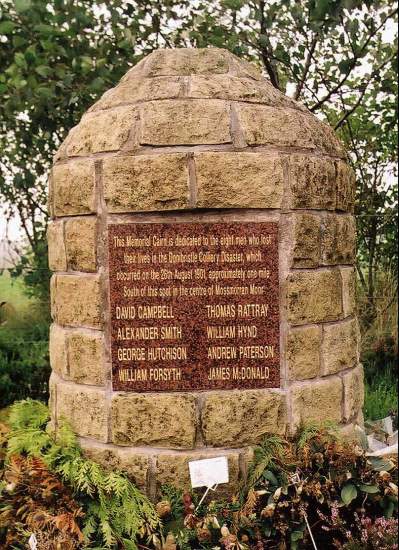 |
The next article is a song about the Donibristle Disaster which was written by James Ross Murray - "Jimmy Murray, the barber" - the grandfather of Sheila McEwan, formerly of Cowdenbeath, who got in touch to express her delight at seeing the poem included. Sheila reported, "Believe it or not my sister and I have never read the whole poem though I have seen parts of it reproduced or referred to in a couple of books (Chicago Tumbles being one of them). It was originally written as a poem, not a song, and, according to my father, was intended to raise funds to help the widows and orphans of the tragedy. Why the family never kept a copy, I will never understand. I had been told many times of the disaster by my grandmother and my aunt and father could quote small bits of the poem but we were never shown a copy. As to the idea of it being sung, that was never mentioned. If you have, could you possibly let me know where you came across the poem? Is it published somewhere and, if it is, can I get copies?"
[If anyone can help in tracing this published article, please contact Mick via the website mailbox as we presently cannot recall who sent this item to the Webmasters.]
| THE DONIBRISTLE DISASTER | |
| 1. | On the twenty-sixth of August, our fatal moss gave
way.
Although we did our level best, its course we couldn't stay. Ten precious lives there were at stake; "Who'll save them?" was the cry; "We'll bring them to the surface, or along with them we'll die." |
| 2. | There was Rattery and McDonald, Hynd and Paterson,
Too well they know the danger and the risk they had to run. They never stopped to count the cost; "We'll save them," was the cry; "We'll bring them to the surface, or along with them we'll die." |
| 3. | They stepped upon the cage, they were ready for the
fray.
They all meant business as they belled themselves away. Soon they reached the bottom, far from the light of day, And went to search the workings, and Tom Rattery led the way. |
| 4. | They lost their lives, God help them. Ah, yes it
was a fact,
Someone put in a stopping and they never did get back. Was that not another blunder? My God, it was a sin. To put a stopping where they did, it closed our heroes in. |
| 5. | We never shall forget them, though they have lost
their lives,
So let us pay attention to their children and their wives, It simply is our duty now, and let us all beware. Their fathers died a noble death and left them in our care. |
| 6. | There was Rattery and McDonald, Hynd and Paterson,
Too well they know the danger and the risk they had to run. They never stopped to count the cost; "We'll save them," was the cry; "We'll bring them to the surface, or along with them we'll die." |
AWARDS
| The heroism of the
rescuers was recognised by gifts and gold watches from
"The Daily Telegraph", Mr. Andrew Carnegie and
the relief Committee who received subscriptions for this
purpose.
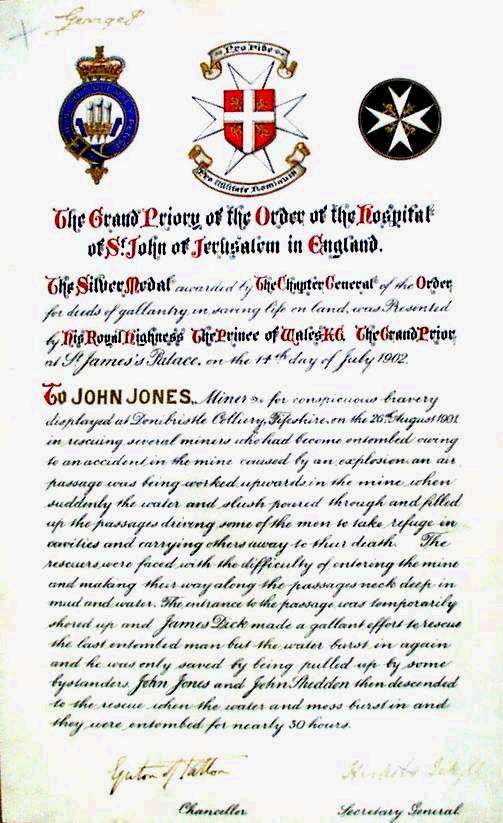
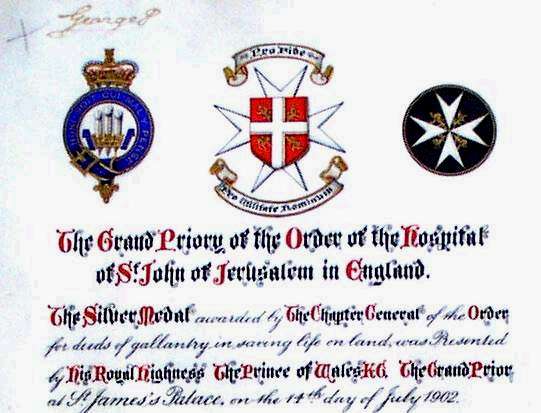
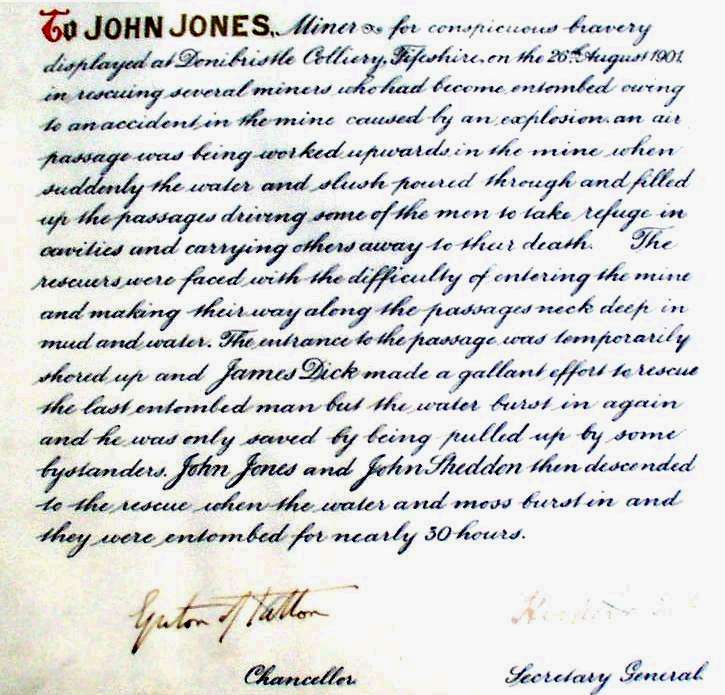
In addition, silver medals for gallantry and illuminated addresses were presented to members of the first rescue party, who brought five men to safety, before being trapped themselves. They, in turn, were released 32 hours later. The addresses, a copy of which is shown below, were presented by the Prince of Wales (George) during a ceremony at St. James's Palace on the 14th July, 1902. We are indebted to Mr. J. T. Jones (grandson of the rescuer John Jones) for permission to display the address. |
|---|
 |
 |
 |
Honouring the Donibristle Heroes
"Honour to whom honour is due."
Messrs Dick, Sheddon, Jones, and Law were each presented
with a gold watch. They also received a gift of £100
each from Mr Andrew Carnegie.
Mr Richardson was presented with a gold watch and a gift of
£50.
Three of the gold watches were presented by the editor of the "Daily Telegraph". The others were provided by the Relief Committee, who received subscriptions for this purpose.
The following miners were also presented with badges "for valour displayed at Donibristle Colliery, 26th August, 1901." -
James Adamson, Elgin Road, Cowdenbeath; William Pollock, Mossview, Cowdenbeath; David Pollock, Norwood Cottages, Cowdenbeath; Bernard Canavan, Cowdenbeath; Cornelius Sullivan, Cowdenbeath; Peter Burns, Cowdenbeath; George Cook, Cowdenbeath; John Scott, Cowdenbeath; Alexander Ritchie, Bowhill; John Marshall, Bowhill; William McQuinston, Bowhill; Alexander Robertson, Bowhill; John Hasrie, Bowhill; John Swan, Lochgelly; Stewart Millar, Lochgelly; Robert Birnie, Donibristle; James Wood, Kelty; and John McGhee, Hill of Beath.
 |
 |
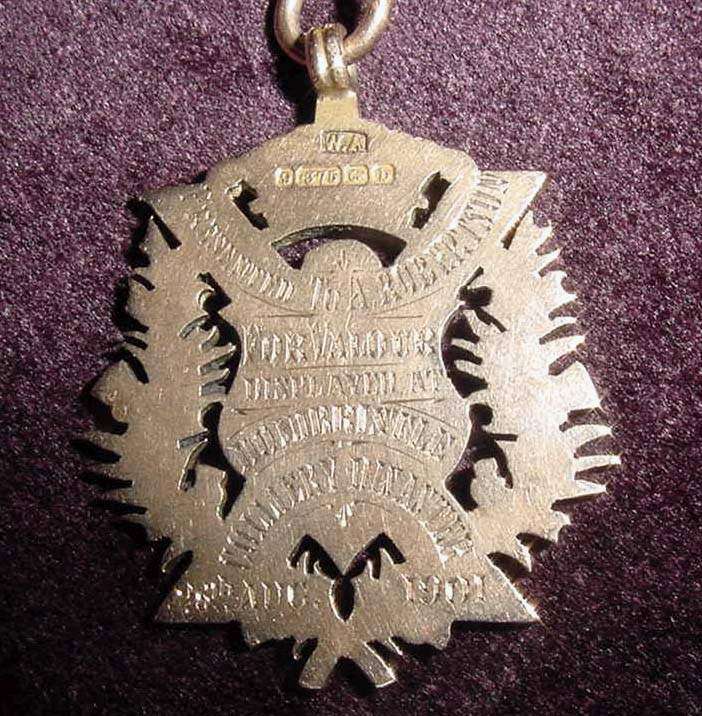 |
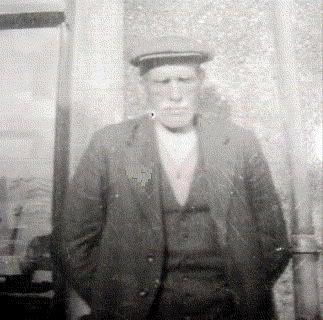
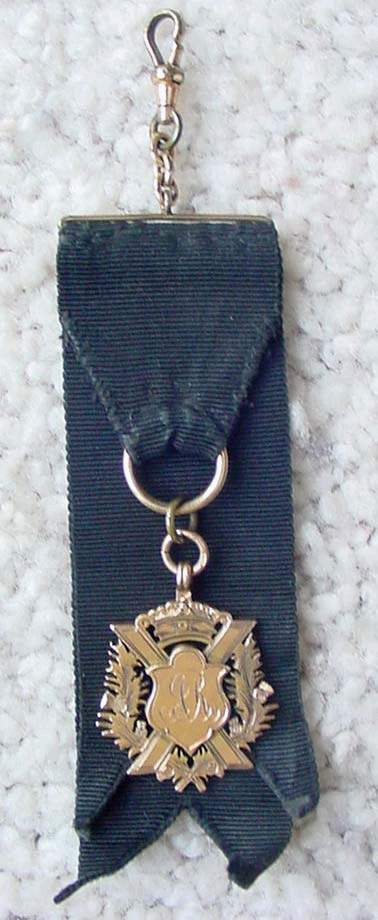
| Alexander Robertson | Medal Front | Medal Back |
| HERE ARE THE WORDS INSCRIBED ON THE MEDAL. |
|---|
FRONT |
| Initials: A R (Alexander Robertson) |
BACK |
| Presented to A Robertson |
| For Valour |
| Displayed At |
| Donibristle |
| Colliery Disaster |
| 26th Aug. 1901 |
DESCRIPTION The medal is a gold. The medal is attached to two small rings (¼ in. diameter) which was then inserted through a double strand of black grosgrain (a closely woven silk or rayon fabric with narrow horizontal ribs) ribbon. At the top of the ribbon is yet another clasp which might then be attached to whatever the wearer would choose. |
Special thanks go to John and Debby Laurie, of California, for sending the photograph of the medal which was presented to John's grandfather, Alexander Robertson, of Bowhill, for his display of valour at the Donibristle rescue operations following the disaster.
-------------------------------------------------
"Dunfermline Press"
7 December, 1901
CLAIM BY ENTOMBED MINERS
In Dunfermline Sheriff Court on Tuesday, actions were called in which the miners who were entombed in connection with the Donibristle Disaster, and were afterwards rescued, sue for damages for their painful experience underground. It was stated that there was a probability of the action being settled.
-------------------------------------------------
"Dunfermline Press"
14 December, 1901
COMPENSATION FOR ENTOMBED MINERS
In Dunfermline Sheriff Court on Tuesday,
settlement was intimated of the actions at the instance of Alex.
Bauld, Thomas Bauld, John Farquhar, John Colville, and John
Beveridge, against the Donibristle Company. The pursuers sued for
£250 each as compensation for injury sustained through their
being entombed in the workings of No. 12 Pit. The ground of
liability was that those for whom the defenders were responsible
adopted a method of forming an air course which was altogether
unskilful and unsafe. In the petition at the instance of Alex.
Bauld it was stated that during the time he was entombed he
suffered great mental agony. Several of his comrades were killed
practically under his eyes, and his nervous system sustained a
severe shock; and the continual strain during the time he was
imprisoned (twenty-four hours of which were spent in total
darkness) had the effect of completely shattering his nerves - he
and the other entombed men having given up all hope of rescue. They
did not know the moment when the branch road in which they had
taken refuge might be filled up by the rushing moss and water.
Besides this, the terrific noise caused by the accident and the
poisoned air they had to breath seriously affected them, both
bodily and mentally. The statements in the petitions by the other
pursuers were to the same effect.
Under the settlement intimated on Tuesday, the
pursuers each agreed to accept £40 and expenses in full of all
claims.
Sheriff Gillespie said it was satisfactory that
a settlement had been arrived at. ...
-------------------------------------------------
"Dunfermline Press"
5 March, 1904
Mr James Rattray, who succeeded his father as oversman in No. 12 Pit, Donibristle Colliery, after the catastrophe in August 1902, was waited upon in the Raith Arms Inn (Mr Breingan) on Saturday evening, and presented with a handsome writing desk on the occasion of his leaving the colliery.
-------------------------------------------------
"Dunfermline Press"
5 March, 1904
... At No. 12 Pit, Donibristle, about 100 men have been laid idle for three or four days through the crosshead of the pumping engine having broken, but the mines there have been getting fairly steady employment during the winter months.
-------------------------------------------------
"Dunfermline Press"
3 September, 1904
Thomas Bauld, miner, met with a slight accident while at his usual employment in No. 12 Pit, Donibristle, on Tuesday. A prop sprang out and struck him a severe blow on the forehead, inflicting a rather nasty wound.
-------------------------------------------------
"Dunfermline Press"
4 February, 1905
Charles Campbell, Fore Row, Donibristle, met with a serious accident in No. 12 Pit, on Saturday. He was drilling a hole, when a mass of debris, weighing about 10 cwt., came away from between two bars and fractured his right leg. He was removed to the hospital, where it was found necessary to amputate his leg at the ankle.
-------------------------------------------------
"Dunfermline Press"
30 June, 1906
Under the Fatal Accidents Inquiry Act, an inquiry was held in the Sheriff Court, Dunfermline, on Thursday - before Sheriff Shennan and a Jury - into the circumstances attending the death of David Campbell, miner, lately residing at New Buildings, Arthur Place, Cowdenbeath, who on 25th May, was killed by a fall from the roof in the Dunfermline splint seam of No. 12 pit, Donibristle. Those giving evidence at the inquiry included: John Kennedy, drawer, Rose Cottage, Dunfermline Road, Crossgates; James Breslin, fireman, Abbey Row, Donibristle; and Alexander Lyle, oversman, Frosty Mountains, Donibristle. A formal verdict was returned.
-------------------------------------------------
H. M. Inspector of Mines Report 1907
Mr. Robert McLaren's Report
Fatal Accident at Donibristle, Fife
Owner: Donibristle Colliery Co., Ltd.
8 February, 1907
Alexander Innes, 45, Miner. Deceased was at work at the coal face, when a large stone fell from the roof upon him, causing injuries to which he succumbed two days later.
--------------------------------------------
"Dunfermline Press"
9 February, 1907
Alexander Innes, miner, Arthur Street, Cowdenbeath, was seriously injured yesterday by a fall of stone in No. 12 Pit, Donibristle. His back and one of his legs were broken. He was conveyed to Dunfermline Hospital.
--------------------------------------------
"Dunfermline Press"
16 February, 1907
Alexander Innes, miner, Arthur Street, Cowdenbeath, who met with an accident in No. 12 Pit, Donibristle Colliery, on Friday last week, has died in Dunfermline and West Fife Hospital as the result of his injuries. A stone had fallen suddenly from the roof upon Innes, crushing him severely, and fracturing his spine, several ribs, and one of his legs.
--------------------------------------------
"Dunfermline Press"
2 May, 1908
Peter Waugh, a pit bottomer, employed in No. 12 Pit, Donibristle, and residing at Dunfermline Road, Crossgates, was killed as he was leaving for home on Thursday. He had been stepping on the cage at the Glassie Seam, which is one of the higher seams, and when in the act of closing the gate, the cage was immediately raised and he fell to the bottom. Deceased was a widower, and was twenty-two years of age.
----------------------------
"Dunfermline Press"
6 June, 1908
Under the Fatal Accidents Inquiry Act, an inquiry was held in the Sheriff Court,
Dunfermline, on Thursday - before Sheriff Shennan and a Jury - into the circumstances
attending the death of Peter Mitchell Waugh, pit bottomer, lately residing at Gladstone
Terrace, Crossgates, who, on 30 April, fell from a mid-working in the shaft of No. 12 pit,
Donibristle Colliery. Those attending the inquiry included:- Charles Carlow Reid, manager;
George Thomson, miner, Store Buildings, Crossgates; George Beveridge, miner, 17 Rose
Street, Cowdenbeath; Henry Cormie; John Beattie, pit-bottomer, Arthur Place, Cowdenbeath;
Alexander Beveridge, fireman, 60 Arthur Street, Cowdenbeath; Alexander Lyle, oversman,
Catherine Cottage, Donibristle; and Hugh Drysdale, winding engineman (12 years in post).
The jury who retired also in this case, found that the accident was due to an unfortunate
omission on the part of the engineman.
--------------------------------------------
"Dunfermline Press"
27 June, 1908
... on Saturday, Thomas Hope, miner, Springhill, Crossgates, was injured on the left shoulder, the breast, and the right leg, also by a fall of material in No. 15 pit, Donibristle Colliery.
--------------------------------------------
"Dunfermline Press"
15 August, 1908
A pithead worker, named Janet Pryde (17), residing at 17 East Park Street, Cowdenbeath, was severely crushed on the left side between the buffers of two waggons at No. 12 Pit, Donibristle Colliery, yesterday. Dr Nasmyth ordered her removal to the Dunfermline and West Fife Hospital.
--------------------------------------------
"Dunfermline Press"
14 May, 1910
Thomas Condie (45), residing at 96 Burnside Place, had his right leg broken above the knee while following his employment in No. 12 Pit, Donibristle Colliery, yesterday.
--------------------------------------------
"Dunfermline Press"
3 December, 1910
MINER'S MYSTERIOUS DEATH
Thomas Hill, miner, who resided at 38 Foulford Place, Cowdenbeath, died in Dunfermline and West Fife Hospital on Sunday night, from a cause not yet certified. On the 19th ult. he was found, by a road repairer, lying in an unconscious state in his working place in the Mynheer seam of No. 12 Pit, Donibristle Colliery. Artificial respiration was resorted to, and Hill, after being medically examined by Dr Nasmyth and Dr Selkirk, was removed in a comatose condition to the Dunfermline and West Fife Hospital. The doctors gave it as their opinion that Hill had probably taken a fit, as there was no sign of any marks on his body, while he had not the appearance of having been suffocated by foul air.
--------------------------------------------
"Dunfermline Press"
16 May, 1914
Marion Fisher, pithead worker, living with her parents in Arthur Place, Cowdenbeath, had on Tuesday a narrow escape from death at No. 12 Pit, Donibristle, where she was employed. She had been standing at the end of the cage when it was being lowered. It cleared her on its course but the gate, which is raised when the cage is at the surface, struck her while it was falling and knocked her into the shaft. Fortunately, she landed on the top of the descending cage before it had gone very far. Her injuries by the accident were severe, one of her legs and her collar bone being fractured. She was removed to the Dunfermline and West Fife Hospital.
--------------------------------------------
"Dunfermline Press"
19 December, 1914
James Moore, 52, labourer, of no fixed abode, employed at No. 12 Pit, Donibristle Colliery, had his right shoulder dislocated by being knocked down by a bogie near the cart shutes on Wednesday. He was removed to Dunfermline and West Fife Hospital.
--------------------------------------------
"Dunfermline Press"
9 January, 1915
Robert Hogg (19), miner's drawer, residing at Downieville Crescent, Dunfermline, was admitted to the Dunfermline and West Fife Hospital on Tuesday suffering from a fracture of the right leg and bruises on the body, received in No. 12 Pit, Donibristle Colliery, through being crushed between some hutches and the "building".
--------------------------------------------
"Dunfermline Press"
25 September, 1915
Thomas Young (35), who resided at Dunfermline Road, Crossgates, was killed in No. 12 Pit, Donibristle Colliery, on Saturday. He was employed as a bottomer, and while he was pulling a hutch on the cage the latter was unexpectedly raised. As a result he was dragged some distance up the shaft, and received such injuries that death must have been instantaneous. He leaves a widow and two of a family.
------------------------
"Dunfermline Press"
9 October, 1915
Under the Fatal Accidents Inquiry Act, an inquiry was held in the Sheriff Court, Dunfermline, on Thursday - before Sheriff Umpherston and a Jury - into the circumstances attending the death of Thomas Young, bottomer, lately residing at Coalville Terrace, Crossgates, who died on 18 September in No. 12 pit, Donibristle Colliery, from injuries received by being caught by an ascending cage. Those giving evidence included:- William Spalding, manager; Andrew Lyle (14), coupler; Alexander Russell, stableman; Alexander Arnott, pitheadman; George Wallace, winding engineman; and Charles Carlow Reid, district agent for Fife Coal Company. The jury returned a formal verdict, adding, as a rider, that the accident might not have happened had a visible indicator been in use in the engine-house. The jury attached no blame to any person for the accident.
--------------------------------------------
"Dunfermline Press"
9 September, 1916
Under the Fatal Accidents Inquiry Act, an inquiry was held in the Sheriff Court,
Dunfermline, on Thursday - before Sheriff Umpherston and a Jury - into the
circumstances attending the death of James Sneddon, boiler cleaner, lately residing at
98 Hospital Hill, Dunfermline, who died in Dunfermline and West Fife Hospital on 18th
August from scalding injuries received on that date in a boiler at No. 12 Pit, Donibristle
Colliery. Those giving evidence at the inquiry included:- William Spalding, colliery manager;
Robert Berry, colliery engineman; and Duncan Wilson, boiler cleaner.
The jury returned a formal verdict, the Sheriff pointing out that the shutting off of this valve
seemed to have been everybody's duty, and therefore, like many of these things, it
became nobody's duty in particular. There was not sufficient information, his Lordship
added, to make any recommendation to avoid a similar accident happening in future.
--------------------------------------------
"Dunfermline Press"
12 October, 1918
RECORD COAL OUTPUT AT DONIBRISTLE
The workers of Swallowdrum belt conveyor section of No. 15 Pit, Donibristle, held a "smoker"
in the Crown Hotel on Saturday night, to celebrate a meantime record output of coal - eleven men
having produced 14,000 tons in 100 days.
The Mining Engineering Company, Sheffield, were represented by Mr Littlewood. Mr Kirkwood
McNeil presided. ... Mr Robert Aitchison wrote appreciating the spirit the men displayed, and trusting
that the present record would soon be eclipsed by something greater. ...
--------------------------------------------
"Dunfermline Press"
16 November, 1918
John Burt, miner, Chapel Street, Cowdenbeath, was accidentally killed while at work in No. 15 Pit, Donibristle Colliery, yesterday morning, by a fall of material from the roof. Deceased, who was well known in football circles, is survived by a widow and eight of a family.
--------------------------------------------
"Dunfermline Press"
14 December, 1918
COLLIERY MANAGER'S HEROISM
An inquiry took place, in Dunfermline Sheriff Court last week, into the circumstances attending the death of John Burt, miner, lately residing at 41 Chapel Street, Cowdenbeath, who died on 15 November in No. 15 Pit, Donibristle Colliery, from injuries caused by a fall of material on him from the roof. At the close of the inquiry, Sheriff Umpherston said that one thing that deserved notice was the action of Mr Robert Aitchison, the colliery manager, in going in and working underneath the fall while exposed to very serious risk.
--------------------------------------------
"Cowdenbeath & Lochgelly Times & Advertiser"
14 January, 1920
ACCIDENT TO PITHEAD WORKER
Janet Marshall (16), a pithead worker, 43 Arthur's Place, had her foot badly injured at No. 12 Pit, Donibristle Colliery, last week. While following her employment her foot was caught by the pinions of a "creeper" and had the chain not snapped with the extra strain the accident might have been more serious. She was removed to the Dunfermline and West Fife Hospital, where it was found necessary to amputate three of her toes.
--------------------------------------------
"Cowdenbeath & Lochgelly Times & Advertiser"
1 September, 1920
Presentation
Mr John Duncan, late under-manager at No. 12 Pit, Donibristle, was met by workers in the Masonic Arms, Cowdenbeath, on Saturday night and presented with a pocket book and treasury notes and a gold brooch for Miss Duncan. Mr A. Hutt presided, and called upon Mr McDonald to make the presentation.
Mr Duncan suitably replied. A very enjoyable evening was spent. The following contributed songs:- Messrs Gillies, Hunter, Crighton, Marshall, Fraser, McDonald, and Duncan.
--------------------------------------------
"Dunfermline Press"
9 July, 1921
... Some consternation was created by an unfounded rumour at the end of the week that the Fife Coal Company, Ltd., intended to close down No. 12 Pit, Donibristle Colliery, where 120 men were employed before the stoppage. Happily, an official assurance was soon forthcoming that no such drastic step was contemplated. It has been decided, however, to close one of the shafts of the pit, the intention being to wind the coal by means of a companion shaft. ...
--------------------------------------------
"Cowdenbeath & Lochgelly Times"
25 January, 1922
Arthur Templeman, miner, Foulford Street, Cowdenbeath, suffered a compound fracture of the left hand and had two fingers of the left hand smashed as a result of a stone falling on him in No. 12 Pit, Donibristle Colliery, on Monday. He was removed to Dunfermline West Fife Hospital.
--------------------------------------------
"Cowdenbeath & Lochgelly Times"
24 May, 1922
Mr Andrew Hutt, Bowling Green Street, Cowdenbeath, has been promoted by the management of the Fife Coal Company from Donibristle Colliery, to be undermanager at No. 1 Pit, Lumphinnans.
--------------------------------------------
"Dunfermline Press"
18 August, 1923
... While working in the Swallowdrum section of No. 15 Pit, Donibristle, Fife Coal Company, John Law, a face miner, got his hand caught with a coal conveyor at the face, and one of his fingers was badly injured. He was attended to by Dr Shepherd, who had the wound dressed.
--------------------------------------------
"The Scotsman"
21 January, 1926
FIFE PIT FATALITY. - William Skinner, miner, 54 years of age, who resided at 165 Broad Street, Cowdenbeath, lost his life in the Lochgelly splint seam of No. 15 Pit, Donibristle Colliery, yesterday morning, through being buried beneath a heavy fall of coal. Deceased leaves a widow and son.
---------------------------
"Dunfermline Press"
23 January, 1926
William Skinner, 54 years of age, who resided at 165 Broad Street, Cowdenbeath, lost his life in No. 15 Pit, Donibristle Colliery, early on Wednesday morning. While following his usual work in the Lochgelly splint seam he had been caught beneath a heavy fall of coal, and when he was extricated life was found to be extinct. His death had been apparently due to suffocation as his body was almost free from marks. He leaves a widow and son.
--------------------------------------------
"Dunfermline Press"
20 February, 1926
Alex McIntosh, miner, Springhill, received serious injuries to his head and shoulders by a stone coming away from the roof of his working place in the Glassee section of No. 15 Pit, Donibristle.
--------------------------------------------
"Dunfermline Press"
13 March, 1926
Under the Fatal Accidents Inquiry Act, an inquiry was held in the
Sheriff Court, Dunfermline, on Thursday - before Sheriff Umpherston
and a Jury - into the circumstances attending the death of William
Skinner, brusher, lately residing at 165 Broad Street, Cowdenbeath,
who died on 20th January, in No. 15 Donibristle pit, Fife Coal
Company, Ltd., from injuries received by a fall of material on him
from the roof.
Those giving evidence included:- George Marshall, manager,
Donibristle; John Fowlis, brushing contractor, Baldridgeburn Street,
Dunfermline; and John McGovan, fireman, Stenhouse Street,
Cowdenbeath. A formal verdict was returned by the jury.
--------------------------------------------
"Dunfermline Press"
9 April, 1927
COLLIERY SAFETY COMMITTEE
The monthly meeting of Donibristle No. 12 Safety Committee was held in the Institute - Mr. George Marshall, manager, in the chair. These meetings are held with the chief aim of discussing how to prevent accidents. Each accident that occurs is reviewed and discussed. Mr. James Wilson, Donibristle office, is secretary.
--------------------------------------------
"Cowdenbeath Advertiser"
12 May, 1939
DONIBRISTLE DISASTER RECALLED
DEATH OF A RESCUER
The Donibristle Disaster of 1901 is recalled by the death last weekend of Mr James Dick, an 80-year-old retired miner who passed away at Methil. Mr Dick, who formerly resided in Cowdenbeath, was one of the two remaining survivors of the eight heroes who formed the rescue squads at the disaster. The sole survivor of the rescuers is now ex-Baillie Sheddon, Cowdenbeath. …
--------------------------------------------
Donibristle One Hundred Years On
"Central Fife Times"
Thursday, 6th September, 2001
Paintings vividly recall disaster
 |
The commemoration of the centenary of the Donibristle Pit
Disaster came to a climax on Friday night with a special
event held in Cowdenbeath.
Broad Street Bowling Club was the venue for the function
organised by local councillor Alex Maxwell in conjunction
with the town's community council.
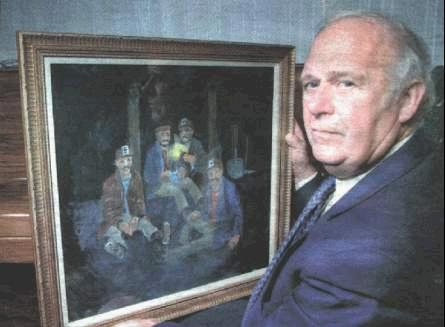
A centrepiece of the event was the presentation of four
paintings depicting what happened at the Moss 100 years ago
past last month when men died after liquid moss poured into a
mine shaft.
Artist David Lockhart produced the paintings and Mr Maxwell
can be seen holding a vivid creation of four would-be
rescuers entombed themselves underneath Mossmorran.
Mr Maxwell said that the event had been a great success.
Donibristle Event Marked On Canvas By Fife Painter
Friday evening saw the conclusion of a number of
commemoration events to mark the centenary of the Donibristle
Disaster in which eight miners lost their lives as the result
of an inrush of liquid moss.
The previous Sunday wreaths were laid at the memorial cairn
on the outskirts of the town, a Church Service was held at
the Trinity Church and a concert took place in the Lochgelly
Centre.
On this occasion the earlier part of the evening was
dedicated to remembering the victims of the disaster, and
recalling what had taken place, with a ceilidh in the latter
part.
On behalf of Cowdenbeath Community Council, Mrs Mary Maxwell
welcomed the large audience, explaining the role of the
Community Council in maintaining the heritage of the town,
which "had been built on coal", and the relevance
of the Donibristle Disaster to the people who lived in
Cowdenbeath.
On display was a Commemoration book listing all the known
names of Fife men who lost their lives at work over the last
century, some 1800 in all.
Mr Jack Beck then sang the opening song, "The
Mossmorran Disaster" whose words were taken from a poem
by local barber of the time Jimmy Murray written to raise
funds for the dependants of the victims.
The main tribute was presented by local Councillor Alex
Maxwell, who explained conditions in the mining industry at
the time and how they shaped the outlook of miners and their
families.
At the time of the Mossmorran disaster on average four men a
day were being killed in Britain's pits, and the
Mossmorran disaster had to be seen in the context of a great
demand for coal, and the desire of the coal owners to
maximise profit.
He outlined the specific events at Donibristle Colliery,
describing the rescue attempts, the entombing of the
rescue party comprising of Rattray, McDonald, Hynd and
Paterson, their subsequent discovery and the harrowing
messages from the dying men which were found.
He also paid tribute to all the other 'miners whose
names honour the pages of this Commemoration Book', and
concluded by talking about "all of the thousands, those
who did not die through a fatality at work but, as a
consequence of dust and disease, spent and are still spending
their later years stricken by bronchitis and emphysema."
He concluded by saying, "Yes we must remember the dead,
but perhaps our best tribute to those who died, is to make
sure we remember the living."
At that point artist David Lockhart from Cupar, presented
four paintings related to the disaster, to Mr John McGhee on
behalf of the Community Council. These will form part of a
six-piece ensemble to be hung in the Town Council Chamber and
Mr Maxwell was pictured displaying a view of the Moss.
A minutes silence was then observed, broken by Piper John
Innes, who played 'The Flowers of the Forest' and
Jack Beck ended this part of the programme by singing
"Dark as a Dungeon".
The vote of thanks was given by Councillor Willie Clarke, a
former miners leader in Fife, who after thanking those who
had organised and taken part in the event, directed his main
comments to the "shameful treatment given by the
Government to ex-miners and their wives, with thousands of
miners having died without proper compensation for the severe
respiratory diseases they suffered as a result of their work,
and thousands of others who were confined to their home,
hardly able to breathe, denied decent pensions and proper
compensation despite the billions creamed off by the
Government from the mineworkers pensions funds.
The evening then continued with 'stovies and
sandwiches', singing and dancing to the Kingdom Folk
Trio.
Mr Maxwell said later that since Friday he had received a
number of requests for copies of his address. He said that he
would be happy to reproduce it for people who could make a
donation to the community council's fund to pay for the
four paintings.
The following item draws our Donibristle story to a close ...
"Central Fife Times"
14 March, 2002
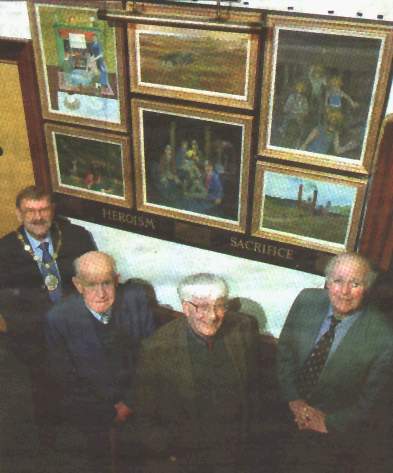
Donibristle Disaster Paintings Unveiled
Four paintings to commemorate the Donibristle Pit Disaster
were unveiled by Fife Council's convener, Councillor Tom
Dair, at a ceremony held on Thursday, in Cowdenbeath Town
House.
A number of events were held last summer to mark the
centenary of the disaster in which eight miners lost their
lives as the result of an in-rush of liquid moss.
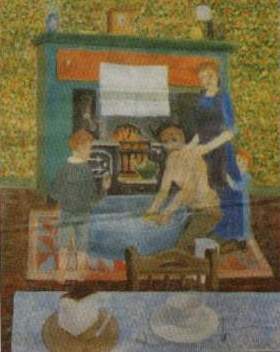
Cowdenbeath Community Council commissioned artist David
Lockhart, from Cupar, to produce four paintings depicting
what happened at the Moss 100 years ago. The pictures will be
hung in the Town Council Chamber.
 |
 |
--------------------------------------------------
