REPORT
ON AN
accident at Donibristle Colliery, Fifeshire, which occurred on the 26th August, 1901, and was caused by a flow of soft peat and moss into the mine workings, involving the loss of eight lives -
BY
J. B. ATKINSON, ESQ.
H. M. INSPECTOR OF MINES
18, Merchiston Gardens,
Edinburgh.
16th November, 1901.
INTRODUCTION
On the 26th August, 1901, about 1.40 p.m., soft peat or moss commenced to flow into a heading in the East section of Mynheer Coal Seam workings of the Nos. 12 and 15 Pits, Donibristle Colliery, and caused the death or imprisonment of the persons shown in the following tables.
TABLE I.
KILLED.
| No. | Name | Age | Occupation | Body recovered | |
| Date | Place | ||||
| Engaged in the workings near the inflow. | |||||
| 1 | David Campbell | 54 | Pit inspector | Not yet found | |
| 2 | Alexander Smith | 48 | Oncostman | 27th September | At face of highest road off working heading on west side in moss. |
| 3 | George Herd Hutchison | 50 | Miner | 15th September | On main level, in moss, 105 yards from extremity of flow. |
| 4 | William Forsyth | 20 | Wheeler | 25th September | In refuge hole, 40 yards from top of lower incline on west side. |
| Forming a rescue party from pit bottom | |||||
| 5 | Thomas Rattray | 54 | Oversman | Not yet found | |
| 6 | William Hynd | 52 | Pit bottomer | ” ” | |
| 7 | James Bowman McDonald | 32 | Incline bottomer | ” ” | |
| 8 | Andrew Paterson | 40 | Ostler | ” ” | |
TABLE II.
RESCUED.
| No. | Name | Age | Occupation | Time
when
rescued |
Hours
imprisoned |
Remarks |
| In mine at time of inflow 1.40 p.m. on 26th. | These miners had been
at work about 7 hours before they were imprisoned. |
|||||
| 1 | John Farquhar | 40 | Miner | 5.50 p.m. on 27th | 28 | |
| 2 | John Colville | 33 | ” | 6.00 p.m. | 28 | |
| 3 | Thomas Bauld | 36 | ” | 6.15 pm | 28 | |
| 4 | Andrew Love | 40 | ” | 6.30 p.m. | 28 | |
| 5 | John Beveridge | 32 | ” | 6.45 p.m. | 29 | |
| 6 | Alexander Bauld | 42 | ” | 2.00 a.m. | 60 | |
| Rescuers imprisoned on the 27th. at 6.30 p.m. | ||||||
| 7 | John Jones | - | Mining contractor | 2.00 a.m. | 32 | |
| 8 | John Sheddon | - | Miner | 2.00 a.m. | 32 |
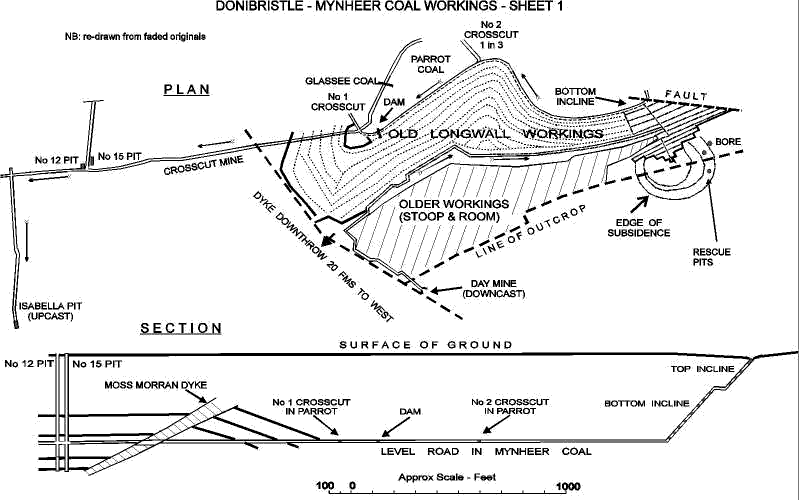
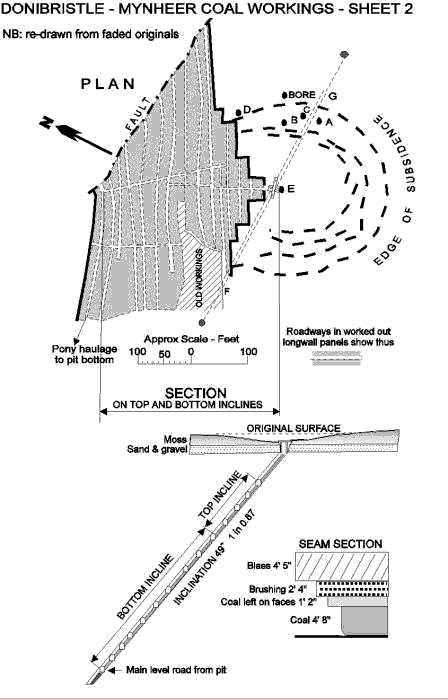
SHEETS 1 & 2
 |
 |
| Sheet 1 | Sheet 2 |
|---|
Six persons, engaged near the inflow, escaped with more or
less difficulty on the 26th, by means of a road leading to a
day mine.
An inquiry, under the Fatal Accidents Inquiry (Scotland)
Act, was held in the Dunfermline Sheriff Court on the 25th
September, 1901, into the circumstances of the accident.
Sheriff Substitute Gillespie presided; Honorary Sheriff
Substitute Walker occupied a seat on the bench.
The following were parties to the Inquiry:- Mr. J. S.
Soutar, Acting Procurator Fiscal; Mr. John Ross, Solicitor,
Dunfermline, appeared for the Donibristle Colliery Company;
Mr. James Currie Macbeth, Solicitor, Dunfermline, appeared
for the Fife and Kinross Miners' Association and for the
relatives of the deceased; Mr. W. G. Campbell, Solicitor,
Edinburgh, appeared for Messrs. Anderson and Chisholm,
Solicitors, Edinburgh, agents for the Occan Insurance
Company, Limited, with whom the Donibristle Colliery Company
were insured against liability for accidents to workmen; I
was present as Inspector of Mines.
Mr. R. McLaren and Mr. H. Johnstone, Inspectors of Mines
assisting in the district; Mr. James Innes, President, and
Mr. John Weir, Secretary, of the Fife and Kinross
Miners‘ Association, were also present.
Fifteen witnesses were examined, including Mr. A. H. Nasmyth, the junior partner of the Donibristle Colliery Company; Mr. Alex. Nasmyth, the manager of the colliery; and Mr. John Gemmell, Mining Engineer, Edinburgh, one of the partners of the firm of Messrs. Landale, Frew and Gemmell, Mining Engineers, Glasgow, who acted for the landlord, the Earl of Moray, and occasionally advised the owners.
| The jury returned the following verdict:- | |
| The jury unanimously find that the deceased were killed in the Mynheer Seam of No. 12 Pit of Donibristle Colliery on 26th August, 1901, by a subsidence of the mossy surface, which flowed into the workings. | |
| This colourless verdict satisfies all the requirements of the Fatal Accidents Inquiry (Scotland) Act so far as the jury is concerned. |
I was informed of the accident by telegram on the 26th, and arrived at the colliery about 9 p.m. and from that time either Mr. Johnstone, one of the Inspectors assisting in the district, or myself was present assisting to the best of our ability in the various operations, until the last man was rescued. Since then several examinations of the mine have been made by the Inspectors assisting and myself in investigation of the cause of the accident, and to suggest means for the recovery of the bodies of the victims.
Donibristle Colliery is situated in the Parish of Aberdour, and
near the Burgh of Cowdenbeath in Fifeshire. It is owned by a
private company trading as the Donibristle Colliery Company, the
partners of which are Mr. James Armstrong Nasmyth and his son Mr.
Alexander Hogg Nasmyth. Both partners hold certificates as managers
of mines, and are well acquainted with every detail of the
management of collieries. The age of the senior partner precluded
him from taking an active part in the affairs of the Company, but
the junior partner directed as owner all the main operations of the
colliery.
The certificated manager is Mr. Alexander Nasmyth, a nephew of
the senior partner.
No under-manager was appointed, although Thomas Rattray the oversman of Nos. 12 and 15 Pits, which included the district in which the accident occurred, held a certificate as under-manager of a mine.
The mineral area leased by the Company lies on the southern edge
of the Fife Coal Field; the seams worked all lie in the Lower or
Carboniferous Limestone series of the Carboniferous System of
Scotland. The Donibristle coalfield is intersected by several large
faults. The inclination of the measures is somewhat irregular, but
on the whole the rise is to the south, all the seams cropping out
in that direction within the limits of the field leased.
A feature of the coalfield is that most of the workings lie
under a moss, 450 feet above sea level, a rough square of about 1
mile each way, known as Moss Morran, and consisting of flat
moorland, still the home of a few grouse.
It was stated by Mr. Gemmell at the Inquiry that an old map of
Fife, dated 1662, Moss Morran is shown as a sheet of water. The map
Mr. Gemmell referred to is Timothy Pont's map of Fife,
published at Amsterdam as part of Blaen's "Atlas"
in the year 1662.
At the time of the accident the following openings from the surface, communicating with the underground workings, were in use:-
| The James Pit and the Marion Pit } | To the north of the field. | ||
| The No.12 Pit and No.15 Pit } | These pits were recently sunk
deeper from the Mynheer
to the Dunfermline Splint, and during the sinking were in turn used as a coal winding shaft. |
||
| The Fan or Isabella Pit. | |||
| The Day Mine on the Moss. | |||
| There are about 270 person employed underground at Donibristle Colliery and 80 on the surface. | |||
For the purposes of this report it is only necessary to describe
particularly a part of the colliery lying to the east and north of
a large fault known as the Moss Morran Dyke, with its approaches
from the surface, as shown on Sheet I. accompanying this report.
The Nos. 12 and 15 Pits are sunk to the Dunfermline Splint seam
at a depth of 97 fathoms, intersecting the Mynheer seam at 77
fathoms. A level in the Mynheer seam extends in an easterly
direction from No. 12 Pit for 120 yards, and from this level a
stone mine, driven nearly flat for 310 yards, crosses the Moss
Morran Dyke, which has here a throw of 20 fathoms up to the east,
and catches the Mynheer seam on the rise side.
Levels were driven in the Mynheer seam on each side of the stone mine, and headings from the levels enabled the coal to be worked across the hill on the longwall method. To the north-west the coal was exhausted and the workings are not shown on the plan. To the east the level continued for 540 yards to the working heading and terminated at a large fault a few yards further in. A portion of coal still remained to be extracted near the outcrop and to the rise of the extremity of the level.
From the Mynheer level inside the Moss Morran Dyke, two stone mines were driven to the Parrot seam which lies above the Mynheer, intersecting also the Glassee seam. The first stone mine was a continuation of that across the Moss Morran Dyke and was driven level, the second was 227 yards further in, and was driven with an inclination of 1 in 3. The position of these stone mines is shown on Sheet I., but the workings, which were of considerable area in the Parrot seam and less extensive in the Glassee seam, are not shown as the moss did not penetrate to them. The workmen employed in these seams at the time of the accident escaped without difficulty.
It will be observed on Plan I. that to the rise of the first portion of the level extending to the east are workings marked "old workings". These workings had been prosecuted many years ago from a higher level and were on the stoop and room system. They extended from the level at which they were won to the outcrop, but had not exhausted the coal in an easterly direction, so that the innermost heading of the present workings passed them and was driven in the coal to the outcrop, the outer headings having all terminated on reaching the older workings. It was at the face of the innermost heading that the moss burst in.
Through the older workings was an intake air-way from the surface, which continued as such along the upper roads of the longwall workings to the working faces.
The inclination of the innermost heading was 49 degrees, at which rate the outcrop was soon reached.
On Sheet II. is depicted on a larger scale the actual working places in the Mynheer seam at the time of the accident.
The Mynheer seam is 5 feet 10 inches thick in the vicinity of the burst, and is directly overlaid by a blaes or shale roof. The road was of very good quality; near the outcrop the backs in the coal were coated with clay. A section of the seam is given on Sheet II.
The coal, as already stated, is worked on the longwall system across the hill; at intervals of about 10 yards on the slope, levels, directly opposite to each other, leave the heading at right angles on either side. At the working face 14 inches of coal was left on as a roof, but in the heading and levels this was worked, and in addition 2 feet 4 inches of the roof stone was blasted down and built on the low side of the levels, while wood pillars were put in on the rise side.
The heading into which the moss burst did not extend in a direct
line to the main level, but was worked as a "cut chain
brae"* for a length of 40 yards on the slope to an
upper level along which the hutches were taken by hand for 14 yards
to a lower heading worked as an ordinary self-acting incline, and
104 yards long on the slope to the main level. The miners and their
drawers worked the cut chain brae, and a wheeler named William
Forsyth, took the hutches from the bottom of the upper heading
along the short upper level to David Rattray, who ran them singly
down the second heading, where a bottomer named James Bowman
McDonald was stationed, who coupled the hutches in rakes of six,
whence they were led to the shaft in three stages by horses.
[*
A self-acting incline arranged for the running of hutches of coal
from several points on its length.]
In proceeding to and from their work the miners in the Mynheer seam made use of Nos. 12 or 15 Pits and the roads along which the coal was led; access to the workings was available by the day mine and air-way, but this route was not used by the miners, although the officials made periodical journeys through it.
The Officials who acted in the workings inside the Moss Morran Dyke, under the Manager, were:
| Thomas Rattray | ... Oversman | |
| David Campbell | ... Pit Inspector or Fireman of the Mynheer workings | |
| Alex. Mitchell | ... Pit Inspector or Fireman of the Parrot and Glassee workings | |
| James Rattray | ... Roadsman | |
| James Dick | ... Roadsman |
Thomas Rattray and David Campbell, who would have been most important witnesses, both lost their lives in the accident.
The heading in the Mynheer seam having reached the outcrop about October, 1900, operations were suspended in it until a few days before the accident.
When the outcrop was reached the question of connecting it with the surface was considered in order to secure
| (1) A ready means of ingress and egress to and from the workings; | |
| (2) An improvement in the ventilation. |
Neither of these reasons was urgent. The miners would certainly have welcomed the new road, as it would relieve them of a toilsome journey underground, including a long climb up the inclines. As regards ventilation it was not proved to be defective, but the new road would have improved it.
Mr. A. H. Nasmyth, the junior partner, Mr. Alex. Nasmyth, the manager, and Thomas Rattray, the oversman, discussed the matter. Mr. A. H. Nasmyth stated at the Inquiry that he then told the manager and oversman that he would not agree to anything being done except on very safe lines, and that the position of the communication on the surface was to be ascertained and tests made to ascertain the thickness of moss, and if it proved thicker than where previous shafts had been sunk through it nothing was to be done. The manager and oversman, after locating the position of the heading face on the surface, probed the moss in November, 1900, by an iron rod 15 or 18 feet long, and found no bottom. The result of this test was not reported to Mr. A. H. Nasmyth, and he concluded that it was unfavourable, and that nothing was to be done. Mr. A. H. Nasmyth further stated that he would not have dreamt of putting the heading up.
The manager stated at the Inquiry that after the tests he told
Rattray that it was no use putting a pit there, and that the matter
was never again discussed by them.
Previous to the accident the knowledge of the surface deposits
appears to have been as follows:-
| (1) The immediate surface was ordinarily hard moss and heather. | |
| (2) The sinking of shallow pits on the outcrops of the various seams had shown that soft moss was commonly found below the upper solid crust. | |
| (3) Underground operations in the Mynheer and other seams, and the sinking of pits, had shown that a bed of sand or sand and gravel lay below the soft moss, separated from it by a bed of closer moss. | |
| (4) The moss above the Mynheer heading had, as already stated, been probed about November, 1900, by an iron rod and found to be of considerable thickness and soft, and the bed of sand had been observed above the coal in the heading. | |
| (5) A flow of moss into the mine had taken place some 40 years ago, unaccompanied by any loss of life, but filling a section of the workings. This inflow took place at a point about 300 yards to the west of the present inflow. In one case a "sit" or subsidence had taken place without any inflow of moss. |
NARRATIVE OF THE ACCIDENT.
Operations were resumed in the heading on Thursday, the 22nd
August, and were carried on by David Campbell, pit inspector for
the Mynheer workings, and by Alexander Smith, an oncost man, who
had been pit inspector in the west side Mynheer workings; James
Dick and James Rattray, roadsmen, occasionally assisted.
A barricade was erected above the incline wheel to prevent the
material worked going down the heading; this barricade closed the
road entirely, and the stuff that accumulated against it was
afterwards removed to the rib sides on either side of the heading.
The sand and gravel was worked away following the hard pavement of
the seam, and the bottom of the moss reached on Saturday, the 24th,
and on that day James Dick probed it by pushing forward in a
slanting direction an iron rod 17 feet long and ½ inch diam.
Dick reported this to Thomas Rattray before starting work on the
day of the accident and Rattray asked him if any water was got and
if he required a spade to dig out the moss.
Dick answered both questions in the negative, and added that as
there was still 6 feet of sand to dig out a spade was not required.
Operations were continued on the 26th, and by about 1.40 p.m.,
while David Campbell and Alexander Smith were working at the face
of the heading, the roof gave way, and was immediately followed by
a rush of moss. The barricade appears to have prevented the moss
flowing directly down the heading and forced it along the rib sides
of the upper roads.
On the east side it flowed round the two upper faces, but was
prevented reaching the third face by a heavy fall of roof, and this
road and its face remained free from moss except for a few yards
from its junction with the heading. On the west side the moss had a
free course and passed round the faces and into the air-way,
cutting off in a short time all communication in the direction of
the air shaft.
The barricade gave way an hour or two after the burst and was swept down the heading along with the wheel and its frame, the timber, rails, and sleepers, and thereafter most of the moss would flow directly down the heading, along the short level and down the second incline, and then flow in the direction of the drawing shafts.
Campbell and Smith, engaged at the heading face, were probably instantly smothered. Three of the miners on the west side of the heading escaped by the intake air-way, two of those on the east side escaped by the same route after crossing the heading.
The only miner who lost his life was George Herd Hutchison, who worked on the west side; he was swept down the heading and his body was found in the level.
David Rattray, employed at the top of the second incline, was rescued from behind a stopping on the lower heading by his brother James Rattray and James Dick, who entered the workings by the day mine.
William Forsyth, the wheeler on the short level between the headings, seems to have attempted to escape down the lower heading, by the side of which his body was found, in a refuge hole 10 yards below the point from which David Rattray was rescued. James Dick and James Rattray nearly rescued Forsyth, but were beaten back by the moss.
The remaining six miners Nos. 1 to 6 in Table II., of whom only one, John Colville, worked on the west side, took refuge in No. 3 road on the east side, where they remained until rescued. The road was dry and the air was good, and except for the terrible risk they ran of the moss not getting away but rising and engulfing them, and the want of food, they might have been in a worse situation.
James Dick and James Rattray, the roadsmen, were underground at the time of the accident, but not in the Mynheer district; the latter came up the pit and informed his father Thomas Rattray, the oversman (who was on the surface), of the accident, and went with him to the point of subsidence. Dick went into the Mynheer level and met the moss flowing out about 50 yards from the working heading; he came up the pit, saw Thomas Rattray and let him know the position. Thomas Rattray, having returned from the point of subsidence to the Nos. 12 and 15 Pits, saw the manager and informed him of the accident, and then about 3 p.m., along with William Hynd, pit bottomer, James Bowman McDonald, incline bottomer, and Andrew Paterson, ostler, as a rescue party, descended No. 15 Pit, and were not seen again, nor have their bodies been found up to the present time.
It is surmised that they had broken through a stopping on the Mynheer level at the foot of one of the old headings, and endeavoured to reach the workings by the old roads.
The manager having been informed of the accident, about 2.40 p.m., by Thomas Rattray, who told him that the moss was 50 yards along the level from the foot of the incline, as reported by James Dick, visited the subsidence on the surface and saw what had taken place. He returned to No. 15 Pit and went down to join Rattray and his rescue party, but could find no trace of them; he found the moss had advanced 400 or 500 yards from the foot of the incline. He returned to the surface and again visited the point of subsidence, accompanied this time by Mr. A. H. Nasmyth, and found the moss still flowing into the hole. He then went down No. 15 Pit and caused a stopping, or light dam, to be erected in front of the moss in the level, and beyond this dam, shown on Sheet I., the moss never extended, nor did it exert much pressure on it.
Some time during the afternoon two square pits, A & B, Sheet II., were started in the moss, near the edge of the subsidence, to reach the workings, and these were pushed on during the night, but were given up on the 27th owing to difficulties arising from the soft nature of the moss and the presence of water.
A third round pit, C, Sheet II., was started, and an old boiler with the ends removed brought forward to act as a tub. This third pit was soon given up.
The plans of the workings were not in the office at the time of the accident, but were in the office of Messrs. Landale, Frew and Gemmell, Mining Engineers, Glasgow, who surveyed the workings and had the plans away for the purpose of adding the last survey, which had been completed during the past week.
A telegram was despatched and the plans arrived about 10 p.m., and next morning a survey was made, and it was found that the positions of the three rescue pits were such that they would go down on solid coal in which some distance would require to be driven before the faces were reached. A fourth pit, D, Sheet II., round in section, was started in a more favourable position, but was not proceeded with, as it was decided to attempt to enter the mine by the hole in the moss.
The position of a bore put down to test the thickness of the moss, &c., is shown on Sheet II. The borers reported the following as the result:-
| Moss | 24 feet |
| Sand | 7 ” |
| Rotten Rock | 7 ” |
| Coal | 1 ” |
As a preliminary step to entering the hole in the moss, two wire ropes, parallel to each other, and about 6 feet apart were stretched across the hole, and made fast at the ends. On these ropes a carriage was fitted, which was pulled backwards and forwards by other ropes, see F, G, Sheet II.
The hole was examined from this carriage about mid-day on the 27th. A few yards of the heading could be seen: it was free from any accumulation of moss which, however, continued to flow in and disappear.
Operations were begun to roughly secure the sides of the hole by timbers, and eventually the bottom of the hole or pavement of the seam was reached, and signals received from the imprisoned men.
James Dick, roadsman, Donibristle Colliery, John Jones, mining
contractor, Hill of Beath Colliery, and John Sheddon, miner, were
in turn lowered down the heading by a rope, and five of the
imprisoned men brought to the surface.
While Jones and Sheddon were
down the heading along with Alexander Bauld, the only man not
brought up, the moss again began to flow into the hole in large
quantity, the movement being no doubt helped by the weight of the
large crowd, which eagerly pressed forward, and could not be kept
back. The improvised shaft was wrecked, and there were some narrow
escapes from being carried down the hole. An attempt was again made
to get down the heading by James Richardson, of Hill of Beath
Colliery, but he was unsuccessful, and operations were suspended
until the following morning when the hole was again examined from
the carriage, and found to be much increased in size, and a clear
opening still available.
Two beams, 41 feet long, 12 inches broad, and 6 inches deep,
were brought forward and laid in the moss across the hole, parallel
to each other and 6 feet apart, and nearly at right angles to the
line of the heading. Two smaller beams were laid parallel to each
other and 6 feet apart, on and at right angles to the larger beams,
and to each side of the square thus formed iron hangers were
suspended, and barring bolted to them formed a shaft, which was
carried down to the pavement of the seam, and the space between the
barring and the sand and moss roughly packed with brushwood.
About
2 a.m. on the 29th, Robert Law, miner, Cowdenbeath, having
volunteered, was lowered down the heading at the end of a wire
rope, to which, at intervals of a few feet above him, three short
lengths of hemp ropes were attached, as it was thought prudent to
bring up all together. Law had a hemp rope fastened to his arm, by
means of which he signalled. He was successful in his journey, and
the three men were brought to the surface shortly after 2 a.m.
During the course of the rescue operations at the hole in the moss, and after these were concluded, several parties explored the underground workings, in the hope of rescuing Rattray and his party, but no trace of them was found.
The distance the moss had flowed from the face of the heading to the dam erected on the level is 684 yards.
When moss ceased to enter the hole the lower part of the upper
heading was examined; it was found that only a few yards of it
above the short level was filled. The upper heading down to this
point was clear, but a considerable quantity of moss still remained
in the face and level roads above.
The air-way within 16 yards of
its junction with the lowest working level on the west side of the
upper heading was choked with moss. Moss extended 56 yards up the
inside Parrot mine, and the two old headings, nearer the shaft than
the working heading, were filled with moss for some yards up from
the level.
Mr. Gemmell stated at the inquiry that the area of the subsidence was 2.378 acres, the quantity of moss and water that had entered the mine he calculated at 21,100 cubic yards, and gave the greatest depth of the subsidence as 17½ feet.
When the hole in the moss could be thoroughly examined it was found that 13 feet 9 inches of sand mixed with gravel near the bottom (the rotten rock of the bore) lay directly on the pavement of the seam, then 3 feet of peat moss so firm that it overhung the sand for a foot or two, then came the soft moss and surface crust, together about 20 feet thick.
Comparatively little of the sand and gravel or tough moss had entered the mine; the inflow was almost entirely soft moss of about the consistency of cow dung.
When Dick probed the moss from below he may not have penetrated the tough stratum, and even if he did this bed would close as the rod was withdrawn, much the same (to use Mr. Gemmell's illustration), as a sheet of india-rubber would close after a pin was withdrawn from it, and so prevent the flow of soft moss or water.
After the accident steps were immediately taken for the recovery of the bodies. The hole in the moss was permanently secured by a wood-lined shaft, backed by concrete, and up it the bodies of Smith and Forsyth were brought to the surface. Operations were also commenced at the dam on the main level, the moss was filled into hutches and sent to the surface, and in the course of this work Hutchison's body was found. On the 11th November 415 yards of the level had been cleared of moss, as well as the inside Parrot mine and parts of the old headings.
CONCLUSIONS.
This accident shows plainly the dangerous of tapping moss from below, and that in making a connection between the surface and workings beneath through such material the work should be prosecuted downwards and not upwards.
I do not think any blame attaches to the owners in connection with this accident.
Mr. A. H. Nasmyth, the manager, was responsible for the control, management and direction of the mine (Section 20 (1) Coal Mines Regulation Act, 1887), and by Section 21 (1) was required to exercise daily personal supervision of the mine. He stated at the Inquiry that with the knowledge he had of the moss before the accident he would have considered it dangerous to attempt putting through it from below, and he denied on oath any knowledge of the operations that led to the accident, and stated that the oversman alone was responsible who, he thought had undertaken the work, expecting, if he was successful, it would be a feather in his cap.
On the other hand, the oversman was stated to be a prudent man of large experience, he was present when the great thickness of soft moss was proved by probing it from the surface, and it is difficult to conceive of his undertaking on his own responsibility dangerous work when, even if successful, he might have expected blame for taking the matter into his own hands. David Rattray, one of the oversman's sons, stated at the Inquiry that his father had told him that the manager had given him permission to put a road up, and another witness stated that Rattray told him he was going to ask for permission.The resumption of work in the heading was known to the miners. It was for some days within the knowledge of all the under officials, of whom the only survivors, Jas. Dick, and Jas. Rattray, roadsmen, had not mentioned it to the manager, nor except for David Rattray's statement was there any evidence that the manager knew of the matter.
The manager's denial must be accepted, but he cannot relieve himself of a measure of responsibility in respect-
| (1) The discipline of the mine must have been defective if an oversman undertook such work without the manager's knowledge. | |
| (2) A more frequent examination of the working faces than he appeared to make might have brought the matter to his knowledge. Several witnesses stated they never saw the manager at the working faces. The manager himself stated he was last round the Mynheer working faces about a month before the accident on an idle day, when he was accompanied only by the deceased, Thomas Rattray. |
It must however be conceded that a most active manager of a large colliery like Donibristle might often be absent for a week or more from a small section of workings such as that into which the moss burst, and that during his absence an oversman might prosecute a heading to the outcrop, and also that an oversman might recklessly undertake work of a dangerous character in many parts of a large mine without the manager's knowledge.
It might be that Rattray intended to prosecute the heading for testing purposes only and did not propose putting up through the moss unless he obtained permission, and that the dryness of the sand led him to think all was safe so far as the road had gone. The evidence at the Inquiry did not, however, support this view, the witnesses questioned on the point stating that it appeared to them that the work was not for testing but for putting through the moss.
It may be that there was some misunderstanding which, owing to Rattray's death, will never cleared up. I find it difficult to believe that Rattray acted recklessly on his own responsibility. He had been for many years in the owners' employment and appeared to possess their confidence and to have been entrusted with a considerable portion of the details of administration. It is worthy of note that the extremely dangerous nature of the operations which were being carried on in the heading does not appear to have occurred either to him or to the workmen employed in it. His inquiry whether Dick would require a spade to cut the moss clearly indicates that he anticipated it would be dry and firm, and in their evidence at the Inquiry Dick and Jas. Rattray stated that they had never anticipated danger. There had been little rain, during the summer, and Rattray may have thought the moss would in consequence be dry enough not to run.
No section of the Coal Mines Acts or of the Special Rules deals specifically with the direct cause of this accident, but a breach of the Act with respect to plans was disclosed.
As already stated, there was no plan of the Mynheer workings at the office of the mine at the time of the accident, and this, had the rescue of the imprisoned miners depended on a shaft sunk through the moss, would have caused the delay of some hours in reaching them.
It is a common practice in Scotland for the plans to be removed,
as in this case, for a few days after the surveys are made in order
to be extended, and in many cases no tracings are provided to
supply the deficiency in the interval.
I have frequently had to call attention to this matter, and have
pointed out that it is a breach of Section 34 (1) of the Coal Mines
Act,1887, but have not hitherto recommended a prosecution.
I do not advise a prosecution in this case, but in future when I find no plan or tracing of the workings of the mine at the office of the mine, I shall report the matter with a view to proceedings.
This is an accident of an unusual character, although accidents
due to inrushes of sand and mud are not infrequent.
It is the first of its kind involving loss of life that I have had
direct official cognizance of during the 28 years I have acted as
H. M. Inspector of Mines.
It is an accident that might have been expected to have been more frequent in the early years of coal mining when shallow seams were more worked but, per contra, it is only of late years that coal has been worked on a large scale under moorland, which usually lies at high elevations in sparsely-populated districts away from centres of industry, and this accident is a valuable object lesson to many mines now working under mosses.
Last year an inflow of moss took place at Easter Jaw Colliery in
Stirlingshire, and filled more or less the workings of two seams
and ascended the shafts.
A number of men employed in both seams were able to escape, as the
flow was not so rapid as in the present case.
On 2nd October, 1886, moss flowed into the workings of East
Benhar Colliery, near Whitburn, in the county of Linlithgow, during
the time of my predecessor, Mr. Ralph Moore, who stated in his
annual report that the coal seam 4 feet thick was within 54 feet of
the surface 22 feet of which was wet moss.
One man lost his life and his body was never recovered although a
rescue pit was sunk and reached the coal seven days after the
accident, but as the workings were found to be filled with moss,
and there was no chance of the man being alive, the search was
given up.
In his report on this accident, Mr. Moore stated that a similar burst had taken place two months before, at a point 200 yards away, but without loss of life.
Mr. Gemmell, at the Inquiry, referred to a case at Greenhead, on the Coltness Estate, near Wishaw.
There was, as is usual in mining accidents, no lack of men
willing to undertake great risk in the hope of saving life. This
was not specially characteristic of the Donibristle accident, but
the circumstances attending it: (1) the publicity of the operations
at the hole in the moss, conducted as they were at the bottom of an
amphitheatre of some hundreds of yards in circumference, and
watched from the margin by large crowds; and (2) the rescue of so
many of the imprisoned miners, had, together, the effect of
directing public attention to the matter in an unusual degree, and
was the means of procuring for the rescuers substantial recognition
of their merit.
I am sure they had, at the time, no thought of any
reward, but were actuated solely by feelings of humanity.
| I am, | |
| Sir, | |
| Your obedient Servant, | |
| J. B. ATKINSON | |
| H. M. Inspector of Mines. | |
| The Right Honourable C. T. Ritchie, M. P., | |
| H. M. Principal Secretary of State, | |
| Home Office, London, S. W. | |

Bodies of Entombed Miners Found
On Saturday, 11th December, 1901, the heroic efforts of the Donibristle Miners in the gloomy and ultimately gruesome search for the remains of their entombed comrades were rewarded with success. The whole of the search party (Thomas Rattray, oversman; William Hynd, Andrew Paterson, and James McDonald) were found lying together in the easy pose of sleep, and, by a mere chance, the remains of David Campbell were also found within 70 yards of them, having been borne there by the relentless moss. The search party had succeeded in reaching a place which was free from moss, but were hemmed in all round by it, and thus fell victims to hunger, privation, and the great enemy of the Fifeshire miners - Choke Damp.
After the awful event of August 26th, while the great effort was being made which led to the recovery of six of the entombed miners, a Dam was erected in the main level of the No. 12 Pit high bottom to prevent the moss reaching and destroying the shaft. This Dam was taken out and the work of removing the moss to the surface was carried on continuously for 3 months, during which time 33,058 hutches were loaded and sent to the surface, or something like 12,000 tons. This does not include large quantities which were stowed away in the old roads. Hutchison's body was found in the level a short distance inside the Dam. The level was cleared of moss as far as the Old Brae on the outside of the disused brae leading to the fatal "hole". The workmen were then instructed to work up to the first cut on this brae. When the moss had subsided in this road sufficiently to allow of an inspection, the workmen waded in and found the first trace of their comrades in the smell which is usual in such cases when nearing a body which has been deceased for some time. They next found a wall which the party had built across the road, evidently to dam back the moss when it was pressing near them. A new drift was then discovered, driven from this road to the one above it. They ascended this and found two lamps at the top, also the names of the party were written on the pavement in chalk. At a point 57 yards out from this the four bodies were discovered, Hynd and McDonald lying together with one arm under their heads and embracing with the other. Rattray and Paterson were lying with their feet to those of the other two. Thomas Rattray had taken off most of his clothing. His vest was thrown over the body of McDonald, and in one of the pockets the time-book was found, in which they kept their diary. A watch, found in Hynd's pocket, was standing at 1.05. Beside them was found a pick and shovel which they had taken with them. A message was written in chalk on each side of the shovel, but the rust of time had made this quite illegible.
It would appear that, when Rattray and his companions went
down the pit to rescue the miners, they went "ben"
the level until they met the moss. At this time (August 26th
between 2 and 3 p.m.) they met it at a point inside of the
brae mentioned above. At that time there must have been no
movement of the moss, or at any rate the flow must have been
so slight as to escape detection. Further progress being
impossible this way, they returned to the Old Brae outside,
and apparently have determined to reach the faces by the Old
Cut Road above the level. To do so they had two Stoppings to
take out, one on the brae and one at the mouth of this road.
The Stoppings are built of stone, and made about 4 feet
thick. These they took out and began their journey along the
Cut Road. The old roads stand good for years in the
Donibristle seam, so they managed to penetrate 126 yards.
Here they found the road closed. They at once started to
clear away the fall.
There is evidence here that they had worked very hard,
throwing the dirt behind them until the road was nearly
filled up. Finding it impossible under the circumstances to
work their way through the fall, they would abandon it and
retreat, and find to their consternation that the moss had
risen up the brae to the Cut Road, and had flowed in after
them, thus cutting them off. Could they have reached the brae
again, they could have saved themselves, for this old brae
communicates with the main air-way leading to the air-shaft,
through which James Rattray rescued his brother David. Only
one other Stopping was put in on the brae between the third
and fourth Cut Roads, for the purpose of ventilation. Once
they got to the brae, they could remove this Stopping and
escape. The doomed party must have thought of this, as, with
a view to reaching a higher level, they built a Dam, and
began to drift through this road to the Cut Road above, a
distance of 9 yards. This was an arduous task, and one which
shows the indomitable spirit which those brave and desperate
men possessed. This second road was also closed inside their
drift, and there is no indication that they tried to work
through this fall. The moss by this time had risen up to the
mouth of this road also, and their attempt at escape proved
fruitless. Altogether, the moss traversed about 46 yards of
this road, leaving 57 yards clear to the top of their drift.
Here they resigned themselves to their fate, and filled up
the remaining hours left them in consoling one another and
writing loving and tender messages to their relatives.
Mr. Rattray, being oversman, carried the Company's time-book, on which the shifts of the workmen were marked. On the blank pages of this book they began to write messages, and made 26 entries. (There were only 21 entries in the book when the writer of this article saw it, but a page containing two had been taken out by Mr. James Rattray, one being the deceased oversman's will.) The book itself tells a sorrowful tale. Though in the entries they seldom grumble about pain or discomfort, some of the pages are stained with blood, showing that they must have received personal injuries.
A number of the entries are quite distinctly written, and following the ruling of the page, indicating that they still had light at the time of writing. Others are written in a sprawling fashion, showing that the hands had become unsteady, and that they had no light. Occasionally, one line is written on top of another, and is quite indecipherable. The pencil they used must have been blunt, for, in some places, the lead gives out, and only scratches appear on the paper. The book, when found, was saturated with moisture and very dirty, the binding being undone. James Rattray took it home and dried it, but the paper is now most fragile in texture, and crumbles down when touched.
A study of the handwriting and the messages lead to the conclusion that they were written by two of the men, i.e., T. Rattray and J. McDonald.
| Pages 1, 3, 4, 5, 6, 7, 8, 9, 10, 13, 14, 15, 20, and 25 were probably written by McDonald. | |
| Pages 11, 16, 17, 18, 19, 21, 22, 23, 24, and 26 were in all likelihood written by Rattray. |
There is some doubt as to the author of No. 2.
A perusal of them shows that to the last they behaved in
the same heroic manner, fashioning themselves to their
circumstances when dire fate made that a necessity.
Their last moments were softened with loving thoughts of
their dear ones at home, and that deep religious sentiment
which is the expression of a firmly-grounded faith in the
Creator.
