Owner: not known
South of Balmain Mill, on the western slope of Largo Law, below the old steading of Wormwell, was a very early coal-work in a seam which is known to have cropped out here with a dip towards N.E.
 |
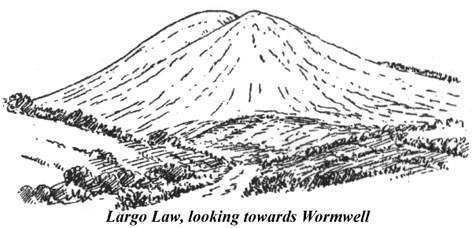 |
| Largo Law,
looking towards Wormwell |
Extract: Statistical Account
of Fife
Parish of Largo - 1791
" ... coal may be wrought to advantage. On the estate of Lundin, the coal has been cropped; but by erecting an engine near the sea, a deep seam, which stretches over upon the estate of Largo, would be opened. This would amply supply the neighbourhood, and afford besides a considerable exportation. ..."
Extract: Statistical Account
of Fife
Parish of Largo - 1845
" ... Many years ago, coal was wrought in large quantities, especially near the coast. At present, there are three seams wrought, but none of them are of the first quality. To the north of New Gilston a singular mass of rum coal is found, under the mass of overlying trap on the south. It is an inflammable bituminous shale, and is extensively used for lime-burning. It is known to be 80 feet thick, and is wrought in an open quarry. ..."
Information on coals found at Wormwell, nr Largo
(based on a report from 1900)
Dating from either the 18th or early 19th century, no
record has been recovered of former operations in this area
between Pitcruvie and Chesterstone.
It is possible that the crop coal here, measuring three
feet six inches thick, was the same seam of Splint and
Cherry Coals which cropped out with an easterly dip on the
west side of the Largo road near Brankston farm just over
½ mile to the north-west of Balmain Mill, and the same
four feet thick coal seam which cropped out on the Keil
Burn just 135 yds. south from Balmain Mill, where it was
thrown by a 15 fathom fault.
... and in a report from 1977 ...
This sequence [basal sandstones] is believed to outcrop on the western slopes of Largo Law but there are no exposures and the only information is derived from a few old boreholes east of Pitcruvie, one of which cut a 2 ft. 11 in. coal around 4 fathoms from the surface, while another found a waste at 4½ fathoms.
Can do with finding out more about this early working
