Owners: Fife Coal Co. Ltd, Leven
NCB
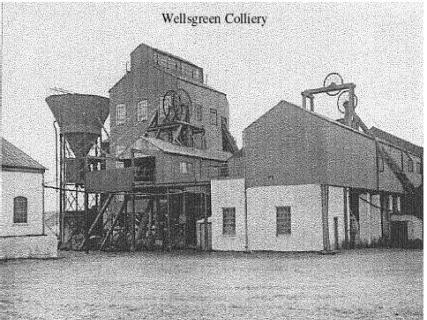
The Wellsgreen Pit lay south of Cameron Bridge/Windygates
and was just by the Standing Stane Road between Kirkcaldy and
Windygates in the Wemyss district. The 'pits' are
reported as sinking in a record from 1890 although it is
believed that the lease was granted several years earlier
(see Notes on the Early Days below.)
A drift mine, which fed coal by conveyer to the pit's
screens and washer, was opened in 1946. The NCB closed this
mine in 1958, and just one year later the pit was closed.
A golf driving range and leisure complex has been built on
the former site of the pit which lay north of the ravine
known as Wemyss Den which is the channel of the Kingslaw
Burn.
 |
 |
---------------------------------------------------------
We are always grateful when website visitors pass on contributions to enhance our content and we wish to thank Gordon Sutherland, Methil, Fife, for giving permission to display his unique colourful projects based on photographs of bygone collieries.
Colin Martin & Chris Sparling, Webmasters.
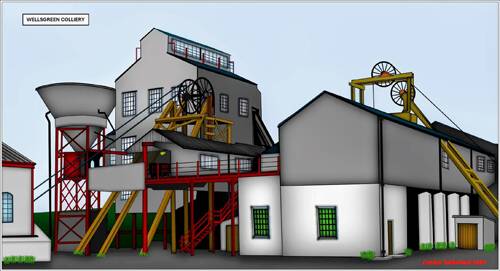
PLEASE NOTE THAT THE ABOVE IMAGE IS © GORDON SUTHERLAND
---------------------------------------------------------
| Pit sinking: 1884/1890 | Pit closed:
temporarily - 1927
finally - April, 1959 |
|---|---|
| Source Date of Information Supplied | |
| Manager / Under-Manager / Men underground / Men above ground / Coal seams worked | |
| 1890 (Fife Coal Co. Ltd.) | |
| Dugald Baird / ------------ / 18 / 41 / Pits sinking. | |
| 1893 (Fife Coal Co. Ltd.) | |
| Mr Richard Kikby, manager; Mr Charles Carlow, agent. | |
| 1896 | |
| Richard Kirkby / ------------ / 186 / 42 / Manufacturing and steam coals. | |
| 1902 | |
| Peter Dunsire / ------------ / 317 / 52 / Manufacturing and steam coals. | |
| 1904 | |
| William Lang / ------------ / 310 / 54 / Manufacturing and steam coals. | |
| 1905 | |
| William Lang / ------------ / 311 / 64 / Manufacturing and steam coals. | |
| 1908 | |
| William Lang / ------------ / 329 / 79 / Manufacturing and steam coals. | |
| 1911 | |
| William Lang / ------------ / 332 / 76 / Manufacturing and steam coals. | |
| 1918 | |
| John Brown / William Cowan / 267 / 97 | |
| 1920 | |
| John Brown / ------------ / 336 / 106 | |
| 1928 | |
| John Brown / ------------ / 316 / 67 | |
| Household and steam coals. Boreland, Three Feet, Bowhouse, Dysart Main, Sandwell and Lower Dysart | |
| 1938 | |
| James Crawford / Thomas Sneddon / 222 / 65 | |
| 1945 | |
| G. Buchan / Hugh Thomson / 182 / 50 | |
| Household and steam coals. Sandwell, Lower Dysart and Dysart Main. | |
| 1946 | |
| Aug: Mr Kennedy,
manager at Bowhill, appointed colliery manager. Mr G. Buchan, manager, appointed manager at Benarty Mine. |
|
| 1947 (NCB) | |
| F. T. Kennedy / ---------- / 168 / 51 | |
| Household,
industrial and steam coals.
Annual output = 63,200 tons. |
|
| 1948 (NCB) | |
| F. T. Kennedy / D. Wilson / 168 / 57 | |
| Steam coal. Bowhouse, Sandwell and Lower Dysart. | |
| 1949 (NCB) | |
| H. Thomson / D. Wilson / 168 / 51 | |
| Steam coal. Sandwell, Lower Dysart and Bowhouse. | |
| 1950 (NCB) | |
| H. Thomson / D. Wilson / 259 / 148 | |
| Steam coal. Lower Dysart and Bowhouse. | |
| 1951 (NCB) | |
| H. Thomson ( Manager) / 254 / 45 | |
| Steam coal. Lower Dysart and Bowhouse. | |
| 1958 (NCB) | |
| D. Wilson / ------------ / 134 / 21 | |
| Household, industrial and steam coals. Lower Dysart and Bowhouse. | |
| 1959 (NCB) | |
| D. Wilson / ------------ / 154 / 29 | |
| Household, industrial and steam coals. Lower Dysart. | |
Wellsgreen Colliery (19th century report)
| Coal seams worked | Thickness | Quality | Class | ||||
|---|---|---|---|---|---|---|---|
| Eight Foot Coal | Roof Coal | > | 1 ft. 6 in. | > | - | > | Steam |
| Good Coal | > | 5 ft. 3 in. | > | - | > | ||
| Six Foot Coal | Coal | > | 1 ft. 6 in. | > | - | > | Steam |
| Stone | > | 9 in. | > | - | > | ||
| Coal | > | 2 ft. 8 in. | > | - | > | ||
| Chemiss Coal | Crow Coal | > | 1 ft. | Not worked | - | ||
| Parting | > | 1½ in. | - | - | |||
| Splint | > | 3 ft. 4 in. | - | Good Household | |||
| Parting | > | 1 in. | - | - | |||
| Binks Coal | > | 2 ft. 4 in. | - | Steam | |||
| Stone | > | 8 in. | - | - | |||
| Coal | > | 1 ft. 6 in | - | Steam | |||
| Parrot Coal | 3 ft. | - | Gas Coal | ||||
| Dysart Main Coal | Coal | > | 2 ft. | > | Not Worked | > | - |
| Stone | > | 1½ in. | > | > | |||
| Coal | > | 6 in. | > | > | |||
| Stone | > | 2 in. | > | > | |||
| Coal | > | 1 ft. 2 in. | > | Worked | > | Steam | |
| Stone | > | 5 in. | > | > | |||
| Coal | > | 3 ft. 4 in. | > | > | |||
| Stone | > | 9 in. | > | > | |||
| Coal | > | 3 ft. 2 in. | > | > | |||
| Stone | > | 1 in. | > | > | |||
| Coal | > | 6 in. | > | > | |||
Information on coals worked at the Wellsgreen Pit, Wemyss
(based on a report from 1900)
At Wellsgreen, the Dysart Main Coal was reached at a depth
of 83 fathoms; the Parrot seam was also passed through. The
Dysart Main Coal - the thickest seam in any part of Fife -
was subject to local variations in the number and arrangement
of its component bands. The top and often the bottom of the
coal (poorer quality) were not usually worked.
The Dysart Main seam was classed as a good quality coal
which was in two layers separated by a stone band. The method
that was used to extract the coal was to take out the lower
coal first, then to take out the upper coal. It was worked in
small areas at a time so that the ventilating current could
be shut off in the event of spontaneous combustion.
The following Wellsgreen Colliery seam information has been extracted from a later source:
| Description | Depth |
| Surface clay | 18 ft. |
| WOOD COAL | 6¼ fms. |
| EARL DAVID'S PARROT COAL | 16¼ fms. |
| BOWHOUSE COAL | 21¼ fms. |
| BRANXTON COAL | 30 fms. |
| BORELAND COAL | 531/3 fms. |
| DYSART MAIN COAL | 83 fms. |
The average thickness of the Brankston Coal worked at Wellsgreen Pit was 18 in.
| Plans of Abandoned Seams for Wellsgreen Pit, Wemyss | Pits or Mines designated in Plans |
|---|---|
| COAL; Parrot (1904) | Wellsgreen |
| COAL; Parrot (1909) | Wellsgreen |
| COAL; Sandwell (Abandoned 4th April, 1928). | WELLSGREEN |
| COAL; Bowhouse (Abandoned July, 1932). | WELLSGREEN |
| COAL; Dysart Main (Abandoned April, 1933). | WELLSGREEN |
| COAL; Boreland or Three Feet (Abandoned 8th June, 1935). | WELLSGREEN |
------------------------------------------------
A Few Notes on the Early Days
by
CHARLES AUGUSTUS CARLOW
1884: In this year the lease of the Wellsgreen area
was obtained, and sinking started. The pit was not deep - 83
fathoms - and the equipment was fairly modern for the time. I
knew personally, and could name now, many of the Wellsgreen
miners, and a fine body of men they were.
One incident about Wellsgreen arose out of a visit of Mr.
Gemmell, the eminent mining engineer. Mr. Gemmell always
maintained the habit of wearing his oldest and shabbiest suit
of clothes. One day, in preparation for going underground, we
emptied our pockets on the office table, and out of
Gemmell's pocket came a large amount of money, including
golden sovereigns, with silver and copper coin. Peter
Dunsire, the manager, eyed this pile of cash and innocently
remarked: "If I'd all that money, I'd buy
masel' a new pair o' breeks."
------------------------------------------------

"Dunfermline Press"
19 November, 1892
A FIFE MINER KILLED
Early on Tuesday morning a man named Thomas Thomson was accidentally killed at the Fife Coal Company's Wellsgreen Pit, at Wemyss. It appears Thomson was sitting on the pit-head frame waiting to begin work, and, overbalancing himself, fell a distance of 20 feet, falling on the top of a locomotive which was standing on the railway below. Deceased was 25 years of age, and resided at Buckhaven, and was the only support of his widowed mother.
------------------------------------------------
"Dunfermline Press"
23 May, 1896
MINERS' STRIKE
The twenty men who came out on strike at Wellsgreen Colliery, Fife Coal Company, received their first strike allowance on Monday. A deputation of the men, accompanied by the General Secretary, waited upon the colliery manager on Monday, but efforts to bring about an amicable settlement ended in failure. It is said that, as the result of boycotting, the men are unable to get work at other collieries in Fife.
------------------------------------------------
"Dunfermline Press"
20 June, 1896
The strike at Wellsgreen Colliery has come to an end. It is stated that the men have, in a manner, received a promise from the contractor that they will be paid the same ton price as they had when they struck work.
------------------------------------------------
"Dunfermline Press"
9 September, 1905
For some days workmen have been grappling with a
fire in the coal bing at Earlseat. Two squads, day and night, are
cutting the bing through so as to save at least half the stock,
which amounts to fully 30,000 tons.
At Wellsgreen Pit, which, like the Earlseat
mines, belongs to the Wemyss Coal Company, fire has also broken
out, and as this is parrot coal, the danger of the whole stock
being destroyed is great.
An idle day was observed at the mines on
Wednesday, as binging is not practicable, and part of the gangway
has been removed, so as to save the huge pithead frame which is so
designed as to serve the five mines.
--------------------------------------------
"Dunfermline Press"
16 September, 1905
The fire which broke out in a coal heap at Earlseat Mine, near Thornton, about a fortnight ago, is still burning fiercely, and there is little prospect of its being extinguished till it burns itself out. ... It is not expected that much of the coal in half of the heap will be saved, and probably the best part of 10,000 tons will be destroyed.
--------------------------------------------
"Dunfermline Press"
8 September, 1906
Mr R. Kirkby, of the Fife Coal Company, Limited,
has been appointed manager of Prestongrange Colliery, under the
Forth Coal Company, Limited.
Mr Kirkby was trained in the Fife Coal
Company's service. His first charge was as manager of the
Wellsgreen Pit. In 1899 he was given the charge of the whole of the
Company's pits in East Fife. Mr Kirkby has a splendid knowledge
of mining. The colliery to which he goes is a comparatively new
one, and the prospects are good.
--------------------------------------------
"Cowdenbeath & Lochgelly Times & Advertiser"
2 January, 1918
COLLIERY CHANGE
Mr John Brown, who held the position of manager for several years at Kinglassie and Bowhill collieries, took his departure on Wednesday to carry on similar duties at Wellsgreen Colliery under the Fife Coal Company. Mr Brown was of a reserved nature and highly respected by the workmen, who could approach him at any time and be treated with civility. …
--------------------------------------------
"Cowdenbeath & Lochgelly Times & Advertiser"
10 April, 1918
METHIL MINER SERIOUSLY INJURED
A mining accident of a serious nature befell David Muir, residing at Laurelbank Cottage, Innerleven, Methil, on Thursday.
While at work in Wellsgreen Colliery, Windygates, belonging to the Fife Coal Company, a stone came away from the roof, and he had a miraculous escape with his life. As it was, he sustained severe injuries, having both legs broken, while he was also badly bruised on the back, and received a nasty wound on the forehead. He was conveyed to Wemyss Memorial Hospital.
--------------------------------------------
"Dunfermline Press"
27 February, 1926
FORMER COLLIERY OFFICIAL'S DEATH.
THE LATE MR WILLIAM LANG.
The death took place, suddenly, at Gullane, on Sunday morning, of Mr
William Lang, who had for many years been a prominent official of the Fife
Coal Company, Ltd. Receiving his early training in the Lanarkshire
coalfield, Mr Lang came to Fife as manager of the Wellsgreen Colliery.
From there he was transferred to the Company's Mary Pit at Lochore.
From 1912 to 1921, he was manager of the Valleyfield Colliery which he
left to become agent of a group of the Company's pits in the Kelty district.
In Lanarkshire, and to a lesser extent in the East of Fife, he had a long
experience of gas conditions underground; and it was because of the
knowledge he possessed of these conditions that he was called as
manager to Valleyfield Colliery. ...
--------------------------------------------
"Cowdenbeath Advertiser"
8 April,
1927
ACCIDENT AT WELLSGREEN COLLIERY
Thomas Chalmers (46), Leven, a brushing contractor, met with a serious accident while working in Wellsgreen Colliery, belonging to the Fife Coal Company. He had been engaged at the face in the Bowhouse Seam Conveyor Run in No. 2 Pit, when a mass of coal fell on him. Four of his ribs were fractured and his left shoulder. He was removed to Wemyss Memorial Hospital.
--------------------------------------------
"The Scotsman"
30 April, 1930
FIFE PIT CLOSED.
But Prospect is Not
Without Hope
Notices have been posted at Wellsgreen Colliery of the Fife Coal Co. dispensing
with the services of all hands at the end of next week. About 250 men are affected. This
is the second extensive pay-off by the Fife Coal Co. in April, and follows the decision to
abandon the Seafield venture announced in March. Wellsgreen Colliery, like Leven No. 1, 2
and 4 pits, has proved a tax on the resources of the Company for the past four years. Much
to the surprise of miners in the district the fine steam engines and machinery were scrapped
three years ago, and electrical plant on an extensive scale was being installed when
the district was further surprised by the Company closing down the colliery. This was
part of the national movement to restrict output by closing the more unprofitable pits.
Last year the colliery was reopened, the electrical plant completed, and the pit fully
staffed. The market for the Wellsgreen output was most limited, and the Company
has decided for the present time at lease to cease operations. A few men will be
retained to keep the plant in order.
With the Michael Colliery of the Wemyss Coal Co. in course of development, most
of the men will eventually be absorbed in this enterprise.
--------------------------------------------
"The Scotsman"
26 April, 1935
FIFE MINERS' ESCAPE WHEN DEBRIS FALLS
Two Fife miners were buried for over three hours yesterday afternoon when debris fell from the roof where they were working. The men - David Bryson, Buckhaven, and John Wallace, Methil - were employed at the coal face of the Fife Coal Company's Wellsgreen Colliery, situated on the Standing Stone Road, near East Wemyss, when, without warning, the roof collapsed. Workmen were soon on the scene, and at great risk from falling stones succeeded, after three hours' strenuous work, in rescuing them. When the fall took place both men were standing beside a hutch, and the debris fell in such a way that a small space was left, which saved their lives. Both were conveyed to Wemyss Memorial Hospital, and it is believed that their injuries are not serious.
-----------------------
"Dunfermline Press"
27 April, 1935
ACCIDENT AT WELLSGREEN COLLIERY.
TWO MINERS UNDER FALL FOR THREE HOURS.
Two miners were buried for over three hours on Thursday afternoon when about 50
tons of rock and earth fell from the roof. They owe their lives to the fact that the material
became jammed against a hutch, thus supporting part of the fall. Squeezed in the tiny
space that was left, and injured as they were, the two men listened anxiously to the
sounds of their workmates slowly cutting through the debris to reach them.
The injured men are David Bryson, Buckhaven, and John Wallace, Methil. They were
employed at the coal face of the Fife Coal Company's Wellsgreen Colliery,
situated on the Standing Stane Road, near East Wemyss.
When the alarm was raised workmen were soon on the scene. At great risk from
falling stones they managed, after three hours' strenuous work, to reach the
trapped men, who are now in Wemyss Memorial Hospital, but whose injuries
are not considered serious.
--------------------------------------------
"Dunfermline Press"
3 July, 1937
ACCIDENT TO LEVEN MINER.
A miner was seriously injured in a blasting accident on Wednesday at the Fife Coal Company's Wellsgreen Colliery, near East Wemyss. Robert Rodger, aged 33, 36 Aitken Place, Leven, was engaged in blasting rock when the charge suddenly went off while Rodger was standing a few feet away. He was conveyed to Wemyss Memorial Hospital suffering from severe injuries to the face, shoulders and arms.
--------------------------------------------
"Leven Mail"
3 March, 1943
EAST WEMYSS - SERIOUS ACCIDENT
While at work in Wellsgreen Colliery early on Friday morning, Robert Drummond, Alexander Street, MacDuff, received severe injuries to the head and shoulders. It seems that Drummond was struck by a fall of coal. He now lies in Wemyss Memorial Hospital in a critical condition.
-----------------------------
"Leven Mail"
10 March, 1943
INJURED MINER DIES
Mr. Robert Drummond, Alexander Street, MacDuff Park, reported in last week's issue to have been severely injured by a fall of coal while working at the coal-face of Wellsgreen Colliery, died early on Sunday morning in Wemyss Memorial Hospital where he was conveyed immediately after his injury. Mr. Drummond leaves a widow and a grown-up family, three of whom are in the services.
-----------------------------
"Leven Mail"
7 April, 1943
EAST WEMYSS MINER KILLED BY FALL OF COAL
How an East Wemyss miner, Robert Drummond, 83 Alexander Street, lost his life by a fall of
coal in the Wellsgreen Colliery, Denbeath, was told at Kirkcaldy Sheriff Court on Friday, when
an inquiry was held into his death.
16 year-old John Drummond, son of the deceased, said that he had worked at the coal face
with his father as a drawer. On February 26 he was taking a tub of coal out to the haulage,
when he heard a very loud noise of something falling. He heard groans coming from his
father, and on going back to the coal face found him lying on the pavement and coal lying
all around him. There was a large piece of coal weighing two or three cwts. by his father's
head. His father was removed to hospital where he died. Sheriff More returned a formal verdict.
-----------------------------
In February, 2014, 'Webmaster' Chris Sparling met with friend, Margaret Lister, Dalgety Bay, to discuss details of the death of her father-in-law, Thomas Leitch Lister, who had a heart attack in the Wellsgreen Pit, but was taken to the Randolph Wemyss Hospital where he ultimately died. We are pleased to report the addition of his name to the Memorial Book.
There would appear to be no newspaper report of the fatal collapse at Wellsgreen Colliery, however, library staff have kindly searched the archives and have forwarded the family notice placed in the Leven Mail (see below).
-----------------
"Leven Mail"
February, 1951
DEATHS
LISTER.- Suddenly, on 24th January, 1951, Thomas Leitch Lister, aged 44 years, beloved husband of Euphemia Taylor, 31 McDuff Street, East Wemyss. Sadly missed.
--------------------------------------------
