Owner: Lady Mary Lindsay Crawford
(Crawford Priory, nr Springfield)
Paton and Graham, lessees (1842)
David Graham (1854-57)
Largoward Coal Co. (1860)
Earl of Glasgow
Teasses Colliery was in the parish of Largo, approximately three mile to the north of Largo. The shafts at Bonnyton, and the several coal pits in the surrounding lands, were probably worked from the beginning of the nineteenth century and by the middle of the century, it had developed into a fairly large colliery, although it was never on the scale of those collieries which developed at the same time in the west and central parts of Fife. The lands around Baldastard farm, to the east of Bonnyton, were also worked extensively and, for the purposes of our index, will be treated as a separate colliery.
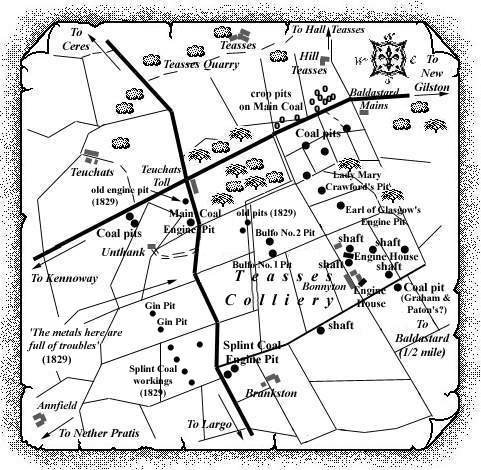 |
By the 1850s, only five working coal pits are thought to
have remained in production. The five shafts on the grounds
close to Bonnyton farm are thought to have worked the deeper
Black Coal.
Research in September, 2002, uncovered the existence of 11
crop pits on the Main Coal seam, north of the road between
Teuchats Toll and Baldastard Mains.
Another five coal pits, scattered around the central
Bonnyton shafts, at locations such as Brankston, Unthank and
Baldastard Mains, are believed to have been worked out by
this time. They probably wrought the Splint Coal of this area
( a cannel type) along with a few other 'poorer
quality' seams and may not even have been part of the
'Teasses Colliery', which is thought to have closed
in the 1860s.
Current research has revealed that several of the unnamed coal pits working the areas of ground peripheral to the main Teasses Colliery (the shafts at Bonnyton farm), are categorised in abandonment plans under Brankston, Appleton, Baldastard, Boghall or simply Largo i.e. under the Parish in which they are situated.
To allow for these categorisations - and where
abandonment plans apply - some of these coal pits have been
given individual entries in the East Fife Index.
These include Lady Mary Crawford's Pit, the Earl of
Glasgow's Engine Pit and the Bulfo Nos. 1, 2
Pits.
--------------------------------------------
"Fifeshire Journal"
18 May, 1833
NOTICE - REDUCTION IN THE PRICE OF COALS
THE Public are respectfully informed, that LADY MARY
LINDSAY CRAWFORD'S MAIN COAL is now Selling at One
Shilling and Fourpence per Load; and the PARROT COAL, at One
Shilling per Load.
Teasses Colliery, May 16, 1833.
--------------------------------------------
"Fifeshire Journal"
23 August, 1838
THE Inhabitants of Cupar and the Country surrounding are respectfully informed, that
TEASSES MAIN COAL
(Late Lady Mary's)
can now be had in any quantity, fresh from the Pits.
Teasses Colliery, 20th August, 1838.
--------------------------------------------
"Fifeshire Journal"
14 February, 1839
NOTICE
THE Public are respectfully informed, that in addition to the Large Fitting completed in 1838 to the MAIN COAL at TEASSES COLLIERY (late Lady Mary's) a Second Shaft has been sunk to the same Coal, which doubles the Supply. The Public may, therefore, feel assured of a steady Supply of the best Coal in the Market.
Teasses Colliery, Feb 13, 1839.
--------------------------------------------
"Fifeshire Journal"
20 June, 1839
NOTICE
THE Inhabitants of Cupar and the Surrounding Country are respectfully informed, that in addition to the former Advertisement of Teasses Main Coal (late Lady Mary's), the LITTLE COAL, or UNDER SEAM, is now selling at 1s. 3d. per load.
Teasses Colliery, 19th June, 1839.
--------------------------------------------

"Fifeshire Journal"
January 23rd, 1840
CERES - FATAL ACCIDENTS AT TEASSES COLLIERY
One of the men employed at this work was killed at the engine-pit on Saturday 10th instant, in consequence of the following circumstances: The unfortunate man and another workman were ascending together in the bucket, when a rope which hung at the top of the shaft to the bottom having got attached to the bucket, was drawn up with it till within a few fathoms of the surface. Here it fell off and fell to the bottom, when - from the weight of the rope, and the suddenness of the jerk - it broke at the top, and in its descent caught hold of the deceased and threw him out of the bucket. He fell to the bottom of the pit, whence his lifeless body was immediately afterwards taken up in a fearfully mangled condition. He has left a wife and family to bewail his unhappy fate.
[On Wednesday 15th January another fatal accident occurred at the same colliery (see Bulfo Pits entry).]
--------------------------------------------
In 1842, a parliamentary commission reported on the employment of women and children in coal mines. Of the mines in East Fife, the commissioners reported:
"The collieries in the district of St Andrews and Cupar are worked to very limited extent, and no females or very young children are wrought below. The only novelty that attracts attention is the peculiar character of the coal at Drumcarra, Largo Ward and Teasses, which spontaneously fires."
The evidence given by mine owners and workers to the commisioners presented a striking picture of working conditions in the pits:
"We employ 65 colliers; four are under 13 years of
age, and five under 18 years. Colliers begin to work at very
early ages in this part, as the working seams are narrow ...
boys are employed to draw the coals in small carts; they draw
with small straps over the shoulders, and to which is
fastened a chain. The carts hold 1½ to 2 cwt. of coal
only, as the deep pit in which they work is not railed; they
work eight to nine hours daily, and principally on their
parents' account. Good working colliers earn 30s. to 40s.
in a fortnight, when they work 12 days. Men are very
short-lived; very few reach 50, and they are often seized in
the breath at 30 and 35 years of age."
David Graham, lessee
"Began work at seven years of age; employed to
draw the bogies with a gordle [rope and chain]; there are no
rails in the pit, and the work is o'er sair; works from
five in the morning until three or four in the day. Takes a
bit of bread down, and gets dinner on return ... Father
touched in the breath, but still works when air is good; and
we take away 20s. to 30s. in the fortnight. Brother got his
legs crushed a while since - was off eight weeks
..."
William Galloway, aged 16, putter
"I think a limitation of the age which children
should work in mines would be harmful, as they ought to begin
young. Boys get injured through carelessness; one was killed
a short time since by bad air."
William Graham, overseer
There were many people like William Graham and unfortunately those who suffered the most were the children who worked for such people.
--------------------------------------------
"Fifeshire Journal"
22 February, 1844
REDUCTION IN THE PRICE OF COALS
THE PUBLIC are respectfully informed that the Price of
TEASSES COALS is REDUCED as follows, viz.-
MAIN COAL ............... 1s.4d. per
load,
SPLINT do. .................. 1s.0d.
do.
CHERRY do. ................ 0s.10d.
do.
RIDDLED SMALL do. .. 0s.8d.
do.
The greatest care in future will be taken that no inferior
Coals are put out, and the Public may rely that every
exertion will be used in furnishing an article which will
give satisfaction. A trial of the Splint Coal is
confidentially recommended.
Teasses Colliery, 21st February, 1844.
--------------------------------------------
"Fifeshire Journal"
8 April, 1847
TEASSES COLLIERY
THE Public are respectfully informed that the different
kinds of COAL are now selling here at the following Prices:-
MAIN COAL ................. at
1s.7d., per 3½ cwt,
UNDER SEAM COAL ... at 1s.6d.,
"
SPLINT
Do.
........... at 1s.4d., "
CHERRY
Do. ........... at
1s.2d., "
Do.
Do. .......... at 1s.0d.,
"
April 6, 1847.
--------------------------------------------
"Fifeshire Journal"
13 January, 1848
Reduction in the Price of Coals at Teasses Colliery
MESSRS PATON & GRAHAM, in returning their sincere
thanks to the Public generally for the very liberal support
with which they have been favoured, beg to intimate that
their Reduced Prices will be as follows:-
Under Seam of Main Coal, at 8s. per
Ton.
Splint
Do. ............ at 6s.8d., "
Cherry
Do. ............. at 5s.6d., "
Do.
Do.
............. at 5s.
"
Teasses Colliery, January 13, 1848.
--------------------------------------------
"The Scotsman"
28 September, 1859
COLLIERY IN FIFE TO LET
To be LET at Martinmas first,
THE COAL-FIELD and COLLIERY of TEASSES, belonging to the Earl of Glasgow.
Besides a considerable local sale, there are several Limeworks in the district which have long
obtained their supply of Coal at Teasses. The Coal is also well known in Cupar Market, about
five miles distant, and the towns of Largo and Ceres are about three miles distant.
Several Seams of Coal are known in the Coal-field, and the Main Coal and Splint Coal of
which have been extensively worked under Teasses Common. Recently a new Seam
has been opened in Balmain Barony, of good quality, and other Seams are confidently
expected to be found below it by boring. The Machinery on the Works, consisting of
Pumping and Winding Engines, belongs to the Proprietor, and, if desired, will be included
again in the Lease.
The present Tenant is not an offerer.
Offers for a Lease, stating fixed yearly rent and optional royalty, will be received by John N.
McLeod, Esq., banker; or Messrs Tods, Murray, & Jamieson, W. S., 66 Queen Street,
Edinburgh, till 1st October next.
--------------------------------------------
Information on coals in the Teasses Coalfield
(based on a report from 1900)
The two coals which came immediately above the Hurlet
Limestone were worked between Hall Teasses and Nether Pratis
for a distance of nearly three miles.
In the old pits, the lower seam (2 ft. thick) consisted half
of parrot and half of cherry coal. The upper seam was 4 ft.
10 in. thick but included a parting of black shale 14 in.
thick. The mining of these seams does not seem to have been
disturbed by many large faults, for the crop of the upper or
Main seam ran in a fairly straight line from north-east to
south-west, from near Hall Teasses by Hill Teasses to
Teuchats, where a dislocation, with a large downthrow to the
south, shifted the crop line westward. It then continued for
another mile until it was interrupted by the igneous mass
which lay to the north of Nether Pratis.
As coal workings were carried northwards as far as Hall
Teasses, it was found that the coal was very foul and
gradually became blind or deprived of its bitumen. The crop
of the coals passed under the Teasses sill, so their altered
condition is what might have been expected.
Further evidence of the disasterous effects of the igneous
intrusions on the coals was revealed by a series of borings
sunk in the late 1890s in the low ground to the east. Three
trials were made in a line on the alluvial flat to the east
of Hall Teasses. Each of them stopped in "hard
whinstone", which was reached at depths varying from 7
to 24 fathoms. One of them passed through three coal seams,
all of which were blind and thin, ranging from 10 to 15
inches in thickness.
About 450 yds. further south, on the opposite side of the
moss, a diamond drill, which was put down to a depth of just
over 105 fathoms, pierced a "whinstone" sheet 200
ft. thick, at a depth of 46 fathoms, and ended off in another
at the bottom. Three thin coal seams were encountered above
the sill passed through, and each of them was found to be
blind. The diamond bore also passed through 2 ft. 4 in. of
limestone at 88 fathoms, and another seam 10 ft. 7 in. thick
at 98 fathoms. These were obviously the lower limestones, but
the numerous and valuable coal seams which usually overlay
them were found to absent in this case.
In spite of these serious obstacles to successful mining,
coal has been searched for and worked at various parts of the
field, especially towards the south between New Gilston and
Baldastard, at a greater distance from the invasive
"whinstone". In this tract, some of the series of
the lower coals were met with.
The Splint Coal of this part of the field, 3 ft. thick,
cropped out between Brankstone and Baldastard, first with a
north-westerly dip, the outcrop then swinging towards the
east, so that the seam was 36 fathoms deep at Baldastard.
On the opposite side of the field, the 4 ft. seam of Splint
and Cherry coal cropped out, with an easterly dip, on the
west side of the Largo road near Brankstone. Traces of old
coal-workings were detected in the ground to the south, but
no information has been obtained regarding them.
... and in a report from 1977 ...
The only complete section of the strata between the St
Monance Little and Charlestown Main limestones in the Teasses
area was provided by the Teasses Moss Borehole (¾ mile
north of Woodside Colliery) where the sequence has been
invaded by a dolerite sill almost 33 fathoms thick which to
some extent obscured its nature. The beds were around 15
fathoms in thickness and included three burnt coals, each
less than 1 ft. thick. Other bores which cut parts of this
sequence showed, however, that where unaffected by the sill
some of these coals were, at least locally, somewhat thicker
than that.
The exact horizon of the Teasses Main Coal is uncertain but
it must lie in this part of the succession. The seam was
extensively worked south of Teasses House. Landale's
original account (1837) gave a thickness of 3 ft. 8 in. of
coal in two leaves for this seam, but in an unpublished
report dated 1879 he amended this to the following and stated
that the quality of the seam decreased eastwards:
| Description | Thickness |
| Splint coal | 1 ft. |
| Parting | 1 ft. 1 in. |
| Cherry coal | 1 ft. 7 in. |
Other boreholes in the area corroborate these latter figures closely.
Landale also recorded a Teasses Under Coal, an unspecified
amount lower in the succession, for which he gave a thickness
of 2 ft., but this was altered to 2 ft. 4 in. in his 1879
report.
The Teasses seam must be regarded as the equivalent of some
of the Radernie coals, but the precise correlation has not
been established.
| Plans of Abandoned Seams for Teasses | Pits or Mines designated in Plans |
|---|---|
| COAL; Buffo; Main; Splint | Teasses |
| COAL;
Main; Splint; Blind (1829)
Seam unnamed (1840) |
Engine; Gin (Teasses) |
| Plans of Abandoned Seams for Branxton (Brankstone) | Pits or Mines designated in Plans |
|---|---|
| COAL; Splint | Engine |
| Plans of Abandoned Seams for Baldastard | Pits or Mines designated in Plans |
|---|---|
| COAL; Seam unnamed | Pits SW of Baldastard Mains |
| COAL; Splint; Buffo | Pits from Unthank to Baldastard |
| Plans of Abandoned Seams for Largo | Pits or Mines designated in Plans |
|---|---|
| COAL (not specified) | Pits at Unthank and Teuchats |
