Owners: Walter Herd
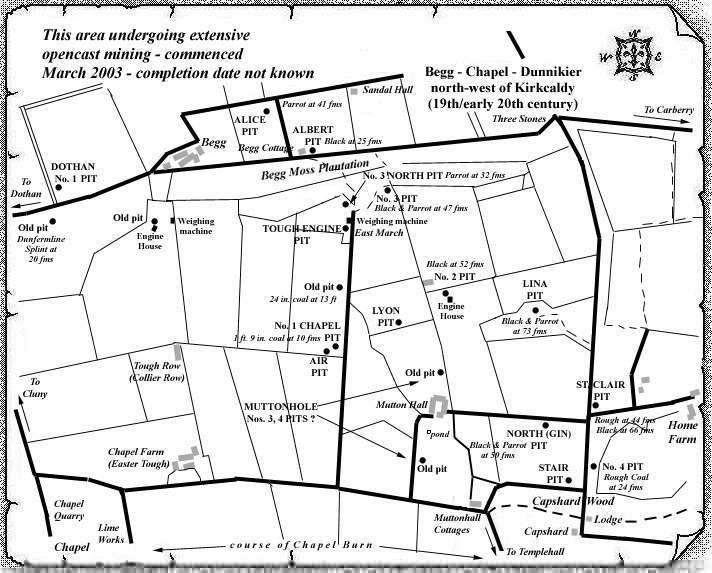
The St. Clair Pit (St. Clair No. 2) of the Dunnikier
Colliery was probably sunk in the 1860s just over ¼ mile
west of Dunnikier House, Kirkcaldy, on the eastern edge of
the route known locally as 'Johnnie's Loan'. It
was by the orchard on the north side of the Home Farm Road
and to the south were located the No. 4 and Stair Pits of the
Colliery. Just 200 yds. to the south-west of the St. Clair
Pit was the site of its nearest neighbour, the North (or Gin)
Pit which worked the Black and Parrot coals at a depth of 50
fathoms.
The St. Clair Pit reached the Rough Coal at a depth of 44
fathoms where the seam was 2½ feet thick. Workings in
the Rough Coal were abandoned in July, 1875. The Black (2 ft.
2 in. thick) and Parrot (2 ft. 4 in. thick) coals were found
in the St. Clair Pit at 66 fathoms and workings in these
seams were abandoned in July, 1880.
 |
| Source Date of Information Supplied | |
|---|---|
| Manager / Under-Manager / Men underground / Men above ground / Coal seams worked / Shaft details | |
| 1873 | |
| Walter Herd / ------ / --- / --- / Rough / D'cast 240 ft. : U'cast 228 ft. | |
| 1874 | |
| Walter Herd / ------ / 20 / 2 / Rough / D'cast 240 ft. : U'cast 228 ft. | |
| 1875 | |
| Walter Herd / ------ / 17 / 2 / Rough / D'cast 240 ft. : U'cast 228 ft. / Abandoned | |
| 1876
(St. Clair Pit not listed in colliery record) |
|
| 1877 | |
| Walter Herd / ------ / 17 / 2 / Black and Parrot / D'cast 396 ft. : U'cast ----- | |
| 1878 | |
| Peter Herd / ------ / 36 / 4 / Black and Parrot / D'cast 396 ft. : U'cast ----- | |
| 1879 | |
| Peter Herd / ------ / 31 / 3 / Black and Parrot / D'cast 396 ft. : U'cast ----- | |
| 1880 (Walter
Herd & Sons)
(Abandoned - 16 July, 1880) |
|
| Peter Herd / ------ / 30 / 3 / Black and Parrot / D'cast 396 ft. (9.5 x 5 ft) : U'cast ----- |
Information on coals worked in the St. Clair Pit area
From the abandonment plan of Black and Parrot Coal workings of July, 1880:
| Description | Thickness |
| Rock | - |
| Blaes | 3 ft. |
| Free Coal (BLACK COAL) | 2 ft. 2 in. |
| Stone | 2 ft. |
| Free Coal } | 9 in. |
| Gas Coal } (PARROT COAL) | 10 in. |
| Free Coal } | 9 in. |
| Freestone bands | 2 ft. |
... and based on reports from 1900-34 ...
A section of Lochgelly Splint and Parrot Coals (or Black
Coal and Parrot as it was known in the nineteenth century),
in the eastern area of this district, was recorded in a bore
half a mile north of Carberry where the Splint (Black Coal)
was recorded as 1 ft. 11 in. of coal, a 1 in. parting of
fireclay and 5 in. of coal.
The Parrot Coal, reached at 66 fathoms in the St. Clair Pit,
was recorded as 3½ in. of coal, 4½ in. of parrot
coal, 1 ft. 3 in. of coal resting on 11 in. of blaes and
separated from the Splint by over 12 ft. of sandstone, fakes
and blaes.
The Swallowdrum Coal was recorded in this same bore as 11 in.
coal with a ½ in. parting, and the Jersey Coals, as five
leaves of coal totalling 3 ft., were distributed through 17
ft. of strata into which a thin whinstone had intruded.
Kelty Main Coal in the Carberry bore was recorded as being in
four coal layers of 6 in., 2 in., 5½ in. and 10 in.
thick, separated from each other by ½ in. fakes, 2 in.
coaly fireclay and 2 in. blaes, respectively.
Small areas of Rough Coal, also known as "Cluny"
Coal, were wrought from the St. Clair Pit and from an old
shaft [Dunnikier No. 4 Pit] some 260 yds. farther south.
In the Carberry bore, the seam which was tentatively
correlated with the Rough Coal, together, possibly, with the
Little Splint, lay 18 fathoms above the Lochgelly Splint, but
little more than 5 fathoms above the Kelty Main.
In skeleton sections of the St. Clair Pit, the Rough Coal was
recorded at 22 fathoms above the Lochgelly Splint Coal. In
the Carberry bore, both the Rough and Little Splint Coals
appeared to be represented by a 22½ in. seam with a
1½ in. median parting, below a thick post of sandstone,
at a depth of 226 fathoms.
The Cardenden Smithy coal, north of Carberry, was 3 ft. thick
including a 1 in. and a 2 in. parting, and the Blairhall Main
Coal was recognised at one point only in the Carberry bore
where it lay about 22½ ft. above the Cardenden Smithy
Coal; elsewhere, it did not appear to be present.
| Plans of Abandoned Seams for St. Clair Pit, Dunnikier | Pits or Mines designated in Plans |
|---|---|
| COAL; Rough (1874); St. Clair (1878); Smithy (1880); Black; Parrot; Glassee | Level; Lina; St. Clair; Spithead; Stair |
| COAL; Rough (July, 1875) | No. 4; Lina; Lyon; St. Clair |
| COAL; Rough (1875); Parrot (1879); Black (1880) | No. 4; North (or Gin); Lina; Lyon; St. Clair; Tough Engine |
| COAL; Black; Parrot (July, 1880) | St. Clair |
| COAL; Black; Parrot; Five Feet; Jersey; Bright; Cairncubie (April, 1927) | Nos. 2,
3; Lina; Lyon; North; Panny Nos. 1, 2;
St. Clair No. 2; Tough |
| See also Dunnikier Colliery entry |
|---|
------------------------------------------------
"The Scotsman"
23 April, 1863
Narrow Escape From Drowning
On Tuesday morning, two miners, named John Rankin, and John Campbell, narrowly escaped drowning in St Clair Pit, near Dunnikier. It would appear that the water in an adjoining pit had burst in upon the one at present being worked, and on the men descending in the morning to commence work, they were precipitated into the water, which was fully eight feet deep. Fortunately both of the men could swim, and having caught hold of the cage they managed to alarm the person at the top of the pit by means of the chain, when they were again pulled up very much exhausted. The water is still rising in the pit.
------------------------------------------------
"Dunfermline Saturday Press"
25 April, 1863
A COAL PIT FLOODED
NARROW ESCAPE FROM DROWNING
A narrow escape from drowning took place at St. Clair coal-pit, near Dunnikier, on Tuesday. It would appear that during the night the water in an adjoining old coal-pit had burst into the one at present being worked, and on two miners, named John Rankin and John Campbell, going down next morning to resume work, they were precipitated into the water, a depth of eight feet. Fortunately both of the men could swim, and on making signs with the rope that lowered them down, they were again pulled up in a very exhausted condition. The water is still rising, and the miners have been necessitated to look for work at another pit. Had the water burst into the pit during the day, when the miners were at work, the loss of life must have been very great.
------------------------------------------------
