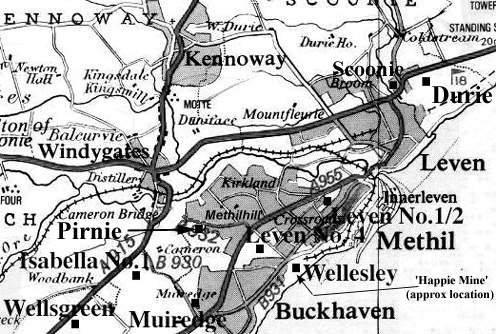
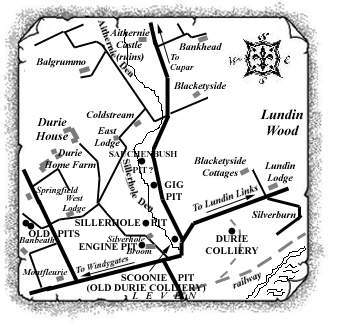
Scoonie Pit and its engine house appear on the 1856 OS map, as Durie Colliery, on the site occupied by the present-day Letham Glen car park at Leven. It was completed in the summer of 1841, a bit later than the Banbeath and Sillerhole area coal-works which may have been worked out by the beginning of the 19th century. Although successful boring operations around 1802 had established the presence of rich coal seams in the vicinity of Scoonie Bridge, it was surprising to read in an 1836 account (see later) that, of the fuels used in Scoonie parish at this time, some included imported coals from England!
 |
 |
|
There were several small coal workings, from fairly early
times *, in the lands just to the south-west and
south-east of Durie House i.e. near Banbeath, and in and
around, Letham Glen, formerly Sillerhole Den. Research
[May '02] has uncovered some information about the coals
on the old Durie estate which were transported in wooden
waggons to Leven harbour where they were transferred to
waiting ships for export to Holland and elsewhere. The route
taken by the wooden coal waggons gave the present-day Waggon
Road, Leven, its name.
* We heard from Lana Archibald, in late 2001, that she had uncovered information concerning the death of her great-great-great grandfather, Andrew Archibald, killed on 25 February, 1750, by a fall into one of the Duries coal pits. The Scoonie Kirk Session Minutes for 25 February, 1750, ordered one shilling per month to be paid to Andrew Archibald's widow (Janet Robertson Archibald). The Author and Webmasters |
Statistical Account of Scotland (1795)
Parish of Scoonie
"There are very extensive seams of coal in the estate of
Durie, which have been wrought for upwards of a century. One seam
is of an excellent quality, and used to be exported from Leven to
Holland, where it met with a more ready sale, than most of the
other coals carried from this part of the country. This seam, so
far as it could be drained by the present water engine, is now
exhausted. The seams now working are of an inferior quality, but
answer for land sale, and furnish fuel for two or three salt
pans, which are very productive. By an additional engine, the
proprietor will have the command of a large field of the
principal or better seam."
"The principal advantage of the parish, is, having
abundance of coal in the near neighbourhood, the ordinary fuel of
the poorest families. Peats are a sort of rarity, of which some
families purchase a small quantity yearly, for their
conveniency."
Statistical Account of Scotland (1845)
Parish of Scoonie
"Beds of coal, varying in thickness, and at different
depths under the surface, pervade the whole of the parish; but
none of the seams are at present [December 1836] worked.
The coal upon the estate of Durie, which was wrought for upwards
of a century, and was drained by a water engine, consisted of
three seams, the two upper, each four feet thick, and the lower
eight feet. There is understood to be a fourth seam below these,
called the craw coal, the cropping of which comes
out about 120 yards south-east of the mansion-house. The third
seam, called the main coal, was considered the best
in the county.
Considerable quantities of it used to be exported to Holland,
where it met with a ready sale; and it is said, even at this day,
that the best Scotch coals in that market go under the name of
Durie coals.
The direction of the strata is from N.W. to S.E.; with one
hitch or dyke below the farm house of Banbeath, and another a
mile farther east.
The following old table shows a section of Durie coal and
metals, cut by a plane perpendicular to the streak, from the crop
to the depth of forty fathoms.
| Thickness of Strata | |
| Description | [Fathoms. Feet.] |
| Earth metals | 1 5 |
| Till | 0 3 |
| Greystone | 2 0 |
| Whitestone | 2 1 |
| Till | 3 3 |
| Coal | 0 4 |
| Ratchel | 1 0 |
| Reddish-stone | 1 1 |
| Hard band | 1 0 |
| Irregular metals | 1 0 |
| Soft till | 1 2 |
| Coal | 0 4 |
| Dogger and hardstone | 1 0 |
| Broats and hardstone | 1 3 |
| Broats | 1 3 |
| Till | 3 0 |
| Dogger and stone | 2 0 |
| Grey broats | 1 0 |
| Whitestone | 1 3 |
| Broats and till | 1 3 |
| Hardstone | 0 3 |
| Till irregular | 1 1 |
| Main Coal | 1 2 |
About the year 1802, a bore was put down near Scoonie bridge,
which reached the bottom of the main coal, at a
depth of 53 fathoms. This bore, besides the upper seams of coal,
passed through a stratum of ochre upwards of 4 feet thick, and
three seams of fireclay, two of which are of the finest quality.
These operations were preparatory to working the main coal; but
the proprietor died soon after, and his heirs are under entail.
[entail : to settle on a series of heirs, so that the
immediate possessor may not dispose of the estate.]
A bed of ochre four feet thick, lying on the estates of Durie
and Aithernie, has been wrought for several years, of which a
considerable quantity is exported."
" ... The common fuel is coal, from the pits of Wemyss and Kilmux. A considerable quantity of English coals is annually imported, and is generally used by the wealthier classes."
|
See separate Durie Colliery East Fife Index entry for the
'new' Scoonie Pit of Durie Colliery.
A study of several abandonment plans indicates that coal works for Durie pits are found listed under Durie, or Aithernie (Estate), or Lundin, Aithernie and Pilmuir (District). One source, in fact, even classifies ground worked near Kilmux Colliery, to the north-east of Kennoway, under Durie. |
Durie Colliery
| Source Date of Information (Owner) |
| Manager / Under-Manager / Men underground / Men above ground / Coal seams worked |
| 1854 (D. Landale, Jnr. & Co.) |
| 1857 (D. Landale, Jnr. & Co.) |
| 1870s (Mr. Charles Maitland Christie, Esq.) |
| ca 1880 (Fife Coal Co. Ltd.) |
| 1896 (Fife Coal Co. Ltd.) |
| H. Nisbet / R. Penman / 147 / 50 [Durie] |
| Household, manufacturing and steam coals. |
| The date when coal working at the Durie Colliery pits ceased is believed to be 1903. |
Durie Colliery (19th century report)
| Coal seams worked | Thickness | Quality | Class | ||||
|---|---|---|---|---|---|---|---|
| Eight Feet Coal | Roof Coal | > | 1 ft. 6 in. | > | - | > | Steam |
| Good Coal | > | 5 ft. 3 in. | > | - | > | ||
| Six Feet Coal | Coal | > | 1 ft. 6 in. | > | - | > | Steam |
| Stone | > | 9 in. | > | - | > | ||
| Coal | > | 2 ft. 8 in. | > | - | > | ||
| Chemiss Coal | Crow Coal | > | 1 ft. | Not worked | - | ||
| Parting | > | 1½ in. | - | - | |||
| Splint | > | 3 ft. 4 in. | - | Good Household | |||
| Parting | > | 1 in. | - | - | |||
| Binks Coal | > | 2 ft. 4 in. | - | Steam | |||
| Stone | > | 8 in. | - | - | |||
| Coal | > | 1 ft. 6 in | - | Steam | |||
| Parrot Coal | 3 ft. | - | Gas Coal | ||||
| Dysart Main Coal | Coal | > | 2 ft. | > | Not Worked | > | - |
| Stone | > | 1½ in. | > | > | |||
| Coal | > | 6 in. | > | > | |||
| Stone | > | 2 in. | > | > | |||
| Coal | > | 1 ft. 2 in. | > | Worked | > | Steam | |
| Stone | > | 5 in. | > | > | |||
| Coal | > | 3 ft. 4 in. | > | > | |||
| stone | > | 9 in. | > | > | |||
| Coal | > | 3 ft. 2 in. | > | > | |||
| Stone | > | 1 in. | > | > | |||
| Coal | > | 6 in. | > | > | |||
Information on coals worked at, or near, Scoonie Pit (old Durie Colliery)
(based on a report from 1900)
The Chemiss or Main Coal, the Six Feet and the Eight Feet Coal seams, cropped out on the north side of the River Leven between Kirkland and Banbeath, until they abutted against the large fault that struck out to sea at Scoonie Links with a throw of 130 fathoms. On the north side of that fault, but at some distance eastward, their outcrops were again traced.
At the Scoonie Pit of the old Durie Colliery, the Eight Feet seam was found at 28 fathoms; the Six Feet seam at 33 fathoms; and the Main Coal at 60 fathoms.
... and from abandonment plans ...
| Plans of Abandoned Seams for Durie Colliery, Leven | Pits or Mines designated in Plans |
|---|---|
| COAL; Seam unnamed (1853) | Aithernie (Estate) |
| COAL; Aithernie; Lundin; Pilmuir; Drummochy; Eight Feet (1853) | Lundin, Aithernie and Pilmuir (District) |
| COAL; Chemiss (Main); Eight Feet. | Durie |
| COAL; Seam unnamed (1899) | Durie |
| COAL; Four Feet; Six Feet; IRONSTONE. | Durie |
| COAL; Chemiss (May, 1900) | Durie, Nos. 1, 2; Scoonie |
| COAL; Six Feet; Eight Feet (January, 1903) | Durie, Nos. 1, 2; Scoonie |
-----------------------------------
"Fifeshire Journal"
19 August, 1841
NEW COLLIERY
THE DURIE COLLIERY, at Scoonie Bridge, near
Leven, is now fitted on the "Main Coal of Durie".
This Coal so admirably adapted for Dining and Drawing-Room use, as
well as for Bakers and others requiring a Clean, open
burning, and durable Coal.
Supplies of the finest Splint Coal may now be
had on the Hill at the following prices, viz.:-
BEST SPLINT COAL at 8s. 6d. per ton, or 1s. 5d.
per load of 3½ cwt.
SPLINT CHEWS at 6s.6d. per ton, or 1s. 1d. per load of 3½ cwt.
COMMON GREAT (with Chews mixed) at 6s. per ton,
or 1s. per load of 3½ cwt.
Carters are furnished with a ticket. specifying
the description, weight, and price of the Coal, with the name of
the parties for whom they have loaded.
This ticket should always be delivered with the Coals
Durie Colliery, 15th August, 1841.
-----------------------------------

"The Scotsman"
Saturday, 6 November, 1841
LEVEN - FATAL ACCIDENT. - Last week, on Wednesday, a melancholy accident occurred at the colliery lately begun at Scoonie Bridge. As a collier of the name of Hunter, a man somewhat advanced in life, was ascending the shaft, he lost his hold, or somehow or other was thrown out of the bucket, and precipitated to the bottom of the pit. When taken out, life was not extinct, but he was unable to speak, and expired in a short time. He has left a wife and eight children, who reside at Thornton, where he was lately employed, to lament his mournful end. - Fife Herald.
-----------------------------------
"Fifeshire Journal"
1 September, 1842
COLLIERS STRIKE
Yesterday afternoon we received information that the whole of the collieries at Durie and Kilmux works had struck on Tuesday morning. Three emissaries from Wemyss came to Durie on Monday night, and demanded, in name of the "general movement", that the workmen should strike. They foolishly yielded; and, in turn, sent three of their number to Kilmux, where they prevailed upon the men there to follow their example. Durie colliers, we understand, are all bound to give a month's notice previous to their quitting the work; and are consequently, under act Geo. IV. cap. 34, liable to be apprehended and committed to jail for breach of engagement.
[Kilmux miners were not out for long - they reportedly returned to work the following day!]
-----------------------------------
"Fifeshire Journal"
9 April, 1846
SERIOUS ACCIDENT WITH LOSS OF LIFE
Wednesday's post brought intelligence to the parents of James Wilson, coal miner at Dura coal-work, near Leven, that he had fallen in his descent that morning from the top of the pit to the bottom, and was killed outright. The unfortunate man has left a widow and eight helpless children to lament his untimely and very unexpected death.
-----------------------------------
"Fifeshire Journal"
11 November, 1847
On the afternoon of Friday last a melancholy accident occurred at Durie coal-pit. While some of the men were amusing themselves by swinging on a triangle it unfortunately upset, and struck a little boy, son of overseer, Mr Stuart. The injuries received being principally about the head, the child died on the same night.
-----------------------------------
"Dunfermline Saturday Press"
22 February, 1873
LEVEN - COAL BORINGS
Borings to ascertain the exact position of a particular seam of coal, which has been partly worked already, were commenced on Wednesday on the estate of Durie, at a point about half a mile due north from Leven. Should the boring prove successful, as anticipated, sinking operations, preliminary to the bringing of the coal to the surface, will, we understand, be undertaken immediately by a company who have negotiated a lease for the same.
-----------------------------------
1 March, 1873
LEVEN - BORING FOR COAL
Boring operations were begun last week on the estate of Durie, in close proximity to Leven, for the double purpose of ascertaining the "dip" or lie of a particular seam of coal, and the best means of making it available.
------------------------------------
21 March, 1874
LEVEN - NEW COAL SEAM
An excellent seam of coal has been discovered in this district a little to the west of the town, where boring operations have been conducted for some time past.
------------------------------------
5 September, 1896
DEATH OF MR ROBERT CHRISTIE OF DURIE
The death took place on the 29th ult., of Mr Robert Christie of Durie, near Leven, Fife, the representative of one of the first of the Fife county families, and a gentleman well-known throughout the county. He was born in 1818, and was the second son of the late Charles Maitland Christie of Durie. ... he succeeded his father to the estate of Durie on the death of his father on 1 January 1872 ... Great changes took place in Leven and neighbourhood under his auspices. The trade in town was largely increased by the opening of the Leven and Durie Collieries, which work the west and east Durie mineral fields respectively, both of which were leased by him to the Fife Coal Company. ...
------------------------------------
