Owners: Earl of Rosslyn Collieries
'Stair pits' were common in the old collieries of
Fife and confusion over identity can arise. Such is the case
here, with sources indicating the presence of two 'Stair
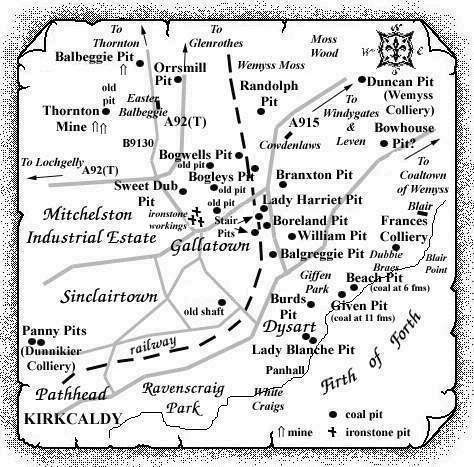
Pits' in fairly close proximity at Boreland, Dysart - one
Stair Pit adjacent to the Lady Harriet Pit and believed to be
working the Dysart Main Coal at a depth of 55 fathoms;
another Stair Pit just west of the Boreland Pit only a few
hundred yards south of the Lady Harriet Pit (see map).
Like most small coal pits in this part of the Dysart field,
these two Stair pits could have been in existence from the
beginning of the 19th century. Probably closed by the 1860s,
coals from the underground workings of one of these pits seem
to have been taken up at the Randolph shafts into the early
decades of the 20th century.
 |
 |
|
No.1
|
Click on Map or Image to Zoom In
|
No.1 |
|
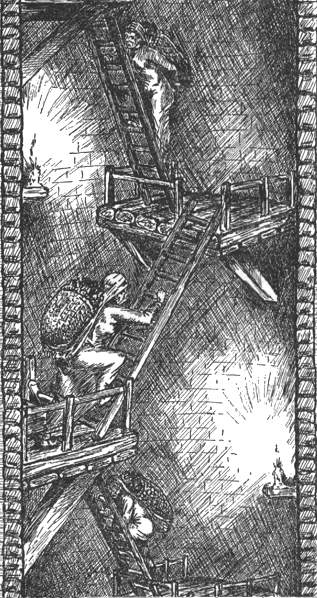
Some stair pits could be as deep as 100 feet.
|
[Abandonment records do list a
Stair Pit, Dysart Colliery, but at this stage of our research
we are unable to say which 'Stair Pit' features in
the abandonment plans.
M. Martin & Webmasters]
| Plans
of Abandoned Seams for Stair Pits, Dysart |
Pits or
Mines designated in Plans |
| COAL;
Dysart Main (1846) |
Balbeggie, Balgreggie, Bogleys, Boreland, Orrsmill,
Stair, William |
| COAL;
Dysart Main (1850) |
Balbeggie, Bogleys, Bogwells, Boreland, Stair,
William |
| COAL;
Dysart Main (1918); Lower Dysart; Branxton; Sandwell;
Boreland |
Balbeggie, Given, Lady Harriet, Orrsmill, Randolph,
Stair, Sweet Dub, William |
| COAL;
Dysart Main (March, 1920) |
Randolph; Stair, Balbeggie, Bogwells,
Orrsmill |
| See also Dysart
Colliery entry - East Fife Index. |
|