Owners: not known
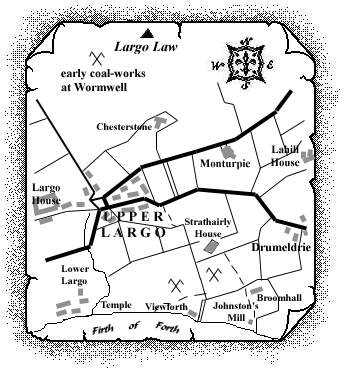
In the early part of the 19th century, four seams of coal, now thought to be from the Carboniferous Limestone Series, were worked in small pits between the shore and Strathairly House, near Upper Largo.
 |
Extract: Statistical Account
of Fife
Parish of Largo - 1791
" ... coal may be wrought to advantage. On the estate of Lundin, the coal has been cropped; but by erecting an engine near the sea, a deep seam, which stretches over upon the estate of Largo, would be opened. This would amply supply the neighbourhood, and afford besides a considerable exportation. ..."
Extract: Statistical Account
of Fife
Parish of Largo - 1845
" ... Many years ago, coal was wrought in large quantities, especially near the coast. At present, there are three seams wrought, but none of them are of the first quality. To the north of New Gilston a singular mass of rum coal is found, under the mass of overlying trap on the south. It is an inflammable bituminous shale, and is extensively used for lime-burning. It is known to be 80 feet thick, and is wrought in an open quarry. ..."
Information on coals worked near Strathairly House, by Upper Largo.
(based on a report from 1900)
In a map that accompanied an early report (by Landale) on
these seams, the coals were represented as extending with a
northerly dip from the bend of the road north of Temple due
eastwards across the Strathairly Burn, when they bent round
to the high road to Largo.
Landale assumed these coal seams to be the same as the
Drumochie coals on the shore. This we now know to be
incorrect in that the Drumochie coals belong to the very top
of the true Coal Measures, while those of Strathairly lie on
the other side of the great fault and unquestionably form
part of the Limestone series.
An interpretation of the position of the Strathairly coals in the district, based on information available at the time, is given in the following diagram:
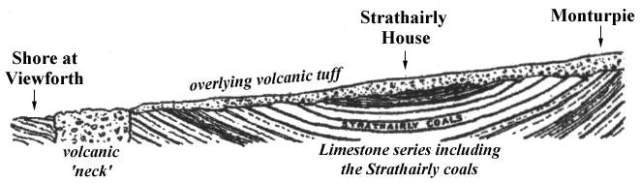
... and in a report from 1977 ...
No other evidence of the existence of coal seams at Strathairly has since been obtained [since Landale, 1837) and general structural considerations suggest that the strata there should more probably be assigned to the Passage Group or to the top part of the Upper Limestone Group.
| Please see Stories Link: Bowman Story, for information on David Bowman, the Grand Old Man of Largo, and other Bowman family enterprises. |
|---|
