Owners: possibly Burntisland Oil Company
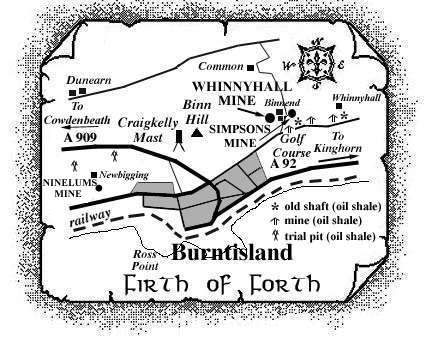
Simpsons Mine is believed to have been a small mine at the base of the escarpment of the Binn Hill, Burntisland, just a few hundred yards east of Whinnyhall or Binnend Mine. The mine is thought to have wrought the outcrop of the Houston Coal. The opening date of the mine is not known but it must have been worked in the early-mid nineteenth century and probably fell into disuse around 1892 when the Whinnyhill Mine and the oil shale mines (see below) in the area were also closing down.
 |
| Source Date of
Information Supplied
Manager / Under-Manager / Men underground / Men above ground / Minerals worked / Shaft Details |
|---|
| 1879/80 (Binnend Oil Co.) |
| Thomas Gillies /
------------ / 27 / 3 / Fells Shale, 5' / D'cast
(12 x 6) 420 ft. : U'cast (7 x 5) 360 ft.
Ventilation by steam jet. |
| 1881 (Burntisland Oil Co. Ltd.) |
| No. 1 Mine:
Henry Hunter / ------------ / 17 / 5 / Shale, 6' /
D'cast (9 x 7) ----- : U'cast (7 x 6) -----
The mines dip 1 in 3½ and are ventilated naturally. |
| 1882 (Burntisland Oil Co. Ltd.) |
| No. 1 Mine:
John Louden / ------------ / 44 / 9 / Shale, 6' /
D'cast (11 x 6) 720 ft : U'cast (6 x 6) 360 ft.
Ventilation Fan 18' dia. No. 2 Mine: John Louden / ------------ / 25 / 5 / Shale, 6' / D'cast (11 x 6) 550 ft : U'cast (6 x 6) 360 ft. |
Information on coal worked near Simpsons
Mine, Burntisland
(based on reports from 1900 and 1934)
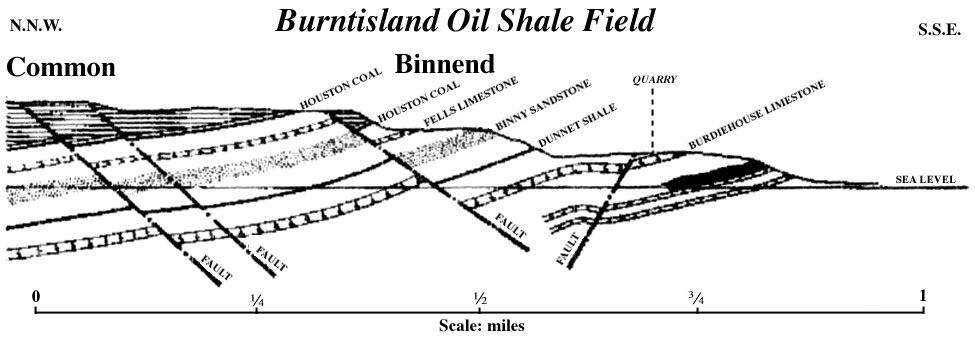
About two fathoms below the lavas and 15 or 16 fathoms above the Fells Limestone lay a thin coal considered to be the equivalent of the Houston Coal of West Lothian.
 |
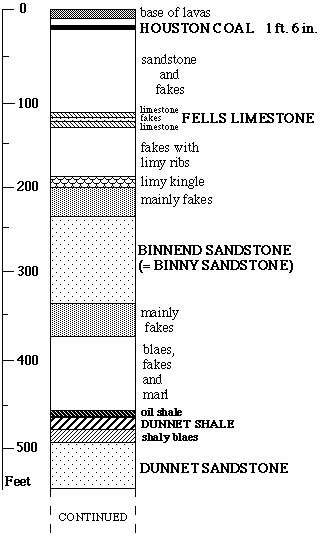 |
A cross-cut mine driven into the strata above the Fells Limestone in search of the Broxburn Shale broke into old 'stoop and room' workings in the Houston Coal and proved it to be an inferior seam, 1 ft. 1 in. thick, and full of iron pyrites. The Houston Coal was not seen west of the Binn Hill.
Oil Shale Mines of Whinnyhill and Binnend
The small groups of cottages comprising Binnend and
Whinnyhall were supposedly built to house miners working in
the coal and oil shale mines in this area during the
nineteenth century.
[The last inhabitants of Binnend (late 1920s or early
1930s?) were rehoused in new homes in Burntisland.]
Bituminous shales which could be used for the distillation of mineral oil occurred in different parts of the Carboniferous series of Fife. They were formerly mined to a considerable extent, but the fall in the price of oil and the residual products led to the abandonment of this part of the mineral industries of the district.
The oil shale above the Burdiehouse Limestone at Binnend, Burntisland, was extensively worked by three mines, of which the longest extended northwards for a distance of 900 yds. The two principal mines were situated on the west side of a north-east fault, which ran through the mined field, and followed the shale, for the distance quoted earlier, from the mine mouths. The seam dipped to the N.N.W., the angle of inclination being at first 10o, but gradually increasing to 18o at the face, which lay about 700 ft. below the surface when operations were suspended. Two faults were crossed in these mines, running nearly due east and west, with downthrows to the south of about 26 and 8½ fathoms respectively. On the east side of the north-east fault, the shale lay on an anticline, a mine being driven along the ridge of this curve to the north-east, with a branch in an E.N.E. direction. The best shale was found at the bottom of this mine in the direction of Kinghorn Loch.
The works, which closed around 1894, manufactured crude and refined oil, "scale", and ammonium sulphate. The "scale" was made into candles in the factory at Kinghorn Loch a mile, or so, to the east.
At a later date, two trial pits sunk to 30 ft. and 41 ft. were also examined near Newbigging to the west of Whinnyhall, but the results of tests on the extracted shales, and lack of suitable rail transport to the Lothian oil refineries, led to no further steps being taken to develop this field.
------------------------------------
"Dunfermline Saturday Press"
8 February, 1873
BURNTISLAND - COAL FIELD
It has been long known that a two feet seam of good coal crops out at the east shoulder of the Binn Hill in this vicinity. In former years farmers and others have been known to avail themselves of this mine for fuel, but it has never been worked for profit. Owing to the increased price of coal, and the occasional difficulty of procuring supplies at any price, there has been some talk of late of working the Binn End seam.
It is to be seen in the northmost of two belts of plantation that run eastward from the Binn Hill, and it is believed that to a certain depth the coal could be worked very profitably. The ground is the property of Mrs. Young, of Colinswell.
------------------------------------
"Dunfermline Saturday Press"
5 September, 1874
BURNTISLAND - COLLIERS AS NAVVIES
The 70 colliers who began work at Burntisland on Monday last, at 22s. a week, have nearly all thrown up the job, finding the work rather heavy and the pay rather light.
------------------------------------
"Dunfermline Saturday Press"
17 February, 1877
BURNTISLAND - NEW MINERAL FIELD
Boring experiments which are now being conducted on the lands of Whinnyhall, Burntisland, show fine seams of coal, both common and cannel, shale, fireclay, and limestone.
------------------------------------
"Dunfermline Saturday Press"
27 July, 1878
BINNEND MINERAL OIL WORKS
These important works are advertised for sale, or rather conversion into a Company property. Mr. Simpson asks for £95,000 for the concern, and the shares are £10 each.
------------------------------------

"Dunfermline Saturday Press"
9 November, 1878
BURNTISLAND - FATAL ACCIDENT
On Monday morning, a miner, named Richard Marshall, was killed instantaneously at the Whinniehall Shale Works, Burntisland. Marshall had seated himself on a bogey which was being drawn to the surface when his head came into contact with the roof of the tunnel, and was shockingly mangled. The deceased was about 23 years of age, and belonged to Starlaw, Bathgate.
"Dunfermline Saturday Press"
28 June, 1884
BURNTISLAND - FATAL ACCIDENT
On Wednesday afternoon, a shale miner named Samuel Lafferty, while employed in No. 3 Mine at Binnend Oil Works, incautiously went forward to examine a fuse which hung fire, when the shot went off. His injuries were almost immediately fatal. Lafferty was twenty-seven years of age, and leaves a wife and four children, who reside at Kirkcaldy.
"Dunfermline Saturday Press"
24 March, 1888
BURNTISLAND - FATAL ACCIDENT
A shale miner named Frank Morgan was killed at the Burntisland Oil Company's Works, Binnend, on Wednesday, by the fall of a piece of shale from the roof.
