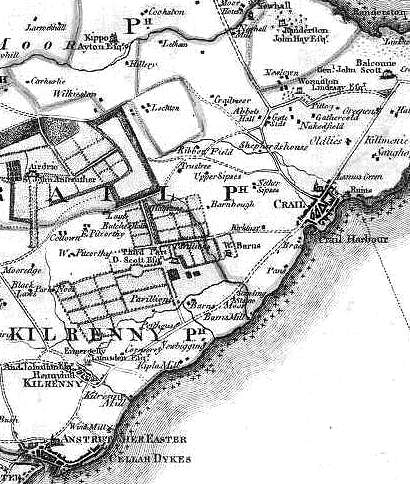
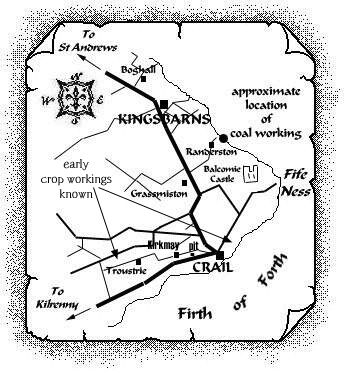
Probably never referred to as 'Randerston pit', these small nineteenth century 'coal-workings', at and just above the shoreline to the south-east of Kingsbarns, around two miles north of Crail, are well worthy of a brief mention since they may be in the running for the title of 'the most easterly coal-mining sites in Fife'.
 |
 |
In 1790, the minister of Crail Parish wrote ... "In times of scarcity, the poor people have from time immemorial been in the practice of digging the thin seams of coal among the rocks along the seashore."
Extract: Statistical Account of Fife - Parish of Kingsbarns - 1836
"... Coal also appears to exist largely underneath
the greater part of the parish; since both among the rocks at
the sea, as well as on the sides of the burns on the high
grounds, seams here and there appear. From the vestiges of
workings on the lands at and immediately above the shore, the
coal, in so far as tow and buckets and levels go, would
appear to have been wrought. Where it peeps out, it is at
times quarried by the poor people; of course it is small and
brushy. By proper application it might become available to
the public, since it is most likely to be a continuation of
the same strata which have for a century past been
successfully wrought on the high grounds to the westward. But
from the vast amount of under water in the ground, the
working would require considerable power, and consequently a
great outlay. ... Some ironstone is also found amongst the
rocks at the shore, imbedded in their laminae, or rolled in
by the tide. A person has a lease of it from the different
proprietors; he emplys a few hands in digging and collecting
it, and usually ships it off to Newcastle, whence he brings
English coal for sale. ...
Fuel.- The chief article of fuel is coal. The present
distance from any pit is about ten miles. That of Largoward
is inaccessible by the muir road during winter; and from Ely
the expense of tolls greatly increases the value. Land coal,
in fact, is only attained by the farmers and their servants
having the cartage free of expense. The general supply is by
sea, brought in during summer, and delivered at the shore. A
small quantity of English coal is also brought from
Newcastle. The larger quantity of the article used comes down
the Frith from Charleston, &c. Dysart Coal is one of the
heaviest articles of family consumption in this quarter. The
summer price of the smaller kind, called chews, is
from 5s. to 6s. per boll of 60 stones, and of great coal from
6s. to 7s. In winter the price is heightened considerably.
Were the road which passes through the parish from east to
west, properly made through the Kingsmuir to the coal
districts, the distance and conveyance would be much reduced.
There is happily at present a prospect of the coal on the
Kingsmuir itself being wrought. Were this the case, I know
not anything that would more essentially conrtibute to the
comfort of the lower orders of the people. "
Extract: Statistical Account of Fife - Parish of Crail - 1845
"... There are many indications of coals having been dug here at an early period ... at present, coals are raised for burning lime. ..."
The early workings at Randerston
(based on a report from 1900)
In a note to the writers of the 1900 document, a Mr. J. Kirkby commented, "Two of the thin coals ... at Pittenweem* .. appear to have been wrought in former times in a primitive sort of way, as the seams are represented by 'waste' in most of the section; and traces of small shafts are occasionally seen in the cliff after falls. And coals much lower in the series are sometimes dug into on the shore by poor folk when prices are high. This I have noticed in the beds to the east of Billow Ness and elsewhere. Perhaps the lowest and oldest coal that I have seen 'worked' was at Randerston, where a couple of men put down a shallow shaft or hole, just above high-water mark, and took a ton or so of cherry coal from a one-foot seam. This coal is 3200 feet below the Hurlet Limestone. There are no coals seen, however, in this section, or yet elsewhere in the Calciferous sandstones on the Fife coast, of sufficient quality and thickness to warrant their being wrought for commercial purposes."
* In the medieval period, it was the monks of Pittenweem Priory who controlled the coalworkings in their area.
Pittenweem
"The colliers are all free, stand engaged by the
year, and are paid in proportion to the work they
respectively perform.
A good and laborious collier will earn about eighteen
shillings a-week."
Statistical Account of Fife - 1793
