Owner: Earl of Rothes
Tenants: Messrs. Bowman & Pryde (1907)
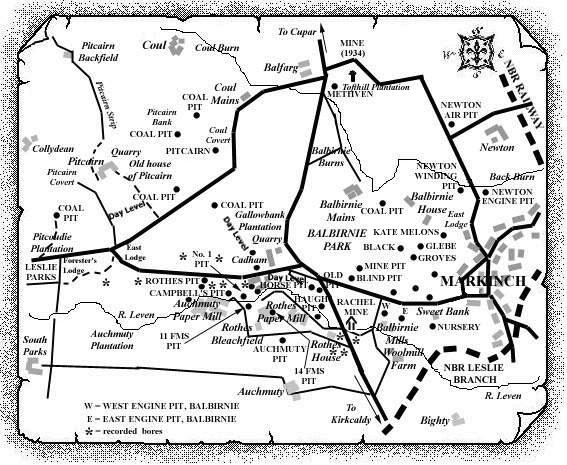
This Rothes Pit, near Cadham, was in the parish of Leslie,
and should not be confused with the much later, 'super
pit', also called Rothes, which was sunk just to the west
of Thornton in the 20th century.
The late nineteenth century Rothes Pit lay in the western
basin of the small Cadham coalfield and worked limestone in
addition to coals. Research (July 2002) suggests that
an earlier engine pit, at this location in the late
18th/early 19th century, may have been closed mid-century,
only to be redeveloped, under lease, by Bowman & Pryde in
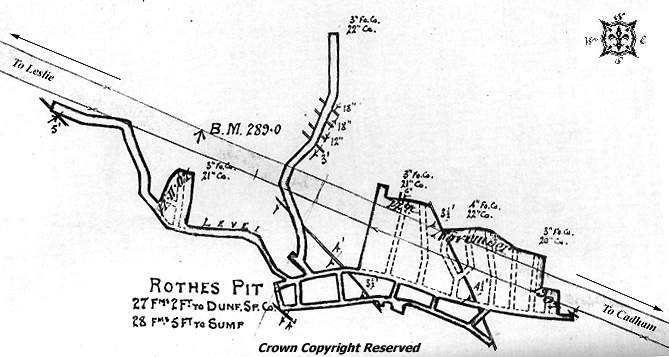
the 1880s, as Rothes Colliery. This old Rothes Pit was sunk
27 fathoms 2 ft. to the Main Coal (Dunfermline Splint), 28
fathoms 5 ft. to the sump, and had probably ceased coaling by
1908 (see Abandonment Plan Table below).
The limestone works associated with the Rothes Pit were
1¼ miles to the west of the pit, near Balgeddie, just
north of Leslie.
 |
 |
Historical
Numerous abandoned pits indicate the extent to which the small Cadham-Balbirnie coalfield has been exploited and there can be no doubt that it was practically exhausted around the beginning of the twentieth century. A mining venture north of Balbirnie House, believed to have taken place around 1934, though successful in tapping a small area of untouched coal, served to emphasise this fact. The Methven surface-mine driven won some coal near the outcrop but old pit workings were soon encountered and the venture had to be abandoned. Referring to this small coalfield in the 'New Statistical Account of Scotland' from 1845, the Rev. J. Sieveright states that the coal was wrought at a very remote period, but not extensively, previously to the year 1730 - when the nature of the field was more accurately ascertained by means of bores. An earlier, even more detailed, account of this coalfield was given by the Rev. John Thomson in 1794. Even at that time it appears that at least half the available coal had been taken out, the quantity removed during the period 1740 to 1792 being given as over half a million tons.
See Coalfields link: Cadham Coalfield for detailed
seam information
|
|---|
Coals worked at, or near, Rothes Pit, Cadham
(based on a report from 1900)
Records indicate that Mill, Main (Dunfermline Splint)
coals have been wrought at the Rothes Pit. The greatest
known depth of Main Coal or Dunfermline Splint, probably
the only seam consistently thick enough to be of great
economic importance, was found at 27 fathoms 2 ft.
A section recorded at this pit had:
| Description | Thickness |
| Blaes | |
| Coal | 6 in. |
| Stone | 2 in. |
| Coal | 3 in. |
| Stone | 18 - 24 in. |
| Foul Coal | 3 in. |
| Coal | 20 - 22 in. |
| Sandstone |
Although a number of old pits in this area have not been identified at this time, it is hoped that further research will resolve this. To the south-east of Markinch lay a group of four pits, the Ringing Pit being the only one identified at this time.
Plans of Abandoned Seams & DatesNote: abandonment dates do not relate to individual pit closures but to the abandonment of seams which had ceased to be worked. Not worked for a period of time, it was quite normal for some coal seams to be re-opened for working at a later date or at a different location. |
|---|
| Plans of Abandoned Seams & Dates (where available) | Pits and Mines designated in Plans |
|---|---|
| Coal - Mill (1883); Main (1885); Limestone (1886) | Rothes |
| Limestone | Rothes |
| Limestone (1890) | Rothes |
| Coal - Dunfermline Splint ( November, 1907) | Rothes |
-------------------------------------------------------
"The Scotsman"
20 August, 1831
TO BE LET.
THE ROTHES COAL FIELD, near Markinch, will be LET, for such a number of years
as may be agreed upon. This coal field contains two seams of coal, named the Main Coal,
which is from five to six feet thick, and the Two Feet Coal, which lies fifteen feet above the
Main Coal. These coals are similar in quality to those of Balbirnie, and were for several years
wrought to great advantage. The sale is wholly inland, but the demand for coal in this district
of Fife is considerable, and the prices received for coal at the adjoining collieries are
encouraging to resume the working of the Rothes coal. It is ascertained that an engine pit of
moderate depth will win a considerable field of the Main Coal; and the Two Feet Coal can
at present be wrought to some extent without much outlay of capital. The river Leven, which
runs through the Rothes Estate, affords power for driving a water wheel, by which it is
expected the Main Coal may be drained.
2. The COAL FIELD and IRON STONE in the Farm of EASTER STRATHORE, in the parish
of Dysart, situated about three miles from the harbours of Kirkcaldy and Dysart. ...
Mr Robert Mitchell, at Cadham, will show the boundaries of the coal fields, and give local
information; and farther particulars will be learned, by applying to Messrs Robert Bald and
John Geddes, mining-engineers, 17, York Place; or to Messrs Tait and Young, W. S., Park
Place, Edinburgh.
Edinburgh, 19th August, 1831.
-------------------------------------------------------
