Owners: Planned by the Fife Coal Company
NCB
"They should really have listened closely to the locals!"
It was well known by old miners in the Thornton area that
the amount of water likely to be encountered in the sinking
of this new colliery would be huge! However, the town of
Kirkcaldy to the south was apparently so short of water that
the authorities there arranged a deal with the N.C.B to tap
the 'limitless' quantities of water around the new
pit.
From a borehole close to the new Rothes Colliery, the
town hoped to pump 200,000,000 gallons of water a year into
reservoirs.
 |
 |
 |
The original intention was to sink the two shafts to 2400 feet and
coal was to be taken at 1800 feet and 2400 feet. At least this was
the plan outlined by the Fife Coal Company. The Coal Board, on Dr
Bakker's advice, changed this to shafts of 2928 feet in depth
and decided to take coal at 1600 feet, 1998 feet, 2400 feet and at
2820 feet.
It had been intended to sink the shafts right down before
starting production at the first level. By 1953, however, so much
time had been lost that the N.C.B. decided that if sinking
continued there was no chance of coal from Rothes by 1957 as had
been planned. They also knew some things which
the public did not.
After passing down through the 1600 feet level, the shafts had
run into worse water troubles than ever. They had also reached a
critical depth when the reinforced concrete walls would have to be
abnormally thick to withstand the pressure of the water and the
cement injection process. At such a stage it becomes cheaper to
pump out the water.
One shaft had struggled down to 1859 feet, the
other was at 1654 feet, and the whole sinking programme was two
years behind schedule. It was clear that another two years would be
needed to take the shafts down to their planned depth. Faced with
the forecast that coal demand would be high in 1957 the N.C.B.
decided, in October 1953, to make sure that Rothes would make some
contribution to that 1957 demand.
Sinking therefore, was suspended
in the No. 2 shaft at 1654 feet so that development could begin to
allow coal to be worked at 1600 feet. The other shaft (No. 1) was
continued and taken to 2508 feet by April, 1956. Sinking the No. 2
restarted in September 1957, and reached 2114 feet in roughly one
year. They have gone no farther.
When, in 1956, the main mines had
been driven on the 1600 feet level and made contact with the coal
the position appeared promising. Within months, however, the Coal
Board were in real trouble. The coal was in a shocking state and
with whin intrusions, bad roof conditions aggravated by water,
thinning of seams, and faults. To paraphrase Mr Parker, the
board's Scottish chairman, "there were unending
geological difficulties."
| Pit opened: Sinking commenced 1947 | Pit closed: March 1962 |
|---|---|
| Source Date of Information Supplied | |
| Manager / Under-Manager / Men underground / Men above ground / Coal Seams worked | |
| 1949 (NCB) | |
| J. Clark, Manager. Sinking. | |
| 1950 (NCB) | |
| S. P. Bruce
Henderson, Manager. Sinking. Dec: Death of Mr Henderson, manager. |
|
| 1951 (NCB) | |
| (Vacant),
Manager. Sinking. May: Mr A. W. Hinshelwood, formerly Civil Engineering Asst., Fife Area, appointed manager. |
|
| 1958 (NCB) | |
| J. B.
Fotheringham : T. Barrie (Asst.) / M. Peden / 411
/ 143
Gas, household, industrial and steam coals. Five Feet, Lochgelly Splint, Upper Cardenden Smithy. |
|
| 1959 (NCB) | |
| J. B.
Fotheringham : T. Barrie (Depute) : S. Alton
(Asst.) / M. Peden / 703 / 147
Gas, household, industrial and steam coals. Five Feet, Lochgelly Splint, Upper Cardenden Smithy. |
|
| 1961 (NCB) | |
| J. B.
Fotheringham : T. Barrie (Depute) / S. Alton : M.
Peden / 1126 / 209
Gas, household, industrial and steam coals. Five Feet, Lochgelly Splint, Upper Cardenden Smithy. |
|
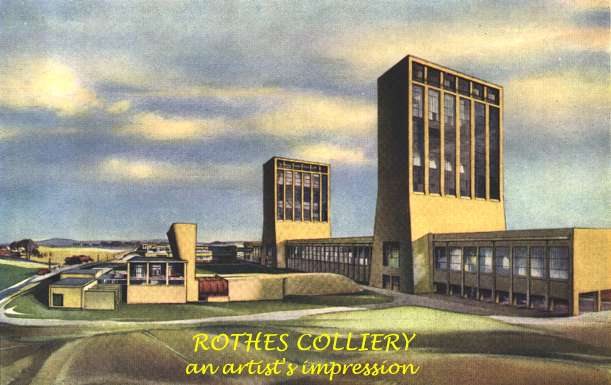
Sinking of this new colliery started in 1947 but the colliery was shut down by 1962. It never produced anything like the coal estimates for the colliery where about 1100 men were employed with the man-power expected to rise towards 2500 when in full production. Like Kinneil Colliery, at Bo'ness, a new form of winding gear, known as Koepe winders, was to be installed. The winding gear was to be situated directly above the shafts and totally enclosed in modern, architect-designed concrete towers, to give a completely different appearance from the orthodox pit-heads of the older collieries.
The Rothes Colliery was to be the show-piece of the great Fife coalfield but, unfortunately, it turned out to be probably the biggest disappointment/disaster in Fife's proud mining record, brought about by bad planning of the mining engineers of the time, who totally disregarded the comments from the experienced, local miners who knew the terrain very well indeed.
By May, 1947, shaft sinking began along with the troubles. Soon they came to the water-bearing strata and by using cement injection, they hoped to overcome the problem. However, the water came in to the workings in unprecedented volumes, sometimes well in excess of the rate of 1000 gallons per minute! The whole sinking programme was badly delayed and this did not look well for the new colliery.
Also around this time, work was started on the building of
the new town of Glenrothes - ready for the in-rush of miners
and their families to the show-piece town close by the
show-piece colliery!
We are grateful to site-visitor Andy Hunter,
Kirkcaldy, who kindly reminded us of the excellent film
promoting the new-town of Glenrothes, with glimpses of
operations at the new Rothes Colliery, which can be viewed
on the Glenrothes Spoon website.
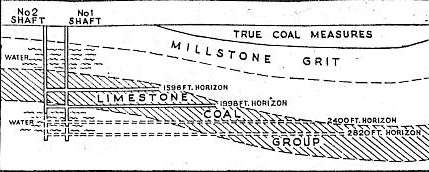
A sectional view of Rothes Colliery
The Coal Board planned to take coal at the four levels shown but did not sink the two shafts to the intended depth. The broken lines indicate work that was never carried out at the colliery. You can also see the two water beds that the shafts had to go through to get to the intended depths.
-----------------------------------------
"The Scotsman"
23 December, 1946
NEW COLLIERY IN FIFE
A Significant Development
in Scotland's Economy
A brief ceremony in the open fields west of Thornton Village in East Fife on Saturday in the
presence of the Secretary of State for Scotland, Mr Joseph Westwood, M.P., and distinguished
figures in the Scottish coal-mining industry, marked the inauguration of work on the last pit to be
started in this country by private enterprise before the National Coal Board takes over on January 1.
The occasion was the cutting of the first sod on the site where a shaft will be sunk for the new Rothes
Colliery which will be one of the most modern mines in Britain and, with an estimated production of
about 5000 tons per day, will ultimately employ some 2000 men.
Planning for the colliery was begun by the Fife Coal Company, Ltd., as far back as 1930, and technical
experts travelled to America and various parts of Europe to study modern mining developments and
equipment in connection with the undertaking. The new pit is part of a general scheme in which the
well-known Comrie Colliery was the first venture by the Company. Estimated to contain 165 million tons in
eleven seams, the leasehold for the new colliery extends to 8½ miles. The actual work of sinking
the shaft will be begun in the near future under the National Coal Board who have approved the
existing plans.
UP-TO-DATE PLANNING
Using a silver spade with which his mother, Mrs Charles Carlow, cut the first sod of the Mary Pit in
1902, Mr C. Augustus Carlow, chairman of the Fife Coal Company, performed the ceremony. In bitterly
cold weather the proceedings were informal and, after Mr Carlow had wished all success to the venture,
prayer was led by the Rev. J. M. Wallace of Thornton.
At a luncheon which followed in the Station Hotel, Kirkcaldy, Mr Carlow, who presided, referred to the
approaching nationalisation of the industry.
"The plans for Rothes Colliery will be handed over by private enterprise to the National Coal Board
and in ten days time, I, personally, shall be out of the mining industry," he stated. "I hope, however,
that I shall be allowed to come to Rothes from time to time to see what is being done. It will be a great
pleasure to me to see this colliery grow as we in our capacity of private enterprise hoped it would."
Mr Carlow said that had it not been for the intervention of the war, he thought the Rothes Pit would have
been well sunk and drawing a good deal of coal before this time. Experience gained from Comrie Pit had
been brought to bear on the new development, and they had gone to great efforts to ensure that the
planning was as up-to-date as possible.
"There is a wide significance attached to this major new development in the East Fife coalfield," declared
Mr Westwood when he proposed a toast of success to the new pit.
"The East of Fife contains great reserves of coal, the full exploitation of which in the national interest is
vital to Scotland's economy, and it is singularly fitting that the initial step towards the development of
these great reserves should be initiated by the Fife Coal Company within a few days of the passing of the
mining industry into the hands of the people of this country. If the industry as a whole had displayed the
sense of public enterprise so splendidly manifested by the Company in their latest developments, then the
whole industry would be in a healthier state than it is today."
Mr Westwood pointed out that the new development was fitted into a co-ordinated plan not only for the coal
industry, but for the physical development of the whole of Fife which would have repercussions throughout
Scotland. He spoke of consultations which he had had with the Minister for Fuel and Power and the National
Coal Board to consider the effect the new sinking would have on the planning of the area. Clearly such a
development must be properly planned from the start, he said. Miners too often in the past have been cut
off from their fellows, and the miners at Rothes must have good homes, good social and recreational facilities,
and all the amenities that the modern industrial worker and his family required.
A GREAT SOCIAL ADVENTURE
He discussed the proposed town in the Leslie-Markinch district which would be only two miles to the north
of the new pit, and said that its prime purpose would be to provide a community directly associated with Rothes
Colliery. It was his intention to push ahead with the procedure for declaring the area to be the site of the new
town as soon as possible, and he mentioned that he would shortly have further meetings with the Local
Authorities to go into the details.
Now that a start had been made with the sinking of the new pit, he added, there must be no delay. The
provision of good houses would be one of the best inducements for recruits to the mining industry.
"The present ceremony in one sense marks the end of one epoch and the beginning of another," he
said. "We are about to embark on a great social adventure - an adventure in which the technical experts,
the industrial experts, and the people of Scotland are all participating, and in which the real aim is how to use
Scotland's rich resources to the best public advantage. We are planning to give the maximum prosperity
and happiness to the people, and this involves concerted action by everyone concerned. However carefully
guided our plans, they are not going to be effective unless co-operation on all sides is assured."
Other speakers included Mr Abe Moffat, president of the Scottish Area of the National Union of Mineworkers;
Lt.-Col. N. E. Baxter, Fife County Convener; and the Earl of Elgin.
-----------------------------------------
"Dunfermline Press"
28 December, 1946
NEW COLLIERY.
Sod Cutting Ceremony at Thornton.
A brief ceremony in the open fields west of Thornton village in East Fife on Saturday, in the presence
of the Secretary of State for Scotland, Mr Joseph Westwood, M.P., and distinguished figures in the Scottish
coal mining industry, marked the inauguration of work on the last pit to be started in this county by private
enterprise before the National Coal Board takes over on 1st January. The occasion was the cutting of
the first sod on the site where a shaft will be sunk for the new Rothes Colliery, which will be one of the
most modern mines in Britain, and, with an estimated production of about 5000 tons per day, will ultimately
employ some 2000 men.
Planning for the colliery was begun by the Fife Coal Company, Limited, as far back as 1930, and technical
experts travelled to America and various parts of Europe to study modern mining developments and
equipment in connection with the undertaking. The new pit is part of a general scheme in which the
well-known Comrie Colliery was the first venture by the Company.
Estimated to contain 165 million tons in eleven seams, the leasehold for the new colliery extends to 8½
miles. The actual work of sinking the shaft will be begun in the near future under the National Coal Board,
who have approved the existing plans. ...
-----------------------------------------
"Dunfermline Press"
21 June, 1947
NEW FIFE COLLIERY
DETAILS OF ROTHES PROJECT
Rothes Colliery, for which sinking operations
started early this year, will cost £2,060,000 before
completion. Production, however, will not start until 1954, by
which time an output of 1000 tons per day is expected.
These were among the details of the new colliery
contained in a paper by Mr William Reid, B.Sc., Ph.D., and Mr Henry
R. King, which was presented to the annual conference of the
Institution of Mining Engineers, which opened in Edinburgh on
Wednesday.
The figure of £2,060,000, which the
colliery will cost, was described as probably two to two and a half
times greater than it would have been if the work had been carried
out in 1938. However, although it might appear high in comparison
with normal British standards, in relation to Continental lay-outs
of a similar nature, it was a reasonable estimate.
When production starts in 1954, an output of
1000 tons per day is expected. This will be built up to5000 tons
per day by 1965; and output may be increased still further to 6000
tons. It is estimated that employment will be given to more than
3000 men.
Major improvements have been made possible by
the experience gained in Fife through the operations at Comrie and
with information gathered on recent visits to the
Continent.
"HORIZON MINING"
The system known as "horizon mining",
practical knowledge of which is limited in this country, will be
adopted because of the geographical structure of the field. In this
system, the number of cross-cuts, forming the panels at each
horizon, limits the maximum output possible in any
field.
In the Rothes field there are five cross-cuts.
With regard to the thickness of the seams, the output from on
cross-cut will vary between 1000 and 1500 tons per day.
The surface plan also incorporates a number of
novel features, and space will be made available for the later
addition of a by-product plant, coal-stocking ground, brickworks,
and a large power station. The plant is designed for efficiency,
cleanliness, and the safety and welfare of the workers.
-----------------------------------------
"The Scotsman"
20 May, 1948
MECHANICAL AIDS IN MINING
Dr Reid on New Winding
System for Rothes
HIGH OUTPUT THE AIM
The possibility of adopting a system of drill hole pin-pointing by means of a slide throwing
a picture on to the face in which tunnelling is taking place, was mentioned by Dr William Reid,
Scottish Divisional Coal Board Production Director, at Dunoon yesterday, when addressing young
miners attending the National Union of Mineworkers Scottish Area Summer School.
Dr Reid, who illustrated his lecture by means of lantern slides, showed diagrams of various types of
machines now in use in mining, principally on the Continent, and referred to a coal plough which
German mining engineers were using.
A diagram of a new type of boring apparatus was described by Dr Reid as a rotary tunnelling machine
at one time used to drill the tunnels under Berlin for Hitler's underground headquarters, from which
he disappeared during the last hours of the war. The Berlin tunnels had been in chalk. British engineers
were now studying whether the machine could be put to use in the harder strata encountered in our
coalfields.
Dealing with systems of coal-winding, Dr Reid (referring to pits as distinct from mines) said that one was
by the use of tubs, and the other by skip, which was a sort of box. At Comrie Colliery skip winding was
in operation.
PLANS FOR ROTHES
The winding system they were going to install at Rothes Colliery was the Kopje winder, a system
which had advantages over ordinary drum winding. There was only one rope, for instance, with the
Kopje winder, and it was a simple matter to put on a longer rope to wind from a lower level if necessary.
Horizon mining, such as they would have at Rothes, consisted of various levels underground. At
Rothes they would work 200, 300, 400, and 500 fathoms.
Dr Reid said that there would be two winders in one shaft at Rothes, but that was not quite new, since
there had been cases in the past. The Rothes shafts would be 24 ft. in diameter, with four cages to each
winder. Each cage would have four decks, and each car would carry three tons, so that there would be a
12 tons load per cage wind. The Comrie skip had a load capacity of 10½ tons.
Rothes was designed for 5000 to 6000 tons per day of two shifts, and he believed they would be able to
handle that tonnage with only two or three men at the surface doing tasks which at present required 20 to
30 men. The winders would be set on towers directly above the shaft 180 ft. from the ground level.
"I was a member of the team which designed Comrie under the leadership of my father, but Rothes is
my turn, and for that reason the design has to be much better," said Dr Reid.
PRODUCTION PROGRAMME
Referring to output, Dr Reid said that Scotland would not be doing its share until it was producing over
30,000,000 tons a year. To do that they had a short-term programme and a long-term programme, the short-term
programme including the starting of 30 new surface mines, and the reconstruction of existing collieries. It was
possible to increase output per manshift to 27 cwts by a reallocation of man-power, and to do that within a
period of three years. They were trying to get a greater proportion of the man-power on coal producing. That
was one of the reasons why America had a very high output per person.
New surface layouts were planned for the Frances and Valleyfield Collieries, and when these were completed,
two or three men would be able to deal with an output which at present required something like 20 or more
surface workers.
Dr Reid said that one of the possibilities in mind for Rothes Colliery was the breaking down of all large coal to
sizes not exceeding 8 ins. and the entire output picked and washed.
-----------------------------------------
"Dunfermline Press"
7 May, 1949
FLOODING AT NEW PIT
Sinking operations at the new Rothes Colliery, Thornton, were suspended for a week because
of flooding. The flooding was caused by a breakdown of the pump, and by late Wednesday night,
when a 700-gallon-per-minute pump was brought into operation, the water was only 46 feet from
the top of the 340-foot shaft.
Since then water has been pumped out continuously, and on Thursday the level had dropped
200 feet.
-----------------------------------------
"Dunfermline Press"
10 September, 1949
COAL BOARD OFFICIAL HONOURED
A presentation dinner to Mr W. S. Landale, agent for the Cowdenbeath group of collieries of the
National Coal Board, who has been promoted to the position of Chief Planning Engineer, Rothes
Colliery, took place in the Woodside Hotel, Aberdour.
Mr A. Tripney, manager, Wellwood Colliery, presided over the company. ...
-----------------------------------------
"Dunfermline Press"
11 February, 1950
FIFE COAL DEVELOPMENTS
Mr George Mullin, general manager of the Fife and Clackmannan Area of the National Coal Board, released information on some of the planned developments for Fife collieries at a Press conference held in the Central Workshops, Cowdenbeath, on Tuesday. ... The other new sinking in the area, at Rothes, was proceeding, but they had experienced water trouble in the sinking operations of two shafts. He estimated that the colliery would not be coal producing until 1956 or 1957, and when in full production, would produce 5000 to 6000 tons per day. ...
-----------------------------------------
"Dunfermline Press"
9 September, 1950
At Rothes Colliery
"The transfer of miners from Lanarkshire to Fife is one of the most important
developments Scotland has ever experienced," said Mr Robens, when, later in the
day, he visited Rothes Colliery, now under construction near Thornton. Mr Robens
added that he was highly pleased at the way this vast reorganisation was being carried out.
Referring to the progress of the new pit, he said that he was convinced that the men in charge
were doing a first-class job.
Work on the Rothes Colliery was started in 1948, and an official stated that sinking will not
be completed until 1954, by which time they will have reached a depth of 3000 feet. Sinking
at the moment has progressed to a depth of 600 feet.
-----------------------------------------
"Dunfermline Press"
30 December, 1950
DEATH OF ROTHES COLLIERY MANAGER
Former Official of Fife Coal Company
The death has occurred in a Glasgow hospital of Mr S. P. Bruce Henderson, B.Sc., M.I.M.E., manager of Rothes Colliery, Fife. ... Mr Henderson, who was 45 years of age, is survived by his wife and three young children.
-----------------------------------------
"Dunfermline Press"
5 May, 1951
N.C.B. APPOINTMENTS IN FIFE AREA
The Scottish Division of the National Coal Board announce the following
appointments in the Fife Area:-
Mr A. W. Hinshelwood, formerly Civil Engineering Asst., Fife Area, to be manager,
Rothes Colliery. ...
-----------------------------------------
"Dunfermline Press"
4 August, 1951
N.C.B. DIVIDE FIFE INTO TWO AREAS
Effect of Reconstruction and Development Plans
As a result of the large-scale reconstruction and development work
which is being undertaken in the mining industry in Fife, and with a view to
greater administrative efficiency, the Scottish Division of the National Coal
Board announce that the Fife area will be sub-divided into West and East
Fife, each with an area general manager in charge.
Mr George Mullin, with headquarters at Cowdenbeath, will retain control in
West Fife, and Mr F. M. T. Bunney, area production manager in No. 4 area,
East Midlands Division, is to take charge of the new East Fife area, with
headquarters initially at East Wemyss.
The new areas will be in effective operation from 1st January.
Rothes to be transferred to East Fife Area
One colliery which will be transferred to the control of the new East Fife area, and which has been associated with West Fife since the infancy of the project, is the new pit which is being sunk at Rothes. This new sinking was conceived and planned by officials of the Fife Coal Company, under whose auspices the cutting of the first sod on the site of the new colliery was carried out. The development of what in future years will be regarded as Scotland's "show-piece" among collieries will be undertaken by the East Fife area, which will embrace 11 collieries and surface drift mines in the Dysart, Michael, and Wellesley groups, with an average weekly output of about 40,000 tons. ...
-----------------------------------------
"Dunfermline Press"
29 December, 1951
MINING DEVELOPMENTS IN WEST FIFE
... Good progress is being made with the development of Rothes Colliery, where
certain features will be introduced for the first time in Scotland.
One considerable problem was of sinking through heavily water-bearing strata. This
was solved during the year, and the shafts are now approaching the level of the first horizon.
Plans have been completed and the contract placed for the erection of the winding engine
towers and mine car circuit hall. These will be the first tower mounted winders to be erected
in the Scottish coalfield, and the structures will be of reinforced concrete. The first coal
seam has been cut. The tunnels to be driven on the first horizon will be used solely for
returning air from the workings on the next horizon to the upcast shaft. ...
-----------------------------------------
The Queen's Visit to Rothes Colliery - 1958
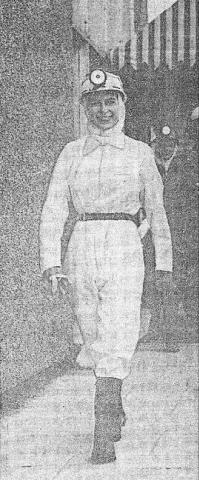
One of the highlights in the colliery's brief history was the visit on June 30, 1958, by Queen Elizabeth II when she donned a suit of white overalls, miner's helmet and gumboots to go underground. It was the first time that the Queen had visited the workings of a colliery.
 |
-----------------------------------------
"Dunfermline Press"
17 January, 1959
... In the East Fife Area, the build-up of output from Rothes has been slower than had been hoped for - 700 tons daily at present. ...
-----------------------------------------
"The Scotsman"
26 August,
1959
"100 years of work at Rothes Colliery," says Lord Forbes.
"Rothes Colliery in Fife will
be able to contribute to the country's power resources
for at least 100 years", stated Lord
Forbes, Minister of State for Scotland, at Kirkcaldy
yesterday. It would provide work for miners from Central
Scotland, where pits were nearing exhaustion.
Lord Forbes was speaking at a Press interview on his visit to
Fife during which he called at the colliery, the new town of
Glenrothes, a linoleum centre in Kirkcaldy, and met Kirkcaldy
Town Council.
He said he was very impressed with the colliery. "Rothes, of course, is fully mechanised. It was the first of the new major sinkings in Fife to reach the initial production stage, and it has now a daily output of one thousand tons. What is encouraging is that Rothes Colliery, like the other modern, expanding collieries in Fife, will provide work for miners from the declining central areas of Scotland where there are pits nearing exhaustion."
He went on, "It is impossible to forecast the future of our power resources, but at least one can say that Rothes will be able to make its contribution in meeting any requirements now for at least 100 years."
Lord Forbes also stated, "I would say the intensive mining operations which are going on in these modern mines such as Valleyfield, Seafield, Bowhill and Rothes, along with the major developments at Michael and Wellesley Collieries, are necessary for the continued existence of Fife as a mining community."
Lord Forbes described Glenrothes as "a very inspiring example of modern civic development." He said, "The population so far is about 10,000 but the town is planned to have a population of 30,000. Glenrothes primarily had to provide homes for miners, many probably from the West. It had been very wisely decided that it should not be entirely a mining community. We want to get away from the old system of having mining towns. We want today a balanced community also with a balance of ages. In this connection, an overspill arrangement has been made by Glenrothes with Glasgow and it is obviously going to be a help to ensure that there is a variety of employment."
----------------------------------------------------
"Dunfermline Press"
14 November, 1959
... Although only two Fife pits are marked down for closure in the latest list, other collieries in the county will be affected by the Coal Board's plans for the next year. Developments at Valleyfield and Rothes will be curtailed. Pits likely to be single-shifted include Bowhill and Glencraig. Pits whose sections now producing are likely to stop include Dundonald and Lumphinnans. In two East Fife pits - Michael and Wellesley - manpower will be cut. ...
----------------------------------------------------
"Risk too great!" says Mr Parker
Mr R. W. Parker, Chairman of Scottish Division of the N.C.B., said yesterday that any future working at Rothes could only be assessed as a high mining risk. A dreadful series of setbacks and disappointments had bedevilled their efforts in the upper workings. Shaft sinking, for example, was delayed for more than a year because of flooding, and eventually abandoned well above the planned depth. Mining ran into faults on an unprecedented scale.
But the closure of Rothes Colliery would help to make it possible for Scottish pits to operate at a profit.
If the miners could raise the average output per man-shift from the present 25.5 cwt. to around 27 cwt. then the Scottish Division would not make an operating loss. The cost of interest charges - normally between £5 and £6 million a year - would be met nationally from the more profitable divisions in England. "In nine months time, we will decide whether to put the colliery on a care and maintenance basis," said Mr Parker. "That means keeping it in a position so that we could go back and exploit the lower horizons if circumstances changed. Fundamentally, it would depend on the marketing position for coal and the economics."
Rothes Colliery cost at least £12 million, and was
planned to be a mining show-piece that would last for 100
years.
The sinking of the colliery had started in 1947 but the
first coal was not produced until January, 1957. The
operating losses of the colliery to date total £3, 600,
000. There had been hopes that Rothes Colliery would
eventually employ 2500 men but its peak labour force,
employed in 1960, was only 1000. At present, 800 miners are
employed and of these some 300 will find jobs on salvage work
either at Rothes or elsewhere. Of the remainder, some 350 -
400 will be given jobs at other pits in the area, but for 150
miners there will be no work in Scotland. They will be
offered jobs in the Midlands or East Yorkshire, England.
----------------------------------------------------
"Dunfermline Press"
11 November, 1961
Concern Over Pit Closures
Bowhill And Rothes May Yet Be Affected
Although no Fife pits were included in the closures announced on March by the Scottish
Division of the National Coal Board, there was disturbing news for the county. The fate of Rothes
Colliery, one of the N.C.B.'s most modern undertakings, is "in the balance," and
Bowhill Colliery, where £3,300,000 has been spent on complete reorganisation, is said to
have a "doubtful future."
There is to be a cut in the labour force at Kinglassie where a pit and a surface mine work as one unit. ...
BOWHILL AND KINGLASSIE
With regard to Bowhill Colliery, where a big redevelopment was carried out after nationalisation,
the Board state that they are "endeavouring to build up its output and reach a position where it
will be worth while continuing. Mr Parker [Chairman of the Scottish Division of the N.C.B.] stated that
he could not say what would be the outcome.
At Kinglassie, where coal was got from a surface mine and a pit working as one unit, the over-all position
was to be improved by closing the surface mine. This abandonment of the upper seams would cut the
working force from 600 to 400.
Rothes Colliery, which cost about £8,200,000, is to be the subject of "detailed appraisal."
Within four or five months the present horizon of coal will be worked out and the Board will have decided
by then whether to try to work another horizon. At its peak, Rothes employed 1100 men. Four hundred
of the present 900 will be moved to other pits soon, and the remainder will await the final decision.
Dealing with the situation at Rothes Colliery, Mr Parker said there were strict limits to the information
which boring could yield as to the workability of seams. From 1950 to 1956 almost continuous difficulty
was experienced with water in the shafts. The water problem had limited coal working to the top horizon,
about 1600 feet below the surface. Owing to geological difficulties, 14 of the 16 coal faces opened
on this horizon since 1957 had had to be abandoned though they should have yielded 2500 tons daily.
The operating loss of 1961, including development, was estimated at over £1,000,000. ...
-----------------------------------------
"The Courier and Advertiser"
Monday March 15, 1993
Final farewell to the Rothes towers
The twin winder towers of the former Rothes Colliery on the outskirts of Thornton were demolished yesterday after over 30 years' existence.
Standing 230 feet tall, the towers were the giant reminders of a pit that never stood the test of time despite its £12 million development costs. It fell victim to a twin-pronged attack from flooding and faults, with the axe finally falling in March, 1962.
The 1500 feet deep flooded shafts have been useful, serving as a testing ground for submersible equipment for the armed forces.
Powerful explosives tore the massive concrete towers apart at half hour intervals yesterday.
The thousands of tons of rubble will be dumped down the shafts which will then be capped - and the pit which was to be the jewel in the crown of the Fife coalfield will simply cease to be.
The demolition was marked with a tinge of sadness for a former steel fixer who helped create the massive towers as a young man in the late 1940s.
Only recently retired and living in Pitlochry, Mr John McGuinness recalled the strength of the structures he helped to build as a foreman employee of an Edinburgh engineering firm.
"We always said it would take God Almighty to bring them down. When I read they were going to blow them up, I thought they would have some job. I know every bit of steel in them."
In his 40 years in the trade, Mr McGuinness said he had seldom seen such hefty steelwork - the towers' main bearing beams had been built using around eight layers of 1.5 inch steel.
"The whole design was really quite awesome because we were pulling the coal up from such a great depth."
Admitting he had made two return trips to Rothes towers over the years "for a touch of nostalgia", Mr McGuinness said he would be sorry to see them go.
"I certainly don't envy the demolition men's job," he added.
However, the demolitions were perfectly executed, apart from some windows in the nearby Fife Fire and Rescue Service headquarters being broken. The building had been temporarily evacuated while a stand-by facility in Kirkcaldy fire station dealt with emergency calls.
Hundreds of people, equipped with cameras and videos, turned out to watch.
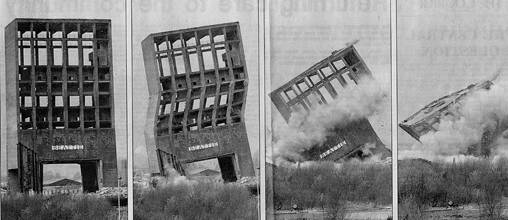
The progressive collapse of the second winding tower.
-----------------------------------------