Owners: Newbigging Coal and Lime Company, Ceres
| See Callange Coal Pits entry for information on early coalworks and minerals in the parish of Ceres. |
|---|
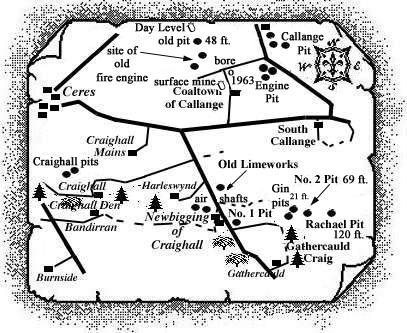
This pit to the south-east of Newbigging of Craighall
probably worked coals and limestone from the mid nineteenth
century until the early 1900s.
Craighall lime kiln, about ¼ mile north of the pit,
built in 1814, was 28 ft. high and 53 ft. wide and was
probably fired in its early years using coals mined from coal
outcrops which occurred near Craighall Mains and east of
Newbigging.
At its heart was a furnace about 12 ft. in diameter and
stretching the full height of the structure. The fire was lit
at the bottom and the charge built up at the open top with
alternate layers of limestone and coal in a ratio of 5 parts
limestone: 1 part coal. The draught was regulated by means of
wooden doors across the bottom recesses. The burnt lime was
drawn out of the flues at the end of the recesses with
long-handled shovels and loaded on to the waiting farm carts.
The old pits of North Callange lay a few miles to the north
of the Newbigging shaft in an area where coals had been
worked for several centuries.
 |
| Pits operating: ca 1750 | Pits closed: 1903 ? |
|---|---|
| Source Date of Information Supplied | |
| Manager / Under-Manager / Men underground / Men above ground / Coal seams worked | |
| 1896 | |
| John Gillon / ------------ / 13 / 10 / Household, manufacturing and steam coals. | |
| 1902 | |
| Robert Kidd / ------------ / 13 / 3 / Household, manufacturing and steam coals. | |
-------------------------------------------------------
Information on coals worked at, or near, Newbigging of Craighall No. 1 Pit
(based on a report from 1900)
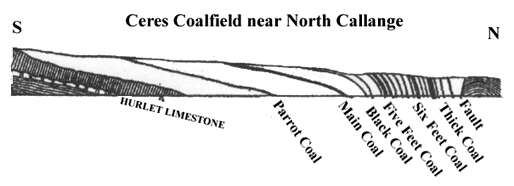
The Ceres coalfield, lying to the east of the village of Ceres, was remarkable in that the coal seams dipped towards N. and N.N.W. at 80° and were so near vertical that they were all packed into a horizontal distance of probably not more than 500 yards! Some of these steep coal seams worked included the Thick Coal, Six Feet Coal, Five Feet Coal and Black Coal.
| See Old Coalfields of East Fife via the Coalfields link for Ceres Coals |
|---|
Besides the steeply inclined seams, two additional coals rose from under them and cropped out a few miles to the south near Craighall Mains. The lower of these coals was a parrot coal measuring 1 ft. 6 in. thick, and the upper, forming the Main seam of this part of the field, had a thickness of 3 ft. 6 in. These two coal seams lay not far above the Hurlet Limestone but they were separated from it here by a whinstone sill. To the east, where this whinstone sill died out, the two coal seams once again approached the limestone and turned round with it in a southward direction, the outcrops of both seams passing just east of Newbigging of Craighall. These coal seams also ran southwards into the small Teasses coalfield.
| Plans of Abandoned Seams for Newbigging of Craighall | Pits or Mines designated in Plans |
|---|---|
| COAL; Gin | Newbigging of Craighall |
| COAL; Gin (1903) | Newbigging No. 2, Rachael |
-------------------------------------------------------
"The Scotsman"
4 February, 1865
COALFIELD IN FIFE
TO BE LET, for such a number of years as may be agreed on, the CERES
EDGE COALS, within the Lands of Newbigging of Ceres, believed to contain Sixteen
Seams, varying from two to sixteen feet, as set forth in an Old Report dated 1806.
Books exist from 1749 to 1761, showing an average profit of £650 a-year, during
twelve years, on a limited output.
For further details apply to D. LANDALE, Esq., M. E. 6 Forth Street, Edinburgh; or
to JOHN FLOCKHART, Esq., Rosebank, Largo, with either of whom offers may be
lodged, stating fixed Rent or optional Lordships.
Edinburgh, 11th January 1865.
-------------------------------------------------------
