Owner: Mr. James Calderwood Durham, Esq., of Largo
The exact locations, opening dates, and numbers of small
pits working North Falfield coal, in the district of
Kilconquhar, are not clear but the above mentioned coal was
probably worked from the 16th into the 19th century.
An extract from the Statistical Account of Scotland for
Kilconquhar parish of that period gives a fairly detailed
account of the small coal-field and some of the operations
involved:
"North Falfield coal, the property of the above
designed Mr Durham, worked by a steam engine, erected in
1784, which drains two distinct coal fields, each consisting
of 2 strata, one of a mixed nature, about 5 feet thick, the
other fine parrot, in great request for the clear light it
affords, and other properties: of these strata the one is 9
feet thick for 60 yards, then gradually diminishing for about
60 yards, till it comes to 5 feet thick, where splint becomes
perceptible, united to the parrot on the pavement, the splint
increasing in an uniform progressive manner, and the parrot
diminishing in the same proportion, till its thickness
becomes 4 feet, where the coal is cut off by a hitch of
considerable thickness, and leaves the parish.
The other stratum is excellent parrot, in some places 9 feet
thick, but not uniform: the coal is always best where it is
thickest.
This colliery employs seldom less than 40, sometimes more
than 50 men, with one as grieve and accountant, and another
as engineer and oversman. Consumption of one year, at an
average for 7 years past, is as follows:
Coals at 18 stone the load of the various kinds,
Loads,
47,572
Yearly
returns, £1553
17s. 11½d.
The pits by which the greater part of the coal is put out,
are 54 or 56 yards deep. This must have been a colliery for a
considerable time, as an account is to be seen in Largo house
of so many loads of parrot coal, driven yearly from Falfield
to Falkland, a distance not less than 10 miles, for the use
of King James VI, his own chamber. The colliers of this
parish are tolerably regular and industrious."
 |
 |
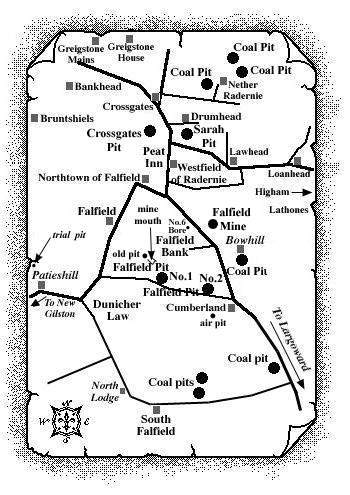
The coalfield around Falfield
This tract of ground was surrounded by large masses of intrusive igneous rock, and was so broken with faults that its detailed structure was not known at the end of the nineteenth century. It was bounded on the south by Dunikier Law and on the south-east it merged into the Largoward coalfield. Its eastern limit was formed by the dolerite of Lathones. Its northern margin was defined by the large fault that separated it from the Radernie coalfield, while on the west it ran up to the edge of the dolerite sheets of Bruntshiels and Bankhead (see above map).
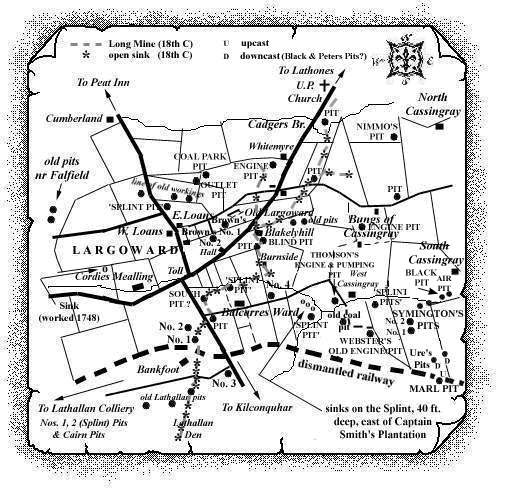
Can do with help on these old pits.
