Owners: Wemyss Coal Company Ltd.
NCB
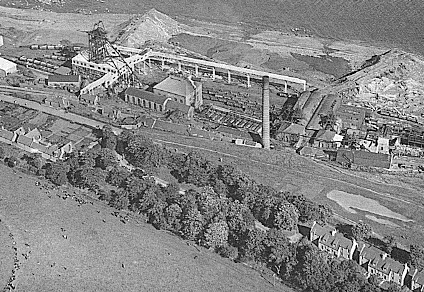
The Michael Colliery was situated on the northern shore of the Firth of Forth, in the village of East Wemyss, midway between Kirkcaldy and Leven. The colliery was eventually to have three shafts in its lifetime.
Shaft details:
No. 1 (20 x 16 ft.) and No. 2 (13 x 10 ft. 6 in.) were
sunk 136 fathoms to the Chemiss Coal in 1898; No. 3 (circular
shaft; 24 ft. 2 in. dia.) was sunk 300 fathoms to the Dysart
Main Coal in 1928; No. 2 was deepened to the Bowhouse seam at
462 fathoms and No. 3 was eventually linked to the same seam
to improve ventilation of lower seams.
 |
 |
 |
 |
|
Displayed Courtesy of Methil Heritage Centre |
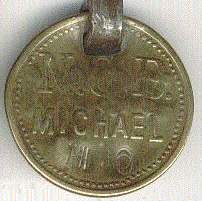
A 'check' from the Michael Colliery
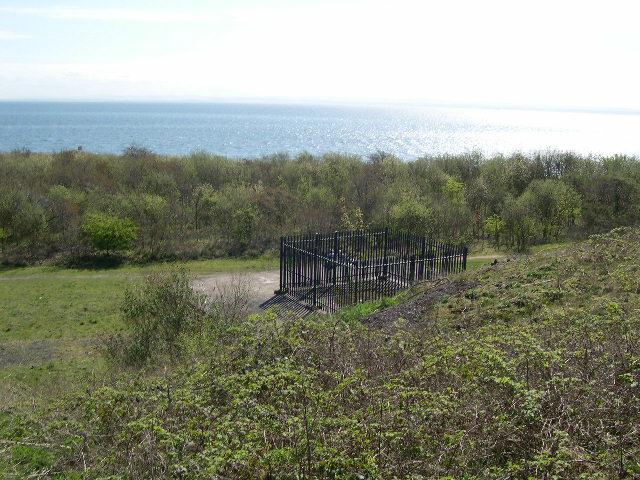
Peter Hall, formerly of Cupar, a great supporter of the website, walked regularly to the sites of former Fife coal mines and kindly supplied us with photographs of what the locations look like now, along with anything else of interest.
M. Martin & Webmasters.
 |
 |
 |
 |
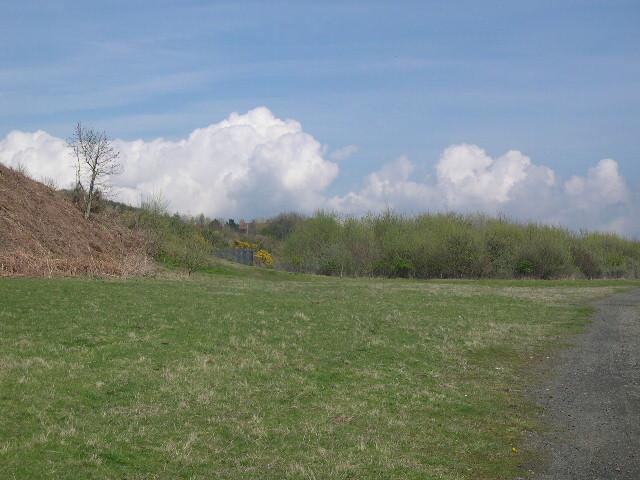
| Michael
Colliery site - looking south to the Forth |
Michael
Colliery site - looking eastwards |
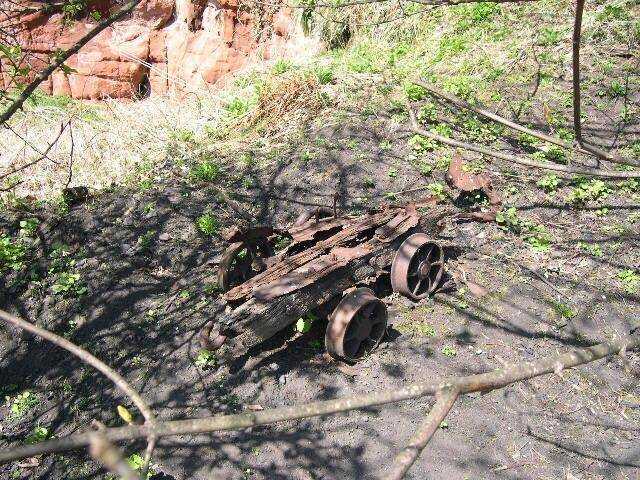
A rusting
bogie which had disappeared on a later visit - hopefully to a good home! |
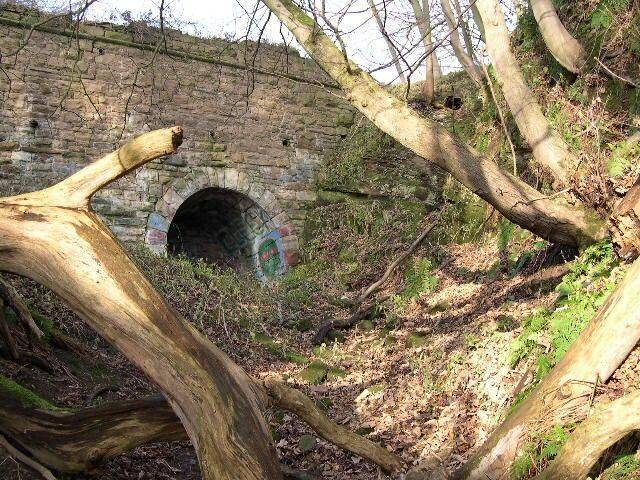
Possible mine entrance west of Michael Colliery at East Wemyss has been blocked up about 10 feet in. |
-----------------------------------------------
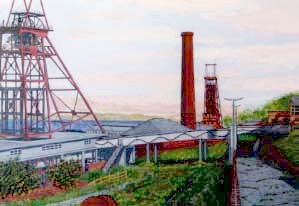
We are always grateful when website visitors pass on contributions to enhance our content and we wish to thank Gordon Sutherland, Methil, Fife, for giving permission to display his unique colourful projects based on photographs of bygone collieries.
Colin Martin & Chris Sparling, Webmasters.

PLEASE NOTE THAT THE ABOVE IMAGE IS © GORDON SUTHERLAND
-----------------------------------------------
| Pit opened: sinking 1894-97 (re-sunk 1928) | Pit closed: 1967 |
|---|
| Source Date of Information Supplied |
|---|
| Manager / Under-Manager / Men underground / Men above ground / Coal seams worked |
| 1904 (Wemyss Coal Company) |
| R. Howieson / ------------ / 476 / 102 |
| Household, manufacturing and steam coals and fireclay. |
| 1905 |
| R. Howieson / ------------ / 742 / 125 |
| Household, manufacturing and steam coals and fireclay. |
| 1908 |
| R. Howieson / ------------ / 796 / 126 |
| Household, manufacturing and steam coals and fireclay. |
| 1909 |
| 27 Jan: Mr David Linton, for many years colliery undermanager, fatally injured in the pit. |
| 1910 |
| April: Mr R. Howieson appointed Agent (Western
Division): Michael, Victoria, Lochhead and Earlseat. Mr Archibald Sharp appointed manager. |
| 1911 |
| Archibald Sharp / ------------ / 814 / 143 |
| 1918 |
| Archibald Sharp / Henry Dalrymple (No. 1 Pit) : James O. Wyles (No. 2 Pit) / 710 / 175 |
| Household and steam coals. Chemiss, Barncraig, Bowhouse and Pilkembare. |
| 1920 |
| Archibald Sharp / ------------ / 810 / 233 |
| 1928 |
| January: Archibald Sharp, manager, moves as manager to the Rosie Colliery. |
| James Keir / J. T. H. Sinclair (No. 1 Pit) : Andrew Jones (No. 2 Pit) / 839 / 272 |
| Household and steam coals. Chemiss, Barncraig, Bowhouse and Pilkembare. |
| 1938 |
| William Galloway / Stewart Bauld / 2183 / 433 |
| 1945 |
| William Galloway / George Wilson / 1554 / 413 |
| Household and steam coals and blaes. Branxton, Chemiss, Barncraig and Bowhouse. |
| 1947 (NCB) |
| J. T. H. Sinclair / ------------ / 1761 / 413 |
| Gas, household,
industrial and steam coals and blaes. Branxton, Chemiss,
Barncraig and Bowhouse.
Approx. annual output = 622,000 tons |
| 1948 (NCB) |
| J. T. H. Sinclair / A. McGuigan / 1761 / 435 |
| Household, steam and blaes. Barncraig, Chemiss, Bowhouse, Branxton and Dysart Main. |
| 1949 (NCB) |
| W. Moody / A. McGuigan / 1761 / 413 |
| Household and steam. Barncraig, Chemiss, Barncraig, Bowhouse and Dysart Main. |
| 1950 (NCB) |
| J. Eadie / A. McGuigan : A. M. Harrow / 1927 / 442 |
| Household and steam coals. Branxton, Chemiss, Barncraig, Bowhouse, Four Feet and Dysart Main. |
| 1951 (NCB) |
| J. Eadie / A. McGuigan : J. S. Baxter / 2059 / 469 |
| Household and steam coals. Branxton, Chemiss, Barncraig, Bowhouse, Four Feet and Dysart Main. |
| 1952 (NCB) |
| William Livingstone / Mr Hardy / ---- / --- |
| Household and steam coals. Branxton, Chemiss, Barncraig, Bowhouse, Four Feet and Dysart Main. |
| 1958 (NCB) |
| Vacant / W. G. Irwin : A. Flockhart : R. Maxwell / 2841 / 512 |
| Gas, household,
industrial and steam coals.
Coxtool, Boreland, Lower Dysart, Branxton, Chemiss, Barncraig, Bowhouse, Four Feet and Dysart Main. |
| 1959 (NCB) |
| W. Darling : A. Nicols (Depute) / W. G. Irwin : A. Flockhart : J. C. Tilston / 2678 / 444 |
| Gas, household,
industrial and steam coals.
Coxtool, Boreland, Lower Dysart, Branxton, Chemiss, Barncraig, Bowhouse, Four Feet and Dysart Main. |
| 1961 (NCB) |
| A. Cairns : A. Nicols (Depute) / D. Wilson : J. Souter : J. H. Archibald / 2194 / 353 |
| Gas, household, industrial and steam coals. Lower Dysart, Branxton, Chemiss, Bowhouse and Dysart Main. |
| 1964 (NCB) |
| A. Cairns : A. Nicol (Depute) : J. Simpson (Asst.)/ D. Wilson : J. Souter : J. H. Archibald / 1941 / 265 |
| Household, industrial and steam coals. Lower Dysart, Branxton, Chemiss, Bowhouse, Dysart Main and Four Feet. |
| 1967 (NCB) |
| G. Duncan / A. Nicol / 1874 / 316 |
| The average weekly output
of 16,750 tons was produced from fully mechanised shearer
loader faces as follows:
Chemiss seam No. 10 District 4,055 tons Four Feet seam No. 31 District 1,275 tons Bowhouse seam No. 40 District 2,184 tons Branxton seam No. 22 District 3,701 tons Dysart Main seam No. 1 District 4,285 tons Dysart Main seam No. 3 District 1,250 tons |
| 1971 (Scottish Coal) |
| Michael: Manager Pumping Pits: J. I. Bald |
| 1973 & 1974 (Scottish Coal) |
| Michael: Manager Pumping Pits: J. Moodie |
| This pit had a system of ventilation partly in common with Wellesley, Muiredge, Lochhead and Rosie Collieries. |
The Barncraig seam, in the No. 1 shaft, was an excellent quality coal and was reached at a depth of 89 fathoms in 1897. Who would have imagined that, from this beginning, the pit was destined to become one of the largest employers of miners in Fife. In 1927, conveyors were installed to replace the slower rope haulage systems.
By 1934, the No. 2 shaft was used only for ventilation but it is believed that some redevelopment of this took place the following year. At the time of Nationalisation, the Michael Colliery was the greatest producer of coal in Scotland. The already large workforce would eventually reach 3,296 in the 1960s.
Sadly, in common with most of the Fife pits, the Michael Colliery paid a high price in lives lost for the winning of coal.
---------------------------------------------------------------
The Michael Colliery
- more on its shafts and geology -
The sinking of Nos. 1 and 2 shafts, both rectangular in
cross section and wood lined, was begun in 1892 and reached
the Chemiss seam at a depth of 136 fathoms in 1898. The
No. 3 shaft, 24 ft. 2 in. in diameter, and concrete lined, was
sunk to the present pit bottom at a depth of 300 fathoms in
1928.
Just below 300 fathoms was a band of Millstone Grit and
there were plans to sink No. 3 below the Millstone Grit to
access another 8 coal seams, but this was never done.
The No. 2 shaft was later enlarged to 20 feet in diameter,
concrete lined and extended down to 430 fathoms. In 1944, No.
1 Pit was completely filled in and the two remaining shafts
were used for winding coal, No. 3 serving as the downcast and
No. 2 as the upcast. Safety lamps were in use throughout the
mine.
And, to complete the details:
- winding from both shafts produced approx. 1,000 tons per day
- headgear was supplied and erected by Nortons (Tividale) Ltd. of Tipton, Staffs
- steel joist type construction 110 ft. high
- 20 ft. diameter winding pulleys each with 36 spokes
- winding engine (steam) by Fraser & Chalmers of Erith
- two cylinders, 38 in. diameter by 72 in. stroke
- fitted with Whitmore Overwind Preventer and steam brake
- bi-cylindro-conical winding drum, 15 ft. to 22 ft. by 11 ft. 6 in. wide
- 150 lbs per sq. in. working pressure
- 940 nominal horse-power
- 5,500 max. horse-power @ 35.7 rpm
- steam consumption 38,500 lbs per hour
- exhausting to a Parsons mixed-pressure turbo-generator set of 2,500KW
-------------------------------------
Information on coals worked at the Michael Colliery, East Wemyss
The working seams are all contained in the productive coal measures of the carboniferous series; the total thickness of strata between the top seam, the Pilkembare, and the bottom seam, the Lower Dysart, is 225 fathoms, within which there are 19 seams. They dip seawards in a south-easterly direction at gradients varying from one-in-three to one-in-two. The coalfield is remarkably fault-free, but there is one major quartz dolerite transgressive sill running roughly north-east where the measures are thrown up about 50 fathoms to the north-west. At the time of the fire five seams were being worked, the Dysart Main and the Four Feet in No. 3 Pit and the Chemiss, Bowhouse and Branxton in No. 2 Pit.
The following information on the Michael No. 3 shaft is sourced from a plan also showing underground workings in the Branxton Coal at the pit:
| Description | Depth (feet) |
| Lyon Coal | 240 |
| Pilkembare Coal | 435 |
| Wall Coal | 484 |
| Barncraig Coal | 532 |
| Upper Coxtool Coal | 589 |
| Lower Coxtool Coal | 607 |
| Den Coal | 657 |
| Chemiss Coal | 784 |
| Bush Coal | 845 |
| Wemyss Parrot | 1006 |
| Four Feet | 1063 |
| Earl David's Parrot Coal | 1147 |
| Bowhouse Coal | 1196 |
| Branxton Coal | 1264 |
| More Coal | 1377 |
| Boreland Coal | 1402 |
| Upper Sandwell Coal | 1445 |
| Lower Sandwell Coal | 1504 |
| Dysart Main Coal | 1701 |
| Lower Dysart Coal | 1783 |
| BOTTOM OF SHAFT | 1820 |
| Lethamwell Coal | 2146 |
A typical section of the Branxton Coal seam wrought at the Colliery is given below ...
| Description | Thickness |
| COAL | 1 ft. 3 in. |
| COAL | 1 ft. 9 in. |
| Stone | 1 in. |
| COAL | 2 ft. 2 in. |
| COAL | 1 ft. 1 in. |
... while the following table represents a section of the Barncraig Coal seam worked at the Michael Colliery:
| Description | Thickness |
| Blaes | - |
| Mussel Band | - |
| COAL (SPLINT) | 3 ft. 1 in. |
| COAL | 2 ft. 7 in. |
| Stone | 1 in. |
| COAL | 8 in. |
| Stone | 1 in. |
| COAL | 1 ft. |
| Fireclay | - |
| Plans of Abandoned Seams for Michael Colliery, Wemyss | Pits or Mines designated in Plans |
|---|---|
| COAL; Upper Coxtool (January, 1909) | Michael Nos. 1, 2 |
| COAL; Bush (January, 1911) | Michael Nos. 1, 2 |
| COAL; Upper and Lower Six Feet or Coxtool; Parrot (October, 1928) | Michael Nos. 1, 2 |
| COAL; Bowhouse (December, 1928) | Michael No. 1, Lochhead (Surface Dipping) |
| COAL; Pilkembare (March, 1930) | Michael Nos. 1, 2, 3 |
--------------------------------------------
"The Scotsman"
24 April, 1897
SUCCESSFUL MINING OPERATIONS AT WEMYSS. - The Wemyss
Coal Company (Limited) have just reached, at a depth of 90 fathoms, in the "Michael"
new pit, the "Barncraig" seam of coal, in excellent condition, over 5 feet thick,
and having also 9 inches of good cannel.
This fitting consists of two shafts which have
been in process of sinking for a year and a half, and which have been fitted with very heavy
machinery for a large output. The pumping engine is a large compound vertical engine, of a
very economical working type, and the winding engines on both pits are of a strong modern
construction, as well as the pithead frames, which are of steel.
The next seam expected at 40 fathoms deeper, is the well-known Chemiss seam of Wemyss,
mostly splint in character, and of a very fine quality, where last worked near East Wemyss
10 feet thick.
The area of coalfield is very extensive. The site of the new colliery is on the shore, about a
mile east of Wemyss Castle, from which to the North British Railway a branch line has been in
operation for a year or so. Notwithstanding the heavy water encountered, the work has
proceeded satisfactorily under the management of the officials of the Company.
--------------------------------------------

"Dunfermline Saturday Press"
14 August, 1897
WEMYSS - MINER KILLED
While engaged at the sinking of the new pit on Wemyss estate, on Wednesday afternoon, Samuel Neish, a labourer, was killed by the fall of a stone. The squad was engaged boring at the face when the accident happened. Death was instantaneous. Neish was a native of Airdrie, and about 28 years of age.
--------------------------------------------
"Dunfermline Press"
30 July, 1898
ACTION AGAINST A FIFE COAL COMPANY.
Proof was led before Sheriff Armour, in Cupar Sheriff Court on Monday, in an action at the instance of Mr James Neish, woodyard labourer, McLeod's Buildings, Airdrie, pursuer, against the Wemyss Coal Company, East Wemyss, defenders, concluding for £500, or £256, 10s., or such other sum as may be due to the pursuer under the Employers' Liability Act, 1880. The condescendence set forth that, on 4th August 1897, Samuel Neish, son of pursuer, was killed by a stone two tons in weight falling on him while he was boring holes with a boring-machine in Michael Pit, Wemyss Collieries, Fife. It was averred that the accident was caused by the defenders negligently omitting to properly support the roof, and otherwise failing to ensure the safety of their workers. The deceased had taken every precaution required of him in the circumstances. The defence was that the death was caused either through the negligence of the deceased or was the result of inevitable accident. The evidence was very conflicting. Several witnesses were asked if they had read the rules and special regulations as regards mining in Fifeshire, and they replied they had not. Mr Bruce said it was, therefore, very important they should have such cases in Court. The Sheriff - I suppose it would really take a lawyer to understand the rules. (Laughter.) Mr Bruce - There is a superabundance of law on the subject. The Sheriff made avizandum.
--------------------------------------------------
"Dundee Courier"
Thursday 20 October 1898
ACTION FOR DAMAGES
Some time ago proof was heard at Cupar before Sheriff-Substitute Armour in an action at the instance of James Neish, woodyard labourer, Airdrie, against the Wemyss Coal Company Limited for £500 or otherwise the sum of £256 19s or other such sum as may be due to the pursuer under the Employers' Liability Act 1880, as damages for the death of his son, Samuel Neish, which took place on 4th August last, while he was engaged at boring operations at defenders' pit. Yesterday Sheriff-Substitute Armour issued an interlocutor, in which he finds that the pursuer has failed to prove that the death of his son, Samuel Neish, was due to the negligence of the defenders, or those for whom they were responsible: therefore assoilzies the defenders from the conclusion of the action, and decerns; finds the pursuer liable in expenses. In the course of a note his Lordship says the case is based solely on the Employers' Liability Act of 1880, and rests on the leading sinker or charge man, James Fox, to see that the place where the deceased was working was securely propped, and that he failed to perform this duty, notwithstanding more than one warning was given. Assuming Fox's duty to be as stated, it appears to me that the failure alleged has not been established.
--------------------------------------------------
"Dunfermline Press""
13 May, 1899
STRIKE AT A WEMYSS COLLIERY
A dispute has arisen at the Michael Pit, East Wemyss, in connection with a new screening arrangement. ... The dispute at the Michael Pit was settled on Wednesday. The employers granted a concession, and the men returned to work.
--------------------------------------------------
"Dunfermline Press"
3 August, 1901
The miners employed at the Michael Pit, East Wemyss Colliery, lodged their warnings on Saturday with a view to coming out on strike in the event of the non-unionists employed at the pit continuing their refusal to join the Miners' Association. The strikers will be supported by the Association.
--------------------------------------------------
"FA Records - No. 72"
13 November, 1903
John Welsh, 14, Drawer.
Michael Colliery, Fife (Wemyss Coal Co., Ltd.)
A fall took place on a cut chain brae, and while it was being cleared deceased and some other drawers were sent up the brae to be out of harm's way. At the top were two loaded tubs, one on the left-hand side near the heading face and one on the right-hand side at the top branch to which the chain was attached. To clear the fall, three miners, who worked in the section, hauled up an empty tub from the foot of the brae with the chain attached; when the tub was filled they put snibbles in the wheels, to lower it down, but it overpowered them, and when it reached the bottom the sudden jerk on the chain caused the wheel tree at top to break and it struck the tub on the left-hand side causing it to run away, which struck deceased as it passed him. The tub which ran away had its top wheels over the rail ends, but no snibbles were in the wheels, nor was there a rance behind. The brae was 116 yards long with an average gradient of 1 in 5.
--------------------------------------------------
"Fife Free Press"
Saturday, 21 November, 1903
EAST WEMYSS
Fatal accident on the railway
Early on Tuesday morning, while a train of empty wagons was being brought up from Methil to the Michael Pit, the engine left the metals at the Summer road crossing, causing the wagons to buffer. A workman sitting on the engine had his leg almost cut through. He was conveyed to Kirkcaldy Cottage Hospital, where he died on admission. John Penman, the unfortunate man, was about 42 years of age, and lived at Methil.
--------------------------------------------------
"The Scotsman"
24 January, 1905
PIT FATALITY IN FIFE. - A large fall of stone occurred in Michael Pit, East Wemyss, during the week, and while a squad of miners were engaged yesterday in clearing it away, a large stone weighing over three tons suddenly fell. John Mitchell, seventeen years of age, residing at Edington Place, Dysart, failed to get clear, and was crushed to death.
--------------------------------------------------
"Dunfermline Press"
27 May, 1905
An accident occurred on Monday afternoon at the Michael Pit, East Wemyss. It appears that James and George McKay, father and son, residing at 195 Denbeath Village, Methil, had been pushing a loaded hutch from the coal face when, without warning, a heavy fall of splint from the roof came away, completely enveloping them. They were speedily rescued from their perilous position, when it was found that the elder McKay was severely bruised about the head, face and shoulders, while George had sustained severe internal injuries, and had also his left thigh-bone broken above the knee. He was removed to Kirkcaldy Cottage Hospital, and James was conveyed home and attended to by Dr McGregor.
--------------------------------------------------
"Dunfermline Press"
30 September, 1905
A fall of coal took place on Saturday at the Michael Pit, East Wemyss, and a miner named Finlay Ross, about twenty-one years of age, residing in Watt Street, Dysart, who was working at the face at the time, was caught by the fall. He received terrible injuries about the head, face, and shoulder. He was taken to Kirkcaldy Cottage Hospital.
--------------------------------------------------
"Dunfermline Press"
3 February, 1906
At the Court of Session, the jury, after an absence of half-an-hour, returned a unanimous verdict for the pursuer, George Mitchell, father of John Mitchell, eighteen years of age, who was fatally injured on 23rd January, 1905, while in the employment of the defenders, the Wemyss Coal Company Limited, at their No. 2 Michael Pit, East Wemyss. Damages were assessed at £150.
--------------------------------------------------
"Dunfermline Press"
17 February, 1906
COLLIERY DISPUTE SETTLED
The partial reduction dispute at the Michael Pit, East Wemyss, is settled. A reduction of 4d per ton was imposed. The men, after some negotiations, which were abortive, lodged their notices. They, however, continued at work on what is known as day's notices until it was properly disclosed what were the earnings of the men working under the reduction. The result was that from a statement of the wages supplied by the manager to the Union Officials it was proved, after careful scrutiny, that the men were on the average not under the standard wage, but from the nature of the work required of them, they were in their view adequately remunerated. A meeting was held, attended by the assistant secretary, on Friday last, at which the matter was fully discussed. Eventually it was agreed not to come out on strike, as such a drastic step, under the circumstances, might not be approved by the Union.
--------------------------------------------------
"Fife Free Press"
1 March, 1906
WEMYSS PIT FATALITIES
BUCKHAVEN MAN KILLED
An accident occurred late on Monday night, at the Michael
Pit, East Wemyss, belonging to the Wemyss Colliery Company,
resulting in the death of James Thomson (Taylor), brusher,
residing at Balmoral House, West High Street, Buckhaven.
A loaded hutch, the last for the shift, was being hauled
when the chain snapped, and, running down the incline, came
in violent contact, at the foot of the dook, with an upright
post, knocking it over, and bringing down the crown tree with
a large quantity of debris.
It was sometime before Thomson was extricated, when it was
found that death must have been instantaneous, his neck
having been broken.
Deceased was about fifty years of age, and leaves a widow
and family.
ANOTHER BUCKHAVEN VICTIM - GIRL'S SAD DEATH
DRAWN ROUND SHAFT AND NECK BROKEN
The great industry of Wemyss Parish claimed another victim
on Tuesday night. This was a young girl, Mary Lynch, residing
at James Street, Buckhaven, who was killed at the Michael
Pit, East Wemyss. She was on the back shift, engaged in
picking out stones from the coal, when her apron caught in
the turning table and she was whirled round and killed
instantly.
Another local newspaper report commented that she had been
engaged at a travelling screen when her apron became
entangled and she was drawn in and dashed round the shafting.
Her neck was broken and her body otherwise badly bruised.
Deceased was about 17 years of age and resided with her
parents.
------------
"Dunfermline Press"
3 March, 1906
Late on Monday evening, James Thomson Taylor (49), was killed in the Michael Pit, belonging to the Wemyss Coal Company by a fall from the roof.
------------
H. M. Inspector of Mines Report 1907
Mr. Robert McLaren's Report
Fatal Accident at Michael, Fife
Owner: Wemyss Coal Co., Ltd.
5 February, 1907
Ebenezer Johnstone, 14, Drawer. Deceased was pushing a loaded tub down a short brae against an empty on other end of rope, when the ascending empty tub left the rails, causing the loaded one to up end, and his head was crushed between the end of tub and roof, which was low at the part.
--------------------------------------------------
H. M. Inspector of Mines Report 1907
Mr. Robert McLaren's Report
Fatal Accident at Michael, Fife
Owner: Wemyss Coal Co., Ltd.
24 July, 1907
George McGillvray, 44, Shaftsman. Deceased and his neighbour descended the shaft about 4.30 a.m. and went into the dip side to examine the pumps, and after doing so they came back and found the dip cage in the bottom; deceased made to cross on to the cage at end of the shaft and just as he did so the cage was raised and he was taken up to a "bunton" 8 feet above and fatally crushed. After deceased and his neighbour descended several cages had been run conveying the firemen, and the cage on which deceased stepped had been signalled away in the usual way unknown to deceased. It was clearly the duty of deceased to signal before he stepped onto the cage.
------------------------------------
"Dunfermline Press"
27 July, 1907
A distressing fatality occurred early on Wednesday morning at the Wemyss Colliery Company's Michael Pit, East Wemyss. George McGillvray, miner, Approach Row, East Wemyss, had been engaged repairing steam pipes at the bottom of the shaft, and had finished his shift. The engineman had been "belled" to wind the cage to the pithead, and McGillvray, in the act of stepping on to the cage, and before he had time to place himself in a safe position, was crushed between the door-head and the ascending cage, sustaining fearful internal injuries. Although medical aid was speedily rendered, it was evident from the nature and extent of the injuries a fatal issue was imminent, and within an hour of the accident the unfortunate man expired. Deceased was a native of Dysart, forty-five years of age, and leaves a widow and six of a family.
------------------------------------
H. M. Inspector of Mines Report 1907
Mr. Robert McLaren's Report
Fatal Accident at Michael, Fife
Owner: Wemyss Coal Co., Ltd.
3 August, 1907
William Thomson, 41, Brusher. Deceased and his neighbour were engaged following up the coal cutting machine, securing the roof with wood pillars and packing the same with the holings, when the face suddenly burst, and afterwards the roof collapsed, and buried deceased. The section had only been recently opened, and collapse was due to the "first break."
------------------------------------
"Dunfermline Press"
10 August, 1907
An alarming accident, attended by one fatality, injury to a miner, and the narrow escape of three other men, took place in the Michael Pit, East Wemyss, on Saturday. The section was following up the coal-cutting machine when William Thomson was struck down by a stone from the roof. Other stuff came rattling down, and the other men escaped just as more debris came away. J. Morris was cut about the head, but the others escaped clear. It was several hours before Thomson's body was extricated; he had been killed by the stone. Deceased, who resided at Buckhaven, was 42 years of age, and leaves a widow and six children.
------------------------------------
Coal Picker Killed at Michael Colliery
27
March, 1908
Deceased Georgina Wilson, age 16, employed by the Wemyss Coal Co. Ltd., and another girl had finished their work and proceeded homeward by a siding on which a train of waggons was moving. She was run over and killed instantly. There was a proper travelling way provided to obviate travelling on the railway but the siding was the nearer way.
------------------------------------
"Dunfermline Press"
5 September, 1908
VISIT TO WEMYSS COLLIERY
Members of the Institution of Mining Engineers, to the number of about 150, visited Wemyss, Fifeshire,
on Thursday, and inspected the Wellesley Colliery, Denbeath. ... After inspecting the colliery, the members proceeded to Wemyss
Castle, where they were entertained to luncheon by Lady Eva Wemyss - Captain Rosslyn Wemyss presided.
At the close of luncheon, Mr Dixon, Glasgow, proposed "Success to the Wemyss Colliery." The toast
was acknowledged by Captain Wemyss. Lady Eva Wemyss, on entering the room, was cordially cheered.
Subsequently the party inspected the surface equipment and the exhaust steam turbine at the Michael pit.
--------------------------------------
"Dunfermline Press"
14 November, 1908
REMARKABLE PIT ACCIDENT
CAGE CRASHES DOWN SHAFT
On Tuesday forenoon a startling incident took place in the Michael No. 2 pit, East Wemyss. Coals were being drawn and a cage was rising to the bank when by some mischance the rope jerked off the pulley, and, snapping on the bar, the cage crashed down the shaft, and was left a mass of wreckage in the bottom. A dozen men who had gathered at the level and given the signal that they would come up in the next cage shuddered at the narrow escape they had. The miners were able to make their way to the surface through No. 1 shaft, and the cage was replaced by night.
------------------------------------
"Dunfermline Press"
26 December, 1908
WEMYSS PIT FATALITY
RESCUE PARTY HAS NARROW ESCAPE
A distressing fatality occurred on Saturday at the Michael Pit, East Wemyss, belonging to the Wemyss Colliery Company. Alexander Smith, a pit inspector, was engaged in putting up wood to secure the working, when a fall from the roof came away and enveloped him. A rescue party was immediately organised. It set about removing the debris, and had just come upon the man, who was crushed to death, when a second fall of several tons came away. The party had a narrow escape.
------------------------------------
"Fife Free Press"
13 February, 1909
Death Notices
At Approach Row, East Wemyss on the 27th ult., the result of an accident David Linton, oversman, Michael Pit, in his 59th year.
------------------------------------
"Dunfermline Press"
13 August, 1910
An alarming accident occurred on Thursday at Michael Pit, East Wemyss, a fall from the roof imprisoning four miners for four hours. After strenuous efforts the debris was removed, and the men were rescued unhurt.
------------------------------------
"Cowdenbeath & Lochgelly Times"
1 January, 1912
John Stuart, while engaged at Michael Pit, East Wemyss, ten days ago, accidentally overbalanced and fell into a tank of boiling water, sustaining severe injury. The unfortunate man was taken to Wemyss Memorial Hospital, in which institution he succumbed late on Friday night. Deceased was well known in the Scottish Co-operative movement, and was secretary of the East Wemyss Co-operative Society for 20 years. A keen Territorial, he was a good shot.
------------------------------------
"The Scotsman"
4 March, 1912
... Scenes took place at East Wemyss over the proposal to allow eighteen men
down the Michael pit. Very heated altercations took place, but a tentative arrangement
was made until the Board's decision was reported.
Methil coal trimmers twice stopped operations on Saturday. Under the recent agreement,
squads were to be sent home when there was no prospect of work at thir hoists. Only two
squads had anything to do, and the contractors were reminded of the conditions. The
contractors at once got into touch with the shipping agents, who promised to keep four
hoists going, and the remaining two squads were dismissed. Later, as fresh-filled coal
came forward, the men struck against handling non-Union filled waggons. Their leaders
wired that all coal filled from stock made up before the strike was to be handled, and the
men resumed.
------------------------------------
"Dunfermline Press"
13 August, 1921
FLOODING IN FIFE MINES.
ENFORCED IDLENESS.
Over 2000 miners, formerly employed in the Wemyss and Leven pits, are still idle. Water difficulties at the Michael Colliery, East Wemyss, and the Leven Colliery are the barriers in the way of a large percentage of this number being re-started. It is expected that a fortnight may yet elapse before any large number of miners can be installed in the Michael dook workings. To add to this unfortunate condition of affairs other collieries in this district are having to resort to idle days owing to the poor demand for their output.
------------------------------------
"The Scotsman"
9 December, 1922
EX-NAVY MAN'S DEATH IN FIFE PIT. - While working in the Michael Colliery of the Wemyss Coal Co. yesterday morning, Edward Hall (52), Bruce Terrace, Leven, was caught by the bar of the coal-cutting machine, and killed almost instantly. He was a native of Cornwall, and served for over twenty years in the Navy. He rejoined in 1914, and was on board H.M.S. Majestic when the ship was torpedoed.
------------------------------------
"Fife Free Press"
9 December, 1922
LEVEN MINER KILLED.
While engaged in Michael Colliery, Wemyss, yesterday morning with a coal-cutting machine, Edward Hall, Bruce Terrace, Leven, was fatally crushed as the machine swung back. Hall, who was 52, was on board the Majestic when the ship was torpedoed in the Mediterranean. He was latterly Secretary to the Windsor Golf Club.
... but one local paper reported a different accident location ...
"The Fife Advertiser"
9 December, 1922
Ex-Naval Man's Death in Muiredge Colliery
Yesterday forenoon a gloom fell over Leven when it was learned that Leading P.O. Edward Hall
had met his death while at work in the early hours at Muiredge Colliery.
Coming to Leven fifteen years ago as a Coastguardsman, P.O. Hall was extremely popular with
all classes. He was the first man from Leven to rejoin his ship in August, 1914, and he had a
strenuous time in the Dardanelles and various other theatres of active naval warfare. Since coming
home after the war deceased has acted, amongst other things, as secretary for the Windsor Golf
Club.
He leaves a widow and young family, for whom much sympathy is expressed.
------------------------------------
"The Scotsman"
8 August, 1924
Wemyss Coal Co. have taken steps to sink a new shaft to open out the coal measures under the Firth of Forth. Already they have two large pits tapping these seams, the Wellesley near Methil and the Michael Pit sunk on the edge of the former golf course at East Wemyss. The new shaft is a development of the latter which, sunk to 125 fathoms, taps the Chemiss and Bowhouse seams. It is intended to carry this shaft a depth of 300 fathoms, giving an easier connection to the seams at present worked, and opening up also the Dysart main, one of the most important of all the Fife seams. The shaft will have a diameter of twenty-four feet. At the same time, extensive alterations will be made at the pithead, the aim being to secure an easier railway connection, as meantime the gradient is so steep that the average colliery engine can take only half a trainload from the colliery to the main service railway. To secure more room for sidings, &c., the Company came to an arrangement with the Parish Council for the diversion of the footpath between East and West Wemyss. This path debouched on to the sands near Wemyss Castle, and was impassable at high water. Besides diverting the path and erecting a footbridge over the mineral railway, the Company defrayed the cost of a narrow esplanade past the Castle boathouse and Castle on to West Wemyss.
------------------------------------
"The Scotsman"
20 July, 1925
A NEW FIFE COLLIERY.
HOUSING DEVELOPMENTS.
Some years ago the Wemyss Coal Company (Limited) opened a great new colliery, the Wellesley,
whose underground workings today stretch for more than a mile under the Forth, and a similar distance
inland. Two miles to the west another colliery is being sunk and fitted. The pithead frame, which is
entirely constructed of steel, of the new shaft has just been completed. The shaft is 24 feet in
diameter, and will reach a depth of upwards of 300 fathoms, cutting through a dozen workable
seams of excellent household and steam coal.
Sixty years ago few pits in Fife raised more than from 100 to 150 tons a day. The winding engines
on the new colliery at Wemyss will be capable of raising 450 tons an hour, and the main arteries,
which will stretch for miles under the sea, will be protected throughout by steel girders and brick walls.
The new pit will be confined entirely to coal winding, and the men and furnishings will be lowered
and raised at the colliery which is at present in operation. So far as Fife is concerned, the
providing of separate shafts for coals and operatives will be an innovation.
IMPROVED HOUSING.
To meet developments, which proceed apace at the Wellesley colliery, and the prospective needs of the new colliery, the Company upwards of a year ago launched a scheme which embraced the erection of 336 miners' houses - 284 at Methilhill and 52 at Denbeath. The seventeenth century houses at Methilhill have been almost entirely eliminated, and a new village has sprung up. The main arteries are 50 feet in width, and the side streets 25 feet, and the houses are mostly of two storeys, and of three and four apartments, with bathroom, scullery, and other conveniences. The dwellings are erected in blocks of two, with front and back gardens attached to each dwelling. The new houses at Denbeath are also of an improved type. They consist of four and five rooms, and are being let to colliery officials and to miners with large families.
------------------------------------
"Cowdenbeath & Lochgelly Times"
25 January, 1928
PRESENTATIONS TO WEMYSS COLLIERY MANAGER
On the occasion of his leaving Michael Colliery, Wemyss, to take up duties at Rosie Colliery, as manager, Mr Archibald Sharp was made the recipient of an easy chair and a tea-set for Mrs Sharp, subscribed for by the officials and workmen. Mr Thos. Gairns presided. ..
------------------------------------
"The Scotsman"
7 December, 1928
MINING INDUSTRY.
PROGRESS IN SCOTLAND.
COLLIERY DEVELOPMENTS
The abnormal financial and trading conditions which are being experienced in connection with the coal industry are not, so far, as Scotland is concerned, being allowed to retard new colliery developments which were begun early in 1925, and which from nearly the same date were in contemplation.
A GREAT FIFE UNDERTAKING.
On the fringes of the Forth at East Wemyss, the Wemyss Coal Company have almost
completed the sinking and fitting of a pit which promises to be one of the largest colliery
concerns in the country.
Since 1898 two shafts, which have formed the Michael Collieries, have been operating on six
seams at depths of from 50 to 140 fathoms. Adjoining the 1898 pits a new shaft has been
sunk to a depth of 300 fathoms. At a depth of 582 yards the Upper Dysart Main seam was
struck, and was found to be 23 feet 10 inches in thickness, while the Lower Dysart Main at
600 yards from the surface was pierced, the thickness being 12 feet 2 inches. The shaft is
24 feet in diameter, and is cemented from top to bottom. The steam and the electrical fittings
are all upon a large scale. As developments proceed underground it is intended that the
old pits should be utilised entirely for the lowering and raising of the operatives, props, rails,
and stores, while the whole coal output will be wound in the new pit. Sixty years ago
few collieries in Fife had an output of more than 100 to 200 tons a day from depths of
from 50 to 150 fathoms. No. 3 Michael Colliery is being fitted with winding engines and
gearing to draw 450 tons of coal an hour from a depth of 300 fathoms. The pit is in the
heart of a world of coal, and the various seams struck are to be worked for miles under
the Firth of Forth. ...
------------------------------------
"Dunfermline Press"
13 July, 1929
NEW SHAFT AT WEMYSS COLLIERY.
SECOND LARGEST IN GREAT BRITAIN.
The students of the Fife Mining and Engineering Society visited the new shaft
which is nearing completion at the Michael Colliery belonging to the Wemyss Coal
Co., Ltd., on Saturday. The shaft, 24 ft. 6 ins. in diameter, the second largest in
Great Britain, is 300 fathoms deep. When coal is being raised, the total weight to
be lifted from the bottom of the shaft will be 30 tons. The cages, weighing ten tons
each, are able to be of two decks, capable of carrying twelve hutches of 15 cwts
each. The detaching hook weighs 11 cwt. Rigid cage girders have been inserted in
the shaft. Messrs Fraser & Chalmers, Erith, Kent, were the makers of the
winding engines and bi-cylindro-conical drums.
The students were greatly interested in the fit-up, and they were well entertained
by the Company. Mr A. Martin, secretary, was leader of the party, and at the
close of the tour, Mr Charles Frew, treasurer, proposed a vote of thanks to the
Company which was heartily responded to.
------------------------------------
"The Scotsman"
10 August, 1931
COAL CENTRALISATION
Fife Collieries Affected
The scheme of centralisation of the collieries advocated in many quarters as a remedy for the
difficult times in the coal trade is being applied in Fife. Already the Fife Coal Company have
dropped all their concerns save one in the eastern field. The remaining seams are likely to
be wrought in course of time by the Wemyss Coal Company from other shafts.
The Wemyss Coal Company have also abandoned Earlseat mines, and in the recent dispute
over hours and wages they made it no secret that if Muiredge and Rosie pits stopped they
would be closed for good. Scarcely expected, however, was the notice posted at Muiredge
during the end of the week, giving notice to all hands that the pit was to be closed in a
fortnight. About 700 men and boys are affected.
Wemyss Coal Company have just completed a great shaft at East Wemyss, which, like
their shaft at the Wellesley (Methil), taps all the main seams in the Wemyss field and
also opens up to them the coal under the Forth. They will be able to work out the
remaining coal left at Muiredge, one of the oldest collieries in the area.
More men are being taken on at the Michael (East Wemyss) Pit as the working places
are extended, and it is hoped ere long the double shift will be resumed in the
Wellesley, absorbing most of the men paid off at Muiredge.
Low prices for shipping coal have hastened the decision to close this pit. The Rosie,
close by, is kept going with land-sale orders.
------------------------------------
"The Scotsman"
13 April, 1932
NEW FIFE COAL MINE
Pit Sunk at East Wemyss
UP-TO-DATE PLANT
At East Wemyss the Wemyss Coal Co. (Ltd.) have sunk and fitted a new pit,
which promises to be one of the largest concerns in Scotland. The new pit, which
has been given the name of Michael Number III, adjoins Michael Numbers I. and II.,
and which for many years have operated on the upper seams. The new shaft has
been sunk to the lower seams - the Dysart Main and the Dysart Lower - which were
struck at depths of from 300 to 305 fathoms. As many as 16 seams were pierced in the
shaft, the aggregate thickness being 84 feet. The Dysart Main and the Dysart Lower are
respectfully 24 feet and 12 feet in thickness. The seams provide excellent selections
of household and steam coals.
As developments proceed, it is intended that the whole of the coal in the East Wemyss
area should be drawn to the surface in the new shaft, and the two old pits will be
used only for raising and lowering the operatives and for the transport of props
and underground stores. The winding fittings of the new Michael are built to deal with
5000 tons of coal a day.
ELECTRIC LIGHT
The main underground artery is a level cross-cut mine which has been driven
through the strata for a distance of 1300 yards, cutting all the seams as they dip. At
the face coal is cut by machinery, and as new working-places are opened up, the
roof is supported by steel props and straps. An installation of electric light takes the
place of the ordinary lamp at the bottom of the shaft, and Mr Dugald Baird, the general
manager, contemplates the introduction of the same light along the stretches of working
faces.
The new Michael pit and the Wellesley Colliery, three miles east, are laid out to
operate on an area of eight miles from east to west, and three miles under the Forth.
Coal has been worked in the parish of Wemyss by the Wemyss family for five centuries,
and Mr Michael Wemyss, who is chairman of the Wemyss Coal Co. of today, is a direct
descendant of the founder of the family.
During 1931 the management complained frequently of developments being retarded
by the quota.
------------------------------------
"Dunfermline Press"
15 July, 1933
METHIL PIT FATALITY.
A falling girder in Michael Colliery, East Wemyss, on Thursday, struck a Methil miner and inflicted fatal injuries. The unfortunate man was David Taylor, 64 Keir Hardie Street. The accident occurred just as the night shift was drawing to a close. The girder struck Taylor on the head, and death was instantaneous. Deceased was 54 years of age, and leaves a widow and family. He was a well-known member of the Buckhaven United football team from twenty-five years ago.
------------------------------------
"The Scotsman"
13 January, 1934
A formal verdict was returned in an inquiry into the death of Walker Thomson, coal stripper, 3 West Shore Street, Buckhaven, who was killed by a fall of coal in No. 3 Pit, Michael Colliery, East Wemyss, on November 28.
------------------------------------
"Dunfermline Press"
28 April, 1934
MINING STUDENTS AT WEMYSS COLLIERY.
Sixty students from the Scottish Mining Students' Federation visited the New Michael Colliery, East Wemyss, on Saturday, owned by the Wemyss Coal Company, Ltd. The colliery officials conducted the party to the various sections underground. On the call of Dr Joseph Parker, Cowdenbeath, and Mr John Wilson, Heriot-Watt College, Edinburgh, secretary of the Federation, votes of thanks were proposed to the company and colliery officials.
------------------------------------
"Dunfermline Press"
5 May, 1934
FIFE MINING OFFICIAL'S DEATH.
One of Fife's most prominent mining officials, ex-County Councillor Robert
Howieson, Earlseat House, East Wemyss, who for the last thirty years has been
manager and agent of the Wemyss Coal Company (Ltd), died on Monday night
at the age of seventy-two.
In 1904 he was appointed manager of the Michael Colliery, and in 1910 he was
promoted mining agent over the pits in the western area. This position he held
until his death.
Mr Howieson, who was a native of West Calder, was for many years captain
of the then famous football team, Mossend Swifts, and was reputed to be one
of the best half-backs in the country. He was for six years a member of the
Fife County Council, and served on the Licensing Bench and on the
Wemyss Water Trust. He is survived by his wife and a grown-up family.
------------------------------------
"The Scotsman"
19 April, 1935
MINING IN FIFE
Enterprise of Local Undertakings
RECENT DEVELOPMENTS
... THE WEMYSS COALFIELD. - Nothing so outstanding [as Comrie] is contemplated in the east of Fife, but coalowners there are busy enough with improvements and developments. The Wemyss coalfield differs from the rest of Fife in that its greatest development is under-sea. Consequently most of the inland pits have been closed down, and work concentrated in the two great under-sea pits - the Wellesley Pit, close to Methil Docks, and the Michael, at East Wemyss. The smaller Victoria Pit, at West Wemyss, has been electrified, and is used as a "riding" pit for men going to and from the Michael. The inland section is not, however, exhausted. At the Cameron Pit the Wemyss Coal Company are putting down two mines to the Bowhouse coal, a seam hitherto unwrought in that area. This also will be entirely electric wrought, and the existing shaft and fan of the Cameron Pit will be used for ventilation. ...
------------------------------------
"Cowdenbeath Advertiser"
10 May, 1935
FIFE MINER SAVED BY HELMET
A REAL SAFETY DEVICE
What would probably have been a serious accident was greatly minimised by the wearing of a steel helmet by a Fife miner.
James Ritchie, 36 William Street, Macduff Park, East Wemyss, was employed in the Barncraig section of the new Michael Pit when a steel girder fell on his head.
Ritchie would undoubtedly have sustained serious injuries had he not been wearing a safety helmet. The girder slid off his helmet and came in contact with his nose.
------------------------------------
"The Scotsman"
29 January, 1936
IN DEPTHS OF THE EARTH
How Fife Miners Observed the Silence
The two minutes' silence [on the death of King George V] was observed in the depths of the earth at the new Michael Colliery, East Wemyss. Several hundred miners had congregated at the bottom of the shaft, which is 600 yards deep, waiting to return to the surface after having completed their shift, when the electric lights were switched off. This was the signal for the silence to be observed. The miners doffed their caps, and stood with bowed heads until the lights were again switched on.
------------------------------------
"Dunfermline Press"
29 February, 1936
This issue carried news of the death, at the age of 87 years, in Thornton Hospital, of the widow of Mr David Linton, many years undermanager of the Michael Colliery, East Wemyss, who was fatally injured, at the Michael Pit, 27 years ago.
------------------------------------
"The Fife Free Press"
Saturday, May 14, 1936
This issue carried news of the Fatal Accident Inquiry into the death of Thomas Lynch, aged 34, on 13 April, 1936, in the haulage section at Michael Colliery, East Wemyss. Thomas is the grandfather of Tricia Marwick, who kindly sent the information and photograph (see below) in September 2018.
M. Martin & Webmasters
MICHAEL COLLIERY FATALITY
In connection with the death of Thomas Lynch, 8 Queen's Square, Methilhill, on March 25, as a result of an accident in the Barncraig Section of the Michael Colliery, East Wemyss, William Donaldson, jun., 16 years of age, 15 Factory Road, Buckhaven, was formally warned by the Sheriff.
Witness said that he was transporter - he worked the system which took material in tubs down the haulage brae and brought the tubs up again. On March 25, he had several hutches to come up and he gave the motorman the signal. At this time, as soon as the haulage pulled away, the front hutch went off the rails as there were no pulleys on it to get the rope round the turn. It was quite common for the rope to come off. Witness said that he signalled two or three times to stop.
Mr Henderson - What is the signal to stop? - One bell. Two bells are to lower, and three bells are to raise.
Mr Henderson - How many times did you ring? - Four times.
Why did you give more than one? - If the motor had gone on, the front hutch would have made a mess of the rails.
Was there an interval between the times you pulled the bell? - Yes.
What interval? - I am not sure.
Could the signal be taken as one bell and two bells, or taken as three bells? - It could be taken as a signal as three bells.
Which is the haul-away answer? - Yes.
Witness, proceeding, said that he was lifting the hutch when the haulage started away. Lynch, who was quite near him and had come to his assistance to replace the hutch, was jammed against a girder of a steel archway. Witness immediately belled one to stop the haulage, and this was done.
Mr Henderson - Is it not correct first of all to uncouple a derailed hutch and then put it back on the rail? - Yes, that is the correct way.
Charles Scott, 124 Randolph Street, Buckhaven, a brusher in charge of the haulage motor, was asked if he was liable to make mistakes about the number of times the bell rang.
He replied - "If it is indistinct I never start the motor."
Witness said that he received a three-bell signal and started the motor. It had gone about two feet when he felt a jar, which meant that some obstruction had been hit. He stopped the motor and then got a two-bell signal to lower.
Mr Henderson - What would be the effect of lowering at this end? - It would release the tubs and they would go back a bit.
Witness added that he was awaiting another signal when Donaldson came and told him that Lynch had been hurt.
Mr Foster, H.M. Inspector of Mines - Had you previously had difficulty in interpreting Donaldson's signals? - None whatever.
A formal verdict was returned.
--------------------------------------------------------------------
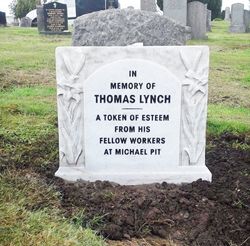
The lovely headstone in memory of Thomas Lynch in Kirk o' Beath Cemetery
------------------------------------
"Dunfermline Press"
5 December, 1936
WEMYSS PITHEAD BATHS.
The short leet for the position of superintendent at the New Michael Pithead Baths, East
Wemyss, is as follows:- Messrs Thomas W. Service, Methilhill; D. H. Cowan, Newmains; and T.O.
Anderson, Cardenden.
The following have been appointed full-time attendants:- Messrs John Burt, Matthew Russell,
James Cunningham - all of East Wemyss; John Henderson and Henry Wilson, Buckhaven.
The baths have also accommodation for pit-head girls, and Miss Annie Whyte, East Wemyss,
and Miss Jean Low, West Wemyss, have been appointed attendants.
There were 357 applications for the positions. The baths are the largest in Britain, costing
about £40,000.
Accommodation is provided for 2400 men and 100 women.
It is expected that the opening ceremony will take place about the end of January.
------------------------------------
"Dunfermline Press"
2 January, 1937
WEMYSS APPOINTMENT REFUSED.
Mr Thomas O. Anderson, who was appointed superintendent of the pithead baths at the
New Michael Colliery, East Wemyss, from a list of 367 applications, has refused the appointment.
Mr Anderson is employed as superintendent of the pithead baths at Minto Colliery, near Lochgelly.
------------------------------------
"The Scotsman"
1 March, 1937
MINING IN FIFE
PITHEAD BATHS
£30,000 Building Opened at East Wemyss
The pithead baths which have been erected at the Michael Colliery, East Wemyss, at a cost of £30,000,
were formally declared open on Saturday by Mr James Adamson, an 87-years-old East Wemyss miner.
Mr Adamson, who started work when he was 11 years old, had a record of 62 years service in the mines when
he retired.
Mr Dugald Baird, general manager of the Wemyss Coal Company, presented Mr Adamson with a cheque for £10 from
the Company. Pithead baths, Mr Baird said, were nothing new in Wemyss parish, as they had baths at the Victoria
Pit in 1860, but, of course, they bore no comparison to the magnificently-equipped building which was being opened
that day. This was the third installation of baths at the Wemyss Coal Company's pits, the other two being at
Wellesley and Lochhead collieries.
Most people realised the advantages of such installations, continued Mr Baird, but the question was often asked - "Are
they used?" In reply to that he could state that Mr Dempster, senior architect for the Miners' Welfare Committee in
London, had told him that in all the baths he had been responsible for in Britain over 99 per cent. of the miners used them.
The new building is of modern design, and has accommodation for 2552 men and 96 women. There are 122 bathing
cubicles for men, and 10 for women.
------------------------------------
"The Scotsman"
26 March, 1937
"TUBE" RAILWAY AT PIT BOTTOM
Fife Colliery Innovation
Wemyss Coal Co. (Ltd.) have constructed a tunnel not unlike the London "Tube" in the underground
workings of the Michael Colliery, East Wemyss, for a transport service by which miners are conveyed between the
pit bottom and their working place. The service has just begun operation.
Many of the workings are situated fully a mile under the Forth, and the cars carry the miners up and down the steep
incline, not only effecting a great saving in time, but also leaving the men more fit to perform their work.
The cars are constructed of steel, holding 14 persons, and resemble the top deck of a tramcar. Several safety
devices are incorporated, whereby it is almost impossible for the cars to break away and run down the incline
in the event of the rope breaking or through the snapping of a coupling.
The Michael Colliery is one of the largest in the country, and employs 2600 persons.
------------------------------------
"Dunfermline Press"
3 December, 1938
MISHAP AT WEMYSS COLLIERY.
About 2000 Wemyss miners were thrown idle on Thursday when the winding rope at Michael Colliery, East Wemyss, was damaged. An official said the damage was not serious in itself, but where the lives of hundreds of men were at stake extraordinary precautions had to be taken. Three shifts had to cease work to enable repairs to be carried out.
------------------------------------
"Cowdenbeath Advertiser"
10 February, 1939
MINER STRUCK BY FALLING COAL
William Bain, miner, of Links Street, Kirkcaldy, was injured by a fall of coal while he was at work in Michael Colliery, East Wemyss, on Tuesday. He was struck on the head by a large piece of coal falling from the roof. He is in Kirkcaldy Hospital with severe head injuries.
------------------------------------
"The Scotsman"
6 March, 1939
WASTE UNDERGROUND
Fife Pit Experiment's Success
PNEUMATIC STOWING
Following upon a successful experiment in pneumatic underground stowing - the first in
Great Britain - made at Lochhead Colliery, Coaltown of Wemyss, Fife, by Wemyss Coal Co., Ltd., the
Company has now introduced the system on a large scale at their Michael Colliery, East Wemyss,
where 3000 workers are employed.
The development of an economical system of stowing waste material underground encompasses
many far-reaching advantages over ordinary methods of coal mining. Where it can be and is employed,
the dumping of redd above ground is naturally reduced, sections can be wholly worked out instead of
leaving huge pillars of coal - "stoops", sometimes 30 yards square - to support the roof, no
pockets are left for accumulation of gas - thus effectively preventing fires - and subsidence is reduced
to a minimum.
When the system has been fully introduced into Michael Colliery, no refuse whatever from this colliery
will be dumped above ground.
GENERAL MANAGER'S STATEMENT
"I do not want it to be thought that this is a system which is going to get rid of redd bings,
however," stated Mr Dugald Baird, general manager of Wemyss Coal Co., in an interview. "The system
was adopted by us primarily to enable stoops in the thick Dysart Main Coal in Lochhead Colliery to be extracted,
to ensure proper control of spontaneous combustion. The system was not adopted to get rid of surface bings,
and can be done economically only in a thick seam."
Hydraulic stowing was at one time successfully employed in Lochhead Colliery, and a total of almost 347,000
tons of redd was stowed underground in this manner. Latterly the length of pipeline was 1900 yards, and the
amount of water that had to be used began to increase beyond the economic limit. For this and other reasons,
the system was abandoned a few years ago.
The pneumatic system, however, has solved many of the difficulties and disadvantages of the hydraulic system.
At Lochhead the stowing material is delivered by waggon and tip-ended into a below-ground hopper which has a
capacity of about 30 tons. Tubs are filled from the hopper, and then taken to the pit bottom. They proceed to
the stowing hopper and tip the material in, thereafter being diverted to the in-bye workings for normal use.
44,000 TONS OF COAL SALVAGED
The normal working of the colliery is thus not disturbed by the stowing operations. The tubs used to bring
down the stowing material are also used for the normal purpose of taking coal to the pithead. The stowing
plant at the moment is over 700 yards from the pit-bottom, and its ultimate position will be about a mile away.
Before removing the stoops, which are 30 yards square, leaving a &qiuot;room" of 15 feet to 20 feet wide,
preliminary packing had to be done to the extent of 25,000 tons. After that the stowing was able to be done
at a ratio of one ton of dirt to one ton of coal extracted.
At Lochhead the machine is stowing approximately 150 tons to 200 tons per shift. This plant has been in
operation for fifteen months, and up to date over 64,000 tons of material have been used to pack the area
solidly, and 44,000 tons of coal have been extracted by the removal of the pillars - 44,000 tons of coal that
under the normal methods of coal mining would have had to be left unworked.
The question of extending the system to other collieries in addition to Lochhead and Michael Collieries, is being
contemplated by Wemyss Coal Co., but the universal application of the system is at the moment precluded by the
fact that it can be economically operated only in thick seams. It may, however, be introduced at Wellesley
Colliery, Buckhaven.
------------------------------------
"Leven Mail" - 10th April, 1940
&
"Fifeshire Advertiser"
- 13th April, 1940
DEATHS.
CHALMERS. - At Wemyss Memoria Hospital, on 6th April (as the result of an accident), Joseph Chalmers, beloved husband of Margaret Drummond, 5 Letham Terrace, Leven.
--------------------
Joseph Chalmers (65), died at 3.00 pm on 6th April, 1940, in Wemyss Memorial Hospital, Denbeath, from traumatic cerebral oedema sustained as the result of an accident while engaged as a coal miner at Michael Colliery, East Wemyss.
--------------------
Joseph and Margaret were married on 21/10/1904 at Springfield, Wester Durie, near Leven.
[The webmasters are grateful to Sheryl Reed Wells, a distant relative of Joseph Chalmers, and the library staff at Dunfermline and Kirkcaldy, for supplying the above infomation.]
------------------------------------
"Dunfermline Press"
20 April, 1940
WEMYSS COLLIERY FATALITY.
John Smith, a 68-year-old Wemyss miner, father-in-law of County Councillor William Drylie, chairman of Fife, Kinross, and Clackmannan Miners' Union Executive, died on Thursday as the result of an accident at Michael Colliery, East Wemyss. He died in Wemyss Memorial Hospital. He had been crossing railway sidings on his way to work at the colliery when he was knocked down and run over by an engine and a race of waggons. His leg had to be amputated.
------------------------------------
"Cowdenbeath Advertiser & Kelty News"
8 August, 1941
METHIL MINERS' OFFICIAL DEAD
The death occurred on Monday of a Methil Miners' Union official and official of Methil Miners' Welfare Institute, Mr Eli Westwood, 177 Don Street, Denbeath.
He worked for 34 years in Michael Colliery, East Wemyss, and for long had been secretary of Methil branch of the Fife Miners' Union. He was 66 years, and is survived by his widow, five sons, and four daughters.
------------------------------------
"Dunfermline Press"
7 August, 1943
A new canteen, which will provide accommodation for serving meals to 500 mineworkers, was opened at Michael Colliery, East Wemyss, on Saturday afternoon. Mr Dugald Baird, general manager, Wemyss Coal Company, presided, and Mr Wm. Gallacher, M.P. for West Fife, performed the opening ceremony.
------------------------------------
"Local Newspaper"
Date unknown, 1945
SEQUEL TO PIT FATALITY
At Kirkcaldy Sheriff Court on Friday, the sequel to a fatality at the Michael Colliery, East Wemyss,
was heard when James Brown Newton, colliery fireman, 267 Methilhaven Road, Methil, was charged
with having, on 21st September, at the dipping heading, Chemiss 900 yds. Section, No. 3 Pit, Michael Colliery,
East Wemyss, being a person authorised in writing by the manager, fired a shot and failed before doing so to
see that all persons in the vicinity had taken proper shelter, whereby William Henry, brusher, 95 Kirkland Gardens,
Methil, was so severely injured that he died later that day at the Wemyss Memorial Hospital, Buckhaven.
A plea of guilty was tendered, and accused was represented by Mr William Robertson, solicitor, Motherwell.
Mr W. M. Paterson, fiscal, related the circumstances of the accident as brought out into the inquiry into Henry's
death, and said that accused had been under a misapprehension. He thought the dead man had been by his
side when he fired the shot, but in reality it was not him but his drawer.
"Your Lordship will appreciate,"
went on Mr Paterson, "that these regulations under which this charge is made are framed for the express purpose
of protecting not only the shot-firer, but everyone in the vicinity of the shot. I submit that in that case the offence is a
rather serious one."
Mr Robertson said the story of accused was a feasible one and asked the Court to believe it. Accused was under
the impression that Henry was at his side when he began to fire the shot and actually said "I think we'll fire the
shot now, Wull." He was referring to the deceased man. The drawer had apparently been there unknown to the
accused.
He said that accused and the deceased man had been very good friends for a long number of years, and after this
very unfortunate accident accused became a mental wreck. He produced a medical certificate from the doctor attending
Newton which said that he had attended him since the date of the accident and even now although he was a little better
he was extremely mentally depressed.
"I doubt very much whether accused will be able to return to his work," went on Mr Robertson. "For a
considerable period he left the district and went to live with friends near Edinburgh. He had been a shot-firer for a considerable
number of years and had been in the pits for 40 years and this is the first time he has ever been in trouble."
Sheriff More said it was a very sad case, this poor man being responsible for his friend's death. He imposed a
fine of 25s.
------------------------------------
"Local Newspaper"
Date unknown, 1945
HIS MISTAKE COST FRIEND'S LIFE
"He honestly made a mistake, and no punishment given him can be more than the experience and suffering he
has undergone."
These remarks were made at Kirkcaldy Sheriff Court yesterday by Mr William Robertson, solicitor, Motherwell, when
he defended James Brown Newton, colliery fireman, 267 Methilhaven Road, Methil.
Newton pleaded guilty to having, on September 21, in the Michael Colliery, East Wemyss, being a person authorised
in writing by the manager, fired a shot and failed before doing so to see all persons in the vicinity had taken proper shelter,
whereby William Henry, brusher, 95 Kirkland Gardens, Methil, was so severely injured he died later in Wemyss Memorial Hospital.
Mr W. M. Paterson, depute fiscal, recalled a public inquiry which had been held on Henry's death, and said from the
evidence it appeared accused walked down the heading where the shot was fired assuming he was followed by Henry,
but it was Henry's drawer. There seemed to have been no warning shout given before the shot was fired, and after
it was fired, when accused turned round, and saw the drawer, they immediately rushed back to the face to find Henry
in a practically unconscious condition.
"The tragedy is," said Mr Robertson, "accused and deceased were good friends, and there was a
time following the accident when nobody was allowed to see him. Even today he is extremely mentally depressed, and
I doubt very much if he will be able to return to his work again."
Imposing a fine of 25s. Sheriff More remarked - "This is a very sad case. He is being well punished just now."
------------------------------------
"THE LEVEN MAIL"
OCTOBER 24, 1945
Fatal Accident Inquiry
Formal Verdict Returned
How The Methil Miner Met His Death
Sheriff More returned a formal verdict in a Fatal Accident Inquiry which came before him at Kirkcaldy Sheriff Court on Friday.
It concerned the death of William Henry, coal miner, at 95 Kirkland Gardens, Methil. First to give evidence was his widow,
Julia Fraser or Henry, 95 Kirkland Gardens, Methil, who said in the witness-box that she had been
married for 14 years, and that her husband was employed at the Michael Colliery, East Wemyss. He always enjoyed good
health and had no serious illness or disability. After her husband had met with his accident she had been informed of
what had taken place, and visited him in hospital. Her husband passed away without recovering consciousness.
Next witness was Alexander Ross, 14 St Mary's Terrace, East Wemyss, and he testified as to being colliery oversman
at the Chemiss Mine, 100 yard section, No. 3 Mine, Michael Colliery, and to knowing William Henry, the deceased man.
About 2.30 in the morning on 21 September, the day on which the accident occurred, he was working with his section
and received word that a firing accident had taken place. When he got to the spot he found Henry with serious injuries
and unable to speak. He was badly injured about the head. He examined the scene of the accident later. James Newton,
the shot-firer had always been a competent worker, and Henry was also always careful and competent. He did not
suffer from defective sight, nor was he deaf or anything else.
James Milne Herriot, 21 Factory Road, Buckhaven, told the Court he was a miner's drawer, and that he had worked
in the Michael Colliery along with Henry prior to his death. He was a very careful worker. Herriot gave evidence as to
the firing of the shot, and said he had been the last to leave the face.
Henry always stayed behind to see that every thing was in order. When he left them on the date the accident took place
he assumed Henry was doing this as usual. He was standing beside Newton, the fireman, when he fired the shot, and
after it had been fired Newton turned to him and asked where he had come from. He told him, and then Newton asked
him where Henry was. Immediately they ran to the face and found Henry lying seriously injured.
Before the next witness, James Newton, 267 Methilhaven Road, Methil, began
his testimony, Mr W. M. Paterson, depute procurator-fiscal, who conducted the
case for the prosecution, asked Sheriff Moore to warn him that if he did not
wish to answer any questions put he was quite at liberty to do so. The warning was
given. Newton said he was the authorised shot-firer on the shift, and said he
had met Henry earlier that morning when Henry was working on the face. This was
shortly before the shot had been fired, and he had told Henry he was ready to fire the shot.
Henry had said he was almost ready, and so Newton left him and made his way up to fire the shot. He assumed that Henry
would leave the face and follow him up. When he was ready to fire the shot he heard someone standing at his side, and
thinking it was Henry he said "Right Willie" and fired the shot. It turned out that the person standing at his
side was Herriot the drawer. He was very surprised when he turned round and did not see Henry. He asked
Herriot where he had come from, and where Henry was, and they both ran to the face and found Henry
lying severely injured.
Last witness was Dr John Wilson, Buckhaven, surgeon in charge of the Wemyss Memorial Hospital who
said he had examined the deceased man and found he was suffering from a compound fracture of the vault
of the skull, his eyes were badly damaged, and his hands more or less blown off. He had many other
smaller injuries. He died at 11.55 a.m. on the same day as he was admitted, and he certified death as
being due to a compound fracture of the vault of the skull. Dr Wilson said the injuries Henry had
received were quite consistent with a shot-firing accident in a pit.
------------------------------------
"The Scotsman"
23 March, 1946
TRAINING YOUNG SCOTS MINERS
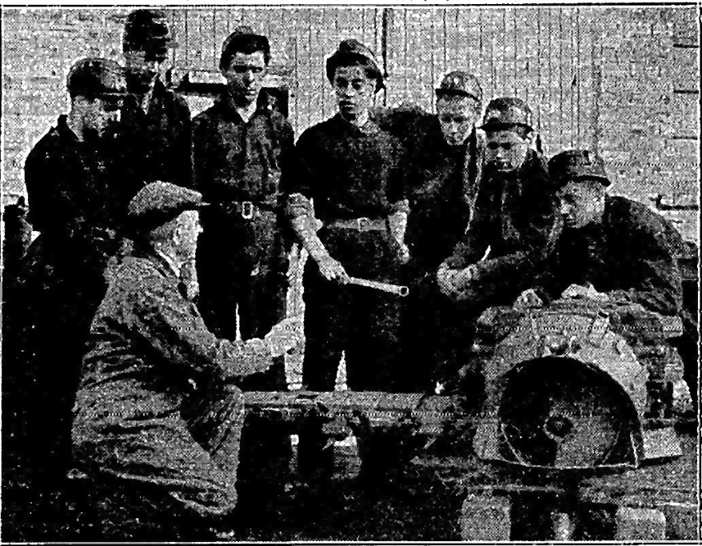
A clan of boys at the pithead training school for young miners at the Michael Colliery, East Wemyss, Fife, receiving instruction in the working of a coal-cutting machine. The boys take a five weeks course of training at the pithead.
Can anybody identify any of these young trainees?
 |
------------------------------------
"Dunfermline Press"
7 September, 1946
IRISHMEN FOR FIFE PITS.
The first party of volunteers from Northern Ireland for the Scottish coalfields arrived in
Glasgow on Tuesday. There were 49 in the party, which split into two for preliminary training
at Muircockhall Colliery, Dunfermline, and Michael Colliery, Buckhaven. The men's ages
range from 18 to 36, and during training they will stay in two hostels.
None of the trainees has any experience of coal mining.
------------------------------------
"Lochgelly Times"
31 July, 1947
NEW HAULAGE AT FIFE PIT
A Help to Production
An innovation to assist the coal production drive will shortly be in operation at the Michael Colliery, East Wemyss, where miners will travel underground by haulage operated by Diesel engine locomotives.
Experiments have proved successful, using 1000 yards of re-laid haulage road and to complete the track approximately the same distance will require relaying.
The men will travel on the main haulage from the pit level and then be conveyed towards the coalface by this new form of haulage.
Although they will still have some distance to walk to reach their actual place of work, at least half an hour's walking time will be saved for the 150 men in the Blandford section.
------------------------------------
"Dunfermline Press"
11 February, 1950
FIFE COAL DEVELOPMENTS
Mr George Mullin, general manager of the Fife and Clackmannan Area of the National Coal Board, released information on some of the planned developments for Fife collieries at a Press conference held in the Central Workshops, Cowdenbeath, on Tuesday. .. In addition, Mr Mullin gave the information that reconstruction schemes were in progress for the purpose of increasing output and efficiency. ... at the Michael Colliery, where No. 2 shaft was being deepened from 300 to 500 fathoms, long level mines would connect with the new pit bottom, and haulage by locomotive would be introduced with an increase of output from 2500 to 5000 tons; ...
------------------------------------
"Fife Free Press"
Saturday, 8 December, 1951
METHIL MINER KILLED
Thomas Gardiner, 56-year-old oncost worker, of
47 Maple Gardens, Methil, died in Wemyss Memorial
Hospital on Thursday afternoon, shortly after being admitted
suffering from severe injuries which he sustained when
struck by runaway hutches at work underground in
Michael Colliery, East Wemyss.
Deceased, who
formerly resided in Buckhaven, where he was well known,
leaves a widow and a large young family.
------------------------------------
"Dunfermline Press"
29 December, 1951
Reconstruction Schemes
... Work is proceeding in previously projected reconstruction schemes at Frances, Michael, and Wellesley collieries. ...
------------------------------------
We are very grateful to Drew and Carol Leslie, Dunfermline, for supplying the following
information in June, 2013.
M. Martin & Webmasters
"Peter Robertson Taylor, was born 3 October 1889, Buckhaven, and died 28 May 1952, at Wemyss
Memorial Hospital, Buckhaven. His death was due to fracture of pelvis and bronchial pneumonia from
injuries sustained as the result of a mining accident on 9 February 1952. While engaged at his employment
as a colliery surface worker at the pithead, Michael Colliery, East Wemyss, Fife, he was
crushed between two full tubs on the surface. His usual residence was 12 Kinnear Street, Buckhaven.
Peter was the widower of Jean Ferguson.
The informant on his death certificate was Andrew Taylor, son of deceased, 20 Lilac Bank,
Buckhaven."
------------------------------------
We are very grateful to Mrs Lesley Ackerley, Croydon, Surrey, for providing the following information in April 2014.
M. Martin & Webmasters
"Via the Index to Memorial Book (Q-R) on your website I have found the name of George Rodger, who was killed at Michael Colliery, East Wemyss, on 6th June 1953. I see there is no entry as to "Cause" relating to this entry.
George appears on my family tree and I have printed copies from the Scotland's People Website of the Registered Entry of his death and also a subsequent entry in the Register of Corrected Entries. This states that he was "buried by a fall of coal and redd from the roof of his working place." I am unclear as to whether his body was in fact recovered.
Hopefully you will be able to add this piece of information to your index in due course."
------------------------------------
"Dunfermline Press"
14 November, 1959
... Although only two Fife pits are marked down for closure in the latest list, other collieries in the county will be affected by the Coal Board's plans for the next year. Developments at Valleyfield and Rothes will be curtailed. Pits likely to be single-shifted include Bowhill and Glencraig. Pits whose sections now producing are likely to stop include Dundonald and Lumphinnans. In two East Fife pits - Michael and Wellesley - manpower will be cut. ...
------------------------------------
"Leven Mail"
Wednesday 12 July, 1961
MINER KILLED
Buckhaven man, Colin Webster (46), 34 Falcon Road, was killed by a roof fall at Michael
Colliery, East Wemyss, on Monday night.
A waste man, Mr Webster was working in the 750 East Branxton Section, 1500 yards from
the pit bottom and 1800 feet underground when the fall occurred.
He leaves a widow, two sons and two daughters.
-------------------
"East Fife Mail"
Wednesday 12 July, 1961
DEATHS
WEBSTER. - The result of a colliery accident, on 19th July, 1961, Colin Webster, aged 46 years, beloved husband of Greta Ogg, 34 Falcon Road, Buckhaven. Service at Kirkcaldy Crematorium tomorrow (Thursday) at 3 p.m., to which all friends are invited.
------------------------------------
"Fife Free Press"
Saturday, 10 February, 1962
Kirkcaldy Miner Killed
Accident at Michael Colliery
A 41-year-old Kirkcaldy miner, Eryk Fojcik, of 63 Pentland Place, died in an accident at Michael Colliery, East Wemyss, on Tuesday.
Fojcik, a repairer, was found underground in the Branxton Section suffering from head injuries shortly before the end of his shift. He was brought to the surface for medical attention but he died shortly afterwards in the Colliery Medical Centre.
He is survived by his wife and three children, the eldest aged 15 and the youngest, a son aged one.
------------------------------------
"Fife Free Press"
Saturday, 10 February, 1962
FOJCIK. - As the result of an
accident on 6th February, 1962,
Eryk Fojcik, beloved husband of
Kathleen Davidson, 63 Pentland
Place, Kirkcaldy. R.I.P.
------------------------------------
"Dunfermline Press"
18 January, 1964
Effect Of Pit Closures In Fife Area
MARKET IMPROVEMENT
Improvement was marked at the following - Michael (Buckhaven) - the largest colliery in the Area, where a favourable movement in results is of great importance in the overall picture, the Board maintain. Both output and productivity increased, the latter from 28.7 cwts in 1962 to over 31 cwts during the past year. Self-advancing supports were introduced into a highly inclined face in the Bowhouse seam and the results from this development had been encouraging. ...
------------------------------------
"Fife Free Press"
Saturday, 16th October, 1965
Kennoway Man Killed at Michael
A 55-year-old pithead worker was killed at Michael Colliery, East Wemyss
on Sunday. Father-of-four William Easton, 91 Wellshot Road, Kennoway, was
working with three other men repairing a waggon loading chute when the boom
loader collapsed.
Easton was trapped and was found to be dead when released. He is survived
by his wife, two sons and two married daughters.
------------------------------------
The Michael Colliery Disaster: 1967
There was a disaster just before the Michael Colliery closed in 1967 with the loss of nine lives. Six men were found dead but the bodies of three miners were never recovered.
The start of the fire of 9th September, 1967.
In the early part of the night shift of the 8th/9th
September, at about midnight, J. Izatt, cablebelt
attendant, was cleaning up the Cable Belt Road near its
junction with the Loader Mine. He heard several rumbling
noises; he did not regard them as unusual, however, thinking
they were due to normal movement of the strata. At about
2.30am., he travelled down the Loader Mine and went into the
under-manager's office, on the low side of the Loco
Level, where he saw A. Stirling, oversman. He told Stirling
that he had heard rumbling in the roof and that there had
been one loud bang. As a result of this conversation,
Stirling went up the Loader Mine a few minutes later to where
Izatt was working. He noticed nothing unusual en route and
concluded that the bang had resulted from the breaking of the
sandstone roof.
About an hour later, Stirling, having returned to the
under-manager's office, smelt smoke coming through
ventilation pipes from the Loco Level. He went out of the
office to the Loco Level where he saw a blue haze. He then
turned right into the Loco Level and walked as far as No. 3
Heading which he entered and found quite clear. He came back
and looked up the Loader Mine and saw what he took to be
burning coal falling from the roof about 20 to 25 yards away
from him. There was no smoke. Amongst a small quantity of
this material, he particularly noticed
one piece lying on the floor, about six inches
square, and it was blazing! It was black but there
were fumes coming from it. He rushed along the Loco Level, up
Bell's Heading, and back down the top end of the Loader
Mine where, about 15 or 20 yards from the entrance, he met
Izatt coming out of very heavy smoke. Izatt had returned to
his work in the Cable Belt Dock, and had been cleaning out at
the back of the loading point when he had been suddenly
enveloped in thick black smoke. The conveyors were
stationary, and had been so for some time, although they had
been running normally earlier in the shift.
 |
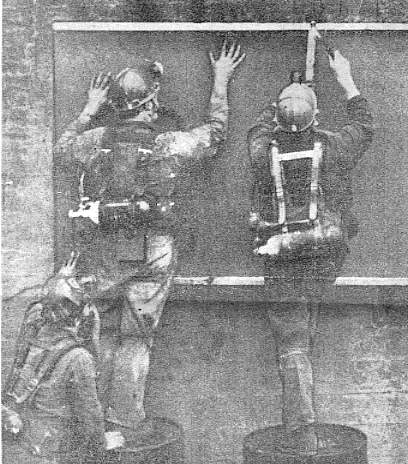 |
| Image 1 | Image 2 |
| Image 1 | Under-ground lay out of the Michael Colliery |
|---|---|
| Image 2 | No.2
Shaft of the Michael Colliery is sealed off with sand
bags and special sheeting.
For this is the only way to quell the fire below... to starve it of air. The pit is now a tomb. |
At the No. 2 Pit Bottom
A. D. H. Smith left the Coal More Turn at about 4.40 am.
and walked along the 430 Mine towards the shaft. He was
passed by two fitters who told him that there was a fire and
that the men should withdraw. Near the pit bottom at about
5.10 am., M. Blankenstein, a deputy, told him that the
onsetter had gone up the shaft and that it was closed. After
some delay in getting through on the telephone, Smith spoke
to Nicol and told him that he had a stretcher case to send up
and that the atmosphere was getting hazy. All three hundred
and two men, except about half a dozen, were sent up by 5.40
am. Readings taken with a P.S. carbon monoxide tube showed a
trace at the pit bottom and a little more in the 430 Mine.
Smith went to the bottom of the Lower Dysart Manriding Dock
to satisfy himself that all the men from inbye were out and
finally rode up the No. 2 Shaft at 7.00 am. leaving the
acting onsetter and the pumpsman at the pit bottom to await
their day shift reliefs; their services were required as the
pumps had to be run continuously. He kept in touch with them
from the surface by telephone.
W. Cull, a deputy, went down the No.3 Shaft at 8.50 am. with
the day shift onsetter and pumpsman. They walked down the
Lower Dysart Manriding Dock and found thick smoke on the
inbye side of the doors to the 430 Mine. After leaving the
doors open for a while, it cleared and they went on to the
No. 2 Shaft bottom. Conditions deteriorated and at 10.45 am.,
wearing short-period breathing apparatus, they were brought
up the No. 2 Shaft by a rescue brigade.
A very high standard of self-discipline in the miner.
I cannot conclude this necessarily brief account of the escape of the men from the mine without referring to their general behaviour. That the evacuation was completed in extremely difficult conditions in such a commendably short time is, in itself, a tribute to the very high standard of self-discipline exercised by all. Under-officials displayed their concern for the safety of the men in their charge and the men an equal concern for the welfare of their workmates. That there was at times some confusion is, in the circumstances which obtained, quite understandable. That there was at no time the slightest degree of panic is remarkable. Had there been, the death role in this incident would undoubtedly have been very much higher.
Names of the Deceased
| Name | Age | Occupation |
| Alexander Henderson | 41 | Power loader operator |
| Henry Morrison | 36 | Power loader operator |
| Johnston Smith | 60 | Power loader operator |
| James Tait | 41 | Oversman |
| Andrew Thomson | 55 | Power loader operator |
| Philip Thomson | 64 | Greaser |
Men Not Found
| Name | Age | Occupation |
| Hugh Gallacher | 61 | Pumper |
| James McKay | 59 | Greaser |
| Andrew Taylor | 43 | Deputy |
--------------------------------------------
'Big Tam Abercrombie' was doon the pit that night
Dougie Abercrombie, Cupar, has thanked us for our efforts in producing this website and has kindly sent us some images he has acquired of the sad event at the Michael Colliery, including scenes at the pithead involving rescue efforts and attempts to seal the shaft. Dougie is so proud of his late dad, Thomas Barclay Abercrombie, known as 'Big Tam Abercrombie', who was 'doon the pit' at the time of the disaster but who got out safely.
Dougie has requested that if anyone wishes to copy any of his images, they kindly acknowledge the source. These images may not be used for commercial purposes or printed productions.
M. Martin & Webmasters.
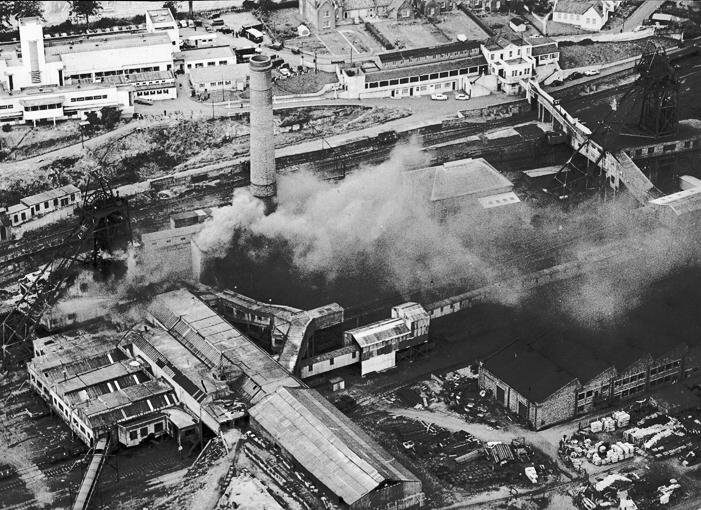 |
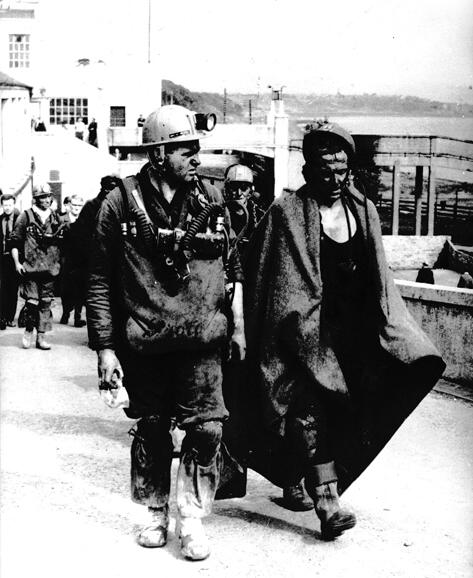 |
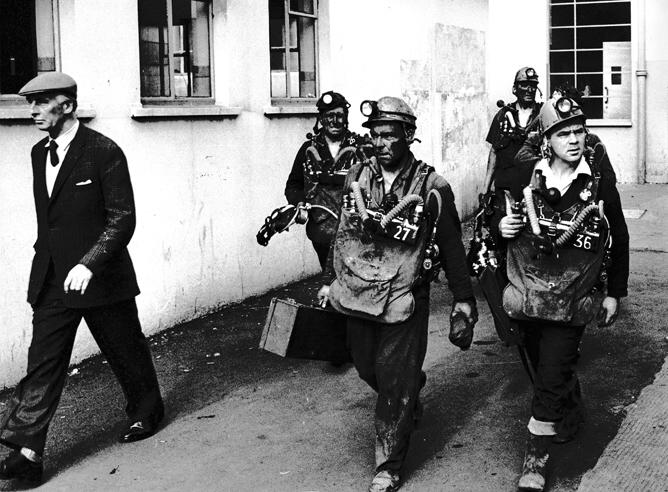 |
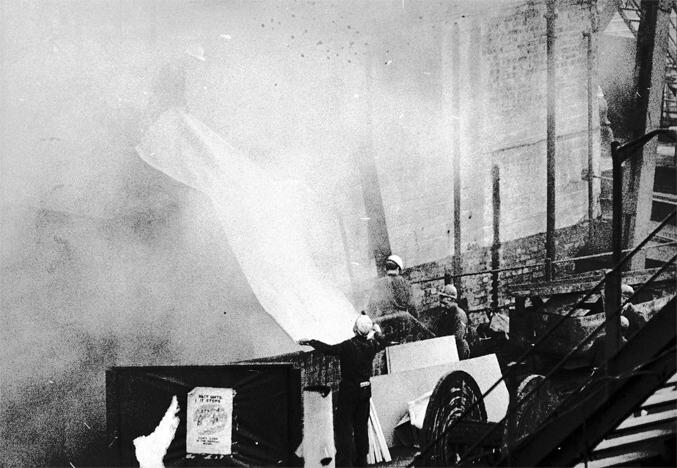 |
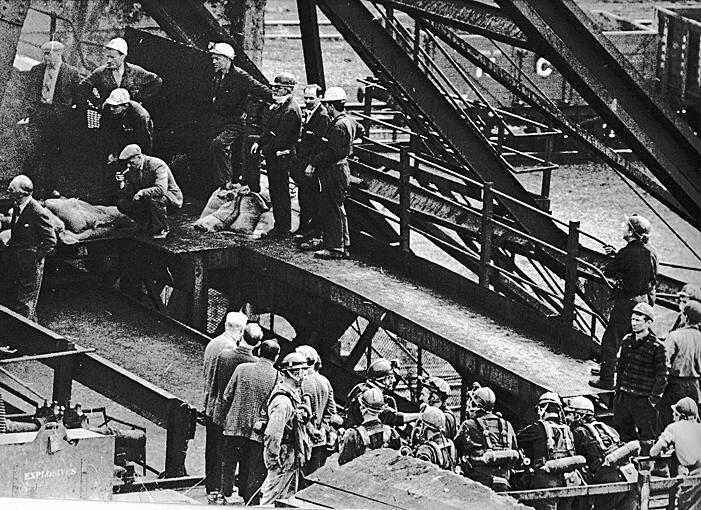 |
--------------------------------------------
"THE FIFE FREE PRESS"
1968
George Medal for Pit
Disaster Hero
The heroism of a 58-year-old Buckhaven miner in the Michael
Colliery Disaster, almost a year ago, has been recognised with the
announcement that he is to receive the George Medal.
At his home, 149 Wellesley Road, former Michael Deputy, Mr David
Hunter, received a letter on Monday saying: "The Queen has
been graciously pleased to approve the Prime Minister's
recommendation that the George Medal be awarded to you."
A second letter also arrived for Mr Hunter, this time from the
Ministry of Power.
It read: "The Minister of Power has learned with much pleasure
that Her Majesty the Queen has been graciously pleased to confer
upon you the George Medal in recognition of your outstanding
bravery in operations to rescue colleagues when fire broke out at
the Michael Colliery on September 9, 1967."
On that fateful day Mr Hunter was making a routine check in the Sea
Mine area. He received a telephone call from
an oversman telling him to get the men out.
Having done that Mr Hunter tried to get the cable belt going.
"I shouted into the four feet section to see if anyone was
there," he said, describing his
actions. "After a while Charlie Cunningham answered
and I went in and pulled him out -- no other man got out alive."
"Once I had dragged him out, I half-carried him through the
smoke for 50-60 yards."
QUEEN'S COMMENDATION
Leader of the Michael Colliery Rescue Team, Mr William Shaw, 18
Barncraig Street, Buckhaven, received the Queen's Commendation
for his work.
Shaw, who is now 39, was ordered to take a four-day compulsory rest
following burns he received in the initial rescue attempts.
During the Fair Fortnight, he is employed at the rescue station,
Cowdenbeath, but will return to his new job at the Seafield
Colliery, where he is Fire Officer and Rescue Captain.
He was captain of the Michael Rescue team for 10 years and has been
attached to rescue teams for fifteen of his 21 years in the mining
industry.
This week, his wife, Mrs Kathlyn Shaw said: "He received the
letter when he came home from work on Monday night.
He was very happy to get it."
During the rescue operations, Shaw made three attempts to get two
men who eventually escaped. During an attempt to draw smoke away
from the affected part of the pit, Shaw -- when he opened
the last of eight doors -- was knocked over by the blast and burned
about the face.
POSTHUMOUS AWARD
The Edward Medal, a posthumous award for bravery, has gone to
Andrew Taylor, Adamson Terrace, Leven, the deputy who went back to
certain death underground at Michael.
Mr Taylor, who was 43, was a power loader operator. He
had worked as a deputy at Michael Colliery.
After the fire started, he made his way through underground workings
with two other men.
But then, worried in case all the men in his section hadn't been
able to get clear, he turned back into the thick smoke.
His body was never recovered.
Mr Taylor left a wife, two teenage sons, and a young daughter.
--------------------------------------------
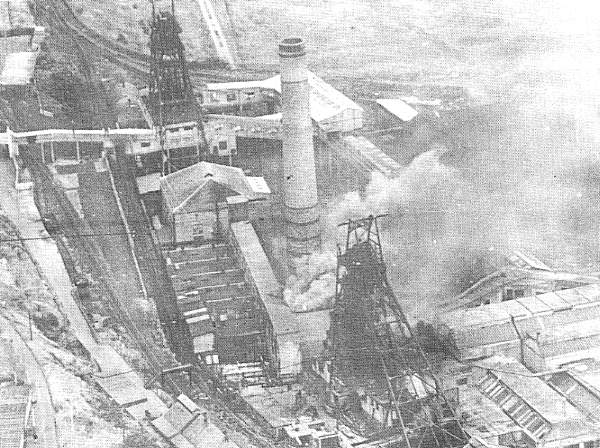 |
| smouldering remains |
--------------------------------------------
"Dunfermline Press"
17 February, 1968
Michael Colliery Closure Decision
The Town Clerk reported on correspondence with the Minister of Power, regarding the N.C.B. decision to close Michael Colliery, in view of the high unemployment in the area. The Minister had replied that the N.C.B. decision was taken after thorough examination of the prospects; it was the N.C.B.'s duty to choose which collieries they required to meet demand and it would not be sensible to spend money if the Michael Pit were not needed to meet such demand. The Minister added that the Government would keep the matter under review and that Leven and Methil were to have additional incentives for new industry.
--------------------------------------------
"East Fife Mail"
14 July, 1999
The smouldering remains of the Michael Colliery bear testament to one of Levenmouth's worst industrial disasters. Earl September 9, 1967, 1800 feet below ground, fire ravaged through Scotland's biggest and deepest coal mine, killing nine men. As if human tragedy was not enough, the pit was sealed and later closed by the National Coal Board, ending 75 years of mining here in the Wemyss area. Almost half the pit's Labour force was paid off and the rest either retired or transferred. The community rallied bravely in being united by tragedy, but a savage economic blow had been dealt.
--------------------------------------------
"East Fife Mail"
20 November, 2002
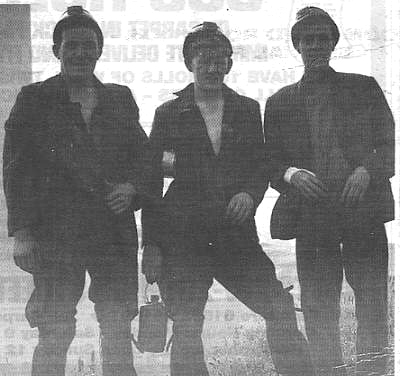 |
- Our peek into the pictorial archives this week shows three hard-working miners at the Michael Colliery in East Wemyss which had the biggest and deepest pit in Scotland.
- This photograph was taken in 1955 at the colliery's pit head and shows, from left, miners John Salmond, Dan Shaw and Danny Sullivan.
- The Michael symbolised Levenmouth's rich industrial heritage for 75 years until tragedy struck on September 9, 1967, when the pit became instead the site of one of Levenmouth's worst industrial disasters.
- Nine men lost their lives in an underground fire at the colliery, and the village's proud industrial history was lost alongside them. A monument near the former site is still used for remembrance services and floral tributes.
- This photograph, loaned by Mr. D. Shaw, 43 Factory Road, Buckhaven, takes us back to happier times in the Michael's history.
- It also reminds us that industrial success rested entirely on the willingness of local men to undertake what was potentially an extremely dangerous job.
------------------------------------
"East Fife Mail"
15 January 2003
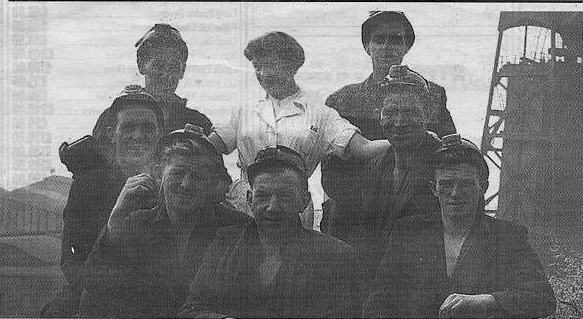 |
- Our look into the pictorial archive this week shows us a happy group of miners accompanied by a 'Coal Queen' at the Michael Colliery, East Wemyss in 1955.
- The Michael Colliery was distinctive during the mining industry's heyday as having the biggest and deepest pit in Scotland, but sadly in 1967 the pit became instead the site of one of Levenmouth's worst natural disasters.
- Nine men lost their lives in an underground fire at the colliery, and the village's proud industrial history was lost alongside them -- a monument near the former site is still used for remembrance services and floral tributes.
- The people identified in this photograph taken in much happier times are, clockwise from top; Kelly (?), Danny Sullivan, David Duthie, Jim Moodie, Andrew Wilson, James Shaw, John Salmond and Jock Webster.
- The photograph was loaned to the East Fife Mail by Linda Henrickson, North Feus, Upper Largo.
--------------------------------------------
A Personal Recollection
William H. MacLeod, Guardbridge, Fife.
9 July, 2004
"The picture of welding at the Central Workshops [in your Cowdenbeath workshops booklet] recalled an incident that I had almost forgotten. I got one of several illicit footplate trips on the Wemyss Private Railway down to the Michael and I was taken to see repair work on recovered roadway steel arches. I was staggered to see the warped and twisted form of these initially symmetrical sections after being subjected to the movements and pressures of the overlaying strata. I was more amazed to see how some of these could be corrected and reformed. ..."
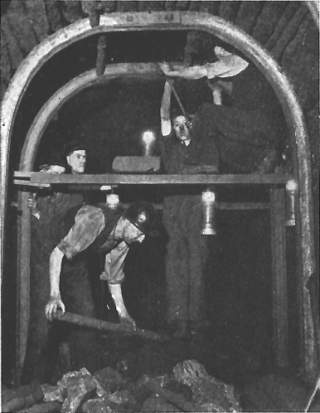 |
--------------------------------------------
"East Fife Mail"
8 September, 2004
A fitting memorial
By James Campbell
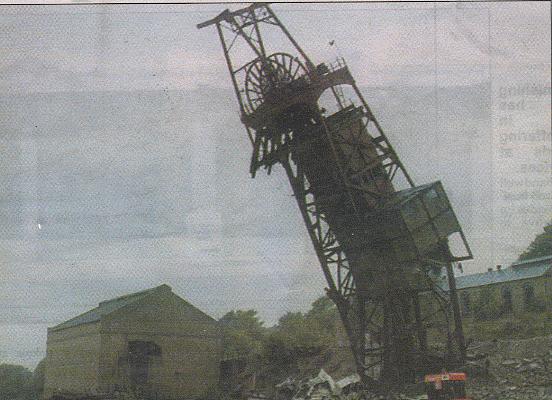 |
The Michael's pithead gear was demolished in the 1990s. Now, in
Denbeath, a lasting tribute is to be
made to those who died in the
terrible fire which broke out far below ground on September 9, 1967.
A PLAQUE commemorating one of the worst days in
Fife's mining history will be unveiled at the Denbeath Miners Welfare
on Sunday.
The Fife Miners Community Cultural Group is behind the
gesture to remember the men who died in the Michael Colliery disaster 37
years ago this week.
Similar plaques have been unveiled to commemorate
other pit disasters at Seafield and Kelty.
The idea was first mooted
during a meeting of the Retired Miners Group which then received funding
from the Coal Industrial Social Welfare Organisation.
Sacrifices
Retired Miners secretary Dan Imrie said: "We need to keep
bringing up these disasters. People forget about them and we feel it's
important not to.
"In the future people will be able to look at
the plaque and remember the sacrifices these miners have made."
The disaster happened in 1967 when, at around 3.30 a.m. on September 9,
a seam of coal ignited 1800 feet below the ground in the Michael
Colliery - then Scotland's biggest and deepest coal mine.
The
spontaneous blaze, accelerated by polyurethane foam lining the
surrounding area, produced raging flames, searing heat and thick,
choking black smoke.
In all, nine miners lost their lives in the
disaster, which happened just as 300 men were about to complete the night
shift. The pit became a tomb for three victims whose bodies could not
be recovered, and it was first sealed and later closed by the National
Coal Board.
A monument was erected in 1992 to acknowledge the 25th
anniversary of the fatal fire and, three years later, the towering
pithead gear was finally demolished. A piper from Methil Pipe Band
will also perform during Sunday's ceremony which begins at 11 a.m. and
is open to any member of the public wishing to pay their respects.
--------------------------------------------
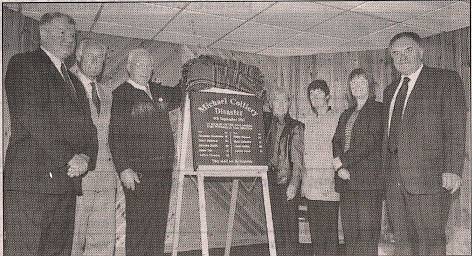 |
"East Fife Mail"
15 September, 2004
Michael Memorial Unveiled
A plaque commemorating the loss of nine coal miners in East
Wemyss was unveiled during a sombre ceremony at the Denbeath
Miners Welfare on Sunday.
The Fife Miners Community Cultural Group was behind the
gesture to remember those who died in the Michael Colliery disaster
37 years ago last week.
The idea was first mooted during a meeting
of the Retired Miners Group which received funding from the Coal
Industrial Social Welfare Organisation.
The disaster happened on
September 1967 when a seam of coal ignited 1800 feet below the ground
in the Michael Colliery - Scotland's biggest and deepest coal mine
- killing nine men.
A monument was erected in 1992 to acknowledge
the 25th anniversary of the fatal fire. Unveiled by former Fife
Regional Council convener Bert Gough, it stands in East Wemyss.
Three years later, the once thriving colliery's towering
pithead gear was finally demolished.
Pictured unveiling the plaque are (from left) NUM Scotland president Nick Wilson; retired chaplain Hugh Ormiston; Jim Crawford; Jim Coombe; Fife MSPs Christine May and Tricia Marwick and Central Fife MP John MacDougall.
--------------------------------------------
"The Courier"
(An article by Michael Wemyss - date unknown)
A requiem for the Michael
The Wemyss Coalfield has been worked by the Wemyss family for hundreds of years. The coal
measures, dipping as they do seawards, provide much undersea coal still to be worked - the
best of the land coals having been fairly intensively worked.
My father developed the coalfield very rapidly between 1890 and 1908, when he died. The well-known
mining engineer John Gemmell carried on the development for some years till he died in 1921.
Then after the first world war I was elected chairman of the Company which had been specially
formed to develop the Wemyss minerals in 1894.
Sabotage
In 1921 the collieries, having been under Government control during the war, were handed
back in a hurry to the colliery owners, when the Government found that the time for charging high
prices for export had come to an end, and that those on the shipping side of the trade were losing
large sums. The colliery owners realised that coal had to be produced cheaper and that, therefore,
wages, which in the coal industry represented 70 per cent. of total cost of raising a ton of coal,
had to be reduced as well as other costs if the production of coal was to be carried on.
A strike took place, lasting three months, and the Wemyss collieries fared badly because no
protection had been organised to prevent sabotage at the collieries. Roving bands of men
were going about breaking up pumps, &c., at the collieries, and amongst other damage
Michael Colliery was flooded.
Not bright
Owing to flooding of the workings in 1921, the shafts had to be cleared of water and many
of the underground roadways had to be remade. This work took considerable time and expense.
The future for Michael Colliery did not look very bright. Finally, however, the board came to the
conclusion that, whatever the cost, the Michael Colliery had to be repaired and redeveloped. There
were many reasons for coming to this decision, amongst which were providing work locally,
and it was the most favourable area geographically to develop.
The best seams of coal outcrop under the sea between West Wemyss and Dysart. It was
considered that approaching these undersea outcrops from the Michael Colliery, where the
outcrops were under the land, would lessen the chances of much water coming from the
undersea outcrops.
It became clear that the redevelopment of the Michael Colliery would have to be on a large
scale and that an output of 1,000,000 tons per annum would seem to be a reasonable target.
Costly
Plans for this development took some time to prepare, but a large shaft, No. 3, was
started being sunk in 1923 to a depth of 303 fathoms to a pit bottom planned just below
the Dysart lower seam.
At the same time a stone mine was being driven 1360 yards long from the furthest point
seawards back to the proposed new pit bottom, through which the further development
of the undersea coals could be cheaply transported. These developments were costly,
but if the Company was to exist such developments had to be carried out.
The financial needs to pay for the developments were supplied over a period by people
lending money on debenture, by the Company itself, and by ordinary shareholders getting
very small and sometimes no dividends on the ordinary shares for many years.
When the development work was approaching completion, there were people keen
enough to acquire what had cost a lot to carry out, but until nationalisation came about,
the management and ownership remained in the hands of those who had planned and
caused the redevelopment of Michael Colliery.
So many are now gone, but memories of them remain. Mr Foster Brown, the Crown mineral
engineer with undersea mining experience all round the country. Mr Gemmell, with special
experience of east coast mining. Mr Kirkby, with experience of undersea mining in Canada.
And the younger generation learning from them, such as Messrs Baird, Keir, Galloway, &c.,
and so many others all concentrating on making a success of the new developments at the
colliery.
Memorial
With the coming of nationalisation, however, the officials working at Michael Colliery
were to a great extent dispersed. One is inclined to think that if this dispersal had not
taken place the colliery would have been more successful in later years.
Regret at the fate of the colliery - now a ghost colliery - is still uppermost in the minds
of so many who helped with its development.
But, perhaps one day some form of memorial will be made to register the devoted work
of those whose energies and wisdom in the past enabled so many to work in safety at the
colliery for so many years.
--------------------------------------------
"The Courier"
10 September, 2007
Fitting tribute to mine victims
The 40th anniversary of the Michael Pit disaster was marked with a memorial
ceremony yesterday. Peter Grant, administration leader of Fife Council, laid a wreath
at the East Wemyss memorial to the nine men who lost their lives when fire broke
out deep underground on September 9, 1967.
Over 300 miners escaped, many by the narrowest of margins.
Mr Grant said, "I've never been underground when a fire broke out. I can
never imagine how terrifying it must have been. Yet 300 men quietly, calmly and with
no panic made their way to safety. How much worse would the death toll have been
had it not been for the supreme courage of these men, making the long, slow journey
to the surface when every instinct in their bodies told them to panic? How many of those
300 men risked their own lives to make sure their comrades got out safely?"
He added, "We mourn for the lives that were lost that day, and for the terrible toll of
lives lost in the Michael and elsewhere in an industry which gave so much to Fife and yet
took away so many of our people. The Fife we live in today was built on coal physically,
literally, economically and socially. The simple, basic values of decency and honesty, of
respect for yourself and your neighbour, the willingness to put yourself out to help others,
to stand together in the face of any adversity - these values were born of our mining past
and live on in the present. Those same values will outlive me; they will outlive everyone
here. They will last forever in our mining communities - a permanent legacy of our past,
and a fitting tribute to the fallen heroes of the Michael Colliery."
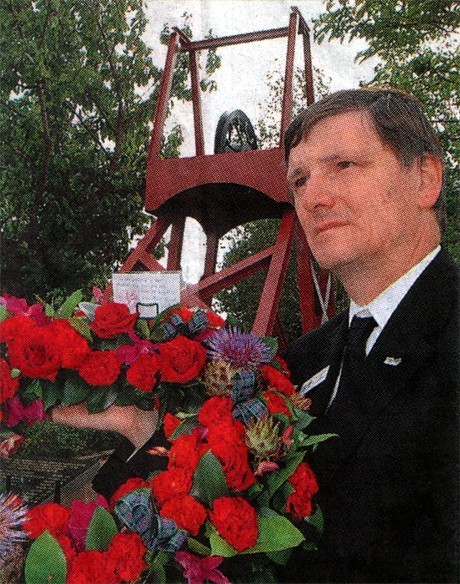 |
Mr Grant laying the wreath.
Click on Image to Zoom In--------------------------------------------
"Fife Free Press"
27 July, 2017
By Dawn Renton
In the early hours of a coaling shift at the Michael Colliery, East Wemyss, on Saturday, September 9, 1967, more than 300 men were working underground.
By the end of the day, close to 80 men would be injured and nine would sadly lose their lives in one of the largest underground fires in British mining history and the worst to hit the Kingdom of Fife.
The alarm was first raised at 2am and it was just over an hour later that the Cowdenbeath Rescue Station was called.
The team was told that a fire had broken out at Michael Colliery and that it was needed at the mine.
George Rodger, now aged 94, was only 44 at the time and was part of the rescue operation team from Cowdenbeath.
He recalls risking his own life to save the miners still trapped underground.
"It was like looking right into the mouth of hell," he recalled. "It was dark, filled with smoke and there was this searing heat. Most of the men got out but some were still down the pit and it was our job to get them out as quickly as possible.
So we headed down and there were bodies lying there, black on one side, and pink on the other. It was a horrific scene, really horrific.
The apparatus that we had at the time only lasted for two hours. The air was so foul that it limited how long we could stay underground before we had to get back to the surface to change our breathing apparatus. The team was split into twos and we went down, came back up, the other team would head down, and so this would continue until we had everybody out."
At 8.30am the rescue team found the body of Philip Thomson on the Cable Belt Dook. There was no sign of his workmate James McKay.
The rescue brigade sought to penetrate the Sea Mine but attempts had to be suspended due to the thick smoke that filled the air.
In order to reduce this, it was decided to try and open the three doors in the No. 2 Heading but the rescuers were driven back by heat and smoke.
"I helped rescue five men before the conditions put a halt to our mission. A great wall of fire met us while we were down there - we were only feet away from it."
George continued. "We managed to open two doors but when we tried to open the third we were hit by a blast of intense heat, which singed us and the smoke stung our eyes. We just couldn't see anything but smoke and fire. It was a terrifying situation to be in but we knew that we needed to get the rest of the men out. That was our job."
By about 9.15am the atmosphere in the Sea Mine improved and the rescue mission was able to continue.
Between 9.40am and 10.25am five bodies were recovered. But there were still three men missing - Andrew Taylor, Hugh Gallacher and James McKay.
As the rescue mission continued into its second day, small groups of people had
gathered at the pit head. Families, friends, neighbours all wanted to know the fate of their loved ones. Efforts were made to fight the fire in such a way that it might be possible to find the three men but by late afternoon on September 10, conditions deteriorated and it was decided that too many men were being put at risk.
Mine ventilation stoppings were finally placed, sealing in the remaining three bodies.
Soon the word passed round of "All hope abandoned".
The winches fell silent, the pit wheels silhouetted against the dark and still sky. Only a single plume of smoke was now visible where once there was a thick dense cloud.
"We all tried our best down there," George said. "We just could not get the other men out. It was a sad moment when we knew that we had to give up. It wasn't just the smoke that was the danger. There was the falling coal that we had to look out for. Those men were buried underneath it and we just could not reach them."
The disaster is something that George has never forgotten.
"Those days have stayed with me and they still do," he said. "The best way to describe it is just 'pure hell'. I knew that after the Michael Pit I would never be able to go down another mine again.
That was me finished. I left the mine rescue team and retired at the age of 44."
The subsequent inquiry found that, although no evidence was produced that it was from spontaneous heating, it is believed that the fire occurred in the roof coal somewhere in the Loader Mine that was lined with polyurethane.
The men who lost their lives
The men recovered on Saturday, September 9: Alexander Henderson (41), Leven; Johnstone Smith (36), Buckhaven; James Tait (41), Buckhaven; Andrew Thomson (55), Leven; Philip Thomson (64), Leven; and Henry (Harry) Morrison (35), Buckhaven.
There were three bodies that were not found: Hugh Gallacher (61), Kirkcaldy; James McKay (59), Methil; and Andrew Taylor (43), Leven.
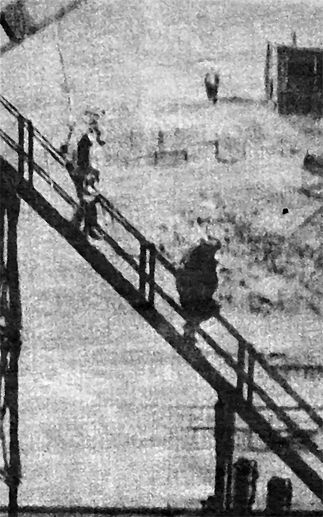 |
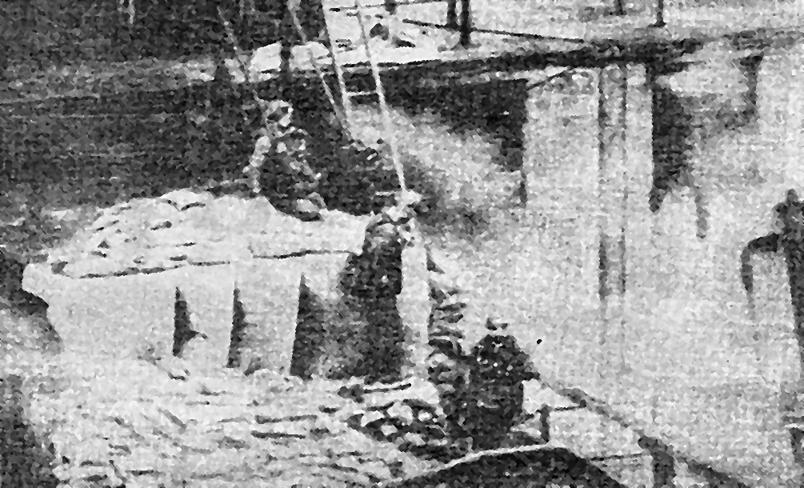 |
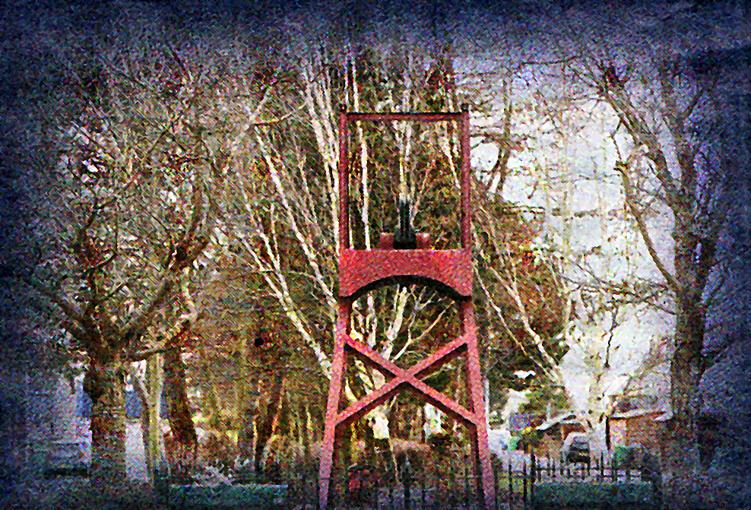 |
--------------------------------------------
