Owners: Thornton Colliery Co. Ltd.
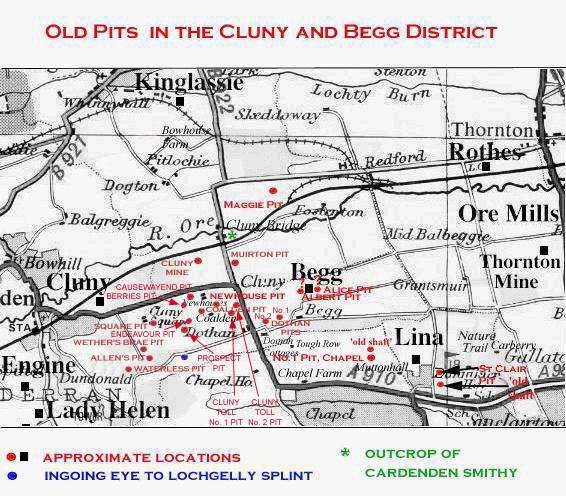
The 'Maggie Pit' was in fact two shafts sunk near Cluny Muir around 1899, a few hundred yards north-east of Cluny Bridge, to the north-west of Kirkcaldy. In abandonment plan records as Thornton Nos. 1, 2 Pits, the two shafts were located just north of the Dunfermline and Thornton section of the L.N.E.R. line with the 'Maggie Pit house', presumably the residence of the pit manager, located several hundred yards to the north of the shafts. The opening date of the pit, which wrought the Cardenden Smithy Coal at a depth of 32 fathoms, was probably 1900 and coaling seems to have ceased early in 1903 with the colliery plant being sold off in April of that year.
 |
| Source Date of Information Supplied | |
|---|---|
| Manager / Under-Manager / Men underground / Men above ground / Coal seams worked | |
| 1902 (Thornton Colliery Co. Ltd.) | |
| R. Calderwood / ---------- / --- / --- / Standing |
Information on coals worked at, or near, the Maggie Pit
(based on a report from 1934)
The distance from the Rough Coal to the Cardenden Smithy
was fairly constant over this district, averaging a little
under 18 fathoms. The intervening strata consisted mainly of
sandstone and faky beds and, besides the Little Splint Coal,
usually included a thin rib of coal 6 to 9 fathoms above the
Rough Coal, which probably represented the Lochgelly
Blackband Ironstone.
The lower leaf of the Cardenden Smithy Coal was little more
than a rib of coal separated from the upper leaf by less than
a fathom of sandt strata.
The upper leaf of the Cardenden Smithy Coal ranged from 1
ft. 9 in. to 2 ft. 3 in. thick and had been worked to a very
limited extent as the 'Smithy Coal' from the Maggie
Pit, north-east of Cluny Bridge. Its outcrop could be seen at
the base of a low bank beside a well some 200 yds. south of
Cluny Bridge and close to the north side of the railway line.
The following beds were exposed at this point:
| Coaly blaes } | 6 in. |
| COAL, with ½ in. parting } UPPER LEAF | 1 ft. 2½ in. |
| PARROT } | 2 in. |
| Faky and sandy blaes | 1 ft. 1 in. |
| Sandstone | 1 ft. 3 in. |
| Fireclay | 8 in. |
| COAL, LOWER LEAF | 5 in. (seen) |
| Plan of Abandoned Seams for Thornton Nos. 1, 2 - Kinglassie | Pits or Mines designated in Plan |
|---|---|
| COAL; Smithy (February, 1903) | Thornton Nos. 1, 2 |
-------------------------------------------------
"Dunfermline Press"
4 March, 1899
NEW COAL FIELD
Sinking operations have been commenced on the estate of Raith, near Thornton Junction. The coal is the well-known Lochgelly splint and parrot coal, and will be reached at a depth of about 70 fathoms. The colliery is being equipped for producing an output of about 100 tons per day.
-------------------------------------------------
"The Scotsman"
8 April, 1903
SALE OF COLLIERY PLANT AT THORNTON COLLIERY,
THORNTON, FIFE,
On THURSDAY, 9th April, at 11 o'clock.
SHIRLAW, ALLAN & CO., have received instructions from Matthew
Mitchell, Esq., C.A., Glasgow, Liquidator of the Thornton Colliery Co., Ltd., to
SELL by AUCTION as follows:-
2 Pairs Coupled Winding Engines, 24 in. Cylinders by 5 ft. 3 in. stroke, by A.
Bennet & Son, Dunfermline, and 20 in. Cylinders by 4 ft. stoke, by Murray &
Paterson, Coatbridge; Horizontal Pumping Engine, 26 in. by 5 ft.; Horizontal Winding
Engine, 14 in. by 3 ft.; 3 Double Flued Lancashire Steam Boilers, 28 ft. by 7½ ft.,
by G. Ingles & Co., Ltd., Airdrie, with Mountings; 15 ft. Waddle Fan, with 14 in.
High Speed Engine; Evans' "Griff" Sinking Pump, 21 in. by 12 in.
by 2 ft.; Duplex Tangye Steam Pump, 6 in. by 4 in.; 6 in. Double Cylinder Steam
Winch; 3 Ton Derrick Steam Crane, by Butters, Glasgow; 20 Ton Waggon Weighing
Machine; 7 Ton Lorry Weighing Machine, and 1 Ton Hutch Weighing Machine, all by H.
Pooley & Son; 2 Trestle Pithead Frames, about 55 ft.; Two Pairs 10 ft. Spider Pulleys;
Pair 7 ft. Bell Cranks, Pumping Frame and Pulley, Pithead Scaffolding, about 66 Fathoms
19 in. and 50 Fathoms 13 in. C.I. Pump Pipes and Connections; 3 Double and Single
Power Pit Cranes; Winding and Crane Ropes; Iron Sinking Kettles and Water Barrel;
about 80 Fathoms 4 in. and 40 Fathoms 8 in. Acme Steel Flanged Pipes; C.I. and Steel
Plates, Engineers', Smiths', and Joiners' Tools; Large Quantity Chains,
New Smithy Iron, Old Brass, M. and C.I. Scrap; Stores, P.P. Legs, New Timber, Office
Furniture, Mining Instruments, &c.
Also, Brick Buildings of Office, Workshops, Engine and Weigh Houses with Slated
and Corrugated Iron Roofs, Chimney Stalk, Boiler and Engine Seats, Wooden Erections, &c.
NOTE. - The Plant has all been recently put down, and most of it is as good as new.
Trains to Thornton Junction from Glasgow (Queen Street H.L.) at 9 A.M., and from
Edinburgh (Waverley) at 9.35 A.M.
Brakes will await the arrival of above Trains to convey intending purchasers to the Sale.
Catalogues from Auctioneers.
Hamilton, 23d March 1903.
-------------------------------------------------
Can do with some more information on this pit. Why was it called the Maggie Pit?
