Owners: possibly Mr Durham of Largo
Williamson & Co. (1842)
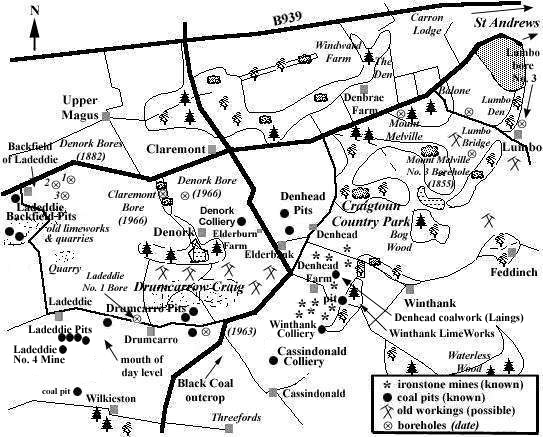
This group of three pits, which included an engine pit on
the north side of the Denhead road, lay just over ¼ mile
to the east of Drumcarrow farm. Another shaft lay a short
distance to the north of the engine pit, and the third shaft
was located on the opposite side of the road almost opposite
the engine pit.
These pits are known to have been working in the 1850s but
possibly date from the previous century, continuing to work
into the 1860s.
 |
 |
|
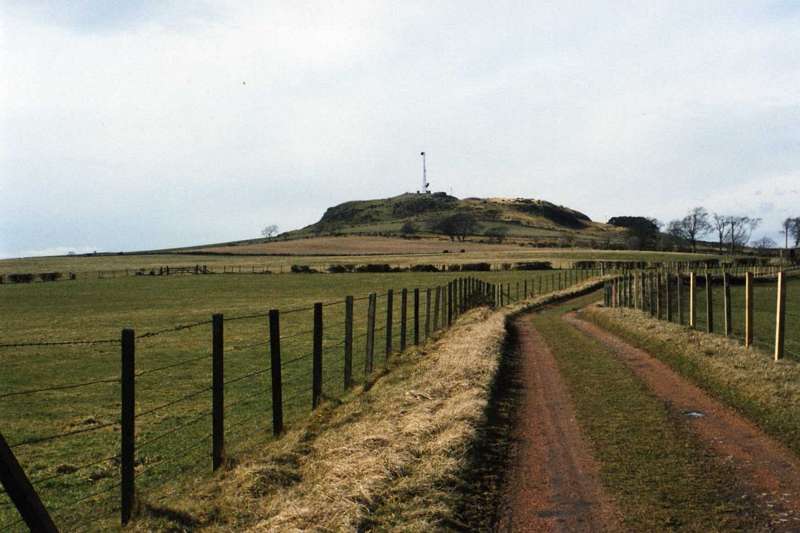
Drumcarrow Craig from Winthank coalfield |
Statistical Accounts of Scotland (1795)
Parish of Cameron
"... upon the lands of Lathockar, belonging to Miss Scott, who, it is to be hoped, when she arrives at majority, will give proper encouragement to cultivate that barren spot. What has been of singular service in making such an alteration is the limestone and coal, with which this parish abounds." ...
" ... The article of coals is very much advanced in price within these 40 years: A cart load at the hill cost only 1s. 4d.; but now, for the same quantity, 3s., and sometimes 3s. 6d. is paid. Indeed, it must be owned, that the expense of working coal is greatly increased. Two fire engines are employed for that purpose, in this parish, by Mr. Durham of Largo, and the coal-hewers receive more wages. Adjacent to one of these fire engines, he has lately erected a number of houses to accommodate the workmen." ...
Unfortunately, this account does not identify the
location of these old coal-works within Cameron parish.
M Martin & Webmasters
| See also Drumcarrow (West) Colliery for information on a group of pits known to have been located around ¼ mile west of the farm. This small colliery is believed to have worked from the 1750s to around 1850. A great deal of ironstone mining also took place in this area and to the east of the Drumcarro pits, near Winthank. |
|---|
Drumcarrow Colliery in 1842
In 1842, a parliamentary commission reported on the
employment of women and children in coal mines. Of the mines
in East Fife, the commissioners reported:
"The collieries in the district of St Andrews and
Cupar are worked to very limited extent, and no females or
very young children are wrought below. The only novelty that
attracts attention is the peculiar character of the coal at
Drumcarra, Largo Ward and Teasses, which spontaneously fires.
At Drumcarra, a portion of the coal wall is on fire, and the
smoke causes not infrequently a complete cessation of labour
from the 'stifle' arising therefrom."
The evidence given by mineworkers to the commissioners
presents a striking picture of working conditions
underground.
"We employ about 50 persons in the mine; 15 are
under 18 years of age and nine boys 10, 12 and 14 years of
age; very young people are of no use here, as much caution is
required from the nature of our coal which is frequently on
fire ... No accidents have taken place from the stifle which
the burning produces ... many of our present colliers were
labourers in the fields; they are generally good workmen,
although they are called grass-colliers."
Alexander Telfer, overseer
"The pit is much troubled with fire-stifle, which
sends the men to sleep ... when men are overcome with the
stifle, we take them into the fresh air, which brings back
their senses."
Alexander Smith, aged 14, hewer
"Began to work on coal three years ago; left farm
service, as the coal work was likely to pay better; can earn
2s.6d. to 3s. a-day when work is regular ... Service is
preferable to coal work, but my wages were only 4s.1d.
a-year, and I had to clothe myself; would not have left, only
father wished me; a little brother is now below opening the
traps; he is twelve years old and has been down nine
months."
Andrew Ferres, aged 17, hewer
--------------------------------------------
"Fifeshire Journal"
22 June, 1843
DRUMCARRO COLLIERY
REDUCTION IN THE PRICE OF COAL
THE Public are respectfully informed that the
COALS at this Colliery are to be REDUCED Twopence per Load
of 4 cwt. from and after the 23d current.
Drumcarro, 20th June, 1843.
--------------------------------------------
| See also menu links to 'Children' and 'Historical' |
|---|
Statistical Accounts of Scotland (1845)
Parish of Cameron
"In almost every part of the parish, either coal, freestone, trap, whinstone, or limestone may be found. There is at present good coal got at Drumcarro. Limestone is wrought at Radernie and Winthank."
"Plenty of coals can be procured at Drumcarro, in the parish, and at Largoward, bordering upon the parish but situated in that of Kilconquhar, - which cost, on an average at both places, 1s. 6d. per load of 3 cwt."
Parish of Ceres
"... Beyond Kinninmont the coals are broken up, and some of them driven aside by the eruption of the trap hill of Ladedda. The thick coal and other five of the seams are tossed up to the top of the hill of Drumcarro, where they are regularly wrought. The south slope of Ladedda-hill has many marks of old pits upon it, proving that the coals pass along there. ." ...
--------------------------------------------
"Fifeshire Journal"
28 JUNE, 1849
DRUMCARRO COAL
THE SUBSCRIBERS beg to intimate to the Public
that they have always a Supply of MAIN COAL at 6s. 8d. per Ton.
Also Small do. At 3s. 4d.
Orders from St Andrews will be received by John
Forrester, Merchant, Church Street.
Drumcarro, 26th June,
1849.
--------------------------------------------
Information on coals worked at, or near, Drumcarrow Pits
(based on a report from 1900)
Five or more coal seams, having a north-westerly dip of
20°, were worked on the lands of Drumcarrow farm. At the
bottom lay the Eight Feet seam and at the top the Ten Feet
seam.
The Drumcarrow pit on the north side of the road, a little
to the east of the farm, was 28 fathoms deep and reached the
Six Feet and Four Feet seams.
Below these lay the Parrot Coal, which was reached by a
shaft, 21 fathoms deep, on the south side of the road. Still
lower came the Black Coal, which cropped out immediately to
the south of the fork of the road to Cassindonald. All of
these seams were inclined towards the north-west at angles of
8° to 10°.
At the west end of Drumcarrow Craig, however, the seams were
found to be greatly disturbed and thrown on end.
... and in a report from 1977 ...
The Largoward Black Coal outcrops on the hillsides south
of Drumcarrow Craig, dipping north-westwards at a low angle.
It was at one time worked from a group of pits about ¼
mile east of Drumcarro Farm, but no details are available. In
the Drumcarro Borehole (1963), put down to prove the sequence
in this area, the seam section is coal 11 in., on seat earth
29 in., on coal 21 in.
The coal was also worked in the Denhead Syncline, a
north-easterly-trending structure lying to the east of
Drumcarrow Craig. ...
Like the underlying Largoward Black Coal, the Largoward
Splint Coal was formerly worked to the south of Drumcarrow
Craig and in the Denhead Syncline. ... The Drumcarro Borehole
(1963) encountered old workings in this seam ...
... Coal seams probably lying in the same part of the sequence as the 'Six Foot' Coal of Ladeddie Frontfields were stated in Gemmel's 1900 report to have been worked about 1850 from a group of shafts about 500 yds. east of Drumcarro Farm. ... The seams were described as a 4 ft. coal overlying a 6 ft. coal; no other details were given. Boreholes, drilled by the Opencast Executive of the National Coal Board in 1953, provided a section through these strata. One borehole proved 6 ft. 2 in. of coal in five leaves, closely overlying a 5 ft. 6 in. cavity; together these probably represent the worked coals mentioned in Gemmel's report. ... Although coals in the Lower Limestone Group were also formerly worked from pits in this vicinity the general aspects of the strata in the Ladeddie Boreholes (Nos. 6 and 7) indicates that the 4 ft. and 6 ft. coals ... probably all lie in the lower part of the Limestone Coal Group; they are separated from the Lower Limestone Group seams by a small fault. ...
--------------------------------------------

"FIFESHIRE JOURNAL"
April, 1850
FATAL COAL-PIT ACCIDENT
On Friday last, a man named David Small, a collier, residing at Damhead, in the parish of St Andrews, while employed in putting up a partition in one of the shafts at the Drumcarro Colliery, was suddenly exposed to a current of foul air, which producing stupefaction, he fell off the scaffold on which he was working, and was precipitated to the bottom, a height of about thirty feet, where he was killed.
| Also see Coalfields link: Old Coalfields of East Fife for seams in Drumcarro district |
|---|
