Owners: R. G. E. Wemyss
Wemyss Collieries
Wemyss Coal Co. Ltd.
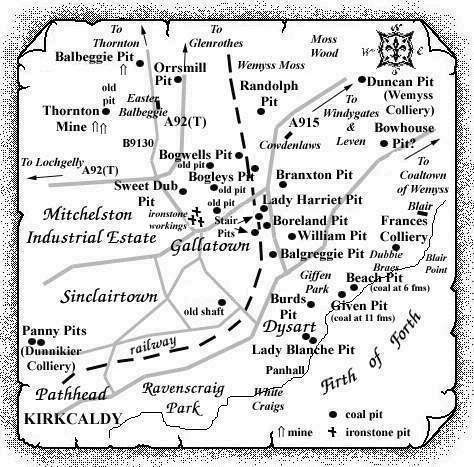
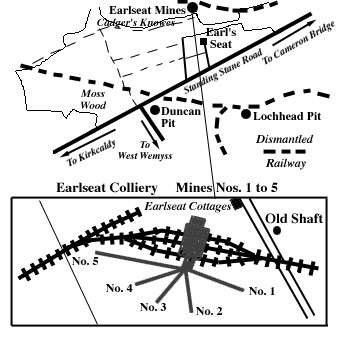
The Duncan Pit lay just to the south of the Standing Stane
Road about half a mile north-west of the Lochhead Farm which
gave its name to the old Lochhead Pit in that area. Making
its initial appearance in a colliery record of 1882 as
Duncan's Pit, it was indicated as working the Parrot seam
at a depth of 37½ fathoms.
This short-lived pit, working the Dysart Main seam, ceased
coaling in 1891 but was retained as an air-shaft for
neighbouring pits well into the 1930s. No detailed records on
the nature and quality of the coal seams wrought at the
Duncan Pit have been found to date but sources indicate that
the Duncan's winding engine, and a few other pit-head
features, were shipped about half a mile east to be used at
the Lady Lilian Pit (sinking commenced 1890).
Linked by rail to the Lady Lilian (later re-named Lochhead),
the Duncan Pit's rail sidings are reported to have been
used for Lochhead Pit waggons for many years, the last
sidings being removed around the start of the Second World
War.
 |
 |
----------------------------------------------------------
| Source Date of Information Supplied |
|---|
| Manager / Under-Manager / Men underground / Men above ground / Coal seams worked / Shaft Details |
| 1882 (R. G. E. Wemyss) |
| Duncan's: A.
Crookston / ---------- / 212* / 63* / Parrot
D'cast (12 x 5) 223 ft. : U'cast ( 9 ft. dia.) 213 ft. Natural ventilation. * Manpower also includes Victoria, Lady and Hugo Pits. |
| 1890 (R. G. E. Wemyss) |
| Duncans: Andrew
Crookston / ---------- / 149 / 19 / Dysart Main
D'cast (12 x 5) 223 ft. : U'cast (9 ft. dia.) 213 ft. Fan ventilation. Fan (Schiele), 4½' dia. |
----------------------------------------------------------
| Plans of Abandoned Seams for Duncan Pit | Pits or Mines designated in Plans |
|---|---|
| COAL; Dysart Main (Upper and Lower Leaf) |
WEMYSS Duncan |
| COAL; Dysart Main (1890) | DUNCAN |
| COAL; Dysart Lower; Dysart Main (1 September, 1926) |
EARLSEAT Nos. 1, 2, 3, 4, 5; Duncan |
----------------------------------------------------------
"The Scotsman"
3 May, 1887
IMPORTANT FIFESHIRE ARBITRATION CASE. - In the Royal Hotel, Edinburgh, yesterday, the hearing of evidence was begun in an arbitration case between Mr R. G. Erskine Wemyss and the Earl of Rosslyn, regarding the working of the coal under the lands of the former by the latter. Mr Erskine Wemyss claims that Lord Rosslyn, as his lessee, should work the coal leased by him on what is known as the "long-wall" system, as at present in use at the Duncan pit on the Wemyss estate, which would thereby have the effect of largely increasing the lordships derived by him from the mineral field. On the other hand Lord Rosslyn, as lessee, contends that, he is not bound to work by the method in use at that pit. The parties have referred the dispute to Mr Landale, M.E., and Mr John Williamson, M.E., who have selected Mr Mungall to be oversman in the arbitration. The case is expected to last ten days, as a large number of witnesses have to be examined on both sides. The amount at stake is stated to be between £40,000 and £50,000. ...
----------------------------------------------------------
"The Scotsman"
28 May, 1887
A FIFESHIRE MINING ARBITRATION CASE. - Judgment has been given by the oversman in the arbitration case between Mr R. G. Erskine Wemyss and the Earl of Rosslyn regarding the working of the coal by the latter under the lands of the former. Mr Erskine Wemyss claimed that Lord Rosslyn, as his lessee, should work the coal leased by him on what is known as the "long-wall" system, as at present in use at the Duncan Pit on the Wemyss estate, which would thereby have the effect of largely increasing the lordships derived by him from the mineral field. On the other hand, Lord Rosslyn, as lessee, contended that he was not bound to work by the method in use in the pit. ... The oversman [Mr James Mungall, manager, Clyde Iron Works] has decided that it is not practicable to work the seam as it at present exists in the Francis and Randolph pits by the long-wall method, thus settling the dispute in favour of Lord Rosslyn. ...
----------------------------------------------------------

"Dunfermline Press"
10 September, 1887
WEMYSS - MINER KILLED
On Thursday, a miner named David Reid, twenty-five years of age, and residing in Dysart, was killed in the Duncan Pit by a heavy fall from the roof. Deceased was only lately married.
----------------------------------------------------------
"The Scotsman"
12 March, 1890
MINER KILLED IN A WEMYSS MINE. - A miner named John Dryburgh, aged 20 years, was killed in the underground workings of the Duncan pit on the Wemyss estate. He was engaged at what is known as "sapping" the roof at the coal face, when a large quantity of it gave way and fell upon him, crushing him to death.
---------------------------------
"Dunfermline Press"
15 March, 1890
WEMYSS - FATAL MINING ACCIDENT
On Tuesday, an accident took place at the Duncan Pit, Wemyss Colliery, whereby a young man named John Drysdale, residing at Coalton of Wemyss, lost his life. It seems that Drysdale was engaged in the underground workings at the face of the coal, and was "tapping the roof", when a portion of it gave way and fell upon him.
[See Memorial Book - DRYBURGH, John]
--------------------------------------------
"Dunfermline Press"
8 August, 1891
WEMYSS - FIRE AT COAL PIT
Fire broke out in the Duncan Pit at West Wemyss Station a few days ago, and, notwithstanding that efforts were immediately made to have it extinguished, the output of the pit since Saturday has been practically stopped.
--------------------------------------------
