Owner: possibly Mr Durham, Largo
Williamson & Co. (1842)
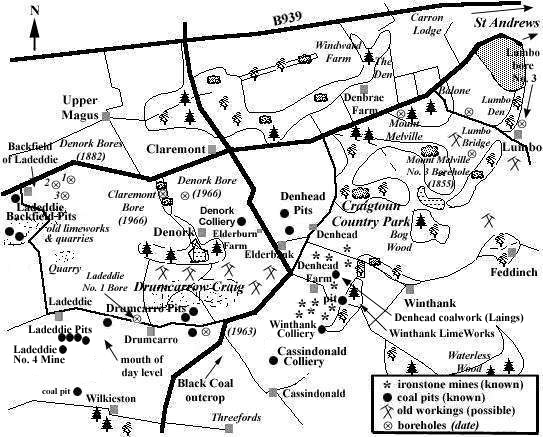
Drumcarrow (Drumcarro) Colliery, dating from the mid-18th
century, employed 50 workers in 1842 and included the Crop
and Dean Pits.
Located ¼ mile to the west of Drumcarrow Farm, this old
colliery, which also had an engine pit (exact location not
known), was closed around 1850.
 |
 |
|
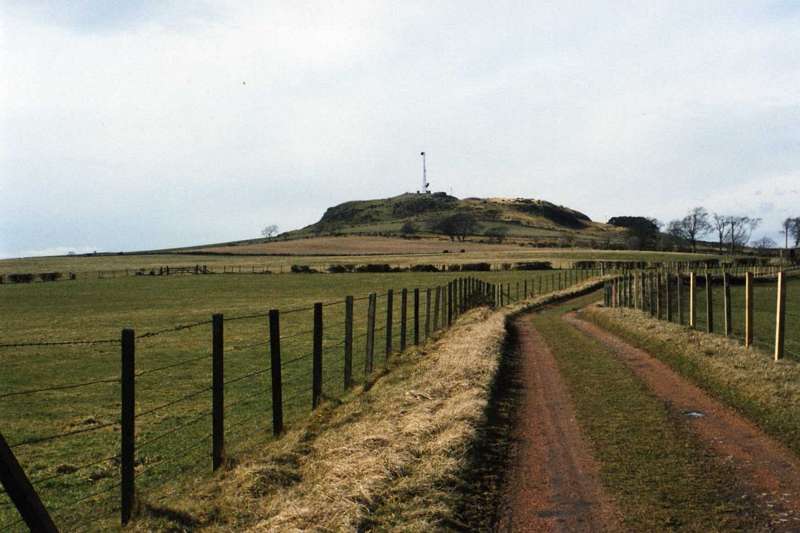
Drumcarrow Craig from Winthank coalfield |
Statistical Accounts of Scotland (1795)
Parish of Cameron
"... upon the lands of Lathockar, belonging to Miss Scott, who, it is to be hoped, when she arrives at majority, will give proper encouragement to cultivate that barren spot. What has been of singular service in making such an alteration is the limestone and coal, with which this parish abounds." ...
" ... The article of coals is very much advanced in price within these 40 years: A cart load at the hill cost only 1s. 4d.; but now, for the same quantity, 3s., and sometimes 3s. 6d. is paid. Indeed, it must be owned, that the expense of working coal is greatly increased. Two fire engines are employed for that purpose, in this parish, by Mr. Durham of Largo, and the coal-hewers receive more wages. Adjacent to one of these fire engines, he has lately erected a number of houses to accommodate the workmen." ...
Unfortunately, this account does not identify the
location of these old coal-works within Cameron parish.
M Martin & Webmasters
------------------------------------------------
"The Scotsman"
11 September, 1833
SPINNING MILL, &c. AT CUPAR FOR SALE.
... A coal-work is now opened at Drumcarrow, only three miles or thereby from Cupar where coals could be obtained for the Engine at a moderate rate. ...
------------------------------------------------

"Fifeshire Journal"
12 April, 1838
ACCIDENT
On Wednesday the 4th instant, an accident of a serious nature occurred at Drumcarro colliery. While three men were in the act of ascending the pit after their day's work, by some inadvertency one of the hooks had not been put right into the bucket, and unfortunately coming out when they were a considerable distance from the bottom, one of the men, of the name of William Wallace, fell away and was killed on the spot. The other two held by the chain until lowered again to the bottom and relieved.
------------------------------------------------
Drumcarrow Colliery in 1842
In 1842, a parliamentary commission reported on the
employment of women and children in coal mines.
Of the mines in East Fife, the commissioners reported:
"The collieries in the district of St Andrews and
Cupar are worked to very limited extent, and no females or
very young children are wrought below. The only novelty that
attracts attention is the peculiar character of the coal at
Drumcarra, Largo Ward and Teasses, which spontaneously fires.
At Drumcarra, a portion of the coal wall is on fire, and the
smoke causes not infrequently a complete cessation of labour
from the 'stifle' arising therefrom."
The evidence given by mineworkers to the commissioners
presents a striking picture of working conditions
underground.
"We employ about 50 persons in the mine; 15 are
under 18 years of age and nine boys 10, 12 and 14 years of
age; very young people are of no use here, as much caution is
required from the nature of our coal which is frequently on
fire ... No accidents have taken place from the stifle which
the burning produces ... many of our present colliers were
labourers in the fields; they are generally good workmen,
although they are called grass-colliers."
Alexander Telfer, overseer
"The pit is much troubled with fire-stifle, which
sends the men to sleep ... when men are overcome with the
stifle, we take them into the fresh air, which brings back
their senses."
Alexander Smith, aged 14, hewer
"Began to work on coal three years ago; left farm
service, as the coal work was likely to pay better; can earn
2s. 6d. to 3s. a-day when work is regular ... Service is
preferable to coal work, but my wages were only 4s. 1d.
a-year, and I had to clothe myself; would not have left, only
father wished me; a little brother is now below opening the
traps; he is twelve years old and has been down nine
months."
Andrew Ferres, aged 17, hewer
--------------------------------------------
"Fifeshire Journal"
22 June, 1843
DRUMCARRO COLLIERY
REDUCTION IN THE PRICE OF COAL
THE Public are respectfully informed that the
COALS at this Colliery are to be REDUCED Twopence per Load
of 4 cwt. from and after the 23d current.
Drumcarro, 20th June, 1843.
--------------------------------------------
"The Scotsman"
8 June, 1844.
SCOTS BANKRUPTS.
EXAMINATIONS, &c.
... Creditors of Charles Eldred Maillardet, sometime tenant of the Drumcarro Coal Works, now in Crail, meet in Dickson's Inn, Crail, 18th June, at twelve o'clock. ...
--------------------------------------------
| See also menu links to 'Children' and 'Historical' |
|---|
Statistical Accounts of Scotland (1845)
Parish of Cameron
"In almost every part of the parish, either coal, freestone, trap, whinstone, or limestone may be found. There is at present good coal got at Drumcarro. Limestone is wrought at Radernie and Winthank."
"Plenty of coals can be procured at Drumcarro, in the parish, and at Largoward, bordering upon the parish but situated in that of Kilconquhar, - which cost, on an average at both places, 1s. 6d. per load of 3 cwt."
Parish of Ceres
"... Beyond Kinninmont the coals are broken up, and some of them driven aside by the eruption of the trap hill of Ladedda. The thick coal and other five of the seams are tossed up to the top of the hill of Drumcarro, where they are regularly wrought. The south slope of Ladedda-hill has many marks of old pits upon it, proving that the coals pass along there." ...
| See also Drumcarrow (East) Pits for information on a group of pits known to have been located just over ¼ mile east of the farm. These pits are known to have worked in the 1850s and may have closed by the 1860s. |
|---|
--------------------------------------------
"Fifeshire Journal"
28 JUNE, 1849
DRUMCARRO COAL
THE SUBSCRIBERS beg to intimate to the Public
that they have always a Supply of MAIN COAL at 6s. 8d. per Ton.
Also Small do. At 3s. 4d.
Orders from St Andrews will be received by John
Forrester, Merchant, Church Street.
Drumcarro, 26th June,
1849.
--------------------------------------------
"Fifeshire Journal"
8 March, 1849
TO COAL PROPRIETORS
FOR SALE, by Private Bargain, at DRUMCARRO COAL-WORK, near St Andrews -
TWO WINDING GIGS, Two STEELYARDS, FLAT ROPE and
CHAIN (Eighty Fathoms each), SPEAR PLATES, SMITHY TOOLS, PULLIES,
PIT WOOD, &c.
Apply to MR WILLIAMSON, Mining Engineer,
Edinburgh; or MR ALEX. TELFER at the Work.
--------------------------------------------
"FIFESHIRE JOURNAL"
April, 1850
FATAL COAL-PIT ACCIDENT
On Friday last, a man named David Small, a collier, residing at Damhead, in the parish of St Andrews, while employed in putting up a partition in one of the shafts at the Drumcarro Colliery, was suddenly exposed to a current of foul air, which producing stupefaction, he fell off the scaffold on which he was working, and was precipitated to the bottom, a height of about thirty feet, where he was killed.
--------------------------------------------
Information on coals worked at, or near, Drumcarrow Pits
(based on a report from 1900)
Five or more coal seams, having a north-westerly dip of 20°, were worked on the lands of Drumcarrow farm. At the bottom lay the Eight Feet seam and at the top the Ten Feet seam. At the west end of Drumcarrow Craig, however, the seams were found to be greatly disturbed and thrown on end.
... and in a report from 1977 ...
... A thick coal seam was formerly worked, as the 'Main' or 'Thick' Coal, at the group of pits midway between the farms of Drumcarro and Ladeddie. The colliery closed down in 1850, and according to Gemmel's unpublished report of 1900, the last engine pit was 65 fathoms with coal seams as follows:
| Description | Thickness at depth in shaft |
| Splint Coal | 3 ft. 3 in. thick at 23 fms. |
| Main Coal | 10 ft. to 12 ft. thick at 53 fms. |
| Four Feet Coal | 4 ft. thick at 61 fms. |
| Eight Feet Coal | 6 ft. thick at 65 fms. |
This record is derived from a number of earlier reports
which date from between 1753 and 1850. The highest or
'Splint' seam was also known as the 'Five
Feet' seam in some reports; estimates of its thickness
range from 3 ft. 4 in. to 4 ft. 11 in.
The 'Main' or 'Thick' seam was subject to
spontaneous combustion which caused trouble throughout the
life of the colliery. According to Gemmel's report the
thickness of strata between the Four Feet and the Eight Feet
seams is 3 fathoms but in an unpublished report (1841) by
Landale it is stated that this interval varies from 3 ft. 3
in. to 11 ft. 6 in.
Telfer (1842, unpublished report) gave the thickness of the
interval as 7 ft. 6 in. including 20 in. of coal. In Ladeddie
No. 1 Borehole the interval is 3 ft. 3 in.
Early reports mention other workable coals above the
'Splint' seam, but these records were ignored by
Gemmel.
A series of exploratory boreholes was put down in this area
by the Opencast Executive of the National Coal Board in 1953,
proving a sequence very similar to that quoted by Gemmel.
Ladeddie No. 1 Borehole cut a seam just over 10 ft. thick, in
three leaves, at just over 11 fathoms, a waste at 19 fathoms
and an 11 ft. 9 in. seam in four leaves just below the last
at around 22 fathoms.
The uppermost seam probably represents the 'Main'
coal while the waste and lower coal probably represent the
'Four Feet' and 'Eight Feet' coals
respectively. Stratigraphically higher beds were encountered
in four other bores of the series which were sited a short
distance to the west of No. 1 Borehole near the old engine
pit.
These bores did not provide a complete record of the strata
above the 'Main' coal but if dips are taken into
account, the logs can be pieced together to reveal an
apparently unfossiliferous sequence 33 to 49 fathoms thick
containing at least four thin coal seams, of which two appear
to have been worked.
One of the worked seams probably represents the
'Splint' coal of Gemmel's account.
This sequence at Drumcarrow (West) Colliery may be compared
with the higher part of the Ceres succession. The preferred
correlation links the 'Main' coal of the Drumcarro
area with the Ceres Thick Coal, the 'Four Feet' coal
with the Ceres Upper Four Foot Coal and the 'Eight
Feet' coal with the Ceres Six Foot Coal.
The beds above the 'Main' coal cannot easily be
related to the Ceres sequence.
| Plans of Abandoned Seams for Drumcarro | Pits or Mines designated in Plans |
|---|---|
| IRONSTONE. |
WINTHANK AND DRUMCARRO
Ball's; Sims; Whin |
| COAL; Five Feet; Eight Feet; Main | DRUMCARRO |
| COAL; Five Feet; Eight Feet; Main; Splint; Parrot (1836) |
DRUMCARRO
Crop; Dean |
| COAL; Five Feet; Eight Feet; Main; Splint | DRUMCARRO |
| COAL;
Upper Four Feet; Main (1840)
IRONSTONE (1867) |
DRUMCARRO |
| Also see Coalfields link: Old
Coalfields of East Fife
for seams in Drumcarro and Ceres districts |
|---|
