| Mention Dysart Colliery in mining circles and most
people will probably be able to tell you of the Frances
Colliery, its proud headframe having undergone recent
refurbishment. Delve a bit deeper and some may recall
that there was once the old Lady Blanche Pit down by the
shore. The locals may tell you that the Randolph Pit,
some distance from the shores of the Firth of Forth, was
also part of the Dysart workings, but only the oldest of
miners, or researchers like ourselves, would be able to
list around a dozen more old workings in this ancient,
world-famous Fife coalfield.
M Martin & Webmasters. |
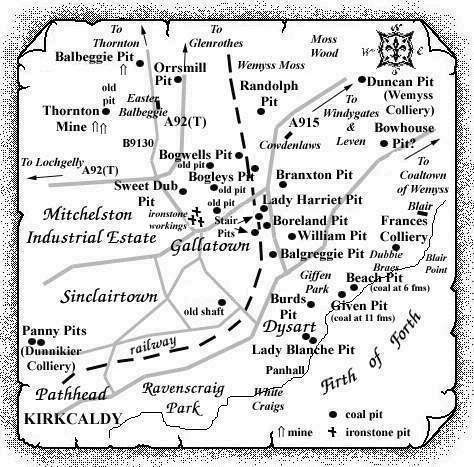
Dysart pits identified so far include:
Balbeggy (or Balbeggie); Balgreggy (or
Balgreggie); Beach; Boglees; Bogwells; Boreland; Branxton;
Burds; Fitzroy; Frances; Given; Lady Blanche; Lady Harriet;
Orrsmill; Randolph; Stair; Sweet Dub; William
The nature of the early Dysart coal-works is described in
an early Statistical Account (see later).
While most of the smaller pits named above operated during
the mid-late nineteenth century, the Lady Blanche, Randolph
and Frances pits of the Dysart field, owned by the Earl of
Rosslyn's Collieries Ltd., were purchased by the Fife Coal
Company in July, 1923. The Frances Surface Mine was opened,
just to the north of the main shaft area, in the following
year.
 |
Dysart Colliery
| Source Date of Information (Owner) |
|---|
| Manager / Under-Manager / Men underground / Men above ground [Pit/Mine] / Coal seams worked |
| early 15th century (Henry, Earl of Orkney) |
| 1729 (Lord Sinclair)
(John Sinclair was coalgrieve to Lord Sinclair at this time.) |
| 1760 (James St.
Clair)
Dysart Colliery - 18th C employees (full service dates unknown) James Adams, overseer, coal works at Dysart David Lauson, coal grieve in Dysart, 1784 |
| 1791
(105 employed at Dysart coal-works) (24 employed as ironstone miners) |
| 1798
John Veitch, late tacksman, salt-works, Dysart - died 30 Nov 1798 |
| 1838
Mr Anderson, colliery grieve. |
| 1842 Messrs Beveridge & Smith, Lessees Mr. David Butt, overseer. |
| 1847 (Earl of
Rosslyn) Dec: Mr Cumberland Watt, manager. |
| 1857 (Earl of Rosslyn) |
| 1869 (Earl of Rosslyn) |
| 1886 (Earl of Rosslyn) |
| April: A. G. Patterson, colliery manager. |
| 1890 (Earl of Rosslyn) |
| A. G. Patterson / C.
Methven / 212 / 55
[Lady Blanche, Randolph and Francis pits listed in record.] Earl of Rosslyn died 6 September, aged 57 years. |
| 1896 (Earl of Rosslyn) |
| A. G. Patterson / John Hope / 252 / 62 [Dysart] |
| Manufacturing and steam coals. |
| 1902 (Earl of Rosslyn Collieries Ltd.) |
| A. G. Patterson / Thomas Pattinson / 315 / 92 [Dysart] |
| Manufacturing and steam coals. |
| 1904 (Earl of Rosslyn Collieries Ltd.) |
| John Irvine / ------------ / 354 / 70 [Dysart] |
| Manufacturing and steam coals. |
| 1905 (Earl of Rosslyn Collieries Ltd.) |
| John Irvine / ------------ / 363 / 88 [Dysart] |
| 1908 (Earl of Rosslyn Collieries Ltd.) |
| John Irvine / S. Clarkson / 605 / 21 [Dysart] |
| 1911 (Earl of Rosslyn Collieries Ltd.) |
| ------------ / ------------ / 642 / 133 [Dysart] |
| 1916 (Earl of Rosslyn Collieries Ltd.) |
| Aug: Mr John Clark, appointed colliery manager, ex-Aitken Colliery, Kelty. |
| 1918 (Earl of Rosslyn Collieries Ltd.) |
| David Reid / John
Loudon / 616* / 178* [Lady Blanche and Frances]
James Saunders, manager, Randolph Pit * manpower figures relate to all three Dysart pits |
| 1923 (Fife Coal Company Ltd.) |
| June: Fife Coal Company purchase the Dysart Colliery. |
| 1924 (Fife Coal Company Ltd.) |
| June: Mr John Clark, appointed agent at Bowhill Colliery. |
| 1928 (Fife Coal Company Ltd.) |
| Robert Aitchison / Joseph Bell / 637 / 127 [Dysart] |
| Household and steam coals. Dysart Main, Lower Dysart, Boreland and Sandwell. |
| 1938 (Fife Coal Company Ltd.) |
| A. B. Sanderson / William White (Pit) : Andrew Hutt (Surface Mine) / 639 / 185 [Frances] |
| 1945 (Fife Coal Company Ltd.) |
| Alex. Thomson / William White / 623 / 180 [Frances] |
| Household coals. Eight Feet, Lower Dysart, Wall and Boreland. |
| 1947 (NCB) |
| William Livingstone / William White / 680 / 196 [Frances] |
| Household,
industrial and steam coals.
Approximate annual output = 265,300 tons |
| 1948 (NCB) |
| William Livingstone / William White (Pit) : Andrew Hutt (Surface Mine) / 650 / 221 |
| Gas, household and steam coals. Wall, Eight Feet, Boreland, Sandwell and Lower Dysart. |
| 1951 (NCB) |
| William Livingstone / T. Smith : A. Wallace / 864 / 224 [Frances Pit and Surface Mine] |
| Household coals. Lower Dysart, Sandwell, Chemiss and Six Feet. |
| 1958 (NCB) |
| A. Cairns / W. Clark : E. Daily / 1174 / 308 [Frances] |
| Household, industrial and steam coals. Barncraig, Branxton, Lower Dysart, Lethamwell, Coxtool, Bowhouse, Chemiss. |
| 1959 (NCB) |
| A. Cairns / W. Clark : E. Daily / 1116 / 278 [Frances] |
| Household, industrial and steam coals. Boreland, Branxton, Lower Dysart, Lethamwell, Coxtool, Bowhouse, Chemiss. |
| 1961 (NCB) |
| D. Patterson / W. Clark : E. Daily / 1113 / 270 [Frances] |
| Gas, household, industrial and steam coals. Barncraig, Lower Dysart, Lethamwell and Chemiss. |
| 1964 (NCB) |
| D. T. Patterson : Asst. J. Wallace / W. Clark : J. Lawrie / 1033 / 206 [Frances] |
| Household, industrial and steam coals. Barncraig, Lower Dysart, Lethamwell. |
| 1971 (NCB) |
| J. C. Kennedy / W. Clark : J. Lawrie : A. Bennet / 964 / 204 [Frances] |
| Household, industrial and steam coals. Coxtool and Bowhouse. |
| 1973/74 (NCB) |
| J. C. Kennedy / W. Clark : J. Lawrie : A. Bennet / 919 / 178 [Frances] |
| Household, industrial and steam coals. Coxtool and Bowhouse. |
| 1977/78 (NCB) |
| J. C. Fox / W. Clark
: A. Bennet / 718 / 159 [Frances]
Mechanical Engineer: J. M. Justice / Electrical Engineer: R. Simpson |
| 1979 (NCB) |
| Vacant / W.
Clark : A. Bennet / 718 / 159 [Frances]
Mechanical Engineer: A. Little / Electrical Engineer: R. Simpson |
| Household, industrial and steam coals. Bowhouse. |
| 1980/81 (NCB) |
| J. Souter / W. Kerr
: A. Bennet / 718 / 159 [Frances]
Mechanical Engineer: A. Little / Electrical Engineer: R. Simpson |
| Household, industrial and steam coals. Bowhouse. |
| 1982 (NCB) |
| J. Souter / W. Kerr
/ 718 / 159 [Frances]
Mechanical Engineer: R. H. Watson / Electrical Engineer: R. Simpson |
| Household, industrial and steam coals. Bowhouse. |
| 1984 (NCB) |
| J. Souter / J.
Sorbie / 718 / 159 [Frances]
Mechanical Engineer: R. H. Watson / Electrical Engineer: A. Thomson |
| Household, industrial and steam coals. Bowhouse. |
| 1987/88 (NCB) |
| W. Miller /
Vacant / 718 / 159 [Frances]
Mechanical Engineer: R. H. Watson / Electrical Engineer: W. L. Wilson |
| Household, industrial and steam coals. Bowhouse. |
| Frances Colliery actually ceased coaling in 1984 following fires in the workings. |
The earliest record we have found to date, for Dysart,
states that Henry, the Earl of Orkney, was operating small
coal-works around 1407/1408, digging the principal Dysart
Main seam which cropped out on the shore near Dysart. [The
Dysart Main seam which varied from 20 ft. to 30 ft. in
thickness was to be worked for over 500 years. The seam was
one which was apt to spontaneously combust and fires which
gave off carbon monoxide were to prove frequent throughout
the history of the colliery.]
In the 15th Century, the process of working coal was of a
very primitive type. The coal seams were attacked at the crop
on the shore or in the banks of streams, drainage being
effected by following up the coal-getters with simple
trenches. When these trenches became too deep, mining
underground became the next option and shallow pits or
"sinks" were put down on the levels at intervals,
with a view to supplying fresh air to the
"rooms".
David Elcho, the second Earl of Wemyss, is reported as having stated in 1643 of another well-known coal seam of the Dysart coalfield, that the Bowhouse seam was a coal 10 ft. thick "first found in Dysart ground east of the Dobbie Craig at the playfield where the witches is burned".
Dysart was one of the busiest ports in Fife centuries ago, the trading with the 'Low Countries' being such as to give Dysart the name 'Little Holland'. Coal shipments were also reported to be taking place in the late 16th Century to Portugal, France and the Baltic. Records show that between 1551 and 1560, Dysart exported 1,000 tons of coal; 7,000 tons between 1560 and 1600; and 60,000 tons between 1631 and 1640. The tendency for the Dysart Main to combust spontaneously is reported to have caused several fires in ship's holds, particularly on long voyages.
James St Clair, in 1760, is reported to have left notes in his Charter Room of all his coals in the Barony of Ravenscraig and Dysart pointing out that ancestors, who had been mining in the 17th Century, brought about "many ruinous and destructive consequences." He also tells how the winning of the Dysart Main coal was interrupted several times by fire.
In 1753, an engine pit was sunk 258 ft. to the Dysart Main seam for pumping. It is recorded that this engine pit later became the Lady Blanche No. 1 Pit. A dook was apparently driven to Balbeggy Pit in 1831 and coal was taken up to the Bogleys Pit until 1848.
The saltworks at Dysart were owned by the Earl of Rosslyn,
the colliery owner, and when Robert Bald, a prominent mining
engineer, reported on Dysart Colliery in 1817, there were
only six pans in operation. He commented that " ...
without the salt pans at Dysart to consume the small coal,
the Dysart coal cannot be wrought on account of its
spontaneous ignition if left below ground." This
situation had led to a series of fires, as mentioned earlier,
one of which burned for a number of years. The nature of this
coal may have put onward costs on the production of salt.
Bald recommended that " ... the pans can either be
let at a fixed price or by certain royalty paid on the small
coal consumed on them ...".
But this was to no avail as the result of the repeal of the
Salt Duties of 1823 led to the end of the saltworks at Dysart
soon after.
In 1842, Mr. David Butt, overseer of the Dysart Colliery, submitted to the Commission, "Our coal is 22 feet thick and we quarry the same from top to bottom; and horses draw from wall-face to the pit-bottom on main roads trammed with iron; the lowest horseway is six feet high. We have no other method of ventilating our pits than by leaving open unemployed shafts".
Orrsmill Pit, to the south of Thornton, operated with 37 square pillars with rooms 17 ft. wide. The saltpans it supplied were closed down as unprofitable in 1839. Although the Lady Harriet had been refitted around this time, coal working ceased at this pit in 1852. It was re-opened a short time later but closed again in 1857 when the nearby Branxton Pit was opened.
At the Tyrie coalfield, Dysart, the Griffon Pit [later Given Pit?] was reported as working the Sandwell coal seam around 1845. The same seam was also worked in the 1840s by the Bogleys and Lady Harriet Pits; in 1845 by the William Pit; and in 1871 by the Branxton Pit.
From Statistical Accounts: Parish of Dysart (1795)
"... The mines are coal and ironstone. There are
14 beds of coal in the Sinclair estate. Most of them are
thin, and have been wrought out above the level of the sea.
Three of the thickest of these beds, which are near one
another, are now working. The uppermost bed is 5 feet thick.
The distance between it and the second bed, is 18 inches,
being a foot of coal, with 3 inches of till above and under
it. The 2nd bed of coal is 8 feet thick; under it, is a bed
of stone and till 2 feet 3 inches; and under it the 3rd bed
of coal, 5 feet thick*.
* The metals cut through in getting to the coal, are, 1st,
next the surface, 2 fathom brownish stone; 2nd, 14½
fathom till, very close; 3rd, 8 fathom brownish stone,
porous, and mixed with iron veins; 4th, 7 fathoms till, mixed
with thin beds of freestone, hard; 5th, 2 fathom blueish
stone, very hard, must be wrought with gunpowder; 6th, 6
fathom till, mixed with thin beds freestone; 7th, ½
fathom, a hard coarse coal, mixed with stone, which is
immediately above the beds of coal that are wrought, and is
left for a roof.
They are now working these beds of coal 60 fathoms below the
surface. The water is raised by 2 steam engines: the coals
are raised by 3 horse gins. Horses are employed under ground
to bring the coals to the pit bottoms. The average quantity
of coals raised annually for 7 years preceding 1791, is
15,267 tons, value £4000, and 7000 tons of culm, value
£583; 105 persons are employed**.
** Dysart coal was amongst the first wrought in Scotland,
having been begun more than 300 years ago. It was on fire
nearly as far back. It is said to have had periodic eruptions
once in 40 years; a remarkable one in 1662. This fire is
supposed to have been occasioned by pyrites, which is found
in this coal. ... The effects of it may still be traced by
the calcined rocks from the harbour, more than a mile up the
country. The road from the harbour is called Hot Pot Wynd,
and another near it, the Burning. In the beginning of this
century, the flames were seen at night coming out of the pit
mouths. In 1741, the coal was set on fire by a lime kiln,
which had been placed too near it. It did not burn violently;
but was not extinguished for some years. In 1790, it again
took fire, from what cause is unknown. It did not burn with
fury; but occasioned much smoke and bad air. The colliers
were prevented from working for some months. It is now
extinguished. The means used, were to exclude the air as much
as possible, and to allow the water to rise by stopping the
engines. Dysart coal has a strong heat; but being slow in
kindling, and having much ashes, is not so pleasant for rooms
as some lighter coals. It dips to the S. E. (most of the
metals on the sea coast of this parish dip the same way) 1
fathom in 3 near the shore; but is flatter as it goes north.
There are 5 beds of ironstone, which being near each other,
are wrought at the same time. They lie below the coal; and as
they dip the same way, are wrought to the W. of it, where
they come nearer the surface; 24 men are employed in this
work, who raise 2080 tons annually. A ton of stone yields
about 1200 weight of iron. ...
... Borland was begun in 1736, for accommodating the
colliers, and has been since increased. It contains 196
inhabitants. ... The causes of this increase of population
are, an Antiburgher meeting-house being erected at Pathhead,
which drew those of that persuasion near it; the advantage of
being near coal, and the encouragement for labour about the
coal-works; and what has contributed much more than either,
the rapid increase of the manufactures. ...
Salt was made here [Dysart], at least some time before 1483,
as appears by an agreement with the family of St. Clair, of
that date. The works were more extensive than at present.
There are vestiges of many salt-pans, which have been
demolished long ago. Much salt was exported to Holland; but
none of late years. Seven pans are now going, and employ 14
salters, besides 2 or 3 hands occasionally to carry the salt
to the granaries. About 17,100 bushels are made annually,
value £1200. The fuel employed is chiefly culm. 120
loads are required to make 100 bushels of salt. ...
As to foreign exports and imports from and to Dysart
annually, there were exported 4584 tons of coal, chiefly to
Copenhagen, Gottenburgh, and the ports of Holland. ... Goods
sent coastways annually, are, 2080 tons of ironstone to
Carron-works; 3583 tons coal to Dundee, Perth, Montrose,
Aberdeen, & c. ...
The first advantage is, plenty of coal; but posterity will
not thank us for wasting it so fast by exportation. ... The
chief disadvantage is, a scarcity of good water, particularly
in the town of Dysart; the surface is much drained by the
working of the coal."
Extract : Statistical Accounts of Fife 1836
Parish of Monimail
"... Fuel, &c. - The fuel principally used is coal, brought from the parishes of Markinch and Dysart. ..."
Extract : Statistical Accounts of Fife 1843
Parish of Moonzie
"... Fuel.- The fuel commonly used is coal, either English coal brought from Newburgh or Balmerino, or Scots coal from Balbirnie or Dysart. The price varies according to the demand, and has been higher for these two last years than formerly. A single cart-load at Dysart, where they are cheapest, and which contains 12 cwt., cost 3s. 3d. To this there is to be added, tolls and carriage, which will amount to as much more. English coal are sold at Newburgh at from 4s. 6d. to 5s. the boll of 6 cwt."
Statistical Accounts: Parish of Dysart (1845)
The notes, very disappointingly, contain only a summary
of the same statements made in the Account of Dysart Parish
for 1795 and give no information whatsoever on individual
pits, miners or owners during the period since 1795.
M. Martin & Webmasters
A generalised
section of the Dysart Coalfield
(from a 1900 report)
 |
Generalised summary
of the Dysart Coalfield
(1900 report)
| Description | Thickness |
| Fms. Ft. In. | |
| Strata below the Upper Barren Red Group of Coal Measures | 47 0 0 |
| WALL COAL | 0 3 6 |
| Strata | 17 0 0 |
| BARNCRAIG COAL | 1 0 0 |
| Strata | 14 0 0 |
| UPPER COXTOOL COAL | 0 2 6 |
| Strata | 5 0 0 |
| LOWER COXTOOL COAL | 0 3 0 |
| Strata | 6 0 0 |
| DEN COAL | 0 2 0 |
| Strata | 20 0 0 |
| CHEMISS COAL | 1 3 0 |
| Strata | 10 0 0 |
| BUSH COAL | 0 3 9 |
| Strata | 58 0 0 |
| PARROT COAL | 0 3 3 |
| Strata | 6 0 0 |
| WOOD COAL | 0 3 0 |
| Strata | 6 0 0 |
| EARL'S PARROT COAL | 0 2 0 |
| Strata | 8 0 0 |
| BOWHOUSE COAL | 0 2 6 |
| Strata | 7 0 0 |
| BRANKSTONE COAL | 0 2 6 |
| Strata | 10 0 0 |
| MORE COAL | 0 1 9 |
| Strata | 13 0 0 |
| MANGIE COAL | 0 2 4 |
| Strata | 4 0 0 |
| SANDWELL COAL | 0 1 3 |
| Strata | 33 0 0 |
| DYSART MAIN COAL | 3 1 2 |
| Strata | 13 0 0 |
| SEVEN FOOT COAL | 1 0 7 |
| Strata to top of Millstone Grit | 33 0 0 |
Important
information on the general structure of the Dysart coalfield
(1900 report)
Before proceeding to consider more in detail the composition and distribution of the coal seams in the above table, it may be convenient to take notice of some important features in the general structure of the field, more especially as these must be understood before the meaning of an apparently anomalous disposition of the coal outcrops can be appreciated.
Although the coast-section (see generalised section above) supplies a fairly complete and unbroken section of the strata, this regularity disappears in the inland part of the district. The superficial breadth of the strata greatly expands and instead of the single coal outcrops that emerge on the coast, some of the seams have two outcrops.
Less than a mile from the shore, a double fold,
complicated by a powerful fault, begins to make its
appearance. The outcrops of the lower coals in this group,
i.e. those up to and including the More Coal, continue
their normal direction towards N.N.W.
The higher coals, i.e. from the Brankstone Coal seam
upwards, turn off sharply to the north-east, and the space
between the main outcrops of the two groups of coals
continues to widen, until two seams which are only distant
from each other by about 1200 yds. on the shore, are
separated by an interval of more than 2 miles.
If there were only curvature in question, and if we could
strip off all the overlying cover of drift, it would be seen
that the coal measures have here been 'ridged-up'
into an anticlinal and a synclinal fold, the axes of which
run in a N.N.E. to S.S.W. direction.
Consequently, some of the upper coals would be found to lie
in a basin or trough on the west side, and some of the seams
below them to crop out along the sides or crest of the arch.
Unfortunately, the ground is too much concealed by
superficial deposits to permit an actual sight of this
interesting structure which has only been discovered by means
of the bores and underground workings of the coal-pits.
From these same sources, we learn that the anticline has
been ruptured by a powerful fault which still further
complicates the structure of the coalfield.
The position of this fault has been proved in the southern
part of its course between Boreland and
Cowdenlaws. It must run on in a nearly northerly
direction, probably increasing in magnitude as it goes, until
it ends off against the great fault between Markinch
and the sea. The effect of this dislocation is to throw down
the strata on its western side. Hence, the lower coals, which
run continuously from the sea to Markinch along their
normal outcrop, and ought to be deep underground in the
centre of the coalfield, are actually brought to the surface
on the east side of the fault. Although it has not been
actually identified, there is reason to suppose that a least
the upper part of the Millstone Grit may also come up above
the ground towards the valley of the River Leven.
While the dislocation of the Dysart coalfield is under
description, reference may be made to the other more
important faults by which the coal seams have been displaced:
1. One passes in a south-easterly direction through
Earl's Seat, a mile to the east of Thornton
Junction, and it shifts the outcrops of the Seven
Foot and Dysart Main Coals about 400 yds., with a
downthrow to the west.
2. Another still more powerful fault strikes from this last
one near Earl's Seat, and runs in an E.N.E.
direction to the sea at Broadhill Rocks, near
Buckhaven. It has a southward downthrow of 60 or 70
fathoms, which increases eastward to 100 fathoms, and it
shifts the outcrops of the coals westwards for three-quarters
of a mile.
3. Another fault, lying further north and running inland
from a little south of Methil, by Muiredge and
The Maw, has a downthrow to the south of 30 to 45
fathoms.
Further north lie the great parallel faults which have cut the coalfield and Millstone Grit into 'slices' with a persistent downthrow to the south.
-------------------------------------------------
"The Scotsman"
7 March, 1827
COALS AND SALT WORK IN FIFE,
TO BE LET.
To be Let, for such a number of years as may be agreed on.
THE COLLIERY and SALT WORKS of DYSART, containing several Seams of Coal,
with the Engines and Machinery.
The Main Coal is upwards of twenty feet
thick; the under, or nine feet Coal, contains a valuable bed of Cannel or
Parrot Coal, suitable for Gas Works; and immediately adjoining, are valuable
Bands and Balls of excellent ironstone.
For particulars apply to Mr Bain,
factor, at Dysart House; or to Mr Bald, mining engineer, 7, North St David
Street, Edinburgh.
Dysart, 21st Feb. 1827.
-------------------------------------------------
"The Scotsman"
3 February, 1830
Dysart. - The new dock in Dysart, will not be finished so soon as was at first anticipated. A factious spirit and a want of money among that venerable body, the Town Council, by whom the work is carried on, was the first cause of this delay, but a second cause has since arisen. Lord Rosslyn imagines that a wet dock there will have a tendency to destroy his coal; and a celebrated engineer has confirmed this opinion, by stating the possibility of such a catastrophe. Improbable though this may be, the law's delay, as Shakespeare says, will in all likelihood protract the work for some time.
-------------------------------------------------
"Fife Journal"
6 July, 1833
DYSART
All is still here. The clay trade is over, the coal trade grows dull, the noise of a wheel-barrow on the streets creates alarm ....
------------------------------------------------
"The Scotsman"
29 August, 1838
NARROW ESCAPE. - On Saturday last, as Mr Anderson, the grieve at Dysart colliery, was attending to his duty on the coal-hill, he was without ceremony set upon by an ass, which fastened upon one of his legs, and instantly upset him. The animal kept its hold firmly for some time, braying wildly, and worrying, and shaking its victim about as a terrier would have done a rat. The bystanders were "in a peck o' troubles", when fortunately a young gentleman who was close by, observing Mr Anderson's perilous situation, hastened to the spot, and with great presence of mind, thrust his hand forcibly up the animal's nostril, and thereby caused it to quit its hold. Mr Anderson was rescued in a very exhausted state, and his leg is severely lacerated. The ass is now muzzled, as all asses ought to be.
------------------------------------------------
During our expansion of information for the Children section (see Menu 1) we observed in the 1842 Commission Report from Dysart Colliery, a mention of David Archibald being killed, in February 1841, as a result of an accident involving a chain. (See below).
M. Martin & Webmasters.

- No. 419 - David Butt, overseer:- Employ 30 male adults, 15 young men, and three boys; the latter are used as horse-drivers. No females have been wrought in our mines for 12 years. The work is very heavy, as our coal is 22 feet thick and we quarry the same from top to bottom; and horses draw from wall-face to the pit bottom on main-roads trammed with iron; the lowest horseway is six feet high. Several accidents have occurred; only two lately. Andrew Adamson broke two ribs six weeks since and David Archibald was killed by the chain coming off the pillar-wheel the middle of last February. We have no other method of ventilating our pits than by leaving open unemployed shafts, which are six in number and two employed, leave eight openings. We have a school near the colliery, to which the children of colliers are sent on moderate fees; girls as well as boys attend. The girls after they are educated are employed in the fields, bleachfields, &c and many are sent out to respectable service.
------------------------------------------------
"Fifeshire Journal"
19 December, 1844
A fatal accident occurred here at the New Colliery on Thursday morning last, the sufferer being one of the colliers, called Michael Paton, a young man, a native of Markinch. The unfortunate man was employed with a number of other workmen in removing a bed of tiles or stone from the roof of the mine, when a large part of the loose material came off suddenly and fell upon Paton, who was literally covered or buried beneath a mass of stones and rubbish. The death of the poor man was instantaneous. His father and grandfather were also killed in a similar manner a few years ago.
------------------------------------------------
"Fifeshire Journal"
26 June, 1845
On the morning of Friday last, a man belonging to the Boreland was instantly killed in the coal mine at Thornton, in consequence of the falling of a large stone upon him from the roof of the mine in which he was working. His name is Adamson. His brother was at work at his side at the time the stone fell, and was also dreadfully injured, and escaped barely with his life. The one killed is a widower; he is about forty years of age, and has left two children to lament his loss.
--------------------------------------------------
"Fifeshire Journal"
30 December, 1847
DYSART COLLIERY
An Regular Supply of Excellent Fresh-Drawn HOUSEHOLD COAL, from this Colliery, will be sent by Railway to CUPAR, on and after MONDAY the 3d proximo. Orders left with MR DAVID WALKER, Crossgate (who is appointed Agent), will be punctually attended to.
PRICE
10s. 6d. per Ton Delivered with Tolls.
10s. " " at the Railway.
-------
FOR SALE,
The MATERIAL of an OLD ENGINE; also, the SHELLS of TWO SALT PANS.
Apply to
CUMBd. WATT, Manager
Dysart Colliery, 29th Dec. 1847.
--------------------------------------------------
"Dunfermline Press"
December 8, 1860
One day last week, an accident of rather a serious nature occurred in one of the Dysart coal-pits. A man named Thomas Dewar, belonging to Thornton, when engaged in his hazardous occupation, a portion of the coal unexpectedly came away, bruising him so severely that he is not yet free from danger.
-------------------------------------------------
"Dunfermline Press"
16 February, 1861
Last week, as a young lad, employed at Dysart Colliery, was in the act of uncoupling a small waggon of about 11 cwt., he missed his footing and fell. Fortunately the waggon upset at the time, or, instead of getting several of his ribs broken, the result might have been of a more serious nature.
------------------------------------------------
... but unfortunately in next week's publication ...
"Dunfermline Press"
23 February, 1861
The accident that we noticed last week, as having occurred at Dysart Colliery to a young lad named Hutcheson, had been of a more serious nature than was at first supposed, for after lingering a few days, he died on Wednesday last week.
------------------------------------------------
Supplement: "Dunfermline Press"
6 July, 1861
On the afternoon of Saturday last, a miner, named Alexander Kidd, employed at Dysart Colliery, was taking down what is known as the "roof coal", when a large portion of it came suddenly away, bruising the young man very severely. He was shortly conveyed home, where he now lies in a very dangerous state.
------------------------------------------------
Supplement: "Dunfermline Press"
9 November, 1861
On Saturday morning, as James Paton, a labourer, was hooking on one of the tubs, he lost his balance and fell to the bottom of the pit. He was killed instantaneously. Deceased was an unmarried man, and resided in Dysart.
------------------------------------------------
Supplement: "Dunfermline Press"
9 November, 1861
On the morning of Monday, as Alexander Nicholson, a miner at Dysart Colliery, was busy employed in bringing down his coal, it suddenly came away upon him. He was severely bruised, but is not considered dangerously hurt.
------------------------------------------------
"Dunfermline Press"
17 May, 1862
DYSART - COAL-PIT ACCIDENT - TWO MEN KILLED
On Tuesday morning, a fatal accident took place at Dysart
to four miners. While busily engaged in bringing down their
coal, a portion of the roof came away upon them.
A young lad of the name of [William] Fairfull was killed
on the spot, and another young man, named Duncan, had both
his legs broken and otherwise severely bruised. He lingered
on until the afternoon, when death put an end to his
sufferings. The father of Fairfull, we learn, was not much
hurt; but the other individual, whose name is Watters, and
about 70 years of age, is considered to be dangerously
bruised. No blame rests upon any one.
------------------------------------------------
Supplement: "Dunfermline Press"
30 August, 1862
DYSART - SERIOUS COLLIERY ACCIDENT
On the morning of Saturday last, as David Stevenson, a miner at Dysart Colliery, along with some others, were busy preparing their day's work, a large portion of what is termed the "roof coal", almost a ton in weight, suddenly came away, bruising Stevenson in a frightful manner, so that faint hopes are entertained of his recovery. No blame is attached to either man or managers, as this sad occurrence was purely accidental.
-------------------------------------------------
" Dunfermline Press"
14 March, 1863
On the morning of Wednesday last, a young lad, named Addison, employed at Dysart Colliery, got himself severely crushed by a portion of the roof coal falling upon him. He was conveyed home, where he lingered on until about two o'clock P.M., when death closed his sufferings.
--------------------
We believe this boy to be 12-year-old Peter Adamson,
not Addison as reported in the newspaper.
M. Martin & Webmasters.
---------------------------------------------------
"Dunfermline Press"
16 April, 1864
At Dysart Colliery, on Tuesday, a fall from the roof came suddenly away, and lacerated one of the hands of a miner, named John Keddie, very severely. Fortunately, none of the bones were broken. Dr. Todd was promptly in attendance, and had the wound properly dressed.
-------------------------------------------------
"Dunfermline Press"
23 February, 1867
DYSART - MINING
The fittings of the new coal shaft at the town are now completed, and considerable quantities of coal are being daily brought to bank, the quality of which is allowed by those who are competent judges to be excellent.
------------------------------------------------
18 May, 1867
The miners of Wemyss and Dysart collieries have had their wages reduced to the extent of threepence on the ton. Dysart commenced the reduction on the 13th inst., and Wemyss commences on the 20th. They had a penny per cwt. formerly, and we think a penny per cwt. should be the minimum price for hewing coal at the dullest time, as it is well known the labour of the miner is heavy, and he is exposed to a great amount of danger while at work, besides his liability to a premature loss of health for want of pure air to breathe while working.
--------------------------------------------------
25 May, 1867
The miners' wages have this week been all more or less reduced. In the Dunfermline districts the wages are reduced to the extent of 3d. and 4d. per ton, which tells sadly on a day's wage. In Wemyss and Dysart a similar reduction has been made.
------------------------------------------------
"Dunfermline Press"
21 March, 1868
A NEW SEAM OF COAL
For some time past, boring operations have been actively carried on at Dysart Colliery, in order to ascertain if a seam of cannel or gas coal did exist among the minerals on the estate. We are led to understand that a seam of moderate thickness was reached last week, and only about 60 feet under the surface. This recent discovery must prove a valuable acquisition to Dysart estate.
-------------------------------------------------
"Dunfermline Press"
17 September, 1870
On Friday forenoon, a fatal accident occurred in the underground workings at Dysart Colliery. It appears that two miners - Robert Blyth and George Melville - when about to resume work after breakfast, went in search of a "wage" to force down the coal, when Melville went forward to the face. At that time, a large mass of what miners term "the head coal" unexpectedly came away and fell upon Melville, depriving him instantaneously of life. Deceased was upwards of 50 years of age, and leaves a family to mourn his untimely fate. It is thought that no blame is attachable to the manager or his underground viewers, as the fatal occurrence was purely accidental.
---------------------------------------------------
"Dunfermline Press"
6 July, 1872
A week ago, the miners in Dysart Colliery made a demand for an advance of 1s. per day, to commence on 8th July. They have been offered an advance of 9d. but with this they are not satisfied, and no agreement has been come to. This week the miners demanded that no boys should be allowed to enter on an engagement or apprenticeship to mining operations unless they are the sons of miners. This rule is already being put into operation, and several youths have been ejected from one of the pits as their parents did not belong to the mining class.
------------------------------------------------
"Dunfermline Journal"
21 December, 1872
DYSART - THE PRICE OF COAL
Coal has this week been reduced 1s per ton. The price is now 12s 6d at the pithead.
-------------------------------------------------
"Dunfermline Journal"
18 January, 1873
The miners employed at Dysart Colliery held a meeting in the Town Hall on Thursday. There were delegates present from the other collieries, and it appeared that the majority were determined to remain out. After the purport of the meeting became known, some of the proprietors of mills and factories issued notices to their employees, that in the event of the dispute not coming to a speedy termination, on and after the date their works might be put on short time, or stopped altogether without further notice.
-------------------------------------------------
"Dunfermline Press"
19 October, 1878
Notices were posted up on Monday at Dysart Colliery that after fourteen days from that date, the miners' wages were to undergo a reduction of 10 per cent. The other men employed under or above ground will also have their wages reduced.
------------------------------------
"The Scotsman"
5 April, 1886
DYSART. - Mr A. G. Patterson, colliery manager to the Earl of Rosslyn, has been appointed Consul at Dysart for Norway and Sweden, in room of Mr McLay retired.
------------------------------------
"The Scotsman"
20 November, 1886
A GLOOMY OUTLOOK FOR DYSART. - A correspondent writes:- It is currently reported that the Earl of Rosslyn has abandoned a scheme which, if it had been carried out, would without doubt have greatly promoted the prosperity of the shipping interests in Dysart. This is due, it is alleged, to the over-exacting or grasping policy of the Town Council. Some time ago Lord Rosslyn's colliery manager advertised for tenders for the cutting of an underground inclined plane from the harbour head to the bottom of the Frances Pit - a distance of several hundred yards - the object being to bring the output of this pit and of those adjoining thus handily for shipment at the harbour, and thus supersede the present antiquated and expensive way of loading vessels from carts. At the north end of the harbour, and in close proximity to the mouth of the projected tunnel, is a considerable face of rock about 50 feet high, which, of course, would have to be removed to allow of the necessary buildings in connection with the tunnel. This ground, as also the solum of the harbour, is the property of the town, and at a recent meeting of the Town Council Lord Rosslyn was granted a 99 years' lease of this piece of ground, which measures about one-twelfth of an acre, at £2, 10s. per annum, but upon conditions so onerous and restrictive that Lord Rosslyn has refused to proceed with the scheme. Dysart obtains a revenue from the harbour of over £800 per annum, derived wholly from the exportation of coal; and, from the additional facilities which would have been obtained in loading from the tunnel, that income would assuredly have been considerably augmented. The result of this difference, it is rumoured, is that negotiations are at present being carried on between Mr Wemyss of Wemyss Castle and Lord Rosslyn, with the view of getting Dysart coal loaded at Methil new dock, which, it appears, could be done at less cost than by the process at present in use at Dysart.
------------------------------------
"Dunfermline Press"
2 January, 1892
THREATENED LOCK-OUT OF THE
FIFE MINERS
There are indications that a crisis is imminent in the Fife coal trade. The miners employed by the Earl of Rosslyn at Dysart Colliery have been on strike for a fortnight in consequence of their being underpaid to the extent of 1s. per day. ...
----------------------------------------------------
"Dunfermline Press"
4 September, 1897
EARL OF ROSSLYN'S COLLIERIES
Last week's list of new joint-stock companies contains the following:- The Earl of Rosslyn's Collieries, Limited, with a capital of £100,000 in 10,000 shares of £10 each, to adopt an agreement between the Earl's trustees and the Company, and to carry on the business of coalmasters, &c., in Fifeshire. The first subscribers are:- Rosslyn, Earl of Rosslyn, landed proprietor, Balbeggie, Dysart; Robert Charles de Grey Vyner of Fairfield, Yorkshire, landed proprietor; John Cullimore, solicitor, The Friars, Chester; Henry Mungall, coalmaster, Cowdenbeath; Algernon E. Sydney, solicitor, 46 Finsbury Circus, London; Oliver Rutherford, law agent, St Andrew Square, Edinburgh; A. Gilbert Patterson, manager, Collieries, Dysart. The registered office is at Dysart.
---------------------------------------------------
"Dunfermline Press"
13 November, 1897
FAILURE OF LORD ROSSLYN
A receiving order has been presented in the London Bankruptcy Court on behalf of the Earl of Rosslyn.
--------------------------------------------------
"Dunfermline Press"
16 July, 1898
A party of about sixty members of the Scottish Industrial Art Association visited the collieries of the Earl of Rosslyn's Coal Company (Limited) at Dysart on Saturday.
----------------------------------------------------
"Dunfermline Press"
9 March, 1907
This issue carried the news that Mr John McKay, oversman, Alice Pit, Fordell Colliery, has left the district to take up an important appointment with Dysart Coal Company.
----------------------------------------------------
"Dunfermline Press"
16 March, 1907
Auchterderran Mining School students who have been attending the class during the winter session, numbering 35, along with their teacher, Mr Richard Robertson, paid a visit to Balgonie and Dysart Collieries on Saturday for the purpose of seeing the surface plant and modes of working underground. After their tour of inspection the students were entertained to dinner in the Commercial Hotel by the management of the Dysart Collieries, Mr Irvine, the general manager, occupying the chair.
----------------------------------------------------
H. M. Inspector of Mines Report 1907
Mr. Robert McLaren's Report
Fatal Accident at Dysart, Fife
Owner: Earl of Rosslyn
29 August, 1907
John Penman, 45, Miner. Deceased was taking down the upper bed of the second working in the Dysart Main Coal seam, when it fell upon him and he was killed instantly. The coal fell away from between two keen parallel lypes which were unseen.

----------------------------------------------------
H. M. Inspector of Mines Report 1907
Mr. Robert McLaren's Report
Fatal Accident at Dysart, Fife
Owner: Earl of Rosslyn
24 October, 1907
Alexander Eadie, 19, Miner. Deceased was at work in the first working of the Dysart Main Coal seam, when the roof fell over a large area, and part fell on him and crushed him against a tub, which he was filling at the time.
----------------------------------------------------
"The Scotsman"
4 March, 1912
DEMONSTRATION AT DYSART
The number of men on strike at Dysart is about 900, and on Saturday
a large number of the strikers, headed by the local brass band, and carrying
banners bearing mottoes referring to the dispute, had a march round the
neighbouring districts of Boreland and Gallatown.
Amongst the mottos were:- "The miners' reward for working - 39,755
deaths since 1873, and 153,000 accidents every year."
"The coalowners' reward - £27,000,000 of profits per year."
"What we demand, and what we intend to get - a minimum of 6s. per day."
The feeling amongst the men here generally is that the present week will see the
end of the dispute. ...
----------------------------------------------------
"Dunfermline Press"
22 July, 1916
Mr John Clark, who has had a lengthy connection with the Aitken Pit, Kelty, first as an oversman and for the last few years as manger, has received an appointment as colliery manager at Dysart.
----------------------------------------------------
"The Scotsman"
28 February, 1921
DISMISSAL AT FIFE PITS.
LEVY ON WORKERS.
At a special meeting at Dunfermline on Saturday of the Executive Board of the Fife, Kinross,
and Clackmannan Miners' Association, a discussion took place with regard to the large
amount of unemployment in the pits of the counties. At Dunnikier Colliery, Kirkcaldy, it was
reported, 200 men had been dismissed, and at Dysart Colliery the services of 100 men had
been dispensed with. There had also been dismissals at other collieries.
With a view to alleviating the prevalent distress, the Executive recommended to the favourable
consideration of the members the imposition of a voluntary levy. The suggestion was that each
man should contribute a sum of sixpence per shift, and the hope was expressed that it would be
possible to collect the contributions at the colliery offices.
----------------------------------------------------
"The Scotsman"
9 June, 1923
FIFE COAL COMPANY.
PURCHASE OF DYSART COLLIERIES.
It is stated that the Fife Coal Company, Limited, has bought Dysart Collieries, which
belonged to the Earl of Rosslyn Collieries, Ltd. The agent of the Dysart pits, Mr John Clark,
was formerly manager of the Company's Arthur [sic - Aitken] Pit, Kelty.
The three pits purchased are in the Dysart area, and are known as the Randolph, the
Francis (sic), and the Lady Blanche, from which the combined daily output is approx
2000 triping tons.
Practically the whole of the production from the Lady Blanche pit is shipped from the
port of Dysart, which is in close proximity, while a large part of the outputs from the
Randolph and the Francis is shipped at Burntisland and Methil.
----------------------------------------------------
"Cowdenbeath & Lochgelly Times"
4 June, 1924
THE NEW COLLIERY MANAGER
Mr John Clark, who has been appointed agent for the Bowhill Colliery of the Fife Coal Company, comes to the district with a good reputation, both in respect of his professional qualifications and his personality. Mr Clark, who comes direct from the Dysart Collieries, was for some time manager at the Aitken Pit, Kelty.
----------------------------------------------------
"Cowdenbeath & Lochgelly Times"
23 July, 1924
BOWHILL COLLIERY MANAGER HONOURED
Mr John Clark, Sunnybrae, who recently took over the duties of mines agent, vice Mr Jas. Hendrie, was the recipient of a beautiful china cabinet with clock and side ornaments, and a gold brooch for Mrs Clark, from representatives and employees of the Dysart Collieries.
The presentation took place in Dysart Town Hall, and a very happy gathering met under the able chairmanship of Mr Jas. Saunders.
----------------------------------------------------
"Cowdenbeath & Lochgelly Times"
24 June, 1925
FIFE'S SEA COAL
Round about Wemyss and Dysart and at other
points along the Fife coast coal seams are known to crop out under
the sea. Occasionally, after a heavy storm, quantities of this
"sea coal" are washed up and strewn along the beach, and
gathered by people living in the vicinity, and used for fuel
purposes.
Mixed with better class coal from the pits this
"sea coal" makes a remarkably fine burning fire, and one
that lasts considerably longer than the ordinary coal
fire.
The recent storms have washed up quite a
respectable quantity of this coal on the Fife coast, and it has
been selling in Wemyss and district at 6s a ton.
There is a story told of a Fife fisherman in
former days who loaded his boat from an outcrop among the rocks,
and, however exaggerated this incident may be, it is a fact,
vouched for by the writer, that as far east as Anstruther, in which
vicinity there are no coal pits, among the rocks on the shore are
to be gathered small quantities of coal-like matter, when in summer
the boys and girls were wont to gather and kindle into a fire on
which to roast mussels and limpets.
As a matter of fact, of course, at Wemyss and
Dysart almost all, if not the whole, of the output of the local
coal pits comes from under the bed of the Firth of Forth. The pits
near Culross and Valleyfield also run out under the water, and the
same conditions apply at Bo'ness on the opposite side of the
Forth.
In the Wemyss district a shaft sunk inland many
years ago worked through good coal into a layer of burnt coal. It
was then discovered that a located lava stream running through the
seam for some reason bifurcated just at this point, and it took the
coalowner a year or more of unprofitable working to reach down to
the profitable mineral below. It is now an ascertained fact that
the greater part of the floor of the Firth of Forth is a fine seam,
which will be worked in years to come.
Mining under the sea is not difficult but as the
seam here has to be followed downwards - the dip being to the Bass
Rock - the further the working under the sea goes, the more pumping
becomes an important factor in the undertaking.
----------------------------------------------------
| See East Fife Index for individual pit entries. |
