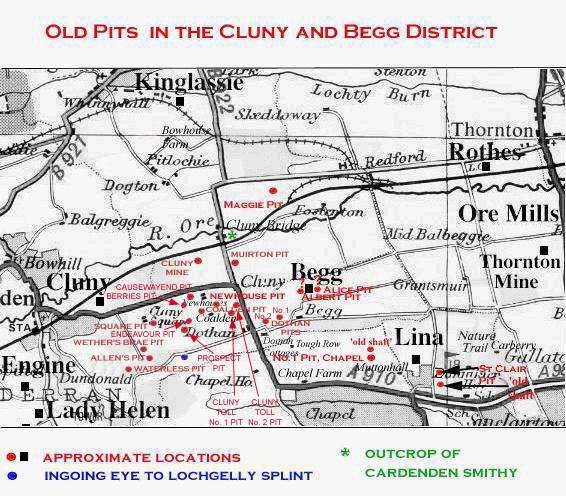
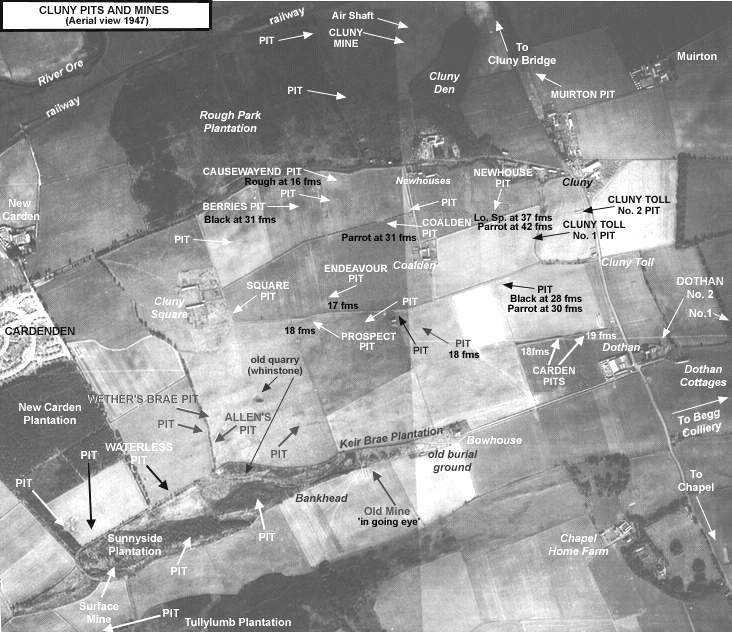
In a History of Auchterderran Parish, the writer states, "Dundonald, Cluny, and Lochgelly are very ancient coalfields. ... Coming south to the old Cluny coalfield, you pass, the 'old coal pit' by the roadside (Kinglassie Road); another in the plantation to your left before reaching the store (Cluny Store); and in the fields to the front of Coaldeane and Cluny Square there are sites of no less than eight (one of them being the Engine House Pit) in these three fields, all marked on the map as 'old coal pits'. In front of Sunnyside Wood we see the old Waterless Pit and Waterless Dub; and adjoining the Weather Brae there is the old quarry and another 'old pit' in the same field."
The many abandoned pits in the Cluny district indicate that coal mining was actively pursued in the past over several hundreds of years. For example, in the section dealing with the parish of Kirkcaldy in a 'Statistical Account of Scotland' from the year 1796, the Rev. Thomas Fleming stated that the town of Kirkcaldy obtained its supplies at that time from the collieries of Dysart or of Cluny and that there was a depot of Cluny coals kept at Kirkcaldy for exportation, "from which about 600 tons have been annually shipped during the last 5 or 6 years, partly to Hamburgh, but chiefly for Middleburg, where the Cluny splint is said to have the preference of every other species of Scotch coal." A preference for coal from the Cluny Colliery is again referred to by the Rev. John Murray in his 1845 account of the parish of Abbotshall.
Some names of the very early workings will be found, no doubt, in the historical documents, but the site entry continues with information gathered on more recent pits and mines of Cluny Colliery.
Note: The coalfield east of Cardenden runs through to the Cluny-Dothan district within a mile or so and some pits or mines located on the "overlap" between these two collieries will be found listed by the Mines Department under both collieries.
Our research to date has revealed the following pits or mines classified under Cluny Colliery:
Allen's; Bank; Berries; Causewayend; Cluny Bridge; Cluny Mine; Cluny Toll Nos. 1/2; Coalden; Cowpark; Dothan Nos. 1/2; Endeavour; Maggie; Mid; Muirton; Newhouse; Pollick Nos. 1/2; Prospect; Square; Waterless; Wether's Brae.
A few of these pits or mines are identified on maps and/or aerial views (see individual entries in East Fife Index) while a number locations still require verification. Can you help?
 |
 |
| A range of information on a named pit or mine, including opening/closing dates, exact location, photographs of workings, details of shaft depths, descriptions of coal seams worked/abandoned, points of historical and/or social interest, etc., will be present in an individual index entry but general information pertaining to the colliery which is often difficult to allocate to an individual pit or mine, is reported in this general entry to which reference will be made from the individual index entries. |
|---|
Cluny Colliery
| Source Date of Information (Owner) |
| ca 1650s - 1720s (Earl of Rothes) |
| 1724 - 1729 (Alexander Swinton - lessee) |
| 1730 - ca 1790 (Earl of Rothes) |
| early 1790s (Ferguson of Raith Estate) |
| 1821
51 miners employed at Cluny Coalworks. |
| 1830s (Goodalls of Bowhill - lessees) |
| 1842 (Clunie Coal
Company)
Mr. Alexander Goodall, Manager - 66 males employed in pits. |
| 1851
James Goodall killed at Clunie Colliery in a massive roof fall - leaves widow and four children. |
|---|
| 1860
J. and A. Goodall |
| 1861
Alexander Goodall [From Parochial Register - Auchterderran.] |
| 1866
Mr. William Clerk, Manager, dies as a result of fall at the colliery. |
| 1869 (Landale, Boyd & Co.) |
| 1873 (Clunie Colliery) |
| James Clark, Manager (see History item) |
| 1880 (Cluny Coal Co.) |
| Cluny Coal Company would appear to have ceased operations in the early 1880s. |
--------------------------------------------------
| We wish to acknowledge W. G. Rowntree as the writer of an article entitled "Introduction to the Rothes Papers" from which we have taken a few statements referring to the 18th century coal mines owned by the Earl of Rothes. The writer was grateful to the Glenrothes Development Corporation and Kirkcaldy District Council for permission to reproduce the Papers which were discovered in 1966 in the roof space of an old farm building which was one of several situated near the stables of Leslie House, once the home of the Earls of Rothes. Leslie House lies within the designated area of the new town of Glenrothes, Fife, and the farm building was the property of Glenrothes Development Corporation at the time the Papers were discovered. At one point they were on loan to Kirkcaldy District Museum. The Papers cover dates from 1580 to 1830, and among them are bills, farm tacks, business letters, and accounts relating to coal and salt workings. We trust that we will be able to display these extracts on our website. M. Martin & Webmasters. |
|---|
" ... Among the Papers there is a warrant by George II at the request of his sheriffs for the arrest and apprehension of a Stephen Row. It is dated 27 August 1741, has the seal of George II embossed on it, and carries the King's signet. [The Stephen Row mentioned was an engineer connected with the coal mines owned by the Earl of Rothes.]
Many of the papers deal with coal mining on the estates of the Earl of Rothes. Those mentioned were at Cadham, Cluny and Strathore.
In 1752, during the time of the tenth Earl, some miners mutinied at Cluny (Clunie), one of the three collieries belonging to the Rothes family, the other two being at Cadham and Strathore. Soldiers were brought along to restore order. The ringleaders of the mutiny were apprehended and put in prison, three at Kirkcaldy and three at Cupar. The prisoners were released after they had signed a document binding them to agree to the terms laid down by the Earl.
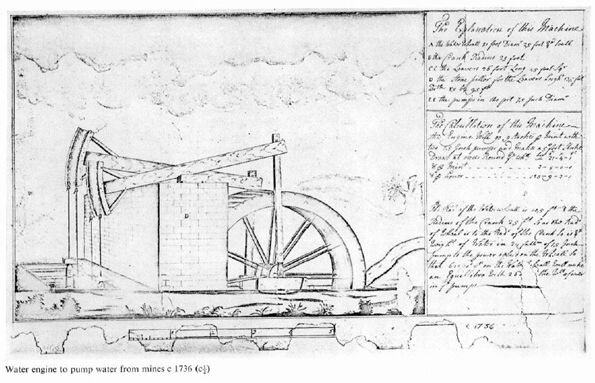
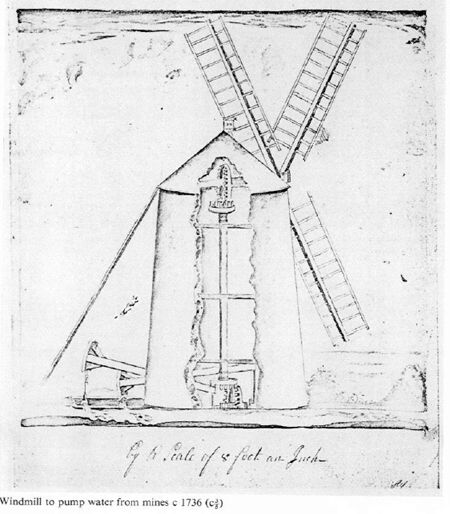
Most of the papers have to do with the coalmines of the tenth Earl in the 18th century. The pits, being near local rivers, were affected by seepage which resulted in the miners having to be transported from one colliery to another until the water was dealt with. The methods used for doing this are shown by two diagrams found with the documents, one for pumps operated by water power and another making use of the wind for the same purpose.
|
|
Other information gained from researching these papers, and pertaining to coal workers at early Clunie pits, will be of interest to anyone researching their ancestry.
1684:
A number of coal workers were paid for working at the 'new sink' on the 3 foot coal seam: James Bell; Henrie or Hendrie Gib; James Nisbet, collier; Robert Nisbet, collier: his son Robert baptised 22 April 1683; and Robert Pratte, quarrier, who was paid for 36 days work at the new pit.
The exact location of this old sink on the 3 foot coal is not known.
A number of coal workers were paid for working at the 'new sink' on the 10 foot coal seam: James Aitken; Robert Coven; Henrie or Hendrie Gib, between June and August. His son Henrie baptised 14 October 1681; his daughter Agnes baptised 3 April 1686; Crispanie Good; James Greige; David Lamb; David Law, windhouse man; Patrick Michie; Robert Michie; Andro Lamb; Andro Nicklesone, windhouse man; John Robertson; and Alexander Selchreidge, who was paid for 36 days work at this new sink.
The exact location of this old sink on the 10 foot coal is also not known.
~1720s:
David Anderson, collier: Mentioned in an account. His wife is given some meal 'he being unable to work by reason of a sore leg'.
1724:
Alexander Swinton - 'Account with Earl of Rothes for cost of fitting up and carrying on the coal work of Clunie in the terms of the contract with the late Earl of Rothes in 1721'.
1728-1738:
Archibald Hastie, coal grieve - 'Paid for running the coalworks. Described as 'formerly oversman' in May 1739 when he was employed with the Laird of Dunnikier. Mary baptised 7 November 1725; Janet baptised 21 January 1728; Elizabeth baptised 6 June 1731'.
1741:
David Elder - 'Paid for setting down the sink at Coalden, June 1741, and boring 14 fathom crop sink at Clunie'.
1742-1763:
James Fortune - 'my own coal hewer' has a 'bearer from the Links work' called Macgregor -'his wife did bear formerly'.
1743-54:
George Scott: Agreement to dig 3 fathoms at 10 pound 5 shillings per fathom. Agrees in December 1744 to work the mine at Clunie for 5 or 6 fathoms. 1754 Paid for seeking the Smiddie Coal.
1743:
James Beveradge or Belvridge, wright and coal grieve - 'James Beveradge of Duddingston agrees to take care of the machine at Clunie'.
1743-49:
John Anderson, Coal grieve: Complaints by hewers in 1749 that they have to wait and drink at the grieve's house before they get their wages on Saturdays. And, that at Cadham, Anderson would pay drawers for finding a ticket lost by the workmen 'so that the coals came into his pocket'.
1744:
William Paterson - 'Paid for 7 days at clearing the mine at Clunie'.
James Paton worked at Clunie 1744-1763.
1744:
Thomas Tod, winless man: 'paid for 1 day at the winless'.
Thomas Balfour worked at Clunie between 1744 and 1752 as sinker and coal hewer.
1746-63:
Andrew Morris, Morice or Morres: Payment to him in October and November 1752 'to support myself and family while unable to work'. [His son Robert, baptised 11 February 1750; his son John, baptised 8 December 1751, his daughter Elizabeth baptised 26 August 1753; his son John Morris, buried 12 January 1754 - died of smallpox.'.
1749:
John Chalmers, winless man - 'Accused by George Blair of stealing coal from the coal hill at Clunie, 1749'.
1749-1763:
James Gillmer or Gilmor - 'To have a contract to be free after 12 months'.
1751-1752:
Alexander Ptolomie, hewer.
1752-63:
David Arnot - 'In weekly account'.
1752:
George Blair, collier, whose working life is listed as 1738 to 1752, is stated to have left Clunie on the 14th October, 1749. Prior to this George Blair appears to have served at other coalworks - Falfield (1738-1741); Balgonie (1741-1743); Balbirnie (1743-1744); Cadham (1744-1745); Lightburn (February-June, 1745); Cadham (June, 1745 - January, 1746); Carden (January - June, 1746); Cadham (June to July, 1747); Balbirnie (July, 1747-February, 1748); Rearus Murs (February-June, 1748); Carden (June-October, 1748); and Clunie (October, 1748 - October, 1749). 'Note in 1752 of agreement that he will serve 3 years then be free'.
1752:
Zachary Cumming or Cunmons, hewer.
1752:
Michael Mitchell, hewer.
1752:
John Adamson, coal hewer - 'Entry money paid for his bearers'.
1752:
Andrew Adamson, hewer - 'His son at coal work'.
1752:
Beathiah Adamson, bearer - 'Entry money paid 16 October, 1752, as bearer to John Adamson'.
1752:
Agnes Adamson, bearer - 'Entry money paid 16 October, 1752, as bearer to John Adamson'.
1752:
?Marin Adamson, bearer - 'Entry money paid 16 October, 1752, as bearer to John Adamson'.
1752:
Henry Hog, miln wright. 'Witnesses bond of John Miller to s'
1752:
John Miller, coal hewer - 'Paid for his entry to the Earl of Rothes' service on 28 September, 1752. His daughter Jean baptised 5 April 1752.'.
1752-54:
1752-3, 1763:
James Ewan, Coal hewer: Paid a premium for marrying. [His son John, born 10 May 1754.
1752-54:
David Wallace or Walles, coal hewer - 'Paid for 4 days seeking the Smiddie Coal and reading the level. His son James baptised 13 May 1753.'.
1752-63:
James Arnot: 'In 1754 paid for work at Smiddie Coal.
1753:
Andrew Wilson, coal hewer. 'His daughter Mary baptised 27 May 1753'.
1753:
Andrew Paton, hewer: Cloth bought for him as premium for marrying.
1754-63:
William Ewan - 'Paid in 1754 for seeking the Smiddie Coal. [Is this the William, son of John Ewan, collier in Kinninmont, baptised 1 March 1730?'.
1763:
Alexander Blair; John Ewan; Thomas Paton; William Reed (occupations not listed.)
Alexander Henderson and David Henderson - 'For drawing redd'; and William Hird - 'Paid for five days drawing below'.
Thomas Suttie, collier: no date. Mentioned in an account. [Margaret baptised 10 April 1726.
--------------------------------------------------
"Fifeshire Journal"
27 September, 1838
CLUNIE - NEW COAL WORKS
At Clunie, on the Orr, a beautiful and extensive
coal fitting is just being constructed at the expense of the very
spirited tacksmen - the Messrs Goodall of this neighbourhood. From
the borings which have been made, as well as from the known state
of the metals in the neighbourhood, the most sanguine expectations
of a valuable working are entertained, although no coal will
actually be turned out for some time to come. The water is pumped
off by a magnificent 50 horse high-pressure engine. This has been
constructed at the Kirkcaldy foundry, and is a first-rate model of
engineering design and of perfect execution and reflects the
highest honour on Messrs Russell.
It is much the largest which has ever been made
in Fife. The gig is worked by a lesser engine of 12 horse power, of
equal beauty. The spirited conduct and enterprise of Messrs Goodall
throughout in this audacious undertaking deserves the highest
praise. The coal expected is of the very first-rate quality. The
uppermost seam is four and a-half feet.
--------------------------------------------------
EVIDENCE ON THE EMPLOYMENT OF CHILDREN
Mr. Alexander Goodall, Colliery Manager
ROYAL COMMISSION - 1842 REPORT
"I have been 19 years connected with the
management of my colliery, during which period no fatal
accident, nor has any of a serious kind, taken place. In this
part, very little disease exists amongst the men, as their
habits and mode of life differ from most colliers. In the
first place, very young boys have never been allowed to go
below ground, and no females whatever work in our pits.
I consider the keeping females out of the mines one of the
most important points towards the improvement of the collier
population, as it forces them to self-dependence, and as they
are obliged to send their daughters into the fields, or to
service, so they are compelled to seek wives from other
trades than their own; and it is a singular fact that
scarcely anyone of our colliers have married upon
colliers' daughters, as also a large number of the
daughters of colliers are married to millers, ploughmen, and
other people.
There is a school (Cluny) attached to the colliery, at which
the majority of male and female children attend. They enter
as early as 5 and 6 years, and continue till 12, when the
boys go down, as they are of no use before that age, although
our seams are very thin, not exceeding 28 inches high, and
our roads 42 inches. The number of men employed is 40 heads
of families, 22 under 18 years of age, and 4 above 12 years.
Few men marry about this quarter till 22 or 24 years of
age."
--------------------------------------------------

"Fifeshire Journal"
15 August, 1844
MELANCHOLY ACCIDENT
The colliers on the coal-works at Clunie have been for some time employed in sinking a new pit. Shortly after they began work on Monday morning, one of the men called William Arnot, while descending the pit, the scaffolding on which he sat gave way, and he immediately fell to the bottom, which was covered with about six feet of water. The unfortunate man was taken out in about half an hour. Mr Smith, surgeon here, was sent for, and the ordinary means tried to restore animation but without affect. The deceased has left a wife but no family.
-----------
"Fifeshire Journal"
22 August, 1844
AUCHTERDERRAN - FATAL ACCIDENT
On Monday week, as William and Thomas Arnott, coal-hewers, residing at Coalden, in the parish of Cardenden, were putting up a wooden partition in the centre of a new pit, which Mr Goodall is now sinking at Clunie, and while they were within a few feet of the bottom of the pit, by some accident they were both precipitated from the scaffold on which they were standing into five feet of water that was in the pit. Before they were got out, William was dead; but Thomas sustained little injury, and is now going about. It is not known whether anything had struck William so as to cause his death under such circumstances.
"Fifeshire Journal"
19 September, 1844
CLUNY COLLIERY - FATAL ACCIDENT
A fine young man of the name of David Blair lost his life here on Thursday last under the following circumstances:- He was at work in a pit in which there are two seams of coal wrought from one shaft - the one eighteen feet below the other. He was in the upper one, and waiting to hook on a tub of coals. He had been looking up the shaft - a thing which is often thoughtlessly done - while a tub of coals was ascending, and a piece from off the tub struck him on the head and knocked him to the bottom of the shaft. Medical aid was promptly procured, but was of no avail, as the wounds he had received on the head were found to be mortal. He ceased to breathe in about three hours after being struck. The deceased was twenty years of age, unmarried, and has left a large circle of relations and friends to mourn his untimely fate.
--------------------------------------------
"Fifeshire Journal"
30 January, 1845
ACCIDENT AT CLUNIE COLLIERY
Mr Goodall, one of the masters, was descending the pit to look after work. He was let down in a bucket or basket, which was suspended by a rope, which passed over a pulley at the top of the pit. The rope jerked suddenly off the pulley, caused by the snow, which filled partially up the space on which it was running. Mr Goodall, in consequence, was immediately precipitated to the bottom of the pit. The unfortunate man has sustained a number of severe contusions in consequence of the accident. They are indeed of so serious a nature, that although medical assistance was immediately procured from Kirkaldy, very faint hopes are entertained of his recovery.
--------------------------------------------
"Fifeshire Journal"
6 July, 1848
CLUNY COAL
Is now delivered in CUPAR by the Railway.
PRICES AT THE STATION
GREAT COAL ... ... 10s. 6d. per Ton.
CHEWS ... ... 9s. 6d. per Ton.
JOHN DOUGLAS, jun., Agent.
Orders left either at Mr Douglas's Shop, Crossgate, or at the Railway Depot, will be punctually attended to.
Cluny Colliery, 5th July, 1848.
--------------------------------------------
"Fifeshire Journal"
Thursday, 13 November, 1851
FATAL ACCIDENT AT CLUNIE
A fatal and melancholy accident occurred her on Tuesday week. As a miner of the name of James Goodall was following his usual avocation, a mass of the roof fell upon him, and crushed him in such a dreadful manner that he died in a short time after the injury. He was a young man of steady and industrious habits, and has left a widow and four young children to mourn his loss.
--------------------------------------------
"Dunfermline Press"
2 December, 1865
FATAL ACCIDENT AT CLUNIE COLLIERY
On Tuesday, a young man named Clarke, residing in Clunie Square, while engaged at his usual employment in the pit, was suddenly deprived of life by a heavy stone falling on the back of his head from the roof of the workings. The stone was removed with the utmost expedition from the body of the young man, but life was extinct. He was about twenty years of age and unmarried.
--------------------------------------------
" Dunfermline Press"
12 May, 1866
FATAL ACCIDENT
Mr. William Clerk, manager of the works at Clunie Colliery, Kirkcaldy, died on Saturday from the effects of injuries he received on the previous Wednesday by falling from an elevated plank.
--------------------------------------------
" The Scotsman"
6 April, 1870
FIFESHIRE.
COALFIELD TO LET.
The Coalfield has been partly fitted up with MACHINERY and PLANT, which a Tenant will be bound to take at a valuation. The Machinery is new, and of an excellent description, and suitable for the field.
The Coal in the adjoining lands has been wrought for many years, and proved to be of an excellent quality, and it is expected that the Field now to be Let will be equally good.
If desired, a Field of Land can be Let along with the Coalfield.
For further information and particulars, application may be made either to Messrs DUNDAS & WILSON, C. S., 16 St Andrew Square, Edinburgh; Messrs J. & G. H. Geddes, M. E., 9 Melville Crescent, Edinburgh; or to Mr J. L. Gow, Raith, Kirkcaldy, who will give directions for showing the Premises and Boundaries, and either of them will receive Offers up till 12th April next.
Edinburgh, 25th March 1870.
--------------------------------------------
The writer of the Auchterderran Parish Account also
provides some interesting comment on the early Cluny
Colliery.
"The name of Goodall was one to conjecture with in
the early days at Cluny. About a hundred years ago, the Raith
Estate Office held Cluny Colliery, and had as Manager,
Alexander Goodall, whose grieve was James Walker. Alexander
was the father of Thomas Goodall, who built Craigderran and
Derran's Vale, Cluny Road. James, along with his father,
afterwards held a lease of Cluny Coal Work. Thomas Goodall
afterwards became manager of Capledrae Cannel Coal Work, now
defunct. It is about 2 miles from the Westfield Oil Works,
two fields north of the Row, which also became defunct over
thirty years ago."
---------------------------------------
Some Coal Seams worked in the Cluny District
(Based on a report from 1934)
The Cluny district embraced the west-central portion of the Kirkcaldy Coalfield. It was separated from the district of Kirkcaldy and Dunnikier by a north-easterly line passing through Dunnikier House (now Dunnikier Hotel), and from the district of Redford, Strathore and Pitteuchar by an east-south-easterly line drawn through Fosterton, one mile east of Cluny Bridge.
The thickness of the Limestone Coal Group was fairly constant throughout this district, and was comparatively small, ranging from 650 ft. here to about 700 ft. in the Begg district to the east. The total content of coal was correspondingly low, falling to as little as 30 ft. at Cluny.There were six or seven separate seams averaging 2 ft. or more in thickness, so that in this respect the district did not compare unfavourably with that of Dunnikier and Kirkcaldy where the group as a whole was more fully developed. The strata were inclined to the north and north-east at an average angle of about 15owhile in the vicinity of Cluny Bridge the general dip was less than 10o.
The distance between the Upper Kinniny Limestone and the Dunfermline Splint Coal was close to 40 or 50 fathoms containing an intrusion of whinstone, the thickness of which decreased in an easterly direction.
Stink or Sulphur Coal was proved in a bore put down a quarter of a mile north of Cluny Square where the coal rested directly on a thin whinstone and was only 5 in. thick. From bores in the Cluny area, the Dunfermline Splint Coal was known to vary in thickness from 1 ft. 7 in. to 2 ft. with, usually, a sandstone roof. Near Dogton, it was split by a 6 in. parting and had a roof of blaes. An old pit sunk to the east of Dothan Cottages is believed to have worked the Dunfermline Splint Coal as the 'Lower Smithy'. In the deeper part of the Cluny field to the east, its thickness was not known to exceed 1 ft. 8 in.
In the vicinity of Cluny, the Five Foot Coal was separated from the Dunfermline Splint by 2 to nearly 9 fathoms of sandstone and faky beds. No records are known of workings in the Five Foot, although its average thickness in bores was about 2 ft. 9 in. In Carden Farm No. 2 Bore, west of Cluny Bridge, the Five Foot Coal was recorded between 2 ft. and 2 ft. 11 in. Its roof and pavement consisted of fakes and sandstone, the roof sometimes showing a thin bed of blaes up to 6 in. thick immediately above the coal. In another bore, about a third of a mile north of Cluny Bridge, the Five Foot seam was 2 ft. 10 in. thick but burnt by the thin whinstone lying directly on it.
The Mynheer and Glassee Coals were represented in the
Cluny district but showed considerable variation. The
thickness of the Mynheer varied from 11 in. of coal and
fireclay to 1 ft. 11 in. of coal, and its position above the
Five Foot varied from 5½ to 10½ fathoms.
The Glassee Coal ranged from 1 ft. of coal and blaes to 2
ft. 4 in. coal, and lay 3½ to nearly 6 fathoms higher in
the sequence. The Glassee was succeeded by 2 to 6 fathoms of
blaes with irony ribs and balls, usually divided by a few
feet of sandy layers into an upper and a lower bed. These
blaes represented the 'Black Metals' of the Central
Coalfield and formed a conspicuous band in the dominantly
sandy succession below the Main group of coals, especially in
those sections where the Glassee Coal was absent. The total
distance from the Glassee Coal (where present) to the
Lochgelly Parrot varied little from an average of 9½
fathoms.
The Lochgelly Splint and Parrot Coals were generally separated by about 2 fathoms of fakes and sandstone. They were worked as the Black and Parrot coals from a number of old pits around Cluny and Dothan. The so-called 'Carden Coal' recorded in two or three old pits in the area, appeared to be the Lochgelly Splint Coal which was usually about 2 ft. thick. However, a maximum of 2 ft. 7½ in. was recorded in the Carden Farm Bore, west of Cluny Bridge. In the few instances where detailed sections of the seam are available, the thickness of Parrot relative to the total thickness of the seam does not exceed 40% and is usually much less than this. The Lochgelly Splint Coal lay 9 to 16 ft. above the Parrot and varied in thickness from 2 ft. 4 in. to 3 ft. 2 in. Its roof was formed of blaes or fireclay and had one or two seams of coal with a total thickness of 1 to 2 ft.
The remaining coals - the Swallowdrum, Jersey and Kelty Main Coals - were poorly represented by a number of very variable, thin seams of coal and beds of coaly blaes and fireclay totalling 11 ft. thick. These were concentrated within a total thickness of 3½ fathoms of strata in a bore half a mile east of Dogton and north of Cluny Bridge, but less than three-quarters of a mile to the south-west, 5 ft. of coal with 4 ft. of coaly fireclay, distributed over 8½ fathoms of strata, represented the Swallowdrum, Jersey and Kelty Main Coals.
The Swallowdrum Coal in the Dogton bore was recorded as 10
in. coal and 4 ft. 10 in. coaly blaes in three leaves; and as
2 ft. 4 in. coal in five leaves, in the bore about a quarter
of a mile north of Cluny Square. In the 'Cluny Square
bore', two coals, 1 ft. 10 in. and 1 ft. 4 in. thick, and
separated by nearly 3 fathoms of blaes, probably represented
the Upper and Lower Jersey Coals, respectively.
The seam which was correlated with the Kelty Main Coal lay 5
to 12½ fathoms above the Lochgelly Splint and in the
Cluny district, it varied in thickness from 12½ in. with
a ½ in. stone parting, to 3 ft. 11 in. with a 16 in.
parting.
The Rough and Little Splint coals were worked in the past
from the old pits of Cluny, where the former seam was known
alternatively as the 'Rough' or 'Cluny' Coal
and the latter as the 'Cluny Splint'.
Both seams showed considerable variation not only in
thickness, but also in position relative to one another and
to the underlying Main group.
West of Cluny Bridge, the Rough Coal was separated from the Kelty Main Coal by 7 to 8 fathoms of strata containing two thin coals which divided the distance approximately into thirds; and from the Lochgelly Splint by 17 to 19½fathoms. North of Cluny Bridge, a thick post of sandstone was developed below the two thin coals mentioned above and accounted for the greater part of the 16 to 18½ fathoms, which there separated the Rough and Kelty Main seams. A 2 ft. 3 in. coal, believed to be the Little Splint, was recorded as cropping out in the small stream flowing northwards from Dothan Cottages, at a point about 300 yds. north of the cross-roads at Dothan.
The distance from Rough Coal to the Cardenden Smithy was fairly constant over the whole district, averaging a little less than 18 fathoms. The intervening layers consisted mainly of sandstone and faky beds and, besides the Little Splint Coal, usually included a rib of coal 6 to 9 fathoms above the Rough, which probably represented the Lochgelly Blackband Ironstone. The lower leaf of the Cardenden Smithy was little more than a rib of coal, separated from the upper leaf by less than a fathom of sandy strata. The Blairhall Main Coal was recognised at one point only, in the bore half a mile north of Carberry to the east of Dunnikier House. Elsewhere, it did not appear to be present unless it was represented by an inconstant rib of coal up to 6 in. thick which occurred in the Cluny district some 6½ to 8½ fathoms above the Cardenden Smithy.
-----------------------------------
Plans of Abandoned Seams & DatesNote: abandonment dates do not relate to individual pit closures but to the abandonment of seams which had ceased to be worked. Not worked for a period of time, it was quite normal for some coal seams to be re-opened for working at a later date or at a different location. |
|---|
| Some Plans of Abandoned Seams for Cluny | Pits or Mines designated in Plans |
|---|---|
| COAL; Little Splint; Black or Lochgelly Splint; Parrot | Cluny (locations not specified) |
| COAL: Little Splint; Lochgelly Splint; Rough Splint | Bank, Mid |
| COAL; Cluny Splint; Rough; Black; Parrot (1868) | Bank, Berries,
Causewayend, Cluny Bridge, Cluny Toll Nos. 1, 2,
Coalden, Cowpark, Endeavour, Newhouse, Square |
| COAL; Splint; Parrot; Rough; Main (1868); Black (1877) | Allen's, Bank,
Berries, Causewayend, Cluny Toll Nos. 1, 2,
Cowpark, Dothan Nos. 1, 2, Endeavour, Newhouse, Prospect, Square, Waterless |
| COAL; Little Splint; Lochgelly Splint (1877) | Pollick Nos. 1, 2 |
-----------------------------------
Some Historical Aspects of Cluny Pits and Mines
This, of course, would be a major study in itself and
could occupy many pages on the site. We thank Dunfermline
Central Library for indicating a piece of work written on
this subject and include here, only a few introductory
paragraphs which indicate the important place of Cluny in the
history of coalmining in the Kingdom.
We wish to acknowledge the original author (unfortunately
not recorded when this information was first gathered) for
the following words.
Michael Martin & Webmasters.
... The estates of the 10th Earl of Rothes were situated virtually in the centre of the Fife coalfield and as a result of this, from a relatively early period, at least by the mid 17th century, the coal deposits around the village of Cluny were directly exploited by the estate, employing a small number of hewers (4 in 1685).
After the death of the 9th Earl in 1722, the pits at Cluny seem to have been put out to tack to an Alexander Swinton in return for a 50% share of the profits. By the end of the decade, however, the estate took back the running of the pits and entered a period of expansion increasing the number of hewers employed at Cluny to 19 by the middle of the century and opening up new pits at Easter Strathore and Cadham.
The pits at Easter Strathore, which were run as a separate colliery during 1738-1740 had been an integral part of Cluny Colliery during the earlier period and were not in fact situated at the present day village of Strathore but in the area between the River Ore and Lochty Burn, directly north of Cluny.
Compared to some neighbouring enterprises, such as Lord
St. Clair's integrated coal, salt and lime works based
around Dysart, the Earl of Rothes pits were on a relatively
small scale, limited perhaps by the dominance of important
neighbours such as the collieries of Lords Leven and St.
Clair.
In common with many of his class, the 10th Earl of Rothes
was content to allow his estate to be administered by trusted
servants with outside help brought in where necessary for
technical advice for the coal enterprise.
By the early 1790s, Cluny was being worked by Mr. Ferguson of Raith, the Rothes family only maintaining the Cadham pits, neighbouring the larger Balbirnie Colliery.
It has been estimated that in the mid 18th century, the Scottish coalfield was providing 20.7% of the total British coal output and most of that figure would have been produced from small collieries such as the Earl of Rothes enterprises. The Rothes pits should therefore be seen as an example of one of the Scottish coal mining enterprises dotted around the Eastern Scottish coalfield.
There is no evidence that the Rothes family ever took much personal involvement in the administration of the coal mining enterprises. For such a relatively small enterprise, consisting at one point during this period of only two collieries, there was a complicated hierarchical management structure, supplemented by specialist help brought in from the immediate locality and other collieries. As the pits formed a part of the estate proper, the estate factor played a major role, although varying in importance at different points, in the overall direction of the collieries.
At the beginning of the 1730s, the estate factor was William Hay, a servant of Rothes who had held the position of administrator of the estate from the early years of the century. Hay oversaw the pits throughout his career to his death in 1745 with the exception of a five year period when the Cluny pits were put out to tack during 1724-1729. Even during this period, Hay received statements of income and expenditure, as Rothes received half the profits from Swinton's tenure until September 1729.
After this, the pits were taken back under direct estate control. Hay, while responsible for the financial operations of the mining enterprises, recognised his own technical limitations in the day to day running of the pits. Clearly he also had difficulties in enforcing the work discipline required to keep the colliers in a compliant mood.
Perhaps because of the problems faced by Hay, his successor John Angus appears to have taken a purely financial interest in the coal enterprises. In "Directions" for Cluny in 1749, which laid out the duties of the newly appointed supervisor William Robertson, the responsibility of the estate factor was only to "account with the grieve every week, receive money arising from the coal and pay the charges to all oncost on the work and keep the coal book".
Angus' successor, John Rolland, appears to have followed the same practice. The removal of the factor from immediate personal involvement in day to day production in the pits, despite the fact that specialist help from outside was always used, was made possible by the insertion of a new management stratum. The first person to take up this position appears to have been Stephen Row, "Engineer". For "looking after the said Earl's coalworks at Clunie and Cadham, Row was to be paid 10 shillings (sterling) per week, together with a house and a 'cow's grass'. " After taking up this position in 1741, Row took up supervision of the two operating pits, making out a number of detailed reports and at least at one point being personally responsible for the introduction of new technology in the shape of "wheel trams" in the Cadham pits. ...
