Owners: John Skinner (1854)
The 1791 Statistical Account for the Parish of
Ceres describes the early coalworks in the area:-
"... There are 3 lime works, and 1 coal work in the
parish, all wrought to a considerable extent. The value of
the coal work is much diminished by the expense of a steam
engine, for drawing off the water. Two coal pits, wrought in
the parish, about 10 years ago, are now given up. ... The
articles of trade in the parish are cattle, horses, corn,
flax, linen, coal and lime. ... The populousness of the
parish of Ceres, is owing to the lime and coal works, and to
the manufactures carried on in it ..."
... and in the 1845 Statistical Account for the Parish
of Ceres we find a very interesting, detailed account of
the old pits and the minerals worked:-
"... Coaltown was once a thriving village, inhabited by
colliers. ... This parish abounds in minerals. Both coal and
limestone are found .... and along the whole southmost part
of this parish, there are appearances both of coal and
limestone. There is no coal worked now; but this has arisen
from the expense of the working, and not from the want of
coals. The Teasses coals can be traced over a considerable
distance of country. A line may be traced from Teasses, by
Hall Teasses, Newbigging, Craighall, and Craighall to
Coaltown. About Hall Teasses, the coal is described as very
fine, and as gradually becoming blind and deprived of
bitumen. There are numerous old pits between Hall Teasses and
New Guilston. At Craighall Castle, the coal is separated from
the limestone by a mass of trap, which has the effect of
tilting the coals and adjoining strata upon edge. This
tilting up of the strata into an almost vertical position,
has brought into notice no less than seventeen seams of coal
within a space of 500 yards. There are, in like manner,
seventeen seams of coal as near the limestone at Pittenweem.
They resemble the above, and are named the Ceres coals; and
their individual names and thickness, along with the
interposing strata, may give an interesting view of the
curious alternations that take place in the formation of
coal."
| This detailed information on the Ceres coals
which followed can be found in the Coalfields section of
the website:
OLD COALFIELDS OF EAST FIFE Please see Coalfields link - Main Menu. |
|---|
"The line of coals above-mentioned bears in a
direction parallel to the limestone. There are nineteen seams
of these coals. Towards Coaltown they gradually flatten and
occupy a greater surface of country. Beyond Kinninmont the
coals are broken up, and some of them driven aside by the
eruption of the trap hill of Ladedda. The thick coal and
other five of the seams are tossed up to the top of the hill
of Drumcarro, where they are regularly wrought. The south
slope of Ladedda-hill has many marks of old pits upon it,
proving that the coals pass along there. The limestone which
runs parallel with the line of coal is wrought regularly at
present, in four different quarries. There is the Tequliats
quarry; there are two on Teasses property, and one at
Ladedda. ...
... It is impossible, in a work of the present nature, to
give a full account of the lime and coal which abound in the
parish of Ceres; but it will be apparent, from what has
already been written, that there is here a very extensive
field either for theorists or practical speculators; and if
the demand for coal continues to increase, it will likely be
found to be neither a bold nor a very profitless speculation
to re-open some of the coal-works that have been allowed here
to get into disuse. ... No coal or limestone has hitherto
been discovered on the north side of Ceres water. There is at
Baltullo mill, near Ceres, a seam of the "wright's
black coal"' which is used for marking. The seam is
from 18 inches to 2 feet thick. The dip is nearly the same as
that of the limestone on the south side. Some of this black
coal was sent to America, and £7 was received for one
ton of it. The proprietor of the ground does not wish it to
be wrought, and has closed up the quarry."
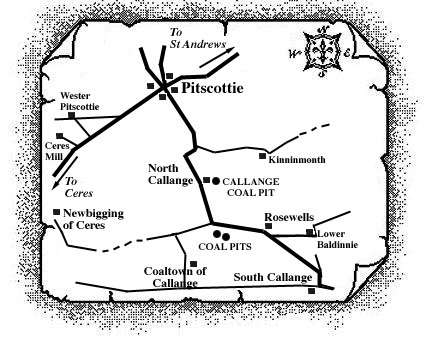
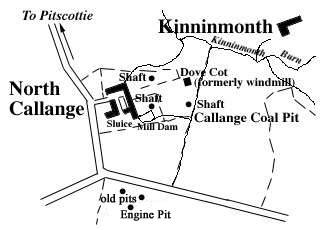
South of Pitscottie, at North Callange, lay the late
eighteenth/early nineteenth century Callange Coal Pit
comprising three shafts of which there are few details
presently available. In a field, less than half a mile to the
south, and just about the same distance north-east of
Coaltown of Callange (a busy village when coals were wrought
in the area) were located a further two coal pits also,
probably, part of this small colliery.
A newspaper article from late 1875 suggests some
investigations of the coal seams were taking place
(see below).
 |
 |
| Callange coal-works
- 18th C employees
(service dates unknown) |
|---|
| John Armitt,
coalier, Coaltown of Callange, Ceres - died 6 Dec
1780 Thomas Nicolson, collier, in Nether Callange |
Information on coals worked at, or near, Callange Pits
(based on a report from 1900)
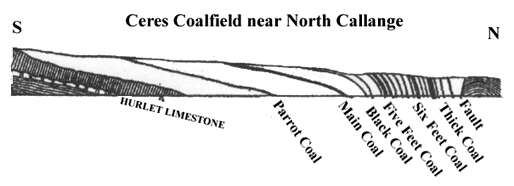
The Ceres coalfield lying to the east of the village of Ceres is remarkable in that the coal seams dipped towards N and NNW at 80° and were so near vertical that they were all packed into a horizontal distance of probably not more than 500 yards. Some of these steep coal seams worked included the Thick Coal, Six Feet Coal, Five Feet Coal and Black Coal.
-----------------------------------------------------
| For a fuller description of the Ceres Coalfield refer to the Coalfields section of the website |
|---|
Besides the steeply inclined seams, two additional coals rose from under them and cropped out a few miles to the south near Craighall Mains. The lower of these coals was a parrot coal measuring 1 ft. 6 in. thick, and the upper, forming the Main seam of this part of the field, had a thickness of 3 ft. 6 in.
-----------------------------------------------------
"The Scotsman"
19 November, 1875
CERES - NARROW ESCAPE OF MINERS
After a long and troublesome series of difficulties, the company which sank a coal pit at Callaup [Callange?], about a mile from the village, have made a start. To begin with, great delay occurred in consequence of the accumulation of water, but a powerful pump at length remedied matters. On Tuesday last the miners in the pit, about twelve in number, ran a narrow escape. One of the men was cutting at the coal seam when he came upon an old working. A great outburst of water ensued, which nearly washed him away, and for a time threatened to drown the whole body of miners. Happily they were speedily rescued, not, however, before the water had dangerously accumulated.
-----------------------------------------------------
