Owners: possibly James Bogie (1830s)
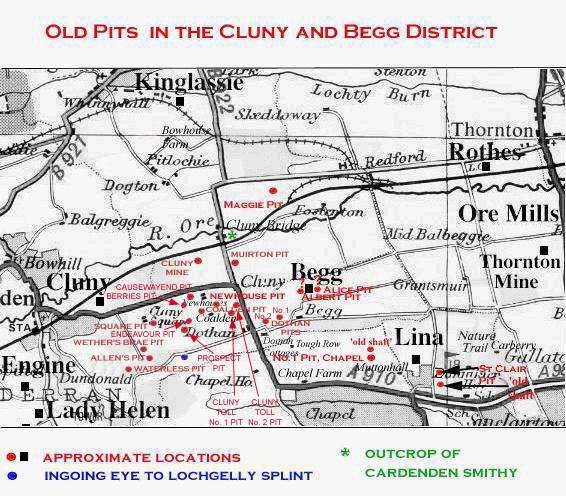
The Carden Pit was sunk to the Parrot Coal at a depth of 18 fathoms and was just a few hundred yards to the north-east of Bowhouse of Carden Farm. The pit just to the east, around the same depth, may also have been a 'Carden pit'.
 |
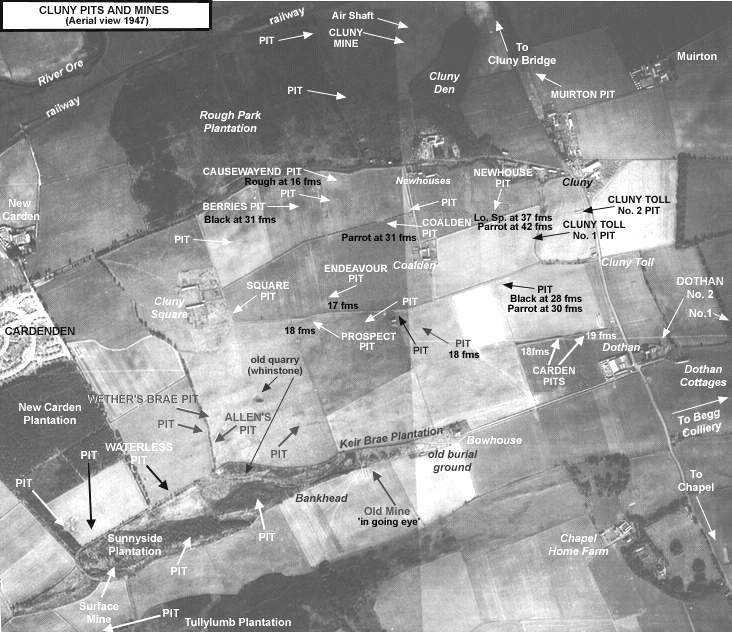 |
| See East Fife Index Entry 'Cluny Pits & Mines' for more details |
|---|
Statistical Account of Scotland : Parish of Kinghorn, Fife - 1793
" ... The Earl of Strathmore is patron of
the parish. The stipend consists of 3 chalders of victual, half
meal, half bear, and 581. 6s. 8d. in money, together with 4 loads
of coal, deliverable at the manse, ...
There is also mentioned in the decreet of
modification and locality of the stipend of Kinghorn, 14½
loads of coal at the pit of Carden; but as this pit is not now
wrought, this part of the living has likewise failed. ...
"
Information on coals worked at, or near, Carden Pit
(based on a report from 1900)
The Gibbs Hall and Carden seams of the Cardenden area were
known as the Lower and Upper Smithy seams as they progressed
eastwards through the Cluny coalfield and on towards
Kirkcaldy.
The Black Coal and Parrot (or Lochgelly Splint and Parrot)
cropped out at the edge of the Sunnyside sill, which they
underlay. These seams were worked in the nineteenth century
in shallow pits sunk through the basalt, while the Carden
seam was also similarly worked to the east of Clunie Square,
at depths of not more than 16 to 19 fathoms.
The Splint and Rough Coal seams of the Dundonald and
Cardenden Collieries was known as the 'Cluny Coal'
when it came east into Cluny Colliery.
From Hyndloup, where it appeared in a ravine, its outcrop
ran eastwards by Cluny Square, Coalden and Begg, until it
began to bend with the other coals south-eastwards to the
River Forth.
The Smithy Coal of Dundonald and Cardenden, from its outcrop
at the foot of Carden Den, struck eastward into Cluny
Colliery and was exposed for 350 yards along the sides of
Cluny Den.
Throughout the Cluny coalfield, the strata dipped at low
angles towards the north, and were not seriously dislocated
by faults. So gentle was their inclination that, 800 yards
north from its outcrop, the 'Cluny Coal' was only 19
fathoms below the surface.
An advertisement in the Fifeshire Journal of 12 July, 1834, for the lease of the Bowhouse of Carden Farm, following the death of James Bogie, indicates that "... Coal is wrought upon the Farm ... ".
