Owners: Earl of Kelly's estate
under Oliver Cromwell
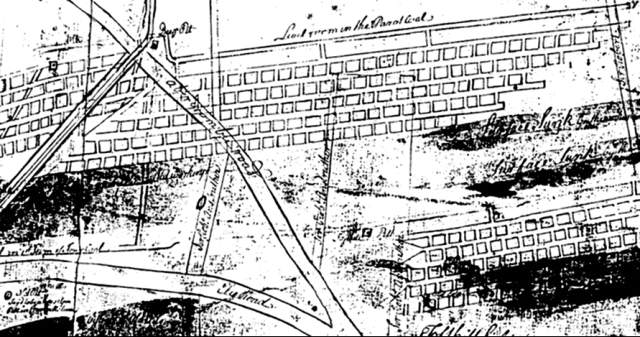
This ancient working (mid-17th century) is alluded to on a
plan section kindly sent by Ian Terris, Glenrothes. Although
difficult to read, this interesting plan clearly shows the
layout of very old 'stoop and room' working in the
'Parot' (parrot) coal in the ground beneath the
junction of Abercrombie Road and Elie Road, just by Croft
Hill, to the west of Pittenweem, with remarks believed to be
"surface sunk by the old workings long ago" and
"old pit said to be a horse-gin pit in Cromwell's
time."
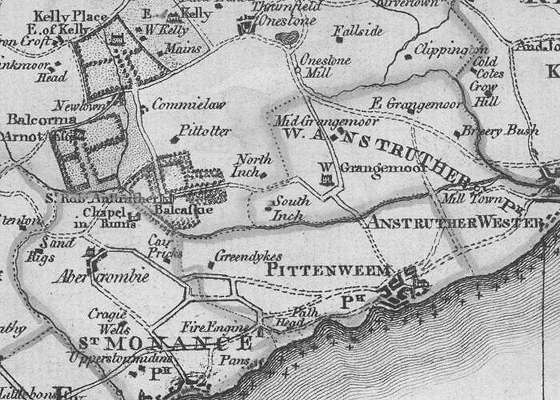
Entries in the Statistical Accounts of Fife also mention the
existence of this early coal-work and suggest that after
years of closure, the underground workings were once again
wrought from around 1770 by Sir John Anstruther when he
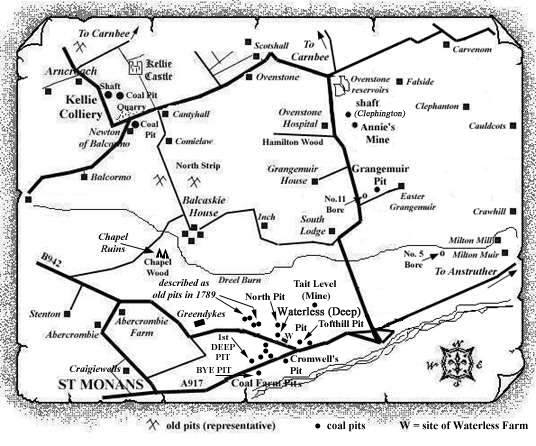
opened up a deeper shaft at Coal Farm, just a few hundred
yards to the south-west of the location of the Cromwell pit.
It seems likely that the Cromwell pit was around 10 fathoms
deep while the 18th century pits were sunk to around 27
fathoms.
[Oliver Cromwell (1599-1658) English statesman, soldier and
Lord Protector - believed to have been in Scotland ca
1651/52]
 |
 |
 |
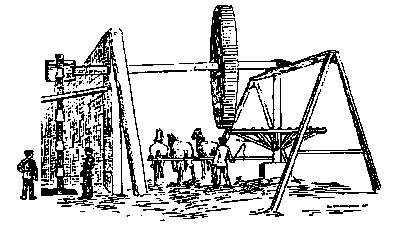 |
| Image of Horse-gin |
Statistical Account of Fife (Pittenweem) 1793
"... The whole surface of the parish is supposed to cover a continued field of coal, which lies in a very extraordinary way, first taking one direction, then a contrary one, with different dipps. The property of it belongs to Sir John Anstruther. When it began to wrought is uncertain. It is believed to have been wrought by Oliver Cromwell, who took possession of the Earl of Kelly's estate, of which it then formed a part; and a pit is still to be seen, that goes by the name of Cromwell's pit. In past times, as much coal was taken out as could be procured without a fire engine. After the working had been long discontinued, Sir John Anstruther, about 20 years ago, erected a fire engine, and has since that period put out an immense quantity of coal, and made salt to a large extent. There are 9 salt pans. The average expense for the coal and salt working is about £50 weekly. The colliers are all free, stand engaged by the year, and are paid in proportion to the work they respectively perform. A good and laborious collier will earn about 18s. a-week. ..."
---------------------------------------
Statistical Account of Fife (Pittenweem) 1845
"... This parish forms part of the coal-field of Fife. The mounain limestone, constituting the lowest bed of the formation, is here seen to crop out on the surface to the west of the town, and above this are workable seams of coal. The intrusion of trap rocks has formed an anticlinal axis, so that the seams of coal dip in two directions. The precise period when coal began to be worked in the pits here cannot be ascertained. The tradition is, that a pit was opened up by order of Oliver Cromwell, who took possession of the Earl of Kelly's estate, of which it then formed a part, and this old working still goes under the name of Cromwell's Pit. After the working had long been discontinued, it was recommenced by the proprietor, Sir John Anstruther, about the year 1770 on a large scale, and still continues. An extensive salt manufactory was also established by the same active proprietor; but this has been long ago given up. ..."
---------------------------------------
Information on coals worked near Pittenweem
(based on a report from 1900)
In medieval times, the monks living on the Isle of May, off shore from Pittenweem in the Firth of Forth, moved to the Fife coast and established Pittenweem Priory (the church in Pittenweem is built on the site of the old priory). The monks controlled the coal-workings in their area and as a number of coal seams cropped out on the beach, they no doubt attracted attention from very early times.
One writer in the 19th century noted, of coal seams in the Calciferous Sandstones, "Two thin coals ... at Pittenweem ... appear to have been wrought in former times in a primitive sort of way, as the seams are represented by 'waste' in most of the section; and traces of small shafts are occasionally seen in the cliff after falls. And coals much lower in the series are sometimes dug into on the shore by poor folk when prices are high. This I have noticed in the beds to the east of Billow Ness and elsewhere."
Steadily, the coals were worked inland beyond Pittenweem where they were worked for centuries. Exposed coal seams can be seen on the shore at Pittenweem even today.
| See Deep Pit and Coal Farm Pit
entries
also Old Coalfields of East Fife (St Monans & Pittenweem) via Coalfields link |
|---|
