Owners: Mr. Simpson
William Anderson, Craighall, Ceres
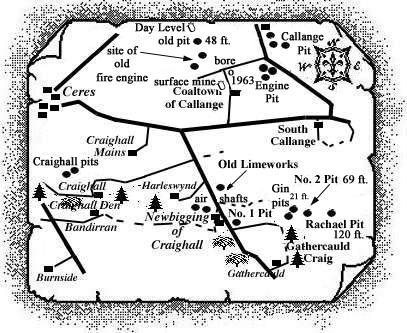
This pit at Craighall, not far from Craighall Mains, was worked from 1914 until around 1920 as a result of the 'discovery' of an unworked coal seam.
 |
"The East of Fife Record"
25 June, 1914
"Great interest has been occasioned in the Cupar district of Fife by the intelligence that a seam of coal has been discovered, and is already to a small extent being worked, at Craighall in the vicinity of Ceres ... Mr Simpson, a former employee of the Fife Coal Company, bringing his practical knowledge to bear on the subject, became convinced that a valuable seam did exist ... At present, Mr Simpson has 15 men employed at Craighall ... Only a small quantity of the 'black diamonds' have found their way to the market, but those who are in a position to know declare that it is of good quality and makes excellent fuel."
| Source Date of Information Supplied | |
|---|---|
| Manager / Under-Manager / Men underground / Men above ground / Coal seams worked | |
| 1914 (Mr. Simpson) | |
| ---------- / ---------- / 15 employees | |
| 1918 (Wm. Anderson) | |
| William Anderson / ---------- / 9 / 3 / Marl coal. |
Information on coals worked at, or near, Craighall, nr Ceres
(based on a report from 1900)
The Ceres coalfield, lying to the east of the village of
Ceres, was remarkable in that the coal seams dipped towards
N. and N.N.W. at 80° and were so near vertical that they
were all packed into a horizontal distance of probably not
more than 500 yards! Some of these steep coal seams worked
included the Thick Coal, Six Feet Coal, Five Feet Coal and
Black Coal.
Besides the steeply inclined seams, two additional coals
rose from under them and cropped out a few miles to the south
near Craighall Mains. The lower of these coals was a parrot
coal measuring 1 ft. 6 in. thick, and the upper, forming the
Main seam of this part of the field, had a thickness of 3 ft.
6 in. These two coal seams lay not far above the Hurlet
Limestone but they were separated from it here by a whinstone
sill. To the east, where this whinstone sill died out, the
two coal seams once again approached the limestone and turned
round with it in a southward direction, the outcrops of both
seams passing just east of Newbigging of Craighall. These
coal seams also ran southwards into the small Teasses
coalfield.
... and in a report from 1977 ...
Two seams, known locally as the Marl and Main coals, were formerly worked from the several pits which comprised Craighall Colliery. They were both 2 ft. 3 in. thick, and the upper seam, the Marl, was in two leaves. The thickness of strata separating the two leaves is not known. These coals certainly lie above the St Monance Brecciated Limestone and must be presumed to lie below the Charlestown Main Limestone, but their positions in the sequence are not exactly known and their identification as the Radernie Marl and Main coals respectively must be regarded as tentative and unproved.
| Plans of Abandoned Seams for Craighall | Pits or Mines designated in Plans |
|---|---|
| COAL; Main; Marl (7 June, 1915) | CRAIGHALL |
| COAL; Main; Marl (9 December, 1919) | CRAIGHALL |
| See Old Coalfields of
East Fife via the Coalfields link for Ceres Coals.
Also Newbigging of Craighall and Rachael pit entries in East Fife Index. |
|---|
