Owners:
1896 - James Pryde & Company,
St Andrews
1897 - Simpson, Robertson, Clark, Bethune (Partnership ?)
1899 - Nicolson & Shepherd
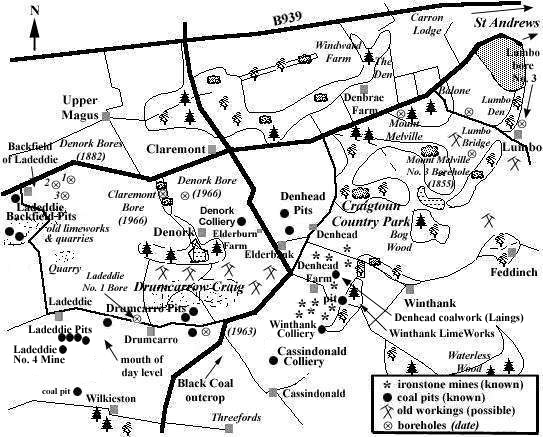
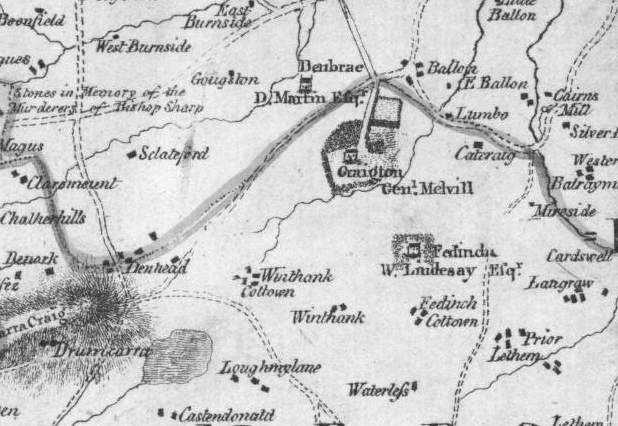
Cassindonald Colliery was located 300 yds. north of the farm at Cassindonald. A record exists for 1896 when the pit was then 'standing' but it is described as having wrought manufacturing and steam coals. No information is available on the numbers employed at the colliery which may have operated for a few years only in the 1890s. A new pit was sunk, to a depth of eight fathoms, at Cassindonald in 1899, and a few years earlier, there was apparently an unsuccessful attempt to rework some of the earlier coalworks (see newspaper items below).
 |
 |
Most people are very surprised to find that coal and ironstone were mined so near to the old university town of St Andrews!
---------------------------------------------
Extracts from Statistical Account of Fife
St Andrews Parish - 1795
" ... Coal is in great abundance within a few
miles of the city; much also is imported from both sides of
the Forth, chiefly from Dysart, Alloa, and
Borrowstounness [Bo'ness]. The proper weight of a
St Andrew's cart-load, or boll of coals, is 75 stone, or
1200 pounds. The average price of this cart-load, including
carriage, has hitherto been from the adjacent mines, 5s.
Dysart, 5s. 4d. Alloa, 5s. 10d. Borrowstounness, 6s. 4d.*
* During the winter 1792-3, St Andrew's sufferred under
the general complaint of scarce and dear coals. The moor
coals were raised to 6s. 6d. Dysart and Alloa to 8s. 9d.
Borrowstounness as high as 11s. ...
... On Denhead moor, in the S.W. corner of the parish, and
on the confines between it and that of Cameron, a coal-mine
belonging to Mr Martin of Denbrae, has sometimes been wrought
to a small extent. On the same moor, Mr Durham of Largo has a
coal. None of these are now occupied. Two or three years ago,
some Englishmen, judging from the appearance of the ground,
expected to find coal in many different parts of the parish,
and entered into contract with several proprietors; but,
after expending a good deal of money in boring, &c. they
were disappointed. ... "
---------------------------------------------
Extracts from Statistical Account of Fife
St Andrews Parish - 1845
" ... The prevailing strata are sandstone,
containing thin seams of coal, and strata of slate clay, with
courses of clay ironstone; thus indicating that the whole
group belongs to the carboniferous series.
... And what gives the slate clay a certain degree of
economic interest, are the courses and thin beds of clay
ironstone which it usually contains and which, at a time when
the iron trade was more profitable than it is now, were
sometimes collected and sent off to the Carron Ironworks. ...
... No mines are at present wrought, but it is understood
that coal, though of an inferior quality, might be procured
at Denhead, near the south-west extremity of the parish. ...
"
---------------------------------------------
Information on coals worked at, or near Cassindonald Colliery
(based on a report from 1900)
The coal-bearing strata of the East of Fife were more
broken up with large faults than they were in the Central and
Western parts of the Kingdom, and much more disrupted and
altered by the intrusion of igneous rocks. There can be no
doubt that these drawbacks arrested the development of coal
mining in the district. Much of the workable coal was
exhausted down to shallow depths before the end of the
nineteenth century and the deeper parts, together with those
where the workings were stopped by faults or by injected
whinstone.
Most of the mining was carried on here before
pumping machinery had arrived and it was abandoned when the
engine then in use could no longer keep down the underground
water.
It is to be feared that older mining plans of many
portions of the old East Fife coalfields, formerly largely
worked, have been either lost or destroyed, and that little
or no information now exists regarding the structure and
condition of these tracts. Happily, by an Act of Parliament,
it became law to officially deposit copies of all mining
plans in the Home Office, where they are ultimately available
for future guidance.
The Hurlet limestone is known to have emerged just north
of the farm at Cassindonald. The Blackband Winthank Ironstone
frequently passed into coal or shale in this district. From a
series of quarries near Winthank, where the limestone was 11
ft. thick, it could be traced for nearly a mile dipping
westward under its usual covering of black shales and
ironstones, with bands of yellow sandstone.
In this part of the district special interest and importance
attached to the lower limestone group, in as much as it here
included the seam of Blackband Ironstone already alluded to.
Its outcrop followed that of the Hurlet Limestone and was
shifted by the same fault that displaced that limestone
eastward at the north end of the Winthank quarries.
The strata in this part of the field were greatly disturbed.
In a boring at Elderbank, to the north of Cassindonald, the
ironstone was found at 20 fathoms. Various seams of coal have
been found and worked on the slope between Elderbank and the
Ceres road but their true position and extent are not
known.
---------------------------------------------
... and in a report from 1977 ...
... The coal worked in the Radernie area as the Brassie Coal was formerly worked to a small extent as the Low Little or Low Lime Coal at Cassindonald Colliery and in the area between Winthank Limeworks and Denhead. According to old reports by mining engineers, its thickness varied between 18 in. and 26 in. ... The Denhead Blackband Ironstone was not found at Cassindonald Colliery. ...
---------------------------------------------
"Dunfermline Press"
22 January, 1898
DISPUTE ABOUT FIFE MINERALS
In the Court of Session on Tuesday, the record
was closed in an action raised before Lord Kincairney at the
instance of James Simpson, quarrymaster, Baldinnie, near Ceres,
Fife, and James Robertson, miner, Ceres, against William Bethune,
merchant, Lundy Mill, Largo, and James Clark, some time coal
manager, residing at Lochgelly. Pursuers sued for £500 as
damages for alleged breach of contract of co-partnery.
The pursuer, Simpson, was tenant of a lime
quarry on the estate of Cassindonald, near St Andrews. Having found
coal on the estate, he and Robertson entered a copartnery with the
defenders in June 1897 for the working of the coals, each of the
defenders advancing £100. The copartnery was to commence on
1st July, and the pursuers commenced the work. On
23rd July the defender Bethune wrote to Simpson stating
that Clark had withdrawn from the partnership, and that he was also
to withdraw. The defenders refused then to sign the lease. As
the pursuers had no capital themselves, they have been unable to
prosecute the works, and the mines have flooded. The defenders deny
that there has been any completed contract of copartnery between
the parties.
---------------------------------------------
"Dunfermline Press"
29 July, 1899
NEW COAL PIT IN FIFE
The opening of a new coal pit at Cassindonald, near the village of Denhead, by Messrs Nicolson & Shepherd, will doubtless give some impetus to the trade in that part of the parish. It is now some years since coal has been worked here, and there is every likelihood that it will continue for many years to come. Mr Nicolson, one of the partners of the concern, was for a considerable time certificated manager at Mr Whittaker's Colliery, now a Limited Company, at Baldastard, in the Parish of Largo, and the knowledge which he has thus obtained will, we hope, be of great benefit to him in his changed circumstances. The present pit has been sunk to the depth of eight fathoms, which embraces two seams of about 2½ and 3 feet in thickness, lying two fathoms apart from each other. The coal gives every evidence of being excellent in point of quality, and is of a cherry nature.
---------------------------------------------
