Owners: Wemyss Collieries
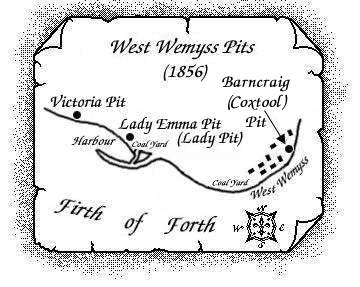
Barncraig Pit was located on the shore at the
east end of the village of West Wemyss. The Barncraig Pit,
probably sinking around 1836, is known to have been working into
the 1860s although the exact closing date is not known.
The Coxtool Coal seam was reached at a depth of 22 fms. and
was worked in the landward sections during 1839. Around
1849-51, the seam extending under the River Forth was
recorded as being worked in small stoops.
In 2007, William MacLeod, Guardbridge, contacted us to say, "Another fascinating pit which had gone long before my time was the Barncraig where the shaft was actually surrounded by the sea - presumably as a minor copy of the Moat Pit. It was abandoned when it was flooded - not by the sea - but by water from old workings. The first inrush caused great trepidation seemingly, as some of the colliers thought that the sea was coming down the shaft. It lay at the east end of the village. My uncle pointed out its approximate position but I was too young to record this in any positive way. This pit might have had some form of structure from shaft to shore (a relatively short distance)."
 |
 |
Barncraig Coal (Eight Feet) and Coxtool Coal (Upper Six Feet)
The pit most likely got its name from the Barncraig and
Coxtool seams (see abandonment plan dated 1836) whose
outcrops at the West Wemyss shore ran northwards keeping
to the west of the Michael and Rosie Collieries. A fault then
displaced the Barncraig outcrop eastwards to just north of the
Rosie Pit where it continued in a north-easterly direction skirting
the Wellesley and the Leven pits, ceasing around the Durie Pit,
just beyond the pits of Leven.
The Barncraig seam produced a first-class household coal and
was extensively worked to near exhaustion in the landward
parts of the Dysart-Leven coalfields. The Barncraig Coal
appeared to attain its maximum development of just over 100
in. in the undersea area opposite the village West Wemyss.
The roof of the Barncraig consisted usually of a fairly thick
bed of blaes, less often of fireclay, and yielded a rich
collection of mussels.
| Plan of Abandoned Seams for Barnecraig and Coxtool | Name designated in Plan |
|---|---|
| COAL; Coxtool or Upper Six Feet (1836) | BARNECRAIG AND COXTOOL |
