Owners: John Balfour, Esq.
| See the Balbirnie
Colliery entry (East Fife Index)
for full details of the old workings of this very important, early Fife coalfield near Markinch. |
|---|
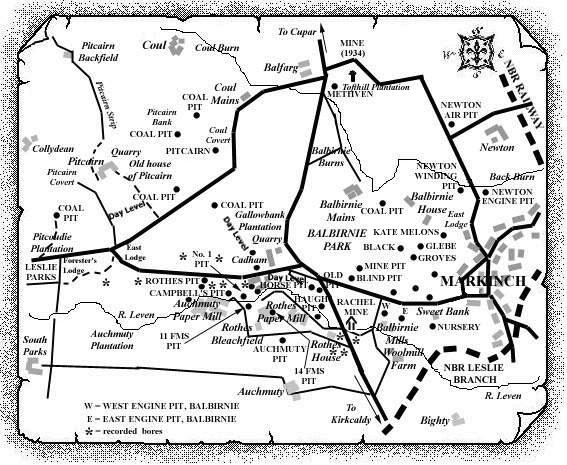
The two Balbirnie Engine Pits, each with a pumping engine, were located within 350 yards of each other, just north of the Balbirnie Mills, about ¼ mile south of Balbirnie Park. Dave Burt, Fife, describes their location as "just north from the River Leven, and east from the old railway crossing into what was Dickinson's Paper Mill".
 |
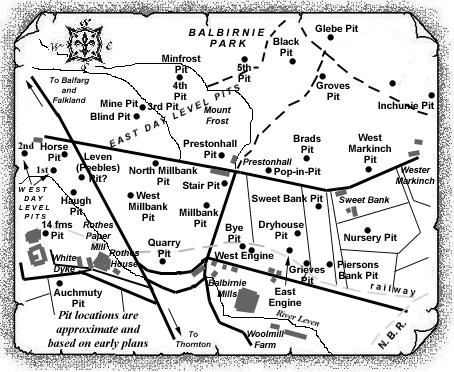 |
In Balfour of Balbirnie's early plans of the
coalfield, the West Engine Pit is also recorded as the
Black Engine Pit, and the East Engine Pit is
recorded as the Easter Engine Pit and as the Blau
Engine Pit. They were probably sunk in the late 1770s to
exploit the coals "below the level" in the
estate, and were the main pumping shafts for Balbirnie
Colliery into the 1860s. There is still, apparently,
brickwork standing at the West Engine Pit location which was
sunk to the Main Coal at a depth of around 24 fathoms. All
three coal seams of this area were worked from this shaft in
a northerly direction.
The East Engine Pit, sunk to a depth of around 24½
fathoms, is also known to have extensively worked all three -
Little, Main and Under - coal seams.
Some 19th century resources researched mention 'the
Balbirnie Engine Pit' but whether this refers to the East
Pit or to the West Pit is not clear from these resources.
All references to 'Balbirnie Engine Pits' have,
therefore, been included in this single entry.
--------------------------------------
Information on coals worked at, or near, the Balbirnie Engine Pits
The Balbirnie Engine Pit had, apparently, the longest continuous section of strata within the small Cadham coalfield which lay immediately to the west of Markinch, Fife. The coal-bearing strata were contained in two shallow basins incompletely separated from one another by a low anticlinal ridge. Workings in the Little, Under and Main Coals extended north to the position of the East Day Level in Balbirnie Park.
Records show that the strata consisted:
| Description | Depth |
| Surface and rock | 18 ft. |
| Craw Coal | 1 ft. 6 in. |
| Freestone | 60 ft. |
| Little Coal | 1 ft. 6 in. |
| Brats and blaes | 18 ft. |
| Main Coal | 4 ft. 9 in. |
| White stone and blaes | 42 ft. |
| Under Coal | 1 ft. 10 in. |
| Fireclay | 12 ft. |
Only the lower part of the Limestone Coal Group was
preserved and this contained but a single coal of workable
thickness, never far below the surface, known as the Main
Coal.
On the eastern side of the ridge, the thickness of coal was
considerably greater and the seam was said to contain a
variable band of splint coal. North of a line drawn through
Balbirnie House (now an hotel) and Newton farm, the Main Coal
was 4 ft. to 5 ft. 6 in. thick, including one or two thin
partings, with a blaes roof and a pavement of fakes or
sandstone. South of that line, a bed of sandstone, normally 1
ft. to 2 ft. thick, and probably the representative of the
midstone‘, occurred near the top of the seam, isolating
a thin upper leaf of 6 in. to 1 ft., with a blaes roof, from
the main part of the seam which measured 4 ft. 3 in. to 6 ft.
3 in. including a thin parting.
At one point between Balbirnie House and Markinch this
sandstone was reported to be 4 ft. 5 in. thick. The grounds
of Balbirnie House, now the Balbirnie House Hotel, where
numerous pits were sunk boasts a golf course but for obvious
reasons have not been exploited for modern housing. Many of
the visitors have their own views as to the great depths of
several of the bunkers on the golf course!!!
-----------------------------------------------
| Plan of Abandoned Seams for Balbirnie Engine Pits | Pits or Mines designated in Plan |
|---|---|
| COAL; Main; Upper; Under; Little (1884) |
BALBIRNIE
Blawhither; Brierbush; Bye; Dryhouse; Engine East; Engine West; Haugh; Leven; Pitcairn; Pitmillan; Quarry; Roadside [Plan Custodian: Wm. Marshall, Sweet Bank, Markinch] |
-----------------------------------------------

"Dunfermline Saturday Press"
November 3, 1860
FATAL TERMINATION OF AN ACCIDENT
Last week we reported that a little boy of the name McDiarmid had fallen out of the window of the engine-house at Balbirnie Engine Pit and had one of his feet much injured. We are sorry to state that he died on Thursday.
-----------------------------------------------
"Dunfermline Saturday Press"
23 February, 1861
One day last week, a miner, named Henry Wyse, when working in a pit at Balbirnie, met with an accident from a portion of the roof falling upon his head, and inflicting a severe wound.
-----------------------------------------------
"Supplement: Dunfermline Saturday
Press"
21 December, 1861
On Tuesday last, a miner named Wyse, when employed in Balbirnie engine pit, a portion of the roof fell in upon him, and broke one of his legs. Mr. Burns, of Wemyss, set the limb, and we are happy to state that he is favourably recovering.
-----------------------------------------------
"Dunfermline Saturday Press"
8 March, 1862
An accident occurrred at Balbirnie Engine Pit, on
Thursday, whereby a miner, named George Smart, was injured.
When at work, a stone fell from the roof of the pit and
bruised him on the back. We are happy to state that he is
recovering.
