In the late 18th century, the parish of Markinch had two large collieries - Balgonie and Balbirnie - which employed many people. The re-erection of the Balgonie Colliery around 1785, as reported in the Statistical Account of Scotland for the parish of Markinch in 1791, was apparently responsible for a considerable increase in population, an earlier successful mining period in the Balgonie pits having ended around 1743.
| See also Thornton Engine Pit entry. |
|---|
 |
Balgonie Colliery
| Source Date of Information (Owner) |
|---|
| Manager / Under-Manager / Men underground / Men above ground / Coal seams worked / Shaft Details |
| 1731 (Earl of Leven) |
| 1785 (Lord Balgonie) |
| 1808 (Lord
Balgonie) Collapse of Leven Iron Company with which Lord Balgonie was involved for a brief perid producing pig-iron. |
| 1823 (Lord
Balgonie) Coal grieve: Mr Alexander Welch. |
| 1845 (James Balfour, Esq., of Whittingham) |
| 1854-72 (Charles B. Balfour, Esq.) |
| 1873 (Charles B.
Balfour, Esq.)
Lochtyside Pit |
| George Linton /
------------ / --- / --- / D'cast (10 ft. dia.) 396
ft. : U'cast (9 x 4½) 72 ft. / Balgonie, 9 feet
Furnace ventilation. |
| 1874/75 (Charles B.
Balfour, Esq.)
Lochtyside Pit |
| George Linton /
------------ / 78 / 20 / D'cast (10 x 5) 396 ft. :
U'cast (6 x 5) 72 ft. / Nine feet
Furnace ventilation. |
| 1876 (Charles B.
Balfour, Esq.)
Lochtyside Pit |
| George Linton /
------------ / 85 / 18 / D'cast (10 x 5) 396 ft. :
U'cast (6 x 5) 72 ft. / Nine feet
Furnace ventilation. |
| 1877 (Charles B.
Balfour, Esq.)
Lochtyside Pit |
| George Linton /
------------ / 50 / 16 / D'cast (10 x 5) 396 ft. :
U'cast (6 x 5) 72 ft. / Nine feet
Furnace ventilation. |
| 1878 (Charles B.
Balfour, Esq.)
Lochtyside Pit |
| George Linton /
------------ / 53 / 17 / D'cast (10 x 5) 396 ft. :
U'cast (6 x 5) 72 ft. / Nine feet
Furnace ventilation. |
| 1879 (Charles B.
Balfour, Esq.)
Lochtyside Pit |
| George Linton /
------------ / 58 / 16 / D'cast (10 x 5) 396 ft. :
U'cast (6 x 5) 72 ft. / Fourteen feet, 9'
Furnace ventilation. |
| 1880 (Charles B.
Balfour, Esq.)
Lochtyside Pit |
| George Linton /
------------ / 51 / 14 / D'cast (10 x 5) 396 ft. :
U'cast (6 x 5) 80 ft. / Fourteen feet, 9'
Furnace ventilation. |
| 1881 (Charles B.
Balfour, Esq.)
Lochtyside Pit |
| George Linton /
------------ / 51 / 16 / D'cast (10 x 5) 396 ft. :
U'cast (6 x 5) 80 ft. / Nine feet
Natural ventilation. |
| 1882 (Charles B.
Balfour, Esq.)
Lochtyside Pit |
| George Linton /
------------ / 37 / 14 / D'cast (10 x 5) 396 ft. :
U'cast (6 x 5) 80 ft. / Nine feet
Natural ventilation. |
| 1890 (Charles B.
Balfour, Esq.)
Lochtyside and Julian Pits |
| Alex. Jamieson / ------------ / 161 / 29 / Dysart Main [Julian Pit] |
| Alex. Jamieson / ------------ / 65 / 20 / Dysart Main [Lochtyside Pit] |
| 1896 (Charles B.
Balfour, Esq.)
Balgonie Colliery |
| Alex. Jamieson / ------------ / 254 / 57 |
| Manufacturing and steam coals, and clay. |
| 1904 (Charles B.
Balfour, Esq.)
Balgonie Colliery |
| Alex. Jamieson / ------------ / 284 / 81 |
| Manufacturing and steam coals. |
| 1905 (Charles B.
Balfour, Esq.)
Balgonie Colliery |
| ---------- / ------------ / 286 / 94 |
| 1908 (Charles B.
Balfour, Esq.)
Balgonie Colliery |
| John Provan / ------------ / 346 / 91 |
| 1911 (Balgonie Colliery Co.) |
| ---------- / ------------ / 385 / 99 |
| Now see separate entries for Balgonie Lochtyside and Julian Pits and the later Branxton Mine. |
A fascinating and detailed account of 'Balgonie coal' given by the Rev. Mr. John Thomson (1791) gives us an insight into this very important Fife coalfield.
"Balgonie coal, the property of the Earl of Leven, was discovered and wrought upwards of 300, some say 500 years ago. As far back as the year 1517, the Coaltown of Balgonie is mentioned in a scheme of division and valuation of the county of Fife, of that date. The name of the village evidently indicates that it had been originally built for the accommodation of colliers, or, because built on the ground where coal had been found and wrought. But since it had grown to such consideration at the above mentioned period, as to be taken notice of in the general description and valuation of the county, it must have existed, and, of course, the coal must have been wrought for a considerable time before. That this coal had been wrought at an early period, to a considerable extent, appears from the coal waste, which can yet be traced for upwards of 3 miles along the line of bearing, and which had been dried by a free level to the depth, at an average, of 14 fathoms. It would appear, however, that when the free level coal was wrought out, the workings ceased. How long ago this happened, it is impossible to say. The grandfather of the oldest man living on the spot 60 years ago, had neither seen it wrought, nor had he seen any person who could tell at what period it stopped. "
"In the year 1731, it was again set a-going by Alexander Earl of Leven, who erected a water engine, which wrought two sets of pumps, with 9 inch working barrels, and which dried the coal to the depth of 30 fathoms. In the year 1732, this coal was let to tacksmen, who carried it on for some years, but meeting with large hitches yielding much water, their engine was overpowered; which obliged the tacksmen to abandon this spot, and erect a windmill at a little distance on the crop, leaving a sufficient barrier to keep off the water, which drained a small breast of the coal. This mill wrought an 8 inch bore 14 fathoms deep, which enabled them to carry on a more extensive winning (i.e. a gaining of the coal) farther on the dip, than the old level free wastes. During this operation, George Balfour, Esq., of Balbirnie, wrought a level to the coal in his estate; anno 1740, which enabled him to undersell the tacksman of this coal; by which means, in 1743, they were obliged to give it up, there not being demand for both. Nothing more was done till the year 1785, when Lord Balgonie erected it again, by fitting up the present engine."
"The former [Balgonie coalfield] has a water engine, with a wheel 26 feet diameter, which works two pumps to the depth of 30 fathoms, with 12¼ inch barrels. What the late tacksman intended, is now carried into effect by the present winning, which commands a very fine breast of coal in both seams. The lowermost seam is yet untouched with this winning. The main seam, now working, consists of
| Feet. Inch. | |
| A mixture of splint cherry coal
and rough coal |
3 0 |
| Stone | 0 4 |
| Rough coal, which includes
9 inches of fine cherry |
3 0 |
| Stone | 0 4 |
| Rough coal | 1 2 |
| Stone | 0 3 |
| Fine strong splint | 1 6 |
| Fine cherry | 0 4 |
| Total between roof and pavement | 9 11 |
"The roof consists of hard blue till, about 10 feet thick, above which are strong posts of freestone, some of which are very hard. The other seam lies 10 fathoms deeper; it is said to be a very fine coal, 7 feet thick, but has some small ribs of stone in it. The average out-put for the last four years is about 30 tons a-day, and so much is the case altered since 1743, that there is a great demand, and the consumption is daily increasing. This coal dips to the E. at the engine, but to the S.E., after passing a large hitch about 500 yards from the engine pit, on the line of bearing at the crop, the dip, or declivity, is exactly a fathom in 3; but, in the dip workings, only one fathom in 4½; which gives ground to believe that it will at last flatten altogether, and even crop out at the opposite point of the compass, which, if the case, will make it a very productive colliery."
The Statistical Table for the parish of Markinch (1791)
indicates that there were 100 coal workers including
colliers, overseers, drawers, &c.
A footnote gives a brilliant, detailed account of operations
in the Balgonie coalfield on its start-up in the 1780s.
"Since 1780, 3 water engines have been erected
upon this coal. The first works 2 pumps, 14 inch working
barrels; the second, 2 pumps of 11 inches diameter; the
third, 2 pumps 15 inch diameter, of the working barrel; and
about 20 fathoms left from the coal, to a mine in which the
water is delivered 5 fathoms below the surface of the ground.
Above the rock is gravel, which admits the winter rains to
pass through the numerous cutters in the strata, conveys it
down to the coal, and is the great cause of such powerful
engines being necessary to drain the coal. It is a pretty
general opinion, that all coals are as good in quality, or
better, in the dip than towards the crop. Also, that any coal
once-discovered, may be wrought to any depth from which it is
possible to draw the water.
But what has recently happened in this very coal, gives
reason to believe that opinion, however general, to be
erroneous; for, when the engines were first erected, from the
favourable appearance of the surface of the ground, composed
of flat and gently rising fields of vast extent, and from the
extreme flatness of the coal, which did not dip above 1 in
12, often not above 1 foot in 20, it had the appearance of
being almost inexhaustable, or, at least, that the under
level coal would be much more extensive than the crop already
wrought; but the very reverse of this was found to be the
case. An engine erected at the trifling depth of 20 fathoms,
in the short space of 10 years from its erection, was found
not only deep enough, but actually deeper than any coal in
that field. In working up the engine level, it was found to
go deeper than any part of the coal; dead water was kept till
the coal was found entirely cut off in the dip by a gravel
dike, composed of gravel and large bullet whin stones, all of
them rounded as if they had been tossed about in water. The
level was pushed on through this gravel, till it was found
impracticable to proceed with safety to the workmen; the coal
was, therefore, wrought along the side of this dike, as deep
as there was any coal, and in the progress of the work, the
coal to the dip on the west side of the field, which this
engine was erected to drain, not only turned out to be of bad
quality, but its thickness was diminished by a hard stone
which divided the seams in two, extending from 1 to 4 feet in
thickness, so hard as only to be wrought with gunpowder;
which added so much to the expense, that the coal could not
be wrought with profit, and was therefore abandoned
altogether, and the third engine erected on the E. part of
the same coal where the seam was found 6 feet thick, without
any stone at all."
"The proprietor wrought up a level along the side
of the river Leven, about half a mile in length, which
lessened the lift of the engine 5 fathoms. In working up this
mine, about 150 fathoms from the place where he intended to
erect his engine, he found the metals on edge perfectly
perpendicular; a little further, he found them dip 1 fathom
in 3, and that to the west, directly contrary to the dip of
the coal, and there he found two seams of coal, with 7
fathoms of stone between them; the first, 2½ feet, and
the other, 3 feet thick, dip 1 in 3.
About 50 fathoms farther, he found flat metal rising to the
west, the proper rise of the coal in that part of the field.
These appearances gave him reason to believe the main coal
did not extend far to the dip, but was either cut off by
these edge metals, or would be found on the dip separated by
a stone into two seams, and suddenly thrown out to the
surface in the form of the two seams he had discovered in his
mine, by a rise of 1 fathom in 3, directly contrary to the
ordinary crop of the coal.
In order to discover this, as soon as the engine was
erected, a level mine was pushed on to the eastward. The coal
was found perfectly good till he approached within 50 fathoms
of the edge metals, where a stone made its appearance in the
middle of the coal, one inch thick, 6 fathoms farther, it
increased to 18 inches thick, and continued to increase till
it was found impracticable to be wrought, and appeared fairly
to divide the seam of coal in two, corresponding in thickness
to the two edge seams he had dicovered in the said mine.
The coal continues flat, but it can hardly be doubted, that
if the level is driven 20 fathoms farther, it will rise the
opposite way, 1 fathom in 3 *."
* Since writing the above, an upset has been pushed forward, and the coal actually found to rise, as supposed above, 1 fathom in 5; and it will, no doubt, a little further on, rise 1 fathom in 3, and crop out at the surface; and the stone will increase in thickness, till it is found 7 fathoms at the surface, and the main coal is thrown out there, in the form of the two seams, above mentioned."
"Since this is the case upon the east part of the field, it is not easy to account, why the same thing has not happened on the west part of the same field, where the gravel dike intervenes, and cuts off the coal in place of the edge metals: the probability is, that the edge metals are also there, and that the coal will terminate and be thrown out to the surface by them in the same way, though in this part the gravel dike seems to be thrust in, between the flat and the edge metals; and is of great thickness, as a trial was made at right angles, a hundred fathoms distant, and 17 fathoms deep, where, in place of the rock and ordinary metals above the coal, nothing but gravel was found; from which it may be concluded, that the dike exceeds 100 fathoms in thickness, how much more, it is hard to say; at the distance of another 100 fathoms, the edge metals are seen in this part of the field also, which destroys every hope of the main coal being again found beyond the dike. From what has appeared in the east part of the field, it seems pretty certain, that if the coal is found at all, it will be in the form of two seams on edge, thrust suddenly up to the surface by these edge metals, and consequently of small extent and little value."
"From what is above recited, it may be inferred, that it is not always safe to trust to the dip side of a seam of coal being of value, though the crop has been found good, which was the case here, the crop having been wrought for 43 years, and everywhere in the natural level found good, and yet the dip the west half of the field has been exhausted in less than 12 years, at least, all that was found valuable in it; how long the dip of the east part of the field now working may last, it is hard to say, though it is scarce possible, allowing the quality to be good through the whole extent of the known field, that any coal will remain to work 50 years hence."
--------------------------------------------
"... in 1785, more powerful engines were erected, and the coal throughout the whole field rendered accessible to the former depth of 30 fathoms, but still only reaching to the 9 feet or upper seam. This coal is presently worked at Thornton, near the bridge of Orr, by steam power. The Balgonie is known to be a continuation of the Dysart coal. The strata dip towards the south-east, and consequently crop out in a north-westerly direction, at an angle of from 20o to 21o, or a rise of 1 in 2½ or 3; but the angle varies at different points; in the field at Thornton, for instance, the rise is only 7½o or about 1 in 8."
"There are two seams of coal along the whole line of bearing; the depth of the level is from 25 to 35 fathoms to the first, or what is commonly called the 9 feet seam, which consists of
--------------------------------------------
The Statistical Account of 1791 for the Parish of Collessie states: " ... The common fuel is coals, brought about 6 miles from Balbirnie, or Balgonie. ..."
--------------------------------------------
The Statistical Account of 1791 for the Parish of Collessie states: " ... The common fuel is coals, brought about 6 miles from Balbirnie, or Balgonie. ..."
--------------------------------------------
"Ironstone is found in the parish in great abundance. Soon after the publication of the last Statistical Report [1791], a company from Newcastle, projected an iron-work on the Balgonie estate. Much expense was incurred, and the scheme had a sufficient trial, but ultimately proved unsuccessful, and the enterprising individuals engaged in it suffered considerable loss. It has long since been abandoned. The stone, however, has frequently been exported to the Tyne for smelting. At present, the working of it interferes with a seam of coal, and is entirely suspended."
--------------------------------------------
Extract : Statistical Accounts of Fife 1791-99
Parish of Monimail
"... Coals chiefly from Balgonie and Balbirnie, in the parish of Markinch, at 7d per load, of 18 stone, are the fuel of the parish. A double cart carries five loads; the carriage costs nearly the purchase in money. ..."
The Statistical Account of 1836 for the Parish of Collessie states: " ... The only fuel used in this neighbourhood is coal, which is driven from the mouth of the pit. The nearest mines are those of Coul and Balbirnie, about nine miles distant. The fuel from both is good, and the price is moderate."
--------------------------------------------
Extract : Statistical Accounts of Fife 1836
Parish of Monimail
"... Fuel, &c. - The fuel principally used is coal, brought from the parishes of Markinch and Dysart. ..."
--------------------------------------------
1842 - Balgonie and Balbirnie Collieries
Mr. William Ballingall, agent to the proprietors of these collieries, says: "It has not been the practice of the proprietors of these collieries to employ very young persons at the coal for many years. At Balgonie or Thornton Colliery only six boys are employed, not one under eleven years of age. At Balbirnie men only are employed, the nayure of the work requiring full strength."
--------------------------------------------
In the Statistical Account for the parish of Markinch (1845) we are given additional information on the more recent mineral and coal-works beyond the start-up of 1785.
--------------------------------------------
| Ft. In. | |
| 1. Splint coal | 2 0 |
| 2. White Daulk stone, hard at first, but falls when exposed to weather | 0 6 |
| 3. Spar coal | 1 3 |
| 4. Same as second | 0 4 |
| 5. Head coal | 3 4 |
| 6. Stone as second (not wrought) | 0 8 |
| 7. Bottom coal | 4 4 |
| Thickness of coal (deducting stone) | 10 11 |
"But a material alteration takes place in the thickness of the Balgonie upper seam after crossing the hitch at Thornton. On the south or Dysart side of that point, the total thickness increases to 13 feet 10 inches as follows:
| Ft. In. | |
| 1. Splint coal | 2 0 |
| 2. Daulk stone}Roof | 0 6 |
| 3. Spar coal}Roof | 1 3 |
| 4. Stone | 0 4 |
| 5. Head coal | 3 10 |
| 6. Mid stone | 0 8 |
| 7. Bottom coal | 5 2 |
| 8. Ground stone} Pavement | 0 8 |
| 9. Ground coal} Pavement | 1 7 |
| Thickness of coal (deducting stone) | 13 10 |
"The second seam, commonly called the seven feet coal, lies 10 fathoms below the nine feet coal above-mentioned, or to a depth of 35 to 45 fathoms on the level. It consists of
| Ft. In. | |
| 1. Head coal | 1 2 |
| 2. Head stone | 0 6 |
| 3. Bottom coal | 1 10 |
| 4. Stone | 0 10 |
| 5. Road coal | 1 0 |
| 6. Stone | 0 6 |
| 7. Rough coal | 1 2 |
| Thickness of coal (deducting stone) | 5 2 |
"The common mode of working the coal at Thornton is what is technically termed "stoop and througher". The working rooms are 13 feet wide, and the pillars 15 feet; the width of the rooms contracting on nearing the crop, or where the roof is insecure."
"The average number of colliers employed may be stated at 30. They are paid at the rate of 2½d. per load of 20 stones Dutch, for large coal, which sells at 1s. per load. The small coal costs 1¾d. per load for hewing, and sells at 6d. The sale was originally confined to the country demand, but latterly the manufactories on the Leven and Orr waters, and in Kirkaldy, have drawn their supplies from hence. With more powerful engines for drawing off the water, the coal seams at Balgonie may be regarded as inexhaustible, as they dip to the east, and are never found to rise to the surface in a direction opposite to the line of bearing."
--------------------------------------------
| Plans of Abandoned Seams for Balgonie Colliery | Pits or Mines designated in Plans |
|---|---|
| COAL;
Dysart Main; Lower Dysart (1831)
[Ground wrought by the Balgonie Engine Pit and further north of the River Leven, around Barnslee, just to the east of Markinch station.] |
Balgonie
[Plan Custodian: Balgonie Colliery Co. Ltd., Markinch] |
| COAL;
Dysart Main (1877)
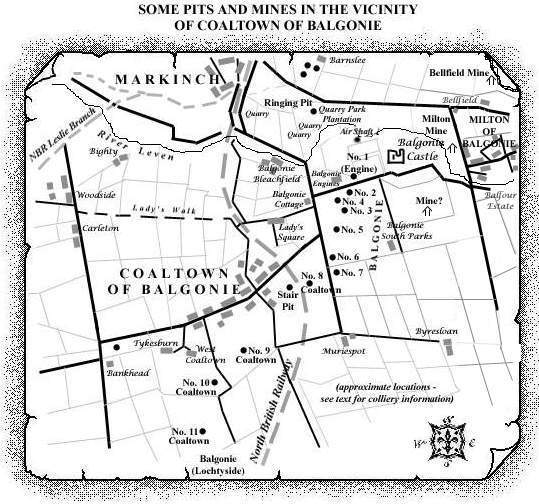
[Ground wrought south of Coaltown of Balgonie - see map for locations of these pits.] |
Balgonie (Coaltown) Nos. 8, 9, 10, 11
[Plan Custodian: Landale, Frew, Gemmell & Arnot, Edinburgh] |
--------------------------------------------------
"Fifeshire Journal"
7 June, 1834
MARKINCH
On the afternoon of Sunday last, about five
o'clock, three young lads about sixteen years of age, named
Robert Clark, Joseph Adam, and Robert Ireland, went into a
plantation near Balgonie Cottage. One of them, Robert Clark, in
looking down an old coal pit, let his bonnet fall in; and the pit
being filled with rubbish to within twelve feet of the top, he went
down to get it out.
On reaching the bottom, he almost immediately
called out to his companions that he was getting sick, and
requested them to help him out.
Joseph Adams went down to assist him, and he
also immediately fell senseless.
Robert Ireland then instantly gave the alarm,
and a number of persons were soon collected on the spot; and two
colliers, George Johnston and John Hutcheson, in succession,
attempted to rescue them, but were each of them obliged to be
immediately hauled up again - the bad air depriving them of sense
and nearly of life.
Captain Peat (who had by this time arrived at
the place) then said, "I'll rescue them or lie beside
them," and immediately descended, and succeeded in fixing a
rope around the arm of Robert Clark by which he was hauled
up.
The Captain again descended for the purpose of
fixing the rope on to Joseph Adam, but those having pulled too
soon, it slipped, which caused some delay, and exposed the Captain
to considerable danger, by detaining him longer in contact with the
bad air; but the rope being let down, it was securely fixed, and
both were hauled up.
The medical gentlemen, who had been sent for,
not having yet arrived, Captain Peat next proceeded to adopt means
to restore animation; and, with this view, he opened a vein in the
arm of each, but all his exertions, combined with able medical
assistance, which had now been procured, were unavailing - life
being totally extinct, although the young lads had not been above
fifteen minutes in the pit.
Much praise is due to Captain Peat for his very active and well-directed endeavours to save the two unfortunate young men; and, it is to be lamented, that these endeavours were not followed by a more successful result.
---------------------
"The Scotsman"
11 June, 1834
Distressing Occurrence. - One of the old coal pits in the neighbourhood of Balgonie, Fifeshire, was on Sunday week the scene of a fatal accident of a heart-rending description. The choke damp from the mine below seems to have forced its way upwards through the loose earth, and, from its comparative density, to have lain in the bottom of the pit, forming a pool of stagnant and heavy gas, which, though invisible to the eye, was charged with vapour destructive to animal life. The pit was about ten or twelve feet deep, with a sloping side; and three boys, about 14 years old, having perceived a dead mavis and a hawk lying at the bottom, one of them, with the curiosity so natural at that age, descended to get hold of the birds. When he reached the bottom he had only time to call to his companions that he felt sick, when he fell over. A second rushed to his assistance, and was immediately in the same state of helplessness. The third, frightened at seeing this, ran and gave the alarm, and several people soon collected round the pit. Two colliers both tried to raise the unhappy sufferers, but alas! the noxious atmosphere paralysed their strength so rapidly, that it was with difficulty they themselves could regain the pure air above. At length, Captain Peat succeeded in fixing a rope round the bodies of the two boys, and they were drawn up after being immured half an hour in the choke damp. Every effort was used to bring back life, but they proved quite unavailing.
---------------------------------------------------
"Fifeshire Journal"
29 March, 1849
IMPORTANT COLLIERY IN FIFESHIRE
To be Let for 19 Years, from Whitsunday first
-
BALGONIE COLLIERY, Parish of Markinch,
Fifeshire.
The Coal Seam is Eight Feet Thick, of superior
quality, and sufficiently hard to stand Railway Carriage without
injury. The Proprietor has lately filled the Coal by the erection
of a modern and very powerful Pumping Engine, in a new part of the
Coal Field, and connected the Works with the Edinburgh and Northern
Railway, which passes through the Mineral Field, so that a Market
is opened not only to Edinburgh and the Towns on the Forth, but
also to Dundee and the North of Scotland, and there is besides an
excellent hand-sale for the supply of the adjoining Villages, and
the extensive Manufactories on the Rivers of Leven and
Orr.
Offers to be given in to CHARLES BALFOUR,
Esquire, of Balgonie, London; to WILLIAM BALLINGAL, Sweetbank,
Markinch; or to DAVID LANDALE, Mining Engineer, South Street,
Edinburgh - on or before the 1st May next, who can show
conditions of Lease, and give any farther particulars that may be
required.
----------------------------------------------------
"Dunfermline Saturday Press"
20 July, 1867
THORNTON - REDUCTION ON COAL AND MINERS' WAGES
The price of coal dug from the Balgonie coal-field, has been reduced 5d. per ton, and a corresponding fall has taken place on the wages of the miners.
--------------------------------------------------
"Dunfermline Saturday Press"
21 March, 1868
THORNTON - THE COAL TRADE
During these few days past, the stock of coals at Balgonie Coal Pit, in this neighbourhood, has been much reduced - between 700 and 800 tons of the mineral having been despatched from the colliery per rail.
--------------------------------------------------
"Dunfermline Saturday Press"
25 April, 1868
THORNTON - COAL-FIELD ON FIRE
For a considerable time past it has been known that Balgonie Coal Field in this neighbourhood, and in the parish of Markinch, is on fire. Sundry futile attempts have been made to extinguish the burning, but this week it has increased in force, so that the miners have been unable to penetrate to the workings.
--------------------------------------------------
"Dunfermline Journal"
18 January, 1873
Unlike many other districts where mining operations engage attention, the greatest tranquillity prevails at the Balgonie and Balbirnie collieries in this part of the county. No special rules have been hung up at the works, and the miners engaged at these coalfields show much contentment and work industriously at their labours. Consequently no coal famine reaches this quarter, and no indications of striking are dreamt of.
--------------------------------------------------
"Dunfermline Saturday Press"
20 September, 1873
MEETING OF MINERS AT MARKINCH
A meeting of miners employed at Balgonie and Balbirnie
Collieries was held in the Town Hall, Markinch, on Saturday
evening - Mr. John Adams, Balgonie, in the chair - for the
purpose of hearing an address by Mr. Cook, of the Fife
Miners' Association, in relation to the new special
rules. He spoke clearly and pointedly on the matter.
A case was brought up before the meeting - that of Robert
Wyse, Balbirnie Colliery, who wanted to work a longer period
than agreed upon by the rest of the workmen. Wyse had gone to
his work for the purpose of carrying out his intention but
the rest of the men refused to go down the pit until Wyse was
brought up. This was done, and his violation of the laws was
strictly opposed. The case was left to the consideration and
decision of the Balgonie and Balbirnie miners. The meeting
was largely attended, and votes of thanks were given at the
close. The miners in the Coaltown of Balgonie district have
held a meeting in the village hall, and formed a set of
bye-laws for the Balgonie and Balbirnie coal works. ...
--------------------------------------------------
"Dunfermline Saturday Press"
13 February, 1875
THORNTON - MINING ACCIDENT
A miner of the name of Murdoch, residing at the village of Woodside, in the parish of Markinch, met with a serious accident on Saturday when working at the coalfield of Balgonie, near Thornton. All of a sudden a large portion of the workings fell in upon and covered him up. He had to be dug out, and when got out was in a critical state, being much cut and bruised.
---------------------------------------------------
"The Scotsman"
1 June, 1882
THORNTON - MINER SERIOUSLY INJURED. - Alex. Steele, miner, employed in Balgonie colliery, in the parish of Markinch, removed a prop on Tuesday evening which had been supporting a large quantity of coal in the roof of the workings. The mass, weighing about 30 cwts., instantly came away and seriously crushed him. He was speedily rescued and taken home, when it was found that his bruises were of an alarming character. His face and head are much cut, and one of his legs broken, besides internal injuries. A fatal termination is expected.
---------------------------------------------------
"Dunfermline Saturday Press"
29 February, 1896
FIFE COAL TRADE
... Balgonie Colliery is running half-time. For this rather favourably situated colliery it is a big falling off in their working time compared to what has been experienced during the depression. ...
------------------------------------

"Dunfermline Saturday Press"
4 July, 1896
MARKINCH - SUDDEN DEATH
On Tuesday forenoon, while Mr H. Adamson, miner, belonging to Coaltown of Balgonie, was returning to the seam in New Balgonie Pit, after taking a full tub of coal out of the lye to his neighbour, he dropped down, and his neighbour found him quite dead on returning with the empty tub. Heart disease is stated to be the cause of death. He leaves a widow and family.
------------------------------------
"Dunfermline Saturday Press"
3 September, 1921
DEATH OF FIFE COLLIERY OWNER.
The death occurred at his residence at Newton Don, Kelso, on Wednesday, at the age of 59, of Captain Charles Barrington Balfour, Lord Lieutenant of Berwickshire. ... Captain Balfour, who was created C.B. in 1919, had a residence at Balfour House, near Markinch, and possessed extensive interests in Fife, being proprietor of the Balgonie Collieries. ...
------------------------------------
"Cowdenbeath Advertiser"
9 June, 1939
630 MEN AND BOYS INVOLVED
AT BALGONIE COLLIERY
Strike notices on behalf of 630 men and boys employed at Balgonie Colliery, near Markinch, owned by the Balgonie Coal Coy., were lodged by the Fife Miners' Union on Tuesday. The notices will expire in 14 days unless a settlement is reached. It was stated at the offices of the union in Dunfermline on Tuesday that there was no change in the dispute at the colliery, where the men are alleging victimisation of a union delegate and refusal of the management to recognise the usual union procedure. No meeting has been arranged between the parties.
------------------------------------
"Dunfermline Press"
26 August, 1939
DEATH OF FIFE LAIRD.
CHAIRMAN OF BALGONIE COLLIERY COMPANY.
Major Charles James Balfour, D.L., J.P., the laird of Balgonie, has died at his residence Newton Don, Kelso. He was chairman of Balgonie Colliery Company, Ltd., Markinch. ...
------------------------------------
