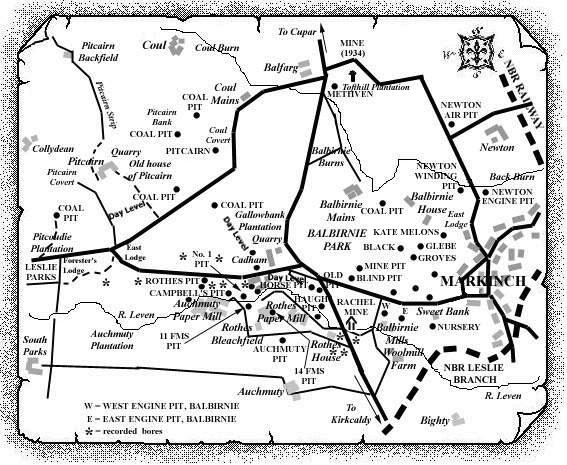
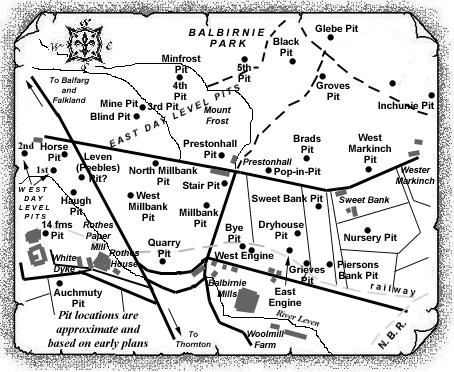
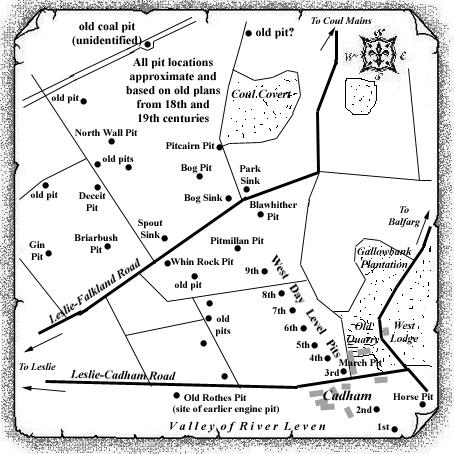
In the late 18th century, the parish of Markinch had two large working collieries - Balgonie and Balbirnie - which employed many people. Balgonie coal was within a mile and a half south-east of Markinch village, and Balbirnie coal within half that distance to the west. A great many of the small early pits, or sinks, working the Balbirnie coals, are believed to date from the 1600s. The first of these early coalworks were located by the banks of the River Leven, close to Blinkbonnie. From here, they spread outwards, to the east and to the west, forming "day levels" which ran respectively towards the lands of Pitcairn, and through the estate of Balbirnie. Several early coalworks are also known to have wrought around Auchmuty, Cadham, Coul and the much-faulted area to the north-east of Leslie, the Leslie estate being the property of the Countess of Rothes.
 |
 |
 |
We have uncovered limited information on a number of these coalworks and have entered these in the East Fife Index. The following coalworks should eventually appear as individual pit, mine, or sink entries:
Auchmuty; Balbirnie Nos. 1 - 9; Black; Blawhither; Blind; Bog; Bogie; Brads; Brierbush (Briarbush); Bye; Deceit; Dryhouse; Engine (East); Engine (West); Foul Coal Pit; Gin; Glebe; Greiges; Grieves; Groves; Haugh; Horse; Inchunie; Kate Melons; Leven (or Peebles); March; Millbank; Mine; Minifrost; Newton; North Millbank; North Wall; Nursery (or Sandbed); Old Bog; Park Sink; Piersons Bank; Pit-in-Park; Pitcairn; Pitmillan; Playfield; Pond Sink; Pop-in-Pit; Prestonhall; Quarry; Roadside; Rothes (Old); South Millbank; Spout Sink; Stair; Sweet Bank; West Markinch; West Millbank; Whin Rock.
| Balbirnie coal-works
- 18th C employees
(full service dates unknown) |
|---|
| John Cassells,
coal hewer, Balbirnie, pre 1795
Robert Mitchell, coal hewer, Balbirnie - 1795 |
A fascinating and detailed account of 'Balbirnie coal' given by the Rev. Mr. John Thomson (1791) gives us an insight into this very important Fife coalfield.
"Balbirnie coal lies both in the Balbirnie estate, the property of John Balfour, Esq., and in Leslie estate, the property of the Countess of Rothes, being one and the same seam; and is called Leslie or Balbirnie coal, according to the estate, in which the works are for the time. But as almost the whole of it, level free, and more than half the underlevel are in Balbirnie estate, it is generally known by the name Balbirnie coal *, and consists of two species, called the little coal and the great coal."
* When this coal was first discovered, cannot be known, but it appears to have been wrought at an early period near Balbirnie Burns, first by a free level, and afterwards by some sort of pumps, at a place called Pump Sink, to the northward of Balbirnie House. Old pits can be here traced along the crop, but the period these were wrought is unknown. About the year 1730, George Balfour, Esquire of Balbirnie, a gentleman who had paid considerable attention to the study of mineralogy, began first to trace the strata by bores and otherwise, from these old wastes, through great part of his estate to the river Leven, nearly one mile distant;- then began at the river, and, by a stone mine across the metals, wrought into the coal, and thus made it level free to a great extent, about the year 1740. By this level, it was wrought from that date till the year 1780. In sinking the first pit on the level, a seam was found 13 inches thick of the little coal, and through the whole field it is exactly 21 feet above the main coal everywhere. The same gentleman bored 12 fathoms through the main coal in search of other seams, but found none above 3 inches thick.
"The quality of the little coal is extremely good.
It is a cherry coal, has something of the caking quality, as
it works iron very well, and is the only coal in this part of
Fife that will do so; for which purpose the very smallest
particles of it are sold to the smiths on the coast of Fife,
from Dysart to St. Andrew's, and the whole inland part of
the country, extending to 1000 tons annually, besides the
quantity of great coal, in the state aftermentioned.
It varies in thickness from 6 feet to 4 feet. The distance
between roof and pavement is generally the same. When a stone
is found in the middle of the seam, the coal diminishes in
thickness, as the stone increases, till at last, if the stone
be very thick, the coal is so much thinned as to be hardly
worth working.
This field of coal is not a regular one: it lies very nearly
in the form of a horse-shoe; supposing it 5 or 6 times
broader than ordinary, and the open space of the common size.
At the place where first discovered, a little to the north of
the river Leven, the dip was directly south. In working
forward, the field divided in two; one level run toward the
north-west, another to the north-east, and the crop was
wrought till within 12 feet of the surface. The two branches
of the level separated further, and the two crops did the
same, leaving a space of many hundred fathoms between, in
which was neither coal, nor the appearance of it: this space
resembled the open part of the horse-shoe. The increasing
consumption of coal will appear from the following
state:
From 1740 to 1763, the quantity of coal at Balbirnie
appears to
have been 42,135 loads, or 8,427
tons annually, which, in 23 years is 192,811
From 1763 to 1777, both inclusive, the average sales were
46,719
loads, or 9,343 tons annually . . .
. . . . . . . . . . . . . . . . . . . . . . . . . . . .
. 140,157
From 1778 to 1792, both inclusive, the average quantity was
54,660
loads *, or 10,932 tons annually . .
. . . . . . . . . . . . . . . . . . . . . . . . . . .
. 163,980
In 1784, owing to a scheme of lowering the price of coal to
all
who were more than ten miles distant
from the coal-works, there
was an additional quantity sold, not
included in the fore-going
average of . . . . . . . . . . . . .
. . . . . . . . . . . . . . . . . . . . . . . . . . . . . . .
. . . . . 4,047
Total number of tons sold in 52 years, . . . . .
. . . . . . . . . . . . . . . 500,995
* The loads in the above computation contain 27 stone Dutch weight each, which is one third more than the sale load, or load sold to the country. The former is known by the name of the collier's load.
"On the supposition that the demand for coal should not increase above the average of the last 15 years, being 10,932 tons annually, but continue the same; and although one half of the whole field of coal were yet entire (which certainly is not the case), an equal quantity would be entirely exhausted in less than 46 years. But the increasing consumption must be immense, when it is considered, that during the first 40 years, there was no other coal-work, except this, to supply this part of Fife, and that during the last seven years the coal of Balgonie has also been wrought, and has supplied the country with 9000 tons annually, notwithstanding of which, the consumption of this coal is continually on the increase."
The writer of the Statistical Account for Markinch Parish (1845) summarises the 18th century achievements before relating the improved nature of coal working around Markinch in the first half of the next century. The details provided are extremely interesting for those keen to learn about how the old coal workings of Fife were set up.
"Balbirnie coal lies on both banks of the Leven,
principally on the estate of Balbirnie, but partly in the
lands of Rothes and Coull, in one continuous seam. A portion
of the field belonging to the Earl of Rothes has at different
times been leased to the proprietor of Balbirnie, who
possesses peculiar advantages for working it, as the greater
portion of the coal that is level free, and also more than
half the under level, are in the Balbirnie estate.
This coal was wrought at a very remote period, but not
extensively, previously to the year 1730, - when the nature
of the field was more accurately ascertained by means of
bores, - proceeding from the old wastes in the direction of
the river, from whence a mine carried across the metals,
rendered the field level free to a very considerable extent.
In fact, no other means of drainage seems to have been
resorted to for a period of forty years, during which time
upwards of 365,000 tons of coal are computed to have been
raised and sold. The Balbirnie coal is now drained by means
of water-engines on the Leven; that on Coull by a
steam-engine."
"The field is somewhat irregular in shape, but
approaches most nearly the figure of an ellipse or
horse-shoe. It is what is called a Trough Coal. The
dip of the Balbirnie seams is very irregular. On the east
side it is sometimes 45o, on the west
12o.
The seams are three in number, and in thickness as follows:
1st, Upper coal, a soft cherry, 1 foot 6 inches; 2d,
Main seam, cherry and splint, 4 feet 6 inches; 3d,
Under coal, cherry, 2 feet."
"The following is a section of the strata passed through in sinking a bore on the south crop, near Newton Bridge, about half a mile from the village of Markinch:
| Fath. Ft. In. | |
| 1. Surface | 0 1 6 |
| 2. Sand, mixed with gravel | 1 0 4 |
| 3. Brown clay, mixed with whinstone | 7 3 8 |
| 4. Gravel bed | 0 4 6 |
| 5. Dark blue blaes | 0 1 0 |
| 6. Whitish fire clay | 0 2 6 |
| 7. White freestone with partings | 2 2 8 |
| 8. White soft till | 0 2 7 |
| 9. Blaes, with gray freestone bands | 2 1 1 |
| 10. Grayish freestone, with partings | 1 4 8 |
| 11. Dark-coloured parting | 0 0 3 |
| 12. Gray freestone, with parting | 0 3 10 |
| 13. Coal | 0 1 10 |
| 14. Black coloured till | 0 0 5 ½ |
| 15. Blaes, with gray freestone bands | 3 0 0 |
| 16. Blue-coloured blaes | 0 3 6 ½ |
| 17. Coal | 0 1 0 |
| 18. Brownish freestone | 0 1 2 |
| 19. Coal splint | 0 1 11 |
| 20. Soft blae parting | 0 0 4 |
| 21. Coal | 0 3 3 ½ |
"But the strata vary in thickness, as well as the coal seams, at different points in the field. In general the depths from the surface to the different seams may be set down as follows:- From surface to upper seam, 17½ fathoms; to main coal, 23 do.; to under coal, 30 do."
"At Balbirnie, the engine is erected on the main seam, with a draft of 25 fathoms, two fathoms being cut below the coal for what is called a sump or well, so that there are no shafts 30 fathoms deep. Cuts are carried right and left from the bottom of the shaft to the upper and under seams, the depth being 25 fathoms, or 50 yards, as noted above. This engine stands on the lowest part of the seam, the coal rising on either side of it. The whole field is thus rendered accessible to the miner, if we except about twenty acres of the lower seam, which can only be drained by an addition of power to the water-engine, and by sinking the shaft seven fathoms deeper. Various bores have been made with a view to the discovery of new seams of coal, but without success. One in particular, from the pavement of the main coal, near the centre of the coal-field, was carried down to the depth of 67 feet 4 inches, till interrupted by a bed of stone, so hard, that in a whole week only six inches were bored through, and the attempts was, therefore, relinquished."
"The average price of Balbirnie coal may be stated
at 8s. per ton; but the price varies according to the
quality.
The colliers, in addition to their daily earnings, are
allowed a free house and garden. Coals for their own use are
charged to them at the hewing rate. The following table will
give a comparative view of the rate of wages for the years
specified. We premise that a single collier is reckoned to
hew at an average ten loads per diem."
| Years, | 1770-1779 | 1780-1789 | 1790-1799 | 1800-1809 | 1810-1819 | 1820-1829 | 1830-1839 |
| Price per load, | 2d. | 2½d. | 2¾d. | 3½d. | 3¾d. | 3¾d. | 3¾d. |
| Wages per diem, | 1s. 8d. | 2s. 1d. | 2s. 3½d. | 2s. 11d. | 3s. 1½d. | 3s. 1½d. | 3s. 1½d. |
"The trap dike by which the Balbirnie coal-field
is intersected, has ... its effects in throwing up and
cutting off the coal seams. A similar vein of trap cuts off
the coal to the north of the Coull engine. Occasional hitches
are met with in all parts of the field, raising or depressing
the strata, but without offering any very serious obstacles
to the operations of the miner.
The upper coal being only 18 inches in thickness, and the
difficulty of sufficiently enlarging the galleries, from the
nature of the strata in immediate contact with it, being very
considerable, the men suffer severely from a confined and
hampered position, and from bad air, so that their general
health and appearance are thereby, in process of time,
sensibly affected. Asthma and consumption are the complaints
to which they are most liable, and at the age of thirty many
of them look old men. Formerly, when engaged on the main
seam, many reached the ages of sixty, seventy, and eighty.
Now, what with the thin seams, bad air, and an unguarded use
of ardent spirits, it is rare to find an old man among
them."
------------------------------------
Extract : Statistical Accounts of Fife
1791-99
Parish of Monimail
"... Coals chiefly from Balgonie and Balbirnie, in the parish of Markinch, at 7d per load, of 18 stone, are the fuel of the parish. A double cart carries five loads; the carriage costs nearly the purchase in money. ..."
------------------------------------
Extract : Statistical Accounts of Fife
1836
Parish of Monimail
"... Fuel, &c. - The fuel principally used is coal, brought from the parishes of Markinch and Dysart. ..."
------------------------------------
Balbirnie coals found markets in all parts of the county:-
Statistical Accounts: Parish of Creich (1838)
"... The common fuel is coal, which is partly
driven from the pits at Balbirnie and Orr Bridge, a distance
of from eleven to thirteen miles from the centre of the
parish, and partly from Balmerino, a distance of five miles,
whither it is imported from Newcastle and Alloa.
The price at Balmerino of English coals is from 4s. 6d. to
5s. 9d. per boll of 42 stones, or six cwt. and of Scotch
coals at about 6s. per boll of 56 stones or 8 cwt. The
present price of coals at Balbirnie is 1s. 6d. per load of 18
stones, and at Orr Bridge is 1s. 3d. per load of 28 stones.
..."
------------------------------------
1842 - Balgonie and Balbirnie Collieries
Mr. William Ballingall, agent to the proprietors of these collieries, says: "It has not been the practice of the proprietors of these collieries to employ very young persons at the coal for many years. At Balgonie or Thornton Colliery only six boys are employed, not one under eleven years of age. At Balbirnie men only are employed, the nature of the work requiring full strength."
------------------------------------
Extract : Statistical Accounts of Fife
1843
Parish of Moonzie
"... Fuel.- The fuel commonly used is coal, either English coal brought from Newburgh or Balmerino, or Scots coal from Balbirnie or Dysart. ..."
------------------------------------
Balbirnie Colliery
| Source Date of Information (Owner) |
|---|
| Manager / Under-Manager / Men underground / Men above ground / Coal seams worked |
| 1730 (George Balfour, Esq.) |
| 1814
Robert Bald, mining engineer, recommended the substitution of iron railways and trammers underground in place of working ponies which were a considerable expense for collieries. |
| 1837
General Balfour died at Leamington, November; buried 16 December, at Markinch. |
| 1842 (John Balfour, Esq.)
Mr William Ballingall, agent |
| 1843
Death of Neil Ballingal (93), in April. He was a mining engineer responsible for much of the early Balbirnie Colliery development, including the water engines erected on the River Leven nearly 60 years earlier. |
| 1857 (John Balfour,
Esq.)
From Hunts "Mining Records" |
| 1880 (John Balfour, Esq.) |
| 1895
Mr John Balfour of Balbirnie died 25 July, 1895. |
| Plans of Abandoned Seams in the Balbirnie, Cadham & Leslie Districts | Pits or Mines designated in Plans |
|---|---|
| COAL; Seam unnamed (1752) |
BALBIRNIE
[Plan Custodian: Wm. Marshall, Sweet Bank, Markinch] |
| COAL; Seam unnamed (1780) |
BALBIRNIE, EAST AND WEST
[Plan Custodian: Wm. Marshall, Sweet Bank, Markinch] |
| COAL; Balbirnie Under |
NEWTON
Kate Melons [Plan Custodian: Landale, Frew, Gemmell & Arnot, Edinburgh] |
| COAL; Main; Upper; Under |
BALBIRNIE, CADHAM AND NEWTON
[Plan Custodian: Wm. Marshall, Sweet Bank, Markinch] |
| COAL; Seam unnamed (1793) |
BALBIRNIE
Nos. 1, 2, 3, 4, 5, 6, 7, 8, 9 [Plan Custodian: Wm. Marshall, Sweet Bank, Markinch] |
| COAL; Main (1796) |
PITCAIRN
[Plan Custodian: Wm. Marshall, Sweet Bank, Markinch] |
| COAL; Seam unnamed (1798-1828) |
BALBIRNIE
[Plan Custodian: Wm. Marshall, Sweet Bank, Markinch] |
| COAL; Main (1820) |
AUCHMUTY AND CADHAM
Bogie; Greiges [Plan Custodian: J & G. H. Geddes, Edinburgh] |
| COAL; Seam unnamed (1863) |
NEWTON
Balbirnie [Plan Custodian: Wm. Marshall, Sweet Bank, Markinch] |
| COAL; Seam unnamed (1874-1880) |
NEWTON
[Plan Custodian: Wm. Marshall, Sweet Bank, Markinch] |
| COAL; Main (February, 1880) |
BALBIRNIE
Newton |
| COAL; Main; Upper; Under; Little (1884) |
BALBIRNIE
Blawhither; Brierbush; Bye; Dryhouse; Engine East; Engine West; Haugh; Leven; Pitcairn; Pitmillan; Quarry; Roadside [Plan Custodian: Wm. Marshall, Sweet Bank, Markinch] |
| COAL; Little (September, 1890) |
BALBIRNIE
Horse |
------------------------
Additional information
on coals worked at Balbirnie
(compiled from various reports and surveys)
There are three coal seams which have been worked in the
Balbirnie area which, from the uppermost downwards, are the
Little Coal (approx. 2 ft. thick); the Main
Coal (up to 6 ft. thick); and the Under Coal
(approx. 2 ft. thick). The workings in the Little and Under
Coals appear to extend north from the banks of the River
Leven, through Prestonhall and Sweetbank into the Balbirnie
estate, the coal having been extracted on the
"Longwall" system of mining. The Main Coal,
however, seems to have been worked from the River Leven
northwards to the Tofthill Plantation at Balfarg Junction.
This coal seam, within 40 ft. of the surface in some places,
was worked by the "stoop and room" method.
The coal seams have been laid down in a synclinal basin,
with the main axis running approximately north-east to
south-west through Balbirnie House, and having side slopes to
the axis ranging from 1 in 30 to 1 in 3. The surface deposits
overlying the solid strata in this district vary from 10 ft.
to 90 ft. in thickness and generally consist of sand and
gravel, or boulderclay.
It is suggested that mining operations may have started in
the late 1600s in the River Leven valley immediately west of
Blinkbonnie junction where the overburden to the Main Coal
had been reduced by erosion. The coal was extracted by an
early form of opencast operation, removing the shallow
overburden to expose the coal. As these primitive excavations
extended into the side of the Leven valley, the overburden
thickness became too much to remove and tunnelling in the
coal followed.
This tunnel in the coal traced the contour of the seam, that
is, it followed a "level course" to avoid the
problem of flooding in the workings. This "level
course" was developed both to the east and to the west
of the original opencast excavations because of the shape of
the seam contouring in this district. These became known as
the East and West Day Levels.
Around nine shafts were sunk at intervals along the first
stage of the West Day Level which stretched from Blinkbonnie,
in an approx. north-westerly direction, towards the
much-faulted ground by the Leslie-Falkland Road in the lands
of Pitcairn. Several small pits operated in this Pitcairn
field, on the north side of this road, but few details are
available about the workings.
Workings in the Main Coal from the East Day Level would be
restricted to the "rise" side of the Day Level,
again because of the inability, at that time, to effectively
pump water from the coalworks, which was drained from the
workings, via the Day Level, into the River Leven.
By the 1780s, the East Day Level had extended from the River
Leven to the west side of Balbirnie House and the Main Coal
between the Level and the west outcrop had probably been
extracted to exhaustion by the stoop and room method. Shafts
were also sunk at intervals along the route of the East Day
Level for ease of access, for ventilation and for raising
coal.
About the same time, the ability to harness the water power
of the River Leven, for driving pumps, meant that water could
be raised vertically from the workings thus eliminating the
need for a "Day Level" by which to drain away the
water from the coalworks.
Pumping engine shafts were therefore sunk on the north bank
of the River Leven, just south of Prestonhall and Sweetbank,
and the Main Coal was extracted by "stoop and
room", in a northerly direction, reaching the East Day
Level to the west, and the outcrop to the east.
Pit shafts sunk in this area were also used to obtain access
to the Little Coal and Under Coals and, by the 1850s, all
three coal seams had been worked from the river area into the
Balbirnie estate grounds, both latter mentioned by the
"fan" system of Longwall workings.
By the 1890s, the ground on the east side of Balbirnie
estate around Stob Cross had been worked in the Main Coal
(stoop and room), and in the early 1900s, two mines were
driven south from Tofthill Plantation, at the north end of
Balbirnie estate, to work the Main Coal by the same method,
meeting with old workings on the west side of the estate.
-----------------------------------------
"Fifeshire Journal"
6 April, 1837
WANTED
A Considerable Number of COLLIERS, at Balbirnie Coal-Work,
Parish of Markinch, Fifeshire.
Coals with Free Houses and Yards, given by the
Proprietor.
Balbirnie, 5th April, 1837.
-------------------------------------------------
"Fifeshire Journal"
12 February, 1846
FOR SALE
A SECOND-HAND STEAM-ENGINE, 24 Horse-Power, with Beam 16
feet long, and whole Gearing, fit for Coal-work purposes.
Apply to MR BALLINGAL, Sweetbank, by Markinch.
11th February, 1846.
-------------------------------------------------
"Dunfermline Saturday Press"
23 February, 1861
One day last week, a miner, named Henry Wyse, when working in a pit at Balbirnie, met with an accident from a portion of the roof falling upon his head, and inflicting a severe wound.
-------------------------------------------------
"Supplement: Dunfermline Saturday
Press"
17 May, 1862
On the afternoon of Friday, a miner, named Robert Adams, when working in a coal-pit on the estate of Balbirnie had one of his legs broken by a large piece of coal falling in upon him.
-------------------------------------------------
"Supplement: Dunfermline Saturday
Press"
20 December, 1862
A new seam of coal has been discovered near Muckart. The coal is of good quantity, and is the best that has been found in the district.
-------------------------------------------------
"Supplement: Dunfermline Saturday
Press
19 December, 1863
NEW COALFIELD
We learn that a new coalfield has been recently discovered on the farm of Pyeston, on the Balbirnie estate. The mineral is of excellent quality, and seems, from the borings made, to be only ten fathoms from the surface, while the seam is fully two feet in thickness.
-------------------------------------------------
"Dunfermline Saturday Press"
10 August, 1867
A number of the miners employed at the Balbirnie Coal Works enjoyed a holiday on Saturday, when they went off in carts to Loch Leven. The weather was favourable, and the day was pleasantly spent.
-------------------------------------------------

"Dunfermline Saturday Press"
27 August, 1870
On Thursday afternoon, a boy about ten years of age, named Walker, met with a fatal accident at the Balbirnie Coal-pit, near Markinch. He had accompanied a carter from Leslie for coal; and on the horse moving backwards while at the pit, the end of the cart struck him on the head, crushing him against the loading bank. His injuries were of so severe a nature that he only lived a short time after the accident.
-------------------------------------------------
"Dunfermline Saturday Press"
11 November, 1871
NEW COALFIELD
An extensive and valuable coalfield has been discovered on the lands adjoining Kinglassie, and belonging to John Balfour, Esq., of Balbirnie, who is shortly to commence mining operations, which will add materially to the trade of the district.
--------------------------------------------------
"Dunfermline Journal"
18 January, 1873
Unlike many other districts where mining operations engage attention, the greatest tranquillity prevails at the Balgonie and Balbirnie collieries in this part of the county. No special rules have been hung up at the works, and the miners engaged at these coalfields show much contentment and work industriously at their labours. Consequently no coal famine reaches this quarter, and no indications of striking are dreamt of.
--------------------------------------------------
"Dunfermline Saturday Press"
20 September, 1873
A meeting of miners employed at Balgonie and Balbirnie Collieries was held in the Town Hall, Markinch, on Saturday evening - Mr. John Adams, Balgonie, in the chair - for the purpose of hearing an address by Mr. Cook, of the Fife Miners' Association, in relation to the new special rules. He spoke clearly and pointedly on the matter. A case was brought up before the meeting - that of Robert Wyse, Balbirnie Colliery, who wanted to work a longer period than agreed upon by the rest of the workmen. Wyse had gone to his work for the purpose of carrying out his intention but the rest of the men refused to go down the pit until Wyse was brought up. This was done, and his violation of the laws was strictly opposed. The case was left to the consideration and decision of the Balgonie and Balbirnie miners. The meeting was largely attended, and votes of thanks were given at the close. The miners in the Coaltown of Balgonie district have held a meeting in the village hall, and formed a set of bye-laws for the Balgonie and Balbirnie coal works. ...
------------------------------------
"Dunfermline Saturday Press"
5 September, 1874
At Balbirnie Colliery, owned by John Balfour, Esq., a
number of the men, after being out for a few days, have
resumed work on their employers terms.
At Largoward, Balgrie, and other coalfields to the east of
this, work goes on as usual, and the supply as yet is equal
to the demand.
------------------------------------
"Dunfermline Saturday Press"
4 September, 1875
On Thursday, while a man named Wilson was engaged in loosening a piece of coal weighing several tons, it suddenly gave way and fell upon him. When his fellow-workmen had the coal removed it was found that he was fearfully bruised, so much so that he died within a few hours.
------------------------------------
"Dunfermline Saturday Press"
30 April, 1887
FATAL ACCIDENT AT BALBIRNIE SQUARE
On Tuesday forenoon while a miner named Mackie was engaged at work on a colliery here, a large stone weighing upwards of three tons fell on him, killing him on the spot. He was about 40 years of age, and leaves a widow and family.
--------------------------------------------------
"Courier"
22 July, 2005
Historic mining ledger
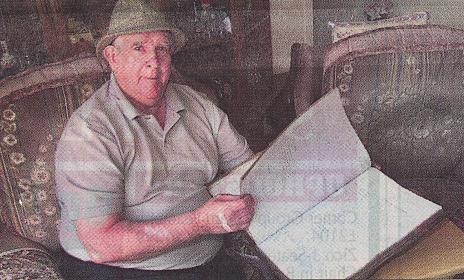 |
Mr Imrie with the ledger
A HISTORIC ledger has been gifted to Kinglassie Mining Museum. The
accounts book, 158 years old, was handed to former miner Dan Imrie,
secretary of Kinglassie and Cardenden Retired Mining Association
recently. The person donating it wishes to remain anonymous.
Mr
Imrie said, "The work is entitled The Balbirnie Coal Book and
dates back to 1847, and so it is a really interesting and unique
find.
"It lists the names of people who did jobs in the pit
and also logs what they got paid, and is in excellent condition
after all this time."
Mr Imrie says the National Union of
Miners general secretary Nicky Wilson has expressed an interest in
it, but is adamant the ledger should remain in Fife.
"I'm
quite happy for Mr Wilson to have a look at it or take it to the
Scottish Mining Museum Trust for further study, but this is a
wonderful piece of Fife's mining heritage and, as such, should
remain here."
He added, "We have a large reference
library here in Kinglassie and a good archive so this is a very
welcome addition to our resources.
"It would be interesting,
however, to get more information about the book's contents,
which perhaps museum staff or historians can help with, as I think
there is a lot to be learnt from it."
--------------------------------------------------
