Owners: probably Mr. Melvill
| The
Banfield Coal Book is a manuscript account book in the
collection of Fife Council Libraries East which details
the workings of a coal pit in East Fife between 1749 and
1761. It apparently records the sinking of shafts, the
type of coal worked and the names of the colliers. It
also lists the equipment and supplies used including
pumps, windlasses, picks, shovels and buckets, cruisie
lamps, candles and ale. Mining was thirsty work and water
at this period was often unfit to drink.
Examination of this manuscript is planned and it is hoped to have more details for this entry. |
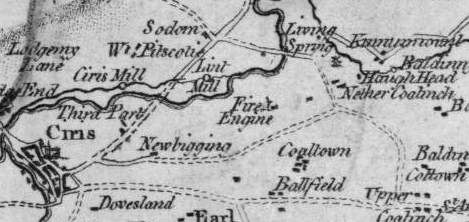
Although it is not certain where the Banfield Coal Pit was, it was probably near Ceres. A map from 1775 shows a 'fire engine' almost mid-way between Ceres and North Callange (here called Nether Coalinch). This is the likely location of the pit because one of the entries in the Banfield Coal Book refers to the "road to the White Den", the White Den being the name formerly applied to a wooded area between Ceres and Callange.
 |
It may also have been the pit which was the subject of an investigation by Ceres Kirk Session in 1777, when several men were charged with damaging the pumps at "the Coal Pit belonging to Mr. Melvill in this parish where the Horse Gin works for drawing water."
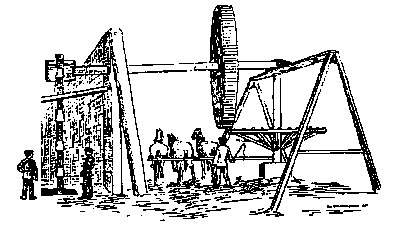
This was probably the type of Horse Gin in use.
Although the accused men agreed that they had gone down into the pit to see how the pumps worked, none admitted causing any damage. The case is recorded in Ceres Kirk Session Minutes.
Evidence given by James Melvill and Thomas Robertson:
"They wrought in Mr Melvill's Coal Pit on Tuesday 15 July last and left their work at the usual time about 6 in the evening when the Pumps as far as they knew were working very well in the usual way. They returned to the work on Wednesday and perceived no alteration until about noon when they discovered that the Pumps were making a hissing noise as if drawing air and did not carry of the water as formerly... Upon examining the Pumps more narrowly they found out several holes that appeared to have been bored with a Gimmlet about a mans height from the scaffold at the bottom."
Evidence given by John McIntosh:
"He was let down the whole way to the bottom, but finding he could not see he immediately called out to the people at the windlass to draw him up; upon his being drawn up, William Lamb"
"went down with a candle upon which he again went down to the bottom and they came up with the candle to the pump heads that he might see how they wrought ... he did no harm to the Pumps and knows of no harm being done to them."
Evidence given by William Lamb:
"Coming from Ceres and seeing a crowd of people about the Pit, he went to learn what was the matter... he was asked whither or no he could find out candles if he went down to which he answered he thought he could as he was well acquainted with the work upon which he went down. He found out candles and as he was lighting them, John McIntosh came down .. . "
The verdict:
Although finding "no convincing evidence of guilt", the Kirk Session agreed that the accused men "should be rebuked for going into the Coal Pit without leave ... & seriously exhorted to more prudent and circumspect conduct in time coming."
| See Callange Coal Pits entry for information on early coalworks and minerals in the parish of Ceres. |
|---|
