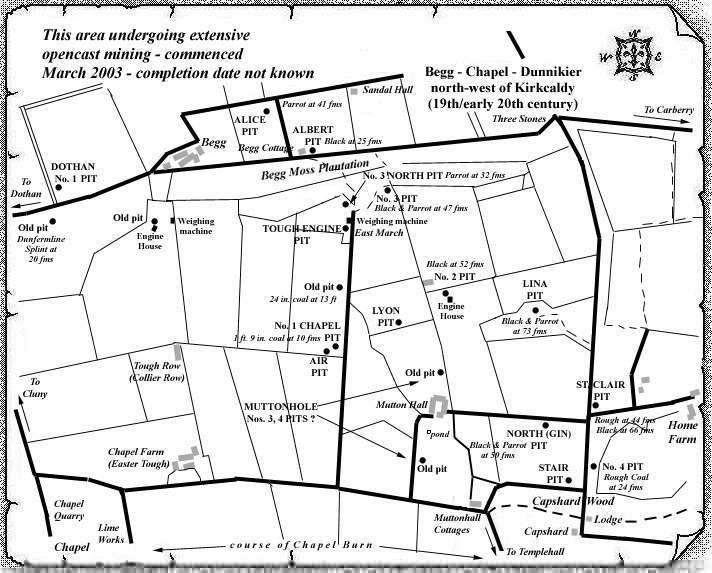
The Albert Pit of the Begg Colliery just to the east of
the Dothan Pits, south of Cluny, may have been sinking in the
1890s. It is known to have wrought the Black Coal at a depth
of 25 fathoms.
The exact colliery closure date is not known but it had
probably ceased coaling before the start of the First World
War. The site now lies beneath a section of the A92 dual
carriageway to the north of Kirkcaldy.
The Begg district embraced the portion of the Kirkcaldy
Coalfield around the Begg Farm, the Chapel area to the
north-west of Kirkcaldy and had its eastern limit at Carberry
which is just north of the present-day, large shopping
complex close to the Dunnikier Way/Overton Road roundabout.
It was separated from the district of Kirkcaldy and
Dunnikier by a north-easterly line passing through Dunnikier
House (now Dunnikier Hotel), and from the district of
Redford, Strathore and Pitteuchar, in the north, by an
east-south-easterly line drawn through Fosterton, one mile
east of Cluny Bridge.
 |
 |
 |
| Opencast workings
Fault |
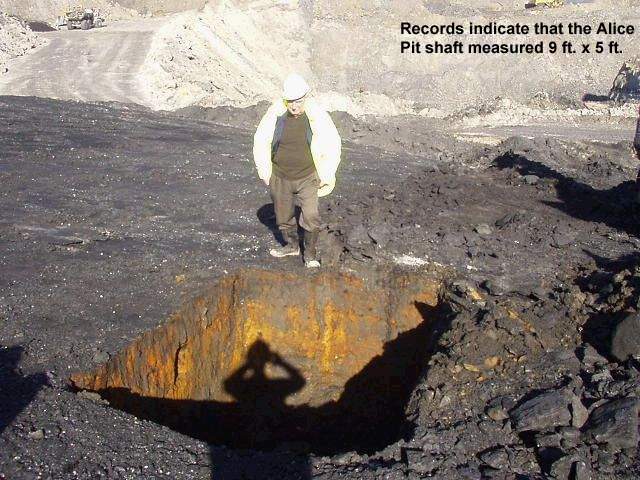
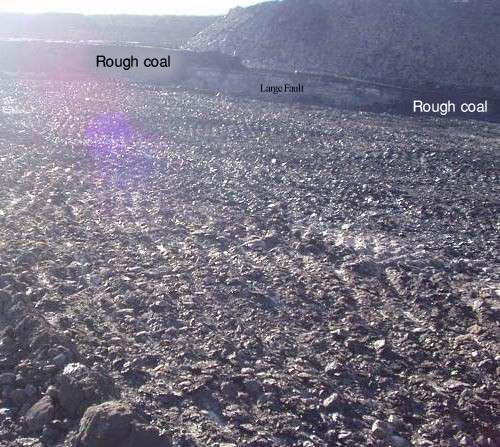
The images, from March, 2003, kindly sent in by Ian Terris, Glenrothes, are from the opencast workings in the lands of the old Begg Colliery just north of the large Kirkcaldy shopping complex by the Chapel Level.
| Source Date of Information (Owner) |
|---|
| Manager / Under-Manager / Men underground / Men above ground / Coal seams worked / Shaft Details |
| 1895 |
| In February, an extensive addition was being negotiated for the Begg Colliery. |
| 1896 (Walter Herd & Son.) |
| Alex. Danskine /
------------ / 57 / 9 / Household, manufacturing and
steam coals.
Listed as Begg Colliery. |
| 1902 (Walter Herd & Son, Ltd.) |
| William Clark /
------------ / 13 / 1 / Household, manufacturing and
steam coals.
Begg Colliery listed as abandoned. |
| 1904 (Walter Herd & Son, Ltd.) |
| J. Henderson /
------------ / 103 / 16 / Gas, household, manufacturing
and steam coals.
Begg Colliery operating. |
| 1905 (Walter Herd & Sons, Ltd.) |
| ---------- / ------------ / 65 / 14 / as Begg Colliery |
| 1908 (Bowhill Coal Co. Ltd.) |
| Archibald Bowman, jr. / William Lyon / 84 / 18 / |
| 1911 (Fife Coal Co. Ltd.) |
| ---------- / ---------- / 96 / 24 / |
| Please see Stories Link: Bowman Story, for interesting tales of the relatives of Archibald Bowman, jr., one-time manager of this colliery. |
|---|
Coal seams worked in the Begg District
The thickness of the Limestone Coal Group was fairly
constant throughout the district and was comparatively small,
ranging from around 650 ft. in the west to about 700 ft. near
Carberry. The total content of coal was correspondingly low,
falling to as little as 30 ft. at Carberry. There were six or
seven separate seams averaging 2 ft. or more in thickness, so
that, in this respect, the district did not compare
unfavourably with that of Dunnikier and Kirkcaldy where the
group as a whole was more fully developed.
The strata were inclined to the north and north-east at an
average angle of about 15o, but between Begg and
Muttonhall, steeper dips up to 25o and
30o were encountered.
Stink or Sulphur Coal was proved in a bore put down half a
mile NNW of Carberry where it reached a thickness of 2 ft. 4
in., including a 1 in. rib of coaly fireclay.
In a boring, in the north-eastern corner of the district, a
thin coal with parrot, believed to be the Dunfermline Splint,
lay 12½ fathoms below the Five Foot Coal, the
intervening layers consisting largely of coarse sandstone. No
records are known of workings in the Five Foot Coal, although
its average thickness in bores was about 2 ft. 9 in. It was,
however, known at several localities to be associated with a
thin whinstone intrusion, which, despite its small thickness,
was likely to have caused fairly extensive damage to the
coal.
An outcrop of Five Foot could be seen on the footpath, 300
yds. north of Tough Row, north of Chapel, where its thickness
was 2 ft. 6 in.
The Rough and Little Splint coals have been worked in the
past from old pits in the vicinity of Begg, where the former
seam was known alternatively as the 'Rough' or
'Cluny Coal' and the latter as the 'Cluny
Splint'. Both seams showed considerable variation not
only in thickness, but also in position relative to one
another and to the underlying Main group.
The distance from the Rough Coal to the Cardenden Smithy was
fairly constant over the whole district, averaging a little
less than 18 fathoms. The intervening layers consisted mainly
of sandstone and faky beds and, besides the Little Splint
Coal, usually included a rib of coal 6 to 9 fathoms above the
Rough, which probably represented the Lochgelly Blackband
Ironstone.
The lower leaf of the Cardenden Smithy was little more than
a rib of coal, separated from the upper leaf by less than a
fathom of sandy strata.
The Blairhall Main Coal was recognised at one point only, in
the bore half a mile north of Carberry.
Dunnikier and Begg Collieries (19th century report)
| Coal seams worked | Thickness | Quality | Class |
|---|---|---|---|
| Rough Coal | 3 ft. 6 in. | 2nd class | Steam (cherry) |
| Black Coal
(Lochgelly Splint) |
3 ft. | 1st class | Steam and household |
| Parrot Coal | 2 ft. | 2nd class | Gas coal |
| Glassee Coal | 3 ft. 6 in. | 1st class | Steam (cherry) |
| Mynheer Coal | 2 ft. | 2nd class | Smithy Coal |
Information on coals worked at, or near, the Albert Pit
The Lochgelly Splint and Parrot Coals were generally separated by about 2 fathoms of fakes and sandstone. They have been worked as the Black and Parrot Coals from this pit and at the nearby Alice Pit (see separate entry).
Plans of Abandoned Seams & Dates |
|---|
| Plans
of Abandoned Seams for Albert Pit,
Begg Colliery |
Pits or Mines designated in Plans |
|---|---|
| COAL; Black; Parrot (February, 1902) | BEGG, Albert; Alice (including portion of workings probably from Dothan Nos. 1, 2) |
| COAL;
Black; Parrot; Smithy; Clunie Splint
(28th February, 1912) |
BEGG, Albert; Alice |
-----------------------------------------------
"Cowdenbeath and Lochgelly Times"
A report in the above newspaper intimates that, in February, 1895, an extensive addition was being negotiated for the Begg Colliery, near Cluny.
