Owners: likely Grangemuir Colliery Company, Pittenweem
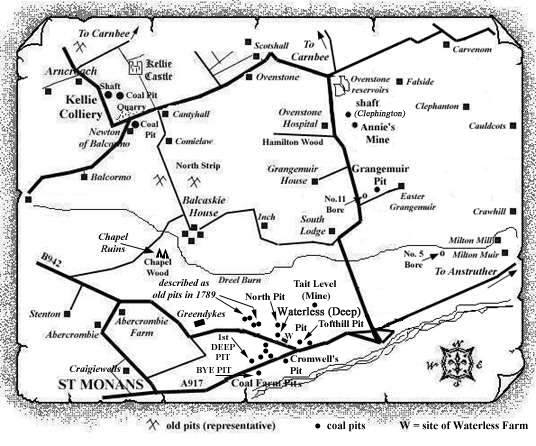
The fact that coal workings once existed close to the picturesque East Neuk towns and villages comes as a surprise to many people who imagine that the Leven area pits were the most easterly in the Fife coalfield. In some areas, the coal seams were so near the surface that little excavation was necessary and there are several records indicating the working of coals from early times and even predicting where future Grangemuir coal workings would probably be successful.
 |
 |
Statistical Account of Fife (Pittenweem) 1793
"The colliers are all free, stand engaged by the year, and are paid in proportion to the work they respectively perform. A good and laborious collier will earn about eighteen shillings a week."
Statistical Account of Fife (Anstruther Wester) 1845
"... the parish ... consists of ... the inferior
coal measures, ... the carboniferous limestone ... and the
upper or true coal measures. ...
... The coal not being worked in this parish, it can only be
judged of from the workings in the neighbourhood of
Pittenweem. There it [the true coal measures] consisted of
seventeen beds, making an aggregate thickness of 82 feet 6
inches. Of course, only a few of the lower coals can make
their appearance in the parish of Anstruther, as they crop
out to the eastward. Faults and dislocations of various kinds
derange them so frequently, that it is impossible to state
with certainty what may be found to the north-west of this
parish. This, however, we know, that two seams are wrought at
Balcaskie; and as the dip is moderate, and these not
apparently the lowest, the cropping of still lower seams must
lie between Balcaskie and Grangemuir. ...
... There are no mines of any description in the parish,
though coals have been worked a few hundred yards from the
boundaries, at Waterriggs and Balcaskie. During summer 1838,
borings for coal were made by Lord William K. Douglas; but
thin seams only were passed through. These trials seem to
have been made too far to the eastward, as the workable seams
of the St Monance basin must crop out considerably further
west. If coals shall ever be discovered in this parish, it
must be between Grangemuir and Balcaskie, and subjacent to
the two Kellie seams now in process of working. ...
... A considerable quantity of ironstone is to be found
along the shores of the burgh, which the magistrates let for
1s. per ton; and it is afterwards quarried and collected and
shipped for Newcastle. ... There are appearances of coal in
the parish at different places; and the name given to some
acres lying north-east from the glebe, viz., the Cowpits or
coal-pits, seem to indicate that the mineral had formerly
been wrought here. Last winter, many of the inhabitants got
liberty from the magistrates to dig coal at the seashore,
below flood-mark, and supplied themselves with many
cart-loads."
Westwood's Directory for Fife and Kinross (1862)
"An abundance of excellent coal exists in the parish ..."
Information on coals worked at, or near, Annie's Mine
A memoir from 1977 has a good description of the mining
activities around 1900 when a series of over 20 bores was put
down to depths of up to 62 fathoms in unexposed ground around
Grangemuir House and Easter Grangemuir.
However, a little to the north of the area in which these bores
were put down, coal was worked from a mine known as Annie's
Mine (opening date probably early 1908), and from a nearby
shaft in which the seam was at a depth of around 27 ft.
Unfortunately, the true identity of this coal seam and
the extent of mining here are not fully known. It is probable that this
venture was undertaken in 1908 (see newspaper article below) and, of course, we
would love to find out the identity of 'Annie' who gave her name
to this mine, near the farm of Falside!
During the late nineteenth and early twentieth centuries,
there were numerous attempts to explore and open up new coal
mines in East Fife. In Pittenweem in the 1890s, for example,
the depressed state of both fishing and agriculture led to a
campaign to develop an alternative industry in coal. However,
despite the claims of the campaign's leaders that
"mines of wealth" waited to be discovered,
the scheme foundered through lack of support from local
landowners.
In general, East Fife coal was of poor quality and was often
difficult and expensive to mine. In the end, the industry
proved uneconomical and the last colliery in East Fife closed
in 1947.
------------------------------------
"Dunfermline Saturday Press"
27 December, 1873
COAL WORKING
The old coal pit at Balbuthie, on the estate of
Kilconquhar, has been reopened, and the "cherry" seam is
now being again wrought with encouraging prospects of
success.
This seam was first wrought by the late Sir
Henry Bethune, who sank a pit, which is about seventeen fathoms
deep, and drew the coals with horse power; but in those days of
cheap and plentiful fuel, the Balbuthie coals were, after a short
trial, abandoned as unprofitable.
In the event, however, of the produce of the
mine not realising a return in the neighbourhood, it is understood
that the lessee, Mr. Terrace, of Edinburgh, will work the mineral
in connection with his extensive lime quarries, and there is thus
every prospect of this coal field being utilised to a considerable
extent.
We also learn that the lessee of the Kellie
minerals is intending to examine the coal field on the Lochty
lands, with the view of working the "splint" seam which
is believed to exist in that quarter.
Mr. Skinner is also actively prosecuting the
sinking of the coal-pit at Clephington. The miners, in the course
of their work, have struck upon a fourteen-inch seam of excellent
ironstone.
------------------------------------
"Dunfermline Press"
22 March, 1902
EAST FIFE COALFIELDS
On Thursday afternoon the first sod was cut in the ground where a pit shaft is to be sunk on the estate of Grangemuir. The ceremony was performed, in the presence of a number of spectators, by Mr Charles Penman, Pittenweem.
------------------------------------
"Dunfermline Press"
22 February, 1908
EAST FIFE COALFIELDS
The lessees of the Walter Coal Pit in the Grangemuir estate of Pittenweem, in the course of their prospecting on adjacent lands on the same estate, last week came on a coal seam of over two feet thick, cropping out in one of the fields on the farm of Falside, at a depth of only some eight feet from the surface, and which from the old "stoops" come across during the course of their "howking", appears to have been worked in ages past. Making another casting a little further south in the same field, the dip of the seam has been ascertained at a depth of 26 feet, with an increase in the thickness to two feet nine inches. The quality of the coal being superior to that of the Walter Pit, the promoters have arranged to at once open out and work this seam by the "dook" or indrive system, and expect to have good output in the course of a week or two.
[We believe the Annie's Mine to be the coal working described in the final sentence of
the above article.
M. Martin & Webmasters
------------------------------------
"Cowdenbeath & Lochgelly Times"
5 July, 1922
On Thursday there died at his residence in
Pittenweem, Mr Charles Penman, a former and much respected citizen
of Cowdenbeath, and one who was well known to many of the other
inhabitants of the burgh.
Mr Penman on leaving Cowdenbeath went to
Pittenweem to become a licence-holder there, a venture which he
carried on with success, and to the satisfaction of the
authorities.
Along with a few others he some years ago
invested in the sinking of a coal pit not far from Pittenweem, but
the project unfortunately was a failure.
------------------------------------
Can do with help on this mine
