This small pit, believed to be 180 ft. deep, was situated close to the north-east corner of Loch Gelly and north of Powguild Farm. It was owned and operated by the Lochgelly Iron & Coal Company probably from the 1890s to around 1910.
| See Central Fife Index Entry ' Lochgelly Pits & Mines' for more details |
|---|
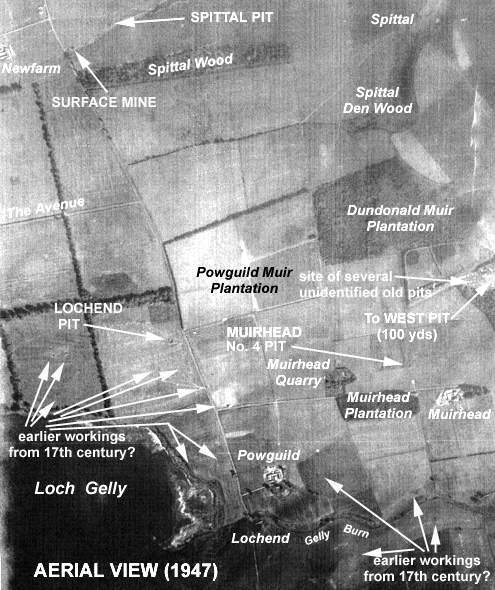 |
Coal is known to have been worked in the early 17th century at Powguild Farm and on the lands between east Lochgelly and Powguild. A contract from June 1620 between the local landowners of Easter Lochgellie and Glenniston describes the sharing of expenses and charges by these parties for "working and winning of the same coll." [coll = coal]
-------------------------------------------
Old Parish records are a great source of information in spite of the many variations in spellings of names, etc., laid down in these documents. The names of some early miners, and the dates when they were working the early, small coalworks, are revealed in records of births, deaths, and marriages.
Henry Cunningham, collier in Lochend of Lochgelly, par. of Auchterdiran - died 1 Mar 1654.
-------------------------------------------
Information on coals worked near Lochend Pit, Lochgelly
(based on reports from 1900 and 1934)
The outcrop of the Lochgelly Splint and Parrot seams appeared on the northern shore of Loch Gelly and ran eastwards against a large fault close to the farm of Muirhead. It further progressed eastwards into the Dundonald, Cardenden and Kirkcaldy fields.
A number of old unidentified pits have also been traced just to the south-west of Lochend Pit on the north-east shore of Loch Gelly.
Several of the large faults from the Lochgelly coalfield extended eastwards and entered Dundonald Colliery. One of these passed a little north of Muirhead and south of Shaws Mill. To the south of it, another dislocation occurred, and between the two no coals were met with. Another east and west fault, with a downthrow of 8 fathoms to the north, ran by the north end of the Muir Plantation near Spittal farm.
The Five Foot Coal lay 5 to 14 fathoms above the Dunfermline Splint with the seams being most widely separated near Lochgelly House and along the north shore of Loch Gelly where the intervening sediments were mainly sandstones. The outcrop of the coal could be traced round the southern margin of the coalfield by means of borings records and old workings from the north-east shore of Loch Gelly to Tullylumb Plantation further east. The coal could formerly be seen in Carden Den underlying the massive sandstone on which Carden Tower was built. At Dundonald, where a considerable amount was raised under the name 'Mynheer Coal', the average thickness was about 3 ft. The seam provided a very good household coal, a representative section measured in a boring at Muirhead quarry having:
| Sandstone, faky at base | - |
| Blaes, faky | 2 ft. 11 in. |
| COAL | 1 ft. 6 in. |
| Sandstone rib | 1 in. |
| COAL | 2 ft. 2 in. |
| Fireclay | - |
In the Spittal farm bore, the whinstone lying above the Mynheer Coal (6 to 9 fathoms above the Five Foot) had caused this to be reduced to coaly blaes. A 20 in. coal, however, with the characteristic ironstone roof was recorded at Powguild Plantation.
Between Spittal farm and Spittal Wood to the north of Lochend Pit, Glassee Coal appeared to be represented by a 7 in. coal resting on coaly fakes cut at a depth of 78 fathoms. No coal was found at the Glassee position in the 1906 bore at Powguild Plantation. As stated earlier, the outcrop of the Lochgelly Splint and Parrot Coals could be seen on the north shore of Loch Gelly, some 250 yds. east of the boathouse, striking towards Muirhead sandstone quarry. However, towards Powguild Plantation, the Lochgelly Parrot Coal was almost entirely destroyed by a thin dolerite sill. This was also the case, just west of Lochend Pit, around the Melgund Pit.
The Lochgelly Splint Coal was generally more than 4 ft. thick and its roof was of fireclay or blaes overlain by a persistent seam of foul coal, locally known as the Craw Coal. A section measured near the outcrop, on the north side of Loch Gelly, gave the following:
| Blaes, faky | - |
| CRAW COAL | 1 ft. 4 in. |
| Fireclay, dark | 4 in. |
| Blaes, parroty | 8 in. |
| COAL, splint | 5 ft. 4 in. |
| Fireclay | 1 ft. 10 in. |
| Fakes and sandstone | - |
The Lochgelly Splint Coal was partly burnt in the ground just to the west of Powguild Plantation.
The Swallowdrum Coal (known in the nearby Dundonald field as the 'Duddie Davie') was a composite seam which lay 3 to 10 fathoms above the Lochgelly Splint and in a boring in South Green Park, on the north side of Loch Gelly, it had the following composition:
| Fireclay | 4 ft. |
| COAL | 9 in. |
| Fireclay | 9 in. |
| COAL | 1 ft. 7 in. |
| Fireclay | 4 in. |
| COAL | 1 ft. 8 in. |
| Coal and fireclay | 9 in. |
| Blaes and fakes | - |
Around Spittal farm to the north of Lochend Pit, the Jersey Coals were of little value, being usually distributed in leaves less than 2 ft. thick through several fathoms of barren strata. Borings between Newfarm and Spittal showed that the Rough Coal, at the base of the Blairhall Group of coals, generally exceeded 5 ft. 6 in. and included a number of dirt bands.
To the east of Newfarm, where a shallow pit was sunk on the seam at the west end of Spittal Wood, the following section of Lochgelly Blackband Ironstone was proved:
| Blaes | - |
| COAL, parrot | 1 ft. 3 in. |
| IRONSTONE, strong | 2½ in. |
| IRONSTONE, softer | 2 in. |
| Fireclay, light | 3½ in. |
| COAL, cherry | 1 ft. 8 in. |
| Fireclay, sandy | - |
The lower leaf of the Cardenden Smithy seam, which lay 6 to 10 fathoms above the Lochgelly Blackband Ironstone, was rarely thick enough to be worked and frequently contained a considerable percentage of foul coal. A thin ironstone rib associated with coal was recorded near Spittal farm, some 3 fathoms above the Blairhall Main Coal which lay 3 to 6 fathoms above the upper leaf of the Cardenden Smithy seam averaging around 2 ft. 9 in. and being described as an ordinary steam coal.
-----------------------------------------------------
| Plan of Abandoned Seams & Date for Lochend | Pits or Mines designated in Plan |
|---|---|
| Lochgelly Splint;
Lochgelly Parrot; Little Splint;
Duddie Davie (1908) |
LOCHGELLY
Lochend, Melgund |
-----------------------------------------------------

"Fifeshire Journal"
30 December, 1841
LOCHGELLY - MELANCHOLY ACCIDENT
On Saturday last, as David Barlas was engaged in sinking a pit at Lochend, in search of ironstone, a quantity of the side slid in and crushed him to death. He has left a widow and four children.
-----------------------------------------------------
"Dunfermline Press"
11 May, 1901
Alexander Frew, miner, Woodend, Cowdenbeath, met with an accident while at work in the Lochend Pit, Lochgelly Iron and Coal Co., on Wednesday. A stone weighing about 3 cwts fell from the roof and struck him on the back, bruising it severely and injuring him internally.
-----------------------------------------------------
