A large number of ironstone and coal workings are known to have operated in and around Lochgelly from very early times and from research and records, we can indicate the existence of the following pits or mines:
Lochgelly Nos. 1, 2, 3, 4, 5, 6, 7, 8, 9, 10, 11, 12, 13, 15, 16, 17, 18, 19, Little Crafty, Westerton, Lochhead, Little Dean, Nottingham, Bye, Old Gig, Cartmore Nos. 1, 2, Great Coal, Muirhead, Stair, Nottingham No. 5, Spittal, Eliza No. 11, Foulford, Lochend, Sawmill No. 4, Wee Mary Nos. 1 & 2, Arthur (or Newton) Nos. 1 & 2, Blackdean No. 5, Castle Hill, Dean, Foulford No. 2, Pepperknowe, Washing Sink No. 1, Whiskey Neuk, Wingate's, Lady, John, Jenny Gray, Melgund, Dovecot, Minto, Eliza, Nellie and Cartmore Mine.
| See Stories Link : Mining Life for an account of miners and mining conditions in early Lochgelly. |
|---|
| See also Early Mining Link for Lochgelly Nos. 16, 18 ironstone mining records. |
|---|
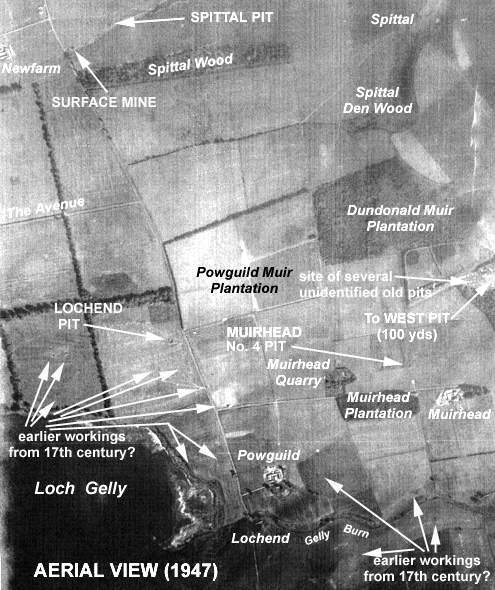
Many of the listed pits or mines are identified on maps and/or aerial views (see individual entries in Central Fife Index) while some locations still require verification.
 |
 |
 |
 |
 |
| A range of information on a named pit or mine, including opening/closing dates, exact location, photographs of workings, details of shaft depths, descriptions of coal seams worked/abandoned, points of historical and/or social interest, etc., will be present in an individual index entry but general information pertaining to the colliery which is often difficult to allocate to an individual pit or mine, is reported in this general entry to which reference will be made from the individual index entries. |
|---|
---------------------------------------------------------
Lochgelly Colliery
| Source Date of Information (Owner) |
|---|
| Manager / Under-Manager / Men underground / Men above ground [Pit/Mine] / Coal seams worked |
| 1770 (?) (John Keeler, Lessee) |
| 1775 (Sir Gilbert Elliot) |
| 1777 (Sir Gilbert Elliot) |
| Around 15 persons employed [Lochgelly*] - daily output around 10 tons |
| 1808 (Lord Minto ) |
| The "gin" or
windlass introduced in an early Lochgelly pit. Around 13 miners believed to have been employed in a single pit at the turn of the century. |
| 1812 (Chisholm and Brown, Lessees) |
| Lord Minto agrees to lease the Lochgelly coalfield. |
| 1814 (Chisholm and Brown, Lessees) |
| Introduction of steam engine to colliery work. |
| 1827(?) (Nicol Thomson, Lessee) |
| 1831- 1836 (John Henderson, Esq., Lessee) |
| By 1836, around 50 persons employed [Lochgelly*] - daily output around 35 tons |
| Lochgelly Splint, Great or Jersey Coal. |
| 1840 (John Henderson, Esq., Lochgelly House) |
| 1841 (John Henderson & Company) |
| Henry Chisholm / ------------ / 119 in total: 94 men & 25 women [Lochgelly*] |
| 1842 (John
Henderson, Esq., Lochgelly House)
[Dunfermline Register] Henry Chisholm, Manager |
| 1851-71 (Lochgelly Iron Company) |
| 1861 (Lochgelly Iron
Company: Russell & Kinnaird)
A. Landale, manager. [Parochial Register - Auchterderran.] |
| A. Landale,
Manager - 1870
[From Dunfermline Register] |
| 1872-1880 (Lochgelly Iron & Coal Company Ltd) |
| 1886 (Lochgelly Iron & Coal Company Ltd) |
| Departure of Mr. William Wright, head engineer, in November - leaving to take up an appointment in India. |
| 1893 (Lochgelly Iron & Coal Company Ltd) |
| John Anderson, manager. |
| 1896 (Lochgelly Iron & Coal Company Ltd) |
| Andrew Nisbet / ------------ / 783 / 122 [Lochgelly*] |
| Gas, household, manufacturing and steam coals. |
| 1902 (Lochgelly Iron & Coal Company) |
| A. Ramsay : Arthur King : I. Penman / 881 / 140 [All other Company Pits except Little Raith Colliery] |
| Gas, household, manufacturing and steam coals. |
| 1904 (Lochgelly Iron & Coal Company) |
| Arthur King / ------------ / 191 / 44 [probably Nellie and Mary Pits] |
| Gas, household, manufacturing and steam coals. |
| 1905 (Lochgelly Iron & Coal Company) |
| Arthur King / ------------ / 185 / 37 [probably Mary Pits] |
| 1908 (Lochgelly Iron & Coal Company) |
| Arthur King / ------------ / 167 / 192? [probably Mary Pits] |
| 1911 (Lochgelly Iron & Coal Company) |
| --------- / ------------ / 661 / 282 [probably Nellie and Mary Pits] |
| 1913 (Lochgelly Iron & Coal Company) |
| -------------- / ------------ / 561 / 125 [Nellie and Mary Pits] |
| 1918 (Lochgelly Iron & Coal Company) |
| James Dawson / Andrew Anderson (Mary Pit) / 687 / 139 [Nellie and Mary Pits] |
| * Individual working pits or mines not known |
| Now see separate entries for Arthur (Newton), Jenny Gray, Little Raith, Mary, Melgund, Minto and Nellie Collieries. |
---------------------------------------------------------
Lochgelly Colliery (19th century report)
| Name of coal | Thickness | Quality | Class |
|---|---|---|---|
| Little Splint | 3 ft. | Good | 2nd class Steam |
| Fourteen Foot | 10 ft. | Good | 2nd class Steam |
| Duddie Davie | 3 ft. | Good | 2nd class Steam |
| Lochgelly Splint | 5 ft. | Good | 1st class Steam |
| Lochgelly Parrot | 3 ft. 3 in. | Good | 2nd class Gas |
| Glassee Coal | 3 ft. | Good | 2nd class Steam |
| Mynheer Coal | 3 ft. 3 in. | Good | 1st class Household |
| Five Foot Coal | 4 ft. | Good | 1st class Steam |
| Dunfermline Splint | 4 ft. | Good | 1st class Household |
---------------------------------------------------------
Plans of Abandoned Seams & DatesNote: abandonment dates do not relate to individual pit closures but to the abandonment of seams which had ceased to be worked. Not worked for a period of time, it was quite normal for some coal seams to be re-opened for working at a later date or at a different location. |
|---|
---------------------------------------------------------
| Some Plans of Abandoned Seams & Dates for Lochgelly | Pits or Mines designated in Plans |
|---|---|
| Splint; Parrot; Great; Smithy; Little Splint (1825) | Lochgelly (locations not specified) |
| Splint; Parrot (1851) | Little Dean, Mary, Nottingham, Sawmill |
| Probably Parrot Coal (1851)
Lower Splint; Glassee (1868) |
John, Lady (Little Raith) |
| Five Feet (1862); Little Splint;
Splint; Glassee;
Upper; Parrot; IRONSTONE (1871) |
Lochgelly Nos. 3, 9, 10, 11, 12, 13, 17, Bye, Jenny Gray |
| Upper (1859); Five Feet
(1862); Mynheer (1863);
Glassee (1866); IRONSTONE (1875); Lochgelly Splint; Lochgelly Parrot (1884); Little Splint (1886) |
Lochgelly Nos. 1, 2, 3, 4, 5, 6, 7, 8, 9, 10, 11, 12, 13, 15, 16, 17, 18, Eliza, Melgund, Nottingham No. 5, Spittal |
| IRONSTONE | Lochgelly No. 9, Foulford, Jenny Gray, Melgund |
| Five Feet; Mynheer (1890) | Whiskey Neuk (Little Raith) |
| Five Feet; Fourteen Feet; Mynheer;
Glassee; Lochgelly Splint;
Lochgelly Parrot; Dunfermline Splint (1894) |
Nellie |
| Lochgelly Splint; Lochgelly Parrot (1899) | Whiskey Neuk (Little Raith) |
| Lochgelly Splint;
Lochgelly Parrot; Little Splint;
Duddie Davie (1908) |
Lochend, Melgund |
| Five Feet; Mynheer (1908) | Nellie |
| Lochgelly Splint; Lochgelly Parrot (1912) | Lochhead |
| Five Feet; Upper Five Feet; Fourteen Feet; Dunfermline Splint; Glassee; Lochgelly Splint; Lochgelly Parrot; Diamond; Duddie Davie; Mynheer; Lochgelly Blackband IRONSTONE (1925) | Arthur (Newton) Nos. 1 & 2, Blackdean No. 5, Dean, Foulford No. 2, Pepperknow, Washing Sink No. 1, Whiskey Neuk, Wingate's |
| Blairhall (1927) | Minto Nos. 1 & 2 |
| Rough (1928) | Minto Nos. 1, 2 11; Eliza |
---------------------------------------------------------
Information on very early coal pits or mines is usually quite difficult to obtain since it was not then a legal requirement to have to submit plans of pit or mine workings as eventually became the case. Fortunately, some historical documents, diaries and letters exist to provide scant evidence of these early ventures.
Scottish Office Records indicate that as early as 1620, contracts were in existence between landowners of Easter Lochgellie and Gleniston for working coll (coal) on the lands to the east of Lochgelly and around Powguild farm, and to the south-west of the village around Lochhead, coals were being won in the early 1640s. An extract from the diary of Earl David of Wemyss states:
"John, Earle of Wemyss, 1643, did work a levell of four colles in his lands of Louchhead, nier Lochgellie, as the mind ther lyes still wrought, first meeting in ye mind with a good colle of 3 fitts thick, 3 with a coll of five fitts thick, 4 and last with a coll of eight fitts, all guid burning colles."
It was also recognised around this time that, for successful operations to continue at the Lochhead workings, the "ingoing-eye" system of mining would have to be replaced by a programme of sinking small pits to reach the seams below. The Wemyss diaries express this point in the entry: "To mine ther colles cause doune sinks on them, and so work them, for they are standing drye ther unwrought, only my father levelled them".
---------------------------------------------------------
LOCHGELLY COLLIERY
For more than a century after the Earl of Wemyss made his entry in his "Diary" coals were gotten in the district by the system of running mines to the crop seams, drainage being provided by lines run from the seams on the high ground to the river Orr, which runs through the valley to the north of Lochgelly railway station. In these days of primitive mining progress was slow, and the output of Lochgelly Colliery in 1815, exactly a century ago, was not more than 50 tons a day. In 1841, when women were prevented by Act of Parliament from entering the mines, the output had risen to about 100 tons a day.
BLAST FURNACES ERECTED.
Mr John Henderson, who afterwards became the head of the firm Henderson, Wallace, &
Co., of Halbeath and Cuttlehill Collieries, was the lessee of the colliery when women bade
goodbye to the mines, and in 1845 he formed a Company which took the title of John Henderson &
Co. The partners were Falkirk men, and had a connection with the iron trade. This connection led the
Company to erect blast furnaces at Lochgelly. The furnaces bear the date 1847, but have since
1872 ceased to light up the district, Lochgelly being a coal rather than an iron centre. With the
suspension of the iron industry, the Lochgelly Iron & Coal Company, Limited, was formed,
and under the supervision of the late Andrew Landale and the late Mr John Connel further
extensive coal developments were undertaken. With an increased capital of 21,000 £10
ordinary shares, and 14,000 £10 preference shares enormous developments have taken
place in recent years, and the output of the Company reaches something like one-and-three-quarter
million tons a year.
Developments have taken place, principally at Brigghills (Minto Colliery), where navigation coal
was struck at the Mary pit, and at the Nellie colliery. For twelve long years operations were
suspended at the latter colliery on the assumption that the coal had been burnt. The burnt coal
of the seventies and the eighties, which would not sell at any price, is the much sought after
navigation coal of today, and instead of being cold and deserted, the Nellie Colliery of today
is one of the finest collieries in the "Kingdom", throwing out a large output of coals
of the finest quality. Mr John Paul is at the head of the management in the pit, and Mr Robert
Storrie is secretary and commercial manager.
The great changes at the colliery are reflected in the burgh of Lochgelly, and the houses and
business premises erected in recent years have been such as to change the whole aspect of
some of the streets.
The following table shows the number of operatives employed at the different collieries belonging
to the Company in 1913, the last year for which detailed statistics are available:-
				  Under ground		  Above ground
	Arthur				374			55
	Dundonald 			291			65
	Jenny Gray			413			45
	Little Raith			631		       137
	Nellie and Mary			561		       125
	Minto			       1249		       162
[Extract Dunfermline Press 6 Nov., 1915: Interesting Historical Notes, Parish of Auchterderran]
---------------------------------------------------------
... and an early account as told in a local history publication ...
The Lochgelly Coalfield as now developed has had a
prosperous and well-managed career. It will employ now from 6
to 7,000 men, and pay in wages some £8,000 week. It rose
out of the small beginnings by John Henderson about the early
1840s. It is still ably managed by John Paul, C.E., and
Robert Storie, Secretary.
From the beginning of the seventeenth century, there was
great eagerness in securing coal until the beginning of the
nineteenth century, when the toy-workings, if we might use
the term concerning this great industry, began to disappear.
Any "coal getting" attempted depended largely on
the success of the Lochgelly miners in draining their
workings naturally to the River Ore, or in running their
"levels" so that water might ultimately reach that
watershed. Then 100 tons a day was seldom reached.
In an old report, dated 1825, the following coal was
available:
| Seam | Thickness |
| Smithy Coal | 2 ft. |
| Three Feet Coal | 3 ft. |
| Fourteen Feet | 14 ft. |
| Lochgelly Splint | 6 ft. |
| Parrot Coal | 4 ft. |
| The Glass Coal | 4 ft. |
By mining on the stoop and room system, most of the coal brought from the underdip workings was carried to the surface, and any water found was, if unnaturally drainable, lifted by hand leverage, placed beside the old Gin Pit, which again delivered it into the Engine level, whence it passed to the river through the Engine Pit.
Since the advent of mighty machinery, motor-driven appliances, and great pumping engines, mining is one of the greatest and most interesting scientific industries of our times; and the contrast is nowhere greater than under the Lochgelly Company of today, with its early life under John Henderson, who was then joined by Messrs. Russell, Falkirk; Thomas Grainger, contractor; and, R. W. Kennard, of the Falkirk Iron Company, whose names remain on several Lochgelly streets. In their time, iron and blast furnaces stood in the "coal yard" near the railway station.
In 1850, Mr. Henderson, who was joined by Mr. Andrew Wallace, chief clerk at Lochgelly, withdrew to his Cuttlehill property, and founded there the firm of Henderson, Wallace & Fraser. When he left, Mr. Andrew Landale became the Manager at Lochgelly, and in 1872, when death had removed the original partners, the Lochgelly Iron & Coal Company was formed with a capital of £100,000. In 1896, Lord Glenarthur, of Glasgow, became Chairman; a post held by Mr. James R. Stewart, Glasgow, since 1872.
On Little Raith Estate, the property of Wemyss of Wemyss Castle, the Company has the Gordon, the Dora, and the Lochhead, on lands to the left-hand side of the tram-way route to Dunfermline. On Lord Minto's estate there are the Melgund, Newton, Jenny Gray, Nellie, Eliza, Minto, the Mary, and the Arthur. The capital of the Company is now £100,000 preference and £150,000 ordinary shares. All the seams wrought are Lochgelly Splint, the Glassee, the Parrot, Mynheer, Five Feet, and Dunfermline Splint.
In their Minto Colliery (newer and up-to-date) the following seams may now be manipulated with calculated ease and precision:
| Seam | Depth (fathoms) | Thickness |
| Little Splint Coal | 60 | 3 ft. 2 in. |
| Royal Coal | 62 | 5 ft. |
| Fourteen Feet | 77 | 7 ft. |
| Duddie Davie | 86 | 4 ft. |
| Lochgelly Splint | 100 | 6 ft. |
| Lochgelly Parrot | 103 | 3 ft. |
| Glassee | 114 | 4 ft. |
| Mynheer | 125 | 3 ft. 6 in. |
| Five Feet | 160 | 4 ft. |
| Dunfermline Splint | 165 | 2 ft. |
In 1856 an old wooden shovel was found in the coal workings to the east of the town. It was about 3 feet over all - the stalk being 2 feet and the flat 1 foot by 7 inches broad. An old sluice door, with a piece of an old wooden bowl, were also found in the same disused mine. These finds were given by Mr. Landale to the Pittencrieff House Museum, Dunfermline, where they can be seen at any time.
------------------------------------
"Fifeshire Journal"
14 December, 1833
COAL.
JOHN HENDERSON begs leave to intimate to his Friends and
the Public, that he has enlarged the weight of LOCHGELLY and
CARTMORE COAL, from 21 to 28 Stones per Load, which he is
still selling at the former low prices, viz:-
SPLINT GREAT -------------------- 10d, per Load
Do. CHEWS
------------------- 7½d, do. do.
PARROT GREAT ------------------- 10d,
do. do.
CHARCOAL ---------------------- 10½d. per Standard
Boll.
The Splint Coal for Durability, Cleanliness, and Economy, is surpassed by none in Scotland. It is most excellently adapted for Family purposes, Bakers, Brewers, and the generation of Steam, & c., being quite free from Sulphur, and never given to Clinker.
N.B. -- Carters will be furnished with Cards,
attested by the Hill Grieve, for shewing the quantity or
weight of coals to be delivered by them.
Lochgelly House, December 2, 1833.
------------------------------------
"Fifeshire Journal"
25 June, 1840
LOCHGELLY
DISCOVERY OF A VALUABLE SEAM
OF COAL
We understand there has been discovered at the Lochgelly Collieries a valuable seam of caking coal, equal, and indeed in some respects superior, to the best English coal. It has been tried at various forges, and found free from sulphur, which is prejudicial to iron. As a household coal, it is peculiarly lasting and free from dust. Lochgelly has long been famous for its valuable splint and parrot seams, but this discovery will add much to the value of that extensive coalfield.
------------------------------------
During our expansion of information for the Children section (see Menu 1) we observed in the 1842 Commission Report from Lochgelly Colliery, a mention of Joseph Harrower and Andrew Beveridge being killed in separate incidents (see below).
M. Martin & Webmasters.

- No. 393 - Eliza Dixon, 17 years old, putter:- Began to work below five years since; works nine hours every day; never been off work; was in the fields before at the coals; left there, as more money is to be had than field labour; could never earn more than 8d. a-day above, now gets 15d. when working in the wet roads. Never got hurt; was below when a young man [Joseph Harrower] was crushed to death by fall of roof three years ago and remembers one Andrew Beveridge being killed in same manner two years since. Reads; was a wee while at the writing but not since down.
[Reads badly; ignorant but has a knowledge of the verses of many Psalms, which she learned at Sabbath-school.]
------------------------------------
"Fifeshire Journal"
15 September, 1842
LOCHGELLY - ENTERTAINMENT
On Friday, our spirited railway contractor, Mr Alexander Brunton, who is at present finishing the line of rail between Lochgelly collieries and the Great North Road, gave an excellent supper to his workmen on the eve of the contract being completed. The company separated at an early hour, highly delighted with the hearty manner in which they were entertained by their employer. We may mention, much to the credit of Mr Brunton, that he gave no intoxicating liquors, as is generally the case in this quarter at finishing - pints; and, in consequence, there was no rioting or brawling to disturb the villagers at the breaking up of the party.
------------------------------------
Lochgelly Colliery - 1842
Mr. Henry Chisholm, manager of the Lochgelly, Castle Hill and Dean Collieries, in the parish of Beath and Auchterderran, in the county of Fife: "At some coal-workings children commence as early as six years of age, and remain below as long as the adults. Very young children are not needed, indeed they are never required; and no children ought to been employed under twelve years of age in any mines, as they lose both education and strength by being underground so early."
Alexander Gillespie, twelve years old, hewer, Lochgellie Colliery: "Father dead, died from dropsy, brought on by sitting in damp work."
------------------------------------
"Fifeshire Journal"
26 October, 1843
LOCHGELLY - NEW SEAM OF COAL
The lessee of the Lochgelly Colliery has been
for some time past exploring his large coal-field, and in his
search has discovered a new seam of coal of a very superior
description. It is confidently declared to be quite unequalled in
the district. It is, however, very deep, and would require a shaft
of 80 fathoms.
It has long been known that we have had six
different seams here, but the seventh was only discovered lately.
Each of the seven different seams is, on average, 5½ feet
thick. Only one of the seven seams, however, has hitherto been
wrought, and that only partially. Such facts may give us some idea
of the mineral wealth we possess. Taking these seams collectively
they are equivalent to one solid mass of coal 38½ feet thick.
A square mile of such a mass of fuel is equal to 1,073,318,600
solid feet. Allowing 40 cubic feet for a cart, this would load
upwards of 24,000,000 carts; a quantity sufficient to maintain all
the inhabitants in Britain in fuel for two years, if we allow to
each family 3½ carts of coals per year, and reckon the number
of families about 4,000,000.
At 4s. 6d. per cart, this large quantity would
be worth £54,000,000 - a sum of money which, if drawn from our
coal-fields for 17 successive years, would ease us of that colossal
burden, the national debt. But the coal in this district is but a
small portion of the whole that is in this country.
As is well known, the great field of Britain
ranges from 250 miles long to 150 broad. Durham and Newcastle
districts are alone said to be sufficient to supply the whole
country with coal for 1700 years to come. And if we consider our
own district as embracing only 6 square miles, it is adequate to
supply a blazing fire to every family in "the kingdom of
Fife" for upwards of 600 years to come.
No one, then, need fear but that our country has
in her bosom material sufficient to meet the demands for
steam-engines, and all other purposes for which coal is used, for
some thousands of years. The fear that our coal mines will ere long
become exhausted may be dispelled from every mind, for the farther
we search, the more abundance we find, and the discoveries of every
day plainly demonstrate that the source is altogether
inexhaustible. We cannot conclude this notice without expressing
our deep regret that the vast mineral treasure we possess should be
allowed to remain in status quo, in consequence of the want
of an easy and ready conveyance to a proper market.
Our railway bill, notwithstanding, was
unexpectedly rejected during last session of Parliament. The
prosperity of our village has been materially affected thereby, and
at the same time a considerable part of the county has been
indirectly injured. With a railway of only four miles extent we
could have supplied the people in numerous and populous villages
and towns on the coast with coals of the best description, at half
of the price or thereby which they are at present paying for
them.
We trust that the numerous subscribers to our
late expected railway will not be discouraged by the defeat they
have already sustained, but imitate the example of one of our
ancient kings and "try again". - Fife Herald
------------------------------------
"Fifeshire Journal"
22 August, 1844
LOCHGELLY - THE COLLIERY
We understand that Mr Henderson and his colliers have come to an agreement, and most of them have commenced working. The labourers are working in a different pit from the colliers.
------------------------------------
"Fifeshire Journal"
9 December, 1847
LOCHGELLY - THRIVING-LIKE
This village appears destined soon to be the
Airdrie of Fifeshire. The iron-works now being erected are rapidly
approaching completion. The field of black-band ironstone is
extensive as well as superior in quality. We expect that
malleable-iron works will become an adjunct to the blast furnaces;
and when the quality of the minerals, the number and thickness of
the seams of coal - some as thick as fourteen feet - are taken into
account, we know of no place where malleable as well as pig-iron
will be made so cheaply as at Lochgelly. Neither have the
enterprising proprietors of these works been negligent of their
coal trade. We understand they have no less than five coal-pits
planted along the Thornton branch of the Edinburgh and Northern
Railway.
The directors expect to open this branch for
mineral traffic next week, when the inhabitants of Fife will,
through the widely-spread ramifications of the railway, get full
supplies of Lochgelly coal, which is known to be surpassed by none
for household purposes.
------------------------------------
30 December, 1847
LOCHGELLY COAL
We are glad to learn that the Thornton Branch of the Edinburgh and Northern Railway is now opened to Lochgelly for mineral traffic, and that the sale of the highly esteemed Lochgelly coal has now commenced at the Cupar and Lindores stations. We understand in a short while it may also be got at the other stations on the line.
------------------------------------
"Fifeshire Journal"
14 December, 1848
On Saturday morning we had a painful example of the many incidents which occur, showing how very brittle is the cord by which life is held. A stout, young man left his home in the best of health to follow his regular calling as a collier. He continued his work until breakfast time. He had just done with it, and was sitting with his head resting on his hands, when the roof gave way and came down upon him. He was got out in an incredibly short space of time, but it was found that life had fled. He was a sober, industrious and careful young man. So sudden and grievous an accident must be very painful to his parents, and must call forth a feeling of sympathy from all those who are acquainted with them.
[We believe this miner to be Thomas Dick (28), Auchterderran, Lochgelly, from a pre-1855 deaths compilation record.]
------------------------------------
"Fifeshire Journal"
28 December, 1848
An accident occurred on Wednesday evening last
in one of the iron-stone mines, which excited great sensation in
this quarter. An old man of the name of John Young was working in
one of these mines with a boy, and met his death in the following
manner.
While lying on his side and busy at work, a
large stone came down upon his legs; finding himself thus caught,
and not being able to extricate himself, he cried to the boy to run
for a pinch and try to remove the stone from off him; but alas!
alas! where was the chance of using any instrument to advantage for
his rescue in a place only two feet high. The boy brought the pinch
and spoke to him, but receiving no answer he flung it down and ran
off with all haste for assistance to Henderson's squad, almost
two park breadth's distant. About forty men were quickly on the
spot. He was then found to be quite dead, lying in the same
position, with his lamp still burning upon his head. As only one
man could get at him at a time, it took them nearly five hours'
hard work before he was got out - always when they had him about
clear, another fall of the roof came away, until they had carried
off about nine feet. And all the rubbish had to be taken outside of
the mine, a rather laborious task. He has left a widow and family
to mourn his untimely end.
------------------------------------
"Fifeshire Journal"
11 April, 1850
LOCHGELLY - MARK OF RESPECT
On the afternoon of Monday last, Mr Matthew was entertained at dinner here in the Queen's Arms Inn, on the occasion of his leaving the management of the Lochgelly Coal and Iron Works. ...
------------------------------------
"Dunfermline Saturday Press"
31 December, 1859
On the night of Wednesday, last week, an accident of a very painful and disheartening character occurred at one of the pits in this neighbourhood. A man of the name of Joseph Gilbert, while being brought up out of the pit, was taken up close to the pulley wheels before the engine was stopped. Apprehending, it is supposed, that he was going to come in contact with the wheels, Gilbert leapt out of the cage, intending to clear the pit - a depth of above 100 fathoms. It is almost needless to say that when the body was recovered it was bruised and mangled in a fearful way, and that life was extinct.
------------------------------------
"Dunfermline Saturday Press"
9 March, 1861
LOCHGELLY IRON WORKS
We regret to learn that, in consequence of the depressed
state of the iron trade, the Lochgelly Coal and Iron Company
are under the necessity of stopping one of their coal pits at
Little Raith, and another at Foulford; and it is generally
thought among the mining community that they will stop
another about Lochgelly. The whole will take place on
Saturday (today).
The consequence is that a great number of the miners will be
thrown out of employment, or will be driven to seek it
somewhere else. It is also stated on good authority that the
Lochgelly blast furnace will soon be blown out.
------------------------------------
Supplement: "Dunfermline Saturday
Press"
6 July, 1861
A melancholy accident occurred in one of the pits here, to
a miner of the name of Duncan Campbell. When engaged in
"holing" or excavating his coal, a large piece,
weighing upwards of two tons, fell above him. Symptoms of
life still manifested themselves when his fellow-workmen got
him removed from under the ponderous mass, but he ceased to
breathe when being conveyed home. The deceased was a most
intelligent, steady, and highly respectable man, an active
member of the committee of our Total Abstinence Society, and
was always found to take a deep interest in social matters
connected with the locality; indeed, his name was seldom
heard save in connection with some movement which had for its
object the bettering of his fellow-men.
His death, therefore, as might be anticipated, has cast
quite a gloom over the whole place. He has left a wife and
three young children to mourn their sad loss, but we are
happy to understand, that by his industrious habits and
foresight, he has left them no altogether unprovided for. The
funeral took place on Monday, and as the deceased was one of
the most respected members of the Lochgelly Rifle Corps,
upwards of sixty of his comrades, under the command of
Lieutenant Landale, attended in uniform with a piece of crepe
on the left arm. On the large and mournful procession
reaching the cemetery gate, six of the more stalwart members
of the corps stepped forward and carried his remains shoulder
high. There was no firing over the grave, nor anything that
might appear in the eyes of civilians as unseemly, but
everything was conducted in the most solemn and respectful
manner.
-----------------------------------------------
"Dunfermline Journal"
October, 1861
This issue carried the good news for the Lochgelly community that, at the Lochgelly Iron Works, at least one furnace had been set a-going.
-----------------------------------------------
"Dunfermline Saturday Press"
26 June, 1869
LOCHGELLY MINING OPERATIONS
Considerable stir at present prevails in regard to mining operations. Large quantities of the "black diamond" are being regularly despatched from the pits in the district, which are reported favourably for the excellent quality of coal they produce.
------------------------------------
"Dunfermline Saturday Press"
1 January, 1870
LOCHGELLY - REVIVAL OF TRADE
A very general depression of trade has reigned in this
location for a considerable time past, but we are glad to
note that a great improvement has already taken place in the
coal and iron trade, on which we almost wholly depend.
The rise in the price of pig-iron has already induced the
Lochgelly Iron Company to put a second furnace in blast, and,
we understand preparations are being made for the lighting of
another in the district. Some ironstone pits, which have been
standing for upwards of two years, are also about to be
started; so that the increased employment given by these
operations is certain to bring an addition to our population,
which will materially affect the trade of our merchants,
&c., which has been very flat for a long time.
-----------------------------------------------
"The Scotsman"
11 November, 1872
EXTENSIVE SALE OF VALUABLE
COLLIERY PLANT, &C,
At LOCHGELLY IRON AND COAL WORKS, FIFE.
Near to COWDENBEATH STATION on the THORNTON and
DUNFERMLINE RAILWAY,
On TUESDAY, 19th NOVEMBER,
at 12 o'clock.
Trains leave Glasgow (Queen Street) at 7.20 and 9.20, and Edinburgh (Waverley Station)
at 7.10, 8.45 and 9.45 A. M.
J. SHIRLAW & SON have been favoured with instructions to SELL the following:-
Beam Engine, 19½ cyl., 4 ft. Stroke, Pumping and Winding.
Beam Engine, 21 cyl., 3½ ft. Stroke, Pumping and Winding.
Beam Engine, 14 cyl., 3 ft. Stroke, Pumping and Winding.
Beam Engine, 29 cyl., 6 ft. Stroke, Pumping.
Beam Engine, 13 cyl., 2½ ft. Stroke, Pumping and Winding.
Horizontal Engine, 18 cyl., 3½ ft. Stroke, Pumping and Winding.
Condensing do., 30 cyl., 3 ft. Stroke, Pumping and Winding.
Table Engine, 15 cyl., 2½ ft. Stroke, Pumping and Winding.
Table Engine, 14 cyl., 3 ft. Stroke, Pumping and Winding.
Beam Engine, 30 cyl., 2 10-12 ft. Stroke, Pumping and Winding.
Eight Steam Boilers, from 20 by 4 to 30 by 6, and Mounting Pithead Frames and
Pulleys, Pit Pipes, Double Powered Crab Cranes, together with a very large assortment
of General Colliery Plant, and part of Oil Work Plant.
Catalogues, which are now ready, will be had at the Works or from the Auctioneers.
Wishaw, 4th October, 1872.
-----------------------------------------------
"Dunfermline Journal"
Saturday, 30 November, 1872
LOCHGELLY - THREATENED STRIKE OF MINERS
On Wednesday last the whole of the miners employed by the Lochgelly Iron Company signified their intention to cease work on the 10th of next month, by giving the usual fourteen days notice. We understand that the men have resorted to this alternative on account of the proposed reduction in their wages, which take effect on the day following that on which their warning expires.
-----------------------------------------------
"Dunfermline Journal"
Saturday, 7 December, 1872
LOCHGELLY - REDUCTION IN THE
PRICE OF COALS
A farther reduction in the price of coal was made this week at Lochgelly Colliery. Excellent household coal can now be had at the various pit heads, at the rate of 12s 6d per ton.
-----------------------------------------------
"Dunfermline Journal"
Saturday, 4 January, 1873
LOCHGELLY - REDUCTION IN
MINERS' WAGES
The wages of the miners in the district were reduced on Saturday last, at the rate of a shilling per day.
----------------------------------------------
"Dunfermline Saturday Press"
12 June, 1875
LOCHGELLY - REDUCTION IN MINERS' WAGES
A notice has been posted up at the Ironstone Pits belonging to the Lochgelly Iron Company, intimating that, on account of the depression at present existing in the iron trade, a reduction would take place at the end of fourteen days, at the rate of 3d. per ton, or 6d. per day. The reduction does not extend to the coal pits.
------------------------------------------------
"Dunfermline Saturday Press"
31 July, 1875
LOCHGELLY - THE COAL AND IRON TRADES
The furnaces here and at Lumphinnans have been blown out for a week or two. Three mines in the Lochgelly Colliery have suspended operations. The miners of the Lochore district have received notice to suspend operations. Fully one-half of the new houses at Lochore are empty, and much distress exists from the want of employment and low wages.
-------------------------------------------------
"The Scotsman"
24 March, 1876
HOUSE OF COMMONS, Thursday.
BURNTISLAND DIRECT MINERAL RAILWAY BILL.
Mr Andrew Landale was called, and examined by Mr ELLIOT. He said - I have been managing partner of the Lochgelly Iron and Coal Company for 26 years. The Company are proprietors of the Lochgelly Iron Works, and also lessees of the Lochgelly Colliery belonging to Lord Minto, as well as another colliery in the hands of the trustees of Mr Wemyss. The lease of the Lochgelly colliery has to run twenty-eight years, and the Wemyss colliery eighteen. The extent of the two collieries is 4000 acres, and the output last year was 182,000 tons. If the pits were in full operation, the output would be much larger. It might be increased without difficulty to 400,000 tons annually. Besides the pits we are working at present we are sinking some new ones, both for coal and iron. We have several blast furnaces standing idle owing to the depressed state of the iron trade, and the high rate of carriage as compared with that paid by our competitors in the West of Scotland. If the furnaces were in operation, 30,000 tons of pig-iron would be produced annually, and there would be a corresponding import of ore from Spain to mix with the local iron. We ship largely from Charlestown and Burntisland, but principally from the latter. The whole of our coal is carried by the North British. During 1875, we paid £18,000 direct to the railway company for dues, and our consignees paid £5000. In common with the other coalowners in the district, we have long been dissatisfied with the existing railway accommodation. We attribute this to the circuitous route, and the detentions at Thornton Junction and Burntisland. We also complain very much of the want of waggons and locomotives. The results as regards waggons is that we have had to provide 300 of our own. Last year our waggons took three days and a -half to go to Burntisland and back to Lochgelly. ... The idea of a direct line to Burntisland was suggested as long ago as 1864. At that time the North British Company were favourable to it. The Lochgelly Company are largely interested in the scheme. We have no doubt whatever that the line will pay. Lochgelly has been a colliery for upwards of 200 years, and ironstone has been worked there since 1847. At Cowdenbeath there is a very considerable colliery. ...
-------------------------------------------------
"Dunfermline Saturday Press"
23 September, 1876
A sad accident occurred on Monday morning at one of the
pits belonging to the Lochgelly Iron Company, by which a lad
named Thomas Gair, about sixteen years of age, was killed on
the spot, and another youth named John Millar, about the same
age, was so seriously injured that no hopes are entertained
of his recovery.
At the time the accident occurred the unfortunate lads had
been in the act of descending a stair to kindle a furnace at
the bottom of this pit kept for the purpose of purifying the
air in the adjoining workings, when through some cause
several steps gave way, and they fell to the bottom of the
shaft, a distance of about nine fathoms, with the sad result
as above mentioned.
---------------------------------------------------
"Dunfermline Saturday Press"
31 March, 1883
While a man named Robert Dickson was assisting to remove a windlass from the top of an old disused pit belonging to the Lochgelly Iron Company, on Thursday forenoon, he lost his balance and fell to the bottom of the shaft, a distance of 20 fathoms, and was killed. Deceased was a widower, and 73 years of age.
Footnote
[The above entry is not in the Mines Report. There is nothing to indicate that Dickson was a miner.]
-------------------------------------------------
"Dunfermline Saturday Press"
25 June, 1887
AMBULANCE WORK
At the suggestion of the managers of the Lochgelly Iron and Coal Company, about thirty of the workmen selected from the different pits meet once a week to be instructed by Dr. Stiell in ambulance work.
--------------------------------------------------
"Dunfermline Saturday Press"
5 November, 1892
SEQUEL TO MINER'S DEATH
In the Dunfermline Small Debt Court on Thursday, Sheriff
Gillespie disposed of the action at the instance of William
Hume, miner, Chapel Street, Lochgelly, against Mrs Janet
Russell or Muckersie, Woodhead Street, Dunfermline, widow of
William Muckersie, who was fatally injured several months ago
while in the employment of the Lochgelly Iron and Coal Co.
The defender's husband died in pursuer's house, and
the pursuer claimed payment of £10, 0s. 6d., as the
value of bed and bedding which had to be destroyed, and as
compensation for loss, trouble, and inconvenience.
It was stated that the pursuer was willing to accept the
£5 which was offered by the defender; but; seeing his
first tender had been refused, the defender reduced his offer
to £4. The Sheriff took into consideration the offer
made by the defender, and the fact that the pursuer had
already received £3, 17s. 6d. from the Fife Miners'
Association and gave decree for only £4, without
expenses. Agents- For pursuer, Mr D. D. Blair; for defender,
Mr J. C. Macbeth.
-------------------------------------------------
"Dunfermline Saturday Press"
24 June, 1893
Robert Fowler, pitwright, met with a rather serious accident on Tuesday. He was engaged repairing the shaft, when by some means he lost his balance, and fell down a distance of seven fathoms. By the merest chance his fall was broken by his arm getting round the bunting, and by that means his life was saved. Dr Dendle promptly attended the sufferer who sustained severe internal bruising and a dislocated shoulder.
-------------------------------------------------
"Dunfermline Saturday Press"
10 February, 1894
Thomas Leitch and John Leitch, miners, Foulford, were injured on Thursday by a fall of coal in a pit belonging to the Lochgelly Coal Company.
--------------------------------------------------
"Cowdenbeath & Lochgelly Times & Advertiser"
11 September, 1895
THE BURGH OF LOCHGELLY
THE LOCHGELLY IRON AND COAL COMPANY.
Despite the dull trade which has been experienced for the past three years, the work of developing the minerals of the western district of the county is being carried on a much more extensive scale than has been the case at any period of the "Kingdom."
At most of the collieries, where there is still a considerable extent of the minerals to work, new shafts are being sunk, while here and there new collieries are being established.
A period of prosperous trade is all that is required to give the Fife miners abundance of work, and to bring a very considerable influx of miners from other counties.
While Cowdenbeath has gone on in recent years increasing by leaps and bounds, the house accommodation in the neighbouring burgh of Lochgelly has been added to but slowly.
There is every prospect, however, of things taking a much faster turn in Lochgelly.
Messrs John Wilson & Coy., have made a bold start with their new works on the estate of Glencraig - two pits are being sunk - and the Bowhill Coal Coy. are pushing on with their operations at a point little more than a mile to the east of the burgh.
The Lochgelly Coal Coy. have also recently added two more pits to their numerous pits - one on the estate of Little Raith and the other on the estate of Lord Minto (a quarter-of-a-mile to the west of the famous Birnie Braes.)
The Lochgelly Company's output of coal amounts to at least 2000 tons-a-day, and when the minerals in the new shafts have been fully developed, this great total will be added to considerably.
Coal was got in the early days of the Lochgelly Coy. - some 50 years ago - to the west of the burgh, but the operations of the olden times were confined entirely to the Lochgelly splint, a seam which was not more than 30 fathoms from the surface.
The new "Arthur" Pit and a shaft adjoining have been sunk to the Dunfermline Splint - 80 fathoms from the surface - and this has given the company an extensive hold of three well-known Fife seams - the Dunfermline Splint, the Five Foot, and the Mynheer.
At present the output of the Arthur Pit is 400 tons a day, but everything points to the conclusion that as work of development goes on this output will be doubled. The winding is done by a handsome pair of coupled engines, which have 20-inch cylinders and a four feet stroke.
Double cages are in operation, and arrangements are being made for increasing the weight of coal carried in each hutch to ten cwts.
The workings are at a much higher level than some of the collieries in the neighbourhood, and the water which falls to be pumped is therefore comparatively trifling.
Every modern move has been adopted on the pithead to ensure (1) fast loading and (2) the rejection of all foreign material which might operate in any degree against the sale of the coal.
The platform at the pithead is an enormous erection, and the hutches are emptied by automatic tipplers which any youth can work with the greatest ease and with perfect safety.
Two effective screens have been erected; and a third will be placed in position at no distant date.
The screens work with great smoothness and regularity, and a feature worthy of note is the fact that the "shakers" were the work of the Company's own servants.
The "Chandler" fan erected on the mouth of the upcast shaft is of the most improved type, and performs its work admirably.
The props used in the pits are cut by steam power, and are raised from the saw mill, near to the mouth of the shaft, to the platform where the hutches are pushed on to the cages.
The coals filled from stock are raised to the screens by steam hoists.
Meantime, the pithead is well lit with lamps; but the lamps are about to give place to the electric light.
All the coals from the three seams are brought on to one bottom, and the facilities for taking on and pushing off the hutches are quite apace with modern requirements and modern invention.
The splint seam is 4 ft. in thickness, the five foot 4½ ft., and Mynheer 3½ ft.
All the coals are of the finest quality, and are quite equal to the coals which earned a good name for Lochgelly Colliery throughout the world.
Extensive sidings connect the Arthur Pit with the Dunfermline and Thornton branch of the North British system, and the pits being near the Kirkcaldy and District Railway, a connection is also being formed here.
A coal washer is to be erected at the Arthur Pit - making the third washer which the Company will have in operation.
A peep through the workshops connected with the colliery shows that the works were well appointed in every respect.
Steam is employed as an aid to the workmen in every department of the shops, and the work turned out by the engineers, joiners, and other tradesmen will compare favourably with the work executed in the large shops of the country set aside for special work.
Mr Nisbet is the general manager of the colliery, and Mr Scott is the chief engineer.
Mr Nisbet was appointed to the post of manager little more than a year ago. The work he has already accomplished quite justifies his appointment.
LITTLE RAITH NEW PIT.
The principal pit at Little Raith Colliery is the Gordon Pit. The shaft is sunk to the Dunfermline Splint Seam, and the seams at present worked are the Dunfermline Splint, 5 ft. thick; the Five Foot, 5½ ft. ; and Mynheer, 4¾ ft.
The shaft is 110 fathoms in depth, and crosscut mines are driven from the splint to the Five Foot and Mynheer seams.
The pumping plant consists of a direct acting engine with 66 in. cylinder and 12 ft. stroke.
The pumps are in three lifts, namely two forcing lifts of 45 fathoms each, and one bucket lift of 19 fathoms.
The delivery pipes for the forcing lifts are 17 in. and the plungers 20 in. diameter.
The diameter of the bucket is 20 in., and of delivery pipes 21 in. The winding engines consist of one pair 24 in. cylinder by 5 ft. stroke coupled horizontal engines, with 12 ft. drums, by M. Todd & Son, Dunfermline.
There is also a crab winch capable of lifting 30 tons.
Screening arrangements - Those are by Kesson & Campbell, Hamilton, and comprise two tipplers, two shaking screens, with two picking tables 30 ft. long each.
The whole is driven by an engine, 9 in. cylinder, with 18 in. stroke.
The engine-houses, pithead, and screens are lighted by electricity, fitted up by Mavor & Coulson, Glasgow.
The dynamo is compound wound, of 100 volts, 30 amperes, and runs at 970 revolutions per minute.
It is driven by a Westinghouse automatic engine, supplied by Alley & MacLellan, Glasgow.
The steam-power for the pumping and winding engines is supplied by four Lancashire boilers, 24 ft. by 7 ft. 6 in., built by Penman & Co., Glasgow.
Mr Thomson is the general manager at Raith Colliery, and he carries on his work with marked ability.
Mr Andrew Landale has had a life long connection with Lochgelly Colliery. His advanced years preclude him taking the same active interest in the works as he did for half a century; but the management in every department has still the advantage of his counsel and advice. Mr Landale was long Chief Magistrate of the burgh and for many years did excellent service as an educationalist. So earnestly did he labour for the cause of education that in 1872 when the educational institutions of most mining districts were found to be hopelessly inadequate for the wants of the people, Lochgelly school was nearly all that could be desired.
Most of Mr Landale's public work, like his active colliery work, is finished, but he still delights to make frequent visits to the burgh and note with approval every progressive step calculated to add to the comforts and general weal of the community.
THE HOUSE ACCOMMODATION.
In anticipation of the further development of the minerals the house accommodation of the burgh is being added to. A block of three-roomed houses has been erected by the Lochgelly company and a second block will be commenced at no distant date.
Water has been introduced into the houses, and the other conveniences are a great improvement on the institutions of the old mining burgh or village. - Dunfermline Journal.
--------------------------------------------------
"Dunfermline Saturday Press"
29 February, 1896
FIFE COAL TRADE
... Lochgelly district is somewhat improved, but still far from satisfactory. ...
--------------------------------------------------
"Dunfermline Saturday Press"
4 July, 1896
Thomas Nicols, engineman, Lochgelly, while oiling a wheel on Thursday at the pithead where he is employed, allowed his right arm to be drawn round the wheel. The arm was terribly crushed, and had to be amputated near the shoulder.
----------------------------------------------------
"Dunfermline Saturday Press"
11 July, 1896
LOCHGELLY IRON AND COAL COMPANY
The first statutory meeting of the reconstructed Lochgelly Iron and Coal Company (Limited), was held in Glasgow on Wednesday. Mr James Reid Stewart, the Chairman, stated that all the shares, both ordinary and preferred, had been taken up by the shareholders of the original Company. Mr Alexander Scott was appointed auditor of the Company. This was all the business, and was purely formal.
Afterwards a meeting of the original Company was held, when the accounts for the year ending 31st May last, at which date the reconstruction took place, were submitted. The balance at the credit of profit and loss was £8590, 0s. 7d., and the report recommended that it should be applied as follows:-
(1) In payment of a dividend for the year at the rate of 7 ½ per cent. per annum on the paid-up capital of the Company, £7875;
(2) to be carried forward to the accounts of the reconstructed Company, £715, 0s. 7d. - £715, 0s. 7d. - £8590, 0s. 7d. The report was adopted.
---------------------------------------------
"Cowdenbeath & Lochgelly Times & Advertiser"
16 September, 1896
ACCIDENT. - On Monday last Geo. Barclay, an engineer employed at the Lochgelly Iron and Co.'s works, was incautiously endeavouring to move a wheel himself, with the result that it fell upon his leg causing a compound fracture. He was attended to by Drs. Dendle and Dewar.
---------------------------------------------
"Cowdenbeath & Lochgelly Times & Advertiser"
4 November, 1896
LOCHGELLY NEWS
A man named Bain, residing in North Street, was seriously injured in the pit on Monday.
---------------------------------------------
"Dunfermline Press"
24 December, 1898
The workmen employed at the Lochgelly collieries have appointed Dr Dickson, assistant to Dr Dendle, as the colliery doctor.
------------------------------------------------
"Dunfermline Press"
18 March, 1899
Dr Frank Dendle, colliery doctor in the Lochgelly area for upwards of eight years, left to enter partnership with Drs Morris and Macgregor, Dunfermline.
-----------------------------------------------
"Dunfermline Press"
19 August, 1899
While John Hopper, miner, Main Street, Lochgelly, was working on Wednesday in the parrot seam of one of the Lochgelly Coal Company's pits, a cwt. of coal fell from the roof upon him breaking his collar bone and bruising his left arm.
-------------------------------------------------
"Dunfermline Press"
27 January, 1900
David Smart, 61 years of age, a fireman, resident at Launcherhead, Lochgelly, died suddenly while on duty on Wednesday at the coal washer at Lochgelly. Deceased burst a blood vessel, and expired before Dr Black arrived.
---------------------------------------------------
"Dunfermline Press"
8 December, 1900
William Andrew, sixty-two years of age, boiler maker, Auchterderran Road, Lochgelly, died suddenly on Monday. While at work in the locomotive shed of Lochgelly Iron & Coal Company's works, he took suddenly ill, and died shortly after being conveyed home. Dr Jeffrey certified that death was due to heart disease. Deceased had been complaining about a pain in his breast for three or four days prior to his death.
---------------------------------------------------
"Dunfermline Press"
16 May, 1903
SUDDEN DEATH OF A COLLIERY MANAGER
Mr Andrew Nisbet, general manager of Lochgelly Iron and Coal Company, Limited, died suddenly late last Friday night. Deceased attended a meeting of his Directors, and had only returned to his residence at Oaks when he suddenly expired. Syncope was the cause of death. Mr Nisbet had been ten years in Lochgelly, having previously been manager at Carfin and Bo'ness. He was well known in mining circles in Scotland, and was a prominent member of the Mining Institute. It was under Mr Nisbet's management that the scheme was recently inaugurated for the sinking of two pits at Brigghills, and the re-opening of the Nellie and other pits.
---------------------------------------------------
"Dunfermline Press"
27 June, 1903
John Leslie, shunter, Elgin Cottages, Parish of Auchterderran, met with a serious accident at No. 12 Washer, Lochgelly Iron & Coal Company, on Monday morning. He was sitting on the footplate of the shunting engine when his legs were jammed against some waggons standing in the lye. His left leg was broken below the knee and the bones of his right leg were so badly shattered that that limb had to be amputated on his removal to the Dunfermline Cottage Hospital.
---------------------------------------------------
"Dunfermline Press"
19 September, 1903
DEATH OF MR ANDREW LANDALE
We regret to record the death of Mr Andrew Landale, coalmaster, which occurred at his residence, Comely Park Place, Dunfermline, on Wednesday. The deceased gentleman, who was in his eighty-eighth year, had been in indifferent health for some years. Mr Landale had a life-long connection with the coal-mining industry. After holding an important post at a colliery in the Lothians, he came to Fife as manager of the Lochgelly Iron Company's works in 1853. When the Company was formed into a limited liability concern in 1873, under the name of the Lochgelly Iron and Coal Company, Limited, he was appointed managing director, and this position he held until 1883, when he resigned. He remained a director of the Company, however, until his death. He was the first Chief Magistrate of Lochgelly on the creation of that Burgh, and was also Chairman of Auchterderran School Board for several years.
---------------------------------------------------
"Dunfermline Press"
Saturday, 14 November, 1903
CURIOUS ACCIDENT
A peculiar accident occurred at Lochgelly on Wednesday, whereby John Anderson (48), locomotive engine-driver, residing in High Street, was injured internally. He was engaged at work on an incline at the Lochgelly Collieries, when the machinery working a wire rope was set in motion. He was caught by the rope and lifted bodily into the air a height of fifteen feet. He fell to the ground with great force, and the injuries he received necessitated his removal to the Dunfermline Cottage Hospital, where he died yesterday.
--------------
"Dunfermline Press"
12 December, 1903
Under the Fatal Accidents Inquiry Act, an inquiry was held in the Sheriff Court, Dunfermline, on Thursday - before Sheriff Gillespie and a jury - into the circumstances attending the death of John Anderson, High Street, Lochgelly, who died two days later following an accident on the wheelbrae for conveying coal from the Jenny Gray and Melgund Pits, Lochgelly Colliery. Those giving evidence included:- Agnes Graham, nurse, Dunfermline Cottage Hospital; Andrew Ramage, manager, Auchterderran Road, Lochgelly; David Crawford, shunter, Park Street, Lochgelly; and John Mill, drum-braker, Grainger Square, Lochgelly. A verdict in accordance with the evidence was given.
FOOTNOTE
Also see report on 25 June, 1904
---------------------------------------------------
"Dunfermline Press"
9 January, 1904
LOCHGELLY IRON AND COAL COMPANY
... With improved trade the Lochgelly Company has a bright future before it. Two great pits are in process of being sunk on the eastern section of the field. At the Dunfermline splint and in the middle of the field two old shafts are to be deepened to the main seam. In the two new pits a splendid fold has been got of the Lochgelly splint seam at a depth of one hundred fathoms, and five feet and Dunfermline splint seams are likely to be struck at depths of from 150 to 160 fathoms.
---------------------------------------------------
"Dunfermline Press"
25 June, 1904
This issue contained an article indicating that Sheriff Shennan, Dunfermline, had refused compensation in the case of Mrs Margaret Wright or Anderson, widow, residing at 31 High Street, Lochgelly, against the Lochgelly Iron and Coal Company. Claim was for £247 13s, in respect of the loss of her son, John Anderson, who was killed while in the employment of defenders as an engine-driver at the Melgund and Jenny Gray pits. The accident happened on the 11th November, 1903; John Anderson died on the 13th November.
---------------------------------------------------
"Dunfermline Press"
4 March, 1905
DEATH OF MR JOHN CONNEL, COALMASTER
This issue carried news of the recent death of Mr John Connel, Lochgelly Iron and Coal Company, Limited. His career began in the office of Messrs Henderson, Wallace & Company, at Cuttlehill Colliery, Crossgates, in 1851. Mr Connel was appointed to the office of Lochgelly Colliery in 1853 and, in 1863 he was appointed shipping agent for the Lochgelly Company.7
---------------------------------------------------
"Dunfermline Press"
25 March, 1905
LOCHGELLY - DULL TRADE
During the past fortnight the collieries at Lochgelly have been giving very little employment. Lochgelly Coal Company has been very quiet, and between idle days and lack of opportunities to get stuff away when working, the Lochgelly men have been badly placed indeed.
-----------------------------------------------
"Dunfermline Press"
29 June, 1907
LOCHGELLY IRON AND COAL COMPANY
At a meeting of the Directors of Lochgelly Iron and Coal Company, held under the
chairmanship of Sir Matthew Arthur, Bart., highly gratifying accounts were given of the
recent efforts to exploit the coalfield. These efforts embraced the re-opening of two old
pits and the sinking of two shafts.
From the Dunfermline splint, which is the lowest seam, a cross-cut has been run in a north
westerly direction, and in this mine the five-foot navigation seam has been struck. It is four
feet in thickness, and in the narrow places, which are being run in every direction in connection
with developments, the high standard of quality which the coal showed when first tapped is
being maintained.
The old Nellie Pits were flooded with water, and 1600 gallons of water per minute were drawn
for two years before the workings were drained. It was agreed to sink one of the pits 68 fathoms
under the coal measures, and from this low bottom run a cross-cut through the strata and catch
the coal as they dip into the trough of the field. The cross-cut has been run and the Dunfermline
splint seam struck. The management were able to report to the Directors at the meeting that the
strata above the Dunfermline splint seam had been pierced upwards for a short distance and the
five-foot seam struck. Both seams turn out to be navigation coal, and are about four feet in
thickness. The Directors have resolved to recommend, subject to audit, payment of a dividend
on the ordinary shares for the half-year to May 31 last of 10 per cent., making, with the interim
dividend paid in December 1906, 12½ per cent., for the year to May 31.
-----------------------------------------------
"Dunfermline Press"
16 October, 1909
LOCHGELLY PROVOST'S INVENTION
An invention has just been patented by Provost Garry, Lochgelly, which has all the elements
of proving a big success in reducing one of the many risks taken by the coal miner in the course
of his employment practically to a minimum. The principle involved is stopping over-winding. The
invention of the Provost promises to obviate these dangers to a great extent. It has been put to
a practical test on several of the Lochgelly pits, and is also being fitted by the principal coal
companies in Fife. The invention is officially described as an automatic lock and safety reverse
gear controller for winding engines, and has its own object of preventing the winding engineman
at the coal pit and the like from making a mistake of failing to reverse his lever when starting to
wind, and this driving his engine in the wrong direction.
With this appliance fitted to the engine, the engineman cannot make this mistake, because
by it he is prevented from giving steam to the engine if the reversing lever should be in a position
to send the engine in a wrong direction, that is, upwards instead of downwards. Should the
reversing lever lie in the wrong position the steam throttle is locked, and cannot be unlocked
until the engineman places the reversing lever in the correct position. The Provost has also
taken up the question of signalling from the pit bottom to the pit bank, which, in his opinion,
is not in such a state of perfection as to ensure absolute safety, and he has invented an
indicator signal bell.
-----------------------------------------------
"Dunfermline Press"
14 January, 1911
Mr Andrew Thom has been presented by the office staff at Lochgelly Iron and Coal Company, Ltd., with a dressing-case on his leaving to fill a vacancy at the Ormiston Coal Company, Ltd. Mr David McQuillan made the presentation.
-----------------------------------------------
"Dunfermline Press"
10 June, 1911
LOCHGELLY COAL COMPANY AND THE
CARE OF PIT PONIES
Under the auspices of the Society for the Prevention of Cruelty to Animals, a competition has
been held among the pony-drivers and stablemen at the collieries belonging to Lochgelly Iron and
Coal Company.
The Inspector of the Society has made the following awards:-
Nellie Pit - Alex. Davis, 10s; Daniel Penman and Robert Taylor (equal), 5s each; Alex. Kinnell,
stableman, 10s.
Mary Pit - James Lister, 7s 6d; Wm. Cowan, 5s; John Askin, a card; James Kennedy, ostler, 10s.
Minto No. 1 Pit - Robert Erskine, 7s 6d and certificate; Wm. Hunter, 5s and certificate; James Haxton,
certificate; Andrew Crichton, ostler, 10s and certificate.
Minto No. 2 Pit - Robert Smith, 7s 6d and certificate; Jas. Locke, 5 s and certificate; David Wilkie,
certificate; George Redpath, ostler, 10s and certificate.
-----------------------------------------------
"Dunfermline Press"
28 October, 1911
Mr Armour, at present commercial manager of Lochgelly Iron and Coal Company, has been appointed managing director of the Edinburgh Collieries, Ltd.
-----------------------------------------------
"Dunfermline Press"
20 January, 1912
Mr Gilbert Storrie, head salesman with the Wilsons & Clyde Coal Company, Glasgow, has been appointed commercial manager of the Lochgelly Iron and Coal Company, in room of Mr Armour, who has been appointed general manager with the Donibristle Coal Company.
-----------------------------------------------
"Cowdenbeath & Lochgelly Times"
28 February, 1912
AMBULANCE COMPETITION
A competition for colliery teams in the employment of Lochgelly Iron and Coal
Company, Ltd., took place in the Drill Hall on Saturday afternoon. It was held under
the auspices of Lochgelly Ambulance Corps (Co-operative section) and medals, the
gift of Dr Stephen, were awarded to the first and second prize-winners. These were
presented at the close by Mr John Paul, general manager of the Coal Company, who
said that ambulance training should be of interest to everyone engaged in colliery work.
The examiners were Dr Keay, Dr Primmer, and Dr Drummond.
The following is the result of the competition -
Points
O. P. T. TOTAL
1 Minto Colliery 84
97 90 271
2 Mary Pit
97 88 67
252
3 Jenny Gray Pit 78
81 75 220
The successful teams were, Minto - James Logan, Charles Scott, James Lindsay, John Crawford, and Joseph Allan; Mary - Geo. Wright, Alex. Lister, Andrew Main, Robert Goodwin, and James Lister.
-----------------------------------------------
"Cowdenbeath & Lochgelly Times"
5 June, 1912
This issue carried the news that Mr James Paul, general manager of the Lochgelly Iron & Coal Company, Ltd., was leaving Lochgelly to take over the managership of Largoward.
-----------------------------------------------
"Cowdenbeath & Lochgelly Times"
19 June, 1912
LOCHGELLY MINING STUDENTS' SUCCESS
The following have been successful in gaining colliery managers' certificates at the recent examinations:- First class, Chas. B. Scott (Minto Pit), Francis Forsyth (Newton Pit), John T. Glen (surveyor); second class, John W. Mathieson and George W. Penman. Several of these were pupils of the Lochgelly Mining School, and their success is an ample justification for the School Board establishing this class. It should prove an incentive to other pupils to pursue their studies.
-----------------------------------------------
"Cowdenbeath & Lochgelly Times"
4 September, 1912
DEATH OF AN OLD RESIDENTER
The death occurred early yesterday morning of Mr Alexander Thomson at his residence at 6 High Street.
Deceased, who had reached the ripe age of 91 years, was in his earlier days one of the most prominent men
in the district. A native of the parish of Dysart, he came to Lochgelly in 1842, seventy years ago. For thirty-six years
he acted as grieve and overseer to the Lochgelly Iron & Coal Company, and superintended their two farms of
Westerton and Boswellknowe. He had also charge of all their surface workers, and acted as buyer of pit ponies
and horses.
At the time of the Dean pit working to the west side of the Birnie Braes, before the railway was laid between Dunfermline
and Thornton, he used to recall how he carted the coal to a central depot at Cowdenbeath, from whence it was
distributed.
Mr Thomson was an original member of Lochgelly Volunteer Company when it was formed during the
French war scare of 1859. He was also well known as a curler, having been a prominent member of the Lochgelly
club for many years. He was a splendid player, winning many prizes, and as a skip was well known all over Fife.
Five years ago the club presented him with a substantial easy chair and a valuable walking stick, an honour of
which he was very proud. At the time of his death, and for many years previously, he held the office of chaplain
in the club, but of late years has not been able to attend the meetings. In his old age he loved to mingle with the
curlers and sang old Scottish songs.
When Lochgelly was formed into a burgh in 1879, Mr Thomson was a
candidate, but was not elected, and he never stood again, though often pressed to do so. Of a fine genial
temperament, Alex. was greatly liked by all who came in contact with him. He was the oldest male inhabitant
in Lochgelly, and his passing away removes one of the landmarks of the town.
-----------------------------------------------
"Cowdenbeath & Lochgelly Times"
30 October, 1912
Mr Andrew H. Telfer, assistant to Mr Paul, general manager of Lochgelly Iron & Coal Co., Ltd.,
has been appointed agent to the Wilsons & Clyde Coal Co., Ltd. Mr Telfer will have the supervision
of seven collieries.
The vacancy caused by his removal will be filled by Mr Peter Henderson, presently manager of the Jenny
Gray Colliery, and Mr Robert Park, surveyor, has been given the appointment vacated by Mr Henderson.
Mr Donald MacDuff has been appointed a surveyor.
-----------------------------------------------
"Cowdenbeath & Lochgelly Times"
20 November, 1912
MINING EXAMINATIONS
An examination of mine firemen was held under the auspices of Heriot Watt College, Edinburgh, in the
East School, Lochgelly, last week, on the properties of mine gases, shot firing, and the Coal Mines Regulation
Act, the testing of mine gases, the measuring of air, &c.
The following firemen passed successfully:- John Hunter, No. 1 Arthur Pit; Archibald Crawford, No. 1 Arthur Pit;
Jas. Gilmour, No. 1 Arthur Pit; Walter Ness, No. 1 Arthur Pit; James Hogg, No. 1 Arthur Pit; James Splitt,
Nellie Pit. The examiners were Mr Kirkby, manager, Denbeath, and Mr Gillespie, Rutherglen.
-----------------------------------------------
"Cowdenbeath & Lochgelly Times"
11 December, 1912
DEATH OF LOCHGELLY'S OLDEST INHABITANT
92 years Mary Bennet, widow of David Penman, South Street.
Mrs Penman was notable as the oldest surviving female who had worked in the mines before the law was
passed which abolished female labour below ground. Deceased was a strong woman physically and constitutionally,
and up till near the end did work which was simply marvellous for one of her years. Her birth register, which she kept
framed, showed that she was born on May 13, 1821, at Shieldhill, a village on the west side of Falkirk.
When twelve years of age the family removed to Reddan district, From thence to Faskin, in the vicinity of Airdrie, they
went shortly afterwards, and here Mrs Penman had her first experience of working below ground. Her work was that
of "laving" water for her father and keeping his place dry. Later on she secured direct employment in the
ironstone pit at Mossneuk, at 2s a day. This pit was sixteen fathoms deep, and there she drew hutches to the pit
bottom and hung them on from whence they were drawn to the surface by a very primitive engine. The method of
descending and ascending the mine then was in hutches, and extreme care had to be taken in guiding these up
and down by touching the sides of the shaft.
Each miner used his own particular hutch for this purpose, and when he arrived at the bottom took it on to his
working place, used it during the day for wheeling the ironstone to the bottom, and came to the surface in it when
his day's labours were over.
The working of ironstone is much harder and decidedly more unhealthy than the "howking" of coal, and it is
all the more marvellous to find one who had experienced this surviving to such an old age. Mrs Penman continued to
work in the pits till the Act of Parliament was passed in 1842 prohibiting female labour in mines. For two years
after this she worked at the pithead and in 1845 - sixty-seven years ago - she married.
Removing to Fife in 1850, Mr & Mrs Penman took up their abode in Kennard Street, Lochgelly, then known as
Plantin Row, not far from where the famous Lochgelly markets were held. Mrs Penman's family, who numbered
eleven, have all been reared in Lochgelly. Of grandchildren she had the large number of 45, while her great grandchildren
totalled 46.
-----------------------------------------------
"Cowdenbeath & Lochgelly Times"
15 January, 1913
This issue carried news of the death of Mr J. Walker, consulting engineer for the Edinburgh Collieries Company (Limited) at No. 2 Pit, Wallyford. ... Mr Walker only took up duty at Wallyford a few weeks ago. He was previous to then for many years chief engineer to the Lochgelly Iron and Coal Company.
-----------------------------------------------
"Cowdenbeath & Lochgelly Times"
5 March, 1913
This issue carried the news that Mr G. Livingstone, oversman, Lochgelly Colliery, was leaving to take up a more responsible position near Bathgate.
-----------------------------------------------
"Cowdenbeath & Lochgelly Times"
23 April, 1913
CARE OF PIT PONIES AT LOCHGELLY COLLIERIES
On Saturday last, at the various collieries belonging to the Lochgelly Iron & Coal Company, Ltd., the
prizes awarded by the R. S. P. C. A. were presented by the managers to the ostlers and pony drivers. We
understand that this giving of prizes by the society over a number of years has created a healthy rivalry
amongst those in charge of the ponies, and the admirable work which is being done by the society in this
direction is reflected in the following prize list, which rebounds to the credit of all concerned:-
Arthur Pits (No. 1 and 2) - 1 William Greig, 2 William Milne, 3 Edward Taylor, 4 Robert Morris. Ostler,
Robert Milne.
Jenny Gray Pit - 1 James Penman, 2 David Anderson, 3 John Molloy. Ostler, David Russell.
Mary Pit - 1 James Lister, 2 John Duffy, 3 Henry Corrigan. Ostler, Geo. Welsh.
Minto Pits (No. 1 and 2) - 1 Jn. Crawford, 2 Alex. Buchan, 3 Robert Cook, 4 George Millar.
Ostler, Andrew Crichton.
Nellie Pit - 1 Robert Reden, 2 William Saunders, 3 Robert Taylor. Ostler, Alexander Kinnell.
-----------------------------------------------
"Cowdenbeath & Lochgelly Times"
23 April, 1913
AMBULANCE COMPETITION IN LOCHGELLY
On Saturday afternoon a competition in ambulance work took place in the Drill Hall for prizes
presented by Lochgelly Iron & Coal Company, Limited. It was open to teams from the Lochgelly
Company's pits. Only three entered. They showed a very complete knowledge of how to give
first aid to the injured, and their movements were keenly followed by a fair gathering of ladies and
gentlemen.
The judges were Dr Sinclair, Crosshill, and Dr Primmer, Cowdenbeath, and they awarded the
prizes as follows:-
1st (gold badges),
Arthur Pit (Thomas Hunter, Charles Faulds, James Ainsworth, Archibald Crawford, and Robert Baxter);
2nd (silver badges),
Minto Pit (Chas. Scott, John Crawford, And. Spence, William Young, and William Melville).
At the conclusion of the competition an exhibition was given by ladies of the Lochgelly Branch of the
Red Cross Society, who looked very capable clad in nurses' garb, and whose work was very
interesting. At the close Mr John Rolland, in room of Councillor Paul, who was unable to be present,
presented the prizes to the winners, whom he congratulated on their success, and complimented their
teacher, Dr Stephen, on training them to such a high state of efficiency.
-----------------------------------------------
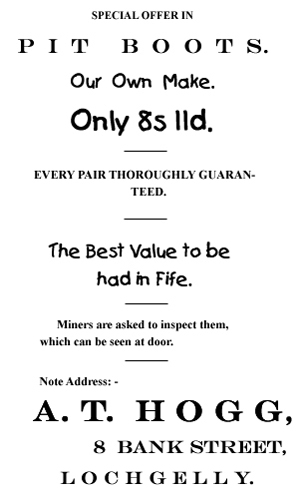 |
.. in the "Times" that same week.
-----------------------------------------------
"Cowdenbeath & Lochgelly Times"
22 October, 1913
An invention which is intended to lessen the risk of accident in pit shafts has been patented by John Fraser, miner, Hall Street, Lochgelly. A demonstration of its working has been given to Lochgelly Colliery officials.
-----------------------------------------------
"Cowdenbeath & Lochgelly Times"
24 December, 1913
This issue carried the sad news of the death of Mr James Armour, who was for several years commercial manager and secretary to Lochgelly Iron & Coal Coy. He was 51 years of age and was well known in mining circles in Scotland.
-----------------------------------------------
"Dunfermline Press"
18 August, 1917
A serious accident befell William McKay, miner, Lochgelly, while at work on Tuesday. He was struck by a hutch, with the result that his arms and legs were severely injured, and he was also hurt internally. He was removed to Dunfermline and West Fife Hospital.
-----------------------------------------------
"Dunfermline Press"
10 November, 1917
PIT LABOURER'S SUDDEN DEATH
On Monday morning, Thomas Anderson (61), labourer, residing at Plantation Street, Lochgelly, was found dead in a workmen's hut at the bottom of a wheelbrae in Lochgelly Colliery works. Shortly before six o'clock he reported himself for duty at the works. Some time later, he was seen by a fellow-worker near the hut. Shortly afterwards, the brakesman at the top of the brae, failing to get a reply to his signal, sent a messenger to the hut. There, Anderson was found apparently dead. Dr Stephen, who saw the body, certified that death was due to natural causes.
-----------------------------------------------
"Cowdenbeath & Lochgelly Times"
19 February, 1922
At the mining examinations held at Lochgelly East School by the Herriot Watt College authorities, 97 firemen gained certificates under the Mines Act.
-----------------------------------------------
"Cowdenbeath & Lochgelly Times"
15 February, 1922
... Mr William Adamson, M. P., the General Secretary, reported in connection with the threatened eviction by the Lochgelly Iron and Coal Coy., Ltd., of certain of the occupants belonging to the Company that, in the cases where Sheriff Umpherston had granted decree for ejection, he (Mr Adamson) had communicated with the Secretary for Scotland in the hope that he would be able to prevent the execution of the notices.
---------------------------------------------------
"Cowdenbeath & Lochgelly Times"
2 January, 1924
LOCHGELLY FIFTY YEARS AGO
Recollection to the Editor of the "Times"
by
Robert Main, 4 High Street, Anstruther.
"… Of pits there were only the Auld Gig, Jenny Gray No. 1 (at the bottom of the Wheelbrae), and the Eliza, going at that time. Robert Fowler and David Paton were the winding enginemen at No. 1 Pit, and the coal was nearly all sold as land-sale. It was a common thing to see a score or more carts waiting their turn all the way from Leslie and Falkland.
Three out of the four furnaces were in full blast. No gas was made in the town, at that time, but the furnaces lit up the countryside for miles, and you could see the wild ducks and other sea birds, on the winter nights, hovering over the light. Some got away, others fell victims to the sulphur fumes and the flames. There were a great number of carting contractors in the town, carting char and limestone to the furnaces. The limestone quarry was away on the south side of Lochgelly Loch - a long, heavy road for a horse."
---------------------------------------------------
"Cowdenbeath & Lochgelly Times"
9 January, 1924
Lochgelly Reminiscences
(continued)
"… George Williamson was the carrier between Lochgelly and Cowdenbeath, and David Pryde to Kirkcaldy, before accommodation was made at Lochgelly Station for delivery of goods. … My schooldays were short. I was down the Eliza Pit at the tender age of ten, assisting "Sandie" Suttie at a wheelbrae, for the large sum of 9d per day, and fourteen hours from the time I left the house until I got back home. Truly, it was hard times! The young folk were not brought up in these days, they were hauled up, and the miner's lot was not to be envied. Yet, all seemed more happier and contented than now. They had to be, for they were only serfs or slaves - call it what you like - and they were powerless to throw off the yoke."
Mr Robert Main was 72 years of age when he wrote these words.
------------------------------------------------
"Cowdenbeath & Lochgelly Times"
19 March, 1924
A contract for 15,000 tons of coal had been placed by the Swedish State Railways with Lochgelly Iron and Coal Company. The orders will be shipped over April, May and June. The price is 32s per ton, c. i. f.
-----------------------------------------------
"Cowdenbeath & Lochgelly Times"
27 August, 1924
Mr John Paul, general manager of Lochgelly Iron and Coal Company, Ltd., has been appointed a director of the Company.
-----------------------------------------------
"Cowdenbeath & Lochgelly Times"
3 December, 1924
Lochgelly Iron & Coal Coy.
IMPORTANT APPOINTMENTS
Several important appointments have just been made by the Directors of the Lochgelly Iron and Coal Company, Ltd. The principal one is that of general manager to succeed ex-Provost Paul, who some time ago was given a place in the Directorate.
The position has been given to Mr Peter Henderson, who has been agent and assistant to Mr Paul. Mr Henderson is a native of Nigg, Ross-shire. He served an apprenticeship as a mining surveyor at the Quarter Collieries, Lanarkshire, and came to Lochgelly about a quarter of a century ago to take up the duties of mining engineer. His first work was assisting the late Mr Andrew Nisbet, general manager, in the laying out of the Minto Colliery, then just being opened up, and later in the re-opening of the Nellie Pit. Later on he was appointed as manager, and more recently he was made an agent and assistant to Mr Paul.
Mr Wm. Ross, who came from Polmont, has been in the services of the Carron Coal Company. He will act as agent for a section of the Lochgelly Collieries, and take up Mr Henderson's present duties.
Another appointment is that of Mr Robert Peters, as chief engineer to the Company. Mr Peters has long been in charge of the electric works of the Company, and this is included in his extra responsibility.
His position as chief electrician will be filled by his brother, Mr John Ritchie Peters.
----------------------------------------------
"Cowdenbeath & Lochgelly Times"
24 December, 1924
CARE OF PIT PONIES - PRIZE AWARDS
The following drivers and others in the service of Lochgelly Iron and Coal Company, Ltd., have received prizes as follows from the Scottish Society for the Prevention of Cruelty to Animals, acting in conjunction with the Company. It is pleasing to see the Society taking such an active interest in the ponies, and this is reflected in their fine appearance. The ponies have been carefully driven and attended to, and are in excellent condition.
GORDON PIT -1, Geo. Bowman, 7s 6d (certificate); 2, Edward Scott, 5s (certificate); 3, Martin Henny, 2s 6d (certificate); recommended, Chas. Nisbet (certificate); recommended, Jas. Bruce (certificate); hostler, Wm. Low, 7s 6d (certificate).
DORA PIT - 1, David Walls, 7s 6d (certificate); 2, Robt. Doig, 5s (certificate); 3, John Blair, 2s 6d (certificate); recommended, John Fraser (certificate); acting hostler, Thos. Wood, 5s (certificate).
NELLIE PIT - 1, Thos. Brady, 7s 6d (certificate); 2, Jas. Cowan, 5s (certificate); hostler, John Hain, 7s 6d (certificate).
LOCHHEAD PIT - 1, Adam Cowan, 5s (certificate); hostler, Robt. Bean, 5s (certificate).
NEWTON PIT (No.1 and 2) - 1, James Shand (No. 2), 7s 6d (certificate); 2, Thos. Paterson (No. 2), 5s (certificate); 3, Jas. Kidd (No. 2), 2s 6d (certificate); recommended Robt. Gray (No. 1), (certificate); recommended Thos. Richardson (No. 1), (certificate); hostler, Robt. Milne, 7s 6d (certificate).
MINTO PIT (No. 1 and 2) - 1, Alex. Munro (No. 1), 7s 6d (certificate); 2, Chas. Herd (No. 2), 5s (certificate); hostler, Jas. Davidson, 7s 6d (certificate).
JENNY GRAY PIT - 1, Jas. Crawford, 7s 6d (certificate); 2, Peter Whyte, 5s (certificate); recommended, Robt. Bald, (certificate); hostler, Robt. Crawford, 7s 6d (certificate).
----------------------------------------------
"Cowdenbeath & Lochgelly Times"
30 December, 1925
PIT PONIES AT LOCHGELLY COLLIERIES
- AWARDS FOR CARE.
The following is a list of certificates and monetary awards, given by the S.P.C.A. for 1925, to employees in the Lochgelly Collieries. We are informed that the active interest the Society takes is reflected in the fine appearance of the ponies, all of which having been carefully driven and attended to:-
GORDON PIT - James Bruce (certificate), 7s 6d; Alex. Shand (certificate), 5s; Ostler, Wm. Low (certificate), 7s 6d; Ronald Aston (certificate).
DORA PIT - David Walls (certificate), 7s 6d; David Aitken (certificate), 5s; Matthew Marshall (certificate), 3s 6d; Robt. Wood (certificate), 2s 6d; Ostler, John Wannan (certificate) 7s 6d; John Drummond (certificate); Jas. Robertson (certificate); David Page (certificate); John Venters (certificate).
JENNY GRAY PIT - Robert Crawford, jun. (certificate), 7s 6d; Peter McGuire (certificate), 5s; Ostler, Robert Crawford (certificate), 7s 6d; Jas. Hendry (certificate).
NELLIE PIT - Thos. Brady (certificate), 7s 6d; Jas. Cowan (certificate), 5s; Ostler, David Pratt (certificate), 5s; Hugh Preston (certificate); Thos. Graham (certificate); Ninian Barrie (certificate).
LOCHHEAD PIT - Harry Lawrie (certificate), 5s; Ostler, James Tulloch (certificate), 5s.
MINTO PIT - John Ferguson (certificate), 7s 6d; Ostler, John Ferguson.
-------------------------------------------------
"The Scotsman"
23 September, 1927
SUDDEN DEATH OF BO'NESS COLLIERY MANAGER. - The death occurred suddenly yesterday afternoon at Kinneil Collieries of Mr William Ross, manager, Kinneil Coal Company, Bo'ness. Mr Ross, when inspecting work underground, was seized with illness, and expired shortly afterwards. Two and a half years ago, when Lochgelly Coal Company took over Kinneil Collieries, Mr Ross went to Bo'ness as manager. The deceased gentleman was 56 years of age, and leaves a widow and young family.
-------------------------------------------------
"Cowdenbeath & Lochgelly Times"
Wednesday, 28 September, 1927
This issue carried the announcement of the death of Mr William Ross, who was about a year in Lochgelly as manager of the local Company's pits. Fully two years ago he was transferred to Kinneil Colliery, which had then been taken over by the Lochgelly Iron and Coal Company.
---------------------------------------------------
"Cowdenbeath & Lochgelly Times"
28 March, 1928
CLOSING OF LOCHGELLY PITS
Something like consternation was created in Lochgelly on Friday, when it became
known that the Lochgelly Iron and Coal Company had posted notices intimating the
closing of four of their pits.
The pits involved are the Mary (Lochgelly Colliery), Dundonald (Dundonald Colliery),
Gordon and Lochhead Pits (Raith Colliery). It is expected that 700 to 800 will be thrown
idle. Less than half of these are resident in Lochgelly.
---------------------------------------------------
"Dunfermline Press"
26 September, 1931
DEATH OF MR JOHN PAUL.
FORMER PROVOST OF LOCHGELLY.
Following a protracted illness, Mr John Paul, who had been prominently identified
with the Scottish coal trade over twenty years, and who was a leading public man in
the county of Fife, passed away at his residence, Stewarton, Viewfield, Dunfermline,
on Wednesday morning.
A native of Shotts district of Lanarkshire, Mr Paul went to Lochgelly twenty-two years
ago as general manager of the Lochgelly Iron and Coal Company, Ltd. ... Six years ago,
Mr Paul retired from the position of general manager of the Lochgelly Iron and Coal
Company, Ltd. He then became a director of the Company, and removed his residence
from Lochgelly to Dunfermline. He was sixty-six years of age.
---------------------------------------------------
"Cowdenbeath Advertiser"
9 March, 1945
DEATH OF FORMER LOCHGELLY COLLIERY MANAGER.
SON OF PROVOST PAUL.
The death occurred suddenly, on Saturday, at his mother's house, Birkdale, Carluke, of Mr James Paul, well-known Lochgelly personality and colliery manager.
Mr Paul came to Lochgelly in 1903, when his father took up the position of general mining manager of Lochgelly Iron and Coal Company, Ltd. He was then a mining student, and went on to fill official positions in the Lochgelly Company and elsewhere.
At one time he was manager at Largoward Colliery. His last appointment at Lochgelly was as agent of Dundonald Colliery, which he left in 1944 to take up a similar post at Douglas. Lanarkshire. Like his father, he was keen on sport, and was a member of Lochgelly Golf Club, Tennis Club, and Curling Club, a loyal follower of Lochgelly United F.C. He had a genial personality, and was much liked. He is survived by his wife and daughter.
---------------------------------------------------
"Cowdenbeath Advertiser"
7 December, 1945
DEATH OF FORMER COLLIERY MANAGER
WELL-KNOWN LOCHGELLY NATIVE
The death occurred at his residence, Lumphinnans Road, on Sunday, of Mr William Barclay, retired colliery manager. He had a long illness.
Deceased was a native of Lochgelly, born in Berry Street and reared in Bank Street. After a short term as an apprentice printer in this office, he started in the pits with his father. Early in life he realised the value of education. He was one of the first students to enrol when the miners' classes were started at Cowdenbeath. The result of his studies brought him a first-class Mine Manager's Certificate. All his service was given to Lochgelly Iron and Coal Coy.
After qualifying he became an oversman in Minto pit, later manager at Jenny Gray and Melgund pits, from there to control of the Nellie and Mary pits, and, finally, to the important responsibility of manager at Minto. …
---------------------------------------------------
"Lochgelly Times"
16 January, 1947
WELL KNOWN COLLIERY OFFICIAL'S DEATH
David McQuillen, an official in the commercial department of Lochgelly Iron and Coal Company, Ltd., died suddenly on Friday morning. He was 63 years of age. …
---------------------------------------------------
"Dunfermline Press"
21 January, 1950
MINING DEVELOPMENT AT LOCHGELLY?
The Ministry of Works are planning to make borings for mineral deposits in land on the south side of Lochgelly. The Ministry has notified Fife County Council and Lochgelly Town Council of their intention to commence the borings immediately to establish whether there are mineral deposits there suitable for extraction under the opencast coal schemes. The borings will be taken in the region of Westerton Farm, Lochgelly, and within an area scheduled by Lochgelly Town Council for housing development. The area is also within the region of the proposed new township between Lochgelly and Cowdenbeath. The Ministry stated that the borings were purely exploratory. If deposits were found, further observations would be invited from the Town and County Councils.
---------------------------------------------------
"Dunfermline Press"
22 July, 1950
OPEN-CAST SITE NEAR LOCHGELLY
Opposition by Fife M.O.H.
Fife County Planning Committee, at a meeting at Cupar, supported opposition by
Dr G. Matthew Fyfe, the County M.O.H., to a proposal by the Coal Board to requisition
over 100 acres of land in the Lochgelly district for open-cast coal work.
Dr Fyfe said the face of the county had been disfigured by open-cast coal work and he
heard from mining sources that the merits of open-cast mining were doubtful.
On Powguild Farm they proposed to requisition 73 acres, and at Muiredge Farm more
than 30 acres. Powguild was a dairy farm with approximately 30 T.T. cows, and if the
acreage were reduced it would cease to function.
A similar situation existed at Muiredge, where a T.T. herd of 35 cows was kept.
Dr Fyfe also opposed the proposal on the ground that the amenities of the area would suffer.
Mr R. L. Christie, Kennoway, chairman, said:- "I think the Medical Officer has put up
an unanswerable case, and we should give direct and absolute refusal."
---------------------------------------------------
"Dunfermline Press"
18 September, 1954
Open-Cast Mining at Windyedge
Supporting a proposal for an open-cast mining venture near Lochgelly, Mr John Sneddon,
Kelty, denied at Fife Planning Committee's meeting that such operations rendered
land unfit for crops for many years afterwards.
The Committee were considering the Planning Officer's recommendation that no
objection be taken to the Ministry of Fuel and Power requisitioning land at Windyedge,
Lochgelly, for extracting coal by open-cast methods.
Mr Sneddon said that he had been told that land used for open-cast mining would not
be fit for recultivation half a century after working stopped. This was bunkum.
In Kelty district, where coal had been taken out by the open-cast method and the land
later ploughed up, it was found to be better agricultural land than it had been originally.
Provost J. Braid, St Monance, disagreed. Provost Braid said there was plenty of coal to
be obtained by deep mining, instead of destroying agricultural land. It seemed to him an
unrealistic situation that such land should be wasted. While he agreed that coal was
of the utmost necessity, deep mining was the answer, not open-cast.
A motion by Provost Braid that they object to the Ministry proposal did not find a seconder.
---------------------------------------------------
"Dunfermline Press"
13 April, 1957
Objection to Opencast Project
Lochgelly Town Council will protest against a proposal to work coal by open-cast in the Auchterderran Road area. ... Mr George Johnston, Town Clerk, said the site was Boswellknowe, on both sides of Auchterderran Road, one part being east of the old brickworks and within 300 yards of the Cooper Ha' housing development. ...
---------------------------------------------------
"Dunfermline Press"
13 January, 1962
Back Garden Coal Mine Refusal
Councillor Mungo Johnstone, Lochgelly, has had another refusal from the N.C.B. for a licence
to operate a private coal mine in the garden of his home, "Lochview," the mansion house
formerly occupied by Lord Minto.
A letter to Lord Robens, seeking reconsideration of the refusal, brought a reply from Hobart House,
stating that special circumstances did not apply, and Mr Johnstone's application would have
to take its place with all the others. The letter, signed by Mr Webb, Under-Secretary, concluded: "As
to your comments on the general state of the industry in Scotland, Lord Robens sees no justification for
the alarmist conclusions which you draw from the Board's recent actions in Scotland. Almost
all the collieries which are scheduled for closure in 1962 are being closed either because reserves
are exhausted or because the men can be more productively employed at other collieries in the
neighbourhood."
---------------------------------------------------
"Dunfermline Press"
14 September, 1973
Coal cache at building site
Bradley Homes (Scotland) Ltd., met with a problem at their new housing development
scheme at the top of "The Avenue," Lochgelly, when they started on the foundations.
When they sunk their first test bore, the cutter dropped a distance of 12 feet. After several more
test bores, they discovered the remains of a partly-worked coal seam, dating back to the days
of the "stip" workings, when the miners left pillars of coal standing for supports,
instead of the usual timber props.
In the eyes of the National Coal Board, the coal belonged to them, but they did not want to extract
it. However, they had no objections to Bradley digging it out, and, in fact, paid them to extract,
and deliver it to the Opencast Site at Westfield.
So far, they have extracted over 2000 tons, and the seam might yield anything up to 5000 tons in all!
When the seam is finally exhausted, Bradley will have to bring in blaes from the "bing"
at Lumphinnans, to infill the hole, along with the heavier material, already extracted, and employ
the use of heavy rollers to pound the surface to ensure it will take the weight of the houses.
---------------------------------------------------
