Owners: Cowdenbeath Coal Company
Fife Coal Co. Ltd.
NCB
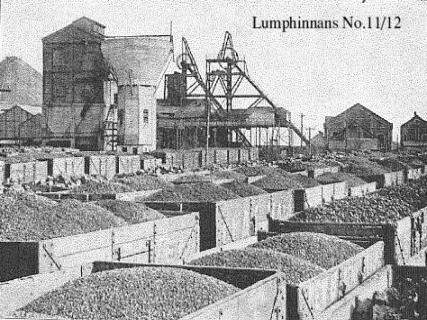
Lumphinnans Nos. 11, 12 Pits were about one mile to the
north-west of Lumphinnans No. 1 Pit and just over ¾ mile
east of the Lindsay Colliery, Kelty. The pits were on the
edge of the Lochore basin and so they had much more in common
with the Aitken (Kelty)/Mary (Lochore) complex than the
Lumphinnans pits to the south-east. Rail connection was made
from the pits to the main Cowdenbeath-Perth rail line.
Records indicate that the No. 11 Pit was sunk around 1896 to the
Dunfermline Splint at 227 fathoms; the No. 12 Pit,
around 1922, to the Seven Feet seam at around 93 fathoms. The
pits and a pump shaft were on the north side of the
Lumphinnans & Kelty branch mineral line and a surface
mine (No. 11) is believed to have been driven (1946) just a
few hundred yards to the south of the pits, on the opposite
side of the mineral line.
 |
 |
 |
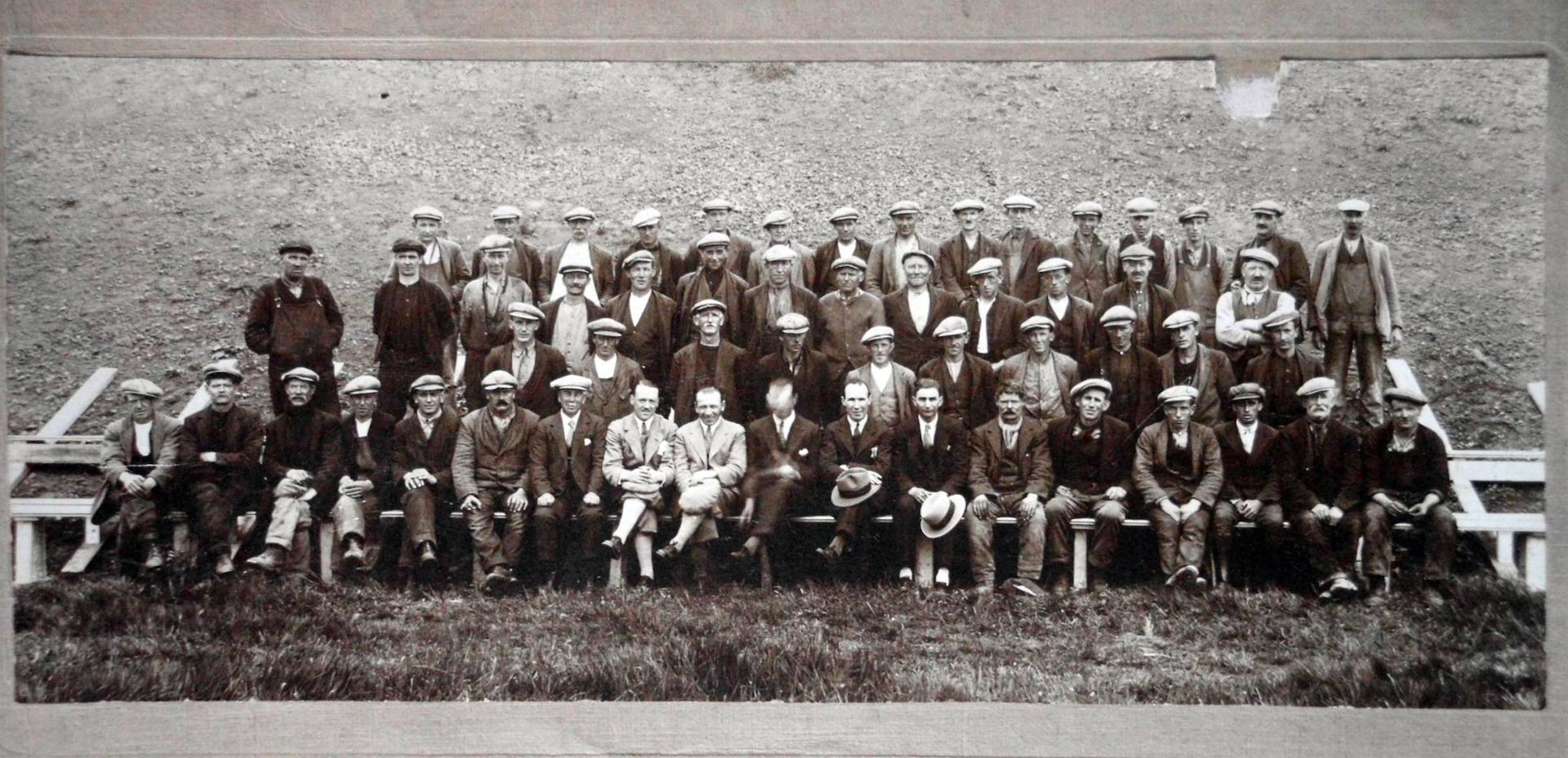
"We are grateful to Teresa Kemp, Lochgelly, for forwarding a group photograph of miners and colliery staff from an earlier period, possibly the 1930s. The photograph is thought to relate to the Peeweep (or Peewit) Pit - Lumphinnans No. XI - and Teresa's great-great-grandfather, David Archibald Reid, is in the rear row, second from right. The image has appeared on Facebook and Davina Burden got in touch to say that one of the men in the front row, with plus-fours (the one to the right), is her Dey, Bob Wilson, and the other one is one of his six brothers. All seven brothers apparently started work in the Peweep, then worked in the Alice, Fordell. Bob Wilson was born 1911 and would probably be in his late 20s in this photo.
Does anybody recognise any of the other faces in this wonderful photograph and can confirm that the employees and staff are from the Lumphinnans No. XI Pit?"
M. Martin & Webmasters.
 |
------------------------------------------------------------
"We are also grateful to Tom Malcolm, formerly of Lochgelly, now living in France, for some recollections of the Lumphinnans Nos. XI and XII. Please see the final article in this entry."
M. Martin & Webmasters.
------------------------------------------------------------
| See Lumphinnans No. 1 Pit entry for general information on Lumphinnans Colliery. |
|---|
The No. 11 was the 'Peeweep Pit' and in June, 1906,
it was referred to in a Dunfermline Press report as the No. XI i.e.
the Roman numeral eleven. The No. 12 Pit (or XII)
was sinking around 1922/25 not far from the No. XI shaft and
they were both to prove very productive pits in their time.
[Footnote: Although local people referred
to the No. XI Pit as 'the Peeweep', on the pit's
banner it read " PEEWIT PIT 1896 - 1965".]
---------------------------------------
| Pit opened: 1896 | Pit closed: November, 1966 |
|---|
| Source Date of Information Supplied |
|---|
| Manager / Under-Manager / Men underground / Men above ground / Coal seams worked |
| 1896-1904 (Fife Coal Co. Ltd.) |
| Thomas Borland, manager.
May: Mr T. Borland moves to manage the new Hawkhill Colliery, Tulliallan. |
| 1905 (Fife Coal Co. Ltd.) |
| John Gray, manager. |
| 1909 (Fife Coal Co. Ltd.) |
| John Gray, manager. May: Departure of Mr Lyle, colliery oversman, to position in west of Scotland. Sept: Mr Hamilton Graham, oversman, transferred to No. 1 Pit Oct: Mr John Hunter, oversman. |
| 1910 (Fife Coal Co. Ltd.) |
| Jun: Mr John Hunter, oversman, transferred to Lumphinnans No. 1 Pit. |
| 1912 (Fife Coal Co. Ltd.) |
| John Gray, manager; John McNee, under-manager |
| 1920 (Fife Coal Co. Ltd.) |
| Manpower: 979 / 316 These figures for all Lumphinnans pits. |
| 1921 (Fife Coal Co. Ltd.) |
| Jul: Mr Smellie, oversman, appointed under-manager at Mossbeath Colliery. |
| 1923 (Fife Coal Co. Ltd.) |
| Sep: Mr James Erskine, under-manager, leaves for a post in India. |
| 1924 (Fife Coal Co. Ltd.) |
| Mr W. Monaghan, manager. |
| 1925 (Fife Coal Co. Ltd.) |
| Mr W. Monaghan, manager; Mr John McLean, under-manager. |
| 1927 (Fife Coal Co. Ltd.) |
| September: Mr W. Monaghan,
manager, leaves to take up similar position at Mary Colliery,
Lochore. Mr H. Penman, No. 1 Pit, Lumphinnans, appointed manager. John McLean/Blyth Davidson, under-managers. |
| 1928 (Fife Coal Co. Ltd.) |
| Mr George Hutchison / John McLean (No. XI Pit) : Blyth Davidson (No. XII Pit) / 601 / 160 |
| Household and steam coals
and blaes. Lochgelly Splint, Gorman, Five Feet,
Glassee, Dunfermline Splint, Mynheer, Fourteen Feet and Diamond. |
| 1929 (Fife Coal Co. Ltd.) |
| George Hutchison, manager.
Sept: Mr Frank Orr, appointed under-manager at No. 11 Pit. Mr John McLean, former under-manager, killed in accident at pit. Mr James Dick, under-manager at No. 12 Pit. |
| 1931 (Fife Coal Co. Ltd.) |
| John Fleming, manager: Frank Orr / Harry King, under-managers. |
| 1932 (Fife Coal Co. Ltd.) |
| John Fleming, manager: Frank Orr / Archibald McNeil, under-managers. |
| 1933 (Fife Coal Co. Ltd.) |
| Dec: John Fleming, manager. |
| 1934 (Fife Coal Co. Ltd.) |
| John Fleming, manager; William Shilliday/George Wilson, under-managers. |
| 1935 (Fife Coal Co. Ltd.) |
| Feb: George Wilson, under-manager. |
| 1937 (Fife Coal Co. Ltd.) |
| May: Mr Hynd, undermanager No. 12 Lumphinnans, appointed manager at Kinglassie. |
| 1938 (Fife Coal Co. Ltd.) |
| John Fleming / William Shilliday (No. XI Pit) : William Jones (No. XII Pit) / 545 / 163 |
| 1939 (Fife Coal Co. Ltd.) |
| Apr: Mr J. Fleming, manager.
Oct: Mr John Bennett, appointed under-manager, No. XI Pit. |
| 1940 (Fife Coal Co. Ltd.) |
| Mr Dempster Smith, appointed under-manager. |
| 1943 (Fife Coal Co. Ltd.) |
| Mr John B. H. Fleming, manager. |
| 1945 (Fife Coal Co. Ltd.) |
| Nos. 11, 12: George Richardson / Dempster Smith / 551 / 168 |
| Household and steam coals and blaes. Little Splint, Lochgelly Splint, Main and Seven Feet. |
| 1946 (Fife Coal Co. Ltd.) |
| Nos. 11, 12: George Richardson, manager. |
| 1947 (NCB) |
| No. 11:Mr James T. Proudfoot / ---------- / 606 / 182 |
| Gas, household, industrial and steam coals. Approx. annual output = 232,700 tons. |
| 1948 (NCB) |
| Nos. 11, 12: J. T. Proudfoot / D. R. Paterson / 587 / 192 |
| Household and steam coals. Blairhall, Little Splint, Seven Feet, Lochgelly Splint, Main and Diamond. |
| 1949 (NCB) |
| Nos. 11: J. Proudfoot / D. Paterson / 590 / 174 |
| Household and steam coals. Lochgelly Splint, Main, Seven Feet, Diamond and Blairhall. |
| 1950 (NCB) |
| Nos. 11: J. Proudfoot / ---------- / 565 / 177 |
| Household and steam coals. Little Splint, Main, Seven Feet, Diamond and Blairhall. |
| 1951 (NCB) |
| Nos. 11: J. Proudfoot / J. Pryde / 580 / 147 |
| Household and steam coals. Little Splint, Main, Seven Feet, Diamond and Blairhall. |
| 1952 (NCB) |
| Nos. 11: J. Proudfoot / J. Pryde / 575 / 131 |
| Household and steam coals. Little Splint, Main, Seven Feet, Diamond and Blairhall. |
| 1953 (NCB) |
| Nos. 11: J. Proudfoot / Geo. Henshilwood / 575 / 131 |
| Household and steam coals. Little Splint, Main, Seven Feet, Diamond and Blairhall. |
| 1954/55 (NCB) |
| Nos. 11: Mr John Eadie / Geo. Henshilwood / 575 / 131 |
| Household and steam coals. Little Splint, Main, Seven Feet, Diamond and Blairhall. |
| 1956 (NCB) |
| Nos. 11: J. Eadie / S. Gibb / 575 / 131 |
| Household and steam coals. Little Splint, Main, Seven Feet, Diamond and Blairhall. |
| 1957 (NCB) |
| Nos. 11: J. Eadie / G. Clark / 597 / 126 |
| Household and steam coals. Seven Foot and Diamond. |
| 1958 (NCB) |
| No. 11: J. Eadie / G. Clark / 605 / 125 |
| Gas, household, industrial and steam coals and Blaes. Seven Foot, Jersey and Lochgelly Splint. |
| 1959 (NCB) |
| No. 11: J. Eadie / G. Clark / 490 / 138 |
| Gas, household, industrial and steam coals and Blaes. Little Splint, Main and Jersey. |
| 1961 (NCB) |
| No. 11: J. Eadie / G. Clark / 280 / 90 |
| Gas, household, industrial and steam coals and Blaes. Jersey, Lochgelly Splint. |
| 1964 (NCB) |
| No. 11: J. Eadie / M. Peden / 325 / 90 |
| Gas, household, industrial and steam coals and Blaes. Jersey, Lochgelly Splint. |
| These pits had a system of ventilation partly in common with Lumphinnans No. 1 |
Information on coals worked at Lumphinnans No. 11 Pit
(based on reports from 1930-34)
From the No. 11 Pit, in the early part of the twentieth
century, the Splint Coal, a good navigation coal, was worked
extensively to exhaustion. It was slightly over 4 ft. thick
and had a pavement of fakes and a roof of faky blaes. Small
areas of Splint Coal to the north of this pit were high in
carbon and had the qualities of anthracite.
The Two Foot Coal seam was very thin here and separated from
the underlying Splint by 14 fathoms of sandstone.
The Five Foot Coal, a fair household and good steam coal,
lay 20 fathoms above the Splint but the overlying blaes was
thicker than at the Aitken Pit and some difficulty in shoring
up the roof of the seam was experienced on the west side of
the shaft.
Glassee Coal was also extensively worked around the pit and
in workings to the north-east. The Glassee seam varied from 2
ft. 6 in. to a little over 4 ft. with a blaes pavement
(frequently coaly) and an ironstone roof.
The Bank Coal (or Lochgelly Parrot) here formed the lower
part of a thick composite seam that included the Lochgelly
Splint Coal.
Swallowdrum Coal, 4 ft. 1 in. thick, lay a few feet below
the Lower Jersey seam which varied from 5 ft. 9 in. in the
south-west workings to 8 ft. near the Mary Pit, Lochore.
In the ground around the No. XI Pit, the Kelty Main Coal
measured 5 ft. and lay within a few feet of the Upper Jersey
Coal. Here, 3 ft. 5 in. of Little Splint Coal, with a
fireclay pavement and a roof of sandy fakes, was cut 85
fathoms from the surface and 10 fathoms above the thick Rough
Coal which was worked at the pit.
Unusually good Lochgelly Blackband Ironstone was found at
the pit but little is known about the quality of the
Cardenden Smithy Coal recorded here as an upper leaf 3 ft. 7
in. thick and lying some 6 ft. above the lower leaf which
measured 2 ft. 8 in., including an 8 in. soft, fireclay band.
The Blairhall Main Coal lay some 6 or 7 fathoms above the
Cardenden Smithy Coal and was recognised by the thick bed of
fireclay which formed its roof. It was well developed here
and the seam, measuring around 7 ft. thick with partings, had
five leaves of coal measuring 8 in., 10 in., 3 ft. 1 in., 3
in. and 1 in.
------------------------------------
| Plans of Abandoned Seams for Lumphinnans Nos. 11, 12 | Pits or Mines designated in Plans |
|---|---|
| COAL; Kinglassie Splint (March, 1925). | LUMPHINNANS Nos. 11 |
| COAL; Five Feet; Mynheer (March, 1927). | LUMPHINNANS Nos. 11 |
| COAL; Gorman (January, 1929); Little Splint (April, 1930)
Later workings have been added to the plan of the Gorman seam. The amended abandonment date is January, 1935. |
LUMPHINNANS Nos. 11, 12 |
| COAL; Diamond or Top and Lower Jersey (Abandoned 17th January, 1934). | LUMPHINNANS Nos. 11, 12 |
| (See Supplement for 1932). Later workings have been added to the plan of the Gorman seam. The amended abandonment date in respect of this seam is 21st January, 1935. |
LUMPHINNANS Nos. 11, 12 |
| COAL; Dunfermline Splint (Abandoned 25th July, 1933); Glassee (Abandoned 17th January, 1936). | LUMPHINNANS Nos. 11, 12 |
------------------------------------
A Few Notes on the Early Days
by
CHARLES AUGUSTUS CARLOW
1896: This was the year of the amalgamation with
Cowdenbeath, when the Cowdenbeath, Foulford and Lumphinnans
Collieries were taken over.
Lumphinnans No. 11 was sunk under the direction of Mr. Henry
Mungall, principal partner of the Cowdenbeath Coal Company.
My chief recollection regarding Lumphinnans No. 11 Pit is in
connection with the outburst of carbon monoxide in 1906,
resulting in the death of two miners - Alexander Black and
Thomas Serrie. I led the rescue party, in an effort to save
these men's lives. The only protection we had was the
canary which I took out of the kitchen before starting for
the pit. Everybody seemed surprised, but I carried the canary
and the men followed me. To our regret, we were unsuccessful.
It may be that some of the "Old Timers" referred to
in this booklet [see F.C.C Menu 4], were in the rescue
party, and may remember stepping over the bodies of horses
overcome by the gas, and our sense of frustration when the
canary kept falling off its perch and we had to go back.
------------------------------------
Additional information on the Lumphinnans Nos. 11, 12 Pits.
1896: In the course of sinking, eleven workable seams were cut.
1933: Pithead Baths were opened by Mr. C. Augustus Carlow, Managing Director of the Fife Coal Company.
1942: Up until this time, five seams were worked at the pit:- Lochgelly, Glassee, Mynheer, Five Foot and Dunfermline Splint.
1946: A new surface mine was driven to extract coal from the remaining six seams.
- For many years Lumphinnans No. XI was known as the 'John Fleming
Pit' because of the strong personality of the then
Colliery Manager.
- The majority of the workforce came from the Cowdenbeath
and Kelty areas.
------------------------------------

"Supplement: Dunfermline Saturday Press"
6 June, 1896
At a pit in process of sinking by the
Cowdenbeath Coal Company at Lumphinnans Colliery, an accident
occurred on Saturday by which one pit-sinker lost his life, and his
two companions had narrow escapes.
It appears that while a loaded kettle was being
raised in the shaft to the surface some part of the gearing,
through some cause or other, gave way, and the kettle fell to the
bottom - a distance of 66 feet. In its descent it struck Robert
Jones (24), Lumphinnans, and inflicted such injuries upon him that
he almost immediately expired. John McAllan, Cowdenbeath, and John
Young, Lumphinnans, who were at the work of sinking with Jones,
were happily beyond the reach of the kettle, and they escaped with
some bruises about the head and shoulders, the result of being
struck by some of the gearing.
The Dunfermline Saturday Press of 27 June, 1896, carried a Report on the Fatal Accident Inquiry into the death of Robert Jones in the new pit being sunk on the farm of Lumphinnans by the Cowdenbeath Coal Company. Thomas Borland, manager, Lumphinnans; David Lindsay and James Fleming, pitheadmen.
------------------------------------------------
"Dunfermline Saturday Press"
10 October, 1896
ACTION FOR DAMAGES ABANDONED
In Dunfermline Sheriff Court on Tuesday it was intimated that the action brought at the instance of John Jones, pit-sinker, 13 Kirkford Houses, Kirkford, against the Cowdenbeath Coal Company, Limited, had been abandoned. The action was one in which pursuer sued for £500 at common law or £250 under the Employers' Liability Act as damages for the loss of his son Robert who was killed while engaged in sinking operations at a new pit, belonging to the Company, on 30 May last. The defenders denied liability for the accident. ...
------------------------------------------------
"Cowdenbeath & Lochgelly Times"
30 June, 1897
We learn that Mr Thomas Borland, jun., of Lumphinnans Colliery, has passed his examination for colliery manager, and has received a first class certificate.
------------------------------------------------
"Dunfermline Press"
8 April, 1899
A frog has been discovered at the bottom of the new shaft which is being sunk near Lumphinnans by the Fife Coal Company, Limited. The frog was found at a depth of nearly 200 fathoms from the surface.
------------------------------------------------
"Dunfermline Press"
5 May, 1900
An accident is reported as having occurred in
No. 11 Pit, North Lumphinnans, on Saturday, in which two men made
wonderful escapes with their lives. It appears that Arthur Waters
and Peter Thomson, brushers, had been engaged at the work of road
repairing near the coal face in the five feet seam of the
pit.
A heavy mass of redd suddenly fell about them
from the roof. Waters escaped with some bruises about the back and
shoulders, and was able to summon aid. On a staff of men appearing,
they found that Thomson was alive in the very centre of the huge
fall, but fully three hours elapsed before they got him rescued
from his perilous position. It seems that the woodwork by which the
roof had been supported had fallen in such a way as to protect
Thomson. Like his comrade, he escaped with a few
bruises.
------------------------------------------------
"Dunfermline Press"
23 June, 1900
Annan Galloway, brusher, Lochgelly, met with a serious accident on Saturday at No. 11 Pit, Lumphinnans. He was struck on the head with a stone which fell from the roof or side of his working place. His forehead was severely cut and bruised. The stone also came against his left hand, the third finger of which was knocked off. Dr Craig ordered his removal to the Dunfermline Cottage Hospital.
------------------------------------------------
"Dunfermline Press"
30 June, 1900
Henry Fair, miner, Lumphinnans, narrowly escaped losing his life at No. 11 Pit, North Lumphinnans, on Monday. He was putting some jumpers on the cage at the mouth of the shaft, and while he was standing with one foot on the cage and the other on the pithead, the cage was set in motion, with the result that he was jammed between the cage and the mouth of the shaft. His left haunch and right leg were very severely bruised.
------------------------------------------------
"Dunfermline Press"
14 July, 1900
FATAL RESULT OF A PIT ACCIDENT
Adam Drylie, 44 years of age, brusher, Chapel Street, Cowdenbeath, died on Monday night from the effects of injuries sustained in the underground workings of No. 11 Pit, North Lumphinnans Colliery, on Friday last week. A stone fell upon him from the roof, breaking his right collar bone and four of his ribs.
--------------
"Dunfermline Press"
28 July, 1900
This issue carried the Report of the Fatal Accident Inquiry into the death of Adam Drylie, contractor, Cowdenbeath, who was fatally injured in No. 11 Pit, North Lumphinnans. Those giving evidence included:- Thomas Borland, colliery manager; Mr Atkinson, H.M. Inspector of Mines; John Drylie, miner (son of deceased); James Brown, miner, Lumphinnans; Thomas Adams, fireman, Lumphinnans; and John Murrie, fireman, Lumphinnans. The jury returned a formal verdict.
------------------------------------------------
"Dunfermline Press"
29 December, 1900
Adam Graham, thirty years of age, pit-sinker, Foulford Road, Cowdenbeath, died in the Dunfermline Cottage Hospital on Thursday morning from the effects of an accident which occurred the previous night in the Fife Coal Company's North Lumphinnans Pit. The cage had become jammed in the shaft, and after Graham and others had released it, it descended before he could get out of the way - the result being that he was crushed and severely injured internally. Another man had a narrow escape.
----------
"Dunfermline Press"
12 January, 1901
This issue carried the Report of the Fatal Accident Inquiry held at Dunfermline Sheriff Court yesterday into the death of Adam Graham. Among those giving evidence were:- Thomas Martin, pit sinker, High Street, Cowdenbeath; John Borland, oversman, son of colliery manager; Thomas Borland, colliery manager; and, John Sinclair, engineman. The Jury returned a verdict in accordance with the evidence led.
---------------------------------------------------
"Dunfermline Press"
8 June, 1901
John Fernie, drawer, 5 Wemyss Street, Cowdenbeath, met with an accident last week in the Dunfermline splint seam of No. 11 Pit, North Lumphinnans. A stone weighing about one ton fell from the roof. Fernie's head was badly cut, and he was also injured internally. He was attended to by Dr Craig.
---------------------------------------------------
"Dunfermline Press"
29 June, 1901
In Dunfermline Sheriff Court recently, the record was closed in an action at the instance of Mrs Isabella Penman or Graham, Foulford Road, Cowdenbeath, widow of Adam Graham, foreman pit-shaftsman, against the Fife Coal Company, Limited, claiming on behalf of herself and her four children a sum of £1000 in name of damages and solatium for the death of her husband. ... The action has now been settled privately by the defenders paying to the pursuer a sum of £450 and expenses.
---------------------------------------------------
"Dunfermline Press"
6 July, 1901
An accident occurred on Saturday morning at No. 11 Pit, Lumphinnans, by which Mr James McMahon, miner, 141 Main Street, Lumphinnans, was rather seriously injured. About half-past six o'clock McMahon was in the act of putting up a crossbar to support the roof at his working face, when a large portion of the roof came away and about buried him. He was badly bruised about the head, body, and left leg.
---------------------------------------------------
"Dunfermline Press"
19 October, 1901
John Reid, tramp labourer, had his right foot run over by a waggon while he was working at No. 11 Pit, North Lumphinnans Colliery, on Tuesday. The injured foot was amputated at the Dunfermline Cottage Hospital.
------------------------------------------------
"Dunfermline Press"
7 December, 1901
Francis Hunter, miner, met with an accident in North Lumphinnans Pit yesterday. He was removed to the Dunfermline Cottage Hospital.
------------------------------------------------
"Dunfermline Press"
29 March, 1902
Bernard Dougan, miner, Kenny's Buildings, Cowdenbeath, was injured in the underground workings of No. 11 Pit, North Lumphinnans, on Saturday. He was placing two hutches on the rails when he was run into by two loaded hutches. Four of his ribs were fractured; and he was severely bruised.
------------------------------------------------
"Dunfermline Press"
29 March, 1902
Patrick McKeon [McEwan?], 22 years of age, miner, residing at Shand's Buildings, Cowdenbeath, was fatally injured in No. 11 North Lumphinnans Pit, on Saturday. He was on one of the wheel braes in the five-foot seam, when a loaded hutch came down upon him, killing him almost instantaneously.
-------------
"Dunfermline Press"
Saturday, 12 April, 1902
This issue carried the Report of the Fatal
Accident Inquiry held in Dunfermline Sheriff Court on Wednesday
into the death of Patrick McKeon, Shand's Buildings,
Cowdenbeath, who was killed on 22 March in No. 11 Pit, Lumphinnans
Colliery.
Those giving evidence included:- Thomas
Borland, colliery manager, Viewfield House, Lumphinnans; Robert
Fowlis, wheeler, Fraser's Crescent, Cowdenbeath; James Dignan,
miner, Foulford Place, Cowdenbeath; David Fraser, roadsman,
Gardener's Street, Dunfermline; and William Wood, oversman,
Mungall Street, Lumphinnans. A formal verdict was returned by the
Jury.
-------------------------------------------------
"Dunfermline Press"
31 May, 1902
Two accidents occurred on Wednesday in the five-feet seam of No. 11 Pit, North Lumphinnans Colliery. Andrew Baird, miner, Broad Street, Cowdenbeath, had his back bruised by a fall of stone from the roof. Through a similar cause, Andrew McAlpine, miner, Sligo Street, Cowdenbeath, was severely bruised and had his head cut so badly that the wound had to be stitched.
-------------------------------------------------
"Dunfermline Press"
30 August, 1902
At the new pit of Lumphinnans Colliery the men
employed have recently shown a desire to have a fixed idle day each
fortnight. It seems they resolved to observe last Saturday, though
some men were at work. The management have resented the action of
the men, and assert that they should be consulted before such a
step is taken, and that if there is to be a fortnightly idle day it
should be mutually agreed on. Negotiations have been opened up
between the management and representatives of the association and
the men affected, and the next interview between both sides is
likely to be held early next week.
At most of the Fife Collieries the principle of
the pits being idle on a given day is very general, but at others
it meets with much opposition from the employers.
-------------------------------------------------
"Dunfermline Press"
Saturday, 1 November, 1902
FATAL RESULT OF A PIT ACCIDENT
Robert Izatt, 18 years of age, miner, 17 Mungall Street, Lumphinnans, died on Thursday morning from the effects of injuries sustained a fortnight ago through a stone falling on him in the underground workings of No. 11 Pit, North Lumphinnans. At first Izatt's injuries were not regarded as serious, but it appears that his skull had been fractured, and inflammation supervened.
------------
"Dunfermline Press"
29 November, 1902
This issue carried the Report of the Fatal Accident Inquiry, held in Dunfermline Sheriff Court, on Thursday, before Sheriff Gillespie and a Jury, into the death of Robert Izatt at Lumphinnans No. 11 Pit. Those giving evidence included:- Thomas Borland, manager; James Izatt, jun., miner, (brother of deceased); Daniel Moore, miner; John Izatt, pit inspector (father of deceased). The Jury returned a formal verdict.
-------------------------------------------------
"Dunfermline Press"
24 January, 1903
Michael McQuillan, Beveridge Place, Lumphinnans, met with a serious accident in the underground workings of No. 11 Pit, North Lumphinnans Colliery, on Wednesday. While employed at his working face, a quantity of stones and rubbish fell from the roof, knocking him down and breaking his left leg a little above the ankle. He was attended by Dr Craig, Cowdenbeath, who ordered his removal to the Dunfermline Cottage Hospital.
-------------------------------------------------
"Dunfermline Press"
7 March, 1903
Thomas Innes, miner, residing at 3 Main Street, Lumphinnans, met with a slight accident in the five-feet seam of No. 11 Pit, North Lumphinnans Colliery, on Monday morning. Part of the coal face came away and knocked him down, bruising his haunches and right thigh. The injured man was conveyed home and attended to by Dr Young, Cowdenbeath.
-------------------------------------------------
"Dunfermline Press"
13 June, 1903
On Wednesday, a miner, named Thomas Hunter, residing in Broad Street, had his legs severely crushed by a fall of stone in the North Lumphinnans Pit.
-------------------------------------------------
"Dunfermline Press"
15 August, 1903
While working in the five-feet seam of No. 11 Pit, Lumphinnans Colliery, between seven and eight o'clock on Tuesday morning, Michael Gibbons (41), a roadsman, residing at Sligo Street, Lumphinnans, was seriously injured by a heavy fall of stone from the roof. A medical examination showed that his right leg had been fractured at the thigh. The injured man was removed to Dunfermline Cottage Hospital.
-------------------------------------------------
"Dunfermline Press"
23 January, 1904
An explosion of gas occurred in the Fife Coal Company's No. 11 Pit, Lumphinnans, on Saturday. While two men, named James Duncan and William Ford, residing in the village, were brushing a road in the Dunfermline splint seam, their light came in contact with a quantity of gas which had accumulated near the roof. As the result of the explosion which followed, the men were badly burned about the face and arms, besides receiving cuts and bruises. In a dazed condition they made their way to the pit bottom. The men were conveyed to Dunfermline Cottage Hospital.
-------------------------------------------------
"Dunfermline Press"
14 May, 1904
On Saturday morning, a miner named Jas. Binnie, residing at Berry Street, Lochgelly, was working at the face in the Dunfermline splint seam of the No. 11 Pit, North Lumphinnans, when a large stone fell from the roof. He was heard crying for assistance, and on some men going to his working place they found him lying with a stone above him. He was extricated, and conveyed to the surface, where he was attended by Dr Dickson, who found that the right thigh bone was fractured above the knee. The injured man was removed to Dunfermline Cottage Hospital
-------------------------------------------------
"Dunfermline Press"
6 August, 1904
Andrew Innes, miner, Lumphinnans, met with his death on Friday last week while employed in the five feet seam of No. 11 Pit, North Lumphinnans, Cowdenbeath Colliery (Fife Coal Company, Limited). A stone, weighing about five cwt., fell from the roof upon him. His back was broken and his spine injured, and he expired while being conveyed home. Deceased was thirty-one years of age.
---------------
"Dunfermline Press"
24 September, 1904
Under the Fatal Accidents Inquiry Act, an inquiry was held in the Sheriff Court, Dunfermline, on Thursday - before Sheriff Shennan and a jury - into the circumstances attending the death of a miner named Andrew Innes, who was injured in No. 11 Pit, North Lumphinnans, on 29 July, by a stone falling from the roof upon him, and who died the same day while being conveyed home in an ambulance waggon. Those giving evidence included:- James Innes, miner, brother of deceased; John Gray, manager; John Pryde, miner, Golfdrum Street, Dunfermline; and Alexander Dickson, pit inspector. A formal verdict was returned by the Jury.
---------------------------------------------------
"Dunfermline Press"
10 December, 1904
The action at the instance of James Duncan, miner, Lumphinnans, against the Fife Coal Company for £500 damages for injuries, is to be appealed to the Court of Session for jury trial.
---------------------------------------------------
"Dunfermline Press"
31 December, 1904
William Arthur, contractor, residing at 140 Main Street, Lumphinnans, met with an accident in No. 11 Pit, Lumphinnans Colliery, on Saturday. A large stone fell from the roof, crushing him against a building. Although no bones were broken his right side was so much injured that it was found necessary to remove him to Dunfermline Cottage Hospital.
---------------------------------------------------
"Dunfermline Press"
18 March, 1905
In No. 11 Pit, Lumphinnans, on Saturday morning, Martin Kelly, miner, Lumphinnans, had his right leg broken between the knee and the ankle by a piece of coal bursting from the face. The injured man was conveyed home, and attended by Dr Craig.
---------------------------------------------------
"Dunfermline Press"
25 March, 1905
This issue carried the announcement that James Duncan, miner, 85 Main Street, Lumphinnans, who had sued the Fife Coal Company for £500 for personal injuries received by him in the Dunfermline splint seam, No. 11 Pit, North Lumphinnans, on 15th January 1904, was awarded £200 in the Court of Session, the case being heard on Wednesday and Thursday by Lord Kyllachy and a jury.
---------------------------------------------------

Wednesday 26 July, 1905
Mines Inspectors Report
by Mr. Robert McLaren
Alexander Wyse, 16, Pony Driver. Deceased put the tail chain on a rake of loaded tubs to side pull forward to the shaft, and when the tubs had moved a few yards the horse fell, and he was crushed beneath it.
--------------
"Dunfermline Press"
29 July, 1905
In No. 11 Pit, Lumphinnans Colliery, on Wednesday, Alexander Wyse, a young pit worker, was severely bruised on the right side through falling while driving a race of loaded hutches.
Foot Note
See Fatal Accidents Inquiry for
16 September, 1905.
---------------------------------------------------
"Dunfermline Press"
5 August, 1905
William Wyse, jun., pony driver, Cottar Houses, Lumphinnans, who was injured in No. 11 Pit, Lumphinnans Colliery, on Wednesday, died in the Dunfermline West of Fife Hospital on Friday night. Wyse was driving a race of hutches when the pony slipped. The lad fell and was jammed among the hutches, sustaining internal injuries, which, though not at first regarded as serious terminated fatally as stated.
---------------------------------------------------
"Dunfermline Press"
19 August, 1905
Two accidents occurred at No. 11 Pit,
Lumphinnans Colliery, on Thursday. William Craig, a chain runner,
residing in Cowdenbeath, was jammed between a runaway hutch and a
building. He received severe bruises on the left haunch and
thigh.
David Hynd, miner, Lumphinnans, was slightly
bruised by being knocked down and dragged a short distance by an
empty hutch, which had broken away from a race.
---------------------------------------------------
"Dunfermline Press"
9 September, 1905
A miner named David Whyte, residing at Lower Oakfield, met with an accident in North Lumphinnans Colliery, on Monday forenoon. He was engaged at the coal face, when a fall suddenly came away, and his head, back, and legs were severely bruised.
---------------------------------------------------
"Dunfermline Press"
16 September, 1905
Under the Fatal Accidents Inquiry Act, an
inquiry was held in the Sheriff Court, Dunfermline, on Thursday -
before Sheriff Shennan and a Jury - into the circumstances
attending the death of a pony driver named Alexander Wyse, jun.,
Lumphinnans Farm Cottar Houses, who died on 28th July
from the effects of injuries sustained by a pony which he was
driving falling upon him in No. 11 Pit, Lumphinnans, on
26th July. Those giving evidence included:- Alexander
Wyse, farm servant, (father of deceased); John Gray, colliery
manager; David Henderson, pit drawer, 29 Beveridge Place,
Lumphinnans; David Macdonald, pit bottomer, Bellmont Terrace,
Lumphinnans; and Allan Penman, pit bottomer, Mossgreen Place,
Kelty.
A formal verdict was returned by the
Jury.
---------------------------------------------------
"Dunfermline Press"
30 September, 1905
On Wednesday afternoon a miner named David McLeod, about 66 years of age, residing at Woodend, Cowdenbeath, met with a fatal accident in No. 11 Pit of the Lumphinnans Colliery, belonging to the Fife Coal Company. He was sitting taking his "piece", when a stone, nearly six feet long, fell upon him, killing him instantaneously.
-----------
"Dunfermline Press"
4 November, 1905
Under the Fatal Accidents Inquiry Act, an inquiry was held in the Sheriff Court, Dunfermline, on Thursday - before Sheriff Shennan and a Jury - into the circumstances attending the death of a miner named David McLeod, Woodend, Cowdenbeath, killed in No. 11 Pit, Lumphinnans Colliery, by a fall of stone from the roof on 27th September. Those giving evidence included:- John Gray, manager; Alexander McLeod, son of deceased; and James Bruce, pit inspector, Norwood Place, Cowdenbeath. A formal verdict was returned by the Jury.
---------------------------------------------------
"Dunfermline Press"
2 December, 1905
While engaged replacing a race of hutches which had gone off the rails in No. 11 Pit, Lumphinnans Colliery, on Wednesday, Hugh Smith (20), a pony driver, residing at High Street, Cowdenbeath, was rendered unconscious by a kick from the pony. The injured lad was removed home in an ambulance waggon. Dr Primmer, who was called, found that, although the left side was severely bruised, no bones were fractured.
---------------------------------------------------
"Dunfermline Press"
9 December, 1905
An accident whereby James Bone Gilchrist, miner, 118 Main Street, Lumphinnans, lost his life, occurred in No. 11 Pit, Lumphinnans Colliery, yesterday forenoon. Deceased had been acting as brakesman on a wheelbrae, when an up-going hutch ran with such force to the top that it knocked out a prop, and allowed a stone weighing two tons to fall on him, breaking his neck, and also severely crushing him otherwise.
---------------------------------------------------
"Dunfermline Press"
16 December, 1905
.. On the same day [Tuesday], John Dow, miner, Summerville's Buildings, Cowdenbeath, had one of the toes of his left foot amputated by a fall from the roof in No. 11 pit, Lumphinnans Colliery.
---------------------------------------------------
"Dunfermline Press"
13 January, 1906
A sad accident, resulting in the death of Patrick Dignan (26), brusher, residing at Stenhouse Street, Cowdenbeath, occurred in No. 11 pit, Lumphinnans, late on Monday night. Occupied in getting some redd stowed in the waste, deceased had had occasion to knock out a prop, when suddenly a mass of stone fell upon him, crushing him so severely that he died half an hour after the accident.
Footnote
see Fatal Accidents inquiry,
below 17 February, 1906
--------------------------------------------------
"Dunfermline Press"
10 February, 1906
James Wallace, 17 years of age, residing at 62 Main Street, Lumphinnans, and employed as hanger-on in No. 11 Pit, Lumphinnans Colliery, had his leg broken in two places on Tuesday by a race of hutches running on top of him on the brae at which he was engaged. The young man was conveyed to the Dunfermline and West Fife Hospital where the doctors found it necessary to amputate the foot.
--------------------------------------------------
"Dunfermline Press"
Saturday, 10 February 1906
While William Shaw, residing at 69 Main Street, Lumphinnans, was working at the coal face in No. 11 Pit, Lumphinnans, on Thursday, a quantity of material fell suddenly from the roof. He was all but completely buried, and was so severely crushed that he almost immediately expired. Deceased leaves a widow and seven of a family.
------------
"Dunfermline Press"
17 February, 1906
Under the Fatal Accidents Inquiry Act, an inquiry was held in the Sheriff Court, Dunfermline, on Thursday - before Sheriff Shennan and a Jury - into the circumstances attending the death of a miner named William Shaw, Main Street, Lumphinnans, who was killed by a fall of stone and blae from the roof in No. 11 pit, Lumphinnans, on 8th February. Those giving evidence at the inquiry included:- Henry Cook, miner, Lumphinnans; Robert Hunter, miner, 43 Main Street, Lumphinnans; Alexander Hutton, fireman; and John Hunter, oversman, 144 Main Street, Lumphinnans. A formal verdict was returned by the Jury.
--------------------------------------------------
"Dunfermline Press"
17 February, 1906
Under the Fatal Accidents Inquiry Act, an inquiry was held in the Sheriff Court, Dunfermline, on Thursday - before Sheriff Shennan and a Jury - into the circumstances attending the death of a miner named Patrick Dignan, jr., Stenhouse Street, Cowdenbeath, who was killed by a fall from the roof in No. 11 pit, Lumphinnans, on 8th January. Those giving evidence included:- John Gray, manager; Patrick Langan, brushing contractor; Robert Young, oncost worker, Cowdenbeath; Daniel Kelly, Cowdenbeath, fireman; and James Philp, fireman, Cowdenbeath. A formal verdict was returned by the Jury.
--------------------------------------------------
"Dunfermline Press"
28 April, 1906
FIRE AT LUMPHINNANS COLLIERY
TWO MEN AND EIGHT PONIES SUFFOCATED
Another mining calamity in the Western
District of Fife falls to be chronicled. Lumphinnans was the
scene of yesterday's disaster, by which two men lost their
lives, and at least eight pit ponies perished.
About eight years ago the Fife Coal Company
completed the sinking of a large pit on the Earl of Zetland's
estate of Lumphinnans, situated about midway between Kelty and
Cowdenbeath. The pit was connected with the Company's No. 1
pit, lying behind the village of Lumphinnans, and the ventilating
arrangements were such that the shaft of the new pit, called No.
11, but locally known as "the Peewit", was the upcast,
while No. 1 was reserved for downcast purposes. As far back as
the oldest Fife miner can recall, there has always been trouble
with fire in the Parrot or Lochgelly Splint Seam, which is the
second coal measure from the surface throughout the county. There
have been introduced instances from time to time of men having
been overcome by what was at first called "stifle", now
known in the scientific world as carbon monoxide, but more
familiarly termed white damp.
It was not, however, until the serious
outbreak occurred at the Fife Coal Company's colliery at Hill
of Beath in 1897 that the dangers of the noxious gas were fully
realised in the county, the lives of seven men being lost on that
occasion. Difficulty has occasionally been caused at Lumphinnans
Colliery by the presence of gas from burning coal, and it seems
to have been aggravated recently.
The shaft of No. 1 pit is being
"ripped" with a view to its enlargement, a development
of the underground workings and a consequent increase of the
out-put being contemplated. Owing to the coal having caught fire,
part of the Lochgelly seam in No. 1 pit had to be built off from
the remainder of the workings, but the "stoppings", as
they are called by the miners, were proving defective. So much
was this so that on Thursday night two sets of six men each were
told off to effect repairs at the walls dividing the section from
other parts of the workings. Gas was found to be issuing from
various fissures in quantities of less or more serious import. At
one point, however, the situation was discovered to be really
alarming.
No "brushing" is required in the
Parrot seam, which is about twelve feet thick, and the men had een
engaged in ordinary pit repairs. Had it been possible to warn them
of their danger, they might have travelled down the brae on which
they were working, and reached the purer atmosphere of the pit
bottom. No one, however, could venture in - for it might have meant
death - and the men are supposed to have fallen where they stood,
and slumbered peacefully away.
Among the first to be apprised of the alarming
occurrence was Mr Henry Rowan, the general manager of the
Company's western pits, who resides in the Kirkford district,
and before daylight had well dawned nearly all the colliery
managers in the locality were upon the scene, including Mr John
Gray, Lumphinnans Colliery; Mr David Beveridge, Aitken; Mr John
Allan, Mary; Mr David Farquhar, Kirkford; Mr James Holmes,
Cowdenbeath; Mr William Riddell, Hill of Beath; Mr George Christie,
Blairenbathie; and Mr James Curlie, Blairadam. Another early
arrival was Mr Robt. McLaren, His Majesty's Chief Inspector of
Mines for the Eastern District of Scotland, who, after examining
the plans of the workings lost no time in donning pit clothes and
descending No. 11 shaft. Mr John Weir, the General Secretary of the
Fife and Kinross Miners' Association, and Mr James Innes,
secretary of Fife Engine-Keepers' Association, were also on the
ground.
It was not necessary to call for volunteers to
form rescue parties. That admirable quality of the miner, which has
been so frequently demonstrated, was made manifest on this
occasion. There were only too many men eager to face the perils of
the situation in the hope, faint though it was, of rescuing Black
and Searry. Several efforts were made to enter the Parrot Seam, but
each proved as futile as the other. On every occasion the men were
beaten back by the deadly atmosphere.
The expedient of carrying canaries, which was
adopted with such success at Hill of Beath, was resorted to. No
sooner were the birds taken into the seam than they dropped from
their perches to the bottom of their cages, this clearly indicating
the danger which existed of proceeding further. Some of the
rescuers were so persistent in their efforts that they were
overcome, and required assistance, and the dazed appearance which
they presented a considerable time afterwards bore evidence of the
dangers which they had braved. Teetotallers though several of them
were, they looked as if they were partially intoxicated. Without
being invidious, it should be mentioned that prominent among those
who displayed heroism were Robert Law and John Sheddon, both of
whom distinguished themselves at the Hill of Beath disasters, and
were presented with gold watches from the "Daily
Telegraph" fund, and £100 from Mr Andrew
Carnegie.
It was soon made apparent under the prevailing
conditions it would be impossible to reach Black and Searry.
Accordingly it was determined to reverse the air course. This
proved to be a difficult task, involving a large expenditure of
labour, and a great loss of time. Willing hands were, however,
speedily at work, some men removing "stoppings" here, and
others erecting partitions there. The operations were concluded
about mid-day, and hope after hope was raised that the half-mile of
roadway which had to be traversed would be penetrated to its full
extent. The white damp had, however, to be driven back yard by
yard, even inch by inch, and at the time of writing the bodies had
not been reached.
As has been already indicated, the noxious
vapour was not confined to the Parrot Seam. It reached the
five-feet seam, in which about sixteen ponies were stabled. Thomas
Bennett, Cowdenbeath, the night ostler, had gone to attend them,
and before he had been many minutes in the stalls he observed them
dropping one after another - curling up, he said, like whelks.
Apparently he was not apprehensive of danger to himself, and he
remained beside his charge until he fell down in a stupor, where he
remained unconscious for half-an-hour.
It was at first reported that all the sixteen
ponies had succumbed, but later inquiries proved that some of them,
on being taken to the pit bottom, had revived. The lowest
computation of the dead animals is eight, but the number may be a
dozen.
Dr Young, Cowdenbeath, was in attendance during
a great part of the day in the expectation that he might be able to
render assistance. None of those who had descended the shaft became
so affected that they asked medical treatment, although it was
distinctly noticeable that Mr Gray, the manager, was suffering
severely from his underground experience.
It was expected that the men would be brought to
the pit bank between one and two o'clock, and the Cowdenbeath
ambulance waggon was in readiness to convey the bodies to
Lumphinnans and Kirkford.
No. 11 pit is worked on in three shifts, and as
many as eight hundred men are employed. These men have been thrown
idle. Work will not be resumed for several days.
The removal of the foul air was an undertaking
which was attended with greater difficulty than was anticipated.
Strenuously those engaged in the operations worked during the day.
Gradually they were able to push back the poisonous gas, and at
half-past nine o'clock last evening, they were within forty
yards of the place where the unfortunate men are supposed to be
located. It is not expected that the bodies will be reached before
this morning. Mr Whalley, the assistant Government Inspector of
Mines, remained on duty during the night.
Ultimately it was
ascertained that the names
of the two men were Alex. Black, Lumphinnans, and Thomas Searry
or Sherry, Kirkford. The former, who was well known in the
district, was a married man about forty years of age, with a
family of four or five, while the latter was unmarried, and lived
in lodgings. ...
---------------------
"Dunfermline Press"
5 May, 1906
THE FIRE IN LUMPHINNANS PIT
It was not until after one o'clock on
Saturday morning that the first of the bodies of the two men who
were overcome by white damp in the Fife Coal Company's No. 11
pit, Lumphinnans, about twenty-four hours before, was discovered.
It proved to be that of George Searry, the young unmarried man,
who lived in lodgings at Kirkford. In the work of reversing the
air current, unexpected difficulties were encountered, these
being due to the pit being connected with so many other workings,
extending over a distance of between three and four miles - from
Hill of Beath on the west to Kelty on the north-east.
Large numbers of men volunteered their
services as rescuers, and the difficulty was not to induce them
to face the danger of the situation, but to restrain them from
incurring the penalty of coming into contact with the gas.
Searry's body was found where the men were supposed to have
been working - fully half a mile from the bottom of the parrot
seam of No. 11 pit. The appearance was that of a peaceful death.
At this time, the carbon monoxide had been driven back, but the
rescuers succeeded in dragging the body from the poisonous zone,
and it was ultimately conveyed to the surface, and taken in the
Cowdenbeath ambulance waggon to Kirkford. It was not known that
Alexander Black, Lumphinnans, had been working along with Searry,
but no trace of him could be found. He was an experienced pit
worker, and it was at one time thought that, on an indication of
danger being given, he had run to a place of safety. Search was
made direct ahead as fast as the white damp was driven forward,
but he could not be found. Ultimately, a side road off the main
brae was penetrated, and here Black was discovered at eight
o'clock - just about twenty-five yards from the spot at which
his comrade had been struck down. The ambulance waggon conveyed
the body to Lumphinnans.
Attention was subsequently directed to
the recovery of the dead ponies, which were ascertained to number
eleven. The first of the prostrate forms was brought to the
surface at about mid-day, and one by one they were hurled to the
redd bing at the north end of the pithead.
The work of making the pit suitable for a
resumption of labour was carried out on Saturday and Sunday, but,
although the greater part of the workings were in each a
condition that mining operations could have been resumed on
Monday morning, there was a disinclination on the part of many of
the men to resume work at the face. As has been noticed before,
miners are averse for a time from going back to a place in which
there has been a death, and consequently there were fewer ascents
of the cages than usual when both the fore and back shifts
started.
Speaking on Monday night at a district meeting
at Kelty, Mr John Weir, the general secretary of the Fife and
Kinross Miners' Association, deplored the frequency of
accidents in the Fife pits, and in referring to the disaster at
the Peewit Pit, pointed out that it was an object-lesson to the
coalowners in Fife. In his opinion, it was desirable in all pits
where there was a possibility of such accidents arising through
spontaneous combustion that there should be at hand appliances
similar to those used in the recent disaster in the French mines.
He had little doubt that, from recent experiences in mining
accidents, it would become compulsory to use these appliances,
just as much as they now had to provide the somewhat meagre
necessities like stretchers and other immediate articles for
first aid.
FUNERAL OF THE VICTIMS
The funeral of Alexander Black took place on Tuesday afternoon. Deceased was a member of several Friendly Societies and the Cowdenbeath Freemasons, along with representative Foresters and others, were included in the cortege.
-------------
"Dunfermline Press"
2 June, 1906
Under the Fatal Accidents Inquiry Act, an inquiry was held in the Sheriff Court, Dunfermline, on Thursday - before Sheriff Gillespie and a Jury - into the circumstances attending the deaths of Alexander Black, oncost worker, lately residing at 89 Main Street, Lumphinnans, and Thomas Serrie, oncost worker, lately residing at 42 Hall Street, Cowdenbeath, who lost their lives as the result of suffocation by white damp in No. 11 pit, Lumphinnans Colliery, on 27th April. Those giving evidence included:- Henry Rowan, superintendent engineer at Cowdenbeath, Fife Coal Company, Limited; David Beveridge, manager of Aitken Pit, Kelty; David Farquharson, colliery oversman, Park Lane, Cowdenbeath; Bernard Fox, oncost worker, 107 Main Street, Lumphinnans, John McNaughton, colliery oversman, Park Lane, Cowdenbeath; Patrick McCartney, pit contractor, Gothenburg Buildings, Lumphinnans; Thomas Bennett, night-shift stable-keeper, 55 West Park Street, Cowdenbeath; John Heckie, brushing contractor, 17 Park Street, Cowdenbeath; John Gibbons, fireman, 72 Main Street, Lumphinnans; James Ritchie, fireman, 95 Stenhouse Street, Cowdenbeath; James Philp, fireman, Annbank House, Cowdenbeath; John Heckie, oversman, 144 Main Street, Lumphinnans; and John Gray, colliery manager. A formal verdict was returned.
-------------
"Dunfermline Press"
23 June, 1906
John McAdam, brusher, Kirkford, had his leg broken, and his head and arm bruised, as the result of an accident in No. 11 Pit, Lumphinnans, on Thursday.
-------------
"Dunfermline Press"
30 June, 1906
Richard Sneddon, 32 Beveridge Place, Lumphinnans, was injured in No. XI pit, Lumphinnans, on the same day [Monday]. On being taken to the Dunfermline and West Fife Hospital, it was found that his back had been bruised.
-------------
"Dunfermline Press"
14 July, 1906
Richard Sneddon, miner, 32 Beveridge Place, Lumphinnans, died in the Dunfermline and West Fife Hospital on Monday as the result of an accident which he sustained in No. 11 pit, Lumphinnans, on 25th June. The deceased was working at the face when a fall of coal took place. The coal, which weighed about half a ton fell upon his foot, and also struck him on the back.
-----------
"Dunfermline Press"
28 July, 1906
Under the Fatal Accidents Inquiry Act, an inquiry was held in the Sheriff Court Room, Dunfermline, on Thursday into the circumstances attending the death of a miner named Richard Sneddon, lately residing at 21 Beveridge Place, Lumphinnans, who was said to have been injured on 25th June in No. 11 Pit, Lumphinnans Colliery, by a fall of coal from the face, and to have died on 9th July in the Dunfermline and West Fife Hospital from the effect of the injuries. Those giving evidence included:- John Sneddon, miner (a son of the deceased); Daniel Kelly, foreman, Morayfield; Mr G. L. Kerr, for the Fife Coal Company; John Gray, colliery manager; and Mary Birrell, nurse at the Hospital. ... It was pointed out by the Sheriff that no evidence had been led as to the cause of death, and he suggested the time and the place of the accident, but that there was no evidence to show that it was the cause of the death.
-----------------------------------------------------
"Dunfermline Press"
1 September, 1906
Shortly before noon on Saturday, the men were working underground in No. 11 pit, Lumphinnans, were notified that a mishap had befallen the cage, and that winding operations would accordingly be suspended for the day. Several of the men set out to travel underground to the workings of the Aitken Pit, half a mile distant, for the purpose of ascending the shaft there. This was objected to, however, by the management "probably on the ground that it would have upset arrangements at the Aitken Pit" and the men, to the number of at least three hundred, were obliged to proceed to the Fair Helen pit, Cowdenbeath, a distance of three miles underground, before they could reach the surface. The road, which was new to the majority of the workers, was uphill a great part of the way, and in consequence of a strong air current at certain places, it was with difficulty that the lamps were kept burning. It took the men about two hours to accomplish the journey.
--------------------------------------------------
"Dunfermline Press"
24 November, 1906
While employed in No. 11 Pit, Lumphinnans, on Friday last week, a miner named James Ditchburn, residing in Carnegie Street, Dunfermline, had one of his legs fractured by a "fall". He was conveyed to the Dunfermline and West Fife Hospital.
--------------------------------------------------
25 January, 1907
Mines Inspectors Report
by Mr. Robert McLaren
George Duff, 30,Miner. Deceased was apparently at work at the coal face, when a part of the roof fell upon him, and caused his death.
---------------------------------
"Dunfermline Press"
26 January, 1907
Yesterday, George Duff, a miner, residing in Main Street, Lumphinnans, was accidentally killed by a large stone falling on his neck while he was at work in No. 11 Pit, Lumphinnans Colliery. Deceased was married, and leaves a family of three.
--------------------------------------------------
"Dunfermline Press"
23 February, 1907
Under the Fatal Accidents Inquiry Act, an inquiry was held in the Sheriff Court, Dunfermline, on Thursday - before Sheriff Shennan and a Jury - into the circumstances attending the death of George Duff, miner, lately residing at 32 Main Street, Lumphinnans, who was killed on 25th January in No. 11 pit, Lumphinnans Colliery, by a stone falling upon him from the roof. Those giving evidence included:- John Gray, manager; William Lyttle, drawer, 32 Carnegie Street, Dunfermline; Alexander McLeod, miner, 38 Sligo Street, Lumphinnans; and James Bruce, fireman, Norwood Cottages, Cowdenbeath. A formal verdict was returned.
--------------------------------------------------
"Dunfermline Press"
16 March, 1907
David Whyte (24), miner, 8 Sligo Street, Lumphinnans, had his right shoulder blade broken by a fall of stone in No. 11 pit on Thursday. A prop supporting a cross bar which Whyte was leaning on gave way, thus causing a fall from the roof.
--------------------------------------------------
2 April, 1907
Mines Inspectors Report
by Mr. Robert McLaren
George Auld, 19, Miner. Deceased was taking down coal, which, when it fell relieved the roof, and it came away on him, causing instant death.
------------------------
"Dunfermline Press"
6 April, 1907
George Auld, a miner, aged nineteen years, and residing at 16 Main Street, Lumphinnans, was accidentally killed in No. 11 Pit, Lumphinnans Colliery, on Tuesday afternoon. Auld was working in the west five-feet seam, when a fall of stone from the roof took place. Dr Craig, Cowdenbeath, who examined the body on its removal home, gave it as his opinion that death must have been instantaneous.
--------------------------------------------------
"Dunfermline Press"
13 April, 1907
FATAL RESULT OF AN ACCIDENT
James McCallum, a young lad, died on Sunday from injuries received on the previous Wednesday in No. 11 Pit, Lumphinnans.
----------------------
H.M.I. Report - 1907
Mr Robert McLaren
James McCallum, 15, Drawer. Deceased was filling a tub, when a mass of coal fell off the face and crushed him, causing death six days later.
--------------------------------------------------
"Dunfermline Press"
27 April, 1907
Under the Fatal Accidents Inquiry Act, an inquiry was held in the Sheriff Court, Dunfermline, on Thursday - before Sheriff Shennan and a Jury - into the circumstances attending the death of a miner George Auld, lately residing at 16 Main Street, Lumphinnans, who was killed on 2nd April in No. 11 pit, Lumphinnans Colliery, by a stone falling upon him from the roof. Those giving evidence included:- David Allan, miner, Main Street, Lumphinnans; Thomas Sneddon, miner, 69 Main Street, Lumphinnans; and Daniel Kelly, fireman, Cowan's Buildings, Morayfield. The jury added to their formal verdict that the cause of the accident was an unseen lipe.
--------------------------------------------------
Under the Fatal Accidents Inquiry Act, an inquiry was held in the Sheriff Court, Dunfermline, on Thursday - before Sheriff Shennan and a Jury - into the circumstances attending the death of James McCallum, jun., pit drawer, lately residing at 8 Chapel Street, Cowdenbeath, who was injured on 1st April in No. 11 pit, Lumphinnans Colliery, by a fall of coal from the face, and died on 7th April. Those giving evidence included:- James McCallum, father of the deceased; John Hunter, oversman; and John Hamill, fireman. A formal verdict was returned by the jury.
--------------------------------------------------
"Dunfermline Press"
4 May, 1907
An alarming incident occurred in No. 11 pit, Lumphinnans Colliery, on Saturday afternoon. Adam Keir, drawer, Woodhead Street, Dunfermline, and David Adams, miner, Cowdenbeath, were the two last men to leave the underground workings. They were proceeding from the main brae of the east section in order to reach the main road. Adams, who was in front, heard a tremendous report, and on looking back found that the roof had given way, and that his companion was buried beneath an enormous quantity of material, which was afterwards estimated at between twenty and thirty tons in weight. Mr John Hunter, the manager, who was at once informed of the occurrence, organised a rescue party. Keir was found to be alive, but pinned to the ground. In this position he was compelled to remain for two hours, because of the necessary caution which had to be observed in reaching him. A crossbar was lying on the back of his neck, and his legs were also securely fixed. Before he could be set free, his jacket had to be ripped open, and it was also found necessary to cut off his boots. Beyond a shock, Keir sustained slight injuries. It was deemed advisable, however, to convey him to the Dunfermline and West Fife Hospital.
--------------------------------------------------
"The Scotsman"
31 July, 1907
WHITE DAMP IN FIFE MINES - SERIOUS REFLECTIONS ON COLLIERY MANAGEMENT. - Sheriff Shennan yesterday decided a case in which Mrs Margaret Butler or Black, Lumphinnans, and her children sued the Fife Coal Company for payment of £500 as damages in respect of the loss of husband and father. The action arose out of an explosion of white damp (carbon monoxide) in the Company's No. 11 pit, known as "The Peewit", in April last year, by which two men lost their lives. There was very little question as to the facts, and the Company offered the full sum payable under the Employers' Liability Act, but the pursuers claimed an award at common law, and proof lasting four days was led. The Sheriff has awarded £400 at common law. In a note, he says this was no mere case of error of judgment. The officials were simply not qualified to read the writing on the wall, and the blame for this rests on the defenders. Competent officials would not only have been on their guard by what was reported to them, but would have pursued investigations which in this case would have revealed the fact that on the Wednesday and the Thursday the men in No. 11 pit were actually suffering from carbon monoxide poisoning. If the gas was not at that time present in fatal quantities, such investigations would have saved the lives of Black and Serrie. To him it seems plain that the death of those men was attributable to the negligence of the defenders in failing to appoint officials who were qualified to manage No. 11 pit under the conditions of its working at the time.
--------------------------------------------------
"Dunfermline Press"
14 September, 1907
Joseph Coleman, pit bottomer, residing at 15 Gardiner's Street, Dunfermline, had his right leg fractured at the ankle in No. 11 Pit, Lumphinnans Colliery, on Tuesday. The leg was crushed between a hutch and a pit prop.
--------------------------------------------------
"Dunfermline Press"
16 November, 1907
A young miner named Myles Foley, residing in Union Street, had the right side of his head badly cut with a stone falling from the roof in No. 11 Pit, Lumphinnans, on Thursday. The wound had to be stitched.
--------------------------------------------------
"Dunfermline Press"
27 June, 1908
... Mr William G. Press, of Bowling Green Terrace, Cowdenbeath, obtained a second-class certificate, qualifying him to act as under-manager of a mine. Mr Press has been employed as oversman at No. 11 Colliery, Lumphinnans, for the last two and a half years. He has also been studying by correspondence under the tuition of Mr T. A. Southern, of the Universal Mining School, Cardiff.
--------------------------------------------------
"Dunfermline Press"
18 July, 1908
A man named David Wallace, twenty-seven, residing at 22 Main Street, Lumphinnans, sustained severe burning injuries in No. XI Pit on Wednesday. He had been working at the face in the east side five feet dook when some gas, which apparently had issued from the coal seam, exploded. Wallace was scorched all over the body, and Dr Young, on examining him, ordered his removal to the West Fife Hospital.
----------------------
"Dunfermline Press"
25 July, 1908
MINING ACCIDENT ENDS FATALLY
The death occurred in the Dunfermline and West Fife Hospital on Saturday of David Wallace, the young miner, residing in Main Street, Lumphinnans, who on Tuesday last was badly burned about the face, arms, and body, by an explosion of gas in the Peewit Pit, Lumphinnans.
--------------------------------------------------
"Dunfermline Press"
1 August, 1908
A miner named William Smith, belonging to Lumphinnans, had his left leg taken off by a fall of stone in No. XI Pit, Lumphinnans Colliery, yesterday morning. Dr Young ordered his removal to the West Fife Hospital.
--------------------------------------------------
"Dunfermline Press"
8 August, 1908
On Monday afternoon, James Baxter (23), miner, Wardlaw Street, Cowdenbeath, sustained a compound fracture of the right leg, and was otherwise injured about the body while at work in No. 11 Pit, Lumphinnans. Baxter was engaged filling a hutch, when he was knocked down by a stone which fell from the roof. He was removed to the Dunfermline and West Fife Hospital after having been attended to by Dr Craig.
--------------------------------------------------
"Dunfermline Press"
12 September, 1908
Under the Fatal Accidents Inquiry Act, an inquiry was held in the Sheriff Court, Dunfermline, on Thursday - before Sheriff Shennan and a Jury - into the circumstances attending the death of David Wallace, miner, lately residing at 22 Main Street, Lumphinnans, who was injured on 14 July in No. 11 Pit, Lumphinnans, by an explosion of inflammable gas, and died on 18 July in the Dunfermline and West Fife Hospital. Those giving evidence included:- Nurse Anderson; Peter Robertson, pit fireman, 36 Broad Street, Cowdenbeath; John Gray, colliery manager; and Peter Lawson, pit fireman. A formal verdict was returned.
--------------------------------------------------
Alexander Kinnear
Died 23 November, 1908
[We were pleased when Deb Delves, Sydney, NSW, a great-grand daughter
of Alexander Kinnear, contacted us with some information. Unfortunately, no newspaper
report has yet been traced but we will continue our search.]
M. Martin & Webmasters.
Deb wrote ...
'The little I know at this stage is that my great-grandfather Alexander Kinnear
was killed at the Lumphinnans No. 11 Pit at 10.20 pm on 23.11.1908, apparently when struck
by a wagon or train. He was born in 1872, the son of Alexander Kinnear and his wife Isabella Rodger
(both deceased before 1908), and he had siblings Henry, Isabella, Thomas and William. Alexander
was married on 22.12.1893 to Elizabeth Lumsden Baird but, sadly, he was living apart from his
family in High Street, Innerleven, at the time of his death. He had two children, Jessie (called "Net"
by the family) Beveridge Kinnear, born 1895 - who remained in Scotland, - and Alexander Baird Kinnear, born
1897, who emigrated to Australia in the mid-1920s with his bride.'
--------------------------------------------------
"Dunfermline Press"
12 December, 1908
A miner named James Beveridge (21), residing at 79 Stenhouse Street, Cowdenbeath, was accidentally killed in No. 11 Pit, Lumphinnans, on Monday. He was caught beneath a fall of stone while working in the east 5-feet seam, and death was instantaneous.
--------------------------------------------------
"Dunfermline Press"
19 December, 1908
ALARMING AFFAIR AT LUMPHINNANS
MEN TWO HOURS IN PIT SHAFT
Yesterday afternoon an alarming affair, happily unattended by loss of life or even of injury to person,
occurred at the Fife Coal Company's No. 11 (Peewit) Pit, Lumphinnans. Between two and three o'clock,
at which hour there is a change of shifts in the pit, a cage, the third to be sent off, left the slides in the shaft,
and became jammed about fourteen fathoms from the bottom. On the cage, which was a double-decker,
there was the full complement of sixteen men, and there was an equal number on the descending cage,
which, too, was brought to a standstill.
Naturally, considerable alarm prevailed among the occupants of both cages. It was on the cage which
had left the slides, however, that the greatest fear existed, for while the sixteen men on the descending
cage were left suspended at a point within shouting distance of the surface, the men on the other cage
were terrified at the likelihood of a slack rope above them and the possibility of their dropping at any
moment to the sump. Without loss of time, the resources of the management, which have been frequently
exercised in cases of emergency, were brought into requisition. Making their way to the Lochgelly Splint
seam, John Hunter, the under-manager, along with James Sorley and Hamilton Graham, were able to
locate the ascending cage several fathoms below that seam. It was at great personal risk that the trio
descended the shaft and set free the obstruction by sending the ascending cage back to the pit bottom.
This was an undertaking which occupied the greater part of an hour.
The portion of the shaft, where the mishap occurred, was wrecked. Besides the sixteen men, there were
250 miners at the pit bottom waiting to be drawn up. These made their way to the Lochgelly Splint section,
from which point a service of cages was run as speedily as possible under the circumstances.
--------------------------------------------------
"Dunfermline Press"
30 January, 1909
Under the Fatal Accidents Inquiry Act, an inquiry was held in the Sheriff Court, Dunfermline, on Thursday - before Sheriff Shennan and a Jury - into the circumstances attending the death of a miner named James Beveridge, lately residing at 79 Stenhouse Street, Cowdenbeath, who was killed by a fall of stone from the roof in the Fife Coal Company's No. 11 Pit, Lumphinnans, on 7th December, 1908. Those giving evidence included:- George Lorne Beveridge, drawer (brother of deceased); Robert Beveridge, roadsman; John Hunter, oversman; Christopher Innes, pit fireman. The jury returned a formal verdict, to which, on the Sheriff's suggestion, was added, "And that the cause of the fall was a lipe in the roof."
--------------------------------------------------
"Dunfermline Press"
27 March, 1909
Andrew Lees, miner, 54 Sligo Street, Lumphinnans, was admitted to the Dunfermline and West Fife Hospital on Monday morning suffering from shocking injuries sustained by a fall from the roof in the Fife Coal Company's No. 11 Pit, Lumphinnans. The injured man expired within a few minutes after being brought into the Hospital. Deceased was fifty-six years of age, and leaves a widow and family.
----------------------------
"Dunfermline Press"
24 April, 1909
Under the Fatal Accidents Inquiry Act, an inquiry was held in the Sheriff Court, Dunfermline, on Tuesday - before Sheriff Shennan and a Jury - into the circumstances attending the death of a miner named Andrew Lees, lately residing at 54 Bridge Street, Lumphinnans, who died in the Dunfermline and West Fife Hospital on 22 March from injuries received on the same day in the Fife Coal Company's No. 11 Pit, Lumphinnans Colliery, by a quantity of coal falling upon him from the face. Those giving evidence included:- John Hunter, oversman; Alexander Dickson, pit fireman; James Cook, miner, 6 Beveridge Place, Lumphinnans; and William Lees, miner, son of the deceased. The jury returned a formal verdict.
--------------------------------------------------
"Dunfermline Press"
8 May, 1909
On Wednesday night, Patrick Mathewson, Foulford Street, Cowdenbeath, was admitted to the Dunfermline and West Fife Hospital, suffering from injuries sustained in No. 11 Pit, Lumphinnans. His hand was so badly crushed that it had to be amputated.
--------------------------------------------------
"Dunfermline Press"
29 May, 1909
On Saturday evening, in the "Gothenburg", a number of the workmen employed at No. 11 Pit, Lumphinnans, met their oversman, Mr Lyle, and presented him with a roll-top writing desk, on the occasion of his leaving the district to fill a more important position in the West. Mr Andrew Kennedy occupied the chair, and Mr Geo. Campbell made the presentation.
--------------------------------------------------
"Dunfermline Press"
26 June, 1909
James Penman Cole, 19, son of Albert Cole, 60 Foulford Place, Cowdenbeath, was fatally injured in No. 11 pit, Lumphinnans, on Saturday. He was repairing a road in the Five Feet Seam when a stone breaking away from the roof pinned him to the pavement. His head was severely crushed, and he lived only a short time. ...
-----------------------
"Dunfermline Press"
17 July, 1909
Under the Fatal Accidents Inquiry Act, an inquiry was held in the Sheriff Court, Dunfermline, on Thursday - before Sheriff Shennan and a Jury - into the circumstances attending the death of James Penman Cole, pit repairer, lately residing at 60 Foulford Place, Cowdenbeath, who was killed by a fall of stone from the roof on 19th June in No. 11 Pit, Lumphinnans. Those giving evidence included:- John Gray, colliery manager; John Aitken and John Kelso, pit repairers, and Daniel Kelly, pit fireman. A formal verdict was returned.
--------------------------------------------------
"Dunfermline Press"
11 September, 1909
Mr Hamilton Graham, an oversman in No. 11 Pit, Lumphinnans, was on the occasion of his transference to No. 1 Pit, presented with a gold albert, along with a silver tea service for Mrs Graham. The ceremony took place in the Gothenburg on Saturday. Mr D. Campbell presided, and Mr W. Mulligan made the presentation.
--------------------------------------------
"Dunfermline Press"
16 October, 1909
Under the Fatal Accidents Inquiry Act, an inquiry was held in the Sheriff Court, Dunfermline, on Thursday - before Sheriff Shennan and a Jury - into the circumstances attending the death of Daniel McMurray, miner, lately residing at Kirkford Street, Cowdenbeath, who met with injuries on 4 September in No. 11 Pit, Lumphinnans, by being struck on the face by a fall of coal. From these injuries he died on 12 September. Those giving evidence included:- Dr Young, Cowdenbeath; Elizabeth Hood or Johnston or McMurray, wife of the deceased; John Gray, manager; John Hunter, oversman; and Peter Lawson, fireman. A verdict in accordance with the evidence led was returned.
--------------------------------------------
"Dunfermline Press"
13 November, 1909
Under the Fatal Accidents Inquiry Act, an inquiry was held in the Sheriff Court, Dunfermline, on Thursday - before Sheriff Shennan and a Jury - into the circumstances attending the death of a miner named James Cairns, lately residing at Roseberry Terrace, Morayfield, Cowdenbeath. Deceased was injured in No. 11 Pit, Lumphinnans on 2 October, and he died in the Dunfermline and West Fife Hospital on 12 October. Those giving evidence included:- Thomas Shaw, pony driver; Thomas McCusker, pit bottomer; and John Hunter, under manager. A formal verdict was returned.
--------------------------------------------
"Dunfermline Press"
13 November, 1909
Under the Fatal Accidents Inquiry Act, an inquiry was held in the Sheriff Court, Dunfermline, on Thursday - before Sheriff Shennan and a Jury - into the circumstances attending the death of Alexander Davidson, trapper, lately residing at Elgin Road, Cowdenbeath, who met with fatal injuries in No. 11 Pit and later died on 18 October from lockjaw. Those giving evidence included:- Dr Bell, Dunfermline; David Fox, pony driver; John Sampson, an acquaintance of deceased; William Campbell, sectional oversman; Steel McCusker, pit bottomer; and John Hunter, under manager. By the direction of the Sheriff, the jury returned a verdict in which they stated that it was not proved what was the cause of the injury to deceased's leg.
--------------------------------------------
"Dunfermline Press"
23 April, 1910
Early on Wednesday morning a brusher named Henry Williamson (44), residing at 11 Main Street, Lumphinnans, was accidentally killed in the West Side Five Feet Seam of No. 11 Pit. He had been engaged "brushing" when a large quantity of material fell upon him, causing instantaneous death. Deceased leaves a widow and four of a family.
--------------------------------------------
"Dunfermline Press"
23 April, 1910
Henry Wilson (24), miner, residing with his parents at Sligo Street, Lumphinnans, met with a serious accident on Thursday while at work in No. 11 Pit. He was employed in the east five feet section, when a large stone fell upon him, crushing him severely about the body. He lies in the Dunfermline and West Fife Hospital in a weak condition.
--------------------------------------------
"Dunfermline Press"
7 May, 1910
John Donnelly, miner, 24 Zetland Place, Lumphinnans, sustained a fractured pelvis by being crushed below a "fall" in the No. 11 Pit on Wednesday. He was taken to the Dunfermline and West Fife Hospital.
--------------------------------------------
"Dunfermline Press"
14 May, 1910
Under the Fatal Accidents Inquiry Act, an inquiry was held in the
Sheriff Court, Dunfermline, on Thursday - before Sheriff Shennan and a
Jury - into the circumstances attending the death of Henry Williamson,
brusher, who, on 20 April, was killed in No. 11 Pit, Lumphinnans, by a
fall of material from the roof and side. Those giving evidence included:-
Thomas Fyvie, under-manager; Alexander Todd, brushing contractor;
Thomas Chrystal; and James Philp, fireman.
The jury returned a verdict to which were added the words - "That
the accident was due to a sudden burst, which could not have been foreseen,
and that no blame attached to anyone."
--------------------------------------------
"Dunfermline Press"
4 June, 1910
Mr John Hunter, oversman, was on the occasion of his being transferred from No. XI Pit to No. 1 Pit, Lumphinnans, met by a number of the workmen of No. XI in the Masonic Arms, Cowdenbeath, on Saturday, and presented with a roll top desk, a barometer, and umbrella together with a gold brooch and umbrella for Mrs Hunter. The presentation was made by Mr J. H. Campbell, Milesmark, Dunfermline. Mr. J. Bruce, presided.
--------------------------------------------
"Dunfermline Press"
2 July, 1910
FATAL RESULT OF PIT ACCIDENT
The death has taken place in the Dunfermline and West of Fife Hospital of Henry Wilson, miner, who was injured some time ago in No. 11 Pit, Lumphinnans, belonging to the Fife Coal Company. While at work Wilson was struck by a fall from the roof, which fractured his spine. Deceased, who was a young man, resided with his parents in Mungall Street, Lumphinnans.
--------------------------------------------
"Dunfermline Press"
9 July, 1910
John Pringle, miner, 52 Main Street, Lumphinnans, met with his death while at work in No. 11 Pit, Lumphinnans, belonging to the Fife Coal Company, on Monday morning. He was engaged in the west side five feet seam, when a large stone fell from the roof upon him, dislocating his neck and causing instantaneous death. Pringle, who was forty years of age, is survived by a widow and family.
-----------------
"Dunfermline Press"
30 July, 1910
Under the Fatal Accidents Inquiry Act, an inquiry was held in the Sheriff Court, Dunfermline, on Thursday - before Sheriff Shennan and a Jury - into the circumstances attending the death of John Haldane Pringle, 52 Main Street, Lumphinnans, killed on 4 July in No. 11 Pit, Lumphinnans, by a fall of material from the roof. Those giving evidence included:- David Pringle (15), drawer, son of deceased; James Hutton Campbell, miner, Milesmark; Thos. Fyvie, under-manager; and David Kelly, fireman, Morayfield. The jury returned a formal verdict, no blame being attached to anyone.
--------------------------------------------
"Dunfermline Press"
30 July, 1910
Under the Fatal Accidents Inquiry Act, an inquiry was held in the Sheriff Court, Dunfermline, on Thursday - before Sheriff Shennan and a Jury - into the circumstances attending the death of a miner named Henry Wilson, 62 Sligo Street, Lumphinnans, who died in the Dunfermline and West Fife Hospital as a result of a stone falling upon him in No. 11 Pit, Lumphinnans. Those giving evidence included:- James Laidlaw, drawer, Foulford Street, Cowdenbeath; Thomas Fyvie, under-manager; and John Bisley, fireman, Cowdenbeath. The jury returned a formal verdict, no blame being attached to any one.
--------------------------------------------
"Dunfermline Press"
3 September, 1910
SERIOUS ACCIDENT AT LUMPHINNANS
ONE MAN KILLED : OTHERS INJURED
A serious accident occurred at No. 11 Pit, Lumphinnans, on Monday, whereby one man
was killed and a number of others were injured. The backshift workers were making their way
underground to their working places. While they were ascending a steep "brae" in the
Lochgelly splint seam, the gradient being 1 in 3, a large stone weighing about two tons broke
away from the roof and rolled to the foot of the incline. Some of the men by stepping to the side
escaped without injury, but others who were following behind were not so fortunate, several being
struck by the stone.
The most seriously injured of the party was Joseph Allan, a lad of seventeen years of age, who resided
with his parents at 190 High Street, Cowdenbeath. He was severely crushed about the abdomen,
and the doctor ordered his removal to the Dunfermline and West Fife Hospital, where he died
at 2.30 on Tuesday morning.
Ruben Close, 20 Sligo Street, Lumphinnans, had his left leg fractured, and Thomas Adams,
Cowdenbeath, and David Archibald, Main Street, Lumphinnans, were cut and bruised.
The other men had narrow escapes.
------------------------
"Dunfermline Press"
24 September, 1910
Under the Fatal Accidents Inquiry Act, an inquiry was held in the Sheriff Court, Dunfermline,
on Thursday - before Sheriff Shennan and a Jury - into the circumstances attending the death of
Joseph Allan, drawer, lately residing at 190 High Street, Cowdenbeath, who died in the Dunfermline
and West Fife Hospital on 30 August from the effects of injuries sustained in No. 11 Pit, Lumphinnans
Colliery, on the previous day as the result of a stone falling from the roof and sliding down a brae upon
him. Those giving evidence included:- John Wilson, oversman; David Archibald, miner, Lumphinnans;
Thomas Fyvie, under-manager; John Gibbons, fireman; Peter Robertson, fireman; and John
Duncan, miner, Inglis Street, Dunfermline.
The jury gave a formal verdict to which was added a rider to the effect that there was no evidence
of negligence contributing to the accident, and recommending that the inspection station should
be so placed as to avoid risk of similar falls or runaway hutches to the men meeting there.
--------------------------------------------
"Dunfermline Press"
1 April, 1911
A miner named David Haggart, residing at 57 Moss-side Road, had one of his legs broken by a fall of stone in No. XI Pit, Lumphinnans, on Thursday.
--------------------------------------------
"Dunfermline Press"
6 May, 1911
LUMPHINNANS MINER'S SUDDEN DEATH
William McCormick, fifty years of age, a widower residing with his son at 50 Main Street, Lumphinnans, died suddenly on Wednesday afternoon. While working on the back shift in the five-feet seam of No. 11 Pit on Tuesday morning he was struck by a quantity of material which fell from the roof. His injuries did not prevent him from finishing work. He did not return to the pit at night, but no serious consequences were looked for, and his death on Wednesday afternoon occurred unexpectedly.
--------------------------
"Dunfermline Press"
3 June, 1911
Under the Fatal Accidents Inquiry Act, an inquiry was held in the Sheriff Court, Dunfermline, on Monday - before Sheriff Umpherston and a Jury - into the circumstances attending the death of a miner named William McCormack, who died on 3 May as the result of injuries sustained by a fall from the roof in No. 11 Pit, Lumphinnans, on the previous day. Those giving evidence included:- William McCormack, jun., brushing contractor; James Casey, oversman; William Blair, brusher; Henry McAdam, brusher; and William Baird, pit fireman.
--------------------------------------------
"Dunfermline Press"
9 December, 1911
An accident occurred in No. 11 Pit, Lumphinnans Colliery, belonging to the Fife Coal Company,
on Thursday afternoon, by which three miners were injured and narrowly escaped with their lives.
The men were:- Robert Sinclair, jun., son of Robert Sinclair, Beveridge Place, Lumphinnans; and
David Todd and John Crawford, resident in Dunfermline.
The men were in the Dunfermline splint seam awaiting the approach of hutches, when one of the
roof girders swung out of its place and fell, bringing with it several tons of stone. Sinclair's father
and another man, named James Pratt, at once rushed to the scene, and Sinclair, in his anxiety to save
his son, managed to get over the fall, and in doing so exposed himself to great danger, as stones and
other material were still coming from the roof. Sinclair, unable to effect a rescue, along with Pratt gave
the alarm, and at once a rescue party was formed under the direction of Mr Fyvie, under-manager. The
party managed to extricate the three imprisoned men after an hour and a half's strenuous labour.
The work was undertaken in circumstances of great danger owing to the falling material; and, indeed,
one of the rescuers, Robert Robertson, a contractor, was struck on the leg by a piece of stone and
had to retire.
Sinclair, it was found, had received several cuts on the head, while his left leg and right side were injured.
Crawford and Todd were injured internally, and had to be removed to the Dunfermline and West Fife
Hospital. These two men had a narrow escape. Todd was found pinned to the pavement by the girder,
which had kept the superincumbent material from crushing him, while a hutch was the means of
saving Crawford from being struck by the falling debris.
--------------------------------------------
"Cowdenbeath & Lochgelly Times"
10 July, 1912
Joseph Rodger (21), miner, residing at 19 Main Street, Lumphinnans, has been injured while at work at No. 11 pit. Rodger had been knocking out a block in front of a race of hutches, and the first which became uncoupled came away and pushed him down the brae, a distance of fifty yards. His right side and leg were badly bruised, while his right ear was lacerated.
--------------------------------------------------
"Cowdenbeath Mail & West Fife Record"
28 September, 1912
Shocking Fatality at Lumphinnans
COWDENBEATH LAD'S SAD DEATH
Henry Aitchison, a lad of 14 years, who resided with his parents at 100 Foulford Street, Cowdenbeath, met with a terrible end in No. 11 Pit, Lumphinnans, on Monday afternoon. Aitchison, who is not long left school, was engaged at the pithead, part of his work consisting of the picking of blae out of the waggons of coal which pass under the machinery for separating the various sizes of coal. No one witnessed the terrible accident by which Aitchison met his sad fate. A shunter who was coming down the stair at the pithead observed that the coal in the waggon in which the unfortunate lad had been at work was spattered with blood and he at once surmised that something was amiss. On investigation he found Aitchison's body (life was quite extinct) lying near one of the coal conveyors. How the accident occurred will never be definitely known but it is thought that the poor lad's jacket had caught in the pinion wheels of the machinery directly above him and that he had been drawn up between them and crushed to death. The body was terribly broken and injured and death must have been practically instantaneous.
-----------------
"Cowdenbeath Mail & West Fife Record"
12 October, 1912
This issue carries the Report of the Fatal Accident Inquiry, at Dunfermline Sheriff Court, on Monday, before Sheriff Umpherston and a jury, into the death of Henry Aitchison, 100 Foulford Street, Cowdenbeath, who died 23 September in Lumphinnans No. 11 Pit. Those giving evidence included:- Robert Anderson, pit inspector, Broad Street, Cowdenbeath; John Gray, colliery manager; John McNee, under-manager; David Keddie, shunter, North Lumphinnans; Archibald Ramsay, surface foreman, 143 Main Street, Lochgelly; and John Munro, engineman, Burgh Road, Cowdenbeath. The jury returned a formal verdict.
------------------------------------------------
"Dunfermline Press"
14 December, 1912
A sad accident happened on Wednesday night in No. 11 Pit, Lumphinnans Colliery, belonging to the Fife Coal Company, whereby a young Dunfermline lad named Hector Ewan lost his life. Ewan who was only fifteen years of age, and resided with his parents at 66a High Beveridgewell, was employed as a filler in the East Lochgelly splint seam, and hearing the roof breaking he started to run. Unfortunately, he ran right underneath the fall, which buried him. Nearly half an hour elapsed before his body was extricated.
------------------------------------------------
"Dunfermline Press"
25 January, 1913
ALARMING PIT ACCIDENT.
On Saturday morning last the winding rope at No. 11 Pit, Lumphinnans Colliery, became detached from the hose when the cage on its upward course was nearly forty feet from the pit bottom, with the result that the cage and coal fell into the bottom. The men, to the number of 300, had to travel to No. 1 Pit, nearly a mile distant, before they could be raised to the surface. This was rather hard on them, seeing it was pay day, which necessitated their going back to their own pit.
------------------------------------------------
"Dunfermline Press"
26 April, 1913
A fireman named James Walker (35), employed in the East Splint Dook of No. 11 Pit, Lumphinnans Colliery, was fatally injured while engaged in conversation with William McIlroy, a contractor, in one of the working places on Wednesday forenoon. A mass of coal burst from the face upon him and crushed him so badly that he died fifteen minutes after being taken to the engine house at the pit mouth. Deceased, who resided at 24 Sligo Street, Lumphinnans, leaves a widow and family of three children.
------------------------------------------------
"Cowdenbeath & Lochgelly Times"
7 May, 1913
Under the Fatal Accidents Inquiry Act, an inquiry was held in the Sheriff Court, Dunfermline, on Thursday, into the circumstances attending the death of James Walker, pit fireman, 24 Sligo Street, Lumphinnans, who died on 23 April in the electric engine house at No. 11 Pit, Lumphinnans, belonging to the Fife Coal Company, as a result of injuries received by a burst of coal from the face. Those giving evidence at the inquiry included:- William McIlroy, miner, Sligo Street, Lumphinnans; William McCormack, miner, Sneddon Place, Lumphinnans; and John McNay, under manager, Lumphinnans No. 11 Pit. The Jury returned a formal verdict.
------------------------------------------------
"Cowdenbeath & Lochgelly Times"
18 June, 1913
An alarming accident, but one which was fortunately unattended with injuries to workmen, took place on Monday afternoon at No. 11 Pit, Lumphinnans, belonging to the Fife Coal Company. Shortly after three o'clock one of the cages was at the pithead, when the rope slipped from the hose and the cage fell to the bottom, carrying with it four hutches of coal, weighing over a ton.
------------------------------------------------
"Dunfermline Press"
13 September, 1913
On Tuesday afternoon, at No. 11 Pit, Lumphinnans, James Armstrong (33), pithead labourer, residing at 62 Foulford Road, Cowdenbeath, received serious injuries while following his occupation on the pithead. He was engaged pushing hutches from the weighing machine on to the tumbler. The hutch being stiff, he placed his feet against the moving creeper, when he slipped and his left leg got entangled in the machinery. The leg was broken below the knee. The machinery was immediately stopped by Mr Lindsay, pithead contractor. Armstrong was conveyed home and attended to by Dr Young, who ordered his removal to the Dunfermline and West Fife Hospital.
------------------------------------------------
"Cowdenbeath & Lochgelly Times"
22 October, 1913
George Redpath (38), wheeler, 45 Mungall Street, and George Aitken (19), drawer, 4 Main Street, sustained severe injuries while following their employment in the East Lochgelly Section of No. XI Pit, a quantity of material from the side falling upon them.
------------------------------------------------
"Dunfermline Press"
21 March, 1914
James Morton (56), pit inspector, 255 North Lumphinnans, while making his inspection in the Glassee seam, No. 11 Pit, on Wednesday, was struck by a runaway hutch on No. 1 brae. One of his ribs was broken and his lung was pierced. He also received an injury to his left leg. After being attended to by Dr Young, the injured man was removed to the Dunfermline and West Fife Hospital.
------------------------------------------------
"Dunfermline Press"
4 July, 1914
A sad accident occurred at No. XI Pit, Lumphinnans Colliery on Tuesday, resulting in the death of William Brown, 36 years of age, who resided at 37 Broad Street, Cowdenbeath. Deceased worked with his brother, Struthers Brown, in the East Lochgelly seam. Some material had fallen in the road near the coal face, and both men were engaged clearing this away when a much larger quantity came down crushing deceased to the pavement. Anxious hands were soon at work removing the debris. After an hour elapsed the body was got out, and it was then evident that death had taken place instantaneously, the head being severely injured. Deceased leaves a widow and eight of a family.
[We were delighted to be contacted by Lance Brown, a great-grandson of William Brown.
See Menu 2: Stories: Anecdotes, for Lance's information on his family connections.]
M. Martin & Webmasters.
------------------------------------------------
"Dunfermline Press"
26 December, 1914
On Saturday, James Philp (53), a roadsman, residing at Hall Street, Cowdenbeath, had one of his ribs on the left side fractured in No. 11 Pit, Lumphinnans Colliery. He was walking down a dook of steep declivity when he slipped and fell while endeavouring to get clear of a large stone which rolled down the brae behind him.
------------------------------------------------
"Dunfermline Press"
18 September, 1915
On Friday, William Fyall [Lyall?] (33), pit repairer, 79 Main Street, Lumphinnans, met with a serious accident in the haulage road, Dunfermline splint seam of the No. 11 pit, Lumphinnans Colliery. He was on his way to assist when he was struck by a moving hutch, and jammed between a crossbar in the roof and the hutch. Dr Young, who examined the injured man, ordered his removal to the Dunfermline and West Fife Hospital.
------------------------------------------------
"Dunfermline Press"
13 May, 1916
Alexander Pringle, thirty-three, who resided at Gardener's Land, Townhill Road, Dunfermline, met with his death while following the occupation of jigger attendant at No. XI Pit, Lumphinnans Colliery, on Tuesday. No one saw the accident happen, but it is presumed that the unfortunate man was dragged in among the machinery while carrying out oiling operations. He leaves a widow and two children.
------------------------------------------------
"Dunfermline Press"
15 July, 1916
Under the Fatal Accidents Inquiry Act, an inquiry was held in the Sheriff Court, Dunfermline, on Thursday - before Sheriff Umpherston and a Jury - into the circumstances attending the death of Alexander Pringle, jigger engineman, lately residing at Townhill Road, Dunfermline, who died on 9th May, at the pithead of No. 11 Pit, Lumphinnans, in consequence of being caught between a power belt and pulley in motion. Among those giving evidence were:- William Edward Richardson, colliery manager; David Oswald, surface foreman; Elizabeth Burnett, pithead worker; and Hannah Nelson, pithead girl. To a formal verdict, the jury added a rider to the effect that the accident was probably due to Pringle oiling the machinery while it was in motion.
------------------------------------------------
"Dunfermline Press"
25 August, 1917
LUMPHINNANS PIT SHAFT ACCIDENT
MINERS' EXCITING EXPERIENCE
On Thursday, a number of men employed in No. 11 Pit, Lumphinnans Colliery, had a very trying experience. While a descending cage was well upon its journey, it was suddenly stopped and held firm by a slide which had got out of place. The winding engineman, observing that something was amiss, brought his engine to a standstill. Both the descending and the upcoming cages were left suspended in the shaft. On the latter there were sixteen men, and there was one man on the down-going cage. Before the slide had been repaired the seventeen men remained suspended in the shaft for close upon five hours.
------------------------------------------------
"Dunfermline Press"
15 February, 1919
David Holmes, repairer, Sligo Street, Lumphinnans, was admitted to Dunfermline and West Fife Hospital on Monday suffering from internal injuries received while following his employment in No. 11 Pit, Lumphinnans.
------------------------------------------------
"Dunfermline Press"
1 March, 1919
James Wilson, motorman, Main Street, Lumphinnans, had his head cut and his body bruised while at work in No. 11 Pit on Monday.
------------------------------------------------
"Dunfermline Press"
1 March, 1919
PECULIAR PIT OCCURRENCE
An apprentice engineer, named Joseph Galbraith (17), son of John Galbraith, Stenhouse Street, Cowdenbeath, had a remarkable experience in No. 12 shaft, Lumphinnans Colliery, on Sunday. He was assisting in the repair of a pipe in the shaft from which is drawn a supply of water for domestic purpose, when he fell a distance of seventeen yards. Mr G. Brown, head engineer, who turned to go down the shaft, in which there is a stair, to see how the lad had fared, was surprised to find that he had managed to reach the top unaided. On being medically examined, Galbraith was removed to the Dunfermline and West Fife Hospital .
------------------------------------------------
"Dunfermline Press"
29 March, 1919
Charles Fleetham, brusher, Sligo Street, Lumphinnans, received a fracture of his right arm, and was injured about the head by a stone falling on him in No. 11 Pit, Lumphinnans.
------------------------------------------------
"Dunfermline Press"
20 September, 1919
James Gordon, furnaceman, Lochgelly, had his leg badly scalded by inadvertently stepping into a pool of hot water while he was engaged making a pipe joint at No. 11 Pit, Lumphinnans Colliery.
------------------------------------------------
"Dunfermline Press"
17 July, 1920
On Thursday night, Peter Docherty, 42 years of age, who resided at High Street, Lochgelly, and employed at No. 11 Pit, Lumphinnans Colliery, was killed on the railway. He missed the workmen's train at Lumphinnans, and was proceeding along the line when he was knocked down by a passenger train at Lumphinnans Junction and instantaneously killed. He leaves a widow and six of a family.
------------------------------------------------
"Dunfermline Press"
31 July, 1920
PITHEAD SCALDING FATALITY
William Thomson, a boiler fireman, died in the Dunfermline and West Fife Hospital on Thursday from injuries received by falling into a pool of boiling water at No. 11 Pit, Lumphinnans Colliery. He was severely scalded about the head and body. Deceased had resided for some time at the workmen's huts at Lumphinnans.
------------------------------------------------
"Dunfermline Press"
9 July, 1921
COLLIERY APPOINTMENT. - Mr Smellie, who has been an oversman at No. 11 Pit, Lumphinnans (Fife Coal Company), for some time, has been appointed under-manager of the same Company's pits at Moss-side, Cowdenbeath.
------------------------------------------------
"Cowdenbeath & Lochgelly Times & Advertiser"
10 August, 1921
Runaway Pony in Lumphinnans Mine
- Oversman Injured
John Hunter, 57 years of age, Bridgend Cottage, Lumphinnans, a well-known oversman, was seriously injured in the East Lochgelly section of No. XI Pit, Lumphinnans Colliery, on Monday. Hunter was at work when he was knocked down by a runaway pony drawing a load of hutches. His chest was badly bruised, three ribs being broken on the left side, and one on the right, and his head was cut. He was removed to the West Fife Hospital in the evening.
-------------------------
"Dunfermline Press"
20 August, 1921
LUMPHINNANS COLLIERY ACCIDENT.
UNDER-MANAGER DIES FROM INJURIES.
The death occurred in the Dunfermline and West Fife Hospital on Thursday of John Hunter, who had been for many years under-manager at Lumphinnans Colliery. A week ago, deceased was engaged in No. 11 Pit, when he was overtaken by a runaway pony. His skull was fractured, and several of his ribs were broken. Deceased was 57 years of age, and resided at Bridgend Cottages, Lumphinnans. He is survived by his widow and a grown-up family. He had been in the employment of the Fife Coal Company for a long series of years, and had been associated with the Fife Coal Company's great developments at Lumphinnans.
-----------------------
"Dunfermline Press"
24 September, 1921
Under the Fatal Accidents Inquiry Act, an inquiry was held in the Sheriff Court, Dunfermline, on Thursday - before Sheriff Umpherston and a Jury - into the circumstances attending the death of John Hunter, pit repairer, Bridge End Cottage, Lumphinnans, the evidence disclosing that in No. 11 pit, Lumphinnans, he was knocked down by a runaway pony, which was fresh and spirited after the protracted stoppage of work in the pit, and which had bolted several times on the morning in question.
------------------------------------------------
"Dunfermline Press"
12 November, 1921
Work has now been resumed at the Fife Coal Company's pit at
No. 11, Lumphinnans, which was the scene of a serious shaft accident
three weeks ago.
About 500 workers have been idle during that period. Eight hundred men
were employed before the strike. The dook workings have been flooded
since April, and this has prevented the full number of miners from being
employed at the colliery.
------------------------------------------------
"Dunfermline Press"
26 November, 1921
It is proposed to double-shift No. 10 Pit, Kirkford, and No. 11 Pit, Lumphinnans, a step that should absorb many of the unemployed. The back shift at No. 7 Pit is to be withdrawn.
------------------------------------------------
"Cowdenbeath & Lochgelly Times"
25 January, 1922
James Brown, brushing contractor, Gordon Street, Cowdenbeath, was severely crushed by a fall of stone from the roof in No. 11 Pit, Lumphinnans Colliery.
------------------------------------------------
"Cowdenbeath & Lochgelly Times"
15 February, 1922
Patrick Robertson (18), residing at 7 School Street, had his leg badly crushed in No. 11 Pit on Monday. He had been coupling up some hutches in the bottom when a race unexpectedly ran against them and his leg was jammed.
------------------------------------------------
"Cowdenbeath & Lochgelly Times"
19 April, 1922
Fire at Lumphinnans Pit
£2000 Damage At "PEEWEEP"
A disastrous fire took place on Sunday about noon, at No. 11 Pit, "Peeweep", when damage, which is estimated at £2000 was done, and which will take from three weeks to a month to repair, thereby throwing over 700 men out of employment. ... Several workmen were in the pit at the time, but as the pit is an upcast air course there was no danger to them, and they only had to suffer the inconvenience of walking underground to the Aitken Colliery about a mile away.
------------------------------------------------
"Cowdenbeath & Lochgelly Times"
24 May, 1922
LUMPHINNANS - NEW PIT SHAFT
A new shaft is to be sunk to the upper coal seams in the vicinity of No. 11 Pit, Lumphinnans Colliery, belonging to the Fife Coal Co., Ltd.
------------------------------------------------
"Dunfermline Press"
17 March, 1923
Under the Fatal Accidents Inquiry Act, an inquiry was held in the Sheriff Court, Dunfermline, on Thursday - before Sheriff Umpherston and a Jury - into the circumstances attending the death of David Thomson, junior, motorman, lately residing at 86 Hall Street, Cowdenbeath, who died on 26th January in No. 11 Pit, Lumphinnans Colliery, from electric shock sustained at a haulage motor distribution box. Those giving evidence included:- Dr Young, Cowdenbeath; Robert Bowden, roadsman, Broad Street, Cowdenbeath; John McLean, colliery under-manager; and Richard Cameron, colliery electrician. A formal verdict was returned by the jury.
------------------------------------------------
"Dunfermline Press"
28 July, 1923
When work was being resumed in the East Lochgelly seam of No. 11 Pit,
Lumphinnans, on Monday morning, one of the firemen, Samuel Potter, failed
to report as usual. A search was made for him, and he was found in a
roadway overcome by white damp, a gas issuing from the coal as the result
of its going on fire spontaneously. Potter, after being carried out and treated,
regained consciousness and was removed home. To check the fire the
management have changed the course of the air in the seam and erected
walls closing in the burning coal.
The Lochgelly seam is very subject to spontaneous combustion and at
other collieries in the district similar trouble has been experienced.
------------------------------------------------
"Dunfermline Press"
1 September, 1923
Mr James Erskine, 2 Keir Street, Cowdenbeath, under-manager, No. 11 Pit, Lumphinnans, has received an important mining appointment in India. He is preparing to leave for his new post about the middle of the month.
------------------------------------------------
"Dunfermline Press"
1 December, 1923
A fatal accident inquiry took place in Dunfermline Sheriff Court the subject being John MacKein Speed, miner, lately residing at 42 North Street, Lochgelly, who died in No. 11 Pit, Lumphinnans. Dr Veitch, Cowdenbeath, gave evidence at the inquiry.
------------------------------------------------
"Dunfermline Press"
22 December, 1923
James Tipping (15), son of Robert Tipping, Mungall Street, Lumphinnans, died in the Dunfermline and West Fife Hospital on Wednesday from the effects of an accident which he sustained in No. 11 Pit, Lumphinnans, on 22nd November. Employed as a drawer, he was attending to a hutch on a level road, when he was caught by another hutch, which unexpectedly came down on the other set of rails. The result was that he was jammed between the two hutches, and received severe injuries to his legs and the lower part of his body. At the hospital, it was found necessary to amputate the right leg above the knee.
------------------------------------------------
"Cowdenbeath & Lochgelly Times"
16 January, 1924
Fire has again broken out in the Lochgelly Splint section of No. 11 Pit, Lumphinnans. The renewed outbreak has affected about 50 men, all of whom will be given employment by the Fife Coal Company, Limited. The fire is caused by spontaneous combustion, the Lochgelly splint seam of coal being very liable to become ignited on that account. Fortunately, the number of men affected is not nearly so large as was at first reported.
------------------------------------------------
"Cowdenbeath & Lochgelly Times"
6 February, 1924
Local Labour Official Killed
A fatal accident occurred at No. 11 Pit,
Lumphinnans, on Monday, resulting in the death of Robert H.
Beattie, who resided at 48 Minghall Street, Lumphinnans.
Mr Beattie, at the time of the accident, was
assisting with the erection of a corrugated iron hut, one end of
which collapsed, pinning the unfortunate fellow underneath, death
being practically instantaneous.
On seeing what was going to happen the colliery
manager, Mr J. Monaghan, shouted to Beattie to clear himself,
which, however, he failed to do. Dr E. Young, Cowdenbeath, was soon
on the scene, but his services, unfortunately, were of no avail.
Beattie had only recently resumed work after having been
incapacitated for several weeks with an injury to one of his feet.
He was the County Council representative for Lumphinnans, a member
of the Kirkcaldy District Licensing Court, Secretary of the
Cowdenbeath branch of the I. L. P. and Fifeshire I. L. P.
Federations.
He took an active part in the Fife Miners'
Reform Union, and was a prominent member of Cowdenbeath
Co-operative Society, having represented that organisation at the
Co-operative Congress held in Brighton during 1922.
By his death the Co-operative Men's Guild
has lost one of its best debaters, whose remarks in any discussion
were always instructive and interesting.
He was 36 years of age, and leaves a widow and a
family of six children.
------------------------------------------------
"Cowdenbeath & Lochgelly Times"
26 March, 1924
This issue carried the Fatal Accident Report
into the death of Robert Henderson Beattie who died of injuries
received on 4 February at No. 12 Pit, Lumphinnans.
Among those giving evidence were: John
Monaghan, colliery manager; Peter Sinclair, craneman, Dunfermline;
James Dewar, foreman engineer; and, William Barclay, Moss-side
Road, Cowdenbeath. A formal verdict was returned by the
jury.
------------------------------------------------
"Cowdenbeath & Lochgelly Times"
23 July, 1924
Thos. Kelly, who resides at 10 Beveridge Place, Lumphinnans, was the victim of an accident which took place last Wednesday morning. He was engaged as a pony driver in the Wallsend Seam, No. 11, and was lifting an empty hutch, when the pony moved away. Kelly fell, and was jammed by the hutch, his left collar-bone being fractured.
------------------------------------------------
"Cowdenbeath & Lochgelly Times"
10 September, 1924
A SHORT-LIVED STRIKE
The question of being paid time and a half when working on the "idle" Saturday afternoon was the cause of a dispute at No. 11 Pit. Round about 100 men, including coal strippers and repairers, were concerned, and they refused to start work till that demand, which they claimed was agreed to some time ago, was conceded.
Matters threatened to develop between Union officials and the pit manager, Mr Penman, brought about a settlement. It is understood that the time and a half rate is to be paid.
------------------------------------------------
"Cowdenbeath & Lochgelly Times"
10 December, 1924
As the result of a stone falling, Robt. Fleming, lodging at 88 South Glencraig, on Monday night, had his foot badly crushed and bruised. It is believed that no bones are broken.
------------------------------------------------
"Cowdenbeath & Lochgelly Times"
18 February, 1925
Another sad mining fatality occurred at Cowdenbeath on Wednesday, Alexander Burt, Gordon Street, losing his life in No. 11 Pit, Lumphinnans Colliery. Burt had been employed at the top of a "drop" pit, which connects two seams twenty fathoms apart. It is not known exactly how the accident happened, Burt being found dead at the bottom of the shaft. He was 35 years of age, and leaves a widow and two children.
---------------
"Cowdenbeath & Lochgelly Times"
18 March, 1925
This issue carried a report of the fatal
accident inquiry into the death of Alex. Burt, jun., oncost worker,
lately residing at 24 Gordon Street, Cowdenbeath, who died on
11th February, in No. 11 Pit, of Lumphinnans Colliery,
from injuries received by falling down a drop pit therein. Among
those giving evidence was the colliery manager, Mr Thomas
Monaghan.
The Sheriff suggested to the jury that they
might add to their formal verdict that the cause of the accident
was both gates being open at the same time. ... The jury adopted
his Lordship's suggestion.
------------------------------------------------
"The Scotsman"
4 June, 1925
LUMPHINNANS MINER KILLED. - John Fearns (49), who lived at North Lumphinnans, Cowdenbeath, was instantaneously killed by a fall of material in the Lochgelly section of No. 11 Pit, Lumphinnans Colliery, yesterday.
------------------------------------------------
"Dunfermline Press"
13 March, 1926
COLLIERY IDLE. - No. 11 Colliery was idle on Thursday owing to a shortage of waggons.
------------------------------------------------
"Dunfermline Press"
20 March, 1926
SAFETY IN THE MINES. - The Safety First Committee of No. XI Colliery
held their monthly meeting on Thursday night. Mr John Monaghan, manager,
presided. Mr John Ford, Fife Coal Company's Safety Inspector, who
delivered an address, asked the Committee to urge upon all workers that
no matter how slight the accident, they should get first-aid and treatment
to avoid septic poisoning setting in.
A series of lectures on "Ambulance and Safety First" are being given.
Dr Young was the lecturer in the Public School on Sunday afternoon. His
address was very much appreciated by those present.
------------------------------------------------
"Cowdenbeath Advertiser"
20 May, 1927
PIT ACCIDENTS
During the week a couple of accidents occurred involving two Cowdenbeath men.
On Friday, while working at No. 1 Colliery, Lumphinnans, John Summerville, miner, 48 Church Street, was caught by a large piece of stone, receiving injuries to the back. He was conveyed home, where he is making steady progress towards recovery.
The other accident occurred at No. 11 Colliery, Lumphinnans, on Monday, when John Philip, brusher, 211 Perth Road, was seriously injured by a fall of stone from the roof. On being removed home, it was found necessary to convey him to hospital, where on examination it was discovered that one of his ribs was fractured. He is now progressing favourably.
------------------------------------------------
"Cowdenbeath Advertiser"
2 September, 1927
ACCIDENT
James Cowie, miner, residing at Bowling Green Street, was severely injured by a fall while following his work at No. 11 Colliery. He was conveyed to Dunfermline and West Fife Hospital suffering from a broken leg.
------------------------------------------------
"Lochgelly Times"
23 November, 1927
Two serious accidents, involving two Cowdenbeath
miners took place on Thursday. The more serious perhaps is that of
William Paterson, 7 Bowling Green Street, Cowdenbeath, who, when
following his work at the Dora Pit, Cowdenbeath, was struck by
three hutches. ...
The other accident referred to involved Chas.
Beveridge, 4 Thistle Street, Cowdenbeath, who was caught by a fall
of coal from the roof of the Diamond Section of No. 11 Colliery,
Lumphinnans. He, however, managed to walk home, and is now
progressing.
------------------------------------------------
"Cowdenbeath Advertiser"
9 December, 1927
MAN BADLY HURT
John Moran, 3 Shamrock Street, met with a serious accident early yesterday morning while engaged at work on the pan runs at No. 12 Colliery, belonging to the Fife Coal Company. Moran's clothing came in contact with the machinery of the belt delivery, causing injuries to the middle part of the body. He was conveyed home in the ambulance and attended to by Dr Veitch, who ordered his removal to Dunfermline and West Fife Hospital.
On enquiring last night, he was found to be progressing favourably.
------------------------------------------------
"Dunfermline Press"
1 September, 1928
George Penman (25), a miner, residing at 57 Nasmyth Place, Kelty, met with an accident while at work in No. 11 Pit, Lumphinnans Colliery, on Tuesday morning. He was in the act of levering coal from the face with a pinch when a stone weighing about half a hundredweight fell and struck him on the left side of the pelvis. Suffering from a severe bruise, he was removed to his home in the ambulance waggon.
------------------------------------------------
"Dunfermline Press"
22 September, 1928
Archibald Hall, 44 years of age, a native of Perth, who resided at 324 Perth Road, Cowdenbeath, was instantaneously killed by a fall of stone following his employment in the Main section of the No. XI Pit, Lumphinnans Colliery, on Wednesday. The stone was so large that it took three hours to extricate the victim of the unfortunate accident. Deceased leaves a widow and three of a family.
------------------------------------------------
"Lochgelly Times"
3 October, 1928
Last week we chronicled a fatal accident, in which Archibald Hall, miner, 334
Hall Street, Cowdenbeath, was killed, and this week we much regret to record the
death of Mrs Hall, who survived her husband by only a few days.
Mrs Hall had been an invalid for some time, and naturally anxiety for her condition
was increased with the death of her husband. Much sympathy is felt for the
three children who have been left orphans.
------------------------------------------------
"Dunfermline Press"
13 October, 1928
A section of men working in No.12 Pit, Lumphinnans, received fourteen days' notice of the termination of contracts on Tuesday morning.
------------------------------------------------
"Lochgelly Times"
March, 1929
It was reported that a number of miners in the district struck work following a stoppage at the Peeweep Pit, but the strike lasted only a few days.
------------------------------------------------
"Dunfermline Press"
27 July, 1929
PIT ACCIDENT. - James Mill, residing at Oakfield Street, Kelty, while at work in No. 11 Pit, Lumphinnans, on Thursday morning was caught by a fall of stone and severely crushed about the body. He was removed home in the ambulance waggon.
------------------------------------------------
"Dunfermline Press"
31 August, 1929
IDLE TIME. - Owing to congestion of waggons, No. 11 and No. 12 Pits were idle on Monday and Tuesday of this week.
Wm. Peacock, brusher, Mungall Street, working in No. 11 Pit, met with an accident to his right hand on Wednesday morning. He was in the act of reaching for his pick when a piece of stone fell, cutting off half of his middle finger.
------------------------------------------------
"Dunfermline Press"
21 September, 1929
COWDENBEATH PIT FATALITY.
UNDER-MANAGER'S DEATH.
John McLean, the under-manager of No. 11 Pit, Lumphinnans Colliery, was killed instantaneously while on a round of inspection underground near the closing hour on Saturday. He had been proceeding up the west side wheel-brae when he was struck by a race of seven hutches which had broken away as the result of the rope snapping. Mr McLean was a native of Lesmahagow. He came to Fife twenty years ago, and was well-known throughout the mining districts of the country, being for a long period secretary of the Scottish Colliery Under-Managers' Association. He was awarded a gold medal for the rescue work he performed after an accident that occurred in the shaft of No. 7 Colliery, Cowdenbeath, a number of years ago. He took a keen interest in cricket, and was a member of the first team raised in Cowdenbeath. Mr McLean, who had resided in Kelty during the last year, was about sixty years of age. He leaves a widow and grown-up family.
------------------------------------------------
McLEAN. - Accidentally killed in No. 11 Pit,
Lumphinnans Colliery, on 14th September, John
McLean, under manager, beloved
husband of
Euphemia Brown, in his 58th year. Sadly
missed.
------------------------------------------------
"Dunfermline Press"
28 September,
1929
COLLIERY APPOINTMENT. - Mr Frank Ord, who has been oversman in the surface mine, Lindsay Colliery, for some time, has been promoted to the position of under-manager in No. 11 Pit, and has taken up duties there.
------------------------------------------------
"Dunfermline Press"
5 October, 1929
Under the Fatal Accidents Inquiry Act, an inquiry was held in the Sheriff Court, Dunfermline, on Thursday - before Sheriff Umpherston and a Jury - into the circumstances attending the death of John McLean, colliery under-manager, Lindsay Cottages, Kelty, who died on 14th September at No. 11 Pit, Lumphinnans Colliery, having been killed in the course of his employment by a runaway race of hutches. Those giving evidence at the inquiry included James Brown, colliery fireman, 334 Perth Road, Cowdenbeath. A formal verdict was returned by the jury.
------------------------------------------------
"Dunfermline Press"
23 November, 1929
PROPOSED BATHS AT LUMPHINNANS PIT.
The miners employed at No. XI Pit, Lumphinnans, are considering the question of baths being erected at the colliery. A deputation comprising Mr James Paterson and Mr M. Moran, and Mr John Ford, Safety Inspector, visited the Broomside Colliery, Motherwell, where baths have been introduced. After hearing their report, the men at No. XI Pit unanimously decided to take a ballot on the question.
------------------------------------------------
"Dunfermline Press"
30 November, 1929
A ballot of the miners was taken at No. 11 Pit, Lumphinnans, on the question of the installation of pithead baths, and 675 voted in favour of the proposal and 175 against it.
------------------------------------------------
"Dunfermline Press"
18 January, 1930
PIT ACCIDENT. - F. Burt, brusher, Hotel Buildings, Cocklaw Street, while employed at the Privet Pit, Lumphinnans No. 12, received severe bruises to his back when a stone became dislodged from the roof. At the time of the accident, he was engaged in taking out a steel prop.
------------------------------------------------
"Lochgelly Times"
5 February, 1930
It is expected that the Pithead Baths at Lumphinnans No. XI Colliery (The Peeweep) will be completed by the summer of 1931.
------------------------------------------------
"Dunfermline Press"
15 February, 1930
PITS IDLE. - The workers at the Aitken Pits and Peewit Pits had an idle day on Wednesday. Work was carried on at the Lindsay.
------------------------------------------------
"Dunfermline Press"
8 March, 1930
IDLE PITS. - The Lindsay Pit workers are enjoying an advantage over their comrades at the Aitken and Peewit Collieries. The latter pits are on short time, while, to use the expression of a worker at the Lindsay - "We have nae lost a shift yet."
------------------------------------------------
"Dunfermline Press"
26 April, 1930
The surface-men of the Lindsay Colliery met in a social capacity in the Supper Room of the Public House Society, Ltd., on Saturday evening. The occasion was a presentation to Mr Wm. Pratt, foreman, on his leaving the colliery to take up a position as coal inspector at the Peewit Pit. ...
------------------------------------------------
"Dunfermline Press"
24 May, 1930
At about one o'clock on Sunday, while James Adamson, Cowdenbeath, was at work on the pithead at No. 11 Pit, Lumphinnans Colliery, a heavy iron plate fell on his right hand, amputating the thumb.
------------------------------------------------
"Dunfermline Press"
27 December, 1930
PIT ACCIDENT. - A miner named John McFarlane, residing at 11 Mungall Street, Lumphinnans, while at work on Monday afternoon, in No. 11 Colliery, received severe bruises to his left leg and side through a piece of coal falling upon him. After receiving first aid from David Kinnell, he was conveyed home in the ambulance waggon.
------------------------------------------------
"The Scotsman"
15 January, 1931
FIFE COAL STRIKE SPREADS
... The situation in Cowdenbeath [Mossbeath Colliery] was yesterday further intensified by another lightning strike which broke out at No. 11 Colliery, Lumphinnans, which also belongs to the Fife Coal Company. The grievance in this case is the dismissal of two men employed there on the back shift. Workers to the number of 150 in this case were completely idle following an unsuccessful appeal to have the men reinstated. The night shift also refused to descend the pit, and if the attempt to bring out the day shift workers is successful, 800 men will altogether be involved.
------------------------------------------------
"The Scotsman"
16 May, 1931
FIFE PIT FATALITY
One Man Killed and Two Injured
Charles Conway, the nineteen-year-old son of Patrick Conway, 172 South Street,
Lochgelly, lost his life and two others were injured in a mining accident which took
place at No. 11 Pit, Lumphinnans Colliery, near Cowdenbeath, belonging to the Fife
Coal Co. (Ltd.)
Conway was following his usual employment in No. 4 Glassee section, together with
James Dickson, who resides at Boyd's Buildings, Kelty, and William Scott, Main
Street, Hill of Beath, when a heavy fall of coal occurred. Dickson and Scott managed
to scramble clear, but Conway was pinned beneath the debris. A rescue party immediately
set to work in an endeavour to extricate the unfortunate man alive, and they has
nearly succeeded when a second fall took place, completely burying him.
When eventually extricated, death was found to be due to suffocation.
Dickson was the more badly hurt of the other two, his arm being severely lacerated,
while Scott escaped with a slight leg injury.
As a mark of sympathy the pit was completely idle yesterday.
--------------------
"Dunfermline Press"
16 May, 1931
LUMPHINNANS PIT ACCIDENT.
MINER KILLED BY ROOF FALL.
TWO NARROW ESCAPES.
A serious accident occurred on Thursday evening in the Fife Coal Company's No.
XI Colliery, Lumphinnans, better known as the "Peewit" Pit, when one man was
killed and other two had miraculous escapes as the result of falls from the roof.
The men were working in a conveyor run in No. 4 Glassee Section when, without any
warning, there was a heavy fall of material from the roof.
Charles Conway (19), 172 South Street, Lochgelly, was caught by the fall. His two
companions, James Dickson, who resides at Boyd's Buildings, Kelty, and William
Scott, Main Street, Hill of Beath, were knocked down by the falling coal, but managed
to get clear. A rescue party immediately set to work to get Conway extricated, but
after they had achieved a partial success in this direction, another fall from the roof
occurred, involving the rescuers in some danger. When Conway was eventually
liberated he was found to be dead.
Dickson received several cuts to his right arm, while Scott was found to be suffering
from a leg injury and bruises. As a mark of sympathy the pit was idle all day yesterday.
Wm. Scott, one of the men who escaped, told a Dunfermline Press representative
yesterday that he had no time to warn his companions, Conway and Dickson, before
the fall took place. He himself was flung on his side and when he shouted, "Is
Conway clear?" all he heard was a moan from the unfortunate man.
------------------------------------------------
"The Scotsman"
1 June, 1931
FIFE MINER KILLED
A mining fatality occurred yesterday morning at No. 12 Colliery, Lumphinnans, near Cowdenbeath, belonging to the Fife Coal Company (Ltd.) The victim was John Wallace, a repairer, who resided at Rosewell Terrace, Cocklaw Street, Kelty. He was engaged following his usual employment when a heavy fall of stone occurred, causing his neck to be broken. He was forty years of age, and leaves a widow and family.
------------------------------
"Dunfermline Press"
6 June, 1931
John Wallace, Rosewell Terrace, Kelty, met with his death as a result of a fall from
the roof in No. 12 Pit, Lumphinnans Colliery, on Sunday.
He was doing repair work in No. 7 conveyor run in order that work could be resumed
after the holidays, when a stone, weighing over 4 cwts., fell from the roof and crushed
him severely.
Deceased who was 40 years of age, was awarded the Military Medal during the Great
War. He took a keen interest in singing, and was a member of various choirs. ... Deceased
leaves a widow and two sons.
------------------------------
"Dunfermline Press"
13 June, 1931
Under the Fatal Accidents Inquiry Act, an inquiry was held in the Sheriff Court, Dunfermline, on Thursday - before Sheriff Umpherston and a Jury - into the circumstances attending the death of John Simpson Wallace, miner, 2 Rosewell Terrace, Cocklaw Street, Kelty, who was killed by a roof fall on 31st May in the underground workings of No. 12 Pit, Lumphinnans Colliery, of the Fife Coal Company, Limited. Those giving evidence at the inquiry included Thomas Foy, miner, 7 Terris Place, Cowdenbeath; and William Baillie, fireman, 33 Grainger Street, Lochgelly. A formal verdict was returned.
------------------------------------------------
"The Scotsman"
8 August, 1931
FIFE STRIKE SPREADS
Communists Prevent an Understanding
A strike which broke out at the Aitken Pit, Kelty, has spread to
No. XI Colliery, Lumphinnans, and now nearly 2000 men in Cowdenbeath
district are idle.
The grievance of the men is that the surface workers have received a
reduction in wages which they consider in excess of the amount under
the new agreement.
Yesterday afternoon Mr C. C. Reid, general manager of the Fife Coal Co. (Ltd.)
addressed a largely attended meeting of Aitken workers at Kelty. Mr Reid
explained that difficulties and anomalies in the new agreement were bound
to arise, but he stated he was prepared to meet a deputation of the men
involved, and endeavour if possible to clarify matters. He appealed to the men
to resume work immediately, as no useful purpose would be served in remaining
idle with the rest of the miners working under exactly the same agreement.
Several lively incidents occurred during the ensuing discussion, and eventually
the Communists took command, with the result that the meeting broke up in
disorder, before any definite decision was arrived at.
------------------------------------------------
"The Scotsman"
10 August, 1931
FIFE STRIKE FAILURE
Communist Tactics Unsuccessful
The lightning strike which broke out at the Aitken Pit, Kelty, and spread to Lumphinnans
No. XI Colliery, is fizzling out. The Kelty branch of the Fife, Kinross, and Clackmannan Miners' Union
have decided to return to work, and a deputation on Saturday interviewed Mr C. C. Reid, general
manager of the Fife Coal Co. (Ltd.), who agreed to make adjustments where possible in the rates
of the surface workers' wages, over which the trouble arose. At a largely attended meeting
of the Kelty branch members yesterday, a report of the interview was given, and a committee
was appointed to continue negotiations.
The rival Union faction - the U.M.S. - which has a large Communist influence, is endeavouring
to keep the men on strike because of the refusal of the coal company to negotiate with their leaders,
but, despite their activities, a full resumption of work is likely to be made today. The men
employed in Lumphinnans No. XI Colliery who ceased work in sympathy are also expected
to resume today.
------------------------------------------------
"The Scotsman"
3 May, 1932
The miners employed at Lumphinnans No. XI Colliery, Cowdenbeath, belonging to the Fife Coal Company (Ltd.), yesterday joined those on strike at Bowhill pit over the question of wage reductions. ...
------------------------------------------------
"Dunfermline Press"
3 May, 1932
John McPherson (16), pan engine attendant, 8 Brucefield Terrace, Lochgelly, was the victim of a roof fall in No. 11 Pit, Lumphinnans Colliery. Suffering from injuries to his back, he was removed to the Dunfermline and West Fife Hospital for treatment, after having been attended to by Dr Foote, Lochgelly.
------------------------------------------------
"Dunfermline Press"
19 November, 1932
Robert Neilson, drawer, 10 Garry Street, Lochgelly, was fatally injured as the result of an accident in No. 11 Lumphinnans Pit at about noon on Monday. No one witnessed the accident, but after a race of hutches had gone down an incline in the Lochgelly splint dip section, he was found badly injured. He appeared to have been crushed between a hutch and the side of the haulage road. Neilson was immediately removed to the Dunfermline and West Fife Hospital, but he died shortly after being admitted. Deceased, who was 26 years of age, was unmarried.
------------------------------------------------
"Dunfermline Press"
10 December, 1932
Adam Connor (48), unmarried, who resided at Brucefield Terrace, Lochgelly, was fatally injured at Lumphinnans No. 11 Colliery yesterday morning. He was assisting in the release of a waggon at the pithead, and was standing in an empty waggon, when his head was jammed between a pithead girder and the top of the vehicle. Deceased, who was employed as table foreman, was well-liked by his fellow employees.
------------------------------------------------
"Dunfermline Press"
17 December, 1932
Under the Fatal Accidents Inquiry Act, an inquiry was held in the Sheriff Court, Dunfermline, on Thursday - before Sheriff Umpherston and a Jury - into the circumstances attending the death of Robert Neilson, miner's drawer, 10 Garry Street, Lochgelly, who died on 14th November in the Dunfermline and West Fife Hospital from the effects of injuries received by him that day in No. 11 Colliery, Lumphinnans, of the Fife Coal Company, Limited. His injuries, the petition stated, were caused by his being crushed between a hutch and the wall of a haulage road. Those giving evidence included James Simpson, underground fireman, 42 West Park Street, Cowdenbeath. The Sheriff remarked that this was a rather difficult case to decide what caused the man's injuries, but they would just have to make the best of it. They would find that the cause of death was injuries received in No. 11 Colliery, Lumphinnans, and that the injuries were perhaps caused by his being crushed between a hutch and the wall. The jury agreed.
------------------------------------------------
"Dunfermline Press"
25 February, 1933
Under the Fatal Accidents Inquiry Act, an inquiry was held in the Sheriff Court, Dunfermline, on Thursday - before Sheriff Umpherston and a Jury - into the circumstances attending the death of Adam Connor, colliery surface worker, 11 Brucefield Terrace, Lochgelly, who was killed on 9th December 1932 at the screening plant of No. 11 Pit, Lumphinnans Colliery, of the Fife Coal Company, Limited, by being crushed between a railway waggon and a girder of the screening plant. Those giving evidence included: William Hunter, 4 Nasmyth Place, Kelty, and John Fleming, colliery manager. A formal verdict was returned by the jury.
------------------------------------------------
"Dunfermline Press"
6 May, 1933
A large gathering representative of mining in the county and of the community in general, attended the formal opening of the pithead baths at Lumphinnans No. XI Colliery on Saturday afternoon. ...
------------------------------------------------
"Dunfermline Press"
22 July, 1933
150 MINERS DISMISSED.
The trades holidays were not a happy experience for many miners in the Cowdenbeath district, as notices terminating their employment have been received by 150 employees of the Fife Coal Co.'s No. XI Colliery, Lumphinnans. This is necessitated by the adoption of a single shift system of the colliery.
------------------------------------------------
"Dunfermline Press"
6 January, 1934
Michael Gibbons (43), miner, 14 Wardlaw Street, Cowdenbeath, received serious injuries as the result of an accident in No. 11 Colliery, Lumphinnans, on Saturday afternoon. He was at work at a conveyor when a quantity of coal, weighing about four hundredweights, came away from the roof and crushes him against a wooden prop. After being attended to by Dr Veitch, he was removed to the Dunfermline and West Fife Hospital.
------------------------------------------------
"Dunfermline Press"
28 April, 1934
Distressing circumstances were associated with a fatal accident in
No. 11 Lumphinnans Colliery on Tuesday morning, in which a young
man lost his life while working alongside his father.
The father and son, John Porterfield (43), 56 Small Street, Lochgelly, and
William Porterfield (19), both brushers, were working along with Ebenezer
Dewar (32), brusher, 12 Millar's Buildings, Kelty, in the main coal
section where they were repairing the roadway. At about 12.30 am they
were in the act of making a stone secure when, without any warning, a
large stone came away from the roof. William Porterfield, who was in a
kneeling position, was struck with great force on the head. His skull
was fractured and death was instantaneous. His father was also
caught and pinned underneath the stone for nearly two hours, and
until the rescue party extricated him, he was unaware that his son was
dead. His legs were badly bruised, and he suffered from shock.
Dewar was pushed into safety by the stone, and he escaped
with slight injuries to a finger.
------------------------------------------------
"Dunfermline Press"
28 April, 1934
... Robert Wood (27), coal stripper, 36 Church Street, Cowdenbeath, had his left leg fractured when he was struck by a large piece of coal which fell from the face while he was working in the Glassee Section of No. 11 Colliery, Lumphinnans, on Saturday.
------------------------------------------------
"Dunfermline Press"
16 June, 1934
Under the Fatal Accidents Inquiry Act, an inquiry was held in the Sheriff Court, Dunfermline, on Thursday - before Sheriff Umpherston and a Jury - into the circumstances attending the death of William Fraser Porterfield, coal miner, 56 Small Street, Lochgelly, who died on 24 April in the underground workings of No. 1 Pit, Lumphinnans Colliery, of the Fife Coal Company, Limited, from injuries caused by a roof fall. Those giving evidence included: John Porterfield, brushing contractor, 56 Small Street, Lochgelly (father of deceased); Ebenezer Dewar, brusher, 12 Millar's Buildings, Kelty; and Adam Martin, underground fireman, 69 Nasmyth Place, Kelty. A formal verdict was returned by the jury.
------------------------------------------------
"Dunfermline Press"
10 November, 1934
David Holmes (39), drawer, 9 Sligo Street, Lumphinnans, lies in the Dunfermline and West Fife Hospital suffering from serious injuries as the result of a pit accident last weekend. While he was at work in No. 11 Pit, Lumphinnans, a steel circle girder broke and about two and a half cwts. of coal fell on him. He received a fracture of the spine.
------------------------------------------------
"Cowdenbeath Advertiser"
8 February, 1935
EXPLOSION AT LUMPHINNANS COLLIERY
MAN SERIOUSLY INJURED
A serious explosion occurred at No. XI Colliery, Lumphinnans, on Wednesday. Two men were injured and one of them is now lying in Dunfermline and West Fife Hospital in a serious condition.
They were George Wilson, under manager, 21 Viewfield Terrace, Lumphinnans, and Arthur Martin, Bridge Cottage, Lumphinnans.
The two men were in course of carrying through an examination of the air course of No. 6 old main gate of the Lochgelly Section when a pocket of gas exploded in the roof.
Martin was more seriously injured and was immediately removed to Dunfermline and West Fife Hospital suffering from severe burning injuries to the head, arms and hands and his condition yesterday was considered critical. Wilson escaped with slight burning injuries, and, after attention, was removed home.
------------------------------------------------
"Lochgelly Times"
31 July, 1935
A Cowdenbeath brushing contractor, John Bingham (38), residing at 29 Foulford Place, was fatally injured in No. XI Colliery, Lumphinnans, on Monday night, when he was caught by a fall of stone from the roof.
--------------------------
"Dunfermline Press"
3 August, 1935
COWDENBEATH PIT FATALITY.
John Bingham (39), brushing contractor, 29 Foulford Place,
Cowdenbeath, was fatally injured on Tuesday in an accident in
the main coal section of the Fife Coal Company's Peewit
Colliery, Cowdenbeath. Deceased was in charge of a number
of men who were engaged in brushing operation, and he had
occasion to fire a shot to dislodge a quantity of material. He
waited for some time and then proceeded into the working
place to see what effect the shot had had.
Suddenly a huge stone, weighing over 2½ tons, fell
from the roof and crushed him to the pavement. His
companions worked feverishly to raise the stone, but
when reached Bingham they found that he was dead. He
appeared to have been killed instantaneously. He is
survived by a widow and two of a family. Deceased
was a native of Worcester.
--------------------------
"Dunfermline Press"
26 October, 1935
Under the Fatal Accidents Inquiry Act, an inquiry was
held in the Sheriff Court, Dunfermline, on Thursday - before
Sheriff Umpherston and a Jury - into the circumstances attending
the death of John Bingham, colliery contractor, who was killed
by a fall of material from the roof in the underground workings
of No. 12 Pit, Lumphinnans Colliery, of the Fife Coal Company,
Limited, on 29th July.
Those giving evidence included: David Boyd, brusher, Boyd's
Buildings, Oakfield Street, Kelty; Robert Rose, brusher, 50 Foulford
Place, Cowdenbeath; and Adam Martin, colliery fireman, 69 Naysmith
Place Kelty. A formal verdict was returned by the jury.
-----------------------------------------------
"Dunfermline Press"
30 November, 1935
LUMPHINNANS PIT ACCIDENT.
A Cowdenbeath man, Owen Nugent, residing at 268 Perth Road, received severe injuries as a result of an accident in the Fife Coal Company's No. 12 Colliery, Lumphinnans, on Tuesday evening. He was carrying out his usual occupation when a stone, weighing about two hundred-weights, came away from the roof and struck Nugent on the back. He was removed to the Dunfermline and West Fife Hospital suffering from severe injuries to his back. Mr Nugent is a well-known parishioner of St Bride's R.C. Church.
-----------------------------------------------
"Dunfermline Press"
14 March, 1936
LUMPHINNANS COLLIERY FATALITY.
Patrick Wallace (22), waggon trimmer, 29 Brucefield Terrace, Lochgelly, was fatally injured while at work at No. XI Lumphinnans Colliery on Monday forenoon. He was employed at the pithead. There was no eye-witness of the accident, but it is assumed that he was struck by a prop which was used in the operation of shunting waggons. He collapsed on the ground and died almost immediately.
-----------------------------------------------
"Dunfermline Press"
2 May, 1936
FATAL RESULT OF KELTY PIT ACCIDENT.
The death took place in the Dunfermline and West Fife Hospital on Saturday of James Mill (54), Clarion Cottages, Oakfield Street, Kelty, who succumbed to injuries received in an accident at No. 12 Pit, Lumphinnans North Colliery, the previous day. He was employed in the Little Splint seam. He had finished work for the day and was making his way to the pit bottom when he was knocked down by a runaway hutch.
------------------------
"Dunfermline Press"
20 June, 1936
Under the Fatal Accidents Inquiry Act, an inquiry was held in the
Sheriff Court, Dunfermline, on Thursday - before Sheriff Umpherston and
a Jury - into the circumstances attending the death of James Mitchell
Mill, miner, 4 Clarion Cottages, Oakfield Street, Kelty, who died on
25 April in the Dunfermline and West Fife Hospital from injuries received
by him the previous day in the underground workings of No. 12 Pit, Lumphinnans,
of the Fife Coal Company, Limited, caused by his being struck by a runaway
hutch. Those giving evidence included Matthew Lindsay, colliery oversman,
Main Street, Kelty.
On the suggestion of the Sheriff, the jury added to their formal verdict a
rider pointing out that the efficiency of the blocks in use at the place for
securing hutches depends on the regular and systematic inspection and
cleaning of the pit or hollow in which they work.
-----------------------------------------------
"Dunfermline Press"
20 June, 1936
Under the Fatal Accidents Inquiry Act, an inquiry was held in the Sheriff Court, Dunfermline, on Thursday - before Sheriff Umpherston and a Jury - into the circumstances attending the death of Patrick McQuillan Wallace, colliery surface worker, 29 Brucefield Terrace, Lumphinnans, who died on 9th March at the railway sidings at No. XI. Colliery of the Fife Coal Company, Limited, the petition stated, probably from injuries received when engaged in shunting operations. Those giving evidence included Peter McArthur, waggon trimmer, 107 Perth Road, Cowdenbeath. A formal verdict was returned by the jury.
-----------------------------------------------
"Dunfermline Press"
7 November, 1936
COWDENBEATH MAN KILLED.
George Whyte (25), brusher, 50 Park Avenue, Cowdenbeath, was fatally injured while at work in the Fife Coal Co.'s No. XI Colliery, Lumphinnans, in the early hours of Tuesday morning. He was employed in the main coal section and was carrying out his usual duties when a stone from the face of the brushing fell on him and caused severe injuries to his head.
----------------------
"Dunfermline Press"
19 December, 1936
Under the Fatal Accidents Inquiry Act, an inquiry was held in the Sheriff
Court, Dunfermline, on Thursday - before Sheriff Umpherston and a Jury - into the
circumstances attending the death of a miner named George Whyte, 50 Park
Avenue, Cowdenbeath, who was killed on 3rd November in the underground
workings of No. 12 Pit, Lumphinnans Colliery, as the result of a roof fall.
Those giving evidence included: George Allan, miner, 17 Hall Row, Hill of Beath;
and Adam Martin, colliery fireman, 69 Nasmyth Place, Kelty. A formal verdict
was returned by the jury.
-----------------------------------------------
"Dunfermline Press"
23 January, 1937
MINING DEVELOPMENTS IN WEST FIFE.
Mining developments which are proceeding at the Fife Coal Company's Cowdenbeath and Lumphinnans Collieries, and also an increased demand for coal, have led to eighty men finding employment. Forty have been absorbed at No. XI Colliery, Lumphinnans, while a similar number has been engaged at Mossbeath Pit. There is every probability of more men being engaged at No. XI Colliery within the next few weeks.
-----------------------------------------------
"Dunfermline Press"
15 May, 1937
FIFE COAL COMPANY APPOINTMENTS.
The Fife Coal Company, Ltd., announce the following appointments:- Mr Benson, Kinglassie, to be manager of No. 1 Lumphinnans; Mr Hynd, undermanager at No. 12 Lumphinnans, to be manager at Kinglassie; Mr King, late manager at No. 1 Lumphinnans, transferred to Central Offices as assistant planning engineer.
-----------------------------------------------
"Dunfermline Press"
19 June, 1937
Thomas Innes, who resides c/o Hunter, King Street, Cowdenbeath, was injured as a result of an explosion which took place on Wednesday in the Mynheer Section of Lumphinnans No. 11 Colliery. After attention, he was removed to the Dunfermline and West Fife Hospital, suffering from facial injuries which include it is feared, the loss of the sight of one of his eyes.
-----------------------------------------------
"Dunfermline Press"
6 August, 1938
An accident occurred at No. XI Colliery, Lumphinnans, on Thursday, when James McHale (16) sustained a fracture to one of his legs in a mishap at the picking tables. McHale, who resides at 20 Sligo Street, Lumphinnans, was removed to Dunfermline and West Fife Hospital. He had been working at the tables, which were moving intermittently, and had taken a seat on a nearby box. When he went forward to the tables again his leg jammed in the moving machinery. The promptitude of Thomas Curran, who was standing on the gangway, in stopping the machinery, saved McHale further serious injury.
-----------------------------------------------
"Dunfermline Press"
17 December, 1938
LUMPHINNANS COLLIERY FATALITY.
Peter McArthur (25), shunter, 107 Perth Road, Cowdenbeath, was fatally injured, yesterday, on the railway at the Fife Coal Company's No. XI Colliery, Lumphinnans. There were no witnesses of the accident, which occurred during shunting operations McArthur being found lying with both legs and an arm badly injured. He was removed to the Dunfermline and West Fife Hospital, where he died a short time after admission.
------------------------
"Dunfermline Press"
25 February, 1939
Under the Fatal Accidents Inquiry Act, an inquiry was held in the Sheriff Court,
Dunfermline, on Thursday - before Sheriff Umpherston and a Jury - into the circumstances
attending the death of Peter McArthur, waggon shunter, 107 Perth Road, Cowdenbeath,
who died on 16th December 1938, in the Dunfermline and West Fife Hospital, as a result
of injuries received that day at the railway sidings at No. 11 Colliery, of the Fife Coal Company,
Ltd., caused by his being run over by a waggon.
Those giving evidence included: William J. Hughes, 31 Wemyss Street, Cowdenbeath
(locomotive driver); John O. Currie, pithead labourer, 26 Brucefield Terrace, Lochgelly,
Robert Taylor, labourer, 70 Sligo Street, Lumphinnans; John A. McBain, 10 Centre Street,
Kelty (chargeman and ambulance room attendant); and Dr William Reid, assistant general
manager of the Fife Coal Company. A formal verdict was returned by the jury.
-----------------------------------------------
"Cowdenbeath Advertiser"
24 March, 1939
Robert Duncan (41), residing at 58 Arthur Place, Cowdenbeath, met with an accident at No. XI Colliery, Lumphinnans, last Friday. He was employed on a bing near the pit when he was struck by a bogie. After attention he was removed to Dunfermline and West Fife Hospital suffering from leg injuries.
-----------------------------------------------
"Dunfermline Press"
22 April, 1939
FIFE COAL COMPANY.
SAFETY COMMITTEE'S VISIT
TO COMRIE.
Members of Lumphinnans No. XI Colliery Safety Committee visited Comrie Colliery on Wednesday afternoon, accompanied by Mr J. Fleming, manager, and Mr J. N. Williamson, safety engineer. They were received by Mr K. H. McNeil, agent, and Mr J. Archibald, manager, and spent an interesting two hours inspecting the surface lay-out and the underground development near the shaft bottoms. At the conclusion of their visit they were entertained to tea.
-----------------------------------------------
"Cowdenbeath Advertiser"
28 April, 1939
KIRKFORD MAN INJURED IN PIT ACCIDENT
John McAdam, miner, 11 Foulford Place, Cowdenbeath, met with an accident in No. XI Colliery, Lumphinnans, on Monday. While engaged tightening up a drum of a conveyor belt the lever which he was using was impelled forward against his left arm, causing a slight fracture. After attention, he was removed to Dunfermline and West Fife Hospital.
-----------------------------------------------
"Dunfermline Press"
27 May, 1939
LUMPHINNANS COLLIERY ACCIDENT.
John Cunningham (25), Main Street, Hill of Beath, was injured while at work in the stone mine, No. 11 Pit, Lumphinnans, on Sunday evening. He received a compound fracture of the left leg, when a piece of stone fell from the roof while he was in the act of boring a hole for shot-firing. He was removed to the Dunfermline and West Fife Hospital.
-----------------------------------------------
"Cowdenbeath Advertiser"
28 July, 1939
LUMPHINNANS No. XI COLLIERY
ACCIDENT-FREE BONUSES
The draw for the accident-free bonuses for June at Lumphinnans No. XI Colliery has been made as follows:-
Main Coal XII. - Walter Booth, James George, John Brown, A. Marshalsey.
Lochgelly XII. - Matthew Lindsay, Alex Taylor.
Little Splint - Adam Beveridge, sen., Adam Reid, Alex. Scott, Joe Stobbs.
Mynheer Rise - James Beveridge, D. Duncan.
Lochgelly XI. - W. Bremner, R. Duncan, T. Ford, jun., Andrew Kellock.
General Oncost and Main Coal XI. - D. Moffat, John Scott, H. Guild, David Morgan.
Surface - May Maxwell, R. Campbell, P. Donnachie, John Duffell.
-----------------------------------------------
"Dunfermline Press"
29 July, 1939
FOREMAN COLLIERY ENGINEER INJURED.
Charles Gibson, 63 Foulford Street, Cowdenbeath, foreman engineer employed by the Fife Coal Company, Ltd., was injured on Saturday while assisting in the installation of a new screening plant at No. 11 Colliery. In the course of the work he slipped off a plank and fell about 16 feet to the ground. He received injuries to his chest. On his removal to Dunfermline and West Fife Hospital an X-ray examination disclosed that no bones were broken. He is progressing favourably.
-----------------------------------------------
"Cowdenbeath Advertiser"
5 July, 1940
JOINER INJURED
James Marshall, joiner, 20 Gladstone Place, Dunfermline, was injured at No. 11 Pit, on Saturday. He was found lying in the workshop suffering from a fracture to the jaw and a fracture to the left shoulder-blade. He was removed to hospital and is making good progress.
-----------------------------------------------
"Dunfermline Press"
29 March, 1941
Under the Fatal Accidents Inquiry Act, an inquiry was held in the Sheriff
Court, Dunfermline, on Thursday before Sheriff MacLean into the circumstances
attending the death of a miner named Alexander Amos, 8 Oliver Street, Lochore,
who died at his home on 9th February from injuries received on 21st January
caused by a fall from the roof of his working place in the underground workings
of No. 11 Colliery, Lumphinnans. Those giving evidence included: John Leishman,
stripper, 58 Montrose Cottages, Lochore; William J. K. Laing, stripper, 75 Waverley
Street, Lochore; John McPherson, colliery supervisor, 109 Main Street, Lumphinnans;
and Matthew Crawford Lindsay, oversman, Braewell Cottage, Main Street, Kelty.
After hearing medical evidence, the Sheriff recorded a formal verdict that the cause
of Amos's death was pneumonia resulting from the injuries received by him
in the pit.
-----------------------------------------------
"Dunfermline Press"
27 September, 1941
LOCHGELLY YOUTH'S FATAL INJURIES.
Barbato Nardone (15), a pithead worker, who resided at 32 Cartmore Road, Lochgelly, died in Dunfermline and West Fife Hospital on Thursday as the result of injuries received in a pithead accident on Tuesday.
--------------------------
"Dunfermline Press"
18 October, 1941
Under the Fatal Accidents Inquiry Act, an inquiry was held in the Sheriff Court, Dunfermline, on Thursday before Sheriff MacLean into the circumstances attending the death of Barbato Nardone, 32 Cartmore Road, Lochgelly, who died on 25th September in Dunfermline and West Fife Hospital from injuries received on 23rd September at the pithead at No. XI Pit, Lumphinnans Colliery, caused by a fall from a girder at the picking tables. Those giving evidence included: Robert Selkirk, picking table chargehand, 24 Arthur Street, Cowdenbeath; John Mackie (14), 24 Rosewell Drive, Lochore; and John Aitken (16), picker, 14 Mungall Street, Lumphinnans. A formal verdict was recorded by the Sheriff.
-----------------------------------------------
"Dunfermline Press"
7 November, 1942
COWDENBEATH PITWORKER KILLED.
Fatal Fall Down Shaft.
William Shankly (57), colliery shanksman, 124 Barclay Street, Cowdenbeath, was killed while at work in No. XI Colliery on Tuesday afternoon. Shankly had been in charge of shaft alterations, and the work was practically completed when the accident occurred. He and others were engaged fixing wires when he suddenly overbalanced and fell down the shaft, a distance of over 300 feet. Death was instantaneous. A workmate made an unavailing attempt to arrest his fall. Deceased, who leaves a widow and a family of two daughters, was previously employed at Mossbeath Colliery.
---------------------------
"Dunfermline Press"
21 November, 1942
Under the Fatal Accidents Inquiry Act, an inquiry was held in the Sheriff Court, Dunfermline, on Thursday before Sheriff MacLean into the circumstances attending the death of William Shankly, colliery shaftsman, 124 Barclay Street, Cowdenbeath, who was killed on 3rd November in No. XI shaft, No. XI Colliery, Lumphinnans, by falling from the top of the cage to the bottom of the shaft. Those giving evidence included John W. McKinlay, shaftsman, 31 Main Street, Lumphinnans, and John Aitken, shaftsman, 14 Mungall Street, Lumphinnans. A formal verdict was recorded by the Sheriff.
-----------------------------------------------
"Dunfermline Press"
21 November, 1942
... John Laing (40), miner, 5 South Glencraig, was killed on Wednesday morning in No. 12 Pit of the North Lumphinnans Colliery, belonging to the Fife Coal Company, Ltd. He was working as a "packer" when he was struck by a fall from the roof. He leaves a wife and one child.
-------------------------
"Dunfermline Press"
19 December, 1942
ROOF FALL IN LUMPHINNANS COLLIERY.
The Sheriff [MacLean] also recorded a formal verdict after an inquiry into the death of John Laing, miner, 5 North Glencraig, who was killed on 18th November by a fall of material from the roof in course of his employment as a packer in Lumphinnans No. XII Colliery.
-----------------------------------------------
"Dunfermline Press"
27 March, 1943
Mr Arthur B. Martin, surveyor, Lumphinnans No. XI Colliery, has been appointed to a similar position at the Fife Coal Company's Comrie Colliery.
-----------------------------------------------
"Cowdenbeath Advertiser"
6 April, 1945
COWDENBEATH MINER INJURED
A well-known Cowdenbeath man, Wm. Mitchell (45), 61 Factory Road, Cowdenbeath, is in hospital suffering from serious injuries.
He was working in the Main Seam at No. 11 Pit, when a fall took place and crushed him to the "pavement."
Mr Mitchell is secretary of the Cowdenbeath Plotholders' Association.
-----------------------------------------------
"Dunfermline Press"
24 November, 1945
DEATH FOLLOWS ACCIDENT
The death took place in Dunfermline and West Fife Hospital on Sunday morning of Mr William Mitchell, miner, Factory Road, Cowdenbeath, who sustained an injury to his spine in No. XII Pit of North Lumphinnans Colliery eight months ago. Deceased was secretary to the Cowdenbeath Gardens and Plotholders' Association. He leaves a widow and one daughter.
--------------------------
"Dunfermline Press"
8 December, 1945
This issue reported briefly that a Fatal Accident Inquiry was held in Dunfermline Sheriff Court, on Thursday, before Sheriff Hamilton and a jury, into the death of William Bateman Mitchell, miner, 61 Factory Road, Cowdenbeath, on 18th November in Dunfermline and West Fife Hospital from injuries received on 3 April as the result of a fall of material from the roof in No. 12 Pit, Lumphinnans No. XI Colliery. One witness at the inquiry was named as John Paterson, 30 Mitchell Street, Hill of Beath. A formal verdict was returned.
-----------------------------------------------
"Dunfermline Press"
2 February, 1946
MINING DEVELOPMENTS IN WEST FIFE.
Fife Coal Co.'s Vast Programme.
The Government's policy of nationalisation of the mines has tended to dwarf in the
public mind all other questions affecting the industry. Yet in Fife a vast programme of development
and modernisation is being undertaken by the Fife Coal Company, Ltd., and will assure the
continued pre-eminence of the county as one of the greatest coalfields in Britain.
A well-known figure in the Fife coal industry, in conversation with a Dunfermline Press representative
this week, said nationalisation was not regarded as a bogey to the future of the industry in so far
as development was concerned, and the present schemes, and probably even larger plans for the future,
would be proceeded with as a normal and necessary job of work.
The necessity of such schemes is emphasised by the falling output and reduced manpower, etc.,
and, briefly speaking, the aim of all concerned with the industry is to discard all but the most modern
methods - both on the surface and underground - in order that production may be raised to meet the
requirements of the country for home needs ad foreign consumption; and, in general, the reconstruction
of the industry aims at an output per manshift equal to approximately two tons, or almost double that
obtained now. ...
RE-ORGANISATION OF LUMPHINNANS COLLIERIES.
One of the most noteworthy schemes being undertaken by the Company concerns the Lumphinnans
Collieries. These are the No. XI and XII Pits, over fifty years old, and No. I Colliery, sunk over ninety
years ago. In view of the comparatively short distance between the collieries, it was obviously essential
that there should be a scheme of centralisation evolved, and that the two establishments should be
merged into one as a preparatory step toward the efficient handling of the coal from a level common
to the collieries.
In the early examination of this question, consideration was given to the closing of No. I Colliery altogether,
but instead a scheme of mechanisation was introduced as a preliminary to the reorganisation of the three
pits, with, it is happy to say, a very substantial increase in productivity resulting.
For the reconstruction operations, which are scheduled for completion before March of next year, several
schemes were examined, and finally it was agreed that the advantage of a scheme whereby a mine would
be driven from the surface to the remaining coal reserves of the two collieries - estimated at some 7,000,000
tons - would be very great indeed, and would eliminate the existing small haulages and intermediate landings,
which the working of the coal further and further away from the shafts has necessitated.
The new mine will be driven through 750 yards of stone by completely mechanical operations, and will
terminate in the heart of the coal reserves of the two collieries. ..
These are but a few of the many schemes which the Company is undertaking. At many collieries smaller operations have been successfully completed, but in all of them, whether large or small, all modernisation has been directed towards three phases of mining - transport, face mechanisation, and surface reconstruction.
-----------------------------------------------
"Dunfermline Press"
23 February, 1946
COAL COMPANY APPOINTMENTS.
Mr Wm. Beveridge, Cowdenbeath, has been appointed senior safety inspector of the Fife Coal Company,
Ltd., in succession to Mr John Ford, who recently retired after many years' service.
Mr Beveridge was a safety inspector at No. XI Lumphinnans Colliery for many years and in 1944 was
appointed visiting safety inspector at the larger collieries of the Company.
Mr Frank Orr, who was formerly an under-manager at No. XI Lumphinnans Colliery, has been appointed
safety inspector and training officer for several of the Company's smaller collieries.
-----------------------------------------------
"Dunfermline Press"
14 December, 1946
SUDDEN DEATH.
Matthew Carruthers Lindsay (54), oversman, Braewell Cottages, Main Street, Kelty, died suddenly on Tuesday evening. He had finished work at No. XI Colliery, Lumphinnans, and had entered a bus to proceed home when he had a seizure which proved fatal.
-----------------------------------------------
"Dunfermline Press"
31 May, 1947
COLLIERY CANTEENS
At a meeting of the District Miners' Welfare Committee, held at Dunfermline yesterday, it was agreed to provide canteen facilities at the Alice Pit, Fordell, and No. XI Pit, Cowdenbeath.
-----------------------------------------------
"Dunfermline Press"
3 January, 1948
WEST FIFE PIT ACCIDENTS.
Three pit accidents, one of which proved fatal, took place in West Fife during the week. In the early hours of Saturday morning, William Drylie (38), Auchterderran Road, Lochgelly, met with a serious accident in Lumphinnans No. XI Colliery, when he was rendered unconscious in an explosion which occurred during the development of the Blairhall Smithy Seam. He was removed to Dunfermline and West Fife Hospital suffering from serious internal injuries and shock. He died from his injuries on Tuesday. ...
-----------------------------------------------
"Cowdenbeath Advertiser & Kelty News"
5 March, 1948
ACCIDENT CAUSED BY FOG
Heavy fog, which reduced visibility to a few yards on Wednesday evening, caused the death of a Lumphinnans miner on the Kelty-Lumphinnans mineral railway.
The victim was Thomas Lister (42), who resided at Main Street, Lumphinnans. He was proceeding to work on the night-shift at Lumphinnans No. XI Colliery and was knocked down by a train. He sustained multiple injuries. Death must have been instantaneous.
-----------------------------------------------
"Dunfermline Press"
28 May, 1949
COLLIERY ACCIDENTS
... James Young (52), 56 Main Street, Lumphinnans, formerly a
well-known football player, had his right arm amputated in Bridge of
Earn Hospital this week following an accident in No. 11 Pit, near
Cowdenbeath.
Young was employed on a mechanical dumper on the pithead
and his arm became jammed against a steel structure when his
machine capsized. Efforts were made to save the limb, but this
was found to be impossible.
-----------------------------------------------
"Dunfermline Press"
11 February, 1950
FIFE COAL DEVELOPMENTS
Mr George Mullin, general manager of the Fife and Clackmannan Area of the National Coal Board, released information on some of the planned developments for Fife collieries at a Press conference held in the Central Workshops, Cowdenbeath, on Tuesday. ... In addition, Mr Mullin gave the information that reconstruction schemes were in progress for the purpose of increasing output and efficiency. ... at Lumphinnans No. XI Colliery, the new surface mine would eliminate the vertical shafts, and was intended to increase the output from 1000 to 1100 tons per day. ...
-----------------------------------------------
"Cowdenbeath Advertiser & Kelty News"
12 May, 1950
SUDDEN DEATH
The death occurred suddenly on Saturday morning of Mr James Baxter, 52 Young Terrace, Cowdenbeath. Baxter, who was employed as foreman of the lamp cabin at Lumphinnans No. XI Colliery, collapsed and died while following his usual duties in the lamp cabin. Deceased was 63 years of age.
-----------------------------------------------
"Dunfermline Press"
8 July, 1950
SHOT-FIRING COMPETITION
Winners' High Marks
The final of the N.C.B. Central Sub-Area shot-firing competition was held at
Lochgelly Workshops, when 12 finalists took part, three from each agent's group.
The finalists qualified from an entry of 250 competitors drawn from collieries between
Wellwood and Kinglassie.
The competition, arranged in the interests of safer shot-firing in the mines, was
organised by Mr H. G. McGuire, sub-area safety and training officer, who was
complimented on his realistic surface production of a double unit coal face section,
having all the underground conditions.
The adjudicators were Mr John Millar, planning engineer, and Mr Wm. Gemmell,
training centre manager.
They selected the winners as follows:- 1 Peter Orr, Lumphinnans No. XI Colliery; 2
Wm. Young, Bowhill Colliery; 3 John Robertson, Glencraig Colliery.
Mr Gemmell complimented the men on the high standard attained in the competition.
It had been a difficult task to select the winners as the highest mark was 97 and
the lowest 75.
-----------------------------------------------
"Dunfermline Press"
15 July, 1950
A long-awaited improvement has been completed at Glencraig by the cleaning out of the Fitty Burn which has been silted up with washer refuse from the Peewit Pit. The work was completed by the N.C.B. and County Council; and they now appeal to residents to keep the burn free of rubbish.
-----------------------------------------------
"Dunfermline Press"
26 August, 1950
TOWARDS GREATER SAFETY IN MINES
Shot-Firing Competition
The second annual shot-firing competition of the Fife and Clackmannan area of the
N.C.B. was conducted at Mossbeath Training Centre, Cowdenbeath, on Wednesday
evening when nine competitors, out of an original entry of 300, contested the final stage.
The prize-winners were:- 1 Wm. Young, Bowhill, 161½ pts; 2 P. Orr, Lumphinnans
No. XI Colliery, 152½ pts; 3 A. Crawford, Frances Colliery, Dysart, 147½ pts.
Mr L. R. Milligan, area production manager, presided at the presentation of prizes which
was made by Mr H. R. Houston, H.M. Divisional Inspector of Mines for Scotland.
-----------------------------------------------
"Cowdenbeath Advertiser & Kelty News"
23 March, 1951
POLE DIES IN LUMPHINNANS PIT
A Polish miner, Jan Siromski, who resided at the Miners' Hostel, Perth Road, Cowdenbeath, collapsed and died while at work in Lumphinnans No. XI Colliery on Wednesday night. Deceased, who had resided in Cowdenbeath during the past three years, had no next-of-kin in the country. He was 39 years of age.
-----------------------------------------------
"Dunfermline Press"
6 October, 1951
ENGINEER INJURED IN PIT ACCIDENT
Henry Reid (52), engineer, 17 Woodbank, Cowdenbeath, received a fracture of the skull as the result of an accident at Lumphinnans No. XI Colliery. Second engineer at the colliery, he was inspecting a machine which had been giving trouble. The machine slid forward and his head was pinned against the pavement. He was taken to Dunfermline and West Fife Hospital.
-----------------------------------------------
"Dunfermline Press"
26 January, 1952
PITWORKER'S SUDDEN DEATH
A 36-year-old Cowdenbeath miner, Robert S. Mustard, 2 Mossend Terrace, collapsed and died suddenly in a bus last Friday afternoon. Mustard, who was employed as a packer in Lumphinnans No. XI Colliery, was returning home after collecting his pay at the colliery office. He had to run to catch the bus, and soon after it had started he was seen by his fellow employees to slump in his seat. He died while being taken to the surgery of a Cowdenbeath doctor. Deceased is survived by his widow and a son and daughter.
-----------------------------------------------
"Dunfermline Press"
29 January, 1955
PITHEAD FATALITY
Cowdenbeath Man Falls on Conveyor Belt
George Barclay, 20 Woodend Cottages, Cowdenbeath, received fatal injuries in an
unusual accident at Lumphinnans No. XI Colliery on Monday.
Barclay, who was employed as a pithead colliery belt attendant, fell on to the conveyor
belt and was carried to a picking table before his plight was seen by other pithead
workers. He sustained severe chest injuries and died almost immediately.
Deceased, who was 61 years of age, was unmarried.
-----------------------------------------------
"Dunfermline Press"
4 June, 1955
£2500 Award for Ballingry Miner
Lost Right Eye in
Pit Accident at Lumphinnans
A Fife miner who lost his right eye when struck by a splinter from a stone which a
workmate was breaking and who sued the National Coal Board for £4000, was
on Thursday awarded £2500 by a jury sitting with Lord Migdale in the Court of
Session.
On 24th October, 1952, the miner, William Faulds, 22 Kirkland Gardens, Ballingry,
was working as a stripper at No. 11 Colliery, Lumphinnans. Near the coal face another
employee, believed by the pursuer to have just finished his training, without warning
struck the stone with a hammer, causing the injury to Faulds' eye. This other miner,
the pursuer contended, should have taken care for the safety of others.
The Coal Board in defence, said stone breaking was frequent, and Faulds should have
placed himself at a reasonably safe distance.
A personal note
["This lovely man, who I called 'Uncle Wullie', was
a neighbour of ours when I lived with my family at 183 South Glencraig in the late 1940s. This was in the row
of tenement houses sometimes referred to as the 'Burn Row'. My 'Auntie
Bunt' and 'Uncle Wullie' Faulds had a lovely family of girls - Betty, Maisie,
Janet, Helen and Margaret - and when they moved to Kirkland Gardens, Ballingry, as we did
to Kirkland Avenue, we kept in touch for years. Ena and William joined the family during the
Ballingry years.
I was so pleased when, following the death of my dear wife, some of the
girls came along to convey their condolences, as they did a couple of years later, when my
mother passed away.
Thank you - the Faulds family - for being part of my life."
Chris 'Robin' Sparling, Webmaster.]
-----------------------------------------------
"Dunfermline Press"
29 December, 1956
Award for Pit Safety Device
Mr James T. Proudfoot, N.C.B. area mechanisation engineer and formerly manager of
Lumphinnans No. XI Colliery, has invented a safety device for a slope drift balanced rope haulage.
Mr Proudfoot has been awarded £75 by the Coal Board's Divisional panel which deals with
awards to inventors.
The presentation was made on Thursday afternoon at the Cowdenbeath Area offices by Mr James
Hutcheson, Area production manager.
-----------------------------------------------
"Dunfermline Press"
16 November, 1957
Award for Inventor
Under the scheme of awards for inventors, sponsored by the National Coal Board, Mr James T. Proudfoot,
Lochgelly, area mechanical engineer for the West Fife Area has received £100.
Mr Proudfoot's latest invention is a device for the simultaneous tripping and scraping of coal and
already it has been brought into use in several collieries. Last year Mr Proudfoot was awarded £75 for
the invention of a safety device.
-----------------------------------------------
"Lochgelly Times"
12 December, 1957
Ted Sharp, the well known dance band leader, was instantaneously killed as the result of an accident which occurred at Lumphinnans No. XI Colliery. Mr Sharp, who was employed as a roadsman, was struck by a runaway hutch in the Lochgelly Splint Section of the pit. He was 53 years-old and lived in Kelty. Another man, Robert Sutherland, was also struck by the hutch and suffered a broken collar bone and a fractured thigh.
----------------------
"Dunfermline Press"
14 December, 1957
Band Leader Killed in Pit Accident
Well known as a dance band leader, Edward Sharp (53), 52 Croall Place, Kelty, was
killed on Tuesday in an accident at Lumphinnans No. 11 Colliery, Cowdenbeath. Sharp,
who was employed as a roadsman, was struck by a runaway hutch.
Another man, Robert Sutherland (41), 56 Mungall Street, Lumphinnans, was taken to
Bridge of Earn Hospital suffering from a broken collar-bone and broken thigh.
Sharp is survived by his wife and one son.
-----------------------------------------------
"Cowdenbeath Advertiser"
31 October, 1958
The National Coal Board headquarters in Cowdenbeath confirmed that certain sections of local pits were closing. Sections of Lumphinnans Number XI Colliery were to close and the NUM were negotiating for the transfer of men to other pits as they would be redundant at Lumphinnans. It was also stated that negotiations were proceeding with union officials for the transfer of a small number of men from Cowdenbeath Number Seven pit which had been affected by an underground fire.
-----------------------------------------------
"Dunfermline Press"
28 February, 1959
Colliery Fatality
Donald Campbell, Buller Street, Lochgelly, was fatally injured in an accident at Lumphinnans No. XI Colliery on Monday. A fall of stone, while he was working as a stripper, caused severe head and internal injuries. He was removed to Dunfermline and West Fife Hospital, where he died on Tuesday evening. Mr Campbell, who was 38, leaves a widow and two children.
-----------------------------------------------
"Dunfermline Press"
14 November, 1959
... Although only two Fife pits are marked down for closure in the latest list, other collieries in the county will be affected by the Coal Board's plans for the next year. Developments at Valleyfield and Rothes will be curtailed. Pits likely to be single-shifted include Bowhill and Glencraig. Pits whose sections now producing are likely to stop include Dundonald and Lumphinnans. In two East Fife pits - Michael and Wellesley - manpower will be cut. ...
-----------------------------------------------
"Dunfermline Press"
16 July, 1960
Colliery Section Closure
Rumours that 62 men were being declared redundant at Lumphinnans No. XI Colliery,
due to the closure of a section of the pit, have been denied both by the Coal Board and local
N.U.M. officials.
A N.C.B. official confirmed that a section of the pit was closing after the trades holidays, due
to exhaustion of the coal seams, but he said all the men involved would be given alternative
employment at other collieries in the area.
-----------------------------------------------
"Dunfermline Press"
3 December, 1960
NEW COAL-CUTTING MACHINE FROM U.S.
To Be Used Experimentally At Lumphinnans Colliery
A new coal-cutting machine, the first of its type in Europe, went into production at Lumphinnans No. XI Colliery on Thursday.
-----------------------------------------------
"Dunfermline Press"
3 June, 1961
Fife Teachers Go "Doon Pee-Wee"
"Doon the Pee-Wee" for West Fife miners means going to work at Lumphinnans No. XI Colliery, National Coal Board. Last week a party of schoolteachers from the Cowdenbeath area gathered at the pithead of No. XI and made an extended tour of the pit. The party was met by Mr Robert Melville, safety and training officer; Mr Robert Scott, economy officer; Mr Thomas Dunlop, deputy; and Mr John Brown, back shift oversman. ...
-----------------------------------------------
"Lochgelly Times"
28 December, 1961
The prospect of the life of Lumphinnans Colliery being extended for another ten years was made public by Abe Moffat at the village's old folks treat, held in the Welfare Institute. The NUM official told the company that the development of a seam of coal extending towards the old No. 1 pit would see this happen. He added, "This is indeed very good news for the Lumphinnans miners and their families."
-----------------------------------------------
"Dunfermline Press"
10 March, 1962
Sudden Death In Pit
A 59-year-old miner, William King, 45 Gray Park, Cowdenbeath, died with tragic suddenness in No. XI Colliery, Lumphinnans, on Monday night. He was employed as a brusher in the Jersey No. 5 Section when he suddenly collapsed following a heart attack. He died almost immediately. Mr King, who was a widower, is survived by two sons and one daughter.
-----------------------------------------------
"Dunfermline Press"
15 February, 1964
Fire-Fighters At Colliery
Fire in the main return airway of Lumphinnans Colliery caused the withdrawal
of the back-shift last Friday afternoon. The pit was out of production over the weekend
as efforts to seal off the fire area went on over Friday, Saturday and Sunday.
There was a risk of the whole pit going on fire. Two teams from the Cowdenbeath
Rescue Station pumped rapid-drying cement into the area to cut off the supply
of oxygen and so smother the fire. This was an extremely difficult task as many
cracks and fissures in the strata had to be closed.
Mine and union officials were at the scene continuously over the weekend, and the
men carrying out the work of blanketing the fire had to wear breathing apparatus,
so thick were the fumes from the fire. Their efforts were successful and the colliery
resumed production on Monday. The work of driving an alternative road to by-pass
the fire area went on until Thursday. The new stretch of roadway is about 200 feet
long.
-----------------------------------------------
"Dunfermline Press"
31 October, 1964
Pit Stoppage
Production came to a halt in Lumphinnans No. 11 Colliery, Cowdenbeath, on Monday
morning when there was another outbreak of over-heating in the Lochgelly Splint section.
About 100 men on the dayshift were not allowed to descend the pit as a precautionary
measure, but normal working was resumed on the backshift.
A Coal Board spokesman explained, "Some months ago an area in the colliery was
affected by underground heating which made it necessary to seal off one district. Opening-out
work to restore this district has been in operation for some time. At the weekend there
were signs of a recurrence of the heating and further work had to be done to seal off the
old roads."
-----------------------------------------------
"Dunfermline Press"
5 June, 1965
Over 100 Years Service
With over 100 years of service to the mining industry between them, two old "buddies" since boyhood left the cage of Lumphinnans No. XI Colliery for the last time. Both have been in the industry for 51 years, and, in the case of Michael Green, 200 Perth Road, Cowdenbeath, all of this time has been spent at the "Peewit," as the pit is known locally. Richard Gibbons, 26 Alexander Street, Cowdenbeath, has been there 47 years. The pair have been workmates, as underground pump attendants, for the last 20 years. Mr Green is a past Vice-Chairman of the local Social Welfare Committee, while Mr Gibbons is better known on Cowdenbeath Welfare Bowling Green.
-----------------------------------------------
"Dunfermline Press"
22 October, 1966
The "Peeweep" Is To Close
Lumphinnans Colliery is to close shortly. This was announced by the National Coal Board
on Tuesday night, following a meeting at the colliery between the consultative committee,
representatives of the Board and the Trade Unions. The Board's proposal that the colliery
close at an early date was accepted.
It was explained at the meeting that reserves of coal were difficult and, due to inter-pit connections,
there was the additional problem of water, since pumping stopped at the Mary and Glencraig collieries.
Arrangements are to be made for the redeployment of the labour force, there being 350 employed
at the colliery. Notices will be issued to the men next week. The majority of the men come from
Cowdenbeath and Kelty.
-----------------------------------------------
"Dunfermline Press"
3 December, 1966
'Peeweep' Closure Breaks Family's Proud Record
When the "Peeweep" Pit closed last Friday it brought to an end a family
association with the No. XI Colliery, which started 70 years ago when the pit was first sunk.
The closing marked the retiral of Mr William Lindsay, 58 Stenhouse Street, Cowdenbeath,
whose father, the late David Lindsay, helped to sink the pit. Mr Lindsay started work at the
pit in 1916 when he was 14, at a time when the industry was desperate for manpower, due
to the First World War.
Said Mr Lindsay, "I really had no choice for there was little or no alternative employment.
My first job was on the pithead, and forty years ago I took over the position of winding
engineman at the colliery.
"My father was transferred from No. 1 Pit to No. XI and often recalled the cutting of
the first sod. He was appointed the first pitheadman and was allocated one of the miners'
houses built on the east side of the colliery. It was there that I was born, and we continued
to live there as a family until 1929. These houses were later demolished to make way for
the bings and slurry pond which formed part of the surrounding area as the pit developed." …
-----------------------------------------------
"Dunfermline Press"
24 February, 1968
Mine Managers' Retiral
Two Lochgelly Colliery managers received retiral gifts when they left
the mining industry which they had each served for nearly half-a-century.
Mr Charles Frew was presented with a gold wristwatch, and Mr Dempster
Smith with a pair of binoculars.
Mr Frew started in Fordell Pit in 1925 at 2/4½ per day, six days a
week, but he studied at nights and attended Fife Mining School. About
1934 he gained his first class mine manager's certificate. After a
spell in Derbyshire and Yorkshire, Mr Frew returned to Scotland as an
official at Comrie Colliery, and later at the Cameron Mine and Oakfield Pit.
In 1951 he became manager of the Nellie Pit, Lochgelly, a position retained
until it closed in 1966. He then took over Lumphinnans No. XI until it too closed
down. …
Mr Smith belongs to Bo'ness and started in the pits at fifteen. He
attended night classes and Heriot-Watt College, Edinburgh, to get his
mine manager's ticket. He was a fireman and oversman at Kinneil,
and in 1941 came to Lumphinnans No. 1 as under-manager. Later he
was manager of the Cameron Mine, and in 1950 took over at Kinglassie
for a three-year period. In 1953 he became manager of the Jenny Gray
Pit, Lochgelly, and played a prominent part in the pit's centenary
celebrations the following year. Latterly he was manager of the Minto Pit.
-----------------------------------------------
"Tom Malcolm Remembers"
[contributed March 2018]
Good mornng,
I've just been perusing your website and it is easily the best website on Scottish mining I've seen. Many thanks for that, it has evoked many memories for me.
The following text is a short history of where me and my family fitted into Fife's mining activities and it may well be that it is of more interest to me than anybody else. However, I hope you find something of interest and a reason to rake out more old memories wouldn't be refused if there was some information you think I could provide.
The whole family worked in the coal industry. My father originally served as an apprentice engineer in the Nellie Colliery and my mother worked in the wages department of the Lochgelly Iron & Coal Company's offices next to the colliery.
Following nationalisation the doors to the Lochgelly Iron & Coal Company's offices were shut and locked (more of which anon).
I was born in 1946 and grew up in Lochgelly. My father at this time had moved and worked as an engineer in the Aitken Colliery. At that time my uncle (Willie Walkingshaw) was 'pug driver' at Lumphinans No. 1 and, being close to where I lived, I used to visit there as a child regularly. My uncle moved from that job to become winding engineman and I remember No. 1's winding engine house interior well (with its cage of canaries).
I went down Lumphinans No. 1 sometime around 1951/2 (I reckon there aren't many left who could say they went down Lumphinans No. 1 now) and 'signed' the visitor's book when I returned.
Sometime later my uncle moved to become winding engineman at Lumphinans Nos. 11, 12. He was a man to respect having his standards to maintain. He polished and cleaned No. 12 winding engine religiously. Nos. 11, 12 winders were in the same building but No. 11 was never cleaned . He reckoned the other two enginemen should have done their bit.
Because of dermatitis in his hands (from wood he had handled at No. 1 he reckoned) I used to go once a month to Nos. 11, 12 and do a lot of the cleaning and polishing of No. 12's winder for him. At that tender age I walked all the way down the railway line to the colliery.
As a treat I would go down either No. 12 or No. 11 or the surface mine with the fireman for an hour or two whilst he did his checks (and luxury personified, a shower in the pithead baths). No. 12 was a circular concrete shaft with rope guides and a smooth ride. No. 11 was a rectangular wooden shaft with 12 x1 2 pitch pine guides and it was a very rough ride.
This visiting arrangement lasted for about five or so years during which I remember the arrival of a Lee Norse miner I think it was called. It was too big for the cage and was slung under to go down to the No. 11 inset called the Lochgelly high bottom. The low bottom was the pump house which seemed to me to be a rather grand affair all neatly painted and lit.
Around 1960 a skip wind had been installed in No. 11 on one side only with a water ballast on the other side. Sometime later the winding rope broke and wrecked the shaft. Shaftsmen (shankers) from the surrounding pits were called in to help clear it all up. The work went on for months. The shaftsman in charge was 'Baldy' Gibson. A character and a half.
During this time I started work as an apprentice electrician at Comrie Colliery where I remained for seven years. When Cowdenbeath Technical College accepted all these new apprentices for training they lacked space. So, someone came up with the idea that the old Lochgelly Iron & Coal Coy. offices might be pressed into use. The College organised four apprentices to go and clear the place out and I was one. I walked into the offices that my mother had left about 16 or 17 years before. The Company had used an outbuilding to store records and at the time my mother's wages ledgers were still there undisturbed.
Working in Comrie No. 2 winding engine house one day I looked across at No. 1 and proclaimed I could only see one rope. Indeed, it did have only one rope. It had overwound , the rope detached and came over the pulley wheels, the detaching hook hitting one of the cross braces. Bouncing off that it came through the front of the winding engine house and landed on the floor. The bend in the cross brace was visible until Comrie closed.
The cause was the electricians attempting to change the braking system no-volt coil from the winder during 'piece-time'. At this time both skips were empty and balanced so the electricians emptied the hydraulic reservoir to remove the tension on the braking mechanism and allow the removal of the pins and bolts from the no-volt coil.
Unfortunately, the replacement took too long. The pit bottomer looked at his watch, '';piece-time' was finished so he dropped 25 tons of coal into the skip. Now unbalanced with no brakes the winder slowly gathered speed sending one cage to the bottom and the other into the Ormerod detaching hook. Quite an event. The deputy chief electrician, Tom Cherry, took the blame but it was the workshop foreman, Bob Selby who was on the job.
I left the NCB around 1968/9 and went to work in the surface mining industry starting at Westfield. The next 15 years ,or so, were as chief electrician for the Murphy Mining Group who opencast Scottish coal from Fife to Shotts. The last site I equipped in Scotland (Headless cross) was near Shotts when I constructed the Ruston Bucyrus 1260W dragline. At over 2000 tons is was somewhat bigger than an AB15!
As I said at the beginning, the whole family were in the coal industry and perhaps it is worth a mention that my young brother started working life as an apprentice surveyor in Comrie too. He worked for the NCB all his life and was head of surveying for the NCB, in Derby, when it all stopped. His particular expertise was in attending inquiries as a subsidence expert explaining why the cracks in your house had nothing to do with the mine workings underneath. He might well have some answers to any surveying or geological questions you might have.
Hope this tale is of some interest to you.
Tom Malcolm
-----------------------------------------------
