Owners: Dundonald Coal Company (1892)
Lochgelly Iron and Coal Co. (1910)
NCB (1947)
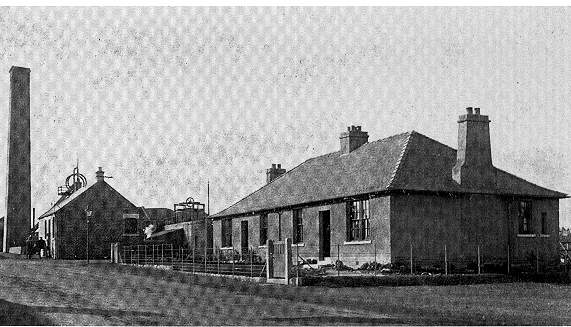
This pit, named after Viscountess Novar of Raith House,
Kirkcaldy, was opened around 1892. It was sunk to a depth of
25 fathoms and lay to the south of the older Engine and
Smithy Pits of the Dundonald Colliery.
A mine, known as the West Mine, was driven to the west of
the Lady Helen Pit in 1897 to work the Little Splint seam.
When the pit and mine were taken over by the Lochgelly Iron
and Coal Co. around 1910, the shaft and mine were enlarged to
enable output to be increased. In May 1946 it was proposed to drive a new surface mine - No. 1 - between Lady Helen Pit and the West Mine to win a large area of coal lying to the north. It was also known as the Blairhall Mine.
A start was made in August 1953 with the driving of another 500 yards drift mine - No. 2 - dipping at 1 in 4 from the surface to the Five Foot seam. It operated on similar lines to the
Benarty and Blairenbathie mines in that coal was brought to
the mine bottom in drop-bottom mine cars hauled by battery
locomotives thence by rope haulage to a surface gantry for
discharge of the coal into storage bunkers. It was also known as the Dothan mine.
No. 1 surface mine had closed in 1960 and all work at No. 2 surface mine ceased along with the closure of the Lady Helen Pit in early 1964.
In 1947, at Nationalisation, the annual output was given as
112,300 tons, while in the NCB Review Year of 1962 it was
given as 76,000 tons with a manpower of 250.
 |

|
| See Central Fife Index Entry 'Dundonald Pits & Mines' |
|---|
| Source Date of Information Supplied (Owner) |
| Manager / Under-Manager / Men underground / Men above ground / Coal seams worked |
| 1904 (Dundonald Collieries, Cardenden) |
| J. Muir Thomson / John Christie / 150 / 42 / Household, manufacturing and steam coals. |
| 1905 (Dundonald Colliery Company, Cardenden) |
| J. M. Thomson / J. Christie / 173 / 49 |
| 1907 (Dundonald Colliery Company, Cardenden) |
| J. M. Thomson / J. Christie / --- / --- |
| 1908 (Dundonald Coal Company, Cardenden) |
| G. Andrew / ------------ / 264 / 79 |
| 1911 (Lochgelly Iron & Coal Company) |
| ------------ / ------------ / 61 / 20 |
| 1916 (Lochgelly Iron & Coal Company) |
| Nov: Departure of Mr James Brown, oversman,
to Prestwick Collieries. Dec: Departure of Mr T. Woleridge, under manager, Lady Helen Pit. |
| 1918 (Lochgelly Iron & Coal Company) |
| Lady Helen: John Armstrong / ---------- / 160 / 25 |
| West Mine: John Armstrong / ---------- / 112 / 42 |
| 1919 (Lochgelly Iron & Coal Company) |
| John Armstrong, manager. |
| 1920 (Lochgelly Iron & Coal Company) |
| Lady Helen: ---------- / ---------- / 312 / 44 |
| West Mine: ---------- / ---------- / 192 / 44 |
| 1923 (Lochgelly Iron & Coal Company) |
| Jul: Mr James Paul, manager. |
| 1926 (Lochgelly Iron & Coal Company) |
| Aug: Death of Mr James Leckie, under-manager. |
| 1928 (Lochgelly Iron & Coal Company) |
| Lady Helen: Walter Black / James Splitt / 141 / 57 / Steam coal and blaes. Lochgelly Splint. |
| West Mine: Walter Black / James Watt / 183 / 51 / Steam coal. Fourteen Feet and Rough Coal. |
| 1931 (Lochgelly Iron & Coal Company) |
| Mr William Gray, manager, killed November 1931. |
| 1935 (Lochgelly Iron & Coal Company) |
| Mr James M. Paul, manager. |
| 1938 (Lochgelly Iron & Coal Company) |
| Lady Helen & West Mine: J. M. Paul / James Watt / 299 / 100 |
| 1945 (Lochgelly Iron & Coal Company) |
| Lady Helen & West Mine: J. C. B. Haynes / D. W. Johnstone / 245 / 97 |
| Household and steam coals. Rough Coal. |
| 1947 (NCB) |
| Lady Helen: G. Johnston /
------------ / 286 / 92
Gas, household, manufacturing coals and anthracite. Approx. annual output = 112,300 tons. |
| 1948 (NCB) |
| Lady Helen & West Mine: D. W. Johnstone / J. Gibb / 263 / 97 / Steam coal. Rough Coal. |
| Blairhall Mine: D. W. Johnstone / ------------ / 13 / --- / Steam coal. Blairhall Coal. |
| 1949 (NCB) |
| Lady Helen: J. Gibb / ------------ / 250 / 92 / Steam coal. Rough Coal. |
| 1950 (NCB) |
| Lady Helen: J. Gibb / ------------ / 252 / 62 / Steam coal. Blairhall Smithy. |
| 1951 (NCB) |
| Lady Helen: J. Gibb / ------------
/ 254 / 56 / Steam coal. Blairhall Smithy. Mar: J. Gibb, manager, appointed manager at Valleyfield. Mr Alex. M. Tripney, manager, Wellwood, appointed manager. |
| 1952-56 (NCB) |
| Lady Helen: A. Tripney / ------------ / 287 / 57 / Steam coal. Blairhall Smithy. |
| 1957 (NCB) |
| Lady Helen: A. Tripney / ------------ / 383 / 65 / Steam coal. Blairhall Smithy, Five Foot. |
| 1958 (NCB) |
| Lady Helen: A. Tripney /
------------ / 390 / 65
Gas, industrial, steam coals and blaes. Cardenden Smithy, Five Foot. |
| 1959 (NCB) |
| Lady Helen: A. Tripney /
------------ / 380 / 65
Gas, industrial, steam coals and blaes. Cardenden Smithy, Five Foot. Sept: Mr Alex. Tripney, manager, retires. Mr Dempster Smith, manager of Jenny Gray, appointed colliery manager. |
| 1961 (NCB) |
| Lady Helen: T. A. Harrison / ------------ / 233 / 32 / Gas, industrial, steam coals and blaes. Five Foot. |
| 1964 (NCB) |
| Lady Helen: T. A. Harrison / ------------ / 221 / 34 / Steam coal and blaes. Five Foot. |
--------------------------------------------
Information on coals worked at, or near, the Lady Helen Pit
(based on reports from 1930-34)
A thickness of 715 ft. of strata, included an estimated 45
ft. of coal at this pit. The Launcherhead fault crossed the
Lochgelly anticline and, with a much diminished throw, passed
to the south of the Lady Helen.
Four leaves of Dunfermline Splint Coal, similar in
development to that found in the Minto Pit, occurred here and
a thin rib of dirty coal and coaly blaes was the only
representative of the Two Foot Coal seam.
The Five Foot Coal, a very good household coal, averaged
about 3 ft. where it was raised under the name 'Mynheer
Coal'. The true Mynheer Coal here was variable and thin
and no coal was found at the Glassee position. The Lochgelly
Splint and Parrot Coals were near the surface at the Lady
Helen and were formerly exposed along the steep banks of
Carden Den to the south-west of Carden Barns. The coals were
approaching exhaustion by the 1930s since there was evidence
of many old pits near the outcrop, particularly to the east
of Lochgelly, and on both sides of Carden Den.
The Lady Helen and its mines also worked considerable areas
of the Lochgelly Splint and Parrot Coal seams which were
separated by only a few feet of fine-grained sediments. In
the Dundonald coalfield, the Swallowdrum Coal, a good
household coal in two leaves, was known as the 'Duddie
Davie'. The upper leaf varied from 1 ft. 6 in. to 3 ft.
in thickness and was separated from a lower 8 in. to 1 ft.
leaf by a thin bed of fakes or faky blaes. The character of
the Lochgelly Blackband Ironstone seam changed as it was
traced eastwards and here the seam consisted of 9 in. to 1
ft. of free coal beneath a 1 ft. 6 in. parrot coal which was
usually irony. The Blairhall Main Coal, lying 3 to 6 fathoms
above the upper leaf of the Cardenden Smithy Coal, did not
exceed 1 ft. 6 in. thick at this pit.
--------------------------------------------
| Plans of Abandoned Seams for Lady Helen | Pits or Mines designated in Plans |
|---|---|
| COAL; Duddie Davie (1908); Fourteen Feet (1911); Lochgelly Parrot (1912); Glassee (1914); Lochgelly Splint (1920) | LADY HELEN: Den; Muirhead No. 4; North ; Smithy |
| COAL; Pilkin (June, 1927) | DUNDONALD: Lady Helen |
--------------------------------------------

"Dunfermline Press"
2 January, 1904
Michael O'Brien, labourer, Vallance Lodging-House, Kirkcaldy, met with his death on Monday at the Helen Pit, Dundonald Colliery, Cardenden. Deceased and several other men were pushing a waggon loaded with wood, when he was caught between the buffers of two waggons, and his head was crushed. In addition, the wheels of the vehicles passed over one of his legs, and death was instantaneous.
-------------
"Dunfermline Press"
23 January, 1904
Under the Fatal Accidents Inquiry Act, an inquiry was held in the Sheriff Court, Dunfermline, on Friday - before Sheriff Gillespie and a jury - into the circumstances attending the death of Michael Brien, labourer, lately residing in Kirkcaldy, crushed between two waggons and killed on 28 December on a siding at the Lady Helen Pit, Dundonald Coal Company. Those giving evidence included:- John Christie, under-manager; William Clunie, labourer; and James Squires and John Burke, also labourers. A formal verdict was returned by the jury.
--------------------------------------------
"Dunfermline Press"
22 June, 1907
A fatal accident took place on Tuesday in the Lady Helen Pit, Dundonald Colliery. The victim was James Taylor (35), a pit inspector or fireman, residing at Burnbank Cottages, Cardenden. Shortly before the fatality an accident had occurred to a young man named David Crawford, who was driving a rake of hutches in the haulage road in the Glassee section of the pit, and Taylor was taking the place of the injured workman. Nobody saw exactly what happened, but the man, who was sitting on a bogie in front of the rake, must have fallen off, and when he was discovered he was found among the wheels of the hutches dead. Dr Jones, who was summoned, found that the man's skull was fractured, and his right leg and knee severely lacerated.
--------------
"Dunfermline Press"
13 July, 1907
Under the Fatal Accidents Inquiry Act, an inquiry was held in the Sheriff Court, Dunfermline, on Thursday - before Sheriff Shennan and a Jury - into the circumstances attending the death of James Taylor, pit fireman, lately residing at Burnbank Cottages, Cardenden, who was killed on 18th June in the Lady Helen pit, of Dundonald Colliery, by being crushed by a race of loaded hutches on which he was acting as bogie man. Those giving evidence at the inquiry included:- John Christie, undermanager, Woodside Cottages, Dundonald Road; John O'Donnell, haulage engineman; Laurence Wildridge, pit worker, 36 Church Street, Lochgelly; Andrew Steedman, oversman, Nicol's Buildings, Bowhill; and John Muir Thomson, manager.
--------------------------------------------
"Dunfermline Press"
12 October, 1907
Alexander Penman, a bogieman, residing at Gammie Place, Bowhill, was admitted to the Dunfermline and West Fife Hospital on Wednesday suffering from injuries which he had sustained in the Dundonald Colliery Company&s Lady Helen Pit. A piece of metal with which he was engaged repairing rails, sprung up and struck him on the face, breaking his nose and cutting his mouth and chin.
--------------------------------------------
"Dunfermline Press"
10 October, 1908
On Wednesday morning, Adam Blair (24), brusher, residing in Station Road, Bowhill, was just finishing his shift in Dundonald Pit, Cardenden, when a stone weighing about a ton came away from the roof unexpectedly, and fell upon him. Assistance was procured, and the stone removed, but Blair only survived a few minutes. He was unmarried, and sympathy is expressed for his aged father and mother.
------------------------
"Dunfermline Press"
17 October, 1908
Under the Fatal Accidents Inquiry Act, an inquiry was held in the Sheriff Court, Dunfermline, on Thursday - before Sheriff Shennan and a Jury - into the circumstances attending the death of Adam Blair, brusher, lately residing at Station Road, Bowhill, who was killed on 7 October in the Lady Helen Pit, Dundonald Colliery, by a stone falling upon him from the roof. Those giving evidence at the inquiry included:- Gilbert Andrew, colliery manager; John Young, miner, Livingstone Place, Cardenden; Hugh Landels, machineman, Dundonald Den; James Summers, oversman, Dundonald Den.
------------------------
"Dunfermline Press"
17 October, 1908
The remains of Adam Blair, who was fatally injured in the Lady Helen Pit, Dundonald, on Wednesday last week, were interred in Bowhill Cemetery on Saturday. ... The funeral was the largest that ever took place here.
--------------------------------------------
"Dunfermline Press"
23 December, 1916
Mr T. Woleridge, under manager, Dundonald Colliery, was honoured on Saturday evening in the
Central Bar, by a large and representative number of officials and workmen of the Colliery.
[It was reported he had been for five years in charge of the Lady Helen Pit.]
--------------------------------------------
"Dunfermline Press"
21 December, 1918
Robert Clephane, Overton Road, Kirkcaldy, met with his death in Dundonald Colliery, Cardenden, on Friday last week. Deceased had just finished work and was proceeding to the pit bottom, when a support in the roof gave way and a quantity of debris fell upon him, death being instantaneous. He had served over 3½ years in the Army, and had only been four shifts at his work as a miner after his return. Deceased was 24 years of age.
--------------------------------------------
"Dunfermline Press"
28 December, 1918
Mr Thomas Seath, who resides at Auchterderran Lodge, Woodend, Cardenden, met with an accident at Dundonald Colliery on Wednesday forenoon. He along with some other workmen had been doing some repairs when he was struck on one of the legs by a rope, with the result that the limb was injured.
--------------------------------------------
"Dunfermline Press"
1 February, 1919
Under the Fatal Accidents Inquiry Act, an inquiry was held in the Sheriff Court, Dunfermline, on Thursday - before Sheriff Umpherston and a Jury - into the circumstances attending the death of Robert Clephane, brusher, lately residing at 39 Overton Road, Kirkcaldy, who died on 13 December in the Lady Helen Pit of Dundonald Colliery, from injuries received by a fall of material on him from the roof. Those giving evidence included: John Armstrong, colliery manager; James Christie, brusher; George Sinclair, miner; and Alexander Arnott, fireman. The Jury returned a formal verdict.
--------------------------------------------
"Dunfermline Press"
6 September, 1919
Under the Fatal Accidents Inquiry Act, an inquiry was held in the Sheriff Court, Dunfermline, on Thursday - before Sheriff Umpherston and a Jury - into the circumstances attending the death of Arthur James Robertson, machineman, lately residing at Hunter Street, Lochgelly, who died on 13 July in the Dunfermline and West Fife Hospital from injuries received on 11 July in the Lady Helen Pit, Auchterderran, of Dundonald Colliery, by being caught by the picks of an electrical coal-cutting machine in motion. Those giving evidence included:- David Wilson, oversman; Francis Wilson, machineman, Park Road, Gallatown; Alexander Drummond Young, machineman, Station Road, Lochgelly; and Henry Webster, fireman, Station Road, Lochgelly. A formal verdict was returned by the jury.
--------------------------------------------
"Dunfermline Press"
13 March, 1920
Mr John Raeburn, joiner, Lady Helen Pit, Dundonald, was met by a few workers belonging to Dundonald Colliery in the Gothenburg premises and presented with a timepiece suitably inscribed, on the occasion of his marriage. ...
--------------------------------------------
"Dunfermline Press"
5 March, 1921
In the Gothenburg on Saturday evening, Mr David Wilson, oversman at Lady Helen Colliery, Dundonald, was presented with a gold watch, suitably inscribed, along with a pipe and tobacco pouch, and Mrs Wilson received a cake rack. ...
--------------------------------------------
"Dunfermline Press"
28 July, 1923
Under the Fatal Accidents Inquiry Act, an inquiry was held in the Sheriff Court, Dunfermline, on Thursday - before Sheriff Umpherston and a Jury - into the circumstances attending the death of Thomas Davidson, miner, lately residing at 18 Dundonald Den, Auchterderran. Davidson died on 19th June in Lady Helen Pit, of Dundonald Colliery, from injuries received by a stone falling upon him from the roof. Those giving evidence included James Paul, colliery manager. The Jury returned a formal verdict.
--------------------------------------------
"Cowdenbeath & Lochgelly Times"
Wednesday, 8 October, 1924
One of the most regrettable accidents that has
happened in the district for a considerable time falls to be
recorded this week.
At Dundonald Collieries in the early hours of
Thursday morning Andrew Greig, who resided at East Cottages, and
Samuel Marshall, Dundonald Den, lost their lives while employed as
machinemen at the Colliery. Both were electrocuted, and life was
extinct when the bodies were found. How they met their death is at
present a mystery.
Both of the deceased were capable workmen and
enjoyed fully the respect of their employers and fellow-workmen.
When news of the tragic affair became known it cast quite a gloom
over a wide area.
The men were found dead near their machines
about 2 am. They were visited by the fireman about five minutes
before the accident, when everything was in order. A corrugated
iron sheet was used on the top of the coal-cutter to keep the water
off it, and the deceased seem to have taken off the sheet to push
it out on to the road line, when it accidentally cut into the
trailing cable, making connection with a live phase, which was the
cause of death.
The late Andrew Greig was well-known and highly
respected in the parish, where he had been resident practically all
his life, and quite recently had the misfortune to lose a daughter
aged 22 years.
Samuel Marshall was not so well-known, he with
his young wife and family having lately come from Baillieston. On
Saturday the remains of Samuel Marshall were interred in Bowhill
Cemetery, and a large assembly of mourners paid their last tribute
of respect to the deceased.
MASONIC FUNERAL
On Sunday the brethren of Lodge St Fothad's,
1059, and Lodge Minto, 385, with the members of Blairden Chapter,
No. 86, O. E. S., accompanied by the Pipe Bands of Lochgelly and
Auchterderran, attended the funeral of the late Andrew
Greig.
The impressive Masonic service was conducted at
the grave by Bros. Beveridge and Maguire, of Lodge St.
Fothad's.
------------
"Cowdenbeath & Lochgelly Times"
19 November, 1924
This issue carried the report of the Fatal Accident Inquiry held at Dunfermline, on Thursday, concerning the double fatality - Andrew Greig and Samuel Marshall - which occurred in October at the Lady Helen Pit, Dundonald Colliery. Among those giving evidence were:- James Murphy, fireman, Station Road, Cardenden, and William Morrison, electrician, 43 Dundonald Den, Cardenden. The jury agreed to add to their formal verdict, a suggestion by Sheriff Umpherston to the effect that a new cover to protect the engine should be put into use i.e. one with no sharp edges which could cut through cable.
---------------------------------------------------
"Cowdenbeath & Lochgelly Times"
10 June, 1925
A distressing fatality occurred about 8 p.m. on Saturday in the Lady Helen Colliery, Dundonald. A machineman, Geo. Paterson, Dundonald Den, met his death by a heavy fall of stone. The "run" had been almost completely cut when, without warning, Paterson was caught. Death must have been instantaneous.
---------------------------------------------------
"Cowdenbeath & Lochgelly Times"
15 July, 1925
Arthur Magee, residing at Balgonie Terrace, was severely crushed about the legs by a fall of coal. The accident occurred on Monday forenoon in Lady Helen Pit, Dundonald Colliery. Magee was speedily brought to the surface, and after being medically attended to by Dr Walker, was conveyed to his home by ambulance.
---------------------------------------------------
"Cowdenbeath & Lochgelly Times"
7 October, 1925
While at work on one of the haulage ways in Lady Helen Colliery on Thursday afternoon, Richard Arnold had the misfortune of having a leg fractured. His foot got jammed twixt the rail and a bracket, causing the injury referred to just above his ankle. On receiving medical aid, he was conveyed home.
---------------------------------------------------
---------------------------------------------------
"Dunfermline Press"
21 August, 1926
COLLIERY MANAGER'S SUDDEN DEATH.
Mr James Leckie, under-manager, Lady Helen Pit, Lochgelly Iron and Coal Company, Dundonald, died suddenly early on Saturday morning. He had been for about three years in the employment of the Lochgelly Iron and Coal Company at Minto and Lady Helen pits, and was highly respected by all who came into contact with him. He belonged to Shettleston district, where he was a manager for many years previous to coming to Cardenden. He was 55 years of age, and leaves a widow and five sons and one daughter to mourn his loss.
---------------------------------------------------
"Dunfermline Press"
22 January, 1927
FATAL ACCIDENT INQUIRY
Robert Harper Wilson, repairer, lately residing at 17 Dundonald Den, Cardenden, who died on 22nd December, 1926, in the ambulance room at Lady Helen Pit of Dundonald Colliery. Dr. Young attended the patient who died shortly after he saw him at the colliery. Cause of death was a cerebral haemorrhage.
--------------------------------------------
"Cowdenbeath & Lochgelly Times"
26 January, 1927
The death of Robert Harper Wilson, repairer, lately residing at 17 Dundonald Den, Cardenden, who died on 22 December, in the ambulance room at Lady Helen Pit of Dundonald Colliery, was enquired into at Dunfermline on Thursday. ... In their verdict, the jury found that the cause of death was cerebral haemorrhage, which might possibly have been accelerated or aggravated by deceased's ordinary work.
--------------------------------------------
"Dunfermline Press"
12 March, 1927
James McKinlay, Lochgelly, employed in the Lady Helen Collieries, Dundonald, received severe facial injuries while at work on Tuesday. After receiving medical attention at the colliery, he was removed to hospital.
--------------------------------------------
"Lochgelly Times"
7 September, 1927
Wm. Fotheringham, who resides at Old Lye, Dundonald, was injured at the Lady Helen Pit, Dundonald Colliery, yesterday. He sustained a fractured leg below the knee, the accident being caused by a burst of coal. After receiving medical attention at the colliery, Fotheringham was removed to Dunfermline and West Fife Hospital.
--------------------------------------------
"Dunfermline Press"
15 June, 1929
Mr James Splitt, who has for a period acted as oversman at the Lady Helen Collieries, was met by a number of the workmen and presented with gifts on the occasion of his leaving for Canada. ...
--------------------------------------------
"Dunfermline Press"
7 December, 1929
An accident befell Wm. Auld, miner, Dundonald Park. While at work in Lady Helen Colliery, he was caught after a heavy fall of coal, by debris, and received a fracture of both legs. On being conveyed to the pithead, he was attended to by Dr J. M. Young, and was later removed to the Dunfermline and West Fife Hospital.
--------------------------------------------
"Dunfermline Press"
21 December, 1929
FATAL ACCIDENT INQUIRIES
Before Sheriff Umpherston and a jury in the Dunfermline Sheriff Court on Thursday, inquiries were held with respect to five fatal accidents which had occurred in West Fife recently. ...
BURST FROM COAL FACE.
The third inquiry was with regard to the death of George Seath, coal miner,
Bella Cottages, Station Road, Cardenden, who died on 26th October at his
dwelling-house from the results of an accident caused by a roof fall, which
happened to him on 14th October in his working-place in the Lady Helen Pit,
of the Lochgelly Iron & Coal Company, Limited.
Henry Townsend, miner, Chapel Village, by Kirkcaldy, who worked in the place
next to Seath, said that he saw 3 or 4 cwts., of stone and coal burst from the
coal face in Seath's working-place. He shouted to Seath when he saw it
on the move, Seath ran back, but he slipped and fell, and some of the material
caught him on the hip. He had to be carried to the pithead.
John Matthewson, Dundonald Road, Cardenden, one of the inspectors in the pit,
spoke to having found the place in order prior to the accident. Seath, he said, was
a good and careful worker.
Dr Young, Cardenden, said that the primary cause of death was hypostatic pneumonia.
Deceased was an old man, over sixty years of age, and after the accident he was
not able to move at all. He was lying quite prostrate in bed. Men of that age who were
not able to move after a shock as he got were apt to develop hypostatic pneumonia.
The jury returned a formal verdict.
--------------------------------------------
"Lochgelly Times"
22 January, 1930
Two minor accidents occurred in Lady Helen
Colliery, Dundonald.
Alex. Sutherland, Livingstone Place, whilst
using the "Sylvester", was struck in the region of the
heart by the handle, in missing, sharply rebounding. He was
rendered unconscious for a short period, and only after treatment
was he able to proceed to his home.
James Forsyth, Dundonald Den, was caught by
falling debris and luckily escaped serious injury. He also was able
to proceed home and on being medically examined it was found no
bones were broken, but he sustained several body
bruises.
--------------------------------------------
"Dunfermline Press"
25 January, 1930
Alexander Sutherland, Livingstone Place, received a serious blow
from the rebound of the handle of a machine while he was at work in the
Lady Helen Colliery. The knock was in the region of the heart, and he
was rendered unconscious. After treatment he was able, with assistance,
to proceed home.
James Forsyth, Dundonald Den, narrowly escaped serious injury from
falling debris. He was caught by the fall. After examination it was found
that no bones were broken, but his body was badly bruised. ...
--------------------------------------------
"Dunfermline Press"
20 December, 1930
PIT ACCIDENT. - James Robertson, Cluny Square, received severe injuries on Saturday forenoon in Lady Helen Colliery, Dundonald. Employed as an oncost worker, his duties included looking after the timber supply, and while in the act of receiving loaded hutches he was caught and severely crushed by one of the vehicles. Medical aid was summoned, and he was attended to by Dr Cuthbert. The injured man was conveyed home by ambulance. A later examination showed that he had received a fractured collar bone and dislocated shoulder, in addition to body bruises.
--------------------------------------------
"Dunfermline Press"
9 May, 1931
David Fernie, residing at Lily Bank, Cardenden, met with an accident while at work on the haulage in the Lady Helen Pit, Dundonald Colliery. He was caught between two hutches and badly crushed. Suffering from internal injuries, he was conveyed to his home, but later he was removed to Kirkcaldy Hospital, where he lies in a critical condition.
--------------------------------------------
"Dunfermline Press"
10 October, 1931
SHORT WORKING TIME. - Dull times are being experienced by those employed in Lady Helen Colliery. During the week ending 3rd October work was available for three days only. The colliery was at a standstill on Tuesday, Friday and Saturday.
--------------------------------------------
"The Scotsman"
12 November, 1931
MINE MANAGER KILLED
While on a tour of inspection in Dundonald Colliery, near Bowhill, yesterday, Mr William Gray, manager of the colliery, was struck by a runaway hutch, and instantly killed. The fatality occurred in a haulage road. Mr Gray, who was a native of Carfin, Lanarkshire, went to the Lochgelly district about twenty-five years ago, and since then has been an official of the Lochgelly Iron and Coal Co. (Ltd.) He was manager of the Newton Colliery, Lochgelly, and Raith Colliery, Cowdenbeath, before being transferred to the managership of Dundonald Colliery only a short time ago. He leaves a widow and family.
--------------------------------------------
"Dunfermline Press"
23 April, 1932
Samuel Shields, Dundonald Den, was injured in Dundonald Colliery by a fall of coal. After receiving medical attention at the colliery he was conveyed home.
--------------------------------------------
"Dunfermline Press"
5 November, 1932
David Barnett, a young lad employed at the Lady Helen Colliery, Dundonald, was the victim of an unfortunate accident whereby he lost his right arm. Barnett was on the scaffolding of the colliery washer, when a sudden gust of wind blew open his overall, with the result that he was caught by the machinery. His arm was practically torn off. With all possible speed the young man was conveyed to hospital.
--------------------------------------------
"Dunfermline Press"
4 March, 1933
Alan Byers, 17 Fifteenth Street, met with an accident in Lady Helen Collieries on Friday morning of last week just prior to finishing his shift. He was caught by a heavy fall of stone and sustained injury to the back which necessitated his removal to hospital.
--------------------------------------------
"Dunfermline Press"
1 April, 1933
John Coutts, miner, 56 Balgreggie Park, Cardenden, received a compound fracture of the right leg as the result of a stone falling on him from the roof in the Lady Helen Pit, Dundonald Colliery, on Tuesday morning. After being attended to by Dr Young, he was removed to the Dunfermline and West Fife Hospital.
--------------------------------------------
"Dunfermline Press"
2 December, 1933
George McGibbon, miner, while at work in the Lady Helen Collieries, met with an accident which caused a compound fracture of one of his arms.
--------------------------------------------
"Dunfermline Press"
9 December, 1933
William Rollo, miner, 133 Dundonald Park, met with an accident while at work in the Lady Helen Collieries. He was caught by a roof fall and one of his legs was fractured. He was conveyed to Kirkcaldy Hospital.
--------------------------------------------
"Dunfermline Press"
17 March, 1934
Alexander Watters, Helen View, met with a rather serious accident in Lady Helen Collieries on Wednesday forenoon. He was caught by a heavy fall of coal and was so severely crushed that he was at once removed to hospital.
--------------------------
"Dunfermline Press"
16 June, 1934
Under the Fatal Accidents Inquiry Act, an inquiry was held in the
Sheriff Court, Dunfermline, on Thursday - before Sheriff Umpherston and
a Jury - into the circumstances attending the death of a miner named
Alexander Watters, Helen View, Dundonald, Cardenden, who died on
2 April in Kirkcaldy Hospital from the effects of injuries received by him on
14th March in the Lady Helen Pit of the Lochgelly Iron and Coal Company,
Limited, as the result of a fall of coal in his working place.
Those giving evidence included: John Kinninmonth Simpson, miner, 22
Dundonald Crescent, Cardenden; James Murphy, underground fireman, 15
Dundonald Crescent, Cardenden; Robert Watters, postman, 16 Pitcairn
Street, Dunfermline (brother of deceased). A formal verdict was returned
by the jury.
--------------------------------------------
"Dunfermline Press"
9 March, 1935
IDLE COLLIERIES. - As a result of a breakdown in the generating plant of the Lochgelly Iron and Coal Company, Limited, two of their collieries, The Jenny Gray and the Lady Helen were thrown idle on Monday and Tuesday.
--------------------------------------------
"Dunfermline Press"
30 November, 1935
FATALITY AT COLLIERY WOODYARD.
DUNDONALD MAN KILLED.
Peter David Barnett (25), a surface worker who resided at 51 Dundonald Den, Cardenden, received fatal injuries as the result of an unusual accident in the woodyard at the Lady Helen Colliery, Dundonald, on Sunday. Along with others, he was engaged in stacking pit wood which had been unloaded from waggons. Barnett, who had only one arm, was lifting a tree at the bottom end of the stack, when, without any warning, the stack slipped towards him. His companion shouted to him and he tried to jump clear, but lost his footing and was caught by the trees and carried over into the railway cutting. Suffering from severe head injuries, he was removed to the Dunfermline and West Fife Hospital where he died on Wednesday.
-----------------------
"Dunfermline Press"
21 December, 1935
Under the Fatal Accidents Inquiry Act, an inquiry was held in the Sheriff Court, Dunfermline, on Thursday - before Sheriff Umpherston and a Jury - into the circumstances attending the death of Peter David Barnett, colliery labourer, 51 Dundonald Den, Cardenden, who died on 27th November in the Dunfermline and West Fife Hospital from injuries received on 24th November in the woodyard at the Lady Helen Colliery of the Lochgelly Iron and Coal Company, Limited, caused by his being struck and knocked down by a stack of pit wood which had collapsed when being built. Those giving evidence included: Andrew Shields, surface worker, 8 Dundonald Den, Dundonald; David Carswell, surface worker, 56 Dundonald Park, Dundonald; and James Paul, colliery manager. The jury returned a formal verdict, the Sheriff remarking that it would be perhaps unnecessary to add anything when they had heard what the colliery manager said he had done in order to obviate a similar accident happening again.
--------------------------------------------
"Dunfermline Press"
11 July, 1936
FIREMAN INJURED AT DUNDONALD COLLIERY.
On Tuesday, James Murphy, colliery fireman, 15 Dundonald Crescent, Cardenden, had one of his legs fractured as a result of an accident, which he received in course of his employment in the Lady Helen Pit, Dundonald Colliery. Lochgelly. After receiving surgical attention, he was conveyed by ambulance waggon to Kirkcaldy Hospital.
--------------------------------------------
"The Scotsman"
1 February, 1939
FIRE IN FIFE PIT
Three hundred miners employed at Dundonald Colliery, near Lochgelly, were thrown idle
yesterday by an underground fire which endangered the pit shaft. Men in the pit bottom, who were
winding coal, saw smoke coming down the shaft, and, on looking up, flames.
It appears that some of the coal in the stratum had taken fire, and this had set fire to the buntings
of the shaft. A hose was quickly procured, and the flames in the buntings were soon extinguished.
In the interests of safety, the workmen were brought up the pit and the colliery declared idle.
Persistent efforts were made to extinguish the outbreak in the stratum, but these had not been
successful up to last night.
The colliery belongs to the Lochgelly Iron and Coal Co., Ltd. It was stated last night that the pit
will be idle again today. It is expected that work will be resumed before the end of the week.
-------------------
"Dunfermline Press"
4 February, 1939
FIRE IN DUNDONALD PIT.
Three hundred miners employed at Dundonald Colliery, near Lochgelly, were thrown idle, on
Tuesday, by an underground fire which endangered the pit shaft. Men in the pit bottom, who were
winding coal, saw smoke coming down the shaft, and, on looking up, flames.
Some of the coal in the stratum had taken fire, and this had set fire to the buntings of the shaft. A
hose was quickly procured, and the flames in the buntings were soon extinguished. In the interest
of safety, the workmen were brought up the pit. The colliery belongs to the Lochgelly Iron and Coal
Company, Limited.
--------------------------------------------
"Dunfermline Press"
8 March, 1941
LOCHGELLY MINER INJURED.
Alexander Hunter (47), stripper, 66 Well Road, Lochgelly, was seriously injured in an accident on Sunday morning in the underground workings of the Lady Helen Colliery, Dundonald. While engaged stripping the coal face, he had occasion to step back, and his right foot was caught by a chain forming part of the conveyor system. He was removed to Kirkcaldy Hospital, where it was found necessary to amputate his right leg below the knee.
--------------------------------------------
"Dunfermline Press"
4 May, 1946
WEST FIFE MINING DEVELOPMENTS.
SURFACE MINE AT DUNDONALD.
Speaking at a film display in Dundonald Miners' Welfare Institute, at which
types of modern mining plant used by Lochgelly Iron and Coal Company, Ltd., were
shown on the screen, Mr L. R. Milligan, general manager, indicated early developments
decided upon by the Company.
It was proposed, soon, Mr Milligan said, to drive a new surface mine between Lady
Helen Pit and the West Mine to win a large area of coal lying to the north. The daily
output would be about 500 tons, and the mine will have a life of about 20 years.
Employment will be given to 150 to 200 people.
Coal would be cut by machinery and taken by conveyor to a central loading point.
From there it would be drawn to the surface in three-ton mine cars, thence by
conveyor to the screening plant. The Company, Mr Milligan added, was contemplating
two similar developments.
--------------------------------------------
"Dunfermline Press"
1 January, 1949
PIT FATALITY
John Black (36), underground fireman, 8 Dundonald Crescent, Cardenden, succumbed in Kirkcaldy Hospital on Tuesday morning to injuries received by him when he was struck by a fall from the roof in No. 2 East Section, Dundonald-Blairhall mine, Dundonald Colliery, on Monday night.
--------------------------------------------
"Dunfermline Press"
26 February, 1949
Other Formal Verdicts
Other formal verdicts were returned by the jury [in Dunfermline Sheriff Court on Thursday] as follows:- that John Black, colliery fireman, 8 Dundonald Crescent, Cardenden, died on 28th December at Kirkcaldy Hospital from crushing injury, compound fracture of the skull and perforation of the lung by the scapula and ribs, sustained by him on 27th December, when crushed by a fall of stone from the roof in the Lady Helen Colliery, Cardenden; and Joseph Docherty, coal miner, c/o Duddy, 15 Clune Crescent, Glencraig, died on 13th December from compound fracture of the skull sustained by him by a fall of stone from the roof in No. 2 Pit, Glencraig Colliery.
--------------------------------------------
Coal from the Lady Helen was used in the boilers at Guardbridge Paper Mill, near St Andrews. William MacLeod, former chief engineer at the mill, has kindly sent analysis details on the incoming coal which was evaluated on its arrival.
| COAL REPORT
Fuel: Lady Helen Supplier: N.C.B. |
Laboratory
Reference: 32/49
Sampled ex: Wagons |
Date
received: 26.9.1949
Date Tested: 27.9.1949 |
THERMAL
VALUES
Calorific Value: 9,800 B.T.U's/lb. Evaporative Power: 9.5 lbs |
|---|---|---|---|
| Moisture: 24.9 % | Volatile Matter (less Moisture): 26.1 % | Fixed Carbon: 39.7 % | Ash: 9.3 % |
--------------------------------------------
"Dunfermline Press"
3 February, 1951
BOWHILL MINER KILLED
John Bradford (40), brusher, Argyll Buildings, Station Road, Bowhill, was pinned to the ground by a fall of stone and killed while at work on Monday afternoon in the Blairhall Mine of the Lady Helen Colliery, Dundonald.
-------------------------
"Dunfermline Press"
10 February, 1951
A formal verdict was returned in the case of John Bradford, coal miner, Argyll Buildings, Station Road, Bowhill, who died on 29th January 1951 in the underground workings of Blairhall Mine, Lady Helen Colliery, Dundonald, from a fractured spine when he was struck by a large stone from the roof.
--------------------------------------------
"Dunfermline Press"
2 January, 1954
MAKING WEST FIFE PITS UP-TO-DATE
DUNDONALD AND GLENCRAIG DEVELOPMENTS
... A start was made in August 1953 with the driving of the 500 yards drift mine dipping at 1 in 4 from the surface to the
Five Foot seam. Debris filling has been mechanised by the installation of a slusher scraper loader. The debris is hauled
up in a special skip which is automatically discharged at the surface into a temporary hopper erected in the present
part of the permanent gantry.
Coincident with this mine drivage, coal development work has started from the Lady Helen shaft. A short face in the
Five Foot seam is being advanced towards the main area to be worked thus allowing the main locomotive level to
be driven towards the new working area.
When the scheme is completed the coal will be belt conveyed to central loading points, filled into two-ton drop bottom
mine cars hauled by battery locomotive to the foot of the drift mine. The load cars, in sets of five, will be hauled to the
surface by a 250 h.p. direct rope haulage and the coal automatically discharged into hoppers from which it will be
belt conveyed to the existing screening plant. ...
--------------------------------------------
"Dunfermline Press"
9 October, 1954
John Soutar (59), 182 Main Street, Kinglassie, collapsed and died when he was about to begin his shift at Dundonald Colliery, Cardenden, last Friday afternoon.
--------------------------------------------
"Lochgelly Times"
22 November, 1956
A strippers' dispute at the Lady Helen Colliery, Dundonald, threw the pit idle on Monday with the result that 410 tons of coal were lost. The strippers at No. 1 face working on the 5 ft seam in No. 2 mine claimed extra allowances for wet and soft floor conditions over part of the face line. No agreement could be reached between the management and men concerned and nine strippers went home with the loss of 80 tons of coal. On Monday afternoon a meeting was held and the men voted to stop work with the result on Tuesday that 382 miners were idle. Following representations by NUM agent John Sutherland the men agreed to resume work on Wednesday.
--------------------------------------------
"Dunfermline Press"
25 May, 1957
Pithead Baths at Dundonald
£46,000 Building
Has Up-to-Date Facilities
Despite the heavy rain on Saturday, there was a large attendance at the opening of the new pithead baths at Lady Helen Colliery, Dundonald. ...
--------------------------------------------
"Dunfermline Press"
8 February, 1958
Unofficial Strike at Lady Helen Pit
Work was at a standstill at Lady Helen Colliery, Dundonald, on Monday, when dayshift men returned
home without going down the mine.
A Coal Board official stated that the cause of the one-day unofficial strike was a dispute between strippers
and preparation workers. A wages dispute, he explained, brought the strippers out last Friday. When they
returned on Monday and found that preparation men had cleared up the coal, they called the pit out on strike. ...
The men unanimously decided to return to work on Tuesday pending an attempt to settle the dispute by the
usual conciliatory machinery.
--------------------------------------------
"Dunfermline Press"
17 January, 1959
750 Fewer Miners in West Fife
The overall manpower in the West Fife Area of the National Coal Board is now 14,000,
showing a total reduction of 750 since the beginning of 1958. A standstill in recruitment has been
maintained during the year, with the exception of Comrie and Valleyfield Collieries.
This is revealed in the annual survey of the West Fife Area, which also states that the output position
at the end of November showed a reduction of 360,000 tons compared with the same period in the
previous year. No Saturday working has taken place since the end of April, and all the collieries
have operated on a five-day week basis. Ten per cent of the Area output is now power-loaded,
and steps are being taken to increase this proportion. ...
The survey, after reporting progress on the sinking of new shafts at Bowhill and Valleyfield Collieries, and drilling operations in the Firth of Forth near Culross, refers to other developments in the Area. ...
The coal reserves in No. 1 surface mine at Dundonald are practically exhausted, and the new No. 2 surface mine has been put into production. At No. 2 mine the coal is belt-conveyed from the faces to central loading points, filled into 2-ton drop bottom mine cars and then hauled by battery locomotive to the foot of the drift mine. The load cars are then hauled to the surface by a 250 h.p. direct rope haulage and the coal is automatically discharged into hoppers from which it is belt-conveyed to the screening plant. ...
--------------------------------------------
"Dunfermline Press"
26 September, 1959
Retiral Gifts for Popular Pit Manager
The popularity of Mr Alex. Tripney, manager of the Lady Helen Colliery, Dundonald, was evidenced
this week when he received four presentations from the men of the pit and the village on the occasion
of his retirement. ...
Mr Tripney has been manager at the Lady Helen for the last eight years and when he retired last week
he had completed 53 years in the mining industry. A native of Slamannan, Stirlingshire, he started work in
a colliery there at the age of 13. When he came to Fife it was to the Elgin & Wellwood Collieries,
near Dunfermline. He has been a colliery manager for the last twenty years. ...
--------------------------------------------
"Dunfermline Press"
14 November, 1959
... Although only two Fife pits are marked down for closure in the latest list, other collieries in the county will be affected by the Coal Board's plans for the next year. Developments at Valleyfield and Rothes will be curtailed. Pits likely to be single-shifted include Bowhill and Glencraig. Pits whose sections now producing are likely to stop include Dundonald and Lumphinnans. In two East Fife pits - Michael and Wellesley - manpower will be cut. ...
--------------------------------------------
"Dunfermline Press"
26 December, 1959
Dismissals At Lady Helen Pit
A total of 92 miners at Lady Helen Colliery, Dundonald, received notice of dismissal last
Friday, but will be given places in neighbouring collieries when the notice expires. Proposals
that unnaturalised Poles and habitual absentees should be made redundant first have been
refused by the N.U.M. branch committee.
Production at the pit is to be cut, and an additional 20 men, at present retained to do salvage
work, will receive notice in a few months. Fifteen older miners are to be compulsorily retired.
For contract men the change to neighbouring collieries will mean a reduction in wages as there is
no contract work available at the receiving pits. The selection of men for transfer is being
made on the basis of seniority, the most recent recruits to leave first.
--------------------------------------------
"Dunfermline Press"
3 February, 1962
Fifty Years' Service In Colliery
At a social gathering in Bowhill Gothenburg Tea Room on Saturday night, the guest of honour was Mr John Davie, Cardenden, who is retiring at the age of 65 from Dundonald Colliery. Mr Davie has a long record of service at Dundonald Colliery, having been employed there for 50 years. County Councillor Charles Watters presided, and Mr David Thomson, on behalf of fellow-workers presented Mr Davie with a travelling clock and a gift of money.
--------------------------------------------
"Dunfermline Press"
14 August, 1965
N.C.B. To Lease Pit Premises
Suitable for factory or storage purposes the disused baths building at the former Dundonald Colliery, Cardenden, extending to approximately 8400 square feet, is being offered by the National Coal Board for lease, with immediate occupation.
--------------------------------------------
"Dunfermline Press"
16 March, 1973
APPROVED
Dundonald Colliery, covering 60 acres to the south-west of Cardenden, will be completely reclaimed if a Fife Planning Committee recommendation is approved by the County Council. …
--------------------------------------------
