Owners: Lassodie Coal Co.
Thomas Spowart & Co. Ltd.
|
Any Fifer with links to, or interests in, the
coalmining history of the Kingdom will know of the
great contribution made by 'Lassodie Colliery'
and the sad demise of the village and its mining
community when deep coalmining ceased in 1931. Some
information on the life and the history of Lassodie
village has been contributed by site visitors and may
be seen via the Stories
Link of the website.
This entry, however, features facts and figures on the early coal works of the Lassodie lands, from the 17th century, to the later pits, mines and miners of the modern Lassodie Colliery; from the first 'commercial' pit sunk on the north shore of Loch Fitty - powered by a horse gin - close to Easter Craigduckie, to the Lassodie Nos. 10, 11 Pits sunk 1890/93 in the north-east corner of the field. Comercial mining initiated in the Fife countryside, in 1859, to establish the Lassodie Colliery, was then given a slightly 'over-the-top' description by a local newspaper reporter! "Dunfermline Saturday
Press"
|
From research and records, we can indicate the existence of the following pits or mines in the Lassodie field:
Easter Craigduckie No. 1; Lassodie Nos. 2, 3, 4, 6, 7, 8, 9, 10, 11; Lochfitty Nos. 1, 2; Lassodie Estate (Methven's Mines); Thornton.
Most of the locations of these pits or mines have been identified but, as you will note on the map, there are a number of coal workings in the Lassodie field still to be identified.
 |
---------------------------------------------------
Old Parish records are a great source of information in spite of the many variations in spellings of names, etc., laid down in these documents. The names of some early miners, and the dates when they were working the early, small coalworks, are revealed in records of births, deaths, and marriages, the first of these records often accompanied by colourful descriptions of what they had been up to, and with whom!
23 May 1609, Pate Meffwan, collier in Lassodie Heuch, "had twa wemen chyldren borne to him in adulterie, the ane of Issobell Kellok, the other of Kate Proud, baptized and callit, the ane Catharine and the uther Nans. The said Pate Meffwan efter the first adulterie committit with Issobell Kellok in the verray tyme that he wes making his repentance for the same he falls the secund tyme in adulterie with Kate Proud."
25 Oct 1618, Nicol Broun, collier in Lassodie, and Mawse Spittell had David; witnesses, David Dewar, Thomas Horne, William Mackie.
---------------------------------------------------
"The Scotsman"
Wednesday, 2 March 1825
FARMS AND COAL IN THE WEST OF FIFE.
To be Let for nineteen years, or such number of years as may be agreed upon.
The following FARMS on the ESTATE of LASSODIE, in the parish of Beath, about four miles
from Dunfermline, viz.
Offices, containing about 197
2. WHINNYHALL, 180
3. BRAEHEAD, 195
4. BLAIRATHIE, 267
The Farms being contiguous, will be let either two or more of them conjoined, or in such divisions as
may be agreed on. The lands are mostly arable, fit for any mode of husbandry, and susceptible of great
improvement at a moderate expense, from the excellent Lime rock on the lands being now opened, and
having commenced burning. They are well situated for markets, the turnpike road from Dunfermline to
Kinross running through the lands.
The COAL on the lands of Lassodie will be let on liberal terms, and at a fixed rent or lordship, or both,
as may be agreed on.
For particulars application may be made to Mr. William Beveridge, writer in Dunfermline; and the lands
will be shown by applying at Lassodie House.
Offers will be received till the 1st day of July next, by Mr. Beveridge, or George Combe, W. S. 2, Brown
Square, Edinburgh.
---------------------------------------------------
"The Scotsman"
20 August, 1828
VALUABLE COAL AND LIME ON THE
ESTATE OF LASSODDIE, TO BE LET.
THE COAL will be LET for nineteen years; the LIME for such a number of years as may be agreed
upon. They lie contiguous, are of superior quality, easily accessible, and for both there is a ready and
extensive demand.
Personal applications to Dr Coventry, North Charlotte Street; George Combe, W. S.25, Northumberland
Street, Edinburgh; Mr Robert Douglas, writer, Dunfermline; or, by letter, to the proprietor, to the care of
Mr Combe.
---------------------------------------------------
"The Scotsman"
Wednesday, 26 June, 1850
DESIRABLE ESTATE IN FIFESHIRE
REDUCED UPSET PRICE, £11,000.
To be SOLD by Public Roup, within McNab's Hotel, Cupar, on Wednesday 17th July 1850, at One P.M.
THE ESTATE OF COCKLAW, including the LANDS of LASSODIE, Part of WINDY-EDGE; and the SUPERIORITY and FEU DUTIES of the VILLAGE of OAKFIELD, &c., measuring 403 Acres Imperial or thereby, together with Two-thirds of the MILL of LASSODIE and CONVERTED MULTURES effeiring thereto; all belonging to the Sequestrated Estate of Mr. James Moodie, deceased, as formerly advertised.
This Estate has a fine southern exposure, is mostly enclosed, and, by judicious drainage and improvements, may
be made one of the most eligible properties in the West of Fife. There are Six or Seven Seams of COAL on the Lands of
Lassodie, which Mr. D. Landale, mining engineer, Edinburgh, reports to be of considerable value, and there is also a
Small Field of BLACKBAND IRONSTONE, which being associated with a thin wild Coal, could be wrought at a moderate expense.
There are about 20 acres in thriving Plantations, affording shelter, and at same time ornamental. The Property lies in the
parish of Beath, within two miles of the Edinburgh & Northern Railway, the branches whereof to Roscobie Lime Works
and Kelty Coal Fields, for which an Act of Parliament has been obtained, pass along its boundaries on the south and
east. It is bounded by the old Queensferry Road on the east, is intersected by the public road from Blairadam to Dunfermline
on the north, and has also access to Dunfermline from the south by another good road, from which it is only about four miles
distant.
[The property has current land rents of £464.16.6, and taxes of £23.14.9.]
---------------------------------------------------
The Lassodie Coalfield
Two faults in the Lassodie area, the Fairfield fault and
the 'Thirty Fathom Fault' combined to produce a cross
ridge of rocks which split the Lassodie syncline into two
small basins, one pitching north towards the village of
Lassodie, the other southwards towards the shores of Loch
Fitty.
It is known that up to 11 pits, of varying size, were sunk
in the Lassodie coalfield and information relating to an
individual pit will be found in separate CENTRAL FIFE INDEX
entries.
One report stated that the Lassodie No. 1, No. 2 and No. 3
Pits worked the southern basin closer to Loch Fitty while the
other pits worked the northern basin, in and around Lassodie
village. However, we respectfully suggest that this may not
be so since geological survey information clearly puts the
locations of the Lassodie Nos. 7, 8 Pits to the south of the
Lassodie Nos. 2, 3 Pits.
Presently, no information is available concerning the
Lassodie No. 5 Pit.
------------------------------
| Colliery opened: 1859/60 | Colliery closed: May, 1931 |
|---|
| Source Date of Information Supplied |
|---|
| Manager / Under-Manager / Men underground / Men above ground / Coal seams worked |
| 1860 (Lassodie Coal Co.)
1 Fatality recorded at Lassodie Colliery. |
| By 1863 (Lassodie Coal
Co.)
First three pits of the Lassodie Colliery sunk and operating. |
| 1870 (Lassodie Coal Co.)
John Black, Manager [From Dunfermline Register.] December - Mr. William Andrew, formerly underground manager, Clyde Ironworks, Tollcross, Glasgow, joins Lassodie Colliery Company as underground manager. Lassodie Nos. 1, 2, 3, 6, 7 Pits operating. |
| 1871 & 1872 (Lassodie
Coal Co.)
John Black, Manager : W. Andrew, Under-manager [From Dunfermline Registers.] |
| 1873 & 1874 (Lassodie
Coal Co.)
J. Brownlie / W. Andrew / Craigduckie No. 1; Lassodie Nos. 2 (discontinued 1874), 3, 6, 9 |
| 1875 (Lassodie Coal Co.)
J. Brownlie / W. Andrew / Lassodie Nos. 3, 4 (Sinking), 6, 9 |
| 1876/80 (Lassodie Coal
Co.)
J. Brownlie, Manager : 1876 -78 : Lassodie Nos. 3, 4, 6, 9 Pits W. Andrew, Manager : 1879 & 1880 : Lassodie Nos. 3, 4, 6, 9 Pits 1 Fatality recorded at Lassodie No. 3 Pit in 1880. |
| 1881 (Lassodie Coal Co.)
W. Andrew, Manager : Lassodie Nos. 4, 6, 8, 9 No. 4 upcast by No. 9; No. 9 aired from No. 4 |
| 1882 (Lassodie Coal Co.)
W. Andrew, Manager : Lassodie Nos. 4, 6, 9 |
| 1887 (Thomas Spowart
& Co., Ltd.)
A private limited liability company formed among the partners of Lassodie and Elgin and Wellwood Collieries. From that date the combined collieries were carried on under the name of Thomas Spowart & Co., Ltd. |
| 1890 (Thomas Spowart
& Co., Ltd.)
W. Andrew, Manager : Lassodie Nos. 4, 9 and No. 10 |
| 1893 (Thomas Spowart
& Co., Ltd.)
W. Andrew, Manager - retired in November : Archibald Brownlie, Under-manager Lassodie Nos. 10, 11 sinking |
| 1895 (Thomas Spowart & Co., Ltd.) |
| Robert Cook, Manager. |
| 1896 (Thomas Spowart & Co., Ltd.) |
| Robert Cook / ------------ / 273 / 81 |
| Household, manufacturing
and steam coals.
1 fatality recorded at Lassodie No. 10. |
| 1900 (Thomas Spowart & Co., Ltd.) |
| David Archibald, Manager . |
| 1902 (Thomas Spowart & Co., Ltd.) |
| David Archibald / ------------ / 339 / 81 / Household, manufacturing and steam coals. |
| 1904 (Thomas Spowart & Co., Ltd.) |
| David Archibald / John Brownlie / 382 / 56 / Household, manufacturing and steam coals. |
| 1905 (Thomas Spowart & Co., Ltd.) |
| David Archibald / ------------ / 437 / 92 |
| 1908 (Thomas Spowart & Co., Ltd.) |
| David Archibald / ------------ / 492 / 130 |
| 1909 (Thomas Spowart & Co., Ltd.) |
| Dec: Death of Mr John Brownlie. |
| 1911 (Thomas Spowart & Co., Ltd.) |
| David Archibald / ------------ / 489 / 143 |
| 1918 (Thomas Spowart & Co., Ltd.) |
| David Archibald / James Wilson : David Ralton / 371 / 100 |
| 1920 (Thomas Spowart & Co., Ltd.) |
| David Archibald / ---------- : David Ralton / 430 / 127 |
| 1928 (Thomas Spowart
& Co., Ltd.)
Accumulation of water in underground workings threatens operations. Powerful pumps appear incapable of controlling the underground flooding. |
| David Archibald / Richard
Scott : David Ralton / 355 / 97 / Household and steam
coals.
Swallowdrum, Splint, Six Feet, Upper Eight Feet, Cairncubie, Mynheer, Five Feet and Eight Feet. |
| 1929 (Thomas Spowart & Co., Ltd.) |
| May: Mr David Archibald, manager, retires after 31 years' service. |
Lassodie Colliery (19th century tabulated
report) and
General Information on the Lassodie Coalfield
| Name of Coal | Thickness | Quality | Class |
|---|---|---|---|
| Six Feet Coal | 3 ft. 6 in. | 1st class | Household and Steam |
| Cairncubie Coal (Upper Leaf) | 4 ft. | 1st class | Household and Steam |
| Eight Feet Coal | 5 ft. | 1st class | Household and Steam |
| Five Feet Coal | 5 ft. | 1st class | Household and Steam |
| Dunfermline Splint Coal | 4 ft. 6 in. | 1st class | Household and Steam |
The coal seams of Lassodie were beyond the limit of the
Dunfermline basin as defined on the north by the great Loch
Fitty fault.
The Splint Coal having been worked under the loch, the
position of the fault has been proved in the underground
workings. The downthrow of this important dislocation is
towards the south, but its amount is evidently gradually
diminishing eastwards.
At Loch Fitty the fault shifts the crop of Splint Coal for a
distance of half a mile further east on the north side. This
crop must rise to the surface some 500 or 600 yards from the
lower end of the loch. It then strikes north-west by
Bentymires, then bends round in the direction of Braehead, so
as to form the lip of another small basin of the Dunfermline
coals. The whole district between Loch Fitty, Blairadam and
the Kelty field has been extensively explored by bores as
well as by pit-workings during the last thirty or forty
years, and a large addition has thereby been made to the area
of workable coal in Fife.
The ground has been found to be traversed, like the Dunfermline field, by a series of north-westerly faults with a downthrow sometimes to the one side, sometimes to the other, and likewise to be much troubled in some parts by igneous material, more especially along a strip between Braehead and Windyedge, where, even at the surface, abundant outcrops of dolerite may be seen. Nevertheless, some tracts of excellent coal have been found, more particularly the Dunfermline Splint and Five Feet seams.
The basin deepens eastwards, until only about a mile from the outcrop of the Splint Coal at Bentymires, that seam has gone down to 124 fathoms a little east of Lassodie Mains.
| See
Coalfields Link - Dunfermline Coalfield
for Coal Seams in the Lassodie, Windyedge and West Kelty coalfields. |
The table shown below gives a summary of the coal
groups for the Lassodie field, and, knowing that some viewers
also take an interest in the geological aspects, we have
included some detailed notes of a 1930 survey after this
table.
M. Martin & Webmasters.
| GROUP | SEAM NAME | LOCAL
NAME |
QUALITY | AVERAGE
THICKNESS Ft. |
AVERAGE
DEPTH Ft. |
| BLAIRHALL | Unnamed | Probably Little Splint. | Poor | 2.25 | 30 |
| Rough | Fourteen Foot. | Poor | 4.0 | 180 | |
| Kelty Black Band Ironstone | Poor | 1.0 | 210 | ||
| MAIN | Kelty Main | Six Foot. | Good | 4.0 | 240 |
| Upper Jersey | Upper Cairncubie. | Good | 4.0 | 258 | |
| Lower Jersey | Lower Cairncubie. | Poor | 3.0 | 264 | |
| Lochgelly Splint | Upper Eight Foot. | Fair | 8.0 | 348 | |
| Lochgelly Parrot | Lassodie Glassee/Bank | Poor | 4.0 | 378 | |
| DUNFERMLINE | Glassee | Lassodie
Eight Foot.
Lochy. |
Fair | 6.0 | 452 |
| Mynheer | Three Foot. | Poor | 3.0 | 570 | |
| Five Foot | Gin. | Good | 5.0 | 642 | |
| Two Foot | Poor | 2.0 | 660 | ||
| Dunfermline Splint | Good | 4.5 | 714 | ||
| Stink or Sulphur | Poor | 1.75 | 784 |
Borings in the Lassodie field at Bentymires and east of Fairfield have proved that, although a number of coal seams lie between the Upper Kinniny Limestone and the Stink (Sulphur) Coal, none are at present of economic value. Traces of these thin coals and of the sandy strata among which they lie can be seen at the north shore of Loch Fitty on either side of the west boat-house. An ochre bed, said to have been mined, which outcrops 70 yards west of the boat-house, probably marks the position of the U. K. Limestone.
A bore on Thornton farm gives a sequence similar to that
at Lassodie, and shows the Stink Coal to lie about 30 fathoms
above the base of the Group. The parrot coal with ironstone
6½ fathoms above the limestone, seems to persist and may
be used as an index.
The Stink Coal is generally sulphury and soft, and seldom
exceeds 1 ft. 9 in. Its outcrop has been recognised on the
north shore of Loch Fitty, about 120 yards east from the west
boat-house, where it is overlain by a thick,
fossil-containing bed of blaes.
North of the fault zone, the Stink Coal is cut in No. 4 Bore, Thornton, below the Whitehouse Wood sill at 33½ fathoms from the surface, and the following section is recorded:-
| Description | Thickness |
| Faky blaes | - |
| Sulphur ball | 3 in. |
| COAL, good | 1 ft. 5 in. |
| Sulphur | 1 in. |
| COAL | 9 in. |
| Fakes | - |
The Dunfermline Splint Coal is rather below average in thickness in the district, and is considerably affected by intrusive whinstone, particularly near Windyedge. It has been mined from numerous Lassodie pits and must now be approaching exhaustion. ... It is underlain by about 18 fathoms of whinstone which appears at the surface in Whitehouse Wood and on Thornton farm.
The Two Foot Coal has not been wrought in the district as
it is generally rather thin. In the west of the Lassodie
field it is separated from the Dunfermline Splint Coal by 5
to 8 fathoms of strata containing a thick bed of sandstone.
The Five Foot Coal seam is the best steam coal in the
district, and as it is uniformly thick, it has been worked
wherever it could be reached.
The position of the Pittencrieff Blackband Ironstone can be recognised in this district but it is nowhere of economic value. In the Lassodie area, it lies 5 fathoms above the Five Foot Coal, and there is never more than a few inches of ironstone associated with a thin coal.
The Mynheer Coal is, as a rule, a bright, hard, steam coal. It is somewhat thin at Lassodie, having its best development in the west in the small syncline around No. 6 Pit, where it reaches 3 ft. 3 in. No information has been obtained as to its condition in the Fairfield basin - it was of good quality, however, near the Nos. 10, 11 Pits.
The Glassee Coal is of fair quality and is usually a thick seam. At Lassodie, where a thick sandstone underlies it, the coal is farther from the Mynheer seam than is usual. Formerly it was not recognised as the Glassee Coal of Dunfermline, but received the name Eight Feet Coal and as such has been wrought from most pits of the colliery. From 5 to 6 fathoms above the Glassee Coal there is a persistent thin seam of coal and ironstone. Between this horizon and the next valuable seam of coal, a whinstone - 10 fathoms thick - has been intruded in the Lassodie basin; this may affect both the Glassee and the overlying coal.
There has been some doubt in the past as to the equivalents of the Lochgelly Splint and Parrot Coal seams in the Lassodie coalfield. At Lassodie, a seam named the 'Glassee Coal', but lying 28 fathoms above the true Glassee seam, is now considered to represent the Lochgelly Parrot of other districts.
The Upper Eight Foot of Lassodie, a composite seam lying 33 feet above the Lassodie Glassee, is undoubtedly the Lochgelly Splint Coal of Cowdenbeath and Lochgelly. The Upper Eight Foot (Lassodie) or Lochgelly Splint Coal lies some 3 to 4 fathoms above the Parrot and is a thick composite seam. In No. 1 Bore, Lassodie, the upper leaf is 3 ft. 10 in. and is of mixed quality, and the lower leaf, separated from the upper by 2 ft. 4 in. of soft black blaes, is 1 ft. 1 in.
In the southern part of the Lassodie Coalfield the Swallowdrum Coal has not been proved except in the east near Lochfitty No. 1 Pit. It is said to be a rough coal of good quality, with a sandy fake roof and sandstone pavement. In the northern half of the field, the coal averages 2 ft. 11 in., but may swell out to more than 5 ft. There is still a considerable acreage of this coal unworked in the Lassodie field.
The Jersey Coals are known at Lassodie as the Upper
and Lower Cairncubie Coals. They lie about 40 ft.
above the Swallowdrum Coal, and are separated from each other
by 4 to 6 ft. of sandy strata. The Lower Jersey is almost
everywhere soft and of poor quality.
The Upper Jersey Coal at Lassodie is a hard splint coal of
very good quality, and is now nearly exhausted in the
northern part of the field. Near the outcrop, to the north of
Lassodie Mains, the seam is 3 ft. 5 in. thick, including a
rib of stone near the base.
The top member of the Main Group at Lassodie is known as the Six Foot Coal, and lies from 2 to 4 fathoms above the Upper Jersey Coal. It is a light coal of fair quality, with a sandstone roof and hard pavement, and may suffer from crushing between the two.
The Kelty Blackband Ironstone is not of economic value at Lassodie, and is generally represented by a thin foul coal about 4 fathoms above the Kelty Main Coal.
The Rough Coal, lying at the base of the Blairhall Group,
and locally named the Fourteen Foot Coal, is confined
to two small basins within the district. In the south it is
present at no great depth in the southward pitching syncline
of Fairfield, and must outcrop along its western limb, near
the eastern end of Loch Fitty. The seam has never been proved
in this area, but it is likely that its development is
similar to that at the north-east corner of the Kingseat
field.
In the north its outcrop can be traced round the southern
margin of the main Lassodie syncline. The seam is of poor
quality and contains several yellow stone partings.
The higher coals in the Blairhall Group are not well known. In the main syncline, north and west of the No. 10 pit, a 2 ft. 3 in. coal lies 14 fathoms above the Rough Coal. It has a thick fireclay pavement and a coarse sandstone roof, and seems to correspond with the Lower Three Foot Coal of Killiebone. A foul coal, 2½ ft. thick, is found 14 fathoms higher in the sequence.
------------------------------------

"Dunfermline Journal"
1 June, 1860
On Saturday afternoon, a serious accident happened to a man named Paterson, a carter at Lassodie Colliery. Having loaded a truck with coal, he was taking out the drag, when, his foot slipping, his legs fell below the truck, which passed over them; inflicting injuries which compelled the amputation of one of the limbs.
[This report appeared earlier in "The Scotsman", Tuesday, 9 May, 1860]
----------
"Dunfermline Saturday Press"
9 June, 1860
We regret to state that the man named Paterson, who sustained severe injuries at Lassodie Colliery lately, by an accident with some waggons, died on Sunday night.
------------------------------------
"Dunfermline Monthly Advertiser"
January, 1862
On Wednesday evening, the workmen on Lassodie Colliery were entertained to a feast by their employer, T. Spowart Esq., of Broomhead House, in the school-room, which was well filled. The occasion of their rejoicing was their discovery of a seam of splint coal, which was known to exist but on which they have come sooner than was anticipated, besides which the coal has proved to be of a very superior quality. This discovery adds much to the mineral wealth of the district, and will increase the traffic on the West of Fife Mineral Railway. We are glad that the enterprising lessee of this new coal-field is so soon to reap such a good return for his outlay. A new village will speedily arise, and the bare fields of Lassodie swarm with life.
------------------------------------
[In February 2017, Gail Darby, Penniac, New Brunswick, Canada, got in touch to see if any website visitors could provide any information on one of her family members.]
M. Martin & Webmasters
"I'm looking for further information on David Flockhart (1827-1891). I found out from this site that he sold her property in Easter Craigduckie (No.1 pit) in an estate sale in November 1870. David and Margaret Reid Reekie (1834-1919) had their 3 children in Easter Craigduckie and then moved to Canada, first to Toronto and then to Collingwood, both in Ontario. My great grandmother, Margaret Alexandria Flockhart (1863-1952), died in Massey, Ontario. I traced the Easter Craigduckie as it is on her gravestone. I vaguely remember her as I was only three when she died. David Flockhart was the son of Henry Flockhart (1791-1851) and Janet Christie (1789-1857), both of whom are buried in the Dunfermline Abbey cemetery.
Margaret Reid Reekie was the daughter of Andrew Reekie (1766-1844) and Margaret Collier (1796- ). If anyone can help me out with family information, it would be greatly appreciated. I have identified family photographs from the surrounding area and it would be great if I could get them identified. I am doing research leading up to a genealogy trip to Scotland in 2018."
Thank you,
Gail
------------------------------------
"The Scotsman"
Saturday, 24 August, 1872
DUNFERMLINE - SERIOUS ACCIDENT
Last night, a lad named Alexander Houston, while engaged in a pit at Lassodie Colliery, near Dunfermline, was caught by a hutch while it was being let down an incline, and thereby sustained injuries of such a serious nature that he was not expected to live through the night.
-------------------
"Dunfermline Saturday Press"
31 August, 1872
On Friday last, a lad named Houston was so severely bruised and cut by coming into contact with a train of coal hutches in their descent down a wheel brae in one of the pits here that he died the following day. His mother is a widow, and much sympathy is felt for her, the boy being her main support. Mrs Houston has been twice married and has lost both husbands by pit accidents.
------------------------------------
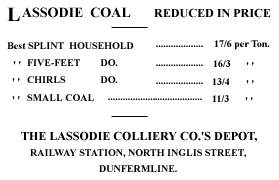
"Dunfermline Saturday Press"
7 June, 1873
------------------------------------
"Dunfermline Saturday Press"
15 November, 1873
In terms of an agreement between Lassodie Colliery Co., and the Telegraph Department of the Post-Office, a private telegraph has just been erected connecting Lassodie Colliery Office with the Post Office at Dunfermline. This will give greatly increased facilities for conducting the business of the colliery; and being the first private wire erected in the district, says a good deal for the enterprise of the Lassodie Colliery Co.
------------------------------------
"Dunfermline Saturday Press"
10 January, 1880
MINE ENGINEERING AND APPLIED MECHANICS' COURSES
We are pleased to notice that the above classes are still in a satisfactory state of progress. We learn that another student attending them, (David Beveridge, Kelty Colliery) has been successful in obtaining a certificate of competency as a manger (under the Coal Mines Regulation Act, 1872). He is the third candidate that has been successful from the class taught by Mr. Robert Andrew at Lassodie, and it is certainly very creditable to the teacher to find them so successful.
------------------------------------
"Dunfermline Saturday Press"
30 June, 1888
A distressing coal pit accident occurred in one of the pits belonging to Thomas Spowart & Co. (Limited), at Lassodie, on Thursday morning. While James Wood (48) and his son were working at one of the seams the facing suddenly gave way, and a large quantity of coal fell upon the father. On being extricated it was found that both his legs were broken, and it was found necessary to send him to the Royal Infirmary, Edinburgh. The injuries received by the son were, happily, not of a serious nature.
------------------------------------
"The Scotsman"
24 November, 1888
DEATH OF MR THOMAS SPOWART COALOWNER. - Mr Thomas Spowart, coalowner, died yesterday at his residence, Broomhead House, near Dunfermline. The deceased gentleman. who was in his 61st year, was well known in mining circles throughout Scotland, having been identified with colliery business during the last forty years. While a youth he was apprenticed as a civil engineer to Messrs Bald & Geddes, Edinburgh, but on the death of his father he assumed the management of Wellwood Colliery, Dunfermline. Later on he acquired Elgin Colliery, which adjoined his own, and for many years conducted a successful and extensive business. He also sank pits at Lassodie. Mr Spowart was one of the promoters of the Linlithgow Oil Company, and was appointed its chairman. He was also president of the Scottish Mineral Oil Association.
------------------------------------
"Dunfermline Saturday Press"
26 September, 1891
MINE VENTILATION IN FIFE
Complaints of bad ventilation are at the present time
rather numerous. In the Lassodie Colliery it appears that in
one of the sections of the pit the system to be enforced to
assist the air is to not allow the miners to fire their shots
unless within a short time of the finish of the working
shift. Some few of the men have disregarded this instruction,
with the result that they are threatened with punishment.
In fairness it might be stated that it is not at all times
an easy matter to ventilate some portions of a pit,
especially if a large waste has to be contended with. Still,
it would be an easy matter in many of the Fife pits to
improve the air which miners have to work among.
------------------------------------
"Dunfermline Saturday Press"
25 November, 1893
Mr Andrew, manager, Lassodie Colliery, who has acted in that capacity for 23 years, is now retiring, and on Saturday evening, in name of the workmen employed at the colliery and a few friends, he was presented with a purse and sovereigns and a silver-mounted walking stick for himself, and a hand-bag for Mrs Andrew. Mr Thomson made the presentation.
------------------------------------
"Dunfermline Saturday Press"
14 December, 1895
On the occasion of his leaving the colliery, Mr James Sharp, oversman, has been presented with a silver watch, and Mrs Sharp with a hand-bag.
------------------------------------
"Dunfermline Saturday Press"
11 July, 1896
While William Robertson, labourer, Halbeath, was engaged braking waggons under a screen at one of the Lassodie pits on Tuesday, he got caught between a waggon and an upright post, with the result that his right collar bone was displaced. He was attended to by Dr Morris, Dunfermline.
------------------------------------
"Dunfermline Saturday Press"
11 July, 1896
This issue a carried the announcement that Lassodie oversman, Mr James Kelloch, was leaving to fill a similar position with the Rosewell Gas Coal Company at Lassodie Mill Colliery just to the east of Lassodie.
------------------------------------

"Dunfermline Saturday Press"
15 August, 1896
James Gloag (35), supposed to belong to Dundee, died suddenly here yesterday morning. Drs Drysdale and Tuke, Dunfermline, who examined the body, certified that death was due to natural causes. Deceased had been employed filling coals at one of the Lassodie pits.
--------------------------------------------
"Dunfermline Press"
30 April, 1898
Mr S. McFedries, oversman, Lassodie Colliery, was leaving to fill a similar situation in Lochgelly.
--------------------------------------------
"Dunfermline Press"
14 January, 1899
The friends of Mr Robert Peggie will be pleased to learn that he has been successful in gaining a first-class certificate at the recent examination held in Glasgow. Mr Peggie has been coached by Mr John Clark, colliery manager, Rosebank.
--------------------------------------------
"Dunfermline Press"
7 July, 1900
Mr James Brown, oversman, Lassodie Colliery, has been successful in obtaining a first-class certificate of competency as mine manager at the recent examination held in Edinburgh. Mr Brown was ably assisted in his preparatory studies by Mr David Archibald, manager of the colliery.
--------------------------------------------
"Dunfermline Press"
18 June, 1904
A social meeting of the students and friends of the mining class was held on Saturday evening in the Public Hall, when twenty-two sat down to supper, presided over by Mr Archibald, manager. In the course of the evening the Chairman, on behalf of the students, presented Mr Strain, oversman, their teacher, with a handsome clinometer. He complimented Mr Strain on the success of his students at the recent examination for mine managers' certificates held in Edinburgh. Four students went forward for examination, and they were all successful in gaining second class certificates. Their names are as follows:- James Lowe, John Fleming, and George Marshall, Lassodie; and James Smith, Kelty. Mr Strain thanked the students for their useful scientific instrument. He felt amply rewarded in the success of the students, and trusted they would now keep the footing they had gained on the ladder of life, and go upwards and onwards until they had obtained first class certificates. Mr John Fleming narrated how the class originated, and said that it reflected great credit on their teacher for his unselfish work in taking the time and trouble of helping others. It was a labour of love, done without money and without price. ...
--------------------------------------------
"Dunfermline Press"
18 June, 1904
This issue carried the news that the Lassodie 'A' team which won the Miners' Ambulance Competition with a total of 85 points consisted of Alexander Malcolm, captain; Archibald Wylie, James Ramsay, Walter Erskine, and Robert Leonard. The team's instructor was Dr Tuke, Dunfermline.
--------------------------------------------
"Dunfermline Press"
7 January, 1905
LASSODIE - MINING
The friends of Mr William Strain, colliery oversman, Lassodie, will be pleased to learn that he has been successful in gaining a first-class certificate at the examination recently held in Glasgow. Mr Strain is a student of the Fife Mining Class.
--------------------------------------------
"Dunfermline Press"
4 May, 1907
LASSODIE - COAL MINING
Mr Strain, the highly esteemed manager; Mr John Fleming and Mr Alexander Shepherd, oversmen, were visited in their new sphere of labour at Hill of Beath by a number of their former fellow workmen from Lassodie Colliery, who were shown over the Fife Coal Company's Dalbeath Pits. the pumping, winding, screening, hauling, and coal-cutting plant were all minutely inspected by the visitors, who manifested great interest in everything they saw. After their tour of inspection had been completed, they were entertained to tea, kindly provided by Mr and Mrs Shepherd, no effort being spared on the part of the latter to make the visit a pleasant one. The party were highly delighted with their afternoon's outing.
--------------------------------------------
"Dunfermline Press"
3 August, 1907
James Stewart, a pithead worker employed by the Lassodie Coal Coy., and residing in Townhill, met with an accident at Lassodie Colliery on Wednesday. He was conveyed to the Dunfermline and West Fife Hospital, when it was found that he had received a compound fracture of the leg.
--------------------------------------------
"Dunfermline Press"
7 September, 1907
Andrew Malcolm, a young lad working in one of the Lassodie pits, was admitted to the Dunfermline and West Fife Hospital on Monday suffering from injuries sustained while engaged at his employment earlier in the day. One of his legs was fractured, and he was bruised about the body.
--------------------------------------------
"Dunfermline Press"
11 January, 1908
LASSODIE - MINING
The friends of Mr Wm. Wilkinson will be pleased to learn that he has been successful in gaining
a first-class certificate at the examination recently held in Glasgow. Mr Wilkinson began the study
of mining under Mr Masterton, of Cross Roads School, Methil, through whose tuition he was successful
in gaining a second-class certificate some years ago. Of late, he has been a student of the Fife Mining
School, and he has also obtained some valuable practical information at the hands of Mr Archibald,
manager of the colliery.
Mr Wilkinson has held the position of oversman in various collieries, both in Fife and the Lothians, and
those who are in a position to judge of his capabilities feel quite confident that he will yet distinguish
himself in the mining industry.
-------------------------------------------------
"Dunfermline Press"
11 April, 1908
... Mr William Wilkinson, Lassodie, appointed manager of Elgin and Wellwood Colliery. Mr Wilkinson succeeded Mr Strain (now at Dalbeath) as oversman at Nos. 10 and 11 Pits, in which position he has won the confidence and respect of both employer and employed. Output at Lassodie was now at 600 tons per day.
-------------------------------------------------
"Dunfermline Press"
5 June, 1909
A COALOWNER'S JUBILEE
INTERESTING CELEBRATIONS AT LASSODIE
A unique event took place at Lassodie on Saturday, Mr John Brownlie, coalowner, being
presented with a illuminated address and silver salver from the employees of Lassodie, Elgin and
Wellwood Collieries in recognition of his fifty years connection with the firm of Messrs Thomas
Spowart & Company Limited. ...
Mr Brownlie came to Lassodie in March 1860, and he (the Chairman) understood that that was
the first month that coals were drawn from the pit. At that time a local man who posed as an
authority on coal mining declared that all the coal that would be extracted from Lassodie would
be so worthless that the labour of digging it would be like ploughing the sands. The late Mr Spowart
and Mr Brownlie though otherwise. ...
-------------------------------------------------
"Dunfermline Press"
18 December, 1909
This issue carried the announcement of the death of Mr John Brownlie, Greenbank, Lassodie, on Monday evening. Mr Brownlie was one of the oldest coalmasters in Fife, if not in Scotland.
-------------------------------------------------
"Dunfermline Press"
1 January, 1910
Mr Wm. Hunter, who had been a residenter in the village almost since the time when the population began to settle down there, died with startling suddenness on Monday evening. Deceased was employed as pit inspector or fireman with Messrs Thomas Spowart & Company, Limited. Being engaged on the night shift, he proceeded to the pit at about ten o'clock in the evening. While waiting on the back-shift squad ascending the shaft, Mr Hunter was suddenly seized with illness, and he passed away while being conveyed by his comrades to his dwelling-house in New Rows. Deceased was 69 years of age. A native of Wellwood, he went to work in the pits at the age of ten years. Forty-seven years ago he took up residence at Lassodie, three years after Lassodie Colliery had been started. Musically inclined, the deceased was for many years leading cornet player in the village brass band, and he frequently led the psalmody in the United Free Church.
-------------------------------------------------
"Dunfermline Press"
1 July, 1911
On Wednesday morning, David Jack, miner, Main Street, Townhill, while working in one of the Lassodie Pits, had his leg broken below the knee by a quantity of coal falling upon him.
-------------------------------------------------
"Cowdenbeath & Lochgelly Times"
14 August, 1912
Early on Friday morning William Guthrie, miner, Kelty, met with serious internal injuries in a pit belonging to Messrs Thomas Spowart and Co., Ltd., at Lassodie. The man was conveyed to the Dunfermline and West Fife Hospital, where he lies in a critical condition.
--------------------------------------------
"The Scotsman"
Thursday, 29 August, 1912
FATAL ACCIDENT IN FIFE
The death took place yesterday morning of Thomas Drummond, New Rows, Lassodie, who had been employed as an attendant at a coal washer at Messrs Thos. Spowart & Co.'s Lassodie Colliery. Drummond had been near machinery, by which part of his clothing was caught, and he was dragged round the shafting. His neck and spine were injured, and several of his ribs were fractured.
----------------------
"Dunfermline Press"
7 September, 1912
Under the Fatal Accidents Inquiry Act, an inquiry was held in the Sheriff Court, Dunfermline, on Thursday - before Sheriff Umpherston and a Jury - into the circumstances attending the death of Thomas Drummond, coal washer attendant, New Rows, Lassodie, who was fatally injured at Lassodie Colliery on 26 August through being drawn round a revolving shaft. Those giving evidence included:- David Archibald, manager; Henry McTrusty, labourer, Fairfield, Lassodie; William Love, labourer, New Rows, Lassodie; and George Drummond, miner, Kelty, a son of deceased. A formal verdict was returned.
----------------------------------------------------------------------------------
"Dunfermline Press"
25 January, 1913
PRESENTATION TO COLLIERY MANAGER.
A combined social was held in the Public Hall, Lassodie, on Saturday, the company including
the colliery underground firemen's class and the two rescue fire brigades. Mr Andrew
Steedman, under-manager of Nos. 10 and 11 Pits occupied the chair.
Mr William Wallace, on behalf of the firemen's class, presented Mr Archibald, manager,
with a set of gold sleeve links and studs. They had all derived a good deal of useful knowledge
from the teaching imparted to them by their manager, making them all feel better equipped to
perform their duties. Mr Archibald in reply thanked Mr Wallace and the class for their useful
and tangible token of their gratitude for the service he had rendered.
Mr Brownlie, J.P., presented the badges and certificates granted by the Fife and Clackmannanshire
Coalmasters' Association to all members of rescue brigades that have become competent.
Two brigades had qualified at Lassodie, and members had been trained and qualified at the
Cowdenbeath Rescue Station. The names of the teams are:- Andrew Steedman (leader),
David Stewart, Alex. Hunter, Alex. Malcolm, and John Ryan; Wm. Wallace (leader), John
Reid, John Todd, James Ramsay, jun., and David Steedman.
The Chairman, on behalf of the brigades, thanked Mr Brownlie and the Fife and Clackmannan
Coalmasters' Association for the handsome badges.
----------------------------------------------------------------------------------
"Dunfermline Press"
31 May, 1913
Mr William Fulton, dispatch clerk at Lassodie Colliery for the last 5½ years, left to take up an appointment as manager of the Pathhead and Sinclairtown Co-operative Society's coal depot.
----------------------------------------------------------------------------------
"Dunfermline Press"
12 August, 1916
While at work in Lassodie Pit, George Pratt, jun., residing at Chipperkyle, Oakfield, had his arm broken in two places through being caught in a wheel.
----------------------------------------------------------------------------------
Winners of Mathewson Cup, Dunfermline, 1916
Lassodie Ambulance Team
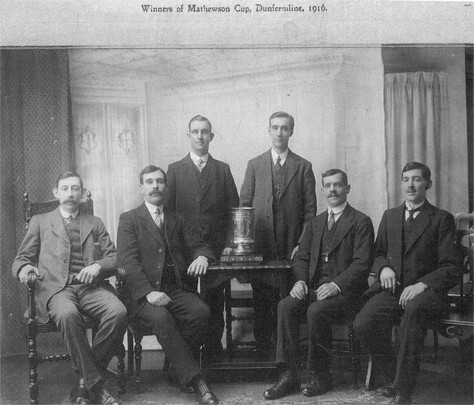 |
Back Row: Andrew Herd (Reserve); Henry Marshall
Front Row:
Henry Lister; Alex. Adamson; John Todd (Captain); Peter Arnott
[Photograph courtesy of Peter Arnott, formerly Crosshill, grandson of team member, Peter Arnott.]
----------------------------------------------------------------------------------
"Dunfermline Press"
21 September, 1918
Mr James Wilson, who has been under-manager in Lethans No. 1 Pit for the last three years, was honoured on the occasion of his leaving to take up a similar position in Lassodie Colliery. ...
----------------------------------------------------------------------------------
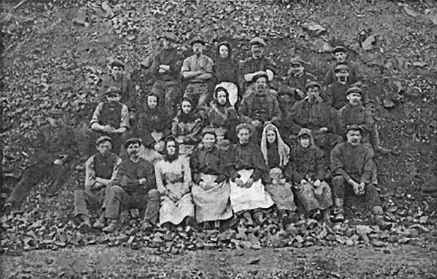
Lassodie Pit Workers
1920s
----------------------------------------------------------------------------------
"Dunfermline Press"
12 February, 1921
The death of Mr James Stronach, retired joiner, on Saturday last, at the ripe old age of 86 years, has removed the oldest inhabitant of the village, and one of the first workers at the colliery. ... At the time when the late Mr John Brownlie's jubilee was celebrated in 1909, Mr Stronach was presented by the Colliery Company with a gold medal:- "In recognition of fifty years' faithful service at Lassodie Colliery." ...
----------------------------------------------------------------------------------
"Dunfermline Press"
2 July, 1921
... At Lassodie, the officials have been able to cope satisfactorily with the water, so that there too the men will all be reinstated forthwith. ...
----------------------------------------------------------------------------------
"Dunfermline Press"
18 May, 1929
A representative gathering of the people of the village [Lassodie] was held in the Welfare Institute Hall on Saturday, to do honour to Mr David Archibald on the occasion of his retirement as colliery manager at Lassodie Colliery after thirty-one years' service. ...
----------------------------------------------------------------------------------
"Dunfermline Press"
2 May, 1931
LASSODIE COLLIERY CLOSED.
THREE HUNDRED MEN AFFECTED.
Further indications of the depression in the Fife coal industry were
furnished on Thursday when Lassodie Colliery belonging to Messrs
Thomas Spowart & Company, Limited, was closed down.
Over 300 men were employed at the colliery, and the fourteen days'
notice which they had received terminating their employment expired on
that date.
It is understood that this drastic step had been taken partly because
of the difficulty of disposing of the accumulation of water which threatens
to flood the underground workings.
That the closure of the pit is to be of a permanent nature is indicated
by the fact that a number of men have been retained for dismantling
operations at the pithead and in the underground workings.
Notices have been posted at the colliery to the effect that the Company's
dwelling-houses in the village have to be vacated in fourteen days.
Lassodie Colliery, which is one of the oldest collieries in the county,
has been in existence for over seventy years. Practically the whole
of the adult male population of the village was employed at the
colliery, and many of the old residents had worked there since boyhood.
----------------------------------------------------------------------------------
"Dunfermline Press"
9 May, 1931
CLOSING OF LASSODIE COLLIERY.
HISTORY OF THE COLLIERY.
Messrs Thomas Spowart & Company, Ltd., took a lease of the minerals
of Lassodie in 18 60. From that year until 1887, Lassodie was worked as a
separate concern. In 1887, a private limited liability company was formed
among the partners of Lassodie and Elgin and Wellwood collieries, and from
that date the combined collieries were carried on under the name of Thomas
Spowart & Company, Ltd.
At an early stage of the development of the Lassodie minerals, the late Mr
John Brownlie, father of Mr H. M. Brownlie (Chairman of the Dunfermline and
West Fife Hospital Committee), took over the management. Under his
supervision great developments took place, and in later years the adjoining
coal field of Thornton was also worked from the Lassodie shafts.
Several hundreds of men were employed, and within a comparatively short
time the village of Lassodie was brought into being, a school and church
being erected in course of time.
At Lassodie the late Mr John Brownlie, who was a member of the old Beath
School Board, did excellent work in connection with educational matters,
and took a prominent place in the promotion of schemes which had in
view the moral and material welfare of his employees, their wives, and families.
Mr H. M. Brownlie, who succeeded his father in the management of the colliery,
has all along manifested a live interest in the welfare of the villagers of Lassodie.
----------------------------------------------------------------------------------
"Evening Dispatch"
Saturday, 16 May, 1931
(A Report from Our Special Correspondent)
'Lassodie gives every indication of rapidly declining into a state where it will be known as Fifeshire's "Deserted Village."
Only a few years ago Lassodie knew peace and contentment. There was a flourishing coal industry to support the 3000 or more inhabitants, and even people from the surrounding countryside.
There was a brass band that was a constant source of pride to the villagers, and won admiration and prizes in many parts of the country.
They had their simple pleasures, their sports, their friendships, their evenings of talking and walking.
Today everything is changed.
The good old days are but a memory. Lassodie sent her fathers and sons to the war. They came back, or rather some of them came back, to strikes, fierce competition, trade depression.
These are some of the things that, slowly, relentlessly approached, to hover like dark clouds over the village.
There are only about 1000 people in Lassodie today. Only about fifty of the men are working, and unless something remotely uncertain happens, the village will soon be no more.
Lassodie has but four shops and a public-house. The church, now without a minister, is in danger of closing down.
I have just visited Lassodie, and what I have heard and seen will remain a vivid memory with me for many a long day as an impression of present-day industrial conditions. The village is situated about four or five miles north-east of Dunfermline, on open moorland country, near Loch Fitty.
The first sight to meet the eye is a single street of low-lying, drab brick houses, with others scattered here and there behind on either side of the only street, and as many straggling, wooden huts as there are homes.
It was raining as I approached. Some men, sheltering on the windward side of a hut, played a quiet game of cards; a dog ran across the street; an ice-cream van was drawn up on one side; the vendor waiting for business that seemed never to come; a woman left the store with a basket of provisions as another was entering. These were the only signs of life.
There are really three villages. The first one entered is Fairfield. A few hundred yards further on is New Houses, then almost equidistant stands Old Houses - the oldest part.
In each there is the same story to tell. Side by side with gaily curtained houses are others standing unoccupied with boards over the windows. Most of the glass is broken.
Of the 300 houses over 100 are closed. Others are being closed almost every week. There is no need to put up a "To Let" board. Nobody wants to occupy them. In rooms where once were happy families now darkness and silence are the only occupants.
Almost any of the grown-up inhabitants can relate the train of events leading to the present state of affairs.
Some time before the war the four pits were working at high pressure, and turning out about 1300 tons of coal each day. Then came the 1921 strike, and the first of a chapter of misfortunes.
Two pits were closed down. Unemployment, until then unknown, visited the village. The drift away of families started. Some of them moved to neighbouring villages, some to the towns, and others emigrated.
Conditions were aggravated by the 1926 stoppage. More unemployment resulted, and the drift away from the village received an impetus.
Now all the pits have closed down. The cost of winning the coal, in view of the great expense entailed in keeping the workings free of the heavy volume of water, it is stated, is prohibitive. At the end of last month nearly 300 men found themselves without work. About thirty men are engaged in dismantling the plant and in pumping operations.
At that time, too, the tenants were given notice to remove from their houses within fourteen days. That period expired on Thursday. They are still in their houses.
What is to happen? Many of them, now advanced in years, wish to remain in or near the house where their parents lived. The sentimental link is strong among these people.
The villagers, who may have difficulty in paying their rents, are waiting to see what is to be. Some of the young men have found work in pits nearby, and stay at their homes in Lassodie.
But still the drift goes on.
The school is situated at New Houses. It is a fine, airy, well-lit building. Mr George Tucker, the headmaster, told me that the school population has dwindled from over 300 pupils to little over 100. Where eight teachers were formerly employed now there are only three and himself.
Mr Tucker sees to the administration of the three R's in his deposed school, but he also is wondering what is to happen. The number of children going to school is steadily growing less.
I spoke with one middle-aged miner whose hands had become coarse and wrinkled in keeping the fires burning in many homes. We spoke of what appeared to me the somewhat gloomy prospect held out by the future for the villagers. What he said surprised me.
"Yes, we may have to face hard times, but we've become accustomed to these. Take my own case. Now that I am idle I have 37s. and four kiddies. I get rent and clothes allowance too. When I was working I could only make a little over £2 a week, and insurance and other items had to be deducted. Sometimes the wage was not even £2, for 'short time' often brought the payroll down. If anything, I am better off now - and have no work to do."
He was quite candid. In many of the homes the same view is held.
I learned that a rumour persists in Lassodie that the pits may be taken over by another concern. Hope springs eternal in the human breast.
Lassodie has certainly fallen on evil days. the drift will go on. When and how the last of the people will take their farewell look at the village and their homes it is hard to say exactly. Such a day may not be long delayed. The unhappy picture of a deserted village is growing from an unpleasant vision into a reality.'
----------------------------------------------------------------------------------
"The Scotsman"
3 February, 1932
Demolition of Fife Mining Village
At the instance of Thomas Spowart & Co. (Ltd), former lessees of Lassodie Colliery, actions of summary removal were called in the Dunfermline Sheriff Court yesterday against the occupants of five dwelling-houses in Lassodie village. An agent for pursuers stated that, the colliery having been closed, the Company, under their mineral lease, were obliged to clear the houses of the land within a certain time. On behalf of the men, all of whom were stated to be in arrears with rent and taxes, in one case to the extent of £16, it was explained that they had not been able to find employment since the colliery was closed in the early part of last year. Sheriff Umpherston gave a decree of summary removal, the men being ordered to quit the houses within three weeks. Each of the defenders was ordered to pay the expenses of the action.
----------------------------------------------------------------------------------
"Dunfermline Press"
16 March, 1940
DEATH OF MR DAVID ARCHIBALD.
FORMER MANAGER OF LASSODIE COLLIERY.
The death took place at Hawthorn Villa, Loanhead, on Sunday, of Mr
David Archibald, who, at the time of his retirement ten years ago, had been
manager at the Lassodie Colliery of Thomas Spowart & Co., Ltd.
Mt Archibald, who was 76 years of age, was an expert in mine management.
During his long residence at Lassodie, he concerned himself with everything
connected with the promotion of the welfare of the villagers.
At Loanhead he took an active interest in all local affairs. He was chairman
of Loanhead Unionist Association, and on several occasions president of
Loanhead Bowling Club. ...
----------------------------------------------------------------------------------
"Dunfermline Press"
9 August, 1941
DEATH OF MR H. M. BROWNLIE
Early yesterday morning, Mr Henry Morrison Brownlie passed away in a
Dunfermline nursing home, where he had been a patient for the last five months.
A son of the late Mr John Brownlie, Lassodie, Mr H. M. Brownlie was trained in the
legal profession. Most of his life-time, however, had been spent in the coal industry.
Succeeding his father as a director of Thomas Spowart & Company., Ltd., Lassodie,
Elgin and Wellwood Collieries, he also took his father's place as general manager
of the Lassodie Colliery of the Company. On the exhaustion of the coal seams at
Lassodie some years ago, Mr Brownlie retired and took up residence in Edinburgh. ...
Mr Brownlie was 76 years of age and was unmarried.
----------------------------------------------------------------------------------
"Dunfermline Press"
28 September, 1946
COLLIERY OFFICIAL'S DEATH.
MR SAMUEL McFEDRIES.
The death has taken place at Wallyford of Mr Samuel McFedries, retired underground colliery manager. He was the only son of Mr Wm. McFedries, who was for some years manager at the Wellwood Colliery of Messrs Thomas Spowart & Company, Ltd. Following the occupation of his father, he was an oversman at Lassodie Colliery, and was for some years occupied in the same capacity in the pits at Cowdenbeath before going to Wallyford over forty years ago. ... Deceased was seventy-seven years of age.
----------------------------------------------------------------------------------
Plans of Abandoned Seams & Dates |
|---|
| Plans of Abandoned Seams for Lassodie | Pits or Mines designated in Plans |
|---|---|
| COAL; probably Kinglassie Splint (no date specified) | Lassodie |
| COAL; Four Feet; Five Feet; Splint (1870) | Lassodie Nos. 1, 2, 3, 6, 7 |
| COAL; Splint (May, 1875) | Easter Craigduckie, No. 1 |
| COAL; Eight Feet (1883); Mynheer or Three Feet (1888) | Lassodie Nos. 2, 6, 7 |
| COAL; Seam unnamed (no date) | Lassodie No. 6 |
| COAL; Glassee (April, 1926); Lochgelly Splint (November, 1926) | Lassodie Nos. 4, 10, 11 |
| COAL; Two
Feet (December 1930); Five Feet (March, 1931); Eight
Feet;
Mynheer; Dunfermline Splint (May, 1931); Cairncubie; Swallowdrum (May, 1931); Six Feet; Upper Eight Feet (May, 1931) |
Lassodie Nos. 1, 2, 3, 4, 6, 7, 9, 10, 11
(including old workings in the Lochgelly Splint; Swallowdrum and Top Cairncubie seams at Lochfitty (?) No. 1) |
| Following
the closure of Lassodie Colliery, a number of private
mines worked the mineral field with varying degrees of
success (see entries for Lassodie Estate
(Methven's Mines) and Lassodie
Mine, Cantsdam..
Although this website has been dedicated to the pits and mines of the Fife coalfields, a brief mention of open-cast working of the Lassodie field, which is still on-going in February, 2003, must be made. |
------------------------------------
Open Cast Workings
Coals classed in earlier years, in this coalfield, as
"uneconomic" propositions were eventually extracted
from the ground by opencast mining techniques.
In April, 1947, the year of nationalisation, Fairfield
Opencast, Lassodie, commenced coal extraction. By September,
1950, the Parley Opencast Site, Lassodie, had started its
operations and within two years, more opencast sites were
underway at the Greenbank, south-east of Lassodie, and Loch
Fitty sites. An extensive area to the north and north-east of
Bentymires continues to be worked opencast at the present
time, February 2003.
 |
-------------------------------------------------
"Dunfermline Press"
22 February, 1947
OPEN-CAST COAL.
Development at Lassodie.
Yesterday, the Ministry of Fuel and Power
confirmed that open-cast working of coal is to be developed at
Fairfield, Lassodie. Drilling operations have revealed a field of
outcrop coal extending over a considerable area, and it is
estimated that between five and six hundred thousand tons of coal
will be mined by open-cast methods within the next three
years.
It is stated that due to the extensive use of
machinery in the operations, considerably less than one hundred men
will be employed.
--------------------------------------------------
When Lassodie fields were first worked by open-cast, the Lassodie School became an office block for the contractors; the washery plant occupied the Lassodie No. 10 pit site; and, the repair yard was located on the Lassodie No. 4 pit site.
--------------------------------------------------
"Dunfermline Press"
17 January, 1948
OPEN-CAST WORKINGS.
Serious Flooding at Lassodie.
On Monday, following heavy rainfall, several million gallons of water flooded
an area of the extensive open-cast coal workings, operated at Lassodie by Messrs
Whatlings, Ltd., contractors, Glasgow and London, on behalf of the Ministry of Fuel
and Power.
The area affected was three hundred yards long by forty feet wide, and the water
was lying to a depth of fifteen feet. Two pumps from Dunfermline N. F. S. were called
into commission, and with their pumping capacity of about 500 gallons per minute, it
was estimated that they would be in operation for several days before the area was cleared.
Anticipating a certain amount of flooding, which would interfere with normal working, the
contractors had removed all machinery from the area, and this, together with workmen,
was transferred to another section of the workings.
--------------------------------------------------
"Dunfermline Press"
21 February, 1948
OPEN-CAST COAL WORKINGS.
Blairenbathie Output.
In relation to the criticism by the Dunfermline branch of the National Farmers'
Union of open-cast coal workings, published last week, it is interesting to record the
output of coal expected from the open-cast coal workings at Fairfield and Blairenbathie,
both units of which work conjointly. The workings at Blairenbathie, which are situated
near Kelty, to the north of the Gask Road, were commenced only two months ago,
and are capable of producing about 2000 tons of coal per week.
Fairfield, at Lassodie, and Blairenbathie are expected by the National Coal Board to
produce approximately 250,000 tons of coal jointly until they are exhausted. They are
worked alternate weeks, according to the situation at each.
MINING RECORD
On Wednesday of last week, a record output for a day's
working was won from Fairfield, when 1661 tons of coal were wrought.
The weekly output for a five and a half days' week at this site
exceeds 7000 tons, giving an average of approximately over 1200 tons.
About 200 men are employed at Fairfield and Blairenbathie. The 300 tons
drag-line at Fairfield, which has been responsible for so great an output,
is at present being overhauled, but substitute machinery is being employed
until the drag-line is operable again.
--------------------------------------------------
"Dunfermline Press"
9 October, 1948
OPEN-CAST MINING
The Lassodie Operations
At the fortnightly meeting of Cowdenbeath Rotary Club,
some interesting sidelights on open-cast coal production and
comparisons with deep mining methods were given by Mr. J. R.
McGibbon, BSc, A.M.I.C.E., manager of the Eastern Division of
Messrs Watlings, Ltd., who are responsible for the scheme at
present in operation at Lassodie. Mr. Alex. Westwater,
president, presided.
Mr. McGibbon said that open-cast coal, although only
initiated in this country in 1941 as a war-time emergency,
had been in operation in America for approximately forty
years. As the land had to be returned to the farmer in a
state capable of producing crops, the removal of the top soil
was a very important factor. This was stored in bings and
replaced after the completion of the work. The removal of the
overburden was the main part of the work, and this had to be
executed efficiently to make any coalfield a successful
enterprise.
Illustrating the big improvements which had been made in the
excavating plant, Mr. McGibbon said that, with the latest
Dragline excavators at Lassodie, they moved on an average
40,000 cubic yards per week. That figure had risen as high as
70,000 cubic yards in one week, and that was equal to 100,000
tons.
With a total personnel of 130 (including clerks), they
produced an average of 7000 tons of coal per week, with a
maximum of 11,000 tons. So far as quality was concerned, he
maintained that this compared favourably with deep mining,
and he knew certain buyers, once they got to know open-cast,
had asked specifically for it.
Since moving into the Lassodie site on 28th March of this
year, the total output to date was approximately 420,000
tons. He expressed the opinion that open-cast coal was
cheaper because the personnel, being more highly technical,
the output per man was greater.
----------------------------------------------------
An old seam abandonment plan shows that the workings in
1948 formed a dog-leg from just east of Lassodie House, down
to the north shore of Loch Fitty, then turning to the east
between the shore and Fairfield.
Another small area was worked at the roadside, halfway
between Fairfield and Windyedge.
The main seam extracted was the Lochgelly Splint and the
overburden was probably removed by the giant excavator known
as 'Mona' after it had completed the Cocklaw
excavation, to the north-east of Lassodie.
-------------------------------------------------
"The Scotsman"
11 November, 1949
Anderson Martin (16), stepson of James McMenemy, labourer, Loch Fitty Crossing Cottage, Lassodie, near Dunfermline, was fatally injured when he was caught in the machinery of an excavator at the opencast coal workings at Lassodie yesterday.
------------------
"Dunfermline Press"
12 November, 1949
YOUTH'S TRAGIC DEATH
Lassodie Accident
A 16-year-old youth, Anderson Martin, nipper, step-son of James McMenemy, labourer, Lochgelly Fitty Crossing Cottage, Lassodie, met with his death under tragic circumstances on Thursday afternoon. While employed at the open-cast coal workings at Lassodie, Martin was caught up with the machinery of an excavator. Death was instantaneous.
-------------------------------------------------
"Dunfermline Press"
26 August, 1950
Progress at Lassodie Open-Cast Coal Site
910,000 TONS PRODUCED
Mr Clunie Impressed by Results
A special invitation to visit the Lassodie open-cast coal workings and obtain,
at first hand, a practical insight into the operations was accepted by Mr James Clunie,
M.P. for Dunfermline Burghs, on Tuesday, when he was conducted round by Mr E.
B. Nisbet, representative of the Ministry of Fuel and Power, from Cowdenbeath.
Afterwards, Mr Clunie, who was accompanied by a Dunfermline Press representative,
expressed the view that the workings were fully justified.
Mr Clunie, who was met by Mr Nisbet on his arrival, first inspected the screening plant
and saw, at ground level, where lorry loads of the newly extracted coal are dumped into
the "boot" - a large tank equipped with a grid.
The coal is then transported by conveyor belt into the actual plant itself, a complicated
system of machinery and subsidiary belts. Right at the start of its journey it is taken in
hand by the Niagara screen which grades it according to size - large coal (over 4 ins),
nuts (1¾ ins - 4 ins), and below that, fragmentary coal and dross.
BLAE USED FOR BRICKS
The dross is eventually ejected below and ultimately finds its way to the great
washeries at Denbeath, Methil. The larger grades continue by belt and come
under careful scrutiny by two squads of young women, ten in each, who deftly
weed out the stone and "foreign" elements and toss them down shutes.
The coal then proceeds to the boom loader and waiting empty railway trucks.
A direct and valuable contribution to the housing problem is being made by
Lassodie, for its blae is being used at Blairadam brickworks in the production of
bricks. The blae, which is hardened clay of a chalky consistency, is being
transported to Blairadam at the rate of about 50 tons a day.
Escorting Mr Clunie at this stage was Mr John Murray, foreman under Messrs
Whatlings, Ltd., the Glasgow contractors under commission at Lassodie from the
Ministry of Fuel and Power. Mr Murray, who resides at 72 Bruce Street, Dunfermline,
is in charge of the plant. Formerly with the railway, Mr Murray was a Government
railway employee in the Gold Coast for nine months, just prior to the war, returning
home on account of an accident.
During the development at Comrie Colliery, he was engaged on the installation
of the railway system, later becoming foreman in charge of railways at the Aitken
Colliery, Kelty, when modernisation works were carried out there.
THE SAMPLING TEST
Each newly loaded truck is subjected to a sampling test before it leaves
Lassodie, known as the float-and-sink test. Four men, under the supervision
of Mr David Duff, Lochgelly, Grade I sampler with the Ministry, undertake this
duty, and, if the coal sample is rejected for quality, the wagon-load is returned
to the screening plant.
From the screening plant, Mr Clunie accompanied Mr Nisbet to the Fairfield
workings, passing on the way the scattered surviving houses of Lassodie
village, with the substantial stone-built school now functioning as offices.
A notable feature of this region of machine-riven country and man-made
mountains is the network of strategic concrete and tarmac roads which
facilitate the passage of the huge 10-wheeled transport lorries.
Pausing on the edge of one yawning chasm, with a mechanical face-shovel
resting on the bottom dwarfed almost to insignificance by towering walls of
exposed strata, Mr Clunie raised a question about the disposal of the piled-up
debris after the coal had been extracted.
Mr Nisbet told him that the rock and stone were tumbled back into the rift
to be succeeded by a blanket of 3-feet of stone-free material. Completing
the restoration was a 12-18 in. surface of the top soil which is carefully
removed before operations begin. This work was supervised by the
Department of Agriculture.
WHEN FLOODING OCCURS
Mr Nisbet also explained in answer to another question, that when
flooding of the workings took place the water was dispelled by pumping.
If the accumulation was too great, or the weather unpropitious, work
was suspended altogether.
Farther on, Mr Clunie made his way to the bottom of a sister working,
the farther wall of which exposed an 80-feet geological cross-section.
Here, the coal was in three stratas. The top-most Kelty main seam and
middle upper Jersey seam had been removed and work was now proceeding
on the lower Jersey seam. Mr Clunie learned that mechanical vertical drills
were used to bore holes behind the face, which was then brought down with
charges.
As the distance by road from these operational zones to the screening plant
was considerable, The Dunfermline Press representative inquired if
a light railway had not been judged suitable for the transportation of the
coal. Mr Nisbet said that experience had proved the lorries to be more
flexible for the job and better for negotiating slopes. He added that it
was estimated the Fairfield zone would be worked out by October or
November this year.
PASTURE ON RESTORED FIELDS
A visit was next paid to Cocklaw Mains Farm. on the Kelty-Dunfermline
highway, to inspect fields which had been restored after the coal
excavation had been completed. A concrete road led gently up from the
valley, and, from the top, a splendid panoramic view was had of the
whole immense hive of industry dominated by its grotesque mountains of
waste.
The fields of Cocklaw Mains presented a brave front of green pasture
and showed but few signs of their comparatively recent upheaval. The
farmer, Mr A MacKenzie, was absent, but later, over the telephone,
he told a reporter that the restoration had been carried out more
satisfactorily than he had hoped. One field, which exhibited a lush
crop, had only been sown with grass this Spring; the others were
sown last year. He thought, however, that years of manuring might
be needed to restore the ground to its original fertility.
THREE YEARS' OUTPUT
The following statistics were given by Mr Nisbet concerning the
Lassodie workings. The undertaking was begun in March 1947.
During the subsequent years, a total production of 910,000 tons of
open-cast coal had been achieved.
At present, due to the exhaustion of Fairfield, the daily output was
about 600 tons, but, within a few months, it was hoped to double
this through fresh operations at the adjacent Parley site, where
preparatory work was now being undertaken, and at Greenbank.
Messrs Whatlings employed 180 workers, including the 20 women pickers.
At the conclusion of the tour of inspection, Mr Clunie described the two
aspects that had impressed him most. He said he thought, from his
observations of the care taken in cleaning the coal, that the finished
product was good and satisfactory, and that this method of
supplementing normal mining methods was not only helpful but fully justified.
He considered further, that the restoration of the old workings had
been extraordinarily successful.
Mr Clunie added that he would like to express publicly his indebtedness
to the officials for the way they had received him and for the information
that had been provided.
-------------------------------------------------
"Dunfermline Press"
27 October, 1951
KINGSEAT MAN INJURED
Arthur Lymer (50), Henderson Street, Kingseat, was injured at the open-cast coal site near Kingseat on Wednesday, when his arm was caught in the screening plant. He was removed to Dunfermline and West Fife Hospital.
-------------------------------------------------
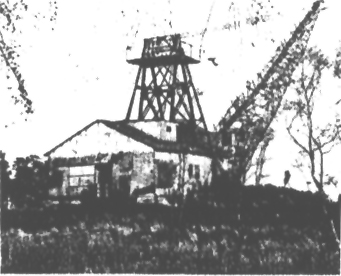
"Dunfermline Press"
22 March, 1952
'Mighty Mona' Is Leaving Lassodie
Giant Excavator that Changed Countryside
Lassodie, the once thriving mining village, which in recent years has
been given over to large-scale open-cast coal operations, is to lose the
giant mechanical digger which has been excavating soil and earth lying
on top of the coal at the rate of 40,000 tons a week.
"Mighty Mona," as the machine has been christened, is being
dismantled and will be transported in 25 loads to an open-cast site at Lumley,
Chester-le-Street, County Durham.
"Mona" has played its part in transforming the ground around
the few surviving landmarks of the village into a torn and scarred countryside.
But "Mona," a giant though she may be at Lassodie, is among
some of the "also rans" in comparison with the huge excavators in
other parts of the country. If she comes up against the 1650 tons colossus
which is in England, she will be completely dwarfed for "Mona"
is a mere 360 tons in weight, operated by a 240 h.p. Diesel engine.
Eight Tons at a "Mouthful"
At one time after coming to Lassodie four years ago, she was working 21
hours a day. She is 50 feet high, 45 feet long, 30 feet wide, and from her jib
which reaches out 150 feet, a five ton drag-line bucket can lift 8½ tons at
one "mouthful." Normally she has four attendants - driver, greaser,
engineer and banksman.
Now 10 men are working a 12 hours day to dismantle her, a job which will
take a further three weeks approximately.
When she goes to England several modifications will be effected, and
more electrical equipment will be added. The work of re-assembling will
take about 12 weeks.
 |
-------------------------------------------------
"Dunfermline Press"
16 August, 1952
Former Open Cast Site
Restoring Land at Lassodie
Restoration of farmland at Fairfield, Lassodie, where open-cast coal
excavations have been in operation for several years is now well in hand,
and the results so far give hope that early misgivings entertained by the
farming community will not be realised.
In 1948, the land, which belongs to the Department of Agriculture, was
requisitioned for open cast workings, in view of the national coal
emergency, and coal was extracted until last year. ...
-------------------------------------------------
"Cowdenbeath Advertiser"
31 August, 1956
A well known local man, William Mackie (31), Arcon Place, Cowdenbeath, was killed when a bulldozer overturned and crushed him at Lassodie opencast site. A keen accordionist, Mr Mackie was engaged on reclaiming work when the bulldozer toppled on the edge of a 12 feet pile of soft soil. Mr Mackie was pinned underneath the machine and despite the efforts of colleagues who worked strenuously to extricate him, he died a few minutes after being released.
----------------------
"Dunfermline Press"
1 September, 1956
Fatal Accident at Open Cast Site
William Mackie (30), 19 Arcon Place, Cowdenbeath, was killed when his bulldozer overturned on Monday evening, at the open cast coal site at Lassodie. He was driving on land reclamation work when the accident occurred.
-------------------------------------------------
"Dunfermline Press"
12 January, 1963
NEW BRICKWORKS AT LASSODIE
A brickworks, which will be the only one of its kind in Scotland, is to be built at Lassodie, near Dunfermline. The factory will be built by local labour, and a new company, E. Abram (Brickworks), Ltd., will manufacture high quality facing and Class "A" engineering bricks in quantity for the first time in Scotland. The bricks will be produced from the area's own raw materials. …
-------------------------------------------------
| Source Date of Information (Owner) | |
|---|---|
| Works / Coal seams worked | |
| 1971-79 (Ernest Abram [Brickworks] Ltd.) | |
| Cultylea (opencast): Blaes and fireclay. |
-------------------------------------------------
"Dunfermline Press"
20 January, 1995
Rail spur for opencast site?
Scotland's new coal owners are due to announce their plans for an opencast site to the north of Dunfermline.
Mining (Scotland) who bought all British Coal's Scottish assets are looking to develop the Greenbank site above Loch Fitty.
The location of the new site would be to the west of the M90 and it is intended that Greenbank will replace the former Keirsbeath site which was on the opposite side of the M90.
A planning application has now been lodged with Dunfermline District Council. It is understood that coal from Greenbank could be useful both for increasing the calorific value of deep-mined coal burnt at Longannet and also as a low-sulphur, low-chlorine supply for blending with coal from English sites to make it suitable for burning for electricity generation.
The Press also believes that both Fife Regional Council and Mining (Scotland)'s subsidiary company, the Scottish Coal Company, are also looking at the possibility of building a rail connection from Greenbank so that coal can be exported by train to its market.
Connection
The two parties are currently looking at the possibility of a rail connection to the site from Townhill and the rail track could take coal directly from Greenbank to Longannet.
A spokesman for the Scottish Coal Company, told the Press, "We intend to continue with the planning application as the site is an integral part of our future strategy. We are aware that there may be some public concern about this issue and we intend to hold a public information exhibition in the near future."
-------------------------------------------------
"Dunfermline Press"
31 March, 1995
Now Battle of Somme looms
Opencast coal mining would turn the north east of Dunfermline into a piece of the Somme battlefield, a local environmentalist has claimed.
Lathalmond resident Alastair Harper is mobilising opposition to the giant Greenbank scheme and the Scottish Coal Company's "flagrant pursuit of corporate profit."
He has teamed up with two other objectors who are delivering leaflets to householders in Kingseat, Kelty and the surrounding area to highlight the hazards of the 800-acre scheme.
The application would involve extracting four million tonnes of coal for ten-and-a-half years between Loch Fitty and the B914 Kelty to Saline road with a further two-and-a-half years for restorative work. …
-------------------------------------------------
"Dunfermline Press"
14 April, 1995
Game on for coal battlers
Loch Fitty chief wades into the battle against opencast coal plans
The battle against the Greenbank opencast mining proposal has gathered momentum. Gerald McKenzie, of Loch Fitty Game Fisheries, was among the group of concerned residents who last week teamed up to form Greenbank Environmental Defence. …
-------------------------------------------------
"Dunfermline Press"
26 May, 1995
Opencast plan ruffles feathers
Birdwatchers in Fife have launched a new fight - to persuade planners to dump proposals for a giant opencast mine near Dunfermline.
Fife Bird Club's objections to a recent plan for a mine development at Parkneuk were upheld by Dunfermline District Council when it voted to reject the scheme.
Now, the club has turned its attentions to the application to extract coal from an 800-acre site at Greenbank, which, it insists, would have an adverse affect on local wildlife. …
-------------------------------------------------
"Dunfermline Press"
25 October, 1996
Jobs row fuels opencast battle
A new row has erupted over jobs as both sides in the battle over Scotland's biggest opencast dig in.
A Kelty restaurateur claims to have evidence that the huge Greenbank development will cost not just local businesses, but also the Longannet deep mine.
But Scottish Coal has countered his claims and warned that without Greenbank, the livelihood of 450 miners could be on the line.
The privatised coal company has applied to Fife Council to remove 3.7 million tonnes of coal over 10 years from 833 acres between Loch Fitty and the M90, with a further 2.5 years of restoration.
Faced with furious local opposition and vehement support for the plans, the council called a special hearing held at Kelty's Community Centre last Thursday.
A final decision is expected to be made by the West Area development committee on 20th November. …
-------------------------------------------------
"Dunfermline Press"
22 November, 1996
Opencast versus Hyundai bombshell
Explosive new evidence that opencasting could affect the proposed new Hyundai plant may undermine Scottish Coal's plans for Greenbank.
Fife councillors have taken an eleventh-hour decision to look again at plans for Britain's biggest opencast after experts warned that blasting and micro-chip production would not mix.
The dramatic intervention came as the council's West Area development committee was apparently poised to ignore planners' recommendations and give Britain's biggest opencast the go-ahead.
But members agreed on Wednesday that the Scottish Coal's plans to remove 3.7 [million] tonnes of coal over 10 years from the 833 acres north of Greenbank should be further probed for "engineering" reasons.
The Press can reveal that consultants have now been hired to test the effect of blasting at Greenbank on the Dunfermline Eastern site earmarked for Hyundai four kilometres away.
It follows recent revelations from consultants employed by Fife Enterprise that even removal of coal without blasting from Crossgates' Prathouse Farm opencast would be incompatible with Hyundai's delicate micro-chip production.
And Kier Mining's plans to opencast at the nearby Drumcooper Farm - due to go to a planning inquiry in February following refusal by Fife Council - would also jeopardise the process.
Mining at Prathouse is due to end next April - over a year before production starts at Hyundai. …
-------------------------------------------------
"Dunfermline Press"
6 December, 1996
Expert blasts opencast claim
A coal expert has poured cold water on claims that losing Greenbank's opencast could cost the Longannet Deep Mine.
Scottish Coal has warned that it cannot "over-emphasise" the importance of cheap sweetener for the proposed Kelty opencast to Longannet's long-term viability.
But a coal consultant told the Press this week that most of the coal was not of high enough calorific value to blend with the Longannet mineral for burning at Longannet Power Station.
The revelation came as Scottish Coal tried to thrash out a compromise application with Fife Council planners who have recommended refusal on environmental grounds.
Dr Andrew Cox had been asked by Fife Council to analyze the data from Scottish Coal and opponents of the planned 3.7 million tonne mine. …
-------------------------------------------------
"Dunfermline Press"
17 January, 1997
D-Day looms for giant opencast
A final decision on whether Scotland's biggest opencast should get the go-ahead is expected on 5th February.
The West Area development committee is due to meet on that date to consider Scottish Coal's application to remove 3.7 million tonnes of coal over 10 years from 833 acres west of the M90 near Kelty.
-------------------------------------------------
"Dunfermline Press"
7 February, 1997
Hyundai 11
Opencast 7
A nail-biting council clash has seen fears for Fife's sunrise future cast what miners view as a shadow over its oldest industry.
A rainbow coalition of councillors this week ignored impassioned NUM pleas to support the last remnants of deep-mining in Fife.
Instead a narrow majority agreed to throw out Scottish Coal's application to opencast at Greenbank on environmental grounds and because blasting could jeopardise micro-chip production at Hyundai's semi-conductor plant.
The tense 11-7 vote by Fife Council's West Area development committee followed passionate debate at a packed Dunfermline City Chambers on Wednesday. …
-------------------------------------------------
"Dunfermline Press"
14 February, 1997
Scottish Coal takes stock
Embattled Scottish Coal this week refused to reveal its next move over Greenbank. The company's application for the giant opencast north of Kingseat was thrown out by Fife Council's West Area development committee last week. …
-------------------------------------------------
"Dunfermline Press"
14 February, 1997
Pitmen's new plea
Miners' union boss Peter Neilson has urged Scottish Coal to submit a fresh Greenbank opencast application - without blasting - in a bid to safeguard the future of Longannet Deep Mine. ...
-------------------------------------------------
"Dunfermline Press"
18 April, 1997
Go-ahead sought for new opencast plans
Scottish Coal gives assurance on blasting
New plans to opencast part of the controversial Greenbank site have now come with a pledge to ban blasting if it would jeopardise Hyundai.
The Press can reveal that Scottish Coal is seeking Fife Council's permission to extract 1.2 million tonnes of coal within the western part of the site, now renamed St Ninians.
The authority's west area development committee voted 11-7 to reject the original Greenbank application in February.
Councillors came to their decision on environmental grounds and because of fears that blasting would jeopardise production at Hyundai's semiconductor plant east of Dunfermline.
Scottish Coal hopes that the smaller application - which has been attacked by anti-opencast protesters - has addressed the environmental concerns.
And a spokesman this week stressed the company would not do anything to jeopardise the £2.4 billion Hyundai investment, which is expected to create a total of 4000 jobs. …
-------------------------------------------------
"Dunfermline Press"
27 June, 1997
Green light for deal on opencast?
A bloody battle over the renewed bid to opencast a West Fife beauty spot appears to have been averted.
The Press can disclose that green campaigners are poised to make a dramatic deal over Scottish Coal's plans for St Ninians.
And the news has been greeted with relief by miners' leaders, who claim it is essential to safeguard Scottish Coal's Longannet Deep Mine. …
-------------------------------------------------
"Dunfermline Press"
8 August, 1997
Opencast re-think?
Opencast campaigners look set for another astonishing U-turn after Scottish Coal appealed against the rejection of its controversial Greenbank proposals.
The Press can reveal that the company lodged an 11th-hour appeal this week because Fife Council had not determined its smaller St Ninians application.
Scottish Coal, which said it had "no alternative," asked the Scottish Office to put the appeal on hold until the new application was considered. …
-------------------------------------------------
"Dunfermline Press"
3 October, 1997
Report allays opencast fears
Ground vibrations would not affect Hyundai's semiconductor plant say experts
Vibrations from a controversial opencast site near Kelty would not affect Hyundai's new Dunfermline plant, councillors will learn today (Friday).
A planning hearing into Scottish Coal's application to extract 1.2 million tonnes of coal at St Ninians is being held in Dunfermline City Chambers.
The proposal centres on a 203-hectare site within the 337-hectare area originally targeted by its controversial Greenbank proposal.
Concerns that ground vibrations could endanger Hyundai's £2.4 billion semiconductor plant were one of the main reasons why councillors rejected Greenbank in February.
But the report to accompany today's hearing reveals, "A technical assessment of ground vibration from within the site has confirmed that the site can be worked without having any harmful effect on the manufacturing factory in East Dunfermline."
The 16 St Ninians objections - some 1500 people objected to Greenbank - will get to state their case. …
-------------------------------------------------
"Dunfermline Press"
24 October, 1997
Opencast plans get green light
Scottish Coal has been given the go-ahead for a 1.2m tonnes opencast mine at St Ninians by Kingseat.
The West Fife development committee this week gave the mine the thumbs-up - eight months after turning down Scottish Coal's bigger Greenbank development planned for the same area. …
-------------------------------------------------
"Dunfermline Press"
3 September, 1999
Opencast rock set for loch project
Rock from St Ninians opencast mine near Kelty could be used for improvement work at Loch Fitty - if Scottish Coal get the council go-ahead.
Scottish Coal are seeking permission to take dolerite - which is in abundance at the site - to Loch Fitty, where it will be used to construct artificial banks.
They stress the removal of the rock will be done on private roads and will have no effect on the restoration of the opencast mine.
A spokesman for Scottish Coal said the dolerite was extracted as part of the normal coal mining process.
"Nowadays it would be put back into the mine but, as it is very hard rock, it is good for construction and at Loch Fitty they are building a number of causeways for which it would be ideal," the spokesman told the Press.
Loch Fitty manager Gerald MacKenzie explained it was hoped to use the stone in the creation of two new fisheries.
"It is totally inert so there will be no problem introducing it into the water," he added.
"We are going to make a causeway or two which will make our fishing an awful lot better and offer different types of fishing and attract a broad range of people."
Mr MacKenzie continued, "There will be no intrusion on public roads because both companies border onto each other - it is convenient for us and convenient for them."
-------------------------------------------------
"Dunfermline Press"
24 December, 1999
Villagers to sink mine cash into sports centre
Residents of Kelty look set to discover that having an opencast mine in your back-yard can have its advantages.
Part of the deal which allowed the development of St Ninians mine was a condition that Scottish Coal pay money into a community fund.
Now, just two years after mining commenced, the Kelty Partnership - which brings together representatives of local groups - hopes to use some of the cash to part-fund a new sporting complex. …
-------------------------------------------------
"Dunfermline Press"
24 March, 2000
Opencast attracts wildlife
Environmentally friendly or bird brained?
Scottish Coal has denied suggestions that its bid to boost barn owl numbers at opencast mines - including St Ninians near Kingseat - reeks of double-standards.
Environment groups have not totally embraced the company's initiative to erect nesting boxes at four opencast sites because they blame the industry for destroying wildlife habitats in the first place.
However, Scottish Coal, which plans to fully restore St Ninians, denies the move is a publicity stunt, describing it as a genuine attempts to help the environment. …
-------------------------------------------------
"Dunfermline Press"
14 July, 2000
Opencast firm plans extension
Scottish Coal has submitted a formal application to expand its operation at St Ninians opencast mine, near Dunfermline.
The company intends mining an additional 109 acres of land beside the existing 445 acres and hopes to extract 1.8 m tonnes of coal over a five-and-a-half year period.
Coal from the site would be blended with that from the Longannet deep mine and used in Longannet Power Station.
If the plans are approved it could provide job security for around 100 workers employed both directly and indirectly at St Ninians.
-------------------------------------------------
"Dunfermline Press"
21 July, 2000
Opencast proposals under fire
Scottish Coal has been accused of using "back-door" tactics to resurrect a giant opencast mining scheme which was controversially thrown out three years ago.
Its bid to opencast 3.7 million tonnes of coal over 10 years at Greenbank, north of Kingseat, was refused in February 1997.
But a smaller 1.2 million tonnes, five-year scheme at the same site, re-named St Ninians, was approved later that year.
Scottish Coal has now applied to extend the life of St Ninians, which is due to last until 2002, by a further five years and extract a further 1.8 million tonnes.
West Fife Environmental Defence chairman Alastair Harper said, "This is just Greenbank through the back door and you can be sure we will be objecting on environmental grounds."
The new development would safeguard around 100 direct and non-direct jobs. …
-------------------------------------------------
The opencast mining site being extracted in 2003, St Ninians, was part of a larger project, Greenbank, which was originally refused planning
permission. The original Greenbank Project extended from
beyond the old No. 6 Pit, in the west; to the M90 motorway in
the east; Thornton Wood in the north to Loch Fitty in the
south, and meant that the old Lassodie village would at last
be buried.
The St Ninians site seems to encompass the western half of
the original Greenbank project. Needless to say, we
understand that the Company has requested an extension to the
St Ninians site which, surprise, surprise, just happens to be
the rest of the Greenbank site!
Work is continuing at the
time of this entry update (February 2010).
-------------------------------------------------
"Dunfermline Press"
6 May, 2004
Opencast workings to become a work of art?
A scar on the West Fife landscape may be finally healed if Scottish Coal's plans to turn former opencast mines into landscaped works of art go ahead.
Former opencast workings overlooking the M90, on the stretch between Kingseat and Kelty, have been identified by the firm as a possible site for the regeneration work, which will involve reshaping tonnes of earth. …
-------------------------------------------------
"Dunfermline Press"
25 November, 2004
Site to be mined round the clock
- QUOTE 'Are we in Lassodie going to be compelled to sit indoors with windows and doors shut for the next few years for the sake of Scottish Coal making a quick buck?'
Scottish Coal has been given the go-ahead to operate St Ninians opencast site, near Kelty, 24 hours a day.
The approval - initially on a three-month trial to monitor noise and nuisance - came despite strong local opposition.
The company's request for longer hours was to meet increased demand and improve the efficiency of the site. There will now be around-the-clock operations of the barrel washer and loading shovels from Monday to Friday.
The existing restrictions at the weekend - 7 am to 1 pm on Saturdays and no work on Sundays or public holidays - remain.
Norman Woolley, proprietor of the Lochfitty Cottage B&B, Lassodie, wrote to the council, to complain about the proposed extension. "There are already enough occasions when the noise generated during the silent hours with no other background noise would be even more intrusive," he wrote.
"This is particularly pertinent to my guest bedrooms, both having windows north facing (i.e. overlooking the site)." …
