Owners: Fife Coal Co. Ltd.
NCB
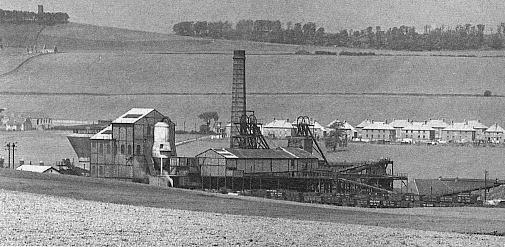
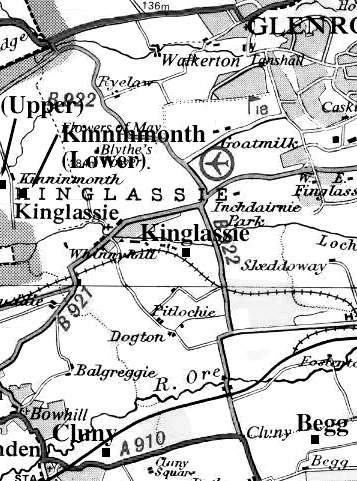
Kinglassie Pit, opened in 1908, was to the north of the Cluny-Begg coalfields and east of the old Boglochty coalfield which provided coals for the nineteenth century pits of the Kinninmonth area. Kinglassie Mine, a later addition around 1932, lay to the south-east of the pit.
 |
 |
 |
A personal tale
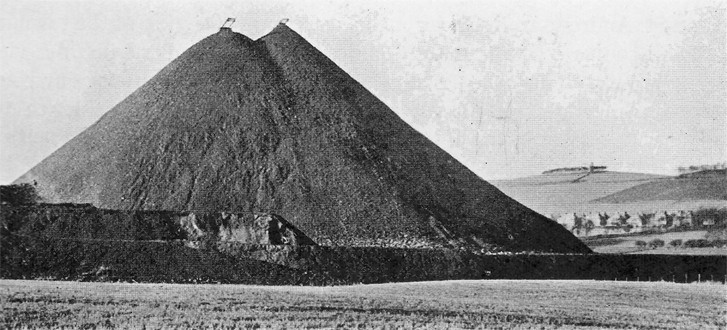
The photograph on the right shows the pit bing
around 1946. The photograph on the left was taken just
before I started work at the pit for a short time
in 1954. In the background of the photographs you can see
the village of Kinglassie where, by
the 1920s, the building of the Burnside Cottages for the
expected influx of miners and their families was well
underway. However, there was still insufficient housing for
the mining families and to help cope with the growing
population, Fife County Council started building the houses
in Laurence Park. Two of my uncles, from the McKenna family,
worked at Kinglassie but I soon moved on to Glencraig.
Kinglassie Pit also had a Drift or Surface Mine for which
planning commenced around 1932. The tunnel of the mine was
600 yards long and I believe it started production around
1938. The Pit and the Surface Mine gave employment to well
over 650 men by this time. One of my uncles was sent to
Kinglassie Pit from the Armed Forces in an attempt to try and
overcome the severe shortage of coal miners at that time. He
was, of course, then known as a "Bevin Boy",
so-named after the Minister of Labour at the time who was
Ernest Bevin.
Kinglassie Pit had a severe water problem and I can
remember my granddad saying that they had to install a special
pump to keep the water at bay. I also understand that the
pump had to be brought back up to the surface in 1923, to be
rushed to the Redding Colliery at Stirling where there was an
in-rush of water which trapped 66 men. Five men were entombed
for nine days and by 3 December, 1923, a total of 40 bodies
were recovered.
This incident, referred to now as the Redding Disaster,
was, sadly, the price we had to pay to get our supplies of
coal. This is something, as a nation, we must never forget!
M. Martin, Author.
| Pit opened: 1908 | Pit closed: November 1966 |
|---|
| Source Date of Information Supplied |
|---|
| Manager / Under-Manager / Men underground / Men above ground / Coal seams worked |
| 1908 (Fife Coal Co. Ltd.) |
| John Allan / --------- / 17 / 36 |
| 1911 (Fife Coal Co. Ltd.) |
| Mr James Tripney* / --------- /
161 / 73 *(appointed September from Bowhill No. 2) |
| 1913 (Fife Coal Co. Ltd.) |
| Jul: Mr James Brown, manager (former under-manager Bowhill No. 1) |
| 1918 (Fife Coal Co. Ltd.) |
| Charles Lilly / --------- / 185 / 64 |
| 1920 (Fife Coal Co. Ltd.) |
| Aug: Mr Blyth B. Davidson,
former undermanager Bowhill Colliery, appointed manager.
Manpower: 431 / 104 |
| 1920-22 (Fife Coal Co. Ltd.) |
| Blyth B. Davidson / ---------
/ --- / ---
May, 1922: Mr Davidson promoted to colliery manager at Leven. August: Mr James Hendrie, manager. |
| 1923 (Fife Coal Co. Ltd.) |
| Apr: Mr John
Biggar, under-manager. Mr Hendrie now an agent for the Company. |
| 1928 (Fife Coal Co. Ltd.) |
| John Miller / William Hunter / 486 / 173 |
| 1929 (Fife Coal Co. Ltd.) |
| Sept: Mr James Crawford, formerly manager at Cowdenbeath No. 7, appointed colliery manager. |
| 1935 (Fife Coal Co. Ltd.) |
| Mr Robert Stewart,
colliery manager, retires. Mr Alex. Burnett, under-manager. |
| 1937 (Fife Coal Co. Ltd.) |
| May: Mr Benson, manager,
appointed manager at Lumphinnans No. 1. Mr Hynd, undermanager, Lumphinnans No. 12, appointed colliery manager. |
| 1938 (Fife Coal Co. Ltd.) |
| T. Duncan / Pit: Alex. Burnett : Surface Mine: J. Borrowman / 421 / 137 |
| 1939 (Fife Coal Co. Ltd.) |
| Jan: Mr T. Duncan, manager. |
| 1945 (Fife Coal Co. Ltd.) |
| C. Inglis / Pit: Alex. Burnett : Surface Mine: George Hutchison / 423 / 141 |
| Household and steam coals and blaes. Main, Lochgelly Splint and Dunfermline Splint. |
| 1947 (NCB) |
| Mr C. Inglis, colliery
manager, at unfurling of NCB flag - January. J. Haynes / Pit: Alex. Burnett : Surface Mine: ------------- / 502 / 134 |
| Household, industrial and navigation coals. Approx. annual output = 243,500 tons. |
| 1948 (NCB) |
| J. Duncan / Pit: Alex. Burnett : Surface Mine: Hugh Beveridge / 502 / 149 |
| Steam coal and blaes. Main, Lochgelly Splint, Dunfermline Splint* and Five Foot**. |
| * Dunfermline Splint discontinued February, 1947. ** Five Foot discontinued May, 1947. |
| 1949 (NCB) |
| J. Duncan / Pit: Alex. Burnett : Surface Mine: H. Beveridge / 501 / 133 |
| Steam coal. Main, Lochgelly Splint, Dunfermline Splint and Five Feet. |
| 1950 (NCB) |
| J. Duncan / Pit:
Alex. Burnett : Surface Mine: H. Beveridge / 515 / 141
Feb:J. Duncan appointed manager at Newcraighall Colliery. Mr Dempster Smith, ex-Cameron Mine, appointed manager. |
| Steam coal. Main and Lochgelly Splint. |
| 1951 (NCB) |
| Mr Dempster Smith / Pit: Alex. Burnett : Surface Mine: H. Beveridge / 546 / 155 |
| Steam coal. Main and Lochgelly Splint. |
| 1952 (NCB) |
| D. Smith / Pit: Alex. Burnett : Surface Mine: H. Beveridge / 586 / 157 |
| Steam coal. Main and Lochgelly Splint. |
| 1953-56 (NCB) |
| D. Davies / Pit: Alex. Burnett : Surface Mine: H. Beveridge / 586 / 157 |
| Steam coal. Main and Lochgelly Splint. |
| 1957 (NCB) |
| Mr George Henshilwood / Pit: Alex. Burnett : Surface Mine: H. Beveridge / 610 / 154 |
| Steam coal. Lochgelly Splint, Lower Lochgelly, Glassee. |
| 1958 (NCB) |
| Jan: Mr Henshilwood, manager at
Kinglassie Colliery for the past nineteen months, moved to Bowhill Colliery as manager.
New manager: Mr R. F. Young, West Fife Area safety engineer, National Coal Board. |
| R. F. Young / Pit:
Alex. Burnett : Surface Mine: H. Beveridge / 610 /
150 Sept: Mr Alex. Burnett retires after 24 years as under-manager. |
| Gas, household, industrial, navigation, steam coals and blaes. Lochgelly Splint, Glassee. |
| 1959 (NCB) |
| R. F. Young / Pit:
F. Rolland : Surface Mine: H. Beveridge / 593 /
135 May: Mr. R. F. Young appointed manager at Valleyfield. |
| Gas, household, industrial, navigation, steam coals and blaes. Lochgelly Splint, Glassee. |
| 1960 (NCB) |
| Jan: Mr James Kennedy,
colliery manager. Jan: Mr Hugh Beveridge appointed under-manager at Valleyfield Colliery. |
| 1961 (NCB) |
| J. Kennedy / Pit: F. Rolland : Surface Mine: A. Forrester / 604 / 140 |
| Gas, household, industrial, navigation, steam coals and blaes. Lochgelly Splint, Glassee. |
| 1962 (NCB) |
| Apr: Mr J. Kennedy, appointed
manager at Glencraig Colliery. Mr Robert Gibb, manager at Blairenbathie, appointed manager. |
| Gas, household, industrial, navigation, steam coals and blaes. Lochgelly Splint, Glassee. |
| 1964 (NCB) |
| R. Gibb / F. Rolland / 284 / 58 |
| Gas, household, industrial, navigation, steam coals and blaes. Lochgelly Splint, Glassee. |
-------------------------------------
Information on coals worked at, or near, Kinglassie Pit
(based on reports from 1930 and 1934)
The Sulphur Coal, usually about 1 ft. thick, was variable
in the Kinglassie area. On the west side of Kinglassie Pit,
it was represented by an inch, or two, of coal and was
sometimes replaced by coaly blaes. An unusually thick
development was recorded in a boring half a mile north-east
of Lochty Bridge where the coal, including a 1 in. median
parting of fakes, measured nearly 2 ft. 6 in.
Where the Dunfermline Splint Coal seam was worked over a
fairly large area north and east of the pits, the thickness
varied from 3 ft. 2 in. to 3 ft. 10 in., including a 1 in. to
3 in. parting near the top of the coal. The intrusive
whinstone, lying just below the Dunfermline Splint, measured
over 30 ft. thick. It cut upwards across the coal to the east
and west resulting in a number of workings being stopped in
burnt coal.
The Five Foot Coal seam here lay just over 5 fathoms above
the Splint Coal and there was no trace of the Two Foot Coal
which normally lay between these two seams. The Five Foot
Coal at the colliery, formerly regarded as the equivalent of
the Two Foot Coal of Cowdenbeath, was usually less than 3 ft.
thick with a thin parting of stone or coaly blaes present
near the top of the coal. The pavement was of sandstone and
the roof of blaes, containing an inconstant ironstone rib a
few inches above the coal.
At Kinglassie and Inchdairnie (about half a mile to the
north-east), the Mynheer Coal lay within 6 fathoms of the
Five Foot Coal and was separated from it by layers that were
sandy but with the lower part of the intervening sediments
consisting of blaes.
A section of Mynheer Coal in Kinglassie had a 2 in. irony rib
above 1 ft. 6 in. fakes which was over a 2 ft. 8 in. coal
described as "burnt with whin streaks".
An invasive, variable whinstone was responsible for burning
the overlying Glassee Coal seam at Kinglassie and Inchdairnie
which varied from 2 ft. 2 in. to 3 ft. 4 in. with an average
thickness of almost 3 ft. Its pavement was of fakes or
sandstone and its roof of blaes with an irony rib. Thin
offshoots of this sill were encountered above the coal in the
pits and in the workings towards the east.
At Kinglassie, Lochgelly Splint and Parrot Coals were not
normally more than 2 to 3 fathoms apart, except in the ground
north-east of Lochty Bridge where they were separated by
almost 6½ fathoms of sandy layers. Both coals were
worked to some extent.
The Lochgelly Parrot Coal varied in thickness from 1 ft. 3
in. to 3 ft. 3 in. and included a variable band of parrot
coal in its upper part. Its average thickness at Kinglassie
and Inchdairnie was 2 ft. 3 in.
The Lochgelly Splint Coal was of good quality but to the
north-east of Lochty Bridge, the seam was reduced to a
thickness of 2 ft. 1 in. and was rendered valueless by a 5
in. median band of soft, sclitty coal and blaes. In the
vicinity of Kinglassie and Inchdairnie, the Lochgelly Splint
was succeeded by several feet of blaes and fakes, usually
including a number of thin coals. The highest of these was
somewhat isolated from the others and may have represented
the Swallowdrum Coal. This coal was overlain by a thick post
of coarse sandstone above which were two seams considered to
be the Lower and Upper Jerseys. The lower seam occurred in
two leaves, separated by 9 in. to about 1 ft. 5 in. of blaes
or fakes and it is possible that the bottom leaf should
actually have been regarded as the Swallowdrum Coal rather
than the thin coal below the sandstone post.
The Jersey Coal seams lay 10 to 14 fathoms above the
Lochgelly Splint, and were separated from each other by 1 to
2½ fathoms of sandstone. Both seams were thin and, as
they contained partings, did not promise profitable working.
Not a great deal of information is available about the
working of the Kelty Main Coal in the area although
thicknesses from 2 ft. 8 in. to nearly 4 ft. 7 in. were known
here. In Kinglassie Pit, where the seam lay among troubled
strata, 2 ft. 8 in. of solid coal was recorded. The seam,
however, thinned out eastwards towards the Burntisland
anticline where measurements of under 1 ft. were common.
The Rough Coal at Kinglassie was comparatively close to the
Kelty Main and separated by fine-grained, sandy sediments
including one or more thin ribs of coal. It was usually in
two composite leaves separated by several feet of fakes and
sandstone.
The Little Splint Coal seam was around 2 ft. 1 in. at
Kinglassie where it lay only 15 to 26 ft. above the Rough
Coal. Again there was evidence of thinning of the seam
eastward towards Burntisland.
Lochgelly Blackband Ironstone was not found in the area
having been replaced by coal, sometimes described as
"parrot" and associated with parroty blaes. This
seam lay about 2 fathoms above the Little Splint Coal.
The Cardenden Smithy Coal, in two rather widely separated
leaves, was well developed over the area. It was separated
from the "parrot" and associated parroty blaes by
around 3 fathoms of finer-grained layers.
The upper leaf of the seam was usually thicker and of better
quality than the lower leaf but an unusually good development
of the lower leaf was recorded in a boring, half a mile
north-east of Lochty Bridge, where 2 ft. 6 in. of coal
included only 1½ in. of soft blaes.
The Bowesbank Coal lay 6 to 20 fathoms above the Index
Limestone of the Upper Limestone Group (poorly developed here
as in West Fife) and was variable in thickness and in
quality.
In the Cowdenbeath-Lochore syncline, where it rested on a
thin bed of fireclay and was overlain by fakes or faky blaes,
the coal generally exceeded 2 ft. and may have reached 3 ft.
9 in. It was variously described in bores as "foul
coal", "parrot coal" and "splint
coal". At Kinglassie and Inchdairnie, a thin coal
measuring up to 18 in. probably represented the Bowesbank
seam.
-------------------------------------------
| Plans of Abandoned Seams for Kinglassie | Pits or Mines designated in Plans |
|---|---|
|
COAL; Five Feet; Sulphur; Glassee (Abandoned 8th September,
1924) ; Mynheer (Abandoned 22nd May, 1930). Later workings have been added to the plan of the Glassee seam. The amended abandonment date in respect of this seam is 16th December, 1935. |
KINGLASSIE Nos. 1, 2 |
|
COAL; Lochgelly Splint; Lochgelly Parrot (Abandoned 22nd April,
1926). Later workings have been added to the plan of the Lochgelly Parrot seam. The amended abandonment date in respect of this seam is 26th January, 1938. |
KINGLASSIE Nos. 1, 2 |
-------------------------------------------
"Lochgelly & Cowdenbeath Times & Advertiser"
6 December, 1905
The Fife Coal Company contemplate large developments. They have acquired the minerals on the estates of Capledrae, Pitkinnie and Inchdairnie. The land comprises between 2000 and 3000 acres and is believed to contain all the seams common to Fife.
-------------------------------------------
"Dunfermline Press"
22 September, 1906
It is stated that the Fife Coal Company intend to sink two pits on their lately acquired field near Leslie. Mr Allan, who had charge of the Mary Pit sinking operations, will superintend the sinking of the two pits. The Bowhill Coal Company are about to begin boring operations on their new field at Stenton, near Thornton.
-------------------------------------------

"Dunfermline Press"
7 May, 1910
A blasting accident occurred at the new sinking pits, Kinglassie, on Saturday, which resulted in the death of John Duff. Deceased, who was only twenty-five years of age, was married to a daughter of Mr Toole, the contractor, and has one son. He was a most anxious, capable workman of great promise, and took a hearty interest in his work. Being of a quiet, unassuming disposition, he was much esteemed by all who knew him.
-------------------------------------------
"The Scotsman"
16 May, 1910
EXPLOSIVES IN MINES. - In Kirkcaldy Sheriff Court on Saturday, Sheriff Armour held inquiries into four fatal accidents. In the case of John Duff, jun., pump repairer, Springbank, West End, Kinglassie, the evidence was to the effect that he met with his death by an accident which occurred on Saturday, 30th April, while he was employed in the service of the Fife Coal Company (Limited), in their Kinglassie pit, while operations were in progress in the roadway connecting Nos. 1 and 2 shafts to the sinking pit, Kinglassie Colliery, and shots were being fired from both sides of the wall separating the two roadways. Deceased failed to get timeously into a place of safety when a shot was being fired from the opposite side of the wall. It appeared that shots were to be fired simultaneously from both sides. Mr Houston, one of the jurymen, said that it was foolhardy to undertake to blow down a partition 2 feet by 9 inches in thickness by firing shots from both sides at the same time. He thought it was only courting disaster, and if men were to undertake the duty under such dangerous circumstances they should be perfectly certain that the fuses were in perfect order and not likely to hang fire. He thought it madness to try to blow down a partition 30 inches thick by firing shots from both sides. The Sheriff said he did not think blame was attached to anyone, but some rules should be made that when firing both sides it should only be done under the supervision of some superior officer in the mines. A rider was added to the verdict calling the attention of H.M. Inspector of Mines to the question.
-------------------------------------------
"Dunfermline Press"
26 November, 1910
KINGLASSIE'S NEW PIT
SINKING OPERATIONS
COMPLETED
Sinking operations in the Fife Coal Company's pit at Kinglassie are now completed,
the required depth having been reached. The work has been in progress over four years,
considerable difficulty being met with in the immense quantity of water encountered,
which at one time exceeded three thousand gallons per minute.
During the last six months the water has pined off considerably, and at the present time
does not exceed two thousand gallons, while the pumps are capable of dealing with
double that quantity. Mr J. Toole, sinking contractor, leaves immediately for Auchinleck,
Ayrshire, where he has contracted to sink two pits for Messrs W. Baird & Sons.
-------------------------------------------
"Cowdenbeath & Lochgelly Times
& Advertiser"
Wednesday 11 January, 1911
SINKING OPERATIONS AT KINGLASSIE
Preparations are being made to resume sinking operations in one of the Fife Coal Company's pits at Kinglassie. It was intended to connect the two shafts by an "inclined" mine, but that plan has been definitely abandoned, and both pits are to be sunk to the same depth. A number of miners have recently found employment at the colliery.
-------------------------------------------
"Cowdenbeath & Lochgelly Times
& Advertiser"
29 May, 1912
A pit accident happened early on Saturday morning at Kinglassie Colliery, whereby Andrew Simpson, residing at Woodend, Auchterderran, had the misfortune to get his right leg broken above the knee. Simpson had just commenced his shift and was preparing a support for a stone in the roof when the stone broke away from a "lipe", which struck Simpson and knocked him down. With all haste the ambulance van from Bowhill Colliery was sent for, and Simpson was conveyed home. Dr Drummond, Craigderran, was soon in attendance, and attended to the injuries.
---------------
Alex. Smith, West End, Kinglassie, was engaged as a wheeler on a brae in the Lochgelly seam of Kinglassie Pit on Thursday afternoon, when he was caught and crushed by a runaway hutch. Three of the unfortunate lad's ribs were broken. He was conveyed home and attended by Dr Wright.
-------------------------------------------
"West Fife Echo"
21 August, 1912
PIT ACCIDENT AT KINGLASSIE
TWO MEN KILLED; TWO MEN INJURED
A serious accident occurred at Kinglassie
Colliery, belonging to the Fife Coal Company, late on Monday night.
As the result of it, two men named William Whitton, residing in
Leslie, and Patrick Macauley, Kinglassie, lost their lives; and two
others have been injured. A large stone, weighing probably between
three and four tons, fell from the roof. Whitton and Macauley were
caught in the heart of the fall, and crushed to death, but the two
others managed to escape with more or less serious injuries. The
pits were recently sunk, and in that work great difficulty had to
be overcome in order to overtake the enormous quantity of water
which ran out of the strata.
Later.- William Whitton was a young lad of about
seventeen years of age, and resided with his parents; while Patrick
Macauley, who was a comparatively young man, was married, and has
left a widow and an infant son. The other two men are not so
seriously injured as was at first reputed. Both men had a wonderful
escape, and are suffering from shock from their dreadful
experience.
-----------------------
"Cowdenbeath Mail & West Fife Record"
24 August, 1912
Double fatality at Kinglassie Pit
Two men were killed instantaneously at
Kinglassie Colliery on Monday night by the falling of a stone
weighing 7 cwts from the roof of the pit. The men were Patrick
Macauley, Lochore, who leaves a wife and a child, and William
Whitton, Prinlaws, Leslie, a lad of seventeen.
Two men, named Ireland, from Heather Inn, and
Livingstone, from Walkerton, were slightly injured.
It seems that the men were engaged at work on
top of the wheel brae, when a very large stone fell from the roof,
crushing them to the pavement. When the stone was removed, it was
discovered that Patrick Macauley and Wm. Whitton were
dead.
The colliery, which belongs to the Fife Coal
Company, is a new one, the pit having been only sunk about three
years ago. Coal has only been drawn recently, and only a few of the
seams are working.
At the sinking of the pit, a great difficulty
was experienced by the amount of water which was encountered, and
extraordinary pumping arrangements were introduced to cope with
it.
-------------------------------------------
"Dunfermline Press"
19 July, 1913
In the Gothenburg on Saturday evening, Mr John Brown, colliery manager, Kinglassie, was met by a number of workers of No. 1 pit, Bowhill, and made the recipient of a roll-top desk and watch, along with a chair for Mrs Brown. Mr John Fulton, under-manager, presided, and Mr Alexr. Mitchell, in fitting terms, made the presentation. Mr Brown suitably acknowledged the gifts. He has acted as underground manager at Bowhill until promoted to the Kinglassie charge.
-------------------------------------------
"Cowdenbeath & Lochgelly Times"
5 November, 1913
This issue carried news of the departure of Mr John Tripney, oversman, Kinglassie Colliery, of the Fife Coal Company, who was leaving for New Zealand.
-------------------------------------------
"Dunfermline Press"
30 January, 1915
CLOSING OF KINGLASSIE COLLIERY
Arrangements are being made to stop operations at Kinglassie Colliery on account of trouble in the workings in Inchdairnie and Kinglassie fields. This will be a severe blow to the village of Kinglassie, but it is expected that the men affected will get employment at Bowhill Colliery.
-------------------------------------------
"Dunfermline Press"
7 August, 1915
At Kinglassie Colliery on Thursday afternoon, George Fernie, electrical engineer, the seventeen-year-old son of Mr Andrew Fernie, mining contractor, Kinglassie, came in contact with a live wire, and was killed. His heart was still beating when found, but all efforts to restore animation failed.
-------------------------------------------
"Cowdenbeath & Lochgelly Times & Advertiser"
2 January, 1918
COLLIERY CHANGE
Mr John Brown, who held the position of manager for several years at Kinglassie and Bowhill collieries, took his departure on Wednesday to carry on similar duties at Wellsgreen Colliery under the Fife Coal Company. Mr Brown was of a reserved nature and highly respected by the workmen, who could approach him at any time and be treated with civility. …
-------------------------------------------
"Cowdenbeath & Lochgelly Times & Advertiser"
16 January, 1918
COLLIERY CHANGES
Several changes amongst colliery managers of the Fife Coal Company have taken place of late and still another takes his departure shortly to carry on similar duties with Pumpherston Oil Company. Mr James Tripney has been with the Fife Coal Company for 14 years, nearly seven of which he has spent at Kinglassie Colliery, as under-manager and manager, giving satisfaction both to employers and employees. …
-------------------------------------------
"Cowdenbeath & Lochgelly Times & Advertiser"
28 May, 1919
SERIOUS ACCIDENT AT KINGLASSIE PIT
Two Kinglassie miners, Robert Ballantyne and James Crawford, were admitted to Kirkcaldy Hospital on Monday in a serious condition.
A shot went off unexpectedly in the Kinglassie Pit, and both men were severely injured about the head and body, and are suffering very badly from shock. Crawford's eyes are also seriously hurt.
Last night the men were as well as could be expected, though in a serious condition.
-------------------------------------------
"Dunfermline Press"
28 June, 1919
Yesterday, while at work in Donaldson's conveyor run in the west dook of the Lochgelly splint seam in Kinglassie Pit, worked by the Fife Coal Company, Ltd., James Drummond Page, 41 years of age, a miner, residing at Kinglassie, was killed by a fall of coal from the roof.
-------------------------------------------
"Dunfermline Press"
6 March, 1920
KINGLASSIE PIT FLOODED
Kinglassie Pit has been flooded by an inrush of water, which nearly blinded the workman who inadvertently tapped the flow. The water rose at the rate of a foot per minute till the pumps were set going. About 400 miners have been thrown idle. It is feared that the flooding may interfere with the great developments contemplated by the Fife Coal Company at Kinglassie.
-------------------------------------------
"Dunfermline Press"
14 August, 1920
Mr Blyth Davidson, undermanager at Bowhill for a number of years, has been promoted to the position of manager at Kinglassie Pit. Mr Davidson has had a long experience in colliery work, and is likely to fill the position with credit to himself and to the advantage of his superiors. He has been engaged for a few years as teacher at the evening classes on mining subjects.
-------------------------------------------
The Great Lock-out of 1921
Descriptions of drastic action at Kinglassie Pit may be given from the Dunfermline Press, telling its tale vividly, but entirely from the standpoint of the authorities and the mine owners. "Here several thousand strikers marched to the pit and ordered that the fires be drawn and the pit closed down within half an hour. The company had called on the police but these were unable to cope with the large crowd. The pit was therefore abandoned and strikers cut the telephone wires. Again, at Oakley Colliery, four or five hundred miners marched from Valleyfield to Kinneddar pit and peremptorily demanded an instant withdrawal of all labour from the colliery."
-------------------------------------------
"Dunfermline Press"
11 June, 1921
Thomas Duncan, an iron-turner, 52 Harcourt Road, Kirkcaldy, was drowned at the pit at Kinglassie while engaged repairing a shaft. Duncan had apparently overbalanced from the cage and fallen down the shaft. There was a considerable amount of water in the pit. The body was subsequently recovered. Deceased, who was about 40 years of age, leaves a widow and four of a family.
-------------------------------------------
"Dunfermline Press"
25 June, 1921
It is believed that, as a result of the miners' strike policy with regard to pumping, the Fife Coal Company, Ltd., have under consideration a proposal to close down Kinglassie Colliery. Even in normal times, it required ceaseless pumping operations to keep the pit free from water, and the present situation is such that it will be unprofitable and impracticable to continue the workings. Several hundred miners were employed at the colliery, which is one of the best-equipped concerns in the country.
-------------------------------------------
"Dunfermline Press"
2 July, 1921
PIT TO BE CLOSED DOWN
... There was a probability that the Fife Coal Company Ltd., would close down Kinglassie Colliery. It has been ascertained, however, that although the concern has not been a profitable one, from the point of view of output, there are other considerations which have induced the Company to re-open the pit.
-------------------------------------------
"Dunfermline Press"
30 July, 1921
... At Dundonald Colliery practically every man is back to his own work, and everything is going on smoothly. The same cannot be said of Kinglassie Colliery, where only about a dozen men are at work in place of nearly 300. There is at present some dispute with the Fife Coal Company and the superior of Inchdairnie estate in connection with royalties, and until this matter is settled there is little likelihood of any more men being employed. The water is still standing about 30 fathoms up the shaft, and sufficient men are only employed to keep it from rising further.
-------------------------------------------
"Dunfermline Press"
20 August, 1921
While work is proceeding only one day per week at several collieries in the
Dunfermline area, matters have assumed a much more serious aspect in other
districts of the county. Kinglassie Colliery, sunk by the Fife Coal Company at
enormous expense about thirteen years ago, is to be closed down permanently.
Although water difficulties, which were accentuated by the stoppage of work, were
recognised a serious obstacle to the continuation of work at the colliery, and
rendered it uncertain as to whether it would be profitable to continue operations, it
is another cause which has led to the decision of the lessees to stop work. The
cause is to be found in a dispute with the superiors with regard to the question of
royalties. Already a beginning is being made with the dismantling of the colliery,
at which in normal times about 350 persons were employed.
-------------------------------------------
"Dunfermline Press"
3 September, 1921
KINGLASSIE PIT.
MAY NOT BE ABANDONED.
There is acute distress at the village of Kinglassie consequent on the Fife Coal Company's pit at Kinglassie being still under water, and no immediate prospect of its being cleared. The water, it seems, is not the only difficulty the Coal Company has to contend with, for it is stated that the pit could be cleared of water in a month if the Company had a mind to. The real trouble, it is stated, has reference to the question of royalties, the Company refusing to entertain the demands of Mr David Russell of Inchdairnie, the proprietor. There is hope, however, that the pit is not to be abandoned. The pit is not to be dismantled above ground meantime, and all that is being taken out from below is some pumps and some cables. There are pumps working at a depth of 100 fathoms. The population of the village is somewhere about 740, and the unemployed number 400.
-------------------------------------------
"Cowdenbeath &
Lochgelly Times"
31 May, 1922
Mr Blyth B. Davidson, colliery manager, Kinglassie Colliery, is moving to a similar position in Leven Colliery. Mr Davidson has been over two years in charge at Kinglassie Colliery. He was manager at Bowhill Colliery for several years previous to his promotion to Kinglassie. He taught mining in Auchterderran Evening School for several years.
-------------------------------------------
"Cowdenbeath & Lochgelly Times"
28 June, 1922
KINGLASSIE PIT TO BE CLEARED OF WATER
The inhabitants of this district have learned with much satisfaction that Kinglassie pit is to be cleared of water. Pumping plant has arrived within the last few days. This is glad tidings for the villagers, as 50 per cent. of the inhabitants have failed to find employment since the strike a year ago, and many must have suffered severe hardships during that period. A considerable time must elapse before the pit is clear of water, but as time goes on more men will be required to assist with the pumping.
-------------------------------------------
"Cowdenbeath & Lochgelly Times"
23 August, 1922
The State of Kinglassie Pit
... unemployment is gradually decreasing in the
mining districts, and every effort is now being made by the
coalowners to get the mining industry back to normal times. This is
most evident at Kinglassie Colliery, belonging to the Fife Coal
Company, which has been idle since the strike. It is the most
up-to-date colliery belonging to the Company, while perhaps it has
been the troublesome for several reasons. It is very much troubled
with water, and was pumping 1500 gallons per minute previous to the
strike. When the pumpmen were withdrawn the water, which one would
imagine soon filled the workings and rushed up the shaft until
almost running over at the pit mouth.
The colliery has since been closed to anyone,
except to the few who are employed, but I was privileged by
accompanying the agent round the colliery. There the management,
under the supervision of Mr James Hendrie, are making strenuous
efforts to get the water out of the shaft, by working night and
day. All that remained of the powerful pumps, destroyed by the
flooding, were lying on the scrap heap, and these have been
replaced by others vomiting out 2000 gallons per minute, while
another, capable of throwing out the same quantity, is in course of
construction, and will be in operation shortly. Mr Hendrie is of
the opinion that once the water is down a little, further progress
will be more noticeable, and assuming they have no breakdown, the
bottom of the shaft should be reached in a few months. Even then
much remains to be done in repairing roads, etc.
Nevertheless it will give employment to many,
who lament their drastic actions in April last, and one not likely
to be forgotten, neither by employee nor employers.
Up to the present the amount of coal production
lost since 1st April last, is estimated at almost
150,000 tons, and in wages nearly £140,000.
-------------------------------------------
"Dunfermline Press"
7 April, 1923
THE UN-WATERING OF KINGLASSIE PIT.
AN ENGINEERING ACHIEVEMENT.
The officials and workmen who were directly connected with the taking out of the water from Kinglassie Pit, which was flooded by the fires being drawn during the strike that took place two years ago, were entertained to supper, in the Burnside Hotel, Kinglassie, on Saturday night, by the Fife Coal Company. Mr James Hendrie, agent, presided. ... Over 100 tons of coal are being drawn daily from the Kinglassie Pit, and no doubt in the near future the output may reach several hundred tons per day.
-------------------------------------------
"Dunfermline Press"
22 September, 1923
Mr Alex T. Muir, who has been in charge of the engineering department at Kinglassie Colliery for eighteen months, and has been promoted to Bowhill as shop foreman, was met in "Kinglassie Arms" on Saturday night by a representative gathering of officials and others employed at the colliery. ...
-------------------------------------------
"Dunfermline Press"
1 December, 1923
UNDERGROUND MANAGER'S APPOINTMENT. - Mr Charles Hunter, who served with distinction in the Royal Engineers during the war, and has been associated with Bowhill and Kinglassie Collieries as underground manager, has received an important appointment as teacher of mining under the New Zealand Government. Mr Hunter has had a brilliant career in mining, carrying off many honours whilst a student at the Mining Centre, Cowdenbeath.
-------------------------------------------
"Cowdenbeath & Lochgelly Times"
28 October, 1925
In Kinglassie Colliery on Saturday morning, Wm. Love, a young man, who resided with his parents at Finmont Cottage, Kinglassie, had his left leg fractured below the knee. On being brought to the surface he was attended by Dr Walker, who ordered his removal to Kirkcaldy Hospital for treatment. Another man, James Cochrane, of Redwells, had his foot injured during the same shift, but his injury did not necessitate hospital treatment. He was conveyed home.
-------------------------------------------
"Dunfermline Press"
23 January, 1926
The Fife Coal Company's Kinglassie Pit was thrown idle on Wednesday on account of flooding. The dayshift men had not long descended when suddenly the colliery's steam and electric power failed. It was then discovered that the steam-producing boilers were empty, the feed pipes having choked. ...
-------------------------------------------
"The Scotsman"
6 November, 1926
RESUMPTION IN WEST FIFE.
OVER 900 MEN AT WORK.
During this week there has been a large increase in the number of miners who have returned to work in West Fife. It is significant that Kinglassie Colliery, one of the largest of the Fife Coal Company's undertakings, has resumed work with over fifty men, who are actually engaged in coal production. Official figures obtained last night show that in the mining area of West Fife 938 miners are employed. These figures take no account of safety men and other workers not actually producing coal. ...
-------------------------------------------
"Cowdenbeath & Lochgelly Times"
2 February, 1927
KINGLASSIE
HOW TWO MINERS MET THEIR DEATH
A public inquiry into the circumstances under
which Thomas Gordon Whittaker, miners' drawer, Chapel Village,
Kirkcaldy, and John Bennet Culbert, miners' drawer, The Croft,
Leslie, met their deaths in Kinglassie Colliery, was held at
Kirkcaldy Sheriff Court on Friday, before Sheriff Dudley Stuart and
a jury.
It was stated that the two deceased were, with
some others, eating their lunch, when they heard the cracking of
the roof some distance away, which had been anticipated, as it was
a new working. They immediately ran off for the main roadway, but
it was there that the roof actually burst, and Whittaker and
Culbert were caught. Another, John Reekie, Chapel, flung himself
clear in the nick of time.
H.M. Inspector of Mines contended that
the evidence showed the main roadway had been insufficiently supported,
and that there was not sufficient means of egress and ingress to
and from the spot. The jury returned a formal verdict.
-------------------------------------------
"The Scotsman"
25 June, 1928
FIFE COAL DISPUTE.
A THREATENED STRIKE
A strike of the miners of Fife was foreshadowed at a meeting of the Executive
Board of the Fife, Kinross, and Clackmannan Mineworkers' Association on
Saturday - Mr James Stewart, Lochgelly, presiding. The meeting was specially
called to consider a stoppage which has occurred at the Fife Coal Company's
Kinglassie Colliery.
The dispute arose through the refusal of the manager to permit four men to ascend
the shaft before the end of their shift. The Company, it was stated, had refused to
enter into negotiations until the men - the whole of the pit workers in the colliery -
who had come out on strike in sympathy, returned to work.
After a full discussion, the Board agreed to recommend the men to vote in favour of
bringing out the whole of the Fife Coal Company's employees until the
Company are prepared to enter into negotiations for a settlement of the dispute.
The vote is to be taken by ballot, and a special meeting is to be held on Thursday of
next week, at which the result of the ballot will be declared.
[It was reported in the Scotsman of 27 June that the dispute had been settled and the arrangements for a sympathetic strike ballot cancelled.]
-------------------------------------------
"Dunfermline Press"
14 September, 1929
Alex. McPherson, junior, Front Row, Cardenden, and William Hogg, Balgreggie Park, met with accidents in the pits last week. McPherson was at work in Kinglassie Colliery when he received serious injury to the lower part of his body. Hogg was employed in Bowhill when one of his ankles was fractured. Both men were conveyed by ambulance to the Dunfermline and West Fife Hospital.
-------------------------------------------
"Dunfermline Press"
21 September, 1929
Mr William S. Peach, assistant to Mr William Spalding, mines agent, Kelty, has been appointed manager of No. 7 Colliery, Cowdenbeath, in succession to Mr James Crawford, who has been promoted to the management of Kinglassie Colliery.
-------------------------------------------
"Dunfermline Press"
26 October, 1929
PRESENTATION TO COLLIERY MANAGER. - Mr James Crawford, colliery manager, who has been transferred from No. 7 Colliery, Cowdenbeath, to Kinglassie, was met by a number of the employees of the former colliery in the D. C. I. Restaurant on Saturday and presented with a cabinet gramophone, together with a fruit service for Mrs Crawford, as tokens of respect. Mr Wm. E. Peach, colliery manager, presided, and Mr D. P. Campbell, engineer, made the presentation.
-------------------------------------------
"Lochgelly Times"
19 February, 1930
Matthew Donaldson, Blair's Buildings, met with a serious accident while at work in Kinglassie Colliery. Donaldson was employed on the night-shift and was caught by a heavy fall, resulting in serious injury to the back. He was conveyed to Kirkcaldy Hospital, and, on inquiry, we learn that grave fears are expressed as to the extent of his injuries.
-------------------------------------------
"Dunfermline Press"
22 February, 1930
PIT ACCIDENT. - Matthew Donaldson, Blair's Buildings, met with an unfortunate accident while employed on Friday night last week, in Kinglassie Colliery. Quite unexpectedly he was caught in a heavy roof fall, and received serious injuries to his back. His condition necessitated his immediate removal to Kirkcaldy Hospital.
-------------------------------------------
"Dunfermline Press"
18 October, 1930
Robert Milne, an Auchterderran lad of seventeen years of age, who resided with his parents at Gammie Place, received severe injuries to his head while he was employed on the haulage road in Kinglassie Colliery on Saturday forenoon. He was in the act of coupling a brace of hutches when his head was caught between the tubs. He was removed to Kirkcaldy Hospital in an unconscious condition.
-------------------------------------------
"Dunfermline Press"
23 April, 1932
Roger Black, 40 Laurence Park, Kinglassie, was killed by a fall of stone in No. 2 dook of Kinglassie Colliery on Tuesday afternoon. Hugh McIvor, an oversman, who was with Black, had a narrow escape from serious injury. Black was on a round of inspection of No. 2 dook when the fall occurred. A large stone fell on him, and he received head injuries. He was very popular with the employees at the pit, and his death has cast a gloom over the village. He is survived by a widow and two children.
-------------------------------------------
"Dunfermline Press"
24 September, 1932
KINGLASSIE FATALITY.
MOTORMAN KILLED.
Andrew Smart (22), a motorman, who resided at 36 Laurence Park, Kinglassie, was fatally injured in an accident at Kinglassie Colliery on Wednesday afternoon. Along with other workmen, he was engaged in unloading a portable dross conveyor from a motor lorry in the colliery grounds. The conveyor toppled off the lorry and fell on top of Smart, who had also fallen from the vehicle. Dr Cuthbert, Cardenden, who was summoned, found that Smart had received severe internal injuries. He was removed to Kirkcaldy Hospital, where he died a few hours later.
-------------------------------------------
"Dunfermline Press"
20 May, 1933
An accident befell John Henderson, residing at Craigvar, Woodend,
while he was employed on night-shift work at Kinglassie Colliery.
Shot-firing operations were being conducted, when, from some as yet
unexplained cause, he received the full force of a shot. Terrible injuries
were inflicted to his face, one of his eyes being destroyed. He was
removed with all speed to Kirkcaldy Hospital, and was later transferred
to Edinburgh Royal Infirmary.
-------------------------------------------
"Dunfermline Press"
9 June, 1934
FIFE MINING EXTENSION.
NEW SHAFT TO BE SUNK NEAR KINGLASSIE.
An effort is about to be made by the Fife Coal Company, Limited to
tap new supplies of coal near Kinglassie by driving a new shaft. Plant
has been installed on part of the lands of Bowhouse Farm, and
driving operations are expected to start in a few days.
Mr Reid, general manager of the Fife Coal Company, states that the
mine is to be driven to tap fairly extensive seams which cannot be
reached from the surrounding mines, or from Kinglassie Colliery.
It is hoped the seams which are to be tapped will be rich enough to materially increase the output from this area and may result in
work for a considerable number of miners. There is no question of
opening a new mine and closing the old one. It is a scheme of
extension.
-------------------------------------------
"Dunfermline Press"
28 July, 1934
KINGLASSIE COLLIERY STRIKE
The employees of the Kinglassie Colliery, belonging to the Fife Coal Company, Ltd., to the number of 600, struck work on Thursday morning. The matter concerned the shift wage paid to men in No. 7 Run of No. 2 Dook. It is expected that negotiations between the Company and the men will lead to an immediate settlement.
-------------------------------------------
"Dunfermline Press"
30 March, 1935
KINGLASSIE COLLIERY.
DISPUTE REGARDING PROPOSED
WORKING CONDITIONS.
Because of the number of strikes and stoppages that have occurred at Kinglassie Colliery during the last ten years, the Fife Coal Company, who are contemplating a £60,000 development scheme at the colliery, are proposing new working conditions in the colliery. Unless the proposals are accepted by the workmen, there is a possibility of the new venture falling through, and the present pit being closed as an uneconomic undertaking. ...
-------------------------------------------
"Dunfermline Press"
4 April, 1936
A fatal accident occurred at Kinglassie Colliery on Tuesday. John Farmer (38), 49 Lawrence Park, Kinglassie, had just gone underground on the afternoon shift and was proceeding to his working place, along with four other miners, when he was struck by a runaway hutch. He was killed instantly. The others managed to jump clear in time. Farmer is survived by his wife and four of a family.
-------------------------------------------
"Dunfermline Press"
28 November, 1936
CARDENDEN MINER'S DEATH.
SIX YEARS AFTER ACCIDENT.
The death of a Cardenden miner from injuries received in a pit accident
over six years ago was the subject of an inquiry at Kirkcaldy Sheriff Court on Monday.
The miner was Matthew Donaldson, Blair's Buildings, Cardenden. Evidence was
given to the effect that on 15th February 1930, while he was working in Kinglassie
Colliery, a stone weighing 3 cwt fell on him.
Donaldson was found lying face downwards with the stone on his back. He was
removed to Kirkcaldy Hospital, where he was kept for several months. As a
result of spinal injuries he was paralysed and confined to bed. He died on 22nd
October this year.
James Drysdale, 48 Lawrence Park, Kinglassie, fireman and inspector, testified
that an hour before the accident the roof was examined and there was then
no sign of a defect. A formal verdict was returned.
-------------------------------------------
"Dunfermline Press"
9 January, 1937
ACCIDENT AT KINGLASSIE MINE.
A serious accident occurred at Kinglassie surface mine on Thursday night. Harold Ross (27), Main Street, Kinglassie, and Charles Millard (24), Woodend Cottage, Cardenden, were at work underground when they were injured by a fall of stone. Ross was removed to Kirkcaldy Hospital. Millard, after attention at the colliery, was conveyed home.
-------------------------------------------
"Dunfermline Press"
15 May, 1937
FIFE COAL COMPANY APPOINTMENTS.
The Fife Coal Company, Ltd., announce the following appointments:- Mr Benson, Kinglassie, to be manager of No. 1 Lumphinnans; Mr Hynd, undermanager at No. 12 Lumphinnans, to be manager at Kinglassie; Mr King, late manager at No. 1 Lumphinnans, transferred to Central Offices as assistant planning engineer.
-------------------------------------------
"Dunfermline Press"
24 December, 1938
KINGLASSIE PIT ACCIDENT.
Daniel McDonald Wilson (19), oncost worker, 56 Mina Crescent, Kinglassie, was seriously injured while at work on Saturday morning in the West Lochgelly Section of Kinglassie Colliery. He was engaged on the haulage road when a laden bogie was derailed and crushed him against the wall. Suffering from injuries to the lower part of his body and severe bruising of the chest, he was removed to Kirkcaldy Hospital.
-------------------------------------------
"Dunfermline Press"
21 January, 1939
LECTURE BY KINGLASSIE COLLIERY MANAGER.
The inaugural lecture in the series arranged for practical mining men by the Fife Education Authority and the Miners' Welfare Committee was given in the Miners' Welfare Institute, Kinglassie, on Tuesday by Mr T. Duncan, manager, Kinglassie Colliery. There was a promising enrolment. Mr Duncan's subject was "A Historical Review of Coal Mining." ...
-------------------------------------------
"Dunfermline Press"
4 February, 1939
FIFE COAL COMPANY, LTD.
COLLIERY MANAGER EXAMINATION SUCCESSES.
At the examinations held in November last for candidates aspiring to obtain the Mines
Department colliery manager's certificate, Mr Robert Laurie, undermanager, No. 2 Pit,
Aitken Colliery, and Mr R. Bell, safety inspector, Kinglassie Colliery, successfully passed
both their written and oral examinations.
As three other employees of the Fife Coal Company, Ltd., gained certificates at the May
examinations, this makes five successes for the year 1938.
-------------------------------------------
"Dunfermline Press"
18 February, 1939
MINE GASES.
In the fourth of the series of lectures being given at the Kinglassie Miners' Welfare
Institute, under the joint aegis of the Fife Education Committee and the Miners' Welfare
Committee, Mr Robert Bell, safety inspector, Kinglassie Colliery, was the lecturer, his
subject being "Mine Gases."
Mr J. N. Williamson, safety engineer, acted as chairman.
Mr Bell said that it was a normal obligation of all those employed underground to appreciate
fully the relative dangers of mine gases, to know how to detect their presence as early as
possible, and, above all, to realise their individual responsibilities in the maintenance of
good ventilation, particularly in the region of the coal face.
-------------------------------------------
"The Scotsman"
6 November, 1939
THREE FIFE MINERS INJURED
Three miners were seriously injured on Saturday in an accident at
Kinglassie Colliery, near Lochgelly, belonging to the Fife Coal Co., Ltd. The
men, who were taken to Kirkcaldy Hospital, are:- Archibald Page, Mina Crescent,
Kinglassie; James Henderson, Main Street, Kinglassie; and Andrew McEwan,
Over Stenton, Kinglassie.
They were struck by debris which burst from the coal face. The three men
were alone in the section, and despite their injuries they managed to scramble
clear, shouting for help. Other miners went to their assistance, and medical aid
was summoned.
It was found that the victims of the accident were suffering from severe head
and shoulder injuries. The men were later stated to be "fairly comfortable".
-------------------------------------------
"Cowdenbeath Advertiser"
9 February, 1940
CRUSHED BETWEEN LOCOMOTIVE AND WAGGONS
LOCHGELLY SURFACE WORKER'S ACCIDENT
A West Fife colliery surface worker, William Crichton, 13 Park View, Lochgelly, was involved in an accident at Kinglassie Colliery on Tuesday.
Crichton is a plate-layer, and, while engaged in his work at the colliery sidings, he was crushed between a shunting locomotive (which had apparently become derailed) and some colliery waggons. His right thigh was fractured, and he was removed to Dunfermline and West Fife Hospital.
-------------------------------------------
"Dunfermline Press"
5 June, 1943
William Smart (51), miner, 9 Laurence Park, Kinglassie, is in Kirkcaldy Hospital suffering from a fracture of the spine and severe crushing of the chest and abdomen as the result of an accident in Kinglassie Colliery. Smart was working in No. 3 main coal seam when a stone, weighing about 15 cwts, fell on him from the roof. After being extricated by workmates, Smart was conveyed to the pithead, and, after being attended to by a doctor, was removed to hospital.
-------------------------------------------
"Dunfermline Press"
27 May, 1944
SUDDEN DEATH IN COLLIERY
Alexander Boyd (41), miner, 19 Denfield Drive, Dundonald, died with tragic suddenness on Tuesday evening in Kinglassie Colliery, where he was employed. Boyd had complained of feeling unwell and was making his way to the pit bottom when he collapsed. He was found lying dead in the main haulage road.
We wish to point out that in the above report, the name of the deceased should have Alexander Doig. We have amended the website memorial book entry in accordance with this notification from his grandson, Alexander Arnott.
M. Martin & Webmasters.
-------------------------------------------
"Dunfermline Press"
4 January, 1947
PITHEAD BATHS FOR WEST FIFE.
Installations at Valleyfield and Kinglassie.
With the excavation work completed, the contractors are expected to make a commencement with the erection of the pithead baths at Valleyfield Colliery this month. It is announced that the next colliery on the priority list for pithead baths is Kinglassie. Sites are being viewed prior to the preparation of sketch plans for an installation which will provide accommodation for 700 men, and will include such facilities as medical treatment centre, canteen, and cycle store.
-------------------------------------------
"Dunfermline Press"
11 January, 1947
At Kinglassie Colliery, the N.C.B. flag was unveiled by Mr Peter Ness, of the National Union of Mineworkers. Mr C. Inglis, colliery manager, also took part. Mr Andrew Archibald, chairman of the Kinglassie branch of the Union, presided.
-------------------------------------------
"Lochgelly Times"
23 October, 1947
Pithead Baths for Kinglassie Colliery
At a cost of £50,000, the Miners' Welfare Commission has sanctioned the erection of pithead baths at Kinglassie Colliery. The employees at the colliery number 750.
-------------------------------------------
"Dunfermline Press"
4 September, 1948
PIT ACCIDENT
David Taylor, 7 Chapel Street, Cowdenbeath, a shunter employed
at Kinglassie Colliery, met with an accident on Thursday of last week,
as the result of a waggon becoming derailed. He was severely crushed,
and sustained a fracture to the right arm and internal injuries.
He was removed to Bridge of Earn Hospital, where he is reported to be
progressing favourably.
-------------------------------------------
"Dunfermline Press"
25 February, 1950
COAL BOARD APPOINTMENTS
The Scottish Division of the National Coal Board announce the following appointments:- Fife and Clackmannan Area - Mr C. Frew, formerly manager, Oakfield, appointed manager, Cameron; Mr D. Smith, formerly manager, Cameron, appointed manager, Kinglassie; and Mr J. Duncan, formerly manager, Kinglassie, appointed manager, Newcraighall, Lothians Area.
-------------------------------------------
"The Scotsman"
22 June, 1950
£70,000 PIT BATHS. - Kinglassie Colliery will shortly have one of the most up to date combined pithead baths, canteen, and medical centre in the country. This new £70,000 unit built by the miners' welfare fund and the National Coal Board is now ready and will be opened officially at 11 a.m. on Saturday. There are nearly 700 miners working at the pit, and provision has been made by the builders for any likely increase in accommodation required. The baths are of standard design and provide accommodation for 723 men. The new type lockers each equipped with a coat hanger and an insulated box for boots or shoes have been installed, and a special drying cabinet has been provided. The dining room of the canteen contains seating for 80 men. The medical centre consists of a treatment room, doctor's room, nurse's room, bathroom, and waiting room, and contains sufficient equipment to enable all casualties to receive prompt and efficient attention. A full-time nurse will be employed in the centre.
-------------------------------------------
"Dunfermline Press"
1 July, 1950
PITHEAD BATHS AT KINGLASSIE
Opening of £70,000 Unit
Kinglassie Colliery now has one of the most up-to-date combined pithead baths,
canteen, and medical centres in the country. This new £70,000 unit, built by the
Miners' Welfare Fund and the National Coal Board, was opened officially on Saturday.
There are nearly 700 miners working at the pit, and provision has been made by the builders
for any likely increase in accommodation required.
Kinglassie's oldest employee, 78-year-old David Crichton, who has over 60 years'
unbroken service at this pit, accepted the baths on behalf of the miners from Dr William Reid,
the deputy chairman of the Scottish Divisional Coal Board, himself a Fifer, and formerly
general manager of the Fife Coal Company, Ltd.
Dr Reid presented him with a clock from the contractors and architects who were
engaged on the project.
Mr John Fleming, agent, presided, and speeches were made by Mr L. R. Milligan, N.C.B.
area production manager, and Mr John McArthur, chairman of the Fife Area Welfare
Committee, who proposed votes of thanks.
Accommodation for 723
The baths are of standard design and provide accommodation for 723 men. The new type
lockers, each equipped with a coat hanger and an insulated box for boots or shoes, have been
installed, and a special drying cabinet has been provided for the clothing of men working
under very wet conditions.
The dining room of the canteen is tastefully decorated and contains seating for 80 men. The
kitchen equipment is almost entirely electrically operated, and is sufficient for the preparation
of all food required for sale in the canteen, including main meals.
The medical centre consists of a treatment room, doctor's room, nurse's room,
bathroom, and waiting room, and contains sufficient equipment to enable all casualties to
receive prompt and efficient attention. A full-time nurse will be employed in the centre.
The medical centre is under the charge of Nurse Catherine Cairns. The bath committee
consists of Messrs Dempster Smith (chairman), John Fleming, A. Burnett, H. Beveridge,
Penman, J. Coughlin, J. Bird, S. Gilmour, and A. Loney (secretary).
On Sunday, the new building was visited by over 3000 members of the general public.
-------------------------------------------
"Dunfermline Press"
8 December, 1951
A 43-year-old Bowhill oncost worker, Peter Cousland, residing at 16th Street, was
severely injured at a junction in a haulage road in Kinglassie Colliery on Wednesday. Dr R.
H. Greig, Bowhill, travelled a thousand yards underground to give medical attention.
The injured man had been standing in the loop of a haulage rope as hutches were being
loaded, and when these were pulled away the rope tightened round his leg causing
serious injury. He was joking when brought to the surface nearly two hours later. An
operation was performed at Kirkcaldy Hospital.
-------------------------------------------
"Dunfermline Press"
19 April, 1952
Kinglassie miners, at a recent meeting of the local branch of the Union, voted to work alternate Saturdays during the summer. The colliery will work the next two Saturdays to make up for the Saturday lost because of the miners' gala weekend.
-------------------------------------------
"The Lochgelly Times"
19 November, 1953
When David Henderson, 25 Second Street, Kinglassie, retired from Kinglassie Colliery he had completed 54 years of service to the coal-mining industry in Fife. Dave worked his last shift at the pit last week at the age of 67. He intended to stay at work till he was 70 but ill-health forced his early retirement. Dave started work at the age of 13 in the Wee Mary Pit as a drawer. He worked with another young lad, Peter Smith, and they had to drag over 300 yards, 170 tubs of coal a shift for the wage of 2/6 a day.
-------------------------------------------
"Dunfermline Press"
26 December, 1953
Colliery Engineer's Retirement
The engineers and officials of Kinglassie Colliery met their chief engineer, Mr Ernest R. Stokell, who is retiring because of health reasons after 34 years in the coal-mining industry. He has been chief mechanical engineer at Kinglassie Colliery for the last eight years. Mr Stokell was presented with a wallet of notes from the men at the colliery. ...
-------------------------------------------
"Dunfermline Press"
20 March, 1954
Mining Official's Death in Yorkshire
The death has taken place in Yorkshire of Mr Ernest R. Stokell, who was chief mechanical engineer at the local colliery for eight years. Mr Stokell, who was 63 years of age, retired in December for health reasons and returned to spend his retirement at his home town, Castleton, in Yorkshire. ...
-------------------------------------------
"Fife Free Press"
9th October, 1954
MINER KILLED.
William McCulloch (58), Denhead Cottages, Auchtertool, was killed at his work in Kinglassie Colliery, on Friday night shift, in the Lochgelly West Section. He is survived by his wife and a grown-up family.
--------------------
"Dunfermline Press"
9 October, 1954
Colliery Fatality
William McCulloch (58), Damhead Cottages, Auchtertool, a coal-face repairer, received fatal injuries in an accident in the Lochgelly West section of Kinglassie Colliery last Friday night. He is survived by his wife and a grown-up family.
--------------------
Death Notice - MCCULLOCH - At Kinglassie Colliery on 1st October, 1954, the result of an accident, William Kerr McCulloch, beloved husband of Alexandrina Wilson, Damhead Cottages, Auchtertool.
-------------------------------------------
"Dunfermline Press"
9 October, 1954
Samuel Roan, 56 Laurence Park, was injured in an accident in Kinglassie Surface Mine last week. He was following his duties as a stripper when a fall occurred. He was removed to the Bridge of Earn Hospital where he was detained. Mr Roan is secretary of Kinglassie Angling Club.
-------------------------------------------
"Dunfermline Press"
30 October, 1954
Kinglassie
Boys Stop Work at Picking Tables
On Monday boys employed at the picking tables of the colliery went home in
protest against what they claimed was an excessive amount of redd and stones
in the coal that was coming from the pit and surface mine at the colliery.
The boys request for extra payment was refused by the management. About
20 boys were involved in the stoppage, but very little production was lost
because the pithead was manned by a skeleton staff of workers.
On Tuesday morning the boys again went home after a pithead meeting.
-------------------------------------------
"Dunfermline Press"
13 November, 1954
Sudden Death in Pit
While at work in No. 8 Section, Surface Mine, Kinglassie Colliery, on Tuesday afternoon, William Brown, 51 Carden Avenue, Cardenden, collapsed and died underground. Mr Brown, who was employed as a packer, was 53 years of age. He is survived by his wife and eight children. In his youth he was a well-known junior football player with Bowhill and St Andrews.
-------------------------------------------
"Dunfermline Press"
8 January, 1955
Kinglassie
Waggons Derailed at Pit
During shunting operations at the colliery during the week-end three waggons were derailed. The accident occurred when a locomotive was putting waggons up the Kelty branch line for storage. No one was injured. A breakdown gang with mobile crane from Thornton removed the damaged waggons on Tuesday and had the track repaired before the colliery resumed work on Wednesday after the New Year's holidays.
-------------------------------------------
"Dunfermline Press"
7 January, 1956
The dayshift miners in the surface mine at Kinglassie Colliery went home last Friday in protest about a wages difference. Half of the colliery output was lost for the day.
-------------------------------------------
"Dunfermline Press"
3 March, 1956
Mr John White, Lochty View, was injured in Kinglassie Colliery last Friday. He was taken to Bridge of Earn Hospital where it was found that he was suffering from a fractured leg.
-------------------------------------------
"Dunfermline Press"
7 April, 1956
Mr W. Kinnell, from the Jenny Gray Colliery, has taken up duty at Kinglassie Colliery as chief mechanical engineer in succession to Mr J. Allan, who is now chief engineer at Bowhill Colliery.
-------------------------------------------
"Dunfermline Press"
20 October, 1956
Kinglassie Pit Exercise Is First In Scotland
Sometime this morning Mr George Henshilwood, manager of Kinglassie Colliery, will lift his phone and
say, "This is a life-saving flash, colliery emergency scheme, from Kinglassie Colliery."
These words will set in motion an exercise that will test a scheme that comes into operation when a major
accident occurs at a colliery. This will be the first time that this colliery emergency scheme has been tried
out in the Scottish coalfield and no effort has been spared to make it as realistic as possible.
The exercise, named "Exercise Mapit," will be taken part in by mines rescue brigade, first-aid
teams, under-ground fire-fighting teams and the surface Civil Defence rescue team. It is being directed by
the West Fife safety engineer, Mr R. F. Young and the joint producers are Mr G. Henshilwood, Kinglassie
Colliery manager, and Mr R. King, West Fife Area Civil Defence officer. It will be in two phases, surface
and underground.
RUNAWAY HUTCHES
The underground incident will take place in the Lochgelly East Section where a train of loaded hutches
running up an incline is assumed to break away and run back; men will be drawn from the section to deal
with the smash when a serious fall of roof occurs, trapping the men and bursting an electric cable which
causes a fire. The section deputy will discover the fall. He will notify the undermanager who will get in touch
with the manager and the emergency scheme will be put into operation. The colliery hooter will also be blown
in intermittent blasts, as is the practice in the case of a serious accident, to call out the personnel required to
operate the scheme.
At once the whole of the colliery will become an operational zone and the various services will go into action.
The rescue team will descend the pit and tackle the job of rescuing the injured and trapped men from the fall
and the underground fire-fighters will tackle the fire. As it is a safety pit no actual fire can be staged but the
area will be dusted with stone-dust and the fire-fighters will have to wash this off in place of dealing with a
fire. During the operations meals will be sent down the pit from the canteen.
On the surface, messages will be collated and sent to token Area headquarters and a tally board will be
kept up-to-date on all services that are working at the colliery.
CRASHED AIRCRAFT
The surface phase, which is to give exercise to the Civil Defence rescue team, envisages a jet
aircraft that has crashed on to the roof of the colliery baths, two men who had been working there
being seriously injured by flying debris.
The arbiters for the entire scheme will be:- Underground, Dr D. L. McKinnon, West Fife Area Medical
Officer; general mining practice, Mr J. Proudfoot, area mechanisation officer; fire-fighting, Mr J. W.
Spence, assistant Area safety engineer; mines rescue, Mr H. Stevenson, Cowdenbeath Rescue Station
superintendent.
Surface - Incident headquarters, Mr J. S. Weir, Area education and training officer, and Mr J. Blamey,
manager, Mossbeath Group Training Centre; general administration, Mr H. Thomson, Area deputy incidents
officer; Civil Defence, Mr T. Forrester, Home Office training instructor, Lindsay Colliery; medical,
Miss Honeyman, nursing sister, Glencraig Colliery.
After the exercise, the arbiters will give a summary of their views on the whole exercise.
-------------------------------------------
"Dunfermline Press"
27 October, 1956
Success of Colliery Rescue Scheme
The joint colliery emergency scheme and Civil Defence rescue team exercise held at Kinglassie Colliery on Saturday was a great success both from the practical and administration points of view. ...
-------------------------------------------
"Dunfermline Press"
14 September, 1957
Visit of Mining Engineers
There were six mining engineers from the West Midlands District of the National Coal Board at Kinglassie
Colliery last week on a visitation to inspect the new scraper box system of coal production that was recently
installed in a section of the surface mine.
The previous week an Indian mining engineer student also inspected the plant.
-------------------------------------------
"Dunfermline Press"
14 September, 1957
Mr Hugh Beveridge, under-manager at the surface mine at Kinglassie Colliery is attending the National Coal Board summer school at Oxford where a series of lectures are being held for Coal Board officials.
-------------------------------------------
"The Lochgelly Times"
10 October, 1957
At a meeting of Kinglassie Colliery Consultative Committee the group manager, Mr G. Farquhar, presented the diploma to Kinglassie for the Best Accident Rate Improvement last year of 84 per cent. And this year they are second in the league with a 62 per cent improvement. The diploma was received by the manager, Mr G. Henshilwood, who was formerly manager at Lumphinnans No. 1 Colliery.
-------------------------------------------
"Dunfermline Press"
30 November, 1957
Death of Retired Colliery Lampman
The death has occurred of Mr Hugh Marshall, 108 Main Street [Kinglassie] in his 79th year. Mr Marshall retired four years ago from the position of head lampman at Kinglassie Colliery, a post he had held for the last thirty years. ...
-------------------------------------------
"Dunfermline Press"
4 January, 1958
Pit Developments in West Fife
MODERNISATION SCHEMES ARE PLANNED
A progress report on reconstruction and modernisation schemes at several West Fife collieries,
which have been estimated to involve expenditure of £10 million, has been issued by the
Scottish Divisional headquarters of the National Coal Board.
The report deals with the major reconstruction projects at Valleyfield, Blairhall, Glencraig and Bowhill
Collieries, and concludes by stating that the work being carried out in the West Fife area will make
provision for the stabilisation of the present output position as several pits will be closed, due to
exhaustion in the next few years. ...
At Kinglassie Colliery power is now being supplied from the 22 kV Kelty/Bowhill transmission line.
-------------------------------------------
"Dunfermline Press"
11 January, 1958
Colliery's New Manager
Mr George Henshilwood, who has been the manager at Kinglassie Colliery for the past nineteen months, has moved to Bowhill Colliery as manager. His successor at Kinglassie Colliery is Mr R. F. Young, who was the West Fife Area safety engineer of the National Coal Board.
-------------------------------------------
"Dunfermline Press"
1 March, 1958
Pit Safety Diplomas Presented
West Fife Area's Achievement
At a dinner held in Cowdenbeath Miners' Welfare Institute last Friday evening, trophies and diplomas were presented to West Fife Area and Cowdenbeath No. 7 Colliery winners respectively of the national mine safety competition and the West Fife Safety League for 1957. ... Mr John Archibald, depute area production manager (planning), in proposing a comprehensive vote of thanks, announced that the runners-up in the competition had been Blairenbathie and Fordell, and two of the larger collieries, Minto and Kinglassie, had been placed third.
-------------------------------------------
"Dunfermline Press"
31 May, 1958
The death has occurred suddenly, at the age of 57, of Mr David Biggar, Main Street, Kinglassie. Mr Biggar who was a pumper in the surface mine at Kinglassie Colliery, was at his work on the day shift. On returning home after completing his shift, he became ill and died during the night. Mr Biggar is survived by his wife and a son.
-------------------------------------------
"Dunfermline Press"
7 June, 1958
Pupils Make Tour of Coal Mine
Pupils of Grove Academy, Broughty Ferry, paid a visit to Kinglassie Colliery as part of their study of British coal-mining. They went down the surface mine at the colliery where they saw the latest in mechanical mining at the pit, the scraper-box system in operation. Afterwards they went down the pit in the cage and inspected the pit bottom. ...
-------------------------------------------
"Dunfermline Press"
12 July, 1958
Pitworkers Injured
While on his way to work as an engineer at Kinglassie Colliery, John Cassells, 14 Millburn Avenue, Coaltown
of Balgonie, was thrown from his motor cycle and sustained injuries to a foot.
His pillion passenger, John McLauchlin, Glenrothes, who is the storekeeper at Kinglassie Colliery, was also thrown
to the ground but escaped serious injury. The accident occurred between Bankhead Farm and Kinglassie.
Alex. Abercrombie, 22 Denfield Drive, Dundonald, received a fracture of the leg while at work at the surface mine at Kinglassie Colliery. After treatment in the colliery medical centre, he was removed to hospital.
-------------------------------------------
"Dunfermline Press"
19 July, 1958
Pitworkers Injured
James Hopton, senior, 59 Laurence Park, Kinglassie, a surface worker at Kinglassie Colliery, was injured in
an accident at his work. He was struck on the side and chest by a hutch of redd and several ribs fractured.
He was taken to Kirkcaldy General Hospital but allowed home after treatment.
Owen O'Brien, steel checker, 208 Carden Castle Park, Cardenden, received a fracture of the right leg
while at work in Kinglassie surface mine last Friday night. He was removed to Kirkcaldy General Hospital.
-------------------------------------------
"The Lochgelly Times"
4 September, 1958
Mr William Caird, Laurence Park, Kinglassie, has been successful in passing First Class in Boiler Practice at an examination held in Edinburgh. He was the only person in Scotland to gain this honour for a National Coal Board employee. Mr Caird, who is 33 years of age, is a native of Bowhill and has been an engineer at Kinglassie Colliery since the age of 14.
-------------------------------------------
"Dunfermline Press"
20 September, 1958
Retiral Gift for Under-Manager
Mr Alex. Burnett, who has retired after being under-manager at Kinglassie Colliery for the
last 24 years, was the guest of honour at a social gathering held in the Miners' Institute
on Saturday evening.
Mr R. F. Young, colliery manager, presided. The group manager, Mr George Farquhar,
presented Mr Burnett with a watch from workers at the pit. ...
Mr William Crichton, 5 Second Street, Kinglassie, has retired from his work as a lampman at Kinglassie Colliery. Mr Crichton, who is 71 years of age, is a native of Freuchie, and resided for many years in Lochgelly. He has been employed at the colliery since 1934.
-------------------------------------------
"Dunfermline Press"
4 October, 1958
Pit "Locomotive" Driver for 53 Years
When 72-year-old Mr William Tait, Main Street, Kinglassie, retires this week from his work
at Kinglassie Colliery as locomotive driver, he will have completed 53 years driving railway engines.
Mr Tait who is a native of Kinglassie, served his time as a blacksmith before he began work on the
locomotives. His first job was on the "pug" at the old Craigend Pit, which stood on the
site of the present Westfield opencast working. Mr Tait recalls that when he worked there it was a
bog and often the water was up above the rails and touching the fire-box of the locomotive.
Mr Tait moved to Kinglassie Colliery when it was sunk 49 years ago, and he has driven the
locomotive at that pit ever since. Every day he has driven an average of fifteen miles. An expert
at repairing bicycles, he has a small business in the village. A remarkably fit man for his age, he
was a footballer in his young days, playing for Kinglassie Amateurs.
-------------------------------------------
"Dunfermline Press"
25 October, 1958
Colliery Accident
Frank McAuley (15), 49 Sauchie Street, Kinglassie, a surface-worker at the local colliery had his hand severely injured at work on Monday morning. He was working at the automatic tippler when his hand was drawn into the tippler. After attending at the colliery medical centre he was removed to Kirkcaldy General Hospital and detained with fractured fingers and severe crushing of the hand.
-------------------------------------------
"Dunfermline Press"
13 December, 1958
Surface Mine Accident
While at his work on the backshift in the surface mine at Kinglassie Colliery, David Clark (36), 22 Sythrum Crescent, Glenrothes, received severe injuries to his legs, and was removed to Kirkcaldy General Hospital. Clark, who is a brusher, was caught by the picks of a coal-cutting machine.
-------------------------------------------
"Dunfermline Press"
24 January, 1959
Weighed Millions of Tons of Coal
Mr Harry Bird, 15 Sauchie Street, Kinglassie, has retired from his job as despatch clerk at
Kinglassie Colliery, which he has held for the last 31 years.
Mr Bird, who is 70 years of age, began work as a despatch clerk at the Jenny Gray and Melgund
Collieries at Lochgelly, and since then he has sent waggons of coal from more than half of the West
Fife pits to places all over Scotland. ...
-------------------------------------------
"Dunfermline Press"
30 May, 1959
New Manager for Colliery
On Monday Mr R. F. Young, who has been manager at Kinglassie Colliery for the past eighteen months, goes to Valleyfield Colliery as manager. Before going to Kinglassie as manager, Mr Young was the N.C.B.'s West Fife Area safety engineer for a number of years. He was formerly the Scottish safety engineer with the National Union of Mineworkers.
-------------------------------------------
"Dunfermline Press"
7 November, 1959
Shed Gutted In Pithead Fire
In the early hours of Wednesday morning fire broke out in the locomotive shed at Kinglassie Colliery and quickly spread to the pitch-pine roof of the building. It was well alight when the night-shift watchman, Mr James Hopton, discovered the blaze and alerted the officials and local workmen who tackled the outbreak with two hose-lines. ...
-------------------------------------------
"Dunfermline Press"
9 January, 1960
Pit Veterans Retire
Under the N.C.B. compulsory retirement plan, the following men at Kinglassie Colliery have retired:- George Vanbeck, James Mark, David Finlay, John Christie, David Reekie, John Percival, Alex. Balfour, Andrew Swan, George Smith, Alex. Wilson, William Welsh, William Wotherspoon, Alex. Blyth, and Alex. Moir. The longest service in the mines amongst these men was that of William Welsh who had completed 64 years in the industry.
-------------------------------------------
"Dunfermline Press"
30 January, 1960
Cheques For 15 Pit Veterans
On Saturday afternoon, under the auspices of Kinglassie Colliery benefit scheme, entertainment was
provided for a number of miners who had recently retired.
Mr James Kennedy, colliery manager, handed over cheques from the Club to 15 retired men whose total
service to the coal industry amounted to more than 800 years. ... So successful was the gathering that
it is proposed to have an annual get-together of the men who have retired from work at Kinglassie
Colliery.
-------------------------------------------
"Dunfermline Press"
30 January, 1960
New Post For Under-Manager
Mr Hugh Beveridge, who has been under-manager at the surface mine at Kinglassie Colliery
for a number of years, leaves the colliery this week to take up an under-manager's post at
Valleyfield Colliery. Mr Beveridge, who belongs to Kinglassie, was formerly safety officer at the colliery.
During the past year he has been in charge of the mechanised faces in the surface mine which uses
the scraper box system. Miners and officials from all over the British coalfield have paid visits to the
colliery to see it in operation.
-------------------------------------------
"Dunfermline Press"
2 April, 1960
Colliery Accident
Arthur Wann, miner, 8 Woodside Terrace, Bowhill, sustained a fracture of the leg in an accident while at work in the Glassee Section of Kinglassie Colliery on Tuesday. After receiving attention at the colliery medical centre, he was removed to hospital.
-------------------------------------------
"Dunfermline Press"
9 April, 1960
Strippers' Strike
On Monday the strippers in No. 6 Glassee Section of Kinglassie Colliery went on strike because of the alleged breaking of locks and tools belonging to them. On Tuesday morning they returned to work but after a pithead meeting, they decided to continue the strike because of the size of the undercut in the coal. They were joined by other strippers in the pit. Oncost and several surface workers were sent home because there was no work available for them because of the strike. The surface mine at the colliery was unaffected by the strike.
-------------------------------------------
"Dunfermline Press"
21 May, 1960
Colliery Shaft Is Blocked By Tons Of Debris
Part of the No. 2 shaft at Kinglassie Colliery collapsed at about eight o'clock on Saturday
morning and the shaft was blocked by hundreds of tons of debris. The collapse occurred when a
cage became wedged in the shaft, causing damage to the shaft lining for about thirty feet.
No one was injured and there was no damage to the men working underground as there are
alternative means of egress. ... An emergency mobile winding engine was brought from Coatbridge
to Kinglassie to assist in the repair work.
-------------------------------------------
"Dunfermline Press"
28 May, 1960
Colliery Shaft Still Blocked
Production is at a standstill at Kinglassie Colliery since the collapse in the No. 2 shaft a fortnight ago.
All the miners have been found work, 36 at Dundonald Colliery, four at Bowhill Colliery, and the remainder
on the surface and in the surface mine at Kinglassie Colliery.
A new bid is being made at the colliery to get another exit from the pit, which will then allow it to get back
into production. This is the driving of a road through from the surface mine to the pit, a distance of 200
yards. Four teams of men are working on this road in an effort to get the pit back to work as soon as possible.
Work is also going on continuously on the repairs to the damaged shaft, where one of the cages is still
stuck.
-------------------------------------------
"The Lochgelly Times"
11 June, 1960
No "Contraband" In Surface Mine
On Wednesday the surface mine at Kinglassie Colliery became a safety lamp mine where smoking is forbidden. The surface mine was begun in 1939, and since that time the miners have enjoyed the privilege of smoking underground. The new order banning smoking has been made necessary as a result of changes that have been made after the collapse which blocked No. 2 shaft at Kinglassie Colliery several weeks ago.
-------------------------------------------
"Cowdenbeath Advertiser"
22 July, 1960
A new mobile winding engine had been used in Central Fife Collieries by the National Coal Board during the past two months. It took the form of a motor lorry and trailer which had been primarily designed for immediate use if the shaft or winding engine at the colliery was knocked out of action. For the past two months it had been at Kinglassie assisting with the repairs to No. 2 shaft at the colliery, which was rendered unserviceable when the shaft collapsed.
-------------------------------------------
"Dunfermline Press"
13 August, 1960
Died In Pit
Just an hour before finishing on the backshift at Kinglassie Colliery last Thursday, John Henderson, an oncost worker, 13 Laurence Park, Kinglassie, collapsed and died. Mr Henderson, who was 47 years of age, was unmarried and resided with his brother and sister.
-------------------------------------------
"Dunfermline Press"
10 September, 1960
Miners' Long Service
At this week's meeting of the Kinglassie Colliery Consultative Committee long service certificates were presented to four miners who retired from the colliery recently, all with over fifty years' service in the mining industry. The certificates were handed over by the colliery manager, Mr J. Kennedy, to Mr W. Johnstone, 38 Laurence Park; Mr Peter Horseburgh, Main Street; Mr G. Eadie, Mina Crescent, all of Kinglassie; and Mr Frank Clark, Denfield Gardens, Cardenden.
-------------------------------------------
"The Lochgelly Times"
9 March, 1961
ANOTHER MINER KILLED AT KINGLASSIE
Word of another fatal pit accident, this time at Kinglassie Colliery, on
Saturday morning, caused more concern in the area.
Andrew Morris (36), of 202 Whitehall Avenue, Cardenden, a machineman
at Kinglassie, was killed by a fall of stone from the roof. He was working
a coal-cutting machine on the power-loading face in No. 5 Lower
Lochgelly Section in the Surface Mine at the pit when he was buried
by the fall.
His workmate, standing nearby, Guy Louden, also from Cardenden,
rushed to his aid but the stone was too large to shift. He rushed for
help but it was nearly an hour before the trapped man was released.
Artificial respiration was tried for some time without success. Death
was due to asphyxiation.
Mr Morris is survived by his widow and a son.
------------------
"Dunfermline Press"
11 March, 1961
Killed By Falling Stone In Mine
At three o'clock on Saturday morning, Andrew Morris, 202 Whitehall
Drive, Cardenden, a machineman employed in Kinglassie Colliery, was killed
when a roof fall occurred.
Mr Morris was working a coal-cutting machine on the power-loading face in No. 5
Lower Lochgelly Section in the surface mine at the colliery when a huge stone
fell from the roof, crushing him against the machine.
His workmate, Guy Lowden, also from Cardenden, rushed to his aid but the
stone was too large for him to remove and he got other workers nearby to help.
It was an hour before they were able to get Morris out from under the stone,
and despite artificial respiration they were unable to save him.
Mr Morris, who would have been 37 years of age next month, is survived by his
wife and a son.
-------------------------------------------
"Dunfermline Press"
22 April, 1961
Colliery Accident
A 35-year-old miner, William Christie, 112 Denfield Avenue, Cardenden, was injured while at work at the mechanical face at the surface mine, Kinglassie Colliery, on Monday. He was brought to the surface and removed to Bridge of Earn Hospital, where it was found that he had a dislocated hip.
-------------------------------------------
"Dunfermline Press"
8 July, 1961
Buried By Fall In Surface Mine
While at his work in the surface mine at Kinglassie Colliery last Friday, John Higgins, miner, 21 Westerlea, Leslie, was buried by a fall of material. After being extricated by workmates, he received attention at the colliery medical centre and was removed to hospital. He sustained a broken arm and facial injuries as well as severe bruising. Mr Higgins, who is 42 years of age, is married, with two of a family.
-------------------------------------------
"Dunfermline Press"
12 August, 1961
Machineman Injured
While at his work on the night-shift in the surface mine at Kinglassie Colliery on Tuesday, Andrew Cassells, machineman, 58 Mina Crescent, Kinglassie, was injured by a pin from the coal-cutter. He received a fracture of the nose and other facial injuries.
-------------------------------------------
"Dunfermline Press"
11 November, 1961
Concern Over Pit Closures
Bowhill And Rothes May Yet Be Affected
Although no Fife pits were included in the closures announced on March by the Scottish
Division of the National Coal Board, there was disturbing news for the county. The fate of Rothes
Colliery, one of the N.C.B.'s most modern undertakings, is "in the balance," and
Bowhill Colliery, where £3,300,000 has been spent on complete reorganisation, is said to
have a "doubtful future."
There is to be a cut in the labour force at Kinglassie where a pit and a surface mine work as one unit. ...
BOWHILL AND KINGLASSIE
With regard to Bowhill Colliery, where a big redevelopment was carried out after nationalisation,
the Board state that they are "endeavouring to build up its output and reach a position where it
will be worth while continuing. Mr Parker [Chairman of the Scottish Division of the N.C.B.] stated that
he could not say what would be the outcome.
At Kinglassie, where coal was got from a surface mine and a pit working as one unit, the over-all position
was to be improved by closing the surface mine. This abandonment of the upper seams would cut the
working force from 600 to 400.
Rothes Colliery, which cost about £8,200,000, is to be the subject of "detailed appraisal."
Within four or five months the present horizon of coal will be worked out and the Board will have decided
by then whether to try to work another horizon. At its peak, Rothes employed 1100 men. Four hundred
of the present 900 will be moved to other pits soon, and the remainder will await the final decision.
Dealing with the situation at Rothes Colliery, Mr Parker said there were strict limits to the information
which boring could yield as to the workability of seams. From 1950 to 1956 almost continuous difficulty
was experienced with water in the shafts. The water problem had limited coal working to the top horizon,
about 1600 feet below the surface. Owing to geological difficulties, 14 of the 16 coal faces opened
on this horizon since 1957 had had to be abandoned though they should have yielded 2500 tons daily.
The operating loss of 1961, including development, was estimated at over £1,000,000. ...
-------------------------------------------
"Dunfermline Press"
2 December, 1961
Mine Accident
While at his work on the mechanised face in the surface mine at Kinglassie Colliery on Monday, David Finlay, 15 Sauchie Street, Kinglassie, received head injuries when a roof fall occurred. He was taken to hospital but allowed home after treatment.
-------------------------------------------
"Dunfermline Press"
20 January, 1962
Colliery's Future
The Area general manager of the N.C.B., Mr T. D. M. Scrimgeour, visited Kinglassie
Colliery last week and held a discussion with the local branch of the N.U.M., the colliery
consultative committee and colliery officials regarding the partial closure of the colliery.
On Sunday, the local branch of the N.U.M. held a meeting in the Institute to report to the
miners the outcome of the talks. Further details about the partial closure at the colliery,
which will involve the closing of the surface mine, will be given after the next meeting.
-------------------------------------------
"Dunfermline Press"
27 January, 1962
N.C.B Jobs Offer For Displaced Miners
A notice posted at Kinglassie Colliery at the weekend gives an indication of the
procedure which is being followed to find jobs for miners displaced by the pit closures
recently announced by the Scottish Division of the National Coal Board.
At Kinglassie, the surface mine is to be closed but the pit, which is 50 years old, will
continue working. It was intimated in November last year that the manpower at the
colliery would be reduced from 728 to 320, and the date when the 358 men will become
redundant was given as 1st June. It is reckoned, however, that the coal faces in the
surface mine will be finished in April.
In the notice posted at the colliery, the Area industrial relations officer invites miners
at Kinglassie to make applications for jobs at other collieries in the Fife Area. Only
about half of the 700 men employed at Kinglassie Colliery live in the village; the other
half travel daily to the pit. The notice invites men at the pit to make application for jobs
at collieries in the areas where they live. It offers oncost jobs at the Lady Helen Colliery,
Dundonald, for men living in the Bowhill area, with prospects of contract work at a
later date. It also offers oncost jobs at Glencraig Colliery for men living in Lochgelly,
Lochore and Ballingry.
Men living in Kirkcaldy and Glenrothes are invited to make applications for jobs at the
Michael, Frances, Lochhead, Seafield and Randolph Collieries.
Another meeting is to be held between Area officials at Kinglassie Colliery and N.U.M.
officials to discuss the partial closure.
-------------------------------------------
"Dunfermline Press"
3 March, 1962
Closure Of Surface Mine Postponed
The men employed in the surface mine at Kinglassie Colliery had a surprise last week
when the N.C.B. announced that the closure of the mine had been postponed for four months.
The surface mine at Kinglassie was one of the closures in Fife announced by the Coal Board
recently, and already some of the 350 redundant miners have been transferred to other pits in
the area. Many miners at Kinglassie were working their notices because of the impending
closure, but these notices have been cancelled in the meantime. Some of the men have
put their names down for jobs offered by the N.C.B. in English pits.
-------------------------------------------
"Dunfermline Press"
28 April, 1962
Colliery Manager's New Post
Mr James Kennedy, manager at Kinglassie Colliery, takes over as manager at Glencraig Colliery on Monday in place of Mr Peter Johnston, who is retiring. Mr Kennedy, a native of Ayrshire, was formerly under-manager at Glencraig Colliery and Jenny Gray Colliery, Lochgelly. The new manager at Kinglassie Colliery will be Mr Robert Gibb, a Glencraig man, who was manager at Blairenbathie Mine.
-------------------------------------------
"Dunfermline Press"
11 August, 1962
Mr James Kennedy, who was manager at Kinglassie Colliery for three years and left recently to take up the position of manager at Glencraig Colliery, was presented with a transistor radio by the colliery officials.
-------------------------------------------
"Dunfermline Press"
11 August, 1962
Mr James Drysdale, 48 Laurence Park, Kinglassie, has retired from his position as economy officer at the Colliery. Mr Drysdale has worked at the colliery since he left school. For a number of years he was a section foreman until his appointment as materials officer and subsequently large coal officer.
-------------------------------------------
"Dunfermline Press"
17 November, 1962
WAGES IN DECIMALS
Miners at Kinglassie Colliery recently were surprised to find their pay lines issued in a new fashion - the
decimal system had arrived. Their wages were shown totalled as a number of shillings, with the pennies as
decimal points of a shilling. A special explanatory leaflet showed that 1d equals 0.08 of a shilling; 2d equals 0.17,
etc.
A new data processing machine is being used to calculate the men's wages. This is one innovation
which is being quite well received in the mining fraternity.
"You can leave your pay line lying about the house and the wife will never understand it," is a general
comment. "The wife'll never know what 'skin' you've got."
-------------------------------------------
"Dunfermline Press"
12 January, 1963
Died In Pit
Late on Friday evening, while at work underground in Kinglassie Colliery, Mr Edward Carlin, 125 Dundonald Park, Cardenden, collapsed and died. Mr Carlin, who was 61 years of age is survived by his wife and grown-up family of two sons and a daughter.
-------------------------------------------
"Dunfermline Press"
18 May, 1963
Future Of Kinglassie Colliery
Another severe blow was suffered by the Central Fife mining area by the issue last Friday of redundancy notices of 117 men at Kinglassie Colliery. This cut in the labour force of 500 was the result of geological intrusions which cut off two working sections. …
-------------------------------------------
"Dunfermline Press"
8 June, 1963
Strike Over
Miners at Kinglassie Colliery, who have been on strike since Tuesday last week, returned to work on Monday following a decision taken at a meeting on Sunday. The miners on the back-shift stopped work because of a dispute regarding the transport of girders underground.
-------------------------------------------
"Dunfermline Press"
10 August, 1963
Mine Closed
The surface mine at Kinglassie Colliery has now closed down and thirty men who were employed in the mine are working their notice at the colliery. It is eighteen months since it was announced that the surface mine would close and this has been postponed on several occasions.
-------------------------------------------
"Dunfermline Press"
18 January, 1964
Effect Of Pit Closures In Fife Area
... The closure of the Aitken Colliery and Kinglassie Surface Mine and the planned
concentration schemes at certain other collieries were the main factors in a reduction
in manpower from about 13,300 to about 11,700. "All closures and concentration
schemes were carried through after the fullest discussions with the Unions concerned,
and the help of the Unions was available in problems relating to the transfer and
placing of men," the report states.
In line with the decrease in the number of pits, the decline in numbers of non-industrial
staff continued. The reduction in 1963 amounted to approximately 7 per cent.
In a report on individual collieries, the Board state that results had, on the whole,
been satisfactory, and some good performances had been achieved.
Exceptions were Kinglassie and Lindsay, Kelty, both of which had been faced either
with dwindling reserves or heavily faulted strata, and Bowhill. ...
-------------------------------------------
"Dunfermline Press"
21 March, 1964
Safety Officer Retires
A well-known Fife mining official, Mr James Nicol, 24 Burnside Cottages, Kinglassie, who has been safety and training officer at Kinglassie Colliery, retired at the weekend. Mr Nicol, who is 64 years of age, started work in Bowhill Colliery in 1919, after he came out of the Army, having served with the Cameronians, in France.
-------------------------------------------
"Dunfermline Press"
17 April, 1965
Colliery Winding Electrified
Electric winding has been installed at No. 2 Shaft at Kinglassie, replacing the steam winding. No. 1 Shaft is still steam winding. This was installed when the colliery opened 51 years ago. No. 2 Shaft is not used for winding coal, but is an emergency exit from the pit.
-------------------------------------------
"Dunfermline Press"
10 July, 1965
Change-Over At Colliery
Work is going ahead on installing the electric winding at No. 1 shaft at Kinglassie, and it will be completed when the colliery goes on holiday on 17th July. No. 2 was changed over from steam to electric winding earlier this year, and when the electrification of No. 2 is completed the boilers at the colliery will be removed. With this change-over a sound that has been familiar in Kinglassie for many years will go - the pit hooter. The hooter was used to start and stop work at the pit and it also sounded on special occasions and at midnight on Hogmanay. It will probably be replaced by a siren.
-------------------------------------------
"Dunfermline Press"
31 July, 1965
Pit Winding Change-over
When the miners at Kinglassie Colliery return to work on Monday after their
holidays they will find a great change. The winding at the pit will be by electric
instead of steam. Engineers and electricians have been busy during the holiday
period making the changeover in No. 1 shaft. This is the main shaft at the
colliery where all men and materials are raised and lowered.
No. 2 shaft, the escape shaft, was changed over from steam to electric winding
at the gala weekend in May. This change-over brings to a close a chapter in the
history of the 53-year-old colliery. With no steam at the colliery the steam boiler
will no longer be working, and starting, finishing and meal-time will now be
signalled with an electric siren.
-------------------------------------------
"Dunfermline Press"
29 October, 1966
Kinglassie Colliery To Close
Another pit in the Fife coalfield is to close. Kinglassie Colliery, which employs
over 300 men, is to start a run-down of manpower and will be closed before the end
of the year.
A statement from N.C.B. Headquarters at Dysart this week said that a special
meeting had been held at the Colliery at which the trade unions involved were
represented. It was agreed that the Colliery should be closed and arrangements
made for the redeployment of men to other longer-life pits.
Kinglassie is within travelling distance of Seafield and other collieries in that district.
The closure will coincide with the closure of Lumphinnans No. XI Colliery, where
the men are being redeployed at present.
When these pits close, there will be one pit left in the area - the Minto. The
closure of Glencraig Colliery in July meant the death of other pits in the area,
due to the stoppage of pumping at that colliery. When Glencraig was closed,
the Miners' Union claimed that the collieries still working at that time,
the Mary, Kinglassie, Lumphinnans and the Minto would close by the end of
the year. The surface mine at Kinglassie was closed in 1963 and at that time
the Colliery was faced with dwindling reserves.
Production started at Kinglassie in 1911 and besides the Dunfermline Splint seam,
the lowest of the limestone series, other seams which have been worked are the
Five Foot, Lochgelly Splint, Main Coal, Glassee and Mynheer.
-------------------------------------------
