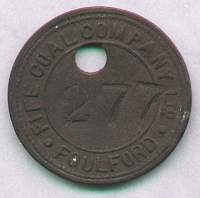
Pit-F-9.Foulford Nos. 1, 2 Pits, Cowdenbeath
Foulford Nos. 1, 2 Pits,
Cowdenbeath
Owners: Cowdenbeath Coal Co. Ltd.
Fife Coal Co. Ltd.
When the Cowdenbeath Coal Co. eventually sank their
Foulford No. 1 Pit in 1884, some 200 yds. to the west of the
Lochgelly Iron and Coal Company's Foulford Pit, they took
over the 'Fair Helen' shaft to be used as an upcast
for the complex. The underground manager, Mr. Anderson, is
reported to have entertained the pit-sinkers to a supper in
late September, 1884, on the occasion of them striking the
Dunfermline Splint seam.
The main shaft, about a mile to the east of Cowdenbeath
Station, was used for winding, pumping and downcast
ventilation.
| See entry
Cowdenbeath Pits and Mines for a summary of mining
activity in the area. |
Click on Aerial View, Map or Images
to Zoom In
The Fife Coal Co. took over this undertaking when they
amalgamated with the Cowdenbeath Coal Co. in 1896. For a number of
years the 'Cowdenbeath No. 9 and Foulford' was a listed working unit. The
Foulford No. 2 shaft was eventually sunk in 1924 and the
Foulford Swallowdrum Mine was in operation by 1927.
Foulford Colliery was adjacent to the original
Dunfermline-Thornton rail line used latterly for goods
traffic avoiding Cowdenbeath (New) Station. Fife Coal Company
had their own railway system linking their pits which did not
have N.B./L.N.E.R. access.
The Foulford complex closed temporarily in 1931 due to the
general economic climate but in fact never re-opened as a
production unit.
Yet Foulford Colliery continued into the mid-1950s as a
central washery for the surrounding pits and the mountainous
conical bings and extensive settling lagoons were left as
evidence (see aerial view).
The area has since been reclaimed and landscaped to form
part of the Dora golf course.
| Pit
opened: No. 1 sinking 1884; No. 2 sinking 1924 |
Pit closed:
1931 |
| Source Date
of Information Supplied |
| Manager /
Under-Manager / Men underground / Men above ground / Coal
seams worked / Shaft Details |
| 1884
(Cowdenbeath Coal Co.) |
| Mr. David
Anderson, manager. |
| 1890
(Cowdenbeath Coal Co.) |
No. 1:
David Anderson / -------------- / 182 / 115 / Lochgelly
Splint & Parrot; Five foot; Dunfermline Splint
D'cast (14 x 6) 917 ft. : U'cast (6 x 4½)
917 ft.
Fan ventilation - Fan (Stevenson's) 10' x
2'. |
| 1899
(Fife Coal Co. Ltd.) |
| Mr. David
Anderson, manager. |
| 1901
(Fife Coal Co. Ltd.) |
| Feb: Mr. George
Christie, temporary manager. |
| 1906
(Fife Coal Co. Ltd.) |
| Mr Beveridge,
under-manager. |
| 1907
(Fife Coal Co. Ltd.) |
April: Mr James Holmes,
manager.
May: Mr John Clark, Aitken oversman, appointed
manager of Foulford Colliery. |
| 1915
(Fife Coal Co. Ltd.) |
| Sep: Mr John Gray, manager.
|
| 1917
(Fife Coal Co. Ltd.) |
| Jun: John Gray, manager;
David Scott, under-manager.
|
| 1918
(Fife Coal Co. Ltd.) |
| April: Mr Alexander Thomson,
under-manager, appointed manager of Mossbeath Colliery.
|
| 1921
(Fife Coal Co. Ltd.) |
Oct: Mr John
Gray, manager, resigns.
Mr Wm. Peat, Mary No. 2 Pit, Lochore, appointed
manager.
Mr Clarke, formerly section oversman, Mary Colliery, Lochore,
appointed under-manager in place of Mr David Scott. |
| 1923
(Fife Coal Co. Ltd.) |
| May; Mr Wm. Peat,
manager, moves to an appointment in India. |
| 1924
(Fife Coal Co. Ltd.) |
February: Mr.
Andrew Crowe, manager, resigns to take up a position
with Wilsons & Clyde, Bellshill.
Mr James McLean, under manager, succeeded by Mr James Methven, Donibristle.
March: Mr
Strickland appointed manager but resigns in October. |
| 1928 (Fife
Coal Co. Ltd.) |
| T. Turnbull
Thyne / -------------- / 190 / 77 |
| Gas,
household and steam coals. Lochgelly Splint, Swallowdrum
and Little Splint. |
| The 1928
information was recorded for Foulford No. 2 and Surface
Mine. |
| 1930 (Fife
Coal Co. Ltd.) |
| Sep: Mr
Thyne, manager, appointed to Dalbeath Colliery. |
------------------------------------------
Foulford Colliery (19th century
report)
| Name of coal |
Thickness |
Quality |
Class |
Lochgelly
Splint and
Parrot Coal
|
Foul |
2 ft. |
not stated |
- |
| Splint |
5 ft. |
not stated |
- |
| Fire-clay |
1 ft. |
not
stated } |
Household coal |
| Coal |
9 in. |
not
stated } |
| Parrot |
2 ft. |
not stated |
Gas coal |
| Coal |
1 ft. 3 in. |
not stated |
Household coal |
| Mynheer Coal |
4 ft. 6 in. |
not stated |
Steam & household coals |
| Five Foot Coal |
5 ft. |
not stated |
Steam & household coals |
| Dunfermline Splint Coal |
5 ft. |
not stated |
Household coal |
| Plans of Abandoned Seams for Foulford |
Pits or Mines designated
in Abandonment Plans |
| COAL; Lochgelly Splint (August, 1903); Mynheer
(31 July, 1906); Fourteen Feet (5 May, 1909); Glassee
(2 February, 1911); Jewel (1 February, 1921); Dunfermline
Splint (22 January, 1924); Five Feet (1 July, 1927) |
COWDENBEATH, No. 9 AND FOULFORD |
| COAL; Swallowdrum (13 March, 1925) |
FOULFORD
No. 1 |
| COAL; Lochgelly Splint; Parrot |
FOULFORD
No. 2 |
| COAL; Five Feet; Upper Five Feet; Fourteen Feet;
Dunfermline Splint; Glassee; Lochgelly Splint; Lochgelly
Parrot; Diamond; Duddie Davie; Mynheer. IRONSTONE;
Lochgelly Blackband (March, 1925) |
ARTHUR OR NEWTON
Nos. 1, 2; Blackdean No. 5;
Dean; Foulford No. 2; Pepperknow; Washing Sink No. 1;
Whiskey Neuk; Wingate's |
| COAL; Main or Fourteen Feet; Diamond; Mynheer;
Jewel; Wee (18 August, 1927) |
FOULFORD |
| COAL; Little Splint; Swallowdrum; Lower Glassee
(September, 1930) |
FOULFORD
No. 2 |
------------------------------
Information on coals worked at Foulford
Nos. 1, 2 Pits
(based on reports from 1930 and 1934)
These Foulford pits lay between the Foulford
boundary-fault on the south and the Lumphinnans fault on the
north.
Dunfermline Splint Coal measured about 4 ft. 4 in. with a
pavement of fakes and a roof of blaes.
The best known development of Two Foot Coal in the district
was a 2 ft. 5 in. coal cut here in the shaft, 4 fathoms above
the Dunfermline Splint seam. It rested on sandstone and was
succeeded by a few feet of blaes.
The Five Foot Coal was 4 ft. 7 in. thick, with a blaes roof,
and underlain by coaly fireclay resting on sandstone.
The Jewel Coal, sometimes called the Upper Five Foot, was
worked in No. 1 Pit at a depth of 136 fathoms. A 3 ft. 6 in.
Mynheer Coal was recorded at the pit, where the seam rested
directly on sandstone and had a 6 in. ironstone in its roof.
The Glassee Coal, only 2 ft. 6 in. at the pit, was separated
from the Mynheer Coal by around 10 fathoms of sandstone.
The Lochgelly Splint and Parrot Coals were similar to the
seams found in the Lumphinnans No. 7 Pit.
The Swallowdrum Coal lay 13 to 16 fathoms above the
Lochgelly Splint and was separated from the overlying Jersey
Coals by 4 to 6 fathoms of sandy layers. It was a thick coal
measuring 3 ft. 6 in. to 5 ft. but generally included dirt
bands rendering it a poor quality coal. The identification of
the Jersey Coals here was not entirely satisfactory.
A 3 ft. 7 in. seam which lay 4 fathoms above the Swallowdrum
Coal, was called the Diamond Coal and a 2 ft. 4 in. coal,
some 3 fathoms higher in the sequence, was linked with the
Kelty Main Coal; but it appears likely that both coals could
be referred to the Jersey group and together formed the
equivalent of the Diamond Coal of Cowdenbeath.
Kelty Main Coal, above the Upper Jersey, was around 2 ft. 6
in. and the Little Splint Coal, measuring 3 ft. 2 in., was
cut in the shaft 19 fathoms above the Kelty Main Coal. It had
a roof of sandy fakes and a fireclay pavement.
Sections of Lochgelly Blackband Ironstone with an average
thickness of 1 ft. 8 in. and associated with a thin coal and
a variable thickness of shaly blaes, lay from 3 to 6 fathoms
above the Little Splint.
The Cardenden Smithy Coal seam was in two leaves, the upper
leaf measured 3 ft. 3 in. and lay 10 fathoms above the
ironstone. It was separated by 4 fathoms of various layers
from a 2 in. coal that appeared to be the only representative
of the lower leaf of the seam which was poor quality, the
coal often being soft and dirty.
At Foulford Pit, the Blairhall Main Coal was commonly less
than 1 ft. thick but it was easily recognised because of its
characteristic fireclay roof.
------------------------------------
"The Scotsman"
28 October, 1884
COWDENBEATH - NEW COALFIELD. - The mineral estate of Foulford,
which was recently acquired by the Cowdenbeath Coal Company, has proved
to be a rich coalfield. Sinking operations have of late been carried on with a
view to ascertaining the extent and quality of the mineral, and the lower or "Dunfermline
splint" seam has been struck at a depth of 150 fathoms. The seam is 4½ feet thick
and of good quality. Eight other workable seams have been struck in the shaft, of a total
thickness of 50 feet. It is expected that at least 300 acres of the respective seams will be
found on the estate, and that the daily output from the one pit will be 500 tons. At another
part of the same Company's workings the "Lochgelly splint" seam, of a thickness
of 12 feet 9 inches, has been struck in a cross-cut mine.
The Company some time ago took over the Lumphinnans Iron and Coal Company's workings,
and it is now computed that they have before them an area of 1800 acres of coal, capable of
yielding 100,000,000 tons. The present daily output is 1200 tons, but once all the shafts are in
thorough working order it is expected that this quantity will be doubled, and even at this rate of
output it will be about 150 years before the field is worked out. Contracts are being taken for the
erection of a large block of workmen's houses, and a reading-room and library are to be
opened.
------------------------------------
"Dunfermline Saturday Press"
28 April, 1888
COWDENBEATH - FATAL ACCIDENT TO A MINER
While Ebenezer Bowman (23), a miner, residing at
Cowdenbeath, was working in No. 1 Foulford Pit (Cowdenbeath
Coal Company) on Friday last week, a large boulder (weighing
about a ton), which he was trying to remove, rolled upon him,
inflicting severe internal injuries. He was conveyed to the
Edinburgh Royal Infirmary in an ambulance waggon, the Ferry
being crossed via Burntisland. On Sunday the poor fellow
succumbed to his injuries.
------------------------------------
"Dunfermline Saturday Press"
27 October, 1888
MELANCHOLY ACCIDENT AT COWDENBEATH
MAN SCALDED TO DEATH
A melancholy accident occurred at No. 1 Foulford Colliery,
Cowdenbeath, on Wednesday evening, resulting in the death of
John Kane (60), labourer, Lochgelly.
At the pithead there are four boilers standing abreast, so
that they are connected by valves. Inside of boiler No. 2
Kane was engaged in cleaning operations, and the valve of the
boiler had been opened for the discharge of water. At boiler
No. 3 an engineman was engaged, and he unfortunately opened
the valve of it and allowed the hot water to rush into boiler
No. 2. Kane's cries soon brought assistance, and he was
removed to his home, where he was attended by Dr. Nasmyth,
and all possible aid was given him. His injuries were such,
however, that he died in a few hours after the accident.
------------------------------------
"Dunfermline Saturday Press"
15 December, 1888
A serious accident occurred on Wednesday in No. 1 Foulford
Pit, Cowdenbeath Colliery, whereby one man was killed and
another seriously injured. It appears that while a number of
miners were working at the face a large mass of coal weighing
about two tons fell from the roof. Thomas Scotland (29), one
of the men, was buried among the fallen material, and so
severe were the injuries he sustained that he died in a few
minutes after he was extricated.
George Davidson (20), a brother-in-law of Scotland, was
struck on the head and face by the coal, and was slightly
hurt. Scotland leaves a widow and two children.
------------------------------------
"Dunfermline Saturday Press"
29 August, 1891
MINER CRUSHED TO DEATH
John Neilson, a miner, resident at Lumphinnans,
was on Saturday crushed to death by a stone falling upon him from
the roof while employed in No. 1 Pit, Foulford Colliery, belonging
to the Cowdenbeath Coal Company.
------------------------------------
"Dunfermline Saturday Press"
6 January, 1894
COWDENBEATH - SAD FATALITY
On Saturday, a peculiarly sad accident happened
whereby Mary Ann Hunter, 18 years of age, lost her life. The poor
girl was in the employment of the Cowdenbeath Coal Company as
pit-head worker at No. 1 Foulford Pit. It seems that the deceased
had been in the act of removing a piece of loose coal from the
lower deck of the cage, when she was caught by the upper deck in
its descent, and severely crushed about the head. Medical aid
proved of no avail, and the sufferer expired a short time after the
accident. Much sympathy is felt for her mother, who was made a
widow also through a pit accident.
------------------------------------
"Cowdenbeath & Lochgelly Times & Advertiser"
13 February, 1895
ACCIDENT. - On Friday, in Foulford Pit, John Honeyman, 16, got himself jammed between a race of hutches and was very severely bruised. Robert Hunter got his leg broken in No. 9 pit, also being jammed between hutches.
------------------------------------
"Dunfermline Press"
16 October, 1897
FATAL RESULT OF AN ACCIDENT
James Bryden, aged 13, son of George Bryden,
miner, Union Street, Cowdenbeath, died on Sunday night from the
effects of injuries sustained on Tuesday last week in No. 1
Foulford Pit, Cowdenbeath Colliery. The lad, while drawing a race
of hutches, had got jammed between the vehicles. It was thought
that he was not seriously hurt, and a doctor was not called until
the following day. It was then found by Dr Thomson that the boy had
sustained severe internal injuries.
----------
"Cowdenbeath & Lochgelly Times"
27 October, 1897
FATAL ACCIDENT INQUIRIES
Inquiries were held in the Sheriff Court on
Friday, relative to the deaths of David Westwood (43), miner,
Chapel Street, Cowdenbeath; and James Bryden (13), pony driver, son
of George Bryden, miner, Union Street, Cowdenbeath. ...
|

------------------------------------
[In February 2010 we were delighted to hear from Lorraine Hayes
(nee Bryden), Victoria, Australia, who emailed to say, "I think the
site is fantastic. From your Memorial Book and with a bit of searching I
discovered James Bryden, aged 13, who died in 1897 in the Cowdenbeath
pit. He was my great-grandfather's younger brother. My great-grandfather
and his family migrated to the coalfields of Victoria in 1923.
My grandfather and father worked in the mines."
A few days later Lorraine was again in touch to tell us "On Saturday
21st March I will be attending celebrations in Wonthaggi, Victoria, Australia, to
mark the 100th year anniversary of mining in the area. At one time the
entire Bryden family depended on the coal mines of Wonthaggi
for their living. All my great aunts were married to mining men and
all my great uncles worked below as well as my great-grandfather,
George Bryden. This legacy began in Cowdenbeath, Fife.
Some day I hope to stand in Union Street, Cowdenbeath,
and feel the presence of all my forebears."
M. Martin & Webmasters.]
------------------------------------
"Dunfermline Press"
20 November, 1897
FATAL RESULT OF AN ACCIDENT
Archibald Penman, labourer,
Bridge Street, Cowdenbeath, died in the Dunfermline Cottage
Hospital, on Saturday morning, from the effects of injuries
sustained at Foulford Pit on Thursday last week. Penman had been
assisting an engineman to put a belt on the coal-washing machine,
when his left leg came in contact with another belt which was in
motion. The leg was drawn into the pulley-wheel, and had to be
amputated. Deceased was 35 years of age.
11 December,
1897
[This issue carried a Report of
the Fatal Accident Inquiry into the death of Archibald Penman on
13th November as a result of the accident at the
Foulford No. 2 coal-washery on the 11th November.
The Inquiry was held on Monday, in Dunfermline Sheriff Court,
and heard evidence from David Anderson, manager; David Dickson,
engine-keeper; Andrew Dickson, labourer; and, PC John Forsyth. The
Jury found that the cause of death was the deceased being drawn
between a revolving belt and one of the pulleys, while endeavouring
to step through the belt, in the course of which he
stumbled.]
--------------------------------------------
"Dunfermline Press"
3 September, 1898
DUNDEE INSTITUTE OF ENGINEERS
VISIT COWDENBEATH
PITS
On Saturday the members of Dundee Institute of
Engineers visited Foulford, Mossbeath, and Kirkford Collieries at
Cowdenbeath. The party were met by Mr Anderson, the manager, and
Messrs Rennie and Christie, and were courteously conducted by them
through the different collieries.
The visit commenced with Foulford Colliery,
where attention was directed to the Lübrig coal washing plant,
and the sizing, riddling, and washing arrangements were explained
in detail. The coal is agitated in tanks, and there carried by a
series of wooden spouts to the jigging screens, whence it passes to
the hoppers, and then to the waggons. This plant works five classes
of coal. The Foulford pit adjoining the washer is winding coal from
a depth of 150 fathoms, and is fitted with winding engines, coupled
and direct action pumping engine. ... The visit, which was most
enjoyable, concluded with votes of thanks to the Fife Coal Company
for their kindness, after which the visitors were entertained at
lunch by the Company.
--------------------------------------------
"Dunfermline Press"
20 May, 1899
Peter Fitzpatrick, pitbottomer, Foulford Street,
Cowdenbeath, met with his death on Tuesday, in the Foulford Pit,
Cowdenbeath Colliery, Fife Coal Co. He was acting as haulage man in
the parrot dook, and was riding on the first of a race of ten
loaded hutches which were being drawn up the dook by means of steam
power.
No one saw the accident happen, but it is
supposed that Fitzpatrick was in the act of leaping off the hutch
when his foot was caught by the chain, with the result that he fell
under one of the vehicles. He was dragged along the road a short
distance. The engineman felt the strain on the rope and at once
stopped the engine. Fitzpatrick was taken out from among the wheels
of the hutches by Alexander Ferguson. The injured man was so
disfigured as to be scarcely recognisable. His skull was badly
fractured, and he only lived a few minutes. It seems that
Fitzpatrick was only acting temporarily at the dook, as the regular
haulage man had not turned up. The deceased was thirty-two years of
age. He was unmarried.
------------------------
"Dunfermline Press"
27 May, 1899
This issue carried the Fatal Accident Inquiry
Report into the death of Peter Fitzpatrick at Foulford Pit,
Cowdenbeath. Among those giving evidence were:- David Anderson,
colliery manager; Mr Atkinson, H. M. Inspector of Mines; John
Anderson, jun., oversman, Cowdenbeath; Peter Gardiner, pony driver;
Alexander Ferguson, miner; and, Robert Shand, haulage engineman.
The jury returned a formal verdict.
------------------------
"Dunfermline Press"
12 January, 1901
An accident terminating fatally occurred at the
Fife Coal Company's No. 1 Foulford Pit, Cowdenbeath, on
Tuesday. James Stott, a waggon shunter, was in the act of coupling
two waggons at a screen, when several other waggons ran away, and
crashed into the one immediately behind him, with the result that
he was caught between the couplings, and several of his ribs were
broken, and he was otherwise injured internally. He was removed to
the Dunfermline Cottage Hospital, where he died shortly afterwards.
The deceased was forty-five years of age.
-----------
"Dunfermline Press"
2 February, 1901
This issue carried the Report of the Fatal
Accident Inquiry, held at Dunfermline, into the death of James
Stott, waggon-shunter, Cowdenbeath. Among those giving evidence
were:- George Christie, mining engineer and temporary manager;
Robert Hay, waggon-shunter, Broad Street, Cowdenbeath; Thomas Dunn
and William Nunn, fellow workmen of deceased; and Nurse Logan,
Dunfermline Cottage Hospital. The Jury returned a formal
verdict.
--------------------------------------------
"Dunfermline Press"
14 June, 1902
PRESENTATION TO AN OVERSMAN
On Saturday evening, a number of the workmen
employed at No. 1 Foulford Pit met in the Raith Arms and presented
Mr Andrew Lindsay, oversman, with a handsome marble clock on the
occasion of his engagement as oversman at the pit
terminating.
--------------------------------------------
"The Scotsman"
2 April, 1904
FIRE AT COWDENBEATH. - Fire broke out yesterday morning in the
stackyard at the Fife Coal Company's Foulford pit, Cowdenbeath,
owing, it is supposed, to sparks being emitted from the adjoining pit stalk.
There were twenty-four stacks of oats in the yard, and of these fifteen
were destroyed, the damage being estimated at about £150.
--------------------------------------------
"Dunfermline Press"
2 April, 1904
On Tuesday morning, a young woman named Euphemia
Hughes, residing with her parents in Chapel Street, and employed as
a pithead worker at Foulford Pit, belonging to the Fife Coal
Company, was injured while on one of the scaffolds. The scaffold
seems to have given way, and the woman fell to the ground, a
distance of nearly 20 feet. She was severely cut about the face and
head, and sustained a severe nervous shock. Dr Craig was
immediately in attendance.
----------------------------------------------
"The Scotsman"
17 September, 1904
COLLIERY FATALITY AT COWDENBEATH. - Alexander Currie, a
labourer, of no fixed residence, aged about fifty years, died in the Dunfermline
Cottage Hospital yesterday from the effects of an accident which had occurred
early in the morning at the Fife Coal Company's Foulford pit. On a waggon
being shunted cries of distress were heard, and it was then discovered that the
waggon was resting on Currie's legs in a lye.
----------------------------------------------
"Dunfermline Press"
27 January, 1906
It was reported that Robert Hunter, miner,
residing at School Street, was severely crushed about the body in
Foulford Pit by a roof fall.
----------------------------------------------
"Dunfermline Press"
3 March, 1906
Mr Beveridge, under manager, Foulford Colliery,
has been presented by the underground workers, on the occasion of
his marriage, with a handsome kitchen clock, along with two
beautiful oil paintings for his intended wife.
----------------------------------------------
"Dunfermline Press"
30 June, 1906
James Pratt, miner, residing in Mungall Street,
Lumphinnans, had his arm broken while descending Foulford Pit on
Monday.
----------------------------------------------
H. M. Inspector of Mines Report 1907
Mr. Robert McLaren's Report
Fatal Accident at Cowdenbeath, Fife
Owner: Fife Coal Co., Ltd.
3 April, 1907
William Brown, 70, Wood-cutter. Deceased was
crossing the lines of rails of the sidings, when unobserved a
train of waggons being pushed by a locomotive came upon him
and he was run down.
-------------------------
"Dunfermline Press"
13 April, 1907
William Brown, a woodcutter, lately residing at Park Avenue, Cowdenbeath,
died in the Dunfermline and West Fife Hospital on Thursday from the effects of injuries
received at the sidings of Foulford Pit, Cowdenbeath, on Wednesday last week.
Deceased who was employed at the pit, was crossing the sidings when he was knocked
down by some empty waggons, the approach of which he had failed to observe. His left
arm and leg were severed from the body. Deceased was seventy years of age.
-------------------------
"Dunfermline Press"
27 April, 1907
Under the Fatal Accidents Inquiry Act, an inquiry was held in the Sheriff Court,
Dunfermline, on Thursday - before Sheriff Shennan and a Jury - into the circumstances
attending the death of a woodcutter, William Brown, lately residing at 24 Park Avenue,
Cowdenbeath, who was injured on 3rd April on Foulford sidings by being run over by waggons
during shunting operations, and died on the 11th April in the Dunfermline and West Fife Hospital.
Those giving evidence included:- James Holmes, colliery manager, Marchmont House, Cowdenbeath;
Robert Strachan, woodcutter, 19 Pretoria Row, Cowdenbeath; and Thomas Dair, shunter,
4 School Row, Cowdenbeath. A formal verdict was returned.
----------------------------------------------
"Dunfermline Press"
4 May, 1907
This issue carried the news that workmen at the Aitken Pit presented Mr John Clark, oversman, with
gifts on the occasion of his leaving the Aitken Pit to fill the more important position of manager of Foulford
Colliery, Cowdenbeath. He had been oversman in the Aitken for four years.
----------------------------------------------
"Dunfermline Press"
18 May, 1907
This issue carried news of the death of Mr John Anderson, oversman, Broad Street, Cowdenbeath.
Mr Anderson was under-manager of No. 3 Pit for a time, and afterwards of Foulford and No. 9.
----------------------------------------------
"Dunfermline Press"
7 September, 1907
A coal cutter attendant named James Brown, residing at 50 Foulford Street, sustained
severe injuries in the Foulford Pit on Tuesday night. He, along with his two sons, had just set
the cutting machine agoing when it swerved round. One of the picks pierced Brown's boot,
and his leg, through being jammed between the disc and the coal, was fractured in
two places.
----------------------------------------------
"Dunfermline Press"
25 January, 1908
A miner named John Muir, residing in Park Street, was severely crushed by a fall of coal
in the five-feet seam of the Foulford Pit on Thursday.
----------------------------------------------
"Dunfermline Press"
1 May, 1909
A miner named Henry Geddes, 55, residing in School Street, Cowdenbeath, was severely
crushed by a fall of stone in the Diamond Seam of the Foulford Pit on Thursday. On being examined
at home by Dr Craig, it was found that the man's back and a few of his ribs had been broken.
In the evening he succumbed to his injuries. Deceased, who leaves a widow and grown-up family,
had resided for over thirty years in the town, and being of a happy disposition, he was greatly respected.
In his younger days he took an active interest in football, and was at one time trainer to the Cowdenbeath
Football Club.
--------------------
"Dunfermline Press"
29 May, 1909
A formal verdict was returned in the case of Henry Geddes, miner, lately residing at School Street,
Cowdenbeath, who was killed by being struck with a stone in his working place in the Fife Coal Company's
Foulford pit on 27 April. The evidence showed that the deceased was in the act of removing a prop, which
was in the way, when the stone, measuring about five feet long and three feet broad and about eleven inches
thick, fell upon him. A lipe was disclosed after the fall. All the witnesses testified to the carefulness with which
the propping rules had been observed by the deceased.
----------------------------------------------
"Dunfermline Press"
17 July, 1909
James Wilson, an engineer, belonging to Loanhead, and residing at 46 Natal Place, Cowdenbeath, was
on Saturday afternoon injured while at work at Foulford Pit belonging to the Fife Coal Company. Wilson was
engaged at the machinery when the half of a flywheel weighing several tons fell on his left foot crushing it.
He was taken to the Edinburgh Royal Infirmary.
----------------------------------------------
"Dunfermline Press"
27 November, 1909
Yesterday forenoon, William Bell (50), residing at 38 Broad Street, Cowdenbeath, received
serious injuries in the diamond seam of Foulford Pit. He was employed in the Conveyor Section,
and through being crushed by a fall of stone, his collar bone, shoulder blade, and a number of ribs,
were broken. He was conveyed home in a very weak condition.
----------------------------------------------
"Dunfermline Press"
2 April, 1910
A shunter named Braid, residing at Pittencrieff Street, Dunfermline, was
severely injured while at work at Foulford Pit yesterday. Braid had been engaged
shunting some waggons at the pithead, and was lying over his coupling pole
inserted into one of the waggons, which were in motion. He failed to observe
an iron standard near the railway, and he struck it with considerable force,
causing his injuries, which were principally internal. He was conveyed to
Dunfermline and West Fife Hospital.
----------------------------------------------
"Dunfermline Press"
18 February, 1911
In the Burgh Arms on Saturday evening, Mr Thomas Lumsden, night oversman,
Foulford Pit, was met by a number of his fellow-workmen on the occasion of his departure
today for British Columbia. Mr Patrick Canovan presided. ...
----------------------------------------------
"Dunfermline Press"
4 March, 1911
Considerable damage was done by fire at the Foulford Pit, Cowdenbeath Colliery,
belonging to the Fife Coal Company, on Monday. The fire originated in the winding
engine-house, and within an hour all the woodwork about the building, together with
that of the haulage engine-room adjoining, was burnt. The scaffolding around the
pit mouth was endangered, but a large squad of men, under the direction of Mr H.
Rowan, general manager, were successful in keeping the fire from spreading to it.
While this work was proceeding other men made preparation for the raising of the
underground workers by the outlet shaft situated a little to the east, and without
much delay the latter were safely brought to the surface. The fire is supposed to
have been due to the brake of the winding engine overheating. The engineers
are busily making good the damage, which was estimated at £500, and not
many days are expected to elapse before work will be resumed. There are
over 100 men employed in the pit.
----------------------------------------------
"Dunfermline Press"
11 May, 1912
While an engineer named Frank Mustard, residing at South Street, was oiling
a fan engine at Foulford pit on Sunday, a board in the floor gave way, and he fell
forward on the machinery. His arm was broken and badly crushed, and he was
speedily removed to Dunfermline and West Fife Hospital.
----------------------------------------------
"Dunfermline Press"
31 August, 1912
There was quite a chapter of minor accidents in the Cowdenbeath district at the week-end
besides the serious one at No. 7 Pit. While Thomas Bell, 26 Lawson's Buildings, and
Thomas Donaldson, Pretoria Row, were in the act of blasting the coal in Foulford Pit the
shot went off unexpectedly, burning each man about the arms and face.
----------------------------------------------
"Cowdenbeath Mail & West Fife Record"
30 November, 1912
John Ewan (24), miner, residing in High Street,
Cowdenbeath, was injured in Foulford Pit early on Tuesday morning,
by a heavy stone falling from the roof. The stone caught him on the
back and inflicted severe bruises. He was conveyed home in the
ambulance wagon and attended by Dr Primmer.
--------------------------------------------
"Dunfermline Press"
28 June, 1913
A young miner named Thomas Thomson, residing at 3 Chapel Street, had
his leg fractured while following his employment in Foulford Pit on Monday.
--------------------------------------------
"Dunfermline Press"
18 July, 1914
Late on Friday night fire broke out at the old coal washer at Foulford, and
the fire brigade were called out. The washer has not been in use for nine years.
--------------------------------------------
"Dunfermline Press"
22 August, 1914
The mining trade continues to suffer considerably. On Monday, the Fife Coal Company
gave notice that No. 7, No. 9, and Foulford Pits would be closed down in a fortnight, and
that an endeavour would be made to give the men engaged at these collieries a share
of the work in the Company's other pits. ...
--------------------------------------------
"Dunfermline Press"
23 October, 1915
John Allan, miner (60), who resided at 30 Park Street, Cowdenbeath, met
with his death instantaneously while following his employment in Foulford Pit,
Cowdenbeath Colliery, on Friday night last week. He was doing repair work in the
fourteen feet seam when a large stone broke from the roof and crushed him to the
pavement. The stone had to be broken before the body could be removed.
Deceased was a widower.
--------------------------------------------
"Dunfermline Press"
21 October, 1916
John Inglis, joiner, Manse Row, Crossgates, was fatally injured at the Fife
Coal Company's Foulford Colliery, Cowdenbeath, on Saturday afternoon.
He was engaged taking down a wooden partition in a brick flue, when the
brickwork unexpectedly collapsed. He was struck on the head by a portion
of the falling material, and on the left hand, the index finger of which was
badly crushed. Dr Primmer, who was called, ordered the man's removal
to the Dunfermline and West Fife Hospital, where he died the same evening.
--------------------------------------------
"Dunfermline Press"
26 May, 1917
William Menzies, 145 Union Street, Cowdenbeath, while working as a machineman
in Foulford Pit on Tuesday night, was seriously bruised by a fall from the roof. He was
medically examined by Dr Young, who ordered his removal to the Dunfermline and
West Fife Hospital.
--------------------------------------------
"Dunfermline Press"
12 January, 1918
Colin Maxwell, miner, 372 Broad Street, Cowdenbeath, was accidentally killed in
Foulford Pit on Thursday. He had been engaged taking down coal at the 14 feet
seam, when a large quantity of stone came away from the roof. His body was
extricated after about an hour's work. Death must have been almost instantaneous.
Deceased, who was well-known in Cowdenbeath district, was 58 years of age. He
leaves a grown-up family. One of his sons, who was organist of Mossgreen Parish
Church, was recently awarded the Military Medal for bravery in the field.
--------------------------------------------
"Dunfermline Press"
6 April, 1918
Mr Alexander Thomson, who has been under-manager at the Fife Coal Company's
Foulford Colliery for several years, has been appointed manager of the Company's colliery
at Moss-side in succession to Mr James McDonald, who has received an appointment
elsewhere.
--------------------------------------------
"Dunfermline Press"
18 May, 1918
Mr Alex. Thomson, Broad Street, under-manager, Foulford Pit, was, on the occasion of his
being appointed manager at Mossbeath Colliery, met by the workmen and their wives in the
D.C.I. Tea-rooms on Friday last week, and presented with an Oak timepiece, suitably inscribed,
together with a pair of bronze ornaments for Mrs Thomson. ...
--------------------------------------------
"Dunfermline Press"
8 June, 1918
Miss Annie Arnott, checker, Foulford Pit, has been presented with an easy chair, a
basket chair, and four kitchen chairs by those employed at the colliery, on the occasion of
her marriage. ...
--------------------------------------------
"Dunfermline Press"
29 March, 1919
Wm. Ferguson, Chapel Street, Cowdenbeath, was badly bruised while at work in
Foulford Pit.
--------------------------------------------
"Cowdenbeath & Lochgelly Times & Advertiser"
28 April, 1920
A miner named Alex. Miller (59), 2 Sligo Street, Lumphinnans, had his left leg fractured below the knee in the Fourteen Feet seam, Foulford Pit, on Friday. He was taking down the coal at the face when a stone broke away from the roof and crushed him to the pavement. On being medically examined he was removed to the Dunfermline and West Fife Hospital.
--------------------------------------------
"Dunfermline Press"
8 May, 1920
Harry Lister, residing with his parents in Natal Place, was badly injured by a
fall of coal in the fourteen feet seam, Foulford Pit, at the end of last week. He was
removed to the Dunfermline and West Fife Hospital, where, on examination, it
was found that his back had been seriously injured.
--------------------------------------------
"Cowdenbeath & Lochgelly Times & Advertiser"
17 August, 1921
Mining Appointment
Mr Andrew Scott, who has been manager at the Fife Coal Company's Foulford Colliery for some years has [been appointed manager] at Kirkford, Hill of Beath. He is to be succeeded at Foulford by Mr Chas. Scott, who had had extensive experience in various collieries throughout Scotland.
[We are in doubt about the accuracy of the above report as other perons are recorded as occupying managerial positions at the mentioned pits.
M. Martin & Webmasters]
--------------------------------------------
"Dunfermline Press"
24 September, 1921
FATAL RESULT OF COWDENBEATH ACCIDENT.
MINER'S LONG ILLNESS.
Mr Harry Lister, Natal Place, Cowdenbeath, who received an injury to his
spine in the mine in April of last year, died in the Dunfermline and West Fife
Hospital on Wednesday. He was well-known in West Fife through having
played football for Lochgelly United and Dunfermline Athletic. ...
--------------------------------------------
"Dunfermline Press"
8 October, 1921
Mr John Gray, who has been manager of the Fife Coal Company's pits
at Foulford and No. 9 for several years, is resigning his position, and will be
succeeded in Cowdenbeath by Mr Wm. Peat, who is at present in charge
of the same Company's sinking pit at Lochore.
--------------------------------------------
"Cowdenbeath & Lochgelly Times & Advertiser"
12 October, 1921
Local Colliery Appointments
Mr John Gray, who has been manager of the Fife Coal Company's pits at Foulford and No. 9 for several years is resigning his position, and will be succeeded in Cowdenbeath by Mr Wm. Peat, who is at present in charge of the same Company's sinking pit at Lochore.
Mr James Paterson, who was formerly under-manager at the Fife Coal Company's Colliery at Benarty, has been appointed to a similar position at No. 2 Pit, Low Valleyfield.
Mr John Skimming has been appointed under-manager at No. 1 Pit.
Mr Clarke, section oversman at the Mary Pit, Lochore, has been appointed under-manager at the Fife Coal Company's No. 9 Pit, in succession to Mr David Scott.
--------------------------------------------
"Cowdenbeath & Lochgelly Times"
4 October, 1922
A fatal accident at the Foulford Pit, involving
the death of John Hannah (35), a coal cutting machineman, occurred
late on Monday evening. The unfortunate man was feeding the coal
cutting machine when a fall of stone took place, and he was crushed
to the pavement. When extricated, it was found that life was
extinct, the victim having been suffocated.
--------------------------------------------
"Dunfermline Press"
7 April, 1923
A deputation from Foulford Colliery met Mr James Smillie,
late under-manager of the colliery, to present him with parting
gifts on the occasion of his leaving for Canada.
--------------------------------------------
"Dunfermline Press"
26 May, 1923
Mr Wm. M. Peat, manager of No. 9 and Foulford Collieries, has
received an important mining appointment in India. He has been in
the service of the Fife Coal Company, Ltd., for a number of years
at different collieries, and has proved himself a capable official.
--------------------------------------------
"Dunfermline Press"
10 November, 1923
COWDENBEATH PIT FATALITY.
BAILLIE'S SON ELECTROCUTED.
Peter Hogg, thirty years of age, who resided in Wardlaw Street,
Cowdenbeath, lost his life in Foulford Pit, Cowdenbeath Colliery, soon
after starting work on the night-shift on Thursday. While he was
engaged with other men at the coal-cutting machinery, it had become
necessary to switch off the electric current. He was on his way to
do this, when it is understood, he came in contact with a machine
electrically charged, and he was electrocuted. Every effort was
made to restore life, but without success.
Deceased, who was the eldest son of Baillie Hogg, leaves
a widow and three of a family.
-----------------------------
"Dunfermline Press"
1 December, 1923
Under the Fatal Accidents Inquiry Act, an inquiry was held in
the Sheriff Court, Dunfermline, on Thursday - before Sheriff Umpherston
and a Jury - into the circumstances attending the death of Peter Hogg,
lately residing at 9 Wardlaw Street, Cowdenbeath, by electrocution.
In this case, where the death took place in No. 1 Foulford Pit, it was
established that, on the day before the accident, one of the men
had received a shock from the cable, which, on examination, was
found to contain a small puncture. The jury returned an open verdict.
-----------------------------
"Cowdenbeath & Lochgelly Times and Advertiser"
6 February, 1924
COLLIERY CHANGES
Mr James Methven, under manager, Donibristle Colliery, has been appointed to succeed Mr James McLean as under manager at Foulford Colliery. Mr Methven is known to be a capable official of the Fife Coal Coy., Ltd., and no doubt he will prove himself an efficient under manager in his new sphere.
--------------------------------------------
"Cowdenbeath & Lochgelly Times"
20 February, 1924
Having received an important appointment with
the Wilsons & Clyde Coal Company, Ltd., at Bellshill, Mr Andrew
Crowe, manager of Foulford Colliery, has resigned from the services
of the Fife Coal Company, Ltd.
--------------------------------------------
"Cowdenbeath & Lochgelly Times"
27 February, 1924
Mr James Methven, underground manager,
Donibristle, was transferred to Foulford Colliery.
--------------------------------------------
"Cowdenbeath &
Lochgelly Times"
12 March, 1924
The position of manager of Foulford and No. 9
Pits, Cowdenbeath, rendered vacant by the departure of Mr A. Crowe
to Lanarkshire has been filled by the appointment of Mr Strickland,
who has had extensive experience in Ayrshire and North of England
Collieries. Mr Strickland comes to Cowdenbeath with excellent
credentials from the North of England. His mining experience there
will no doubt assist him to overcome the difficulties he may be
faced with in his new charge.
-------------------------------------------------
"Cowdenbeath & Lochgelly Times"
2 April, 1924
A company of officials and workmen of No. 9 and
Foulford Pits, Cowdenbeath, met in the Arcade Hotel on Saturday
evening to honour Mr Andrew Crowe, colliery manager, on the
occasion of him leaving the district.
--------------------------------------------
"Cowdenbeath & Lochgelly Times"
23 April, 1924
In the early hours of Thursday morning, Robert
Curran (32), residing at 114 Main Street, Lumphinnans, lost his
life in No. 7 Pit, Cowdenbeath, by being electrocuted. Curran was
working in a machine run of the Little Splint Dook when the
accident happened. The coal cutting machine had been removed from
one run to another, and shortly after the electric current had been
switched on Curran was electrocuted. The miners working along with
him immediately went to his assistance, applying artificial
respiration for fully an hour, but to no purpose. He leaves a widow
and three children, for whom much sympathy is felt.
A somewhat similar accident occurred some months
ago in Foulford Pit, when Peter Hogg, the eldest son of Bailie
Hogg, was then electrocuted.
--------------------------------------------
"Cowdenbeath & Lochgelly Times"
Wednesday, 8 October, 1924
Mr Strickland, who has been colliery manager
with the Fife Coal Company at Foulford and No. 9 Pits at
Cowdenbeath for some time, has resigned his position, having
received an important appointment with a mining firm in the North
of Ireland.
--------------------------------------------
"Cowdenbeath & Lochgelly Times"
10 December, 1924
The new pit at Foulford, Cowdenbeath, is now
completely sunk, the bottom, which is a distance of 47 fathoms from
the surface having been reached, and now the finishing touches are
being put to it. The pit has been sunk to reach the upper seams of
the colliery, and it is expected that there is enough mineral to
keep the pit open for many years to come.
A new pithead is being erected at Foulford,
which will cope with the output of Foulford Pit, the new shaft, and
No. 9, a quarter of a mile away, the coal from which comes by means
of a haulage to Foulford.
--------------------------------------------
"The Scotsman"
Effect of Slack Trade
19 February, 1925
Work at the collieries in the Cowdenbeath district has been slack for some months and the Fife Coal Company, Ltd. have given the workers of Foulford and No. 9 Pits, Cowdenbeath, and of Lassodie Mill and Blairenbathie Collieries, Kelty, fourteen days' notice for the termination of employment. Certain workers in the pits of Raith Colliery, belonging to the Lochgelly Iron and Coal Co. Ltd., have received notices to the same effect.
--------------------------------------------
"Cowdenbeath & Lochgelly Times"
11 March, 1925
200 MEN AFFECTED
The Fife Coal Company have decided to close No.
9 Pit and the Swallowdrum section of Foulford Pit, Cowdenbeath.
This will throw idle over 200 men.
--------------------------------------------
"Cowdenbeath & Lochgelly Times"
20 May, 1925
Foulford Colliery, Cowdenbeath, belonging to the
Fife Coal Company, was idle during the latter part of last week
owing to a breakdown in the pumping machinery. Since the Newton
Colliery, belonging to the Lochgelly Iron and Coal Company, was
shut down there has, it is stated, been an increase in the volume
of water at Foulford Pit, with the result that the pumping plant at
Foulford Pit is unable to cope with the ever-increasing volume of
water. It is not expected that work will be resumed at the colliery
for some time. A large number of men are affected by the
stoppage.
--------------------------------------------
"Dunfermline Press"
3 April, 1926
Oliver McCartney (37), coal-cutting machineman, residing at 34
School Street, Cowdenbeath, was the victim of an accident in No. 5
seam of Foulford Pit, Cowdenbeath, on Thursday. He was in the act
of turning his coal-cutting machine, an operation which requires the
use of a chain attached to a tree or prop, when the tree swung out
of position and struck him on the left side of the head. Suffering from
slight concussion of the brain, he was conveyed home after having
received a "first-aid" treatment.
--------------------------------------------
"Lochgelly Times"
15 June, 1927
COWDENBEATH PITS TO CLOSE
The following Cowdenbeath pits are to close down:-
No. 10 (Kirkford)
Lassodie Mill (Kelty)
No. 1 (Foulford)
This intimation has been made by the Fife Coal
Coy., and it has caused an uneasy feeling in the
district.
Some time ago a prominent official of the Fife
Coal Coy., indicated to us the prospect of such a happening.
Indeed, he expressed the opinion that the present condition of the
mining industry was such that until new plans could be put into
operation there would be a certain closing down of all the older
pits, not only in Fife, but all over the country. New methods were
needed, and only in the newer types of pits could these be applied.
Something like 400 men are involved in the present closing down,
and we were informed that as far as possible they would be absorbed
in other pits. ...
--------------------------------------------
"Dunfermline Press"
6 September, 1930
130 MINERS DISMISSED AT COWDENBEATH.
During this week, 130 workers, representing practically the total number of
men employed at Foulford Colliery have been dismissed. This is accounted
for by the dull trade, but the pit is not definitely closed. Men have been left
in charge of the pumps, and the washery at the pit will continue in operation.
Some of the men are likely to receive employment at other collieries, but the
great majority will be unemployed. At one time, the output at Foulford was 400
or 500 tons per day, but latterly this has dropped to about 200 tons. Mr Thyne,
manager, has been appointed to a similar position at Dalbeath Colliery.
Foulford Colliery has belonged to the Fife Coal Company, Limited, for a period
of twenty-four years. Previously it was under the control of the Cowdenbeath
Coal Company, who disposed of it along with No. 7 Pit, and Nos. I. and XI.,
Lumphinnans and Moss-side, to the Fife Coal Company. Foulford was
generally known among older miners by the name of "Fair Ellen."
--------------------------------------------
"Dunfermline Press"
12 September, 1931
COWDENBEATH COLLIERY FATALITY.
MYSTERY OF HALBEATH MAN'S DEATH.
John Simpson (51), a shunter, who resided at 2 Macdonald Square,
Halbeath, was killed during shunting operations at the railway sidings near
Foulford Colliery, Cowdenbeath, early on Wednesday morning. There were
no witnesses of the accident, and the circumstances under which the
unfortunate man met his death are a matter of conjecture.
Simpson had put up the doors of a train of waggons, and, after returning
to the end waggon, signalled to the driver that all was clear.
Shortly afterwards it was noticed that waggons had been derailed, and
other workmen who went to ascertain the cause of the trouble found
Simpson lying on his back on the sleeper ends. Death had been
instantaneous, deceased's neck having been broken.
It is surmised that he was thrown from a waggon of the moving train
and crushed against a stationary waggon on a line alongside.
----------------------
"Dunfermline Press"
3 October, 1931
Under the Fatal Accidents Inquiry Act, an inquiry was held in
the Sheriff Court, Dunfermline, on Thursday - before Sheriff Umpherston
and a Jury - into the circumstances attending the death of John Simpson,
colliery waggon shunter, 2 Macdonald Square, Halbeath, who was killed
on 9th September, in course of his employment as a shunter at Foulford
Colliery, belonging to the Fife Coal Company, Limited, by being thrown
from and crushed by a railway waggon during shunting operations. Those
giving evidence at the inquiry included Thomas Cunningham Simpson,
locomotive driver, 32 Old Perth Road, Cowdenbeath, and James Houliston
Robertson, waggon man, 29 Foulford Street, Cowdenbeath. A formal
verdict was returned by the jury.
--------------------------------------------
"Dunfermline Press"
16 November, 1940
COWDENBEATH MAN FATALLY INJURED.
A well-known Cowdenbeath man, Mr David Bowman, Union Street,
Cowdenbeath, died in Dunfermline and West Fife Hospital last Friday from
injuries he received in an accident at the Washer at Foulford Colliery,
belonging to the Fife Coal Company, Ltd. He was knocked down by an
empty waggon and crushed between an axle and a wooden platform. His
injuries were so severe that he died a few hours after he was admitted to
hospital. Mr Bowman, who was seventy years of age, had resided in
Cowdenbeath nearly all his life. He leaves a widow and grown-up family.
--------------------------------------------
"Dunfermline Press"
10 June, 1944
This issue carried news of the death of Mr Thomas Thyne, agent of the
Fife Coal Company pits. ... Mr Thyne, who belonged to the Cardenden district,
came to Cowdenbeath, as manager of Foulford Pit, and since then he had
gradually been promoted in the service of the Fife Coal Co. ...
--------------------------------------------
"Dunfermline Press"
10 February, 1951
KNOCKED DOWN BY COAL TRAIN
Crosshill Man Killed
A 70-year-old pit worker was killed and another had a remarkable
escape in an accident which occurred on the N.C.B. mineral railway line
near Foulford Washery, Cowdenbeath, on Thursday.
The victim was John Durkan, labourer, 3 Inchgall Avenue, Crosshill,
and the man who escaped was Charles Lee, 90 Small Street, Lochgelly.
The two men were proceeding to their work at the washery when they
were knocked down by a colliery locomotive propelling 13 loaded wagons.
Durkan was instantaneously killed. Lee owed his escape to the fact that
he had the presence of mind to lie flat on the ground.
The engine, which has a ground clearance of only 11 inches at one point,
and the 13 waggons passed over the two men, but Lee was found to be
suffering only from head injuries. He was removed to Dunfermline and West
Fife Hospital, and after treatment was allowed home.
Durkan is survived by his widow and a grown-up family of five.
--------------------------------------------
Coal from the Foulford Colliery was used in the boilers at
Guardbridge Paper Mill, near St Andrews. William MacLeod, former
chief engineer at the mill, has kindly sent analysis details on the
incoming coal which was evaluated on its arrival.
COAL REPORT
Fuel: Foulford
Supplier: N.C.B. |
Laboratory
Reference: 6/57 A.D.
Sampled ex: Wagons |
Date
received: 24.01.57
Date Tested: 25.01.57 |
THERMAL
VALUES
Calorific Value: 8,232 B.T.U's/lb.
Evaporative Power: 8.52 lbs |
| Moisture:
23.6 % |
Volatile
Matter (less Moisture): 24.5 % |
Fixed Carbon:
34.6 % |
Ash: 17.3
% |
--------------------------------------------
"Dunfermline Press"
20 August, 1960
Washery To Be Abandoned
As the National Coal Board have intimated to Cowdenbeath Town Council that their
Foulford Washery is to be abandoned at an early date as a working unit, the Town
Council will no longer be able to continue discharging sewage effluent into the silt pond there.
As the Dano Bio-Stabilizer plant which is to be erected at the town's sewage works will
not be completed until 1961, the Council agreed at their monthly meeting to enter into negotiations
with the National Coal Board for the use of the lagoon situated to the east of the washery. The
sludge will continue to be discharged into the channels there and the solidified material in the
lagoon will be used for building purposes. It was also agreed that a long-term lease of the
lagoon be sought so that it may be used in cases of emergency such as the overhaul or
breakdown of the stabilizer plant.
--------------------------------------------