| Please refer to the Fordel - early coalworks
entry for
information on this ancient and famous coalfield. |
|---|
|
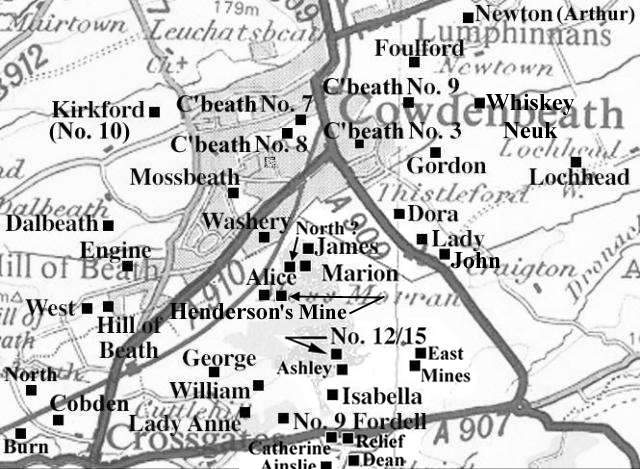
Our research to date is revealing the locations of a
large number of unidentified old pits and mines along
with a similar number of named pits, the locations of
many being indicated either on maps or on aerial views
(see below).
Unravelling the complete picture of the Fordel mining scene is proving quite complex since several pits listed under Fordell Colliery are also listed under Cuttlehill Colliery and/or Prathouse. Changes of ownership of pits bordering different small coalfields did take place, and it is known that some pits closed for a period of time, may have been re-opened to work coal seams at a later date. Most of the Fordell pits worked into the 20th century were located in the small area bounded by Crossgates, Cowdenbeath, Donibristle and Fordell and were known both by numbers and names. Equally, the earlier old bell-pits around Vantage, near Fordell House, and further north towards Drumcooper and up to Fordell village, also appear to have had a similar numbering/naming system. We are aware that the task of providing accurate information on each and every one of the pits or mines is huge - many must just have been shallow holes in the ground - and beg your patience while we attempt to unravel details of the workings of this historic coalfield. |
|---|
 |

|
 |
 |
 |
Pits or mines in the Fordell area are thought to have included:
Ainslie, Alice, Anson, Backmoss, Barnyard, Barnyard Level, Bearing, Blackhill (No. 3), Blackmoss, Bog, Boghead, Botany Bay, Bulwark, Burn, Bye, Calais Hill (Crow), Chance, Combination, Countess, Craw, Crossgates East, Crow's, Cuttlehill (Nos. 1, 2, 4), Dows, Earls, Earl's Row, East March, Engine, English, Fordell No. 7, Fordell No. 8, Fordell No. 9, Fortune, George, Henderson's Mine, Holburn, Hopewell, Hopewell Gin, Humbug (No. 12), Humbug (Vantage), Lady Anne (No. 4), Main Gin West, Mair, March, Meadow, Middlemoss, Mill, Mynheer, Muirs, New Lauder, New Venerable, No. 5, No. 6, No. 7, No. 8, No. 9, No. 10, No. 11, No. 12 (Haugh?), No. 13 (Middleton?), No. 14, No. 15 (Engine?), No.16 (Red Rows?), No.17 (Office?), No. 18 (Drumcooper), North, Old Fordell, Old Venerable (Engine?), Pinkerton's, Piper Sink, Prathouse (No. 3), Ramsay's, Red's, Reid's, Renown, Roadside (No. 4), Roundell, Speedwell, Stair, Success, Tank, Vengeance, Venture, Wellington (later William), West Main, West Moss, West Muir.
| Please
also see the Nationalisation Section of the website - Menu 4 -
for more Fordell Colliery information. |
---------------------------------------------
Fordell (Fordel) Colliery
| Source Date of Information (Owner) |
|---|
| Manager / Under-Manager / Men underground / Men above ground / Coal seams worked |
| early 16th century (Henderson family) |
| 1750 (Sir John Henderson) |
| 1836 |
| W. L Gofton, Manager |
| 1837-1841 |
| Francis Grier, Manager |
| 1842 (Admiral Sir Philip C. H. Durham, Bart.,) |
| Francis Grier, Manager |
| 1845 (Admiral Sir Philip C. H. Durham) |
| 1851-1852 |
| J. Robertson,
Manager
[Dunfermline Registers.] |
| 1853-1859 (G. W. Mercer Henderson) |
| T. Robertson,
Manager
[Dunfermline Registers.] |
| 1860-69 (G. W. M. Henderson) |
| T. Robertson,
Manager in 1868
[County Directory of Scotland] |
| 1871 & 1872 (G. W. M. Henderson) |
| John Whitelaw,
Manager
[Dunfermline Registers.] |
| 1873 & 1874 (G. W. M. Henderson) |
| John Whitelaw,
Manager
Departure of Mr. James Henderson, Underground Manager during 1873. Listed pits: Cuttlehill No. 9, Cuttlehill William, Prathouse Nos. 3, 4, 5 |
| 1875 & 1876 (G. W. M. Henderson) |
| George Hogg,
Manager
Listed pits: Cuttlehill No. 9; Cuttlehill William; Prathouse Nos. 3, 4, 5 |
| 1877 (G. W. M. Henderson) |
| George Hogg,
Manager
Listed pits: Cuttlehill No. 9; Cuttlehill William; Prathouse Nos. 3, 4; Lady Anne; Vengeance |
| 1878 & 1879 (G. W. M. Henderson) |
| Thomas Falconer,
Manager
Listed pits: Cuttlehill No. 9 (stopped Sept. 1878.); Cuttlehill William; Prathouse Nos. 3, 4; Lady Anne; Vengeance |
| 1880 (G. W. M. Henderson) |
| Thomas Falconer,
Manager
Listed pits: Cuttlehill No. 9 (Ventilation shaft.); Cuttlehill William; Prathouse Nos. 3, 4; Lady Anne; Vengeance Alice Pit - sinking. |
| 1881 (Trustees of G. W. M. Henderson) |
| Thomas Falconer,
Manager
Listed pits: No. 9 (Upcast only.); William; Prathouse No. 4; Lady Anne; Alice Pit - sinking. |
| 1882 (Fordell Trust) |
| Thomas Falconer,
Manager
Listed pits: William; Prathouse No. 4; Lady Anne |
| 1890 (Fordell Trustees, Crossgates, Fife) |
| Robert M. Morton,
Manager
Listed pits: George, Lady Anne, William, No. 4 and No. 9 |
| 1896 (Fordell Trustees, Crossgates, Fife) |
| Robert M. Morton / ------------ / 225 / 61 [Fordell*] |
| Gas, household, manufacturing and steam coals. |
| 1902 (Fordell Trustees, Crossgates, Fife) |
| Robert M. Morton / I. Grey / 282 / 71 [Fordell*] |
| Gas, household, manufacturing and steam coals. |
| 1904 (Countess of Buckinghamshire) |
| Robert M. Morton / ------------ / 293 / 68 [Fordell*] |
| Gas, household, manufacturing and steam coals. |
| 1905 (Countess of Buckinghamshire) |
| Robert M. Morton / ------------ / 290 / 68 [Fordell*] |
| 1907 (Countess of Buckinghamshire) |
| Robert M. Morton /
------------ / 290 / 68 [Fordell*]
Robert M. Morton, Manager, killed by a fall down shaft (August) - see later Report. |
| 1908 (Countess of Buckinghamshire) |
| James Morton / ------------ / 304 / 67 [Fordell*] |
| 1911 (Countess of Buckinghamshire) |
| ------------ / ------------ / 361 / 109 [Fordell*] |
| 1918 (Countess of Buckinghamshire) |
| William King / Peter Miller (Alice); William Johnstone (Lady Anne) / 331 / 110 |
| 1928 (Countess of Buckinghamshire) |
| William Simpson Lindsay / Peter Miller (Alice); William Johnstone (William & Lady Anne) / 271 / 106 |
| Gas, household and
steam coals.
Smithy, Lochgelly Parrot, Lochgelly Splint, Mynheer, Five Feet, Dunfermline Splint, Diamond, Glassee, Two Feet and Fourteen Feet. |
| 1929 (Countess of Buckinghamshire) |
| Aug: Mr Wm. S.
Lindsay, appointed manager at Aitken Colliery. Mr James Kelly appointed colliery manager. |
| 1938 (Mercer Henderson Trust, Fordell) |
| James Kelly / M. Johnston (Alice); William Johnstone (William & Lady Anne) / 230 / 111 |
| 1945 (Earl of Buckinghamshire) |
| James Kelly / M. Johnston / 345 / 111 [Fordell*] |
| Gas, household and
steam coals.
Two Feet, Smithy, Dunfermline Splint, Five Feet, Mynheer, Glassee, Lochgelly Splint, Diamond, and Fourteen Feet. |
| 1947 (NCB) |
| James Kelly / ------------ / 357 / 114 [Fordell*] |
| Gas, household and
manufacturing coals.
Approximate annual output = 139,300 tons |
| 1948 (NCB) |
| James Kelly / M. Johnston (Alice); W. Johnstone (William & Lady Anne) / 347 / 122 |
| Gas, household and
steam coals.
Fourteen Feet, Diamond, Smithy, Lochgelly Splint, Glassee, Mynheer, Five Feet, Two Feet, and Dunfermline Splint. |
| 1949 (NCB) |
| James Kelly / M. Johnston / 340 / 104 |
| Gas, household and
steam coals.
Two Feet, Smithy, Dunfermline Splint, Five Feet, Mynheer, Glassee, Lochgelly Splint, Diamond and Fourteen Feet. |
| 1950 (NCB) |
| James Kelly / M. Johnston / 368 / 102 |
| Gas, household and
steam coals.
Smithy, Dunfermline Splint, Five Feet, Mynheer, Glassee, Lochgelly Splint, Diamond and Fourteen Feet. |
| 1951 (NCB) |
| James Kelly / M. Johnston / 413 / 81 |
| Gas, household and
steam coals.
Smithy, Dunfermline Splint, Five Feet, Mynheer, Glassee, Lochgelly Splint, Diamond and Fourteen Feet. |
| 1952-56 (NCB) |
| James Kelly / M. Johnston / 421 / 80 |
| Gas, household and
steam coals.
Smithy, Dunfermline Splint, Five Feet, Mynheer, Glassee, Lochgelly Splint, Diamond and Fourteen Feet. |
| 1957 (NCB) |
| J. H. C. Kelly / M. Johnston / 497 / 72 |
| Gas, household and
steam coals.
Smithy, Dunfermline Splint, Five Feet, Mynheer, Glassee, Lochgelly Splint, Diamond and Fourteen Feet. |
| 1958 (NCB) |
| J. H. C. Kelly / M. Johnston / 500 / 70 |
| Gas, household,
industrial, steam coals and blaes.
Five Feet, Dunfermline Splint, Mynheer, Lochgelly Splint, Kelty Main, Jersey and Swallowdrum, Glassee. |
| 1959 (NCB) |
| J. H. C. Kelly / M. Johnston / 500 / 79 |
| Gas, household,
industrial, steam coals and blaes.
Five Feet, Dunfermline Splint, Mynheer, Lochgelly Splint, Kelty Main, Jersey and Swallowdrum, Glassee. |
| 1961 (NCB) |
| E. Guthrie / M. Johnston / 531 / 86 |
| Gas, household,
industrial, steam coals and blaes.
Five Feet, Dunfermline Splint, Mynheer, Lochgelly Splint, Kelty Main, Jersey and Swallowdrum, Glassee. |
| 1964 (NCB) |
| E. M. Guthrie / A. McK. Walker / 405 / 60 |
| Gas, household, industrial, steam coals and blaes. Kelty Main, Jersey and Glassee. |
| Fordell Colliery closed in 1966. |
| Please see Stories Link: Bowman Story, for information on John Bowman who is believed to have held a position of charge within this colliery during his interesting career. |
|---|
----------------------------------------------
Coal working in the Fordell area
Mining was probably taking place at Fordel (old spelling)
long before 1750, a date often quoted in records as the
commencement date for the colliery. As you can see from the
list of pits and mines above, there were a great number over
the working years of this old colliery and a number of
locations for some of the named pits may never be established
due to the lack of records.
A number of the Fordell pits were linked to the Fordell
Railway by an incline that worked by gravity - the full
waggons going down pulling the empty waggons up.
Fordell Colliery was on the edge of the Cowdenbeath
coalfield and was a going family concern of considerable
importance long before the general intensive development of
the Cowdenbeath area.
An early owner of Fordell, Sir John Henderson, had made a
reputation for himself by driving a day-level of several
miles underground to allow the water to gravitate to a lower
surface level to the south thereby greatly extending the
amount of workable coal reserves of the colliery.
----------------------------------------------
Fordel Pits and Mines - 1842
Mr. Francis Grier, manager of Fordel Colliery, the property of Admiral Sir. P. Durham, Bart., of Fordel: "We have 82 young persons and children working below ground. The females begin to assist to draw by chain from six years of age, and many from six to twelve years are employed."
----------------------------------------------
Fordell Colliery (19th century report)
| Name of coal | Thickness | Quality | Class |
|---|---|---|---|
| Lochgelly Splint | 5ft. 6 in. to 6 ft. 6 in. | Good | Household and steam |
| Lochgelly Parrot | 3 ft. 8 in. to 4 ft. 2 in. | Good | Household and steam
with 6 in. to 8 in. Parrot and steam |
| Blawlowan | 4 ft. 6 in. to 7 ft. | Fair | Steam |
| Mynheer | 3 ft. 8 in. to 4 ft. 6in. | Good | Household and steam |
| Five Foot | 4 ft. to 5 ft. | Good | Household and steam |
| Dunfermline Splint | 4 ft. to 4 ft. 6 in. | Good | Household |
----------------------------------------------
Plans of Abandoned Seams & Dates (Fordell)Note: abandonment dates do not relate to individual pit closures but to the abandonment of seams which had ceased to be worked. Not worked for a period of time, it was quite normal for some coal seams to be re-opened for working at a later date or at a different location. |
|---|
| Plans of Abandoned Seams & Dates (where available) | Pits or Mines designated in Plans |
|---|---|
| Thief or Five Feet; Mynheer; Splint (1826) | Ainslie, Barnyard, Countess, Dows, Meadow, Venerable, Vengeance No. 3 |
| Splint (1834) | Anson, Fortune, Main Gin West, Muirs |
| Splint; Five Feet | Not specified. |
| Five Feet; Glassee or Blawlowan; Mynheer; Dunfermline Splint | Not specified. |
| Mynheer (1869); Five Feet (1872); Splint (1874); Thief; Blawlowan; Upper Eight Feet. | No. 4 or Roadside, No. 5, No. 9, Barnyard, Burn, Cuttlehill, Lady Ann, North, Vengeance, Wellington. |
| Five Feet; Splint; Mynheer (1874) | No. 6, No. 9, Cuttlehill. |
| Five Feet; Blawlowan; Mynheer; Splint (1877) | No. 3 or Prathouse, No. 4 or Roadside, No. 5, Ramsay's |
| Five Feet; Lochgelly Splint; Glassee or Blawlowan; Mynheer; Dunfermline Splint (1898) | No. 3, No. 4 or Roadside, No. 5, Burn, Venerable |
| Blawlowan; Mynheer; Lochgelly Splint | No. 6, No. 9, William |
----------------------------------------------
Some general information on coals worked at Fordell Colliery
(Extracts from geological memoirs)
See individual entries in the Central Fife Index for further details.
The sediments between the Upper Kinniny Limestone and the
Sulphur Coal varied in thickness from 25 to 30 fathoms. They
were normally sandy with partings of blaes, and included a
number of thin coals. The lowest part of the sequence could
be seen in the Balbougie Burn, some 200 yds. south of
Balbougie farmhouse, just over half a mile south-west of
Fordell House. Higher beds, including a coarse reddish
sandstone and one or two thin coals, were exposed in
cliff-sections along the Fordell Burn, north of Fordell
castle. None of the coals were thick enough to be of great
value, and individual seams could not be traced for any
distance.
Stink or Sulphur Coal was proved in borings and workings
over the whole district. It seldom exceeded 1½ ft. in
thickness and almost invariably it had a fireclay pavement
and was succeeded by several fathoms of blaes. Although of
little or no economic value, the Sulphur Coal, with its
overlying blaes, formed an important index-horizon in the
Limestone Coal Group.
The Dunfermline Splint Coal lay from 10 to 12 fathoms above
the Sulphur Coal and was the lowest of the workable seams.
Its high quality and uniform thickness made it an attractive
proposition from early times, and by the early1930s, it was
practically exhausted in the district.
Its outcrop, which marked the limit beyond which mining was
unprofitable, entered some 350 yds. south of Prathouse Pit
and ran north-east for a quarter of a mile. It then swung
round the nose of a small anticline and followed a
south-easterly course to Drumcooper Farm, where it came down
against the Drumcooper fault. The coal was thrown 60 fathoms
down to the south and the crop displaced westwards about 600
yds. It was proved, first running south and then south-east,
for over half a mile, whence occasional 'smuts' in
the fields marked its position to a point some 500 yds. south
of Broomieside Farm. At this point it turned sharply to the
north-east and followed an almost straight course through
Monziehall Farm to the Holburn Plantation fault by which it
was shifted 200 yds. to the west. It was proved along the
south-eastern margin of the Earl's Row basin to a point
150 yds. east of Earl's Row, where it met a large upthrow
fault.
It almost certainly continued round a small anticline on the
north side of the Holburn Plantation fault at the New
Venerable Pit. On the north side of the Earl's Row fault,
it appeared 250 yds. west from the Donibristle road and kept
a north-easterly trend through Donibristle village. It was
stepped eastwards by a 20 fathom downthrow fault and struck
through Moss Row towards the Moss Morran 'dyke'.
The earliest systematic working of the Dunfermline Splint
Coal was probably around Fordell village and southwards along
the trough of the Fordell syncline. Numerous pits sunk in
this field were connected by cross-cut mines with a day-level
which drained the workings southwards into the Fordell Burn.
The day-level can still be traced on the surface by a line of
air-pits from the village to its outlet in the burn west of
Fordell House. The average thickness of coal worked was about
4½ feet. The pavement was normally of sandstone with
occasionally a thin fireclay between it and the coal, and the
roof was of blaes succeeded by a thick sandstone. The blaes
were frequently parroty and contained pyritous nodules.
North of the Earl's Row fault, several shallow pits were
sunk near the outcrop at the Cuttlehill Brickworks and along
the roadside south of Donibristle village, but it is probable
that these workings were small and that portions of the coal
are still solid. The dip was to the north-west at about
10°.
The Five Foot Coal ('Coalthief'), a valuable seam,
was generally a good steam and fair household coal which
maintained a uniform thickness of about 5 ft. Its pavement
was a thin fireclay resting on sandstone and its roof was of
blaes which frequently caused trouble in the workings. A thin
midstone was a feature of the seam, particularly in the
south. It was wrought in the Fordell syncline from the
Fordell day-level, and the seam was exhausted there except on
the south side of the Drumcooper fault where a small area may
lie untouched in the centre of the trough.
At Earl's Row the sandstone overlying the Dunfermline
Splint seam varied so considerably that the Five Foot Coal
may have lain from 8 to 12 fathoms above the lower seam. The
coal locally reached 6 ft. in thickness and had a pavement of
fireclay resting on sandstone, and a roof of soft blaes.
On the south side of the Moss Morran 'dyke', the
Five Foot Coal has been exhausted from a number of pits sunk
through the moss and from crop workings near Moss Row.
The Mynheer Coal seam was probably exhausted by workings
from the Fordell day-level. It lay from 7 to 10 fathoms above
the Five Foot Coal and was normally a good household and a
fair steam coal. It rested on a sandy pavement and almost
invariably had a band of impure clayband ironstone in its
roof. It was around 4½ ft. thick but towards the west
and north it was split by sandy material into two or more
thin leaves, and became unprofitable to work.
The Mynheer Coal was raised from a group of pits near
Broomieside Farm where it lay from 4 to 9 fathoms from the
surface, below a massive false-bedded sandstone.
The Glassee Coal, the highest member of the Dunfermline
Group of coals, lay from 8 to 12 fathoms above the Mynheer.
The intervening strata were variable but usually contained a
thick sandstone with a seam of coal near its top. The Glassee
seam was always off workable thickness, ranging from a little
under 3 ft. to as much as 7 ft. It lay amongst fine-grained
sediments and, like the Mynheer Coal, had an ironstone roof.
In quality it was not so constant as the underlying coals and
contained some dirt bands. It was a fair steam coal.
In the extreme south the coal outcropped to the north of the
group of pits at Broomieside Farm, but it is not known if it
has been worked on the south side of the Drumcooper fault.
The outcrop was repeated north of the fault and could be seen
in the Muir Row Burn where the latter ran west from
Monziehall. The coal lay in a narrow strip along the south
side of the Holburn Plantation fault.
Glassee Coal was present in a small basin north of Moss
Plantation, where it was wrought to its outcrop; and borings
proved that it was present, near the surface, in the deeper
parts of the Earl's Row basin. Where it was bent over a
small anticline in Fordell village, the Glassee Coal was near
the surface. It was displaced by a 10 fathom upthrow fault
passing through Wester Bucklyvie and its outcrop was shifted
to the west of the farm. The dip was to the north-west at a
low angle.
The Lochgelly Splint and Parrot Coals were present in a
small area on the south side of the Drumcooper fault, between
Drumcooper Farm and the mineral railway.
The Lochgelly Splint seam was worked on the south side of a
25 fathom fault that ran through Crossgates village towards
the Anson Pit and its outcrop was known on both sides of the
Inverkeithing road.
In the southern part of the Donibristle field, the Lochgelly
Splint was 7 ft. thick with an overlying 'craw' coal
and an underlying 17 in. bed of coal and fireclay. The Parrot
Coal could also reach 7 ft. of which 4 ft. was a good gas
coal.
------------------------------------------------
"The Scotsman"
Saturday, 17th October, 1835
Dunfermline. - ...
Last week a serious accident occurred at Fordel Colliery. A man was ascending
the shaft in a bucket along with some iron pump work, and when within a yard
or two of the pit mouth, the rope twisted and snapped, and the unfortunate man
was instantly carried down and dashed to pieces. He has left a wife and five
children.
[We believe this miner to be William Laird, 34, who died 7 October.
M. Martin & Webmasters]
------------------------------------------------

"Fifeshire Journal"
26 November, 1840
On Wednesday week, a collier girl, about 21 years of age, while about to step into the descending tub, at the mouth of the pit, at the Fordel colliery, slipt her foot and fell to the bottom, when she was killed.
------------------------------------------------
"Fifeshire Journal"
4 February, 1841
WONDERFUL ABSTINENCE OF THE HORSE
At Sir Philip Durham's colliery at Fordel, there lately occurred two extraordinary instances of the abstinence, and the endurance of life; in two ponies which were employed in the pit. An old waste of water broke in on the working pit, when the workmen were forced to flee for their lives, leaving everything behind, and in particular two ponies. After most laborious exertions to drain the water from the workings, the pitmen descended, twenty-eight days after the accident, and, to their utter astonishment, found the ponies alive. There were only two days' food for them in the pit; and they had devoured their halters, half of the corn bin, and peeled all the bark off the coal props. One of them was in a state of great weakness; but the other was tolerably well, and neighed joyfully on his return to the light of day. This fact is well worth recording in the natural history of the horse.
------------------------------------------------
"Fifeshire Journal"
15 February, 1844
GOING COLLIERY, &c., IN FIFESHIRE
THE Well-known COLLIERY of FORDEL is to Let,
with the RAILWAY, SALT-WORKS, and HARBOUR of ST
DAVID'S.
This extensive Coal-field has numerous Seams of
Coal of the best quality, and is capable of producing a large
out-put for a long period. A great portion of it is level-free, and
part of it is drained by engine power.
There is a well-constructed Railway from the
Coalfields to the Harbour of St David's, on the Frith of Forth,
which is private, and at which Ships of the largest dimensions can
be loaded with safety and dispatch. There is an extension of the
Harbour at present going on, so that larger quantities may be
shipped.
The Vend from this Colliery has hitherto been
among the largest on the Forth.
The Tenants will have the privilege of
communicating the Railway to the neighbouring Coal-fields on
payment of dues.
The Machinery and Colliery Utensils will be
delivered over to the Tenants at a valuation.
Offers for a Lease, stating fixed Rents,
Royalties, and Railway Dues, will be received by JOHN MACDONALD,
Writer, Dunfermline, or MR JOHN WILLIAMSON, Mining Engineer,
Viewfield, Lasswade. MR FRANCIS GRIER, Manager of the Works, will
shew the Premises; and all of whom will afford the necessary
information to Offerers.
Fordel Colliery, by Inverkeithing
9th February, 1844.
------------------------------------------------
"Fifeshire Journal"
5 June, 1845
This issue carried the news of the death of Admiral Sir P. C. H. C. Durham, G. C. B., in Naples.
------------------------------------------------
"Fifeshire Journal"
13 January, 1848
On the morning of Sunday last, David Dow, a blacksmith by profession, was found dead in one of the huts of Fordel Colliery.
---------------------------------------------
"Fifeshire Journal"
20 July, 1848
On Thursday last, the 6th instant, John Ramsay, one of the workmen at the colliery here, engaged in sinking a new shaft, went to work as usual. He had ascended about ten fathoms to an old working where they deposited the materials raised in sinking, for the purpose of sending down to his companion a straw as train to the powder about to be ignited in blasting; and while stooping to place it in the hutch to be let down, a stone from the roof struck him behind; and owing to the position in which he was standing, he was easily overbalanced, and precipitated to the bottom, where he fell a lifeless corpse at the side of James Williamson, College, the light of whose lamp was extinguished simultaneously with the lamp of life in his companion. James, in darkness, took the body on his knee, from which issued two gurgling sort of sighs, and all was still. In this posture, and under circumstances which to a man possessed of less firm nerve would have been appalling and almost insupportable, he remained for three quarters of an hour, till means were procured of drawing them up, which was done only a few minutes before his unconscious widow appeared with his breakfast! She was asked to go home, as John had received severe injuries; after which, and before the cart arrived with his corpse, means were taken to prepare her as well as circumstances would admit for receiving it. She is a young widow; they had been married about nine months, and we saw upon his coffin lid "aged 21." This incident is calculated to warn all to make sure work for their souls by getting an interest in Christ while they are in health; as, if this young man had had that work to do, he was allotted no moment of warning. He was buried on Sabbath last in Dunfermline church-yard; and the Rev. Dr Ralph of Dalgetty - the deceased being a member of his church - chose for his text John v.28, and 29, from which he preached a most heart-stirring, practical sermon, to an attentive congregation. The deceased was a man of excellent moral character, and the most obliging disposition.
-------------------
In October 2009, we were delighted to hear from George Payne
who wrote, "I found your web site and am really
impressed with the amount of information you have gathered in one place.
My g-g-grandmother was the young widow referenced in the Fifeshire Journal
article you have transcribed concerning the death on 6 July 1848 of John Ramsey, Sr.
She remarried Tom Campbell and shortly thereafter immigrated to America, with her
second husband and son, John Ramsey, Jr. settling in Cleveland, Ohio. Family
stories told of her marriage first to Ramsey, who died shortly thereafter, and her
remarriage to Thomas Campbell.
Thank you for all of your work, and for putting so much information there for all to
see."
Best regards,
George Payne
Baltimore, MD, USA.
M. Martin & Webmasters.
---------------------------------------------
"Fifeshire Journal"
20 July, 1848
We are sorry to have to record another fatal accident at the colliery here on Wednesday evening last. Lawrence Wildridge and his neighbour David Beveridge, the night relay of sinkers in a shaft closely adjoining that in which John Ramsay was killed, had gone down to see what execution the recent blast had made, when the dust and smoke extinguished their lights thus causing them to re-ascend in the dark. When about sixteen fathoms up Lawrence Wildridge came in contact with one of the buntings in the side of the shaft, was pulled out of the hatch, and thrown to the bottom. His companion heard him cry to him by name, and on arriving at the top, lost no time in descending with another to get up his unfortunate friend, whom they found endeavouring as well as he could to keep his head above the water which was rising on account of the plug being loosed with the shot. He was conveyed home about eleven o'clock, when medical assistance was obtained as speedily as possible. From the extent of the fall it is rather matter of wonder how he survived it at all than that no prescription could be of any avail. He lingered on, quite sensible, and most earnest about his eternal welfare, and audibly joining in the prayers offered up in his behalf, till ten o'clock on Friday morning, when death ended his sufferings. He was buried in Dalgetty churchyard on Sabbath last, his funeral being numerously attended, and the melancholy occasion was most feelingly improved by the Rev. Dr Ralph. The deceased, who was only thirty-two years of age, bore an excellent character, and has left a widow and child to lament their sudden bereavement.
---------------------------------------------
"Dunfermline Journal"
August, 1854
FATAL ACCIDENT
On Wednesday, the 9th of August, Betsey Cook, a pit-head worker at Fordel Colliery, was about to replace an empty tub on the cage to descend the pit in which the coals are raised, and, lamentable to say, instead of placing it on the cage, she accidentally pushed it into the open aperture of the pit, and fell down after it to the bottom, a height of about 40 fathoms, and her body was so severely mangled that death was instantaneous. Cook was unmarried, and is said to be about forty years of age, and had been working at the same employ for a number of years.
------------------------------------
"Dunfermline Press"
16 July, 1859
GRAND MINERS' PROCESSION AT FORDELL
Yesterday was the anniversary of the colliers'
emancipation from serfdom. The time has long gone by when the
proprietor of Fordell - the ancestor of the present esteemed
laird - freed his dependants from the barbaric yoke, this
memorable event dating from 1798; and year after year the
miners of Fordell have continued, to this day, to commemorate
the event of their glorious jubilee - to worship at the
shrine of the freedom that now is, and to thank their
landlord as the personification of the hand that crushed the
ancient tyrant.
At an early hour yesterday morning, the inhabitants of
Dunfermline might have been seen with their heads over the
window-sills listening to the rub-a-dub and pathos of the
brass band of Lord Elgin's mining population, as they
marched in uniform along the High Street, and away to the
scenes of the Fordell demonstrations.
Shortly after ten o'clock, the mining village of Fordell
was the animated spectacle incident to the marshalling of a
large procession. By eleven o'clock the procession was
formed, and under march to Fordell House to do homage to G.
W. M. Henderson, Esq.
With numerous and gaudy insignia fluttering overhead, and
preceded by Lord Elgin's band, the procession, consisting
of men and women dressed in ball attire, moved on to the time
of the music's stirring tide, the women forming the van,
and the whole phalanx numbering somewhere about 400 before
they reached their destination.
The cortege proceeded along the tramway communicating between
the Pithead or Shank in the Kittlehill district and St.
David's Port. If there was nothing exceedingly
interesting in the scenery along the route there was
self-complaisance enough to sustain the spirit of hilarity.
But let us note by the way that the district traversed has
all the interest attaching to a rich rural scene. The
prominent objects, as they present themselves in succession
are, first, the village of Fordell itself, forming a sort of
square, and consisting of the dwelling-houses of the workmen
employed in these collieries - the church of Moss Green, at a
little distance, overlooking it.
Then, just alongside the tramway, comes the farm-steading of
Minnieywick - Mr. John Drysdale's - and, adjoining it,
some rows of workmen's' dwellings, where, until the
workers were transferred from that quarter to the present
mining district referred to, the workmen had their
headquarters. Just on the opposite side of the road, but a
little further off, are the farm of Drum Cupar - Mr. David
Aitken's - and the parish school, the superannuated
teacher being Mr. Inglis whose substitute, we believe, is Mr.
Moir. On the left is the farm of Broomside, and on the other
hand the farm of Annfield - Mr. J. Drysdale's.
Emerging from the little sylvan pass known as Broomside Wood,
the processionist, who must necessarily be excursionist and
tourist also, has a view to the right of Easter Annfield farm
- Mr. Drysdale's - the Drysdale families going a far
length to monopolise the locality.
On the opposite side is what was known as the farm of
Damleys, now amalgamated with, and forming a continuation of
Broomside; while still further to the left and forming the
background, are the hills of Clola, on the property of Lord
Murray.
A very little more wholesome rustication, and the procession
enters the woods of Fordell, after a tramp of two or three
miles - "a pleasant walk in summer," said a
cicerone, "but O! it‘s a dreary, dreary road in
winter."
So much for the intervening scene.
But the curtain is up again, and, passing the beautiful
cottage occupied by Mr. Henry Young, who superintends the
management of the waggons on the steep incline that occurs
here, the procession enters the gate to the Fordell policies,
just at the fine steading of the Home Farm, occupied by
Robert Berwick, Esq., and proceeds along the approach to
Fordell House - a gorgeous avenue, formed of a row of
wide-spreading elms and beeches on either side of the broad
terrace.
Passing in front of the fine old castle, with its ivied
walls, its turrets, and tiny embattlements, to say nothing of
the crescent and star that crown all, the procession moved
past the beautiful castle garden with its fantastic shrubbery
and charming arrangement, then drew up in the front of the
mansion as the old monarchs of the wood echoed and echoed
again the finale of a tune well calculated to alarm the
natives.
On the landing of the portico stood Mr. Cole, the chief
superintendent of the Fordell works, and his party, ready to
welcome the processionists and receive three lusty cheers of
recognition.
Some carriages and other conveyances were drawn up on the
walks, and among the spectators were Lady Mowbray of
Cockarny, Mr. Mowbray of Otterstone, Mr. Wilson of Whitehill,
Mr. Robert Mowbray of Cockarny, Mr. and Mrs. Wilson of
Whitehill and party, the Rev. Mr. McKay of Inverkeithing, the
Rev. Mr. Thomson of Moss Green Church, Mr. Thomas Robertson,
underground manager of Fordell Works, Mr. William Robertson,
the shipping agent at St. David's, &c. &c. ....
It is interesting also to know that among the banners hoisted
over the peaceful army yesterday were those of Sir Philip
Durham; Sir John Henderson, great-uncle of the present
proprietor; George Mercer Henderson, uncle of the present
proprietor; and the flag of General Mercer Henderson, the
present proprietor's father - the insignia thus
representing all the proprietors from the ages of serfdom
down to the present day.
The family motto is: "solo virtus nobilitat".
------------------------------------
"Dunfermline Monthly Advertiser"
September, 1861
A fatal accident occurred on Saturday last, in one of the pits belonging to Fordell Colliery, to a young man named Joseph Sneddon. While engaged filling a hutch with coals, along with his elder brother, a stone in the roof gave way, and fell on both of them. His brother fortunately escaped with a few cuts about the head; but the unfortunate lad was completely covered by the stone, which was of great size and weight. On being extricated, his injuries were found to be of a very serious nature. No time was lost in having him conveyed to the bank head, when he was evident that death had set his seal upon him, for in a very short time after being brought up he expired, without giving any sign of consciousness. Much sympathy is felt for the sorrowing and bereaved parents. This is the second death in the family caused by accident.
------------------------------------
"Dunfermline Saturday Press"
5 January, 1884
This edition announced the departure of Mr. Edward Gibb, oversman, who was leaving the colliery after a service of upwards of 40 years.
------------------------------------
"Dunfermline Saturday Press"
8 March, 1884
A miner, named Richard Beveridge, while employed in Fordell Colliery, on Wednesday, received a severe crushing by a large amount of coal falling upon him. He is now recovering.
------------------------------------
"Dunfermline Saturday Press"
20 April, 1889
On Saturday last, while William Johnston (70), surfaceman, Crossgates; and Peter Morris (29), surfaceman, Fordell, were engaged on Fordell private railway, and were proceeding down the railway in a waggon, an alarming accident occurred, resulting in the death of Johnston, and serious injuries to Morris. It appears that Morris lost control of the brake. The result was that the waggon ran down the line at considerable speed, and dashed with great violence against a coal-laden train standing on the rails. Both men were thrown out of the waggon which was smashed to pieces. Johnston was killed on the spot, while Morris received serious injuries.
---------------------------------------------
"Dunfermline Saturday Press"
18 April, 1896
LOCOMOTIVE EXPLOSION AT HILLEND
MAN KILLED : NARROW ESCAPE OF OTHERS
A serious locomotive boiler explosion occurred on the
Fordell Colliery railway near Hillend on Monday afternoon.
There were four men on the engine when it left St Davids,
namely - Mr Morton, general manager of Fordell Colliery; John
Duncan, School Board Officer, Crossgates; and a member of the
Dunfermline District Committee of the Fife County Council;
Thomas Drysdale, engine driver, Fordell; and William George,
fireman, Mossgreen.
The engine was brought to a standstill at a point near
Hillend to take in water. Mr Morton and the driver left the
engine to examine a water-meter, and George was entrusted
with the work of filling the boiler - Mr Duncan also
remaining on the engine. Shortly after the water was turned
on, the boiler burst with terrific force. George was blown
along the line a distance of between 40 and 50 yards. The
poor fellow sustained terrible injuries, both his legs being
broken, while he was badly burned about the body. He was
removed at once to the Cottage Hospital, but medical skill
was of no avail, and he succumbed to his injuries at an early
hour on Tuesday morning. Deceased was about 27 years of age.
He was married and leaves a widow and two children.
Duncan received a wound in the thigh. The reason why he was
not more seriously injured is believed to be that he was at
the back of the engine, while the poor man who lost his life
was, it is thought, in front. Mr Morton and the driver, who
were unhurt, had just left the engine a few minutes before
the explosion occurred.
[Inquiries were held in connection with the locomotive boiler explosion. At the Fatal Accident Inquiry held in Dunfermline, and reported upon in the issue of 9 May, 1896, the Jury held that the boiler had burst in consequence of grooving or thinning of the plates.]
----------------------------------------------
"Dunfermline Saturday Press"
15 August, 1896
Sebastian Rennie, labourer, Fordell, met with an accident at Fordell Colliery, on Monday. Among his other duties, Rennie had to light the colliery locomotive fires at an early hour in the morning, and while on a ladder, on Monday, changing the damper of one of the locomotives, the ladder slipped, and he fell to the ground, sustaining a fracture of the right leg. Rennie was found lying in his helpless position by William Mullan, miner. He was conveyed home, and attended to by Dr Nasmyth, Crossgates.
----------------------------------------------
"Dunfermline Press"
13 January, 1900
This issue carried the news of the recent death of the Hon. Hew Adam Dalrymple Hamilton Haldane-Duncan Mercer-Henderson of Fordell, on Thursday morning.
----------------------------------------------
"Dunfermline Press"
12 October, 1901
This issue carries the Report of the Fatal
Accident Inquiry, held at Dunfermline Sheriff Court on Thursday,
relative to the death of William Duncan, 72-73 years old, labourer,
Fordell Colliery, injured on 15th March. Among those
giving evidence were:- Samuel Tippeet, foreman engineer, Fordell
Colliery; James Lynch, labourer, Hillend; and Dr William Ramsay
Nasmyth, Crossgates, medical attendant at Fordell.
The Jury found that the deceased was injured on
15th March, 1901, when endeavouring to stop a runaway
waggon at Fordell Colliery workshop; that he died on 4th
August, 1901, from apoplexy; but they were unable to say whether
the accident was the cause of the apoplexy.
----------------------------------------------
"Dunfermline Press"
26 April, 1902
This issue reported Fordell Colliery presentations to mark the departures of three of their employees to fill situations in West Africa - Mr D. Farquharson, under manager; Mr J. Farquharson, oversman; and Mr J. Christie, foreman joiner.
----------------------------------------------
"Dunfermline Press"
2 March, 1907
This issue announced the departure of Mr William Birrell, Donibristle Colliery, to fill the position of department manager at Fordell Colliery.
----------------------------------------------
H. M. Inspector of Mines Report 1907
Mr. Robert McLaren's Report
Fatal Accident at Fordell, Fife
Owner: Countess of Buckinghamshire
14 August, 1907
Robert M. Morton, 58, General Manager. Deceased, and his under manager had been examining the working of a seam in the shaft, and on arriving back they signalled to be raised to the surface, when all was in readiness they stepped on to the cage and gave the signal, and just then deceased saw that the gate, which was a sliding one, facing the opening was not closed down, and he put out his right foot to press it, when the cage was suddenly raised, and losing his balance he fell off the cage into the shaft. The under manager made an attempt to save him, and caught his jacket, but he was unable to hold him.
----------------------------------------------
"Dunfermline Press"
1 February, 1908
MINER'S TRAGIC DEATH
Robert Murray, miner, 5 Durham Row, Fordell, was found dead early on Sunday morning under tragic circumstances. On Saturday he had been visiting a house at 18 Wemyss Square, Fordell, occupied by John Pollock, miner, and when the family retired to rest they left him sitting in a chair. About half-past six on Sunday morning they found Murray still in the chair, but life was extinct.
----------------------------------------------
"Dunfermline Press"
11 September, 1909
W. Walls, Main Street, Crossgates, met with a nasty accident while following his usual employment. He was on the engine which takes the waggons from Fordell pits to St David's harbour, when something went wrong with one of the levers, and his hand was caught, tearing off two of his fingers by the middle. He was driven home, and attended to by Dr Nasmyth.
----------------------------------------------
"Dunfermline Press"
9 September, 1916
The death took place at his residence at Mossgreen on Saturday of Mr David Dewar, who had been colliery joiner at Fordell for close upon fifty years. ...
----------------------------------------------
"Dunfermline Press"
8 October, 1921
EDINBURGH ROYAL INFIRMARY. - The treasurer of this institution has received the sum of £23 15s 6d, being the amount subscribed for the current year in aid of the funds of the Infirmary by the employees at Fordell Colliery, Crossgates.
----------------------------------------------
"Dunfermline Press"
20 October, 1923
AMBULANCE TEAM. - An ambulance class has been formed in Fordell by the colliery workers. Dr Macdonald, Crossgates, has kindly consented to act as lecturer. It is the intention to form a team from the colliery, which will be trained to compete in ambulance competitions in the county. Mr Jas. Morton, J.P., general manager of the colliery, has offered a silver cup for competition. Mr Wm. Johnstone, Fordell, has been appointed secretary and instructor.
----------------------------------------------
"Cowdenbeath & Lochgelly Times"
10 September, 1924
Mr John Smart, Fordell, retired from work after having completed 60 years' of service with the Fordell Colliery. Seventy-eight years of age, he started work in the mines at the age of nine.
----------------------------------------------
"Dunfermline Press"
10 August, 1929
COLLIERY MANAGER. - Mr Lindsay, formerly manager at Fordell Colliery, has begun duties at the Aitken Pit, Kelty, in room of Mr Alex. Clark. Mr Lindsay comes with the highest credentials and is regarded in mining circles as a young man with a future in the industry.
----------------------------------------------
"Dunfermline Press"
27 March, 1937
DEATH OF COUNTESS OF BUCKINGHAMSHIRE.
The death took place at Fordell House, at seven o'clock last night, of the Right Honourable Georgina Mercer-Henderson, Countess of Buckinghamshire. ... From time immemorial, Fordell Colliery has been worked by the Henderson family. The Countess of Buckinghamshire was a descendant of the Hendersons.
----------------------------------------------
"Dunfermline Press"
4 July, 1942
DEATH OF MR JAMES MORTON.
GENERAL MANAGER,
FORDELL COLLIERY.
Following a brief illness, Mr James Morton, general manager of Fordell Colliery,
passed away at his home, Ansonhill, Fordell, on Tuesday morning.
About thirty years ago, Mr Morton succeeded his father, the late Mr Robert M.
Morton, in the general management of the colliery, which is owned by the Earl of
Buckinghamshire. ... Mr Morton was 65 years of age and unmarried. A brother is
Mr Robert Muircockhall Morton, who was for some years Burgh Engineer,
Dunfermline, before accepting an important post in London.
----------------------------------------------
"Dunfermline Press"
29 August, 1942
FIFTY-EIGHT YEARS IN THE PITS.
Fordell Colliery
Official's Retirement.
INTERVIEW WITH MR Wm. JOHNSTON.
This week, Mr William Johnston, 2 School Houses, Fordell, entered upon well-earned
retirement after fifty-eight years' service at Fordell Colliery.
In an interview with a Dunfermline Press representative, Mr Johnston had a lot
of interesting things to say on the subject of the revolution in mining practice which has
taken place during his working life. He also indulged in pleasant reminiscences of the
social life of Fordell, in regard to which his memory carries him a long way back.
It was as a child of six months that Mr Johnston came from Wallyford to Fordell with his
parents (both of whom were natives of Fife), his father being the late Mr Michael Johnston,
who, like his son, had a long and active association with Fordell Colliery and the social life
of the little community.
BEGAN WORK AT TWELVE.
Mr Johnston was twelve years of age when he began work underground in the William
Pit. At that time the colliery consisted of four pits, the William, the George, the Lady Ann, and
the Humbug, and the Alice was being sunk.
Now there are three pits - the Alice, the William, and the Lady Ann.
Passing through all the grades of mining as a boy, he finally realised the ambition of all young
miners by being allocated a place of his own at the coal face. This was prior to the days of
mechanical appliances, when all the coal was undercut with the pick.
Though working long hours underground he found time to attend evening continuation classes in
Mossgreen School, the teacher of which was Mr James Currie, junior.
Later he became a student at the Fife Mining School, Cowdenbeath, under the supervision of
Mr Wm. Williamson, Mr John Bowman, and, in more recent times, of Dr Parker.
At the end of the first session at Cowdenbeath he gained the under-manager's certificate
by examination in Edinburgh; he concluded his fourth session by being awarded a silver medal
presented by the Fife County Council for proficiency in mining practice, and he further extended
his knowledge of the industry by, along with other students of the Mining School, visiting the
principal collieries in Scotland and Cumberland.
It was in 1904 that Mr Johnston was appointed overman at the William Pit, and from 1913 his
responsibilities were extended by his appointment as under-manager of the William and George Pits.
The late Mr R. M. Morton was then general manager. Altogether in his 58 years' service he
served under three proprietors, three general managers, and five managers.
In his early days in the pit all the underground haulage was driven by steam, pit ponies being
employed in the secondary haulage operations, after the coal had been conveyed part of the
journey by boys who acted as drawers.
Mr Johnston in his time has witnessed the scrapping of these old methods and the introduction
of electricity, which operates the coal cutting machines, face conveyors, and pumps.
AN INCIDENT OF THE 1926 STRIKE.
Since the 1926 coal strike, Mr Johnston explained to the Press representative, the
use of ponies in the pits at Fordell Colliery had been dispensed with.
Their disuse came about in this way. During the troublous days of the dispute, a large crowd of
strikers, mostly from other collieries in the neighbourhood, arrived at the William Pit and drew
the fires of the furnace by means of which steam was raised to operate the pumps.
As a result of the stoppage of the pumps, water accumulated in dangerous depth in the pit bottom.
Colliery officials hurriedly improvised means for raising the ponies to the surface and to safety.
All the ponies had been brought to the bank but one. This was Prince, a much larger beast than
the others, and it was found that it could not be negotiated through an opening by means of which
the other occupants of the stable had been extricated from certain death by drowning.
When the predicament of Prince was explained to the strikers, they humanely permitted the
rekindling of the furnaces and the raising of steam. Mr Johnston and another official descended
the shaft and were alarmed to find that Prince was standing in water which permitted of his head
alone being clear. When he heard the voices of his rescuers he gave a friendly "niccher",
and was provided with nourishment in the shape of whisky, which the rescuers had brought down
the shaft with them.
Prince was placed in a net and wound upwards to the pithead. He did not long survive the ordeal
of having been almost entirely submerged for two days, for after showing signs of recovery, he
became indisposed and died of pneumonia.
THE DAYS OF "BINGING".
Mr Johnston recalled the time when the whole of the mineral product of Fordell Colliery was
transported by railway to St David's Harbour - both railway and harbour being the property
of the colliery owners - and shipped to Norwegian, Swedish, and Baltic ports.
In the early days the ships, he said, were windjammers, which brought to port for use at the
colliery huge cargoes of Norwegian spars, which were used as pit props. He also brought to
memory days when "binging" at Fordell pits was undertaken on a large scale. For
some months in the winter season the miners built large accumulations of coal near the pithead.
There it lay until the end of winter ready to be shipped to the Baltic after the ice which had frozen
the entrances to the harbours had melted.
SOCIAL LIFE OF FORDELL.
As a boy, Mr Johnston was a flag carrier at one of the last famous Fordell parades, and he
was one of a contingent of pit workers who walked and bore a flag in the Franchise demonstration in
Dunfermline.
Changes which have taken place in Fordell village in his time were mentioned by Mr Johnston,
who said that old rows of houses had been demolished, giving place to houses erected by the
Fife County Council.
In the social life of the village he has been a well-known personality for nearly half a century.
Among his services to the villagers in this connection is his work as secretary of the Miners'
Welfare Institute since its erection in 1926.
In his well-earned leisure, Mr Johnston hopes to continue rendering what services may fall to his
lot in the interests of the little community in which he spent so many years. He looks forward, too,
to devoting more time than he has hitherto been able to afford to his garden, which he has
cultivated with marked success over a long period of years.
What will be one of Mr Johnston's proudest possessions is a letter which he received last week
from the Earl of Buckinghamshire, proprietor of Fordell Colliery, expressing appreciation of his
long years of faithful service.
Accompanying the letter was a more tangible token of thanks from his Lordship. Mr Landale,
general manger, has also personally thanked Mr Johnston and expressed best wishes for his
future.
----------------------------------------------
"Cowdenbeath Advertiser"
21 September, 1945
AT FORDELL PIT FOR FORTY YEARS
PRESENTATION TO ENGINEMAN
A social evening was held in the lounge of Hill of Beath Hotel on Friday, when a number of Fordell workers and officials met for the purpose of making a presentation to Mr James McDonald, winding engineman, who has just retired after working with Fordell Coal Company for the past forty years.
Mr M. Johnstone, colliery under manager, in handing over a wallet of Treasury notes, spoke of the long and faithful service Mr McDonald had given to the Fordell Company, and concluded by wishing him many years of good health in his retirement. …
----------------------------------------------
"Dunfermline Press"
31 August, 1946
FORDELL COLLIERY RAILWAY.
ITS USE DISCONTINUED.
What is believed to be one of the oldest privately owned mineral railways in Scotland, that
connecting Fordell Colliery with St David's Harbour, on the Firth of Forth, has now
ceased to function under a scheme of reconstruction providing for modern transport facilities
for the Fordell pits.
Originally consisting of wooden rails, replaced many years ago by a metal track, the railway
until three weeks ago conveyed four to five hundred tons of coal per week from the pits to
the harbour for shipment. Both colliery and harbour belong to the Earl of Buckinghamshire,
and the 200-year-old connecting link is in process of being dismantled between the harbour
and the colliery workshops a distance of three and a half miles.
----------------------------------------------
"Dunfermline Press"
7 September, 1946
CLOSING OF ST DAVID'S HARBOUR.
With the closing and dismantling of the private mineral railway between Fordell Colliery and St David's Harbour, it is stated that the harbour has now been closed to all shipping. More modern methods of transportation of coal in connection with Fordell Colliery have been introduced as part of the scheme of re-organisation connected with the Company's new surface mine, the driving of which will shortly begin following upon the clearing of the site.
----------------------------------------------
"Dunfermline Press"
19th April, 1996
Mine 'blackspot' set for clean-up
Fordell Castle's Keithing Burn is expected to be named as one of the UK's worst abandoned mine pollution blackspots.
But it now looks set for a major clean-up to rid it of pollution from old mine workings.
The burn has been identified as one of the top 30 abandoned mine pollution sites in the UK from which a top 10 list is currently being drawn up by the Coal Authority.
If, as expected, Fordell is identified as one of the top 10 sites, a bid will be made to the Department of Trade and Industry for funding to start a clean-up operation in 1997/98.
A previous clean-up bid was blocked by colourful politician Sir Nicholas Fairbairn, then owner of Fordell, who did not want the burn to lose its unique appearance. …
----------------------------------------------
"Dunfermline Press"
28 February, 1997
Experts refute residents' flooding fears
Crossgates residents fear that they could face flooding from massive surges of water if an underground tunnel is destroyed by opencast mining at Drumcooper.
Mining experts have denied that opencast plans would affect the Fordell day level - a drainage tunnel which allows contaminated water to discharge from the area's disused deep mines into the sea.
Chartered minerals surveyor and mining engineer John Evans was giving evidence at a public inquiry in Dunfermline City Chambers.
The inquiry is part of Kier Mining's appeal against a decision by Dunfermline District Council to reject their plans for an opencast coal mine on the site.
Mr Evans said the day level had probably not been maintained for more than 50 years and it would no longer be possible to travel along it due to debris, increased water flow, lack of access and poor ventilation.
He admitted it was not a matter of "if" the day level would collapse but "when," but claimed that Kier Mining would safeguard the tunnels integrity.
"The operations proposed at the Drumcooper site will present insignificant risk to the underground water course when considered in relation to the present mining instability situation," he said.
"I also submit that the operations will have no significant effect on areas of ground either within or outwith the site."
Cross-examining for Fife Council, Colin Campbell QC asked if mining equipment would pose a threat to the day level.
Mr Evans claimed the equipment would be a safe distance away. …
----------------------------------------------
| See the Central Fife Index entry for
the Alice and William Pits, Fordell.
R. Holman's account of the closure of OLD FATHER WILLIAM also gives an insight into the lives of mining families in the Fordell area. M. Martin & Webmasters. |
|---|
