Owners: Lochgelly Iron and Coal Co. Ltd.
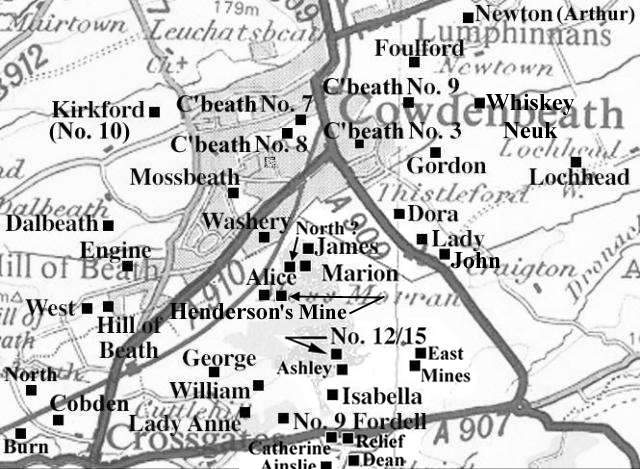
The Dora Pit was one of the pits of the Little Raith
Colliery located just to the south-east of Cowdenbeath. The
Dora Pit was sinking in 1874 on the east side of the
Cowdenbeath to Burntisland Road - about where the Fife
Regional road is now - to a depth of 100 fathoms. Eventually,
there was a railway level crossing here. It linked the Dora
with the original Dunfermline-Thornton railway which ran
through Cowdenbeath (Old) Station in Bridge Street. The Dora
Pit closed in 1959.
 |
|
 |
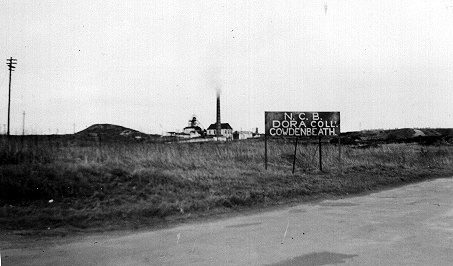
[Ian Cameron, Dalgety Bay, who kindly supplied the photograph of the Dora Pit, pointed out that the Little Raith Estate was Wemyss Estate land and was called thus to differentiate it from the much larger Raith Estate at Kirkcaldy.
Interestingly, James Guthrie, a former electrician at the Dora, recalls that the Dora Pit sign, that was placed near the main road leading into the south end of Cowdenbeath, was erected strictly because of the pending visit, on 28th June 1948, of King George VI and Queen Elizabeth to the Cowdenbeath NCB Workshops. It happened that the route they were taking was along the road into the south end of Cowdenbeath, and James believes it had duplicate signs, joined in a wide 'V', so that it was visible when approaching it from either direction. Somehow, James learned of the time they were to pass and he raced over from the pit and was perched on a hillock, just in time to see their open-top limousine go by. ]
| Pit opened: 1875 | Pit closed: 1959 |
|---|
| Source Date of Information Supplied | |
|---|---|
| Manager / Under-Manager / Men underground / Men above ground / Coal seams worked / Shaft Details | |
| 1874 (Lochgelly Iron and Coal Co. Ltd.) | |
| David Thomson / ------------ / 9 / 4 / Sinking. | |
| 1875 | |
| David Thomson / ------------ / 28 / 10 / D'cast (16 x 6) 600 ft. / U'cast (8 x 5) 492 ft. | |
| 1876 | |
| David Thomson /
------------ / 97 / 25 / D'cast (16 x 6) 600 ft. /
U'cast (8 x 5) 492 ft.
Fan and furnace ventilation. Fan (Guibal), 14' dia. |
|
| 1877 | |
| S. Macdonald / ------------ / 104 / 31 / Dunfermline Splint / D'cast ----- / U'cast ----- | |
| 1878 | |
| S. Macdonald /
------------ / 154 / 25 / Dunfermline Splint / D'cast
(11 x 8½) 600 ft. / U'cast -----.
Furnace ventilation. |
|
| 1879 | |
| S. Macdonald /
------------ / 148 / 38 / Dunfermline Splint, 5 Feet,
5' 6" / D'cast (11 x 8½) 600 ft. /
U'cast -----
Furnace ventilation. |
|
| 1880 | |
| S. Macdonald /
------------ / 184 / 38 / Dunfermline Splint, 5 Feet,
5' 6" / D'cast (11 x 8½) 600 ft. /
U'cast -----
Fan ventilation. |
|
| 1881 | |
| S. Macdonald /
------------ / 213 / 41 / Mynheer, 5 Feet, Dunfermline
Splint / D'cast (11 x 8½) 600 ft. / U'cast
-----
Fan ventilation. Fan 13½' dia. |
|
| 1882 | |
| Robert Stevenson /
------------ / 172 / 92* / Mynheer, Dunfermline Splint /
D'cast (11 x 8½) 600 ft. / U'cast -----
* Manpower shared with Lady Pit. |
|
| 1883 | |
| Mr. John Currie,
oversman, left the Dora in February for a new career.
Serious over-wind accident on 18th August. |
|
| 1888 | |
| Mr. William Mitchell, oversman, left the Dora in August. | |
| 1890 | |
| Alexander McDonald
Thomson / ------------ / 189 / 27 / Mynheer, Five Foot,
Dunfermline Splint
D'cast (11 x 8½) 600 ft. / U'cast (17 x 5½) 480 ft. Fan ventilation. |
|
| 1905 | |
| June: Mr William Mack, oversman, left to take up a post at Bellshill. | |
| 1907 | |
| Mr Duncan Livingston, manager. | |
| 1918 | |
| Gordon, Dora, Lochhead Pits and Lochhead Mine | |
| Frank Forsyth / ------------ / 542 / 155 | |
| 1928 | |
| Gordon, Dora, Lochhead Pits and Lochhead Mine | |
| William Gray / ------------ / 188 / 69 | |
| Household, steam and blaes. Mynheer, Duddie Davie, Fourteen Feet, Glassee, Lochgelly Splint, Parrot, Five Feet, Jewel, Dunfermline Splint, Rough, Upper Five Feet. | |
| 1938 | |
| Gordon, Dora, Lochhead Pits and Lochhead Mine. | |
| Frank Forsyth / Alex. Cunningham / J. Daglish / 236 / 91 | |
| 1945 | |
| Gordon, Dora, Lochhead Pits and Lochhead Mine | |
| E. M. Guthrie / Alex. Cunningham / 214 / 68 / Household, steam and blaes. Little Splint and Diamond. | |
| 1947 (NCB) | |
| Gordon, Dora, Lochhead Pits and Lochhead Mine | |
| E. M. Guthrie / ---------- / 193 / 64 | |
| Gas,
household, manufacturing coals and anthracite.
Annual output = 88,900 tons |
|
| 1948 (NCB) | |
| Gordon, Dora, Lochhead Pits and Lochhead Mine | |
| E. M. Guthrie / R. Scott / 188 / 66 | |
| Household coal and blaes. Little Splint, Fourteen Feet, Duddie Davie, Diamond and Glassee. | |
| 1949 (NCB) | |
| Dora (Little Raith)/ E. Guthrie / R. Scott / 194 / 64 | |
| Household coal. Fourteen Feet, Duddie Davie, Diamond and Glassee. | |
| 1950 (NCB) | |
| Dora (Little Raith)/ E. Guthrie / R. Scott / 204 / 51 | |
| Household coal. Jewel, Two Feet, Glassee and Fourteen Feet. | |
| 1951 (NCB) | |
| Dora (Little Raith)/ E. Guthrie / R. Scott / 214 / 41 | |
| Household coal. Jewel, Two Feet, Glassee and Fourteen Feet. | |
| 1952-56 (NCB) | |
| Dora (Little Raith)/ E. Guthrie / ---------- / 226 / 44 | |
| Household coal. Jewel, Two Feet, Glassee and Fourteen Feet. | |
| 1957 (NCB) | |
| Dora/ E. Guthrie / ---------- / 226 / 44 | |
| Gas, household, industrial, steam coal and blaes. Jewel, Two Feet, Fourteen Feet and Diamond. | |
| 1958 (NCB) | |
| Dora/ E. M. Guthrie / ---------- / 235 / 45 | |
| Gas, household, industrial, steam coal and blaes. Jewel, Two Feet, Kelty Main and Five Feet. | |
| 1959 (NCB) | |
| Dora/ E. M. Guthrie / ---------- / 229 / 36 | |
| Gas, household, industrial, steam coal and blaes. Jewel, Kelty Main and Five Feet, Jersey, Mynheer. | |
------------------------------------
| Plan of Abandoned Seams for Little Raith | Pits or Mines designated in Plan |
|---|---|
| COAL;
Little Splint; Rough; Lochgelly Splint and Parrot; Mynheer, Upper
Five Feet; Five Feet; Dunfermline Splint; Stinking.
IRONSTONE; Lochgelly Blackband (Abandoned 13th February, 1932). |
LITTLE RAITH; Dora; Gordon; Lady; Lochhead; Lochhead, No. 2 |
------------------------------------
| See also Little Raith Colliery entry |
|---|
------------------------------------
Note: The Dora miners mainly lived at the south end of Cowdenbeath (Arthur Street/Arthur Place) and they had a football team called Raith Rovers, long before the Kirkcaldy team was formed. They were seniors and one of the ten original members of the Fife Football Association in 1882. Later that year, they joined with Cowdenbeath Rangers to form Cowdenbeath F.C., in time for the first ever Fife Cup Competition, which was won by Dunfermline (not Dunfermline Athletic who did not exist then).
------------------------------------
Information on coals worked at, or near, the Dora Pit
In the Dora Pit, the Five Foot Coal, 5 ft. to 5 ft. 4 in.
thick, rested on a sandy fireclay and was overlain by blaes
and sandstone. The Lochgelly Splint and Parrot Coal seams
overlain with craw or inferior coal were extensively
wrought here.
The Parrot seam contained a good deal of rough coal and only
a thin band of gas coal. Swallowdrum Coal - 3 ft. 6 in. to 5
ft. thick - was wrought from the pit and the Fourteen Foot
seam was worked to its outcrop from here. It was generally in
leaves with one or more partings and exceeded 7 ft. in
thickness. Although variable in quality, it was regarded as a
good steam coal.
Little Splint Coal was not present in the Dora workings.
------------------------------------
"Dunfermline Saturday Press"
22 May, 1875
A miner named George Swan was somewhat severely injured on Monday, caused by a plank of wood falling on him while working at the bottom of a sinking pit belonging to the Lochgelly Iron Company. The plank, which fell several fathoms, struck the unfortunate man a severe blow on the left side, by which one of his ribs was broken, and the flesh much lacerated. On being conveyed home, he was attended to by Dr. Nelson, who dressed the wounds.
------------------------------------

"Dunfermline Saturday Press"
15 January, 1876
On Thursday morning the body of a young man named Thomas Page was found at the bottom of the shaft of the Dora Pit, Raith, belonging to the Lochgelly Iron and Coal Company (Limited). How the deceased met his death remains a mystery.
------------------------------------
"Dunfermline Saturday Press"
18 August, 1883
TERRIBLE COLLIERY ACCIDENT AT COWDENBEATH
Three men killed and four seriously injured
On Wednesday afternoon, one of the most serious and
deplorable colliery accidents which has occurred in
Fifeshire, since 1876, took place at the Dora Pit, Little
Raith Colliery, belonging to the Lochgelly Iron Company, and
situated a short distance to the south of Cowdenbeath.
As at all the Fife Collieries, this pit - which is
considered to be one of the largest in the county - was
worked on the eight-hours-a-day system, and according to
custom the winding up of coal was stopped at two o'clock
in the afternoon to admit of the miners being brought up to
the bank. About eight men are taken up in the double cage,
and about 130 had been landed at the pit-head in safety. All
went on smoothly until the raising of the last cage but one,
when a terrible overwinding accident occurred. It was shortly
after three o'clock when the cage left the bottom of the
pit, and the occupants were:- Thomas Adams, 51, and his sons,
Thomas, 20, James, 16, and John, 14; David Paterson, 32;
Robert Hunter, 41, and his son William, 17.
Before reaching the landing stage it was apparent to the
occupants of the cage that it was being wound with more than
usual speed, and the rate at which they were ascending formed
the subject of conversation among the occupants. The
unfortunate men passed the landing stage, shouting to the
engineman to stop, and before they had time to attempts to
get off they were tossed over the pulley wheels - the cage
being sent with a terrible crash into the roof of the
engine-house, a distance of at least sixty feet. The result
was that the men were tossed about in all directions - all,
however, miraculously escaping being thrown into the shaft.
James Adams and his brother, John, were thrown on to a
"bing of blaes", a distance of 150 feet from the
shaft - the former being killed on the spot, while the latter
sustained injuries of a very serious character. David
Paterson, who is unmarried, was thrown on to the roof of the
engine-house, and only survived his injuries five minutes.
William Hunter was dragged through the roof with the cage,
and had little more reached home when he succumbed. The other
four men were picked up in the vicinity of the engine-house,
all more or less seriously injured. Robert Hunter was found
to be in the most critical condition, he having received
severe internal injuries, and no hope whatsoever is
entertained of his recovery.
Since Wednesday, he has been unconscious. Thomas Adams,
sen., was very much cut about the face, and his right foot
was severely crushed. He is now considered out of danger.
Thomas Adams, jun., received several bruises on the face,
but he is now able to leave his bed; while John Adams was
hurt internally, and up to last night was unconscious and in
a precarious state.
The news of the accident spread with great rapidity
throughout Cowdenbeath and Lochgelly, and shortly afterwards
the vicinity of the pit was crowded with miners and their
wives and children. Great excitement prevailed, but no time
was lost in summoning medical help; and Dr. Nasmyth, Foulford
House; Dr. Stiell, Lochgelly, and his assistant, were quickly
in attendance, and administered what relief they could to the
injured men.
The manager of the colliery, Mr. Stevenson, and afterwards
Mr. Landale, the managing partner of the Company, also did
their utmost to render what help they could under the
circumstances. The report of the medical gentlemen is as
follows:-
James Adams - killed.
David Paterson - killed.
William Hunter - brought home alive, but died in about two hours afterwards.
Thomas Adams, sen., - very much cut about the face, and right foot very much bruised. Case hopeful.
Robert Hunter - very seriously injured internally.
Thomas Adams, jun., - only a few bruises about the face (least injured of all).
Inspector Hunter, of the Fifeshire Constabulary,
Kirkcaldy, after learning of the accident, drove to the scene
with all convenient speed, and after making a thorough
investigation into the sad affair, arrested James Guthrie,
the engine-keeper, and conveyed him to Kirkcaldy by the last
train. Guthrie, who is about twenty-five years of age, has
hitherto borne the character of being a very steady and
capable workman, and much sympathy is felt for him in the
disagreeable position in which he has been placed. He has
only been six months in charge of the engine at this
particular pit.
There is no doubt that the cause of the accident was
overwinding, as the indicator shows the "drum" had
taken one and a-half turns more than usual - the cage thereby
being raised fifty feet beyond its proper height.
The engine is a coupled one, and the gearing in capital
condition. Shortly after the accident, Thomas Adams, sen.,
who was less injured than the rest, gave an account of the
winding up from the bottom, and stated that from the time of
starting the cage went up at a fearful pace. It seemed only
the work of a second, and during the forty years he has
worked in mines he was never wound to the surface at such a
furious rate.
Thomas Adams, his son, also referred to the rapidity with
which the cage was wound up, and said that he and his
comrades had not time to shout to the engine-man to halt.
From "mid-shank" to the pulley was the work of an
instant, and before they had time to think of anything they
had been dragged over the dangerous brink.
Adams and his two sons had only been working in the Dora Pit
a week when the accident happened - they having come from
Lumphinnans.
The unfortunate accident, it is needless to say, has cast
quite a gloom over the district, and on Thursday very few of
the miners were at work. It was calculated that about 400
miners were idle, and it is not at all probable that work
will be resumed till Monday. In the forenoon, of Thursday,
Mr. Morrison, Cupar, the Procurator-Fiscal for the Eastern
District of Fifeshire, arrived in Cowdenbeath, and opened an
inquiry into the circumstances of the accident in
Brunton's Hotel.
At the pit-head everything still remains in the same
position as after the accident, and nothing will be removed
till Mr. Ralph Moore, the Government Inspector, has made a
thorough investigation of the colliery.
On Thursday morning, James Guthrie was conveyed from
Kirkcaldy to Cupar in custody of Inspector Hunter, and in the
forenoon emitted a declaration in presence of the
Sheriff-Substitute regarding the accident. He was afterwards
committed to prison pending further enquiry.
The accident which is referred to above on 30th
September, 1876, at the William Pit, Fordell Colliery, when,
through a boiler explosion, four women and one man were
killed, and six seriously injured.
------------------------------------
"Dunfermline Saturday Press"
8 September, 1883
THE LATE ACCIDENT AT RAITH COLLIERY
Thomas Adams, one of the men injured by the recent disastrous accident at Raith Colliery, died on Wednesday evening from the effects of his injuries. This is now the fourth death. Adams was 51 years of age, and has left a widow and a grown-up family. One of Adams' sons was killed at the time of the accident and other two injured, but the latter are now in the way of recovery.
------------------------------------
"Dunfermline Saturday Press"
22 September, 1883
ALLEGED CULPABLE HOMICIDE
At the first diet of a Jury Court at Cupar, on Tuesday - Sheriff Gillespie on the bench - James Guthrie, engine-driver, now or lately residing at Hill of Beath, was charged with culpable neglect of duty, in so far as, on the 15th August, while employed by the Lochgelly Iron & Coal Company as engineman for the purpose of working and managing a steam winding-engine at the head of Dora Pit, and which steam winding-engine was used for the purpose of lowering and raising cages or hutches containing workmen, he did fail and neglect to work said engine in a safe and proper manner, in consequence of which said cage was raised at a rapid and furious rate, and was pulled over the pulley, and David Paterson, James Adams, and William Hunter were thrown to the ground or upon the roof of the engine-house, and were so mortally injured that they died soon thereafter; Thomas Adams, junior, John Adams, and Robert Hunter were thrown on the pit shed, and were bruised and wounded to the serious injury of their persons; and Thomas Adams, senior, was thrown to the ground, was bruised and wounded to the serious injury of his person, and lingered on till the 3rd September, when he died.
The accused tendered a plea of not guilty, and the trial was adjourned till Friday, the 28th inst.
------------------------------------
"Dunfermline Saturday Press"
23 February, 1884
THE LITTLE RAITH COLLIERY ACCIDENT
A sixth action against the Lochgelly Iron and Coal Company, arising out of the late accident at Little Raith Colliery, was called in the Sheriff Court, Kirkcaldy, on Wednesday. The petition, which was at the instance of Robert Hunter, miner, Cowdenbeath, concluded for £500 damages for the loss of his son, who was killed by the over-winding accident [Dora Pit] referred to. Mr. Donald McKenzie, solicitor, Dunfermline, appeared for pursuer.
------------------------------------
"Dunfermline Saturday Press"
1 October, 1887
Yesterday morning, a boy named David Hunter, 13 years of age, was killed at Raith Colliery. He had been working at a siding at the Dora Pit, when a prop was knocked out of its position by a hutch, and fell upon him. The poor lad was so seriously injured that he died shortly after being conveyed home.
------------------------------------
"Dunfermline Saturday Press"
12 November, 1887
A peculiar accident occurred in the Dora Pit, Little Raith Colliery, on Wednesday afternoon, whereby John Fyfe, a miner resident in Cowdenbeath, was deprived of life. It appears that at the close of the day's work, Fyfe had been ascending the shaft in a cage along with his father-in-law, and when about midway up the poor seems to have become faint, and falling forward he was crushed between the cage and the fittings of the pit. On reaching the surface it was found that Fyfe was dead. The deceased was married and leaves a wife and four of a family.
------------------------------------
"Dunfermline Saturday Press"
31 December, 1887
... Matthew Waterson was seriously injured in the Dora Pit, Raith Colliery, by being thrown from a train of hutches.
------------------------------------

"The Scotsman"
29 February, 1888
MAN KILLED AT A FIFE COLLIERY. - Thomas Adamson, labourer, seventy years of age, was killed at the Raith Colliery, Fifeshire, yesterday. The deceased had been walking across a siding in connection with the Dora pit, when he was knocked down, and the wheels of several waggons passed over his body, causing almost immediate death.
-------------------
"Dunfermline Saturday Press"
3 March, 1888
On Tuesday morning, a man named Thomas Adamson, Cowdenbeath, met his death by accident on a railway siding at Raith Colliery. A train of empty waggons was being shunted when Adamson somehow got in front of it on the line, and was run over and killed instantaneously. He was 69 years of age.
------------------------------------
"Dunfermline Saturday Press"
2 June, 1888
Andrew Patterson, a boy of fifteen years of age, got his right leg broken while working at the Dora Pit, Little Raith Colliery, on Monday. A stone had fallen from the roof on Patterson's leg.
------------------------------------
"Dunfermline Saturday Press"
25 January, 1890
A miner named James Dow, about fifty years of age, was working in the Dora Pit, Raith Colliery, on Thursday when he was struck by a quantity of stones which fell from the roof. His collar-bone was broken, and he sustained internal injuries.
------------------------------------
"Dunfermline Saturday Press"
6 September, 1890
On Wednesday, a miner named Peter McCulloch met with an accident in Dora Pit (Raith Colliery) which proved fatal. The unfortunate man was an on-cost worker, and was engaged repairing a road when a quantity of stones fell on him, which broke one of his legs, and also one of his arms, besides fracturing several of his ribs. After being conveyed home, it was considered advisable to remove him to the Edinburgh Royal Infirmary, but on the way to that institution McCulloch died. The deceased was a widower, and has left three young children, for whom great sympathy is felt.
------------------------------------
"Dunfermline Saturday Press"
14 February, 1891
On Monday, while Joseph Holman (17), drawer, Cowdenbeath,
was engaged at work on a wheel-brae, in the Dora Pit, Little
Raith Colliery, he was knocked down by a couple of hutches,
and in addition to having his right are severely bruised, he
sustained slight injuries about the body.
On the same day, Thomas Cunningham (38), pit inspector, had
his right leg injured by a piece of coal falling from the
roof of one of the roads while he was engaged in the Lady
Pit, Little Raith Colliery.
------------------------------------
"Dunfermline Saturday Press"
30 May, 1891
A miner named James Venters, residing in Cowdenbeath, was on Tuesday fatally injured while employed in the Dora Pit, near Cowdenbeath. Venters was 30 years of age, and was married.
[Note: Mines Report has the age 35.]
------------------------------------
"Dunfermline Saturday Press"
7 November, 1891
About nine o'clock on Thursday morning some of the men employed in the Dora Pit, Little Raith Colliery, discovered that a large quantity of stone had fallen from the roof of one of the roads, and on further inspection it was found that a pony driver named Thomas Wood was buried among the debris. On Wood being extricated life was extinct. The deceased resided in Crossgates, where he leaves a widow and family.
------------------------------------
"Dunfermline Saturday Press"
14 May, 1892
On Monday, James Elder (16), miner, Arthur Place, Cowdenbeath, while engaged in the underground workings of the Dora Pit, Raith Colliery, belonging to the Lochgelly Iron and Coal Company, was struck by a stone falling from the roof, and was bruised about the lower parts of the body.
------------------------------------
"Dunfermline Saturday Press"
4 February, 1893
There has been a long stoppage of work at the Dora Pit, Little Raith Colliery. The pit is flooded, and about sixty men are idle, being unable to obtain work elsewhere in consequence of their "graith" being in the pit.
------------------------------------
"Dunfermline Saturday Press"
27 April, 1895
James Hall (51), engineman, Park Avenue, Cowdenbeath, while at work in the Dora Pit, Raith Colliery, belonging to the Lochgelly Coal Coy., on Sunday, fell from the top of one of the boilers, and broke his right leg above the ankle. Dr Thomson, who was sent for, set the injured limb.
------------------------------------
"Dunfermline Saturday Press"
24 August, 1895
Grace Tosh (34), pithead worker, Little Raith Colliery Houses, met with an accident on Friday last week. She was carrying wood from the saw-mill to the Dora Pit, and while crossing the rails between two spragged waggons which were standing about three feet apart, three other waggons came up and struck one of the spragged waggons. Her right arm and left hand were caught between the buffers and were much bruised. She was attended to by Dr Selkirk, Cowdenbeath, and afterwards removed to the Dunfermline Cottage Hospital.
------------------------------------
"Dunfermline Saturday Press"
23 January, 1897
SAD ACCIDENT AT COWDENBEATH
TWO MEN KILLED
A melancholy accident occurred yesterday morning at the
Dora Pit, Little Raith Colliery, belonging to the Lochgelly
Iron and Coal Company (Limited), and situated to the east of
Moss Morran Moor, near Cowdenbeath. Work has been partially
suspended at the pit for some time - the coal being taken out
by another shaft - and preparatory to stopping work
altogether, a few men have been recently employed in removing
the underground machinery. Meanwhile pumping operations have
been continued night and day.
At six o'clock yesterday morning, Hugh Thomson, an
engineman, proceeded to descend the shaft to take his place
at the pumping engine at the underground workings, and
relieve the night engineman. Thomson was accompanied by Jas.
Graham, engineer, who intended making arrangements for the
further removal of the machinery. The men were being lowered
as usual in the cage. All went well until a depth of 25
fathoms had been reached, when the winding rope snapped, and
the cage was precipitated to the bottom of the shaft, with
its two unfortunate occupants. James Hall, the engineman at
the pithead, at once realised what had occurred, as the
engine stopped in an instant, and the broken rope coiled
round the pulley above the mouth of the pit. Hall ran for the
colliery manager, Mr Wm. Stewart, who quickly arrived upon
the scene. The manager, along with Samuel Kinnaird, miner;
William Johnston, underground oversman; William Duncan, pit
wright; and William Hamilton, engineer, descended the shaft
by means of the other cage without loss of time.
They discovered the first cage lying in water at the bottom
of the shaft. The cage, which had fallen a distance of no
less than 75 fathoms, was a complete wreck, and resembled a
concertina more than anything else.
The dead bodies of Graham and Thomson were found inside the
cage. The backs of the two poor fellows, and their legs as
well, had been broken, and their bodies were otherwise
mutilated. Death must have been instantaneous. It is stated
that the night engineman had seen the cage at the bottom of
the shaft, but was unaware that it contained the lifeless
bodies of two of his fellow workmen.
The bodies were conveyed to the surface an hour after the
accident. Both the deceased resided in Cowdenbeath. Graham
was 34 years of age. He lived in the Old School Row, was
married, and leaves a widow and two children. Thomson, who
resided at 41 Thistle Street, was 28 years of age. He was
married also, and is survived by a widow and four of a
family.
-------------------
"Dunfermline Saturday Press"
27 February, 1897
An Inquiry was held under the Fatal Accident Inquiry
Act, in Dunfermline Sheriff Court, on Monday, into the deaths
of James Graham and Hugh Thomson.
... The Jury returned the following verdict:- "That the
accident took place in the Dora Pit, on 22nd
January, by the breaking of the winding-rope while the
deceased were being lowered down the shaft; that they were
thrown to the bottom and killed on the spot."
---------------------------------------------------
"Dunfermline Press"
2 March, 1901
James Muirhead, miner, Arthur Place, Cowdenbeath, met with an accident on Friday last in the Dora Pit, Little Raith Colliery. He was pushing a loaded hutch away from the face in the five-feet seam when a stone weighing about two cwt fell from the roof and struck him on the back, knocking him down and injuring him internally. He was conveyed home and attended by Dr Selkirk.
---------------------------------------------------
"Dunfermline Press"
21 December, 1901
Alexander Kerr, brusher, Bridge Street, Cowdenbeath, sustained a fracture of his right leg and had his head severely cut, through a stone falling from the roof upon him while he was at work on Sunday in the Dora Pit, Lochgelly Iron and Coal Company.
---------------------------------------------------
"Dunfermline Press"
31 May, 1902
John Mullan, miner, Foulford Street, Cowdenbeath, has lost a limb as the result of an accident in the five-feet seam of the Dora Pit, Little Raith Colliery. He was proceeding from his working place to the pit bottom along with other two men when he was overtaken on a wheel brae by two loaded hutches. He was knocked down, and his left leg was fractured and badly bruised. On his removal to the Dunfermline Cottage Hospital it was found necessary to amputate the injured limb below the knee.
-----------
"Dunfermline Press"
7 June, 1902
FATAL RESULT OF AN ACCIDENT
John Mullan, miner, Foulford Street, Cowdenbeath, has succumbed to the injuries he sustained recently in the Dora Pit, Little Raith Colliery.
-----------
"Dunfermline Press"
Saturday, 21 June, 1902
In Dunfermline, yesterday, before Sheriff Gillespie and a Jury, the Fatal Accident Inquiry involving the death of John Mullan, miner, Cowdenbeath, at the Dora Pit, took place. Among those giving evidence were:- Mary McCrone, nurse, Dunfermline Cottage Hospital; James Hendrie, manager, Little Raith Colliery; Duncan Beaton (17), Haulageman, 57 Thistle Street, Cowdenbeath; Adam Dunsmore, miner, Raith Colliery Houses, Cowdenbeath; and John Thomson, miner, Thistle Street, Cowdenbeath. A formal verdict was returned by the Jury.
-----------------------------------------------
"Dunfermline Press"
9 May, 1903
Alexander Thomson, miner, Arthur Street, Cowdenbeath, was seriously injured in the Dora Pit, Lochgelly Iron & Coal Company, on Tuesday. He was working at the face when a quantity of coal, weighing about four cwts., fell upon him, fracturing his left collar bone. He was attended to by Dr Selkirk.
------------------------------------------------
"Dunfermline Press"
22 October, 1904
James Russell (25), miner, residing at Moss-side Road, Cowdenbeath, met with his death in the Dora Pit, belonging to the Lochgelly Iron and Coal Company Limited, on Saturday morning. He was working in a dook which leads to the fourteen-feet seam when a stone, weighing about two tons, fell upon him from the roof and killed him instantaneously. Along with others, the deceased was in the act of putting up a prop or beam when the fall took place.
---------------
"Dunfermline Press"
12 November, 1904
Under the Fatal Accidents Inquiry Act, an inquiry was
held in the Sheriff Court, Dunfermline, on Thursday - before
Sheriff Shennan and a jury - into the circumstances attending
the death of a miner named James Russell, lately residing at
Moss-side Road, Cowdenbeath, who was killed in the Dora Pit,
Lochgelly, on 15th October, by a stone falling
from the roof upon him.
Those giving evidence at the Inquiry included William
Falconer, miner, 11 Arthur Place, Cowdenbeath; and Robert
Moffat, inspector. A formal verdict was returned by the
Jury.
--------------------------------------------
"Dunfermline Press"
24 June, 1905
Mr William Mack, the genial and much respected oversman of the Dora Pit, Little Raith Colliery, has removed to the Milnwood Colliery, Bellshill. ...
----------------------------------------------------
"Dunfermline Press"
19 August, 1905
Between nine and ten o'clock on Thursday morning, John Paterson, a drawer, residing at 67 Union Street, Cowdenbeath, sustained severe injuries in the Lochgelly Iron and Coal Company's Dora Pit. He was descending an incline holding on to the rear of an empty hutch when his foot slipped and he fell on his back. With considerable force his head struck a stone on the pavement, causing concussion of the brain. The injured man was conveyed home, and attended by Dr Craig and Dr King.
----------------------------------------------------
"Dunfermline Press"
12 May, 1906
FATAL RESULT OF AN ACCIDENT
Thos. A. Porteous, residing in South Street, Cowdenbeath, died yesterday from injuries received on Thursday in the Dora Pit, Little Raith Colliery. He was a hanger-on, and on the rope breaking on the wheel-brae at which he worked, he had not sufficient time to get clear of the runaway hutches. His injuries were chiefly about the head. Deceased took an active interest in Good Templar work throughout the district. He was thirty years of age, and was unmarried.
------------------------------------------------
"Dunfermline Press"
2 June, 1906
Under the Fatal Accidents Inquiry Act, an inquiry was held in the Sheriff Court, Dunfermline, on Thursday - before Sheriff Gillespie and a Jury - into the circumstances attending the death of Thomas Archibald Porteous, hanger-on, lately residing at Watson's Buildings, Broad Street, Cowdenbeath. On 10th May, Porteous was injured on a wheel brae in the Dora Pit, Little Raith Colliery, by some empty wagons running back and crushing him, in consequence of the wire rope to which they were attached breaking. Those giving evidence included:- James Hendrie, manager; Thomas Hidley, pony driver; Andrew Farrell, wheeler, 32 James Street, Dunfermline; John Galloway, wheeler, New Buildings, Arthur Place, Cowdenbeath; Peter Walker, oversman, 11 Old School Row, Cowdenbeath; and David Campbell, fireman, 15 Thistle Street, Cowdenbeath. A formal verdict was returned.
------------------------------------------
"Dunfermline Press"
6 October, 1906
Robert Gardiner, miner, North Road, Cowdenbeath, met with an injury to his right hand while working in the Dora Pit of the Lochgelly Coal Company. His hand was caught by machinery at which he was engaged, and two of his fingers were torn off. He was attended to by Dr Selkirk.
-----------------------------------------
"Dunfermline Press"
9 February, 1907
On Thursday afternoon, a labourer named Mark Churchill (55), a native of St Helens, Lancashire, and who came from Newcastle only days previously, was accidentally killed at the Dora Pit sidings, Little Raith Colliery, Cowdenbeath.
"Dunfermline Press"
23 February, 1907
Under the Fatal Accidents Inquiry Act, an inquiry was held in the Sheriff Court, Dunfermline, on Thursday - before Sheriff Shennan and a Jury - into the circumstances attending the death of a labourer named Mark Churchill, of no fixed residence, who was killed on 7th February on the railway lyes at the Lochgelly Iron and Coal Company's Dora Pit, by being crushed between two waggons. Those giving evidence included:- Duncan Livingston, colliery manager; Constable David Buchan; and Inspector Webster, Dunfermline. A formal verdict was returned.
--------------------------------------
"Dunfermline Press"
3 August, 1907
A miner named Alex. Thomson, residing at Elgin Road, was severely bruised about the back by three or four cwt of material falling upon him in the "Fourteen" seam, Dora Pit, Little Raith Colliery, on Thursday. His injuries were of such a nature that Dr. Selkirk ordered his removal to the Dunfermline and West Fife Hospital.
--------------------------------------
"Dunfermline Press"
22 August, 1908
A large bing of steam coal lying at the Dora Pit, Little Raith Colliery, belonging to the Lochgelly Iron and Coal Company, and said to amount to nearly 5000 tons, has for some time shown signs of going on fire. Clouds of smoke are rising from the heap, and with a view to saving the stock, men are filling it into waggons. It is expected that very little of the coal will be lost.
--------------------------------------
"Dunfermline Press"
26 September, 1908
Numerous accidents occurred at the beginning of the week. In the Dora Pit, Little Raith Colliery, on Monday, Robert Muir, residing in West Broad Street, was crushed between a race of hutches on a dook and the side of the roadway. His injuries were chiefly internal. ... Muir was taken to the Dunfermline and West Fife Hospital.
--------------------------------------
"Cowdenbeath & Lochgelly Times
& Advertiser"
Wednesday, 24 May, 1911
Thomas Love, brusher, who resided at Arthur Lane, Cowdenbeath, was accidentally killed in the Jewel seam of the Dora Pit, Little Raith Colliery, on Wednesday. He was working on the night-shift, and on his failing to put in an appearance with the other men at piece time, a search resulted in the body of the deceased being found beneath a fall of material in his working place. Love leaves a widow and two of a family.
------------------------------------
The Dora Colliery
(circa. 1911)
(Source unknown)

|
------------------------------------
"Dunfermline Press"
14 September, 1912
Andrew Duff, pithead worker, residing at 51 Thistle Street, was badly bruised about the body and cut on the head by accidentally falling over the redd bing at the Dora Pit, Raith Colliery, on Wednesday. He had been in the act of turning over a hutch to empty when it slipped over, drawing him with it. Dr Selkirk attended to his injuries.
------------------------------------
"Dunfermline Press"
20 January, 1917
David Walls, bottomer, residing at Landale Terrace, Cowdenbeath, while repairing a bell wire in the lower bottom of the Dora Pit, Raith Colliery, had one of his arms severely torn through being caught by the haulage machinery. He was conveyed to the Dunfermline and West Fife Hospital for treatment, and there it was found necessary to amputate the limb.
------------------------------------
"Dunfermline Press"
11 September, 1920
The workers of Dora Pit, Raith Colliery, Cowdenbeath, met in a social capacity in the Co-operative Hall on Friday evening last week - Mr Frank Forsyth, manager of the colliery, presiding. After everyone had done justice to the well-spread tables, the Chairman spoke of the happy circumstances under which they had met - namely, to present Mr Alex. Cunningham, oversman, with handsome gifts on the occasion of his marriage. ...
------------------------------------
"Cowdenbeath & Lochgelly
Times"
4 February, 1925
A water supply has been granted for the Gordon and Dora Pits by the Kirkcaldy District Committee. It will be paid by meter. The Company are to pay for the extra expenses involved in laying the pipes nearer to the pits than the engineers considered necessary, and to provide for a three-inch pipe if the Company desired a larger pipe to be laid.
-------------------------------------------
"Lochgelly Times"
23 November, 1927
Two serious accidents, involving two Cowdenbeath miners took place on Thursday. The more serious perhaps is that of William Paterson, 7 Bowling Green Street, Cowdenbeath, who, when following his work at the Dora Pit, Cowdenbeath, was struck by three hutches. The unfortunate man was dragged for about eight yards. On being taken to the pithead, Dr Selkirk ordered his immediate removal to Dunfermline Hospital, where, on examination, it was found that he was suffering from severe head injuries and a broken collar bone. His left ear was also hanging off. Fortunately he is now out of danger ....
-------------------------------------------
"Dunfermline Press"
29 August, 1931
COWDENBEATH MINERS STRIKE.
One hundred and sixty miners are involved in a strike which broke out at Dora Pit, Cowdenbeath, on Wednesday. The grievance is that the oncost workers' wages are too low, and officials of the United Mineworkers of Scotland, who picketed the pit, persuaded the day-shift workers to take strike action. The pit belongs to the Lochgelly Iron and Coal Company, Limited.
-------------------------------------------
"The Scotsman"
28 January, 1932
Edward Macmillan (21), son of John Macmillan, 14 Marshall Street, Cowdenbeath, was fatally injured yesterday in the Dora Pit, Little Raith Colliery, Cowdenbeath belonging to the Lochgelly Iron and Coal Company. He was engaged putting up a prop in the 14-feet section, when the roof gave way. He was caught by the fall and pinned to the pavement. Death was instantaneous. As a mark of respect, work at the colliery was immediately suspended for the day.
----------------------
"Dunfermline Press"
30 January, 1932
Edward McMullan, the 21-year-old son of John McMullan, 14 Marshall Street, Cowdenbeath, was instantaneously killed by a fall from the roof in the Dora Pit, Cowdenbeath, on Wednesday morning. McMullan was engaged putting up a prop in a 14 feet section when the roof gave way and pinned him to the pavement. Work was suspended at the colliery during the remainder of the day.
-------------------
"Dunfermline Press"
12 March, 1932
Under the Fatal Accidents Inquiry Act, an inquiry was held in the Sheriff Court, Dunfermline, on Thursday - before Sheriff Umpherston and a Jury - into the circumstances attending the death of Edward McMullan, coal miner, 60 Foulford Place, Cowdenbeath, who was killed on 27th January in the underground workings of the Dora Pit, Raith Colliery, belonging to the Lochgelly Iron and Coal Company, Limited, by a fall from the roof of his working place. Those giving evidence included:- Archibald Thomson, miner, 18 Marshall Street, Cowdenbeath, and James Simpson, colliery fireman, 42 West Park Street, Cowdenbeath. A formal verdict was returned by the jury.
-------------------------------------------
"The Scotsman"
15 March, 1937
PIT TO BE REOPENED
The Dora Pit, Raith Colliery, Cowdenbeath, belonging to the Lochgelly Iron and Coal Co. (Ltd.), is to be reopened. Owing to depression, the pit was closed five years ago, but the improvement in the demand for coal has induced the owners to reopen it. There are still seams of valuable coal to be worked, sufficient to keep the pit going for at least ten years. Over 100 men will find employment underground within a few months. The pit was opened in 1879.
-------------------------------------------
"Dunfermline Press"
4 September, 1937
DORA PIT.
The output of coal in Beath area will shortly be considerably increased by the quantity drawn from the Dora Pit. This pit, which belongs to the Lochgelly Iron and Coal Co., was closed during the coal slump about ten years ago, and re-opened three or four months ago. The first quantity of coal produced since the re-opening was brought to the surface this week. Work will be found for a large number of men, most of whom will reside in the south side of Cowdenbeath.
-------------------------------------------
"Dunfermline Press"
13 November, 1937
COWDENBEATH PIT ACCIDENT.
William Dall (27), stripper, 84 Paul Street, Lochgelly, was injured as the result of an accident on Friday last week in the Dora Pit, Cowdenbeath, belonging to the Lochgelly Iron and Coal Company, Ltd. Dall, who was working at the coal face, had just finished boring a shot-hole when a burst of coal came away and partly fell on him. He was knocked against a conveyor, which was in motion at the time, and he received a compound fracture of the lower jaw and severe laceration of the face and chest. After being attended to by a doctor, he was conveyed to the Dunfermline and West Fife Hospital.
-------------------------------------------
"Cowdenbeath Advertiser"
8 November, 1940
COWDENBEATH MAN'S FATAL COLLAPSE
Thomas Bissett, Hall Street, Cowdenbeath, a well-known member of the community, died suddenly on Saturday.
Deceased, who was an underground fireman in the Dora Pit, Cowdenbeath, had just finished work and was waiting for the cage to take him to the top of the pit when he collapsed and passed away.
He was 60 years of age and leaves a wife and family.
For a number of years he has been a prominent member of the Church of God, Bridge Street, Cowdenbeath.
-------------------------------------------
"Dunfermline Press"
24 May, 1941
COWDENBEATH MINER INJURED.
Robert Killigan, miner, Arthur Place, Cowdenbeath, was seriously injured while at work on Saturday morning in the Fourteen Feet Seam in the Dora Pit, Cowdenbeath, belonging to the Lochgelly Iron and Coal Company. He was struck by a fall from the roof and received serious injuries to his back and a fracture of one of his legs. He was removed to Dunfermline and West Fife Hospital.
-------------------------------------------
"Dunfermline Press"
21 November, 1942
Andrew Sneddon (43), a miner, employed in the Dora Pit, Cowdenbeath, belonging to the Raith Group of the Lochgelly Iron and Coal Company, Ltd., lost his life while at work on Monday morning. He was in the act of drawing props when a fall took place, and his death was practically instantaneous. Sneddon resided with a married sister, Mrs Campbell, 50 Main Street, Lumphinnans.
-------------------------------------------
"Cowdenbeath Advertiser & Kelty News"
27 October, 1950
MINER LOSES LEFT HAND
Albert Ganley, 19 Woodside, Cowdenbeath, who met with an injury in the Dora Pit last week, has since had his left hand amputated. His hand was crushed in a conveyor belt. He was removed to Bangour Hospital where it was found necessary to amputate the hand.
-------------------------------------------
"Lochgelly Times"
5 June, 1952
From the early hours of Wednesday morning well into the day, units of Cowdenbeath, Dunfermline and Kirkcaldy Fire Brigades fought a fire which broke out at the disused Gordon Pit between Lochgelly and Cowdenbeath. The situation of the pit is such that four major pumps and 4000 feet of hose had to be employed to link up with the nearest water supply at Thistle Street and High Street, Cowdenbeath. The fire originated on the pithead and spread to the shaft when one of the cages broke away from its moorings and crashed down the shaft carrying burning material with it. The Gordon Pit, which originally belonged to the Lochgelly Iron & Coal Company, stopped production of coal many years ago but the shaft was maintained as an emergency escape route for the adjoining Dora Colliery.
------------------------------------
"Cowdenbeath Advertiser"
20 November, 1953
Statutory notice of the NCB's intention to work a seam
of coal below a section of the new sewer being constructed by
Cowdenbeath Town Council was given at the monthly meeting of
the Town Council. Provost Ewing presided over a full
attendance of councillors.
The seam is known as the "Dora Diamond" seam and
the Town Clerk, Mr P S Williamson, submitting the notice said
the workings would be in the Thistleford/ Bridge Street area
at a depth of some 400 feet with a 40 per cent extraction.
The Town Clerk said he had taken up the matter with the
council's consulting engineers, Messrs Bruce and
Proudfoot, Kirkcaldy, who had furnished a report.
------------------------------------
"Dunfermline Press"
12 March, 1955
Dora Pit Fatality
David Walls (52), shaftsman, 7 Sinclair Drive, Cowdenbeath, was
fatally injured in an accident at the Dora Colliery, Cowdenbeath, on Sunday.
Walls was carrying through repairs to the shaft from a specially erected platform
on top of the cage when a heavy stone fell about 50 feet. Walls sustained
spinal injuries.
------------------------------------
"Dunfermline Press"
7 May, 1955
Electrician's Heroism in Pit Accident
Unsuccessful Bid to Rescue Deputy
One man was killed and another had a narrow escape as the
result of a gassing accident which occurred in the Dora Pit
of Raith Colliery, Cowdenbeath. on Tuesday. The victim was
James Bryson (49), acting deputy, of 10 Main Street. Hill of
Beath. He was overcome by gas in the l4-feet section of the
pit where he had gone alone to start up a fan.
When he failed to reappear after a reasonable time, Robert
Frew, colliery electrician, of 28 Gray Park, Cowdenbeath,
went to investigate and found Bryson in an unconscious
condition. Frew tried to pull him to safety but was also
partly overcome by the fumes and had to give up.
As the pit was idle on account of the miners' gala
holiday, Frew had to make his way to the pit bottom and
'phone for assistance from the surface. Two shaftsmen.
Andrew Black, of 57 West Park Street, and John Buchanan, of
21 Blackburn Drive, both of Cowdenbeath, immediately went to
the rescue.
"IN DAZED CONDITION"
Although in a fairly exhausted condition, Frew
volunteered. to lead the two men along an air course to the
affected section. Meantime a rescue team was summoned. After
about an hour, the three workmen succeeded in locating
Bryson. Artificial respiration was applied without success.
Tributes to the heroic but unavailing efforts of electrician
Frew were paid by his fellow-workmen. Shaftsman
Black said: " Three times Frew tried single-handed to
pull Bryson to safety but only succeeded in dragging him a
matter of six yards. He was in a pretty dazed condition when
we met him at the pit bottom but he insisted on leading us
back the long way round to the section."
Black added: "He was quite right to make his exit when
he did for the condition of the section when we did reach it
was such that had he stayed both men would have been lost. I
was only in a few minutes and was glad to get back amongst
fresh air."
------------------------------------
"Dunfermline Press"
22 October, 1955
COLLIERY WORKER ELECTROCUTED
Thomas Thomson (19), assistant machineman, son of Thomas Thomson, 10 Graypark,
Cowdenbeath, was fatally injured in an accident in the Dora Pit, Cowdenbeath, on Tuesday.
The young lad, who had celebrated his birthday the previous day, was adjusting a cable plug to
a coal-cutting machine when he was electrocuted. For nearly an hour workmen applied artificial
respiration without success.
Deceased's father was at work in another section of the colliery a short distance away.
------------------------------------
Fife On Friday Feature
(source/date unknown)
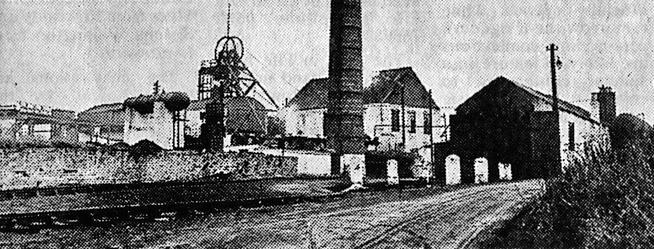
This picture was sent by a Cowdenbeath newspaper (Courier?) reader who once worked at the coal face in the Dora Pit.
"My recollections of my time at the Dora are not particularly pleasant," he writes, "because of the conditions we had to work in. But I do have many fond memories of my workmates there and I am sure that for them, at least, publication of this photograph would bring back a few thought of their own. ..."
Dora Colliery, as she was in 1958.
|
------------------------------------
"Cowdenbeath Advertiser"
12 December, 1958
A meeting of the Cowdenbeath branch of the NUM which included the 170 men employed at the Dora Colliery, was held but there was no protest at the proposed closure of the pit. Indeed, the only protest was against a plan to develop opencast mining at Crossgates. Although they were still awaiting official confirmation of the closure of the Dora, it was generally viewed by the men as inevitable due to the exhaustion of the seams of the pit.
------------------------------------
"Dunfermline Press"
31 January, 1959
First Stage of Fife Pit Closures
The first stage in the closure of the Dora Colliery, Cowdenbeath, took place
yesterday, when 70 men ceased their employment there. The remainder of the
men, with the exception of the salvage team, will go at the end of February.
Approximately 250 men will be displaced by this, the first of three pit closures
which are scheduled to take place in West Fife in 1959.
The other two are the Jenny Gray, Lochgelly, which will cease production in August,
and the Benarty, a small surface mine at Kelty, which will close in October. The Jenny
Gray closure will affect 430 men, and the Benarty 200.
The salvage team at the Dora will number 40, and they will be on salvage work for a
further three months after the second stage of the closure has taken place.
The 210 who are to be displaced at the Dora by the end of February will find
alternative jobs at Comrie, Blairhall and Valleyfield Collieries. Miners from Cowdenbeath
and Ballingry area have been travelling to these pits for some time, and arrangements
have already been made by the N.C.B. to augment the bus service to and from these pits.
No man under 65 will be redundant by the closures. men over 65 will, however, be retired.
The three closures in West Fife are scheduled under the Coal Board's recently
announced policy of the concentration of work in the more productive pits. The Dora, the
Jenny Gray and the Benarty are near to exhaustion. Had there been no policy of
concentration, it is doubtful if the life of any of them could have been extended by
more than a further six months.
------------------------------------
"Dunfermline Press"
8 August, 1959
Dora Pit Closure
The work of salvaging plant and machinery at the Dora Pit, Cowdenbeath, has
now been completed. The final stage of the closure - the filling in of the 84-year-old
shaft - is now taking place.
The Dora, which originally belonged to the Lochgelly Iron & Coal Company, is the
last of the Little Raith group of collieries which worked coal in the Cowdenbeath - Lochgelly
district for over 100 years.
Production at the pit, which latterly reached 66,000 tons annually, came to an end four
months ago. The fifty men who have since been employed on recovery work have been
transferred to other collieries in West Fife.
Dora officials met in a social capacity in the Crown Hotel, under the chairmanship of Mr
John Gilliard. A presentation of a pen and pencil set was made to Mr Eric Guthrie, manager,
who has been appointed to a similar position at Fordell Colliery.
------------------------------------
| Read about James Guthrie's memories of his time at the Dora Pit. See Menu 2: Stories: Memories. Is James' 1949 Sheffield group photograph familiar to anyone else? |
|---|
------------------------------------
"Dunfermline Press"
29 October, 1966
N.C.B. Plan
A plan by the National Coal Board showing their proposals for the prospecting of opencast coal at the Dora site has been approved by Fife County Council.
------------------------------------
"Dunfermline Press"
5 October, 1973
OPENCAST MINING PLAN APPROVED
The Secretary of State for Trade and Industry, has authorised opencast
working of coal at the Dora site, east and south of Cowdenbeath.
About 1,900,000 tons will be removed, mainly for use in power stations. … The
sites of six pits in the area, George, William, James, Marion, Dora, and Gordon
will vanish, as well as the surface buildings of the old pits, Lochhead and Foulford. …
------------------------------------
"Dunfermline Press"
16 November, 1973
Opencast works are approved
The Secretary of State for Scotland has given the National Coal Board the
green light to start opencast mining operations on the Dora Site, Cowdenbeath.
Notice of the approval was given to Fife Planning Committee, when they met on Friday.
------------------------------------
"Dunfermline Press"
14 June, 1974
Assurances on opencast site
Dust and noise from the Dora opencast Mining site will be kept to an absolute minimum.
These were the assurances given by representatives of the NCB and Murphy, Contractors for the
site, when members of Cowdenbeath Town Council visited the opencast workings last Thursday
afternoon. … A "cut" currently being worked was viewed from close quarters, the
opencast techniques being explained by Mr Togher of Murphy and Mr Ramage and Mr Davies
from the NCB. …
When the temporary crushing apparatus is installed at the Dora site the output of coal from the workings is expected to be around 800 tons a day. This coal will be transported to Longannet Power Station by lorries which will leave the site along Burntisland Road.
------------------------------------
"Dunfermline Press"
20 December, 1974
Opencast target is exceeded
The output from Dora Opencast site situated south of Cowdenbeath and stretching towards
Lochgelly, is greatly exceeding the target figure of 8000 tons per week originally set for the project. …
It was stated that the weekly production had at one time reached about 19,000 tons and was
now running at about 12,000 tons per week. … In recent months such landmarks as the Dora,
Lochhead and Gordon bings have disappeared and Foulford bing is next on the list.
Over 100 men are now employed on the site.
------------------------------------
"Dunfermline Press"
25 June, 1976
Mystery death of dozer driver
The cause of an accident which led to a bulldozer driver's death on a Cowdenbeath
opencast coal site, must remain a mystery.
A jury in a fatal accident inquiry in Dunfermline Sheriff Court returned a formal verdict on his
death, but offered no explanation as to the cause of the accident.
David Brown (44), excavator driver, 54 Ryan Road, Glenrothes, died at 21.30 pm on 3rd February
this year, while engaged as a driver with Murphy Group, Leicester, on their opencast site at
The Dora, Cowdenbeath. …
------------------------------------
"Dunfermline Press"
26 November, 1976
COAL CONVOYS
A scheme to transport 500 tons of coal a day, by road, from the Dora
Opencast site, Cowdenbeath, to Longannet, was given the green light by
Dunfermline District's Planning Sub-Committee, last Thursday.
Twenty-five lorry-loads each day will be taken from the Dora site to the
Longannet Mine, for "blending," before going on to the nearby
power station. …
A spokesman for the National Coal Board said, on Friday, that the transport
of the coal by lorry had been going on for some time already. The lorries would
use King's Road to avoid possible bottlenecks and creation of dangers
at Admiralty Road. They would also be sheeted. He added: "This is only
a temporary measure."
------------------------------------
