In a History of Auchterderran Parish, the writer states, "Dundonald, Cluny, and Lochgelly are very ancient coalfields. Reference is sometimes made to the kirk heughs - places in Carden and Dundonald Den where the monks used to gather their 'black stanes', which they gave out as alms to the poor at their kirk doors on Sundays. ... In 1582, King James VI gave the lands of Cardoune, 'with tour, manour (manor), milnes, woods, and coale' to George Martene ... Martene made use of the ancient 'Kirke heughs', and worked only from the side of the Cardoun Burn, and at the 'Monk heughs' of the South Dundonald strip, near the present Lady Helen Pit."
The Parish Account also indicates the nature of the early Dundonald coal scene. "Then there is the Dundonald group, 'ye ancient collehill' ... three of which 'old coal pits' are named, about which Dr. Murray tells us in 1791 there were, including those elsewhere employed as colliers, 31 families. At that time they earned 10s. a week, whilst in 1600 they had 1s. 1d. per day. ... they had in 1763 2s. 6d. a day, when day labourers had from 8d. to 10d., and the earnings of 'free colliers' in Newcastle was only 10d. or 1s. per day."
A number of coal workings are known to have operated in the Dundownate (Dundonald) district from the early sixteenth century and, from around the 1840s, records survive to indicate the operations in a number of pits or mines.
[See later "Lochgelly Times" May 1957 article for 'Historical Notes on Dundonald Colliery'.]
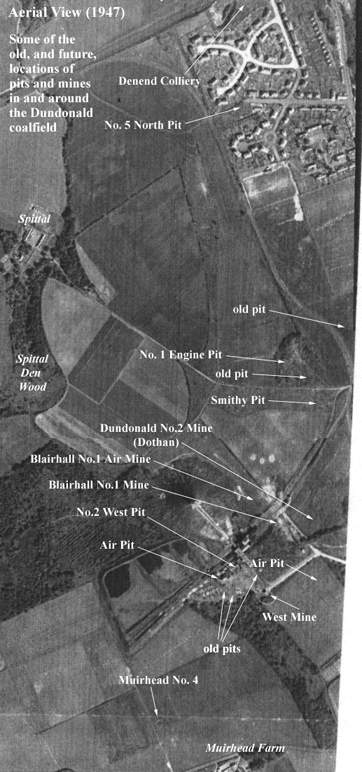
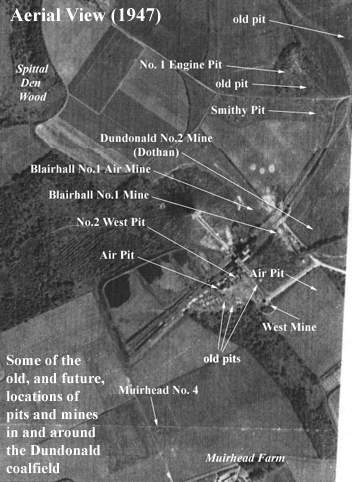
To date, we have identified the following Dundonald area coal-works:
No. 1 Engine, No. 2 West, No. 3 Engine, Dean, Den, Den Burn, Smithy, Muirhead No. 4 , No. 5 North, Lady Helen, West Mine and Blairhall Mine.
A number of these locations are identified on maps and/or aerial views but some sites still require verification.
 |
 |
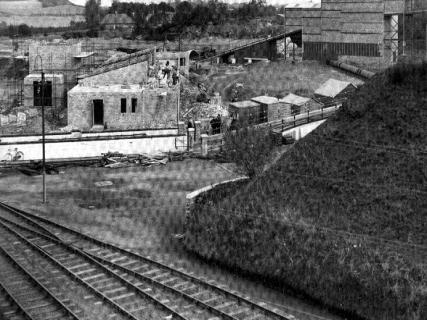 |
| Dundonald Mine No. 2 |
 |
 |
 |
| A range of information on a named pit or mine,
including opening/closing dates, exact location,
photographs of workings, details of shaft depths,
descriptions of coal seams worked/abandoned, points of
historical and/or social interest, etc., will be present
in an individual index entry (see Central Fife Index).
General information pertaining to the colliery over a considerable period of time, which is often difficult to allocate to an individual pit or mine, is reported in this general entry to which reference will be made from the individual index entries. |
|---|
Dundonald Colliery
| Source Date of Information Supplied (Owner) |
| Manager / Under-Manager / Men underground / Men above ground / Coal seams worked / Shaft Details |
| 1532
Earliest reference to coal being wrought at Dundonald |
| 1836 (R. W. Ramsay, Manager)
7 colliers reported to be employed |
| 1842 (Messrs. Grieve &
Naysmyth, Lessees.)
Mr. Andrew Adamson, Manager - 47 males; 12 females employed below ground. |
| 1852 (Messrs. Grieve &
Naysmyth, Lessees.)
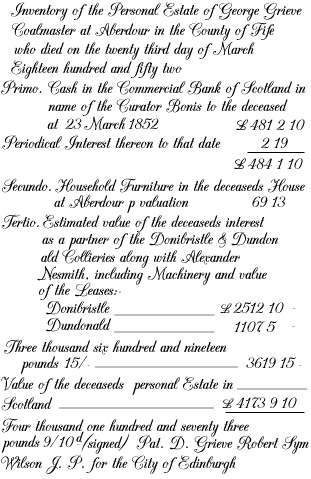
Mr. George Grieve, Coalmaster - died 23 March, 1852 (see reproduction of inventory following this table) |
| 1856-1859 (A. Nasmyth, Manager)
[From Dunfermline Registers] |
|---|
| 1861 (Grieve & Nasmyth)
[Parochial Register - Auchterderran.] |
| Pre 1862 Mr William Paton, manager - service dates not known. |
| 1868/1869 (Alex. Nasmyth) |
| 1870-1872 (A. Nasmyth)
[From Dunfermline Registers] |
| 1873 (A. Nasmyth) |
| A. Nasmyth, jun., / ------------ / --
/ -- / Glass Coal / D'cast 360 ft. : U'cast 270
ft.
[No. 2 or West] |
| A. Nasmyth, jun., / ------------ / --
/ -- / Lochgelly Splint / D'cast 360 ft. : U'cast
270 ft.
[No. 3 or Engine] |
| 1874 (A. Nasmyth) |
| A. Nasmyth, jun., / ------------ / 25
/ 3 / Glass Coal / D'cast 360 ft. : U'cast 270
ft.
[No. 2 or West] |
| A. Nasmyth, jun., / ------------ / 34
/ 15 / Lochgelly Splint / D'cast 360 ft. : U'cast
270 ft.
[No. 3 or Engine] |
| 1875 (A. Nasmyth) |
| A. Nasmyth, jun., / ------------ / 28
/ 3 / Glass Coal / D'cast 360 ft. : U'cast 270
ft.
[No. 2 or West] |
| A. Nasmyth, jun., / ------------ / 36
/ 15 / Lochgelly Splint / D'cast 360 ft. : U'cast
270 ft.
[No. 3 or Engine] |
| 1876 (A. Nasmyth) |
| A. Nasmyth, jun., / ------------ / 20
/ 6 / Glass Coal / D'cast ----- : U'cast 330 ft.
[No. 2 or West] |
| A. Nasmyth, jun., / ------------ / 41
/ 12 / Lochgelly Splint / D'cast 360 ft. : U'cast
270 ft.
[No. 3 or Engine] |
| 1877 (A. Nasmyth) |
| A. Nasmyth, jun., / ------------ / 26
/ 4 / Glass Coal / D'cast ----- : U'cast 330 ft.
[No. 2 or West] |
| A. Nasmyth, jun., / ------------ / 30
/ 14 / Lochgelly Splint / D'cast 360 ft. : U'cast
-----
[No. 3 or Engine] |
| 1878 (A. Nasmyth) |
| A. Nasmyth, jun., / ------------ / 34
/ 5 / Glass Coal / D'cast ----- : U'cast 330 ft.
[No. 2 or West] |
| A. Nasmyth, jun., / ------------ / 44
/ 15 / Lochgelly Splint / D'cast 360 ft. : U'cast
-----
[No. 3 or Engine] |
| 1879 (A. Nasmyth) |
| A. Nasmyth, jun., / ------------ / 33
/ 4 / Glass Coal / D'cast ----- : U'cast 330 ft.
[No. 2 or West] |
| A. Nasmyth, jun., / ------------ / 43
/ 14 / Lochgelly Splint / D'cast 360 ft. : U'cast
-----
[No. 3 or Engine] |
| 1880 (A. Nasmyth) |
| A. Nasmyth, jun., / ------------ / 30
/ 8 / Glass Coal / D'cast ----- : U'cast 330 ft.
[No. 2 or West] |
| A. Nasmyth, jun., / ------------ / 43
/ 16 / Lochgelly Splint & Parrot / D'cast 360 ft.
: U'cast -----
[No. 3 or Engine] |
| 1881 (A. Nasmyth) |
| A. Nasmyth / ------------ / 37 / 9 /
Glass Coal / D'cast ----- : U'cast 330 ft.
[No. 2 or West] |
| A. Nasmyth / ------------ / 48 / 16 /
Lochgelly Splint & Parrot / D'cast 360 ft. :
U'cast -----
[No. 3 or Engine] |
| 1882 (A. Nasmyth) |
| A. Nasmyth / ------------ / 24 / 6 /
Glass Coal / D'cast ----- : U'cast 330 ft.
[No. 2] |
| A. Nasmyth / ------------ / 48 / 17 /
Lochgelly Splint & Parrot / D'cast 360 ft. :
U'cast -----
[No. 3] |
| 1886
60 miners reported to be employed |
| 1890 (Dundonald Coal Co.) |
| George Blair / ------------ / 54 / 11
/ Lochgelly Splint; Glass Coal / D'cast (14 x 6) 300
ft. : U'cast (9 x 5½) 330 ft. Steam ventilation.
[No. 2] |
| George Blair / ------------ / 31 / 7 /
Fourteen feet Coal / D'cast (12 x 5) 240 ft. :
U'cast -----
[No. 5] |
| 1893 (Dundonald Coal Co.) Alex. Nasmyth, owner. |
| Andrew Dunsire, manager. |
| 1896 (Dundonald Coal Co.)
[Partners believed to be Messrs. Fleming, Meikle & Thomson] |
| Peter Dunsire / ------------ / 63 / 13 [Dundonald] |
| Household, manufacturing and steam coals. |
| 1902 (Dundonald Coal Co.) |
| Mr John M. Thomson / ------------ / 103 / 21 [Dundonald] |
| Household, manufacturing and steam coals. |
| 1904 (Dundonald Collieries, Cardenden) |
| J. M. Thomson / ------------ / 150 / 42 [Dundonald] |
| Household, manufacturing and steam coals. |
| 1905 (Dundonald Colliery Co.) |
| J. M. Thomson / ------------ / 173 / 49 [Dundonald] |
| 1908 (Dundonald Coal Co.) |
| May: Mr John M. Thomson, appointed general manager of Dunnikier Collieries, Kirkcaldy. |
| Mr Gilbert Andrew appointed manager - April 1908 G. Andrew / ------------ / 264 / 79 [Dundonald] |
| 1911 (Lochgelly Iron & Coal Company) |
| ------------ / ------------ / 61 / 20 [Dundonald] |
| 1912 (Lochgelly Iron & Coal Company) |
| Mar: Mr J. Beggar, oversman, moves to Bowhill Colliery. |
| 1913 (Lochgelly Iron & Coal Company) |
| ------------ / ------------ / 291 / 65 [Dundonald] |
| 1914 (Lochgelly Iron & Coal Company) |
| Jun: Mr John Rigg, oversman, leaves to move to India. |
| 1916 (Lochgelly Iron & Coal Company) |
| Nov: Departure of Mr James Brown, oversman,
to Prestwick Collieries. Dec: Departure of Mr T. Woleridge, under-manager, Lady Helen Pit. |
| 1918 (Lochgelly Iron & Coal Company) |
| John Armstrong / ------------ / 160 / 25 [Lady Helen] |
| John Armstrong / ------------ / 112 / 42 [West Mine] |
| 1923 (Lochgelly Iron & Coal Company) |
| Jul: Mr James Paul, manager. |
| 1924 (Lochgelly Iron & Coal Company) |
| Mr James Paul, colliery manager. Aug: Mr Robert Wilson, undermanager. |
| 1928 (Lochgelly Iron & Coal Company) |
| Walter Black / James Splitt / 141 / 57 [Lady Helen] |
| Steam coal and blaes. Lochgelly Splint. |
| Walter Black / James Watt / 183 / 51 [West Mine] |
| Steam coal. Fourteen Feet and Rough Coal. |
| 1938 (Lochgelly Iron & Coal Company) |
| J. M. Paul / James Watt / 299 / 100 [Lady Helen & West Mine] |
| 1945 (Lochgelly Iron & Coal Company) |
| J. C. B. Haynes / D. W. Johnstone / 245 / 97 [Lady Helen & West Mine] |
| Household and steam coals. Rough Coal. |
| 1947 (NCB) |
| G. Johnston / ------------ / 286 / 92 [Lady Helen & West Mine] |
| Gas, household, manufacturing coals
and anthracite.
Annual output = 112,300 tons. |
| 1948 (NCB) |
| D. W. Johnstone / J. Gibb / 263 / 97 [Lady Helen & West Mine] |
| Steam coal. Rough Coal. |
| D. W. Johnstone / ------------ / 13 / -- [Blairhall Mine] |
| Steam coal. Blairhall Coal. |
| 1961 (NCB) |
| T. Harrison / ------------ / 233 / 32 [Lady Helen] |
| Gas, industrial, steam coals and blaes. Five Foot. |
 |
| Please see Stories Link: Bowman Story, for information on Alexander Nasmyth's connection with Dundonald Colliery. |
|---|
EVIDENCE ON THE EMPLOYMENT OF CHILDREN
Mr. Andrew Adamson, Colliery Manager
ROYAL COMMISSION - 1842 REPORT
"Children and young persons are not directly employed by the proprietors, as a contract is taken by the men to do their own putting, and they generally employ those who can do it quickest. Part of work is done by winding coals from the working by incline-wheels; the winding generally performed by strong females. As boys are of little use before 12 years of age, none ought to be allowed to descend until arrived at. We have no school or sick-fund belonging to this work."
James Mitchell, coal grieve, Dundonald
"We have few colliers here who get the length of 50 years; more die off near 40. From the bad breath those who go earliest in life get touched with it soonest. We have had no accidents at this pit, but some people suffer from Rheumatism, as much water is below at times, and they get it from damp work. Very young children are of little use, but the contractors take down who they like."
Dundonald Colliery (19th century report)
| Coal seams worked | Thickness | Quality | Class |
|---|---|---|---|
| Smithy | 3 ft. | ordinary | steam |
| Fourteen Foot (Upper Leaf) | 2 ft. 8 in. | good | household and steam |
| Fourteen Foot (Lower Leaf) | 6 ft. | fair | steam |
| Duddie Davie | 2 ft. 9 in. | good | household and steam |
| Lochgelly Splint | 4 ft. 6 in. | very good | household |
| Lochgelly Parrot | 2 ft. 9in. | very good | household (splint) |
| Glassee | 3 ft. 3 in. | good | household and steam |
| Mynheer | 2 ft. 9 in. | very good | household |
The writer of the Auchterderran Parish Account also
provides some interesting comment on the Dundonald scene
around the turn of the century.
"Dundonald Den houses were built in lieu of the old
stone rows which stood at Spittal Road and Knowehead. To
these were added 52 by the County Council. The old
'stone' biggings are now in ruins.
Three seams have been 'wrocht' at this coalfield -
the Lochgelly Splint, The Glassee, and the Mynheer, though it
is generally known that the Five Feet and the Dunfermline
Splint are workable under the Mynheer. One mine and one
vertical pit are still in operation - the West and Lady
Helen.
Since acquiring this field, there has been considerable
increase in the output by the vigorous and active management
of the Lochgelly Company, whose reputation stands high in the
mining world.
Mr. John Thomson, late Manager, used an air-pressure engine
for the first time, and introduced coal-cutting machines,
with considerable increase in his output. This machine holes
the face of the coal to a depth of 3 or 4 feet, and when the
hewers and their drawers finish up, the results of their
efforts beget some energetic hutch-filling, giving as much as
200 tons of an increase where formerly it was
50."
Plans of Abandoned Seams & DatesNote: abandonment dates do not relate to individual pit closures but to the abandonment of seams which had ceased to be worked. Not worked for a period of time, it was quite normal for some coal seams to be re-opened for working at a later date or at a different location. |
|---|
| Plans of Abandoned Seams for Dundonald (with dates where available |
Pits or Mines designated
in Abandonment Plans |
|---|---|
| COAL; Main (1869) | Engine |
| COAL; Lochgelly Splint | Muirhead |
| COAL; Cluny | Den Burn |
| COAL; Duddie Davie (1908); Fourteen Feet (1911);
Lochgelly Parrot (1912); Glassee (1914; Lochgelly Splint (1920). |
Den; Muirhead No. 4; North; Smithy |
| COAL; Little; Cairncubie; Duddie Davie; Lochgelly
Splint;
Parrot; Fourteen Feet (1910) |
Nos. 1, 2; North |
| COAL; Little Splint (February 1927) | Nos. 1, 2; West |
| COAL; Pilkin (June 1927) | Lady Helen |
------------------------------------
"Fifeshire Journal"
5 December, 1839
FINE HARD SPLINT COAL
THE DUNDONALD COAL Co. respectfully intimate
that they ship in quantity, at the well-frequented Port of
Kirkaldy, their superior SPLINT COAL, which is free from Sulphur
and Ashes, and produces a fine Black Cinder.
For Steam-Boats, Distilleries, Breweries,
Bakers' Ovens, and all Furnace purposes, it will be found an
unexceptionable and a powerful and durable Coal, and in
House use to make a clean, cheerful, and economical
fire.
Great, 9s. per ton; Chews, 7s. per ton, - free
on board.
Apply to MR JOHN SMITH, Agent, Kirkaldy.
------------------------------------
"Fifeshire Journal"
4 August, 1842
Very Cheap and Very Superior Coal
THE DUNDONALD COAL COMPANY respectfully notify
that they have just opened up, and now exclusively work, an
entirely new Field of SPLINT, which, for House Use in particular,
CANNOT BE SURPASSED - the Softer Pieces suiting where Hard Splint
will not; for they ignite quickly, swell, or cake in burning,
whilst equally free of ash or sulphur.
The Company, firmly adhering to their rule of
just weight, and no excess, now fix on the following Scale of
Prices, viz.:-
HARD GREAT SPLINT ..................................... 4s. 7d. per Ton.
HOUSEHOLD DO ............................................ 4s. 2d. "
"
CHEW ........................................................... 3s. 4d. " "
CHARCOAL, 7s. 7d. per Kiln of 32 cwts. of raw
Coals.
The Colliery is One Mile South of Auchterderran,
and Four-and-a-Half Miles N. W. of Kirkaldy, and good
Roads.
Dundonald Colliery, August 3, 1842.
------------------------------------
"Fifeshire Journal"
20 April, 1848
DUNDONALD COALS
THE DUNDONALD COAL COMPANY beg to intimate that they have Opened Depots for the Sale of their Coals at the Kirkaldy, Kettle, Cupar, and Collessie Stations of the Edinburgh and Northern Railway, where daily supplies, fresh drawn from the pits, will be had. The following are the Prices at Cupar:-
Great Splint Coal ... ... 10s. 6d. per Ton
Chews ... ... 9s. 6d. "
These Coals are found upon trial to be well adapted for all kinds of Household purposes, and are also an excellent Furnace Coal.
MR JAMES COOPER, Agent, Cupar.
Dundonald Colliery, April 19, 1848.
------------------------------------

"Fifeshire Journal"
3 July, 1851
AUCHTERDERRAN - MELANCHOLY ACCIDENT
An accident occurred here on the afternoon of Saturday last, by which a man named Alexander Moyes, in the employment of the Dundonald Coal Company, was instantly deprived of life. He, along with several others, was employed in loading waggons with coal at Cardenden Station, and at the time was taking two forward to the choke-blocks to be ready for the first passing engine, and it is thought (for none but a boy was near at the time, and who can give no proper account) he had been lying with his breast over the handle of the brake, with his head opposite the buffers of the waggon, and when the first one had reached the choke-blocks, it would immediately come to a stand, and the second one coming forward had instantly crushed his head to a jelly, or something had tripped his foot and thrown him between the buffers. Be this as it may, we have the fearful reality of a man in the prime of life suddenly hurried into eternity. He has left a widow and six children to mourn his untimely end.
----------------------------------------------------
"Dunfermline Journal"
27 January, 1860
ACCIDENTS
Since the publication of our last, we regret much having to record more than one accident of a serious nature, which have occurred in the surrounding districts. ... At the Dundonald Colliery, Lochgelly, John Fleming, one of the workers, had his leg so severely injured as to cause amputation necessary - the engineman causing him to be raised to the pulley-wheels instead of letting him down the pit. It is evident in this case, that the loss of the limb, however serious, saved that of his life. ...
----------------------------------------------------
"The Scotsman"
16 May, 1862
Mr William Paton, mining engineer, Alloa, stated [to the Select Committee of the House of Commons] that he was at one time manager of the Dundonald Coal-Field, east of Dunfermline, and also manager of the mining department of the Devon Iron-Works. He was now manager of the Alloa Coal Company, and was acquainted with the West of Fife and Clackmannan coal-fields. ...
----------------------------------------------------
" Dunfermline Saturday Press"
24 November, 1877
FATAL ACCIDENT
A young woman named Jaap lost her life on Tuesday morning, at Dundonald Colliery, belonging to Mr. Alexander Nasmyth. She was employed on the pit-head, and was endeavouring to put a tub on the cage, not observing that the cage was resting four or five feet high above the pit-head, when she fell with the tub to the bottom of the shaft, and was instantaneously killed.
------------------------------------
"Dunfermline Saturday Press"
12 July, 1884
SUDDEN DEATH
On Saturday last, a miner named Robert Bain died very suddenly. He had been working in one of the pits at Dundonald Colliery, and shortly after the breakfast hour, was observed to fall, when he almost immediately expired. Heart disease is supposed to have been the cause.
---------------------------------------------
"The Scotsman"
9 February, 1895
FLOODING OF A FIFE PIT. - Owing to a large and growing accumulation of water in the workings, it has been found necessary to suspend operations at one of the pits at Dundonald Colliery, Fifeshire. The neighbouring colliery of Denend was closed at the time of the miners' strike, and it is believed that the stoppage of pumping operations there has led to the increase of the flow of water at Dundonald. In view of the fact that heavy pumping machinery is to be fitted up at the "Josephine" Pit, in course of being sunk by the Bowhill Company, it is expected that the stoppage at the Dundonald Pit will only be temporary, but a considerable time must elapse before the water finds its way into the Bowhill workings.
---------------------------------------------
"Dunfermline Press"
30 November, 1901
THE DUNDONALD STRIKE
The dispute at Dundonald Colliery consequent upon the introduction of "Billy Fairplay" has not been settled yet. ...
---------------------------------------------
"Dunfermline Press"
28 December, 1901
The award of the arbiter in the Dundonald
"Billy Fairplay" dispute has now been issued. Under the
award, the men's ton price, which was 3s 3d, is to be increased
to 3s 7d. The award takes effect from the date of the resumption of
work, so that all coal produced since 10th December will
be paid for at the advanced rate.
It is alleged that even with the increase the
men will not make so good wages as they earned previous to
"Billy" being introduced. Strict filling with the harp
reduces the output by something like 22½ per cent., while the
advance given in price is only 10¼ per cent.
----------------------------------------------
"Dunfermline Press"
4 January, 1902
A mining correspondent writes:- The Dundonald men are dissatisfied with the arbiter's award. While they have received an addition of 4d on the ton price, they maintain that they are still unable to make the standard wage of the county. Some men have reported that during the last fortnight their pay has come to only 4s 6d per day even with perquisites. Other workmen are said to be in even a worse position. It should be said that there is no check-weigher at the pit-head. Whether, however, that is sufficient to account for the prevailing discontent is more than doubtful.
----------------------------------------------
"Dunfermline Press"
14 June, 1902
DUNDONALD COLLIERY, Cardenden, has been acquired by a new company, with headquarters in Glasgow.
----------------------------------------------
"Dunfermline Press"
11 October, 1902
Mr Scott, who was a long time head engineer to Lochgelly Coal Company, met with an accident at Dundonald Colliery on Saturday. One of his hands was crushed between two large iron pipes, with the result that the points of four of his fingers were taken off.
----------------------------------------------
"Lochgelly & Cowdenbeath Times & Advertiser"
21 December, 1904
Dundonald Coal Company have acquired a fresh field in Derbyshire. It is the intention to develop the field and install plant similar to that used in Fife. John Thomson will be manager of both fields.
----------------------------------------------
"Dunfermline Press"
12 May, 1906
Some dissatisfaction was expressed among the men employed at the Dundonald Colliery, near Lochgelly, on Monday, owing to a proposal of the masters to claim one cwt in each hutch of coal. The miners held a meeting, and decided to come out on strike, but later in the day the employers withdrew their claim, and the men resumed work on Tuesday morning.
----------------------------------------------
H. M. Inspector of Mines Report 1907
Mr. Robert McLaren's Report
Fatal Accident at Dundonald, Fife
Owner: Dundonald Coal Co.
18 June, 1907
James Taylor, 35, Fireman. Deceased was acting temporarily as bogieman, on an endless rope haulageway, and he appears either to have jumped off or fallen off the bogie at a narrow part of the roadway and was run over.
----------------------------------------------------------
"Dunfermline Press"
4 April, 1908
COLLIERY MANAGERIAL CHANGES
Mr Arthur King, manager of the Newton and Mary Pits, has been appointed to the charge of the Nellie and Mary Pits, in room of Mr Gilbert Andrew, now manager of Dundonald Colliery. ...
----------------------------------------------------------
"Dunfermline Press"
4 April, 1908
APPOINTMENT FOR MANAGER
The many friends of Mr John Thomson, who has been general manager at Dundonald Colliery for the last five years, will regret his early departure from Dundonald. Mr Thomson has received another appointment as manager under Bowhill Coal Company; and his duties will be confined to Dunnikier Colliery, Kirkcaldy, recently purchased by the Bowhill Directors. Mr Thomson has been a favourite amongst the workmen. Mr Gilbert Andrews, underground manager from Lochgelly Iron and Coal Company, Lochgelly, will succeed Mr Thomson at Dundonald.
----------------------------------------------------------
"Dunfermline Press"
20 May, 1908
Mr John M. Thomson, late of Dundonald Collieries, Cardenden, leaving to take up the more important duties of general manager of Dunnikier Collieries, Kirkcaldy, lately purchased by Bowhill Coal Company.
----------------------------------------------------------
"Dunfermline Press"
27 March, 1909
It is understood that Wilsons and Clyde Coal Company, Limited, have purchased the Dundonald Coal Company's collieries on Dundonald estate, near Lochgelly.
----------------------------------------------------------
"Dunfermline Press"
10 April, 1909
FIFE COAL COMBINE
It is alleged that a strange development has arisen in connection with the reported sale of
Dundonald Colliery, Cardenden, to the Wilsons & Clyde Coal Company. One of the shareholders
was not made aware of the transaction until everything was complete. On learning this an interdict
was taken out. The Wilsons & Clyde Coal Company at once withdrew from their bargain,
and Lochgelly Iron and Coal Company, Limited, then commenced negotiations with a view to
purchasing Dundonald Colliery, which extends to upwards of 900 acres of coalfield. In this
they are said to have been successful.
As previously reported, negotiations between the
Lochgelly and the Fife Coal Companies for amalgamation are well advanced, and require only
the consent of the Earl of Minto, superior of Lochgelly.
By the latest transaction, the Lochgelly Company bring into prospect a still wider scope for the
Fife coal combination.
----------------------------------------------------------
"Dunfermline Press"
9 March, 1912
This issue carried news that Mr J. Beggar, oversman, Dundonald Colliery, for a considerable time was the subject of a presentation on his removing to Bowhill Colliery.
----------------------------------------------------------
"Cowdenbeath & Lochgelly Times"
24 April, 1912
On Friday night a miner named Leishman, residing at Henderson Street, Lochgelly, was injured at Dundonald Colliery while engaged at his work. A stone fell from a lipey roof on his back, causing severe bruises. He had a narrow escape from having his back broken. Dr Dickson attended to his injuries.
----------------------------------------------------------
"Dunfermline Press"
21 February, 1914
DEVELOPING THE COALFIELD.
If the present prospecting for coal in Dundonald Colliery, Cardenden, proves successful, there will be a big development here. The output at present is only something like 300 tons per day, but it is probable that this may be increased to 1000 tons daily. The erection of about 150 new houses along the Coal Road is contemplated, and it is proposed also to repair 50 of the present houses, which are standing empty. Should the project mature, employment for several hundred persons additional will be provided.
----------------------------------------------------------
"Dunfermline Press"
13 June, 1914
This issue carried the news that Mr John Rigg, oversman, Dundonald Colliery, was leaving for India.
----------------------------------------------------------
"Dunfermline Press"
25 November, 1916
On his leaving the district, Mr James Brown, oversman, Dundonald Colliery, was met in the
large room of the Gothenburg on Saturday evening, and made the recipient of a handsome
gold watch, along with a wristlet watch for Mrs Brown. ...
[Mr Brown was taking up a position in Prestwick Collieries.]
----------------------------------------------------------
"Dunfermline Press"
20 June, 1917
Mr Gilbert Brown, engineer, Dundonald Colliery, was on Saturday evening made the recipient of a handsome present on the occasion of his leaving the district to fill a more important position at No. 11 Pit, Lumphinnans, belonging to the Fife Coal Company. Ltd. ...
----------------------------------------------------------
"Dunfermline Press"
30 July, 1921
... At Dundonald Colliery practically every man is back to his own work, and everything is going on smoothly. The same cannot be said of Kinglassie Colliery, where only about a dozen men are at work in place of nearly 300. There is at present some dispute with the Fife Coal Company and the superior of Inchdairnie estate in connection with royalties, and until this matter is settled there is little likelihood of any more men being employed. The water is still standing about 30 fathoms up the shaft, and sufficient men are only employed to keep it from rising further.
----------------------------------------------------------
"Cowdenbeath & Lochgelly Times"
1 March, 1922
An inquiry was held in Dunfermline Sheriff Court before Sheriff Umpherston and a jury on Thursday, relating to the death of Richard Lowe Smith, drawer, Allison Place, Kelty, formerly residing in Lochgelly, who died on 10th February in Dundonald Mine of the Lochgelly Iron & Coal Company, Ltd., from a fracture to the base of the skull of which the cause has not been ascertained. ... The manager of the colliery said that from inquiries he had made there were only two explanations which might account for the accident. Either a man named Shannon had run into the deceased with his hutch, or the deceased coming out, had heard Shannon coming out with his hutch, and tried to stop it and fallen back on his head. ... A formal verdict was returned.
------------------------------------
"Dunfermline Press"
28 April, 1923
On Saturday evening, Mr John Moyes, who has been a contractor at Dundonald Colliery for about nine years, was met in the Gothenburg large room by a number of the officials and workmen belonging to Dundonald Colliery and made the recipient of a dressing case. …...
------------------------------------
"Dunfermline Press"
12 May, 1923
Harry Paterson, son of Mr John Paterson, merchant, Auchterderran, met with an accident at Dundonald Colliery on Tuesday evening. While engaged at his work, a stone came away and fell upon him, fracturing his leg. He had only been employed for a short time in the colliery, having failed to find employment at his trade. He was conveyed to Dunfermline and West Fife Hospital.
------------------------------------
"Dunfermline Press"
9 June, 1923
On Thursday forenoon, James Davie, miner, residing at Denside, Dundonald, and employed at Dundonald Colliery, received serious injuries at the Den Burn. An explosive which he was carrying, ignited, and injured one of his hands so severely that the thumb had to be amputated. He was also severely burned about the face, and his sight may be seriously affected. After being attended to, he was removed to Dunfermline and West Fife Hospital.
------------------------------------
"Cowdenbeath & Lochgelly Times"
6 February, 1924
A rather unfortunate accident befell Mr John Barclay, Densaiae, on Saturday forenoon. While at work in Dundonald Collieries he was almost buried beneath a fall of coal, and it was only with great difficulty he was extricated from a perilous position. Many willing workers cleared the fall, and after getting first-aid treatment, Mr Barclay was taken to his home, which, luckily, is not far distant from the mine. So far as can be ascertained, the injuries are not of a serious nature.
------------------------------------
"Cowdenbeath & Lochgelly Times"
16 July, 1924
While at work in the Dundonald Collieries, David Baird, miner, Fourth Street, Bowhill, received serious injuries caused through a fall. On being brought to the surface, Baird was examined by Dr Walker, who found a serious fracture below the knee, and on the doctor's advice the patient was removed to hospital. We learn that the injured man is progressing in a satisfactory manner.
------------------------------------
"Cowdenbeath & Lochgelly Times"
13 August, 1924
PRESENTATION TO OVERSMAN
A representative gathering of the employees of Dundonald Collieries met in the Supper-Room of the Central bar [sic Bowhill Hotel], to honour one of their number who is leaving for abroad.
Mr Marshall A. Carmichael, oversman, was the recipient of a well-filled wallet of Treasury notes.
Mr Robt. Wilson, under manager, capably filled the role of chairman, and Mr Geo. Spence made the presentation.
Mr Carmichael carries with him the good wishes of a wide circle of friends to his adopted country, where his further successes will be watched with interest.
A very pleasant evening was spent in song and sentiment, and Mr Wilson was heartily applauded for his able conducting of the gathering.
------------------------------------
"Cowdenbeath & Lochgelly Times"
17 September, 1924
A fine institute was opened on Saturday at Dundonald. It has been erected through a grant from the Miners' Welfare Fund, and has cost approximately £3000. Very conveniently situated and well-planned, it should prove of great advantage to the community. ... Mr James Paul, manager of Dundonald Colliery (Lochgelly Iron and Coal Company, Ltd.), presided. ...
------------------------------------
"Cowdenbeath & Lochgelly Times"
17 September, 1924
WELL-KNOWN MAN SEVERELY INJURED
Great regret was expressed when it was known that Alex. Spence, Orrbank, had sustained severe injuries at Dundonald Collieries on Wednesday afternoon.
It appears that he was travelling the incline and was crushed by hutches in motion, causing serious injuries to his chest and lower part of the body. With all possible speed he was brought to the surface and first-aid skill applied to relieve his suffering.
Drs Louw and Walker were summoned and, on examination, ordered his removal to hospital. It is learned he is making good progress.
Mr Spence is of a quiet, unassuming nature and much admired by a large number of acquaintances. He is of a well-known and highly respected Lochgelly family, who have been long resident in the district.
------------------------------------
"Cowdenbeath & Lochgelly Times"
22 July, 1925
On Thursday evening, Wm. Sharp, Blythwood Cottages, received injuries of such a nature as necessitated his removal to Dunfermline Hospital. The unfortunate man was employed on the backshift in Dundonald Collieries and had about completed his shift when the accident occurred. He was caught between two hutches, and his injuries are more or less about the limbs and chest.
------------------------------------
"Cowdenbeath & Lochgelly Times"
2 September, 1925
Charles Lawrence, drawer, residing in Lochgelly, was rather severely bruised about his back by a fall of stone in Dundonald Colliery on Friday. After receiving medical attendance from Dr Young the unfortunate lad was conveyed home.
------------------------------------
"Dunfermline Press"
21 August, 1926
COLLIERY MANAGER'S SUDDEN DEATH.
Mr James Leckie, under-manager, Lady Helen Pit, Lochgelly Iron and Coal Company, Dundonald, died suddenly early on Saturday morning. He had been for about three years in the employment of the Lochgelly Iron and Coal Company at Minto and Lady Helen pits, and was highly respected by all who came into contact with him. He belonged to Shettleston district, where he was a manager for many years previous to coming to Cardenden. He was 55 years of age, and leaves a widow and five sons and one daughter to mourn his loss.
------------------------------------
"Lochgelly Times"
10 August, 1927
Peter Cassels, Bishopview [Auchterderran], met
with an unfortunate accident on Friday night while at work in the
Glassee seam, Dundonald Collieries.
Assisting his father with some brushing, he was
rather severely injured about the head through a quantity of stone
becoming dislodged. He was removed with all possible speed to the
pithead, and received medical attention.
------------------------------------
"Cowdenbeath Advertiser"
2 September, 1927
ACCIDENT AT DUNDONALD COLLIERY
A serious accident befell a coal cutter, named Grant, whilst engaged at his work at Dundonald Colliery, Lochgelly Coal Company. He was attending a coal-cutting machine in action when the controlling chain unexpectedly snapped, and the suddenly-released loose end caught Grant round the body. He was knocked down and was found lying unconscious by his mates.
He regained his senses at the pithead, where a medical examination revealed that several ribs were broken and that he was badly bruised.
Grant is 23 years of age, married, and resides in the locality.
------------------------------------
"Lochgelly Times"
23 November, 1927
WORK AT LOCAL PITS
THE FUTURE OF DUNDONALD
Work in the mines locally is by no means
plentiful at present. Bowhill collieries have had two idle days
during the past week, and the workmen at Dundonald, both in the pit
and the mine, have been served with notices intimating that at an
early date all present contracts will cease.
Much speculation regarding the future of
Dundonald is naturally going the rounds. Let us hope if a stoppage
does take effect it will only be a temporary one.
------------------------------------
"Cowdenbeath Advertiser"
25 November, 1927
ACCIDENT
Robert McGregor, West Park Street, Cowdenbeath, met with an accident yesterday while at work in the Dundonald Colliery, Cardenden. On being moved to Dunfermline Hospital, he was found to be suffering from injuries to his back and legs.
------------------------------------
"Lochgelly Times"
30 November, 1927
Robert McGregor (38), married, residing at West
Park Street, Cowdenbeath, met with serious injuries whilst engaged
underground at Dundonald colliery on Saturday.
He was caught by a roof fall whilst in the act
of putting up supports, and was at once seen to be suffering
severely when extricated. He was removed to Dunfermline and West
Fife Hospital and detained.
His injuries are fortunately not so serious as
was first feared, and his condition is now favourable. Robert is a
son of Mr Robert McGregor, Auchterderran Road,
Lochgelly.
------------------------------------
"Dunfermline Press"
13 April, 1929
An accident befell Andrew Wood, miner, Gammie Place, on Thursday evening. Employed in the Dundonald Collieries, he was seriously buried about the legs through a heavy fall of coal. A doctor found that no bones were broken, but Wood suffered severely from lacerated wounds, in addition to bruises.
------------------------------------
"Dunfermline Press"
7 February, 1931
Willie Fraser, Cluny Road, a young lad employed at Dundonald Colliery, met with an accident resulting in the loss of a finger. With others he was assisting with the using of a sylvester, when, without warning, a "miss" occurred and his hand was caught.
------------------------------------
"Dunfermline Press"
23 April, 1932
Samuel Shields, Dundonald Den, was injured in Dundonald Colliery by a fall of coal. After receiving medical attention at the colliery he was conveyed home.
------------------------------------
"The Scotsman"
1 February, 1939
FIRE IN FIFE PIT
Three hundred miners employed at Dundonald Colliery, near Lochgelly, were thrown idle
yesterday by an underground fire which endangered the pit shaft. Men in the pit bottom, who were
winding coal, saw smoke coming down the shaft, and, on looking up, flames.
It appears that some of the coal in the stratum had taken fire, and this had set fire to the buntings
of the shaft. A hose was quickly procured, and the flames in the buntings were soon extinguished.
In the interests of safety, the workmen were brought up the pit and the colliery declared idle.
Persistent efforts were made to extinguish the outbreak in the stratum, but these had not been
successful up to last night.
The colliery belongs to the Lochgelly Iron and Coal Co., Ltd. It was stated last night that the pit
will be idle again today. It is expected that work will be resumed before the end of the week.
------------------------------------
"Cowdenbeath Advertiser"
25 December, 1942
ACCIDENT AT DUNDONALD COLLIERY
SEQUEL TO HUTCH JAM
On Monday morning, James King, a young lad, residing in Dundonald Den with his parents, met with a serious accident in Dundonald Colliery. A "hutch jam" occurred, and on the "race" being released the unfortunate lad was caught and sustained serious injury to his head and face.
Dr Cuthbert was speedily on the scene and, after treatment at the pithead, the patient was conveyed to hospital at Kirkcaldy.
------------------------------------
"Dunfermline Press"
6 February, 1943
PIT PRODUCTION COMMITTEE
Voting for the election of three members of the Dundonald Pit Production Committee resulted as follows:- John Penman, 210; Alexander Mill, 206; John Morrison, 159. Unsuccessful - William Russell, 154.
------------------------------------
"Dunfermline Press"
4 May, 1946
WEST FIFE MINING DEVELOPMENTS.
SURFACE MINE AT DUNDONALD.
Speaking at a film display in Dundonald Miners' Welfare Institute, at which
types of modern mining plant used by Lochgelly Iron and Coal Company, Ltd., were
shown on the screen, Mr L. R. Milligan, general manager, indicated early developments
decided upon by the Company.
It was proposed, soon, Mr Milligan said, to drive a new surface mine between Lady
Helen Pit and the West Mine to win a large area of coal lying to the north. The daily
output would be about 500 tons, and the mine will have a life of about 20 years.
Employment will be given to 150 to 200 people.
Coal would be cut by machinery and taken by conveyor to a central loading point.
From there it would be drawn to the surface in three-ton mine cars, thence by
conveyor to the screening plant. The Company, Mr Milligan added, was contemplating
two similar developments.
------------------------------------
"Lochgelly Times"
20 March, 1947
SUNDAY WORKING IN MINES
Last Sunday two collieries were working in the district, the Dundonald Colliery and the Minto, with a view to easing the coal shortage.
Despite the inclement weather, approximately 85 per cent of a normal day's output was made at the Minto, and 65 per cent (approx.) at Dundonald.
------------------------------------
"The Lochgelly Times"
23 May, 1957
HISTORICAL NOTES ON DUNDONALD COLLIERY
For the opening of the baths a brochure was prepared and it contained the following historical notes on the pit and district by Mr P. W. Brown, F. S. A. (Scot.), who is president of Benarty Antiquarian Club:-
The colliery is situated about one mile south from Cardenden Station, on the Cowdenbeath/Thornton railway. The mining of coal around the district dates back to very early times, principally in the Den immediately to the east of Lady Helen Colliery where the seams from the Dunfermline Splint to the Cardenden Smithy crop out. (Note - "The Cardenden Smithy is in places erroneously called Blairhall Smithy.") In the Den proper and at Hyndloup the sites of many old shafts are indicated.
CARDEN
The estate of Cardoun is first mentioned as the property of one Martyne (Martin). James IV, in 1482, confirms
a charter by John Martyne of Medhope, Linlithgowshire (deceased), granting to his son, Henry, "the lands of
Cardwan in the Constabulary of Kinghorne" which "Barony of Cardon" was afterwards annexed
to Auchterderran parish in 1641.
In 1582 King James VI gave the lands of Cardoun (Carden) "with tour, manor, mills, woods and coal" to
George Martine to whom it came by his mother, Lady Durie. This George was the last of the Martine's.
Martine made use of the "Kirk Heughs" and worked only from the side of the Cardoun burn and at
the "monks Heughs" of the South Dundonald strip, near the present Lady Helen shaft. The last of the
Martins of Cardoun lies buried in the old grave yard on Keir's Brae, where there was also a chapel.
The site of the old grave yard lies east of the Tower and on the north side of the road leading to Bowhouse farm.
In the year 1623 the lands were owned by David Wemyss. It is recorded that one David Betson was in possession
of Cardoun or Cardone in the year 1641 when the lands were disjoined from Kinghorn Parish. He was in possession
in 1630. The ancestors of the Novar family acquired the lands in 1725. These lands include Keir, Chapel, Bowhouse
of Cardoune, Beg (Little), Cardoune, Coldane, Bowleys, the Waulk Mill lands and the Mains of Cardoun.
It was in a field of this latter farm - Cardenbarns - that the last duel was fought in Fife. It took place on Wednesday,
23 August, 1826, in that field facing old Sunnyside strip, between George Morgan, a banker in Kirkcaldy, and Mr
Landale, in which Morgan was mortally wounded. At the trial in the High Court held in Edinburgh, Landale was
acquitted.
In after years a nephew of Morgan married a daughter of the house of David Landale.
The coal from several of the old pits in the Den was taken, in tubs, by horse haulage to a screening site near the
railway, east of Cardenden Station.
DUNDONALD
There is a mention of Dundonald (Dundonalt) as far back as the year 1330. The estate was included in
Lochore-shire, when the overlord was Sir William Lochore of that ilk. On Blaeus map of 1654 the spelling is
Dundonalt, at other times the spelling is Dundownate, Dundonnate, etc. Mining of coal in the lands of
Dundonald was coeval with that of Carden.
In the Old Statistical Account of the Parish of Auchterderran, compiled in the year 1790, there is mention of one,
Robert Balfour, as working coal at Dundonald. In the Session Records of the Parish reference is made to a "Coal Hill"
at Dundonald in the year 1735. When the Commission was carrying out investigations regarding child and female labour
in 1841, the manager of Dundonald was a Mr Andrew Adamson for Messrs Grieve and Nasmyth, coalmasters, who
also at one time were working coal in Donibristle Estate, south of Cowdenbeath.
The Dundonald collieries were owned by Nasmyth for many years, after which the undertaking was acquired by
Messrs Fleming, Meikle and Thomson; Lochgelly Iron & Coal Company entered into a lease of the minerals in
1910. In 1923 the same Company purchased the lands of north Dundonald from Novar Estates Company.
Lady Helen was named after the then Viscountess Novar. At one time the Lady Helen was a self-contained fitting,
but when the present screening plant and washery were erected at the west mine, the output was conveyed on
the surface by endless rope haulage.
At the west mine side there was originally a coal winding shaft (now filled up) and latterly the West Mine itself.
No. 1 MINE
In the year 1946 the present No. 1 Mine and its companion were sunk by the Lochgelly Company to work the
Cardenden Smithy coal known as Blairhall Smithy.
This mine was the first to be fitted with drop bottom cars of 4-ton capacity. The cars, containing their loads, are
emptied into a hopper at the mine top. From the hopper the coal is conveyed to the Screening and Washery
Plant. The mine has its own system of ventilation.
Apart from the surface mine haulage this mine working has an all-conveyor system of transport.
No. 2 MINE
A large area of coal, particularly on the five foot seam, lies eastwards beyond the Den and extends towards
Bowhouse Farm. The coals in the vicinity of the Den were partially worked from the Lady Helen shaft. To work
the remaining coal No. 2 Surface Mine was commenced in the year 1953.
This new mine is fitted with 2-ton drop bottom cars, the coal being moved out the level by locomotive haulage to
the bottom of the Surface Mine, and taken by direct haulage to be emptied into a hopper at the mine top and
thence by conveyor to the preparation plant at West Mine.
The Lady Helen shaft acts as the return for the No. 2 Mine and at the shaft top a ventilation fan is situated.
------------------------------------
"Dunfermline Press"
16 March, 1973
APPROVED
Dundonald Colliery, covering 60 acres to the south-west of Cardenden, will be completely reclaimed if a Fife Planning Committee recommendation is approved by the County Council. …
------------------------------------
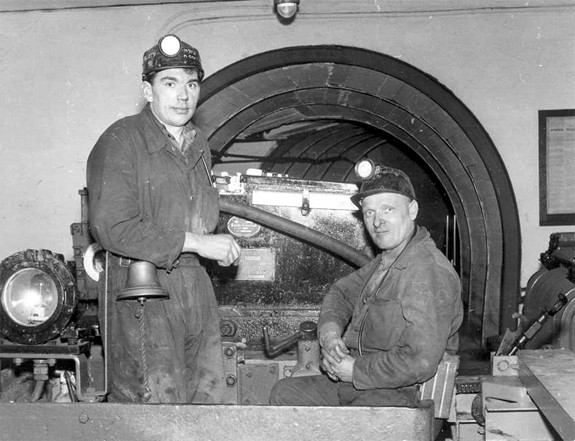
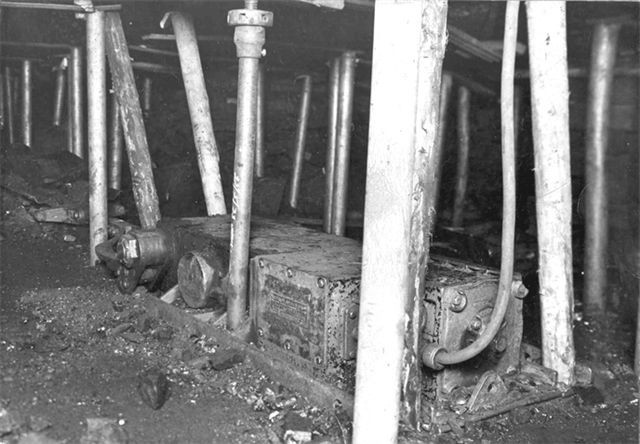
In early 2007, Neil Chalmers, Scotlandwell, kindly sent us these two images:-
 |
 |
"The one on the left is taken onboard the only underground loco in the Lady Helen
Colliery. My dad, William Chalmers, Electrician, (standing) and William Adamson, Chief
Electrician. The photo was taken around 1954-55 in the underground loco station in No. 2 Mine
with the small roadway behind running out to meet the main roadway. The loco is a Greenwood
and Bartley.
The second photo was taken in a mine in this area but I don't know exactly where. It shows
an Anderson Boyes 15" shaker conveyor on the faceline. The motor/gearbox is situated
at the tailgate with the coal travelling away from it. On one of the steel supports there is a date
chalked on 25/5/33. The coal must be quite thick as the driving unit is 15" in height."
------------------------------------
