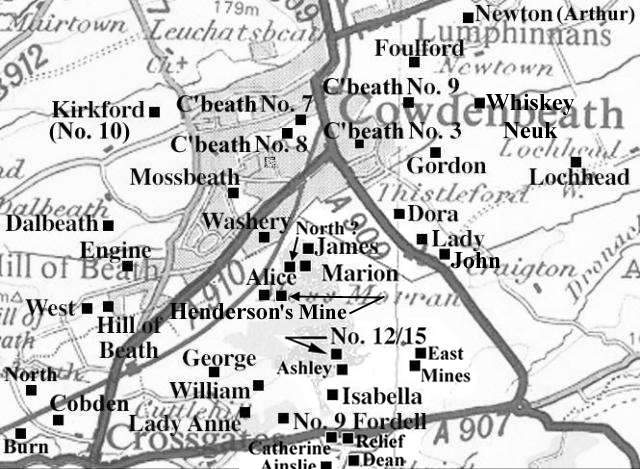
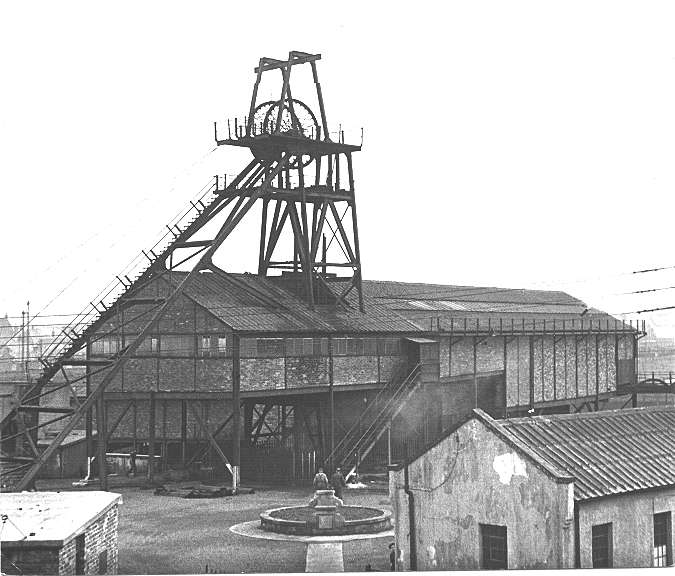
The Cowdenbeath No. 7 shaft was situated just south of
Stenhouse Street, in the centre of the town, and close to the
site of Central Park. It was connected to No. 3 and No. 8 for
ventilation and drainage purposes and later to No. 10
(Kirkford).
As the aerial map shows, coal from the pits to the west of
Cowdenbeath passed over a level crossing in the middle of the
High Street and there are many stories about the frustration
caused to pedestrians and drivers of vehicles who were forced
to wait while the 'pug' and its train of wagons
trundled slowly over the crossing. On another occasion, the
wagons 'stopped' a runaway horse and van!
| See entry Cowdenbeath Pits and Mines for a summary of mining activity in the area. |
 |
|
 |
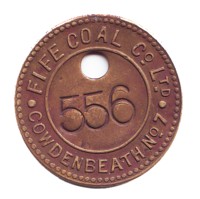 |
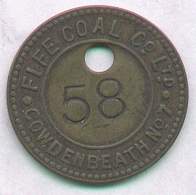
Check No. 556 displayed courtesy of George Hunter, Crossgates.
| Pit opened: an early ironstone pit;
sinking deeper ca 1869 & 1877 |
Pit closed: 29 January, 1960 |
|---|---|
| Source Date of Information Supplied | |
| Manager / Under- Manager / Men underground / Men above ground / Coal seams worked / Shaft Details | |
| 1877 (Cowdenbeath Coal Co.) | |
| William Moodie /
------------ / 15 / 6 / ----- / D'cast (11 x 10) 720
ft. : U'cast (10 x 5) 720 ft.
Ventilation by fan. Sinking. |
|
| 1878 (Cowdenbeath Coal Co.) | |
| William Moodie /
------------ / 29 / 21 / Five Feet / D'cast (11 x 10)
812 ft. : U'cast (10 x 5) 812 ft.
Ventilation by fan - fan 10'. |
|
| 1879 (Cowdenbeath Coal Co.) | |
| William Moodie /
------------ / 38 / 25 / Five feet, Splint / D'cast
(11 x 10) 812 ft. : U'cast (10 x 5) 812 ft.
Ventilation by fan - fan 10'. |
|
| 1880 (Cowdenbeath Coal Co.) | |
| Davey Thomas / ------------ / 86 / 25 / Five Feet; Splint / D'cast (16 x 10) 812 ft. : U'cast ------ | |
| 1881 (Cowdenbeath Coal Co.) | |
| Davey Thomas /
------------ / 160 / 32 / Dunfermline Splint, 4 ft. 6
in.; Mynheer, 4 ft.;
5 feet, 6 ft.; 14 feet, 8 ft. 6 in.; Glassee, 2 ft. 6 in.; Lochgelly Splint and Parrot, 12 ft. D'cast (16 x 10) 812 ft. : U'cast ----- |
|
| 1882 (Cowdenbeath Coal Co.) | |
| Davey Thomas /
------------ / 155 / 43 / Fourteen Feet; Five Feet;
Mynheer;
Dunfermline Splint; Lochgelly Splint and Parrot. D'cast (16 x 10) 812 ft. : U'cast ----- |
|
| 1883 (Cowdenbeath Coal Co.) | |
| Mr. D. Thomas, manager,
leaves Cowdenbeath for an appointment in Yorkshire.
Mr. David Anderson, former manager of Little Raith Colliery, appointed colliery manager at Cowdenbeath. Mr. James Adamson presently employed as oversman. |
|
| 1890 (Cowdenbeath Coal Co.) | |
| David Anderson /
------------ / 314 / 34 / Lochgelly Splint & Parrot;
Five foot; Mynheer; Dunfermline Splint
D'cast (16 x 10) 812 ft. : U'cast ----- Ventilation by fan - fan (Guibal) 24' x 8' |
|
| 1896 (Fife Coal Co. Ltd.) | |
| David Anderson / ------------ / 638 / 195 / As Cowdenbeath Colliery | |
| Gas, household, manufacturing and steam coals. | |
| 1901 (Fife Coal Co. Ltd.) | |
| June: Mr William Brown, manager. | |
| 1902 (Fife Coal Co. Ltd.) | |
| W. E. Richardson / ------------ / 417 / 43 / As Cowdenbeath Nos. 7 & 10 | |
| Gas, household, manufacturing and steam coals. | |
| 1904 (Fife Coal Co.) | |
| James Holmes /
------------ / 291 / 194
As Cowdenbeath Colliery (not including No. 10) |
|
| Gas, household, manufacturing and steam coals. | |
| 1905 (Fife Coal Co.) | |
| James Holmes /
------------ / 247 / 173
As Cowdenbeath Colliery (not including No. 10) |
|
| 1908 (Fife Coal Co.) | |
| W. E. Richardson /
------------ / 258 / 61
As Cowdenbeath Colliery (not including No. 10) |
|
| 1909 (Fife Coal Co.) | |
| June: Mr Robert Crawford, ex-Mauricewood,
appointed manager.
As Cowdenbeath No. 7 & Kirkford |
|
| 1911 (Fife Coal Co.) | |
| Mr Robert Crawford /
------------ / 587 / 121
As Cowdenbeath No. 7 & Kirkford |
|
| 1912 (Fife Coal Co.) | |
| Oct: Mr Robert Crawford,
manager, promoted to Dunnikier Colliery. Mr George Christie (ex-Benarty Colliery), appointed new manager. As Cowdenbeath No. 7 & Kirkford |
|
| 1913 (Fife Coal Co.) | |
| Mr George S. Christie,
manager. Nov: Mr John Spence, assistant manager, appointed manager at Mossbeath Colliery. |
|
| 1914 (Fife Coal Co.) | |
| Mr George S. Christie, manager.
July: Mr James Dempster, under-manager. |
|
| 1918 (Fife Coal Co.) | |
| George S. Christie / John
Alexander / 347 / 147
As No. 7 & No. 10 (Kirkford) |
|
| 1920 (Fife Coal Co.) | |
| ---------- / John
Alexander / 414 / 179
As No. 7 & No. 10 (Kirkford) |
|
| 1921/22 (Fife Coal Co.) | |
| Robert Gillespie /
John Alexander / --- / ---
As No. 7 & No. 10 (Kirkford) July, 1922: Robert Gillespie appointed to succeed Mr W. C. Bridgewood as agent for the F.C.C at Leven. August: Mr John Alexander, oversman at No. 7 Pit, appointed manager. Kirkford and No. 7 Pit. |
|
| 1924 (Fife Coal Co. Ltd.) | |
| Hugh Penman, manager, Cowdenbeath No. 7 Pit. | |
| 1927 (Fife Coal Co. Ltd.) | |
| September: Mr James Crawford to manage No. 7 and Kirkford Pits. | |
| 1928 (Fife Coal Co. Ltd.) | |
| James Crawford /
------------ / 249 / 64
As Cowdenbeath No. 7 |
|
| Household and steam. Mynheer, Glassee, Fourteen Feet, Little Splint, Swallowdrum and Diamond. | |
| 1929 (Fife Coal Co. Ltd.) | |
| Sept: Mr William S.
Peach, asst. to Mr Spalding, appointed manager.
Mr James Crawford appointed manager at Kinglassie Colliery. |
|
| 1937 (Fife Coal Co. Ltd.) | |
| Jan: Mr John Miller, manager. | |
| 1938 (Fife Coal Co. Ltd.) | |
| Mar: Mr John Miller, appointed
manager at Aitken Colliery. New colliery manager is Mr H. Black. H. Black / Wm. Huggins / 402 / 115 As Cowdenbeath No. 7 & No. 10 (Kirkford) |
|
| 1940 (Fife Coal Co. Ltd.) | |
| May: Mr H. Black, manager,
appointed manager at Valleyfield Colliery. Mr Wm. Reid, under-manager at Bowhill, appointed colliery manager. |
|
| 1945 (Fife Coal Co. Ltd.) | |
| J. Bennett / Andrew
Mackenzie / 403 / 153
As Cowdenbeath No. 7 & No. 10 (Kirkford) |
|
| Household coal. Five Feet, Glassee, Lochgelly Splint, Diamond and Main. | |
| (Cowdenbeath No. 7 Pit continued to work coal with No. 10 used for pumping and ventilation) | |
| 1947 (NCB) | |
| J. Eadie / Andrew
Mackenzie / 368 / 78
As Cowdenbeath No. 7 & No. 10 (Kirkford) |
|
| Gas, household and industrial coals. Approx. annual output = 163,300 tons. | |
| (Cowdenbeath No. 7 Pit continued to work coal with No. 10 used for pumping and ventilation) | |
| 1948 (NCB) | |
| J. Eadie / Andrew
Mackenzie / 362 / 92
As Cowdenbeath No. 7 & No. 10 (Kirkford) |
|
| Household coal. Main, Diamond, Lochgelly Splint, Glassee and Five Feet. | |
| (Cowdenbeath No. 7 Pit continued to work coal with No. 10 used for pumping and ventilation) | |
| 1949 (NCB) | |
| J. Eadie / A. Forrester / 359 / 85 | |
| Household coal. Main, Lochgelly Splint, Glassee and Five Feet. | |
| 1950 (NCB) | |
| John F. Abbot / A. Forrester / 379 / 66 | |
| Household coal. Main, Lochgelly Splint, Glassee and Diamond. | |
| System of ventilation partly in common with Lindsay and Mossbeath. | |
| 1951 (NCB) | |
| J. F. Abbot / A. Forrester / 390 / 64 | |
| Household coal. Main, Lochgelly Splint, Glassee and Diamond. | |
| System of ventilation partly in common with Lindsay and Mossbeath. | |
| 1952-56 (NCB) | |
| J. F. Abbot / A. Forrester / 386 / 68 | |
| Household coal. Main, Lochgelly Splint, Glassee and Diamond. | |
| System of ventilation partly in common with Lindsay and Mossbeath. | |
| 1957 (NCB) | |
| J. F. Abbot / A. Forrester / 365 / 56 | |
| Household coal. Glassee, Diamond, Lochgelly Splint, Swallowdrum, Five Foot. | |
| This pit had a system of ventilation partly in common with the Aitken Pit and Cowdenbeath No.10 (Kirkford) Pit. | |
| 1958/59 (NCB) | |
| J. F. Abbot / A. Forrester / 370 / 55 | |
| Gas, household, industrial and steam coals, and blaes. Glassee, Lochgelly Splint, Swallowdrum, Five Foot. | |
| This pit had a system of ventilation partly in common with the Aitken Pit and Cowdenbeath No.10 (Kirkford) Pit. | |
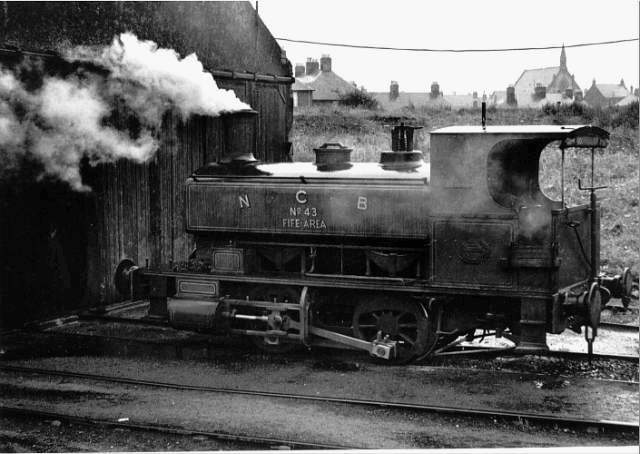 |
This photograph of locomotive No. 43, sent by Steve
Oakden, was taken at Cowdenbeath No. 7 Pit loco-shed. We
understand that after the pit closed the shed was retained
for the loco shunting in and around the area workshops. The
No. 43 is an Andrew Barclay Type locomotive with 14 in.
cylinders.
The many dirt bings and mines scattered around the periphery, certainly detracted considerably from the amenity value of the town and living conditions were further exacerbated by environmental scars inflicted on the town by mining. Older residents will well remember the effects of mining subsidence caused by workings under the town at moderate depths. The never-ending repairs to the High Street; the lop-sided buildings at Woodend; the original Beath High School, Stenhouse Street, shored up by external timbers and the walls held together by steel tie bars and wall plates!
On occasions, the men working in the Cowdenbeath No. 7 would come down by the No. 10 (Kirkford) shaft which was a lot nearer the working coal faces of the No. 7.
Information on coals worked at Cowdenbeath No. 7
Pit
(based on reports from 1930 and 1934)
Cowdenbeath No. 7 boasted 5 ft. 1 in. of Five Foot Coal
whilst at the neighbouring No. 8 Pit, no coal was found at
this position.
Two leaves of Jewel Coal of 1 ft. 3 in., separated by 5 in.
stone, were recorded here. Glassee Coal was around 3 ft. to 4
ft. thick and the Lochgelly Splint and Parrot Coals were
recorded as a single seam varying from 9 ft. to 13 ft.
Swallowdrum Coal measuring 3 ft. 7 in. was recorded 65
fathoms from the surface, with a fireclay pavement and a roof
of fakes. The Upper Jersey Coal in the pit had a red stone
rib near its base and was a good household coal; the Lower
Jersey coal being of poor quality.
A 7 ft. coal of the Fourteen Foot seam was recorded at a
depth of 60 fathoms while several thin leaves of Rough Coal
totalled 2 ft. 8 in.
The Cardenden Smithy Coal was found in two leaves of 3 ft. 2
in. and 2 ft.
Plans of Abandoned Seams & DatesNote: abandonment dates do not relate to individual pit closures but to the abandonment of seams which had ceased to be worked. Not worked for a period of time, it was quite normal for some coal seams to be re-opened for working at a later date or at a different location. |
|---|
| Plans of Abandoned Seams for Cowdenbeath No. 7 | Pits or Mines designated
in Abandonment Plans |
|---|---|
| IRONSTONE (September, 1871) | COWDENBEATH
Nos. 4, 5, 6, 7, 8 and Foulford Nos. 1, 2, 3 |
| COAL; Lochgelly Splint; Parrot.
IRONSTONE (1850-74). |
COWDENBEATH
Nos. 4, 5, 6, 7, 8, 9 and Foulford Nos. 1, 2, 3 |
| COAL; Dunfermline Splint (August, 1907); Lochgelly Splint (May, 1913); Glassee (August, 1914); Five Feet (November, 1919); Wee (February, 1922); Mynheer (January, 1926) | COWDENBEATH
No. 7 |
| COAL; Fourteen Feet (1924) | COWDENBEATH
No. 7 |
| COAL; Main or Fourteen Feet; Diamond; Glassee; Mynheer; Jewel; Two Feet (August, 1927); Five Feet (December, 1927) | COWDENBEATH
No. 7, Kirkford No. 10, Mossbeath No. 1 |
| COAL; Diamond (November, 1928); Main (April, 1930); Swallowdrum (October, 1930); Little Splint (October, 1930) | COWDENBEATH
No. 7 |
| COAL; Glassee (December, 1933) | COWDENBEATH
No. 7, Cowdenbeath No. 10, Mossbeath No. 1 |
| COAL; Two Feet or Wee (April, 1934) | COWDENBEATH
No. 7, Mossbeath No. 2 |
-------------------------------------
"Dunfermline Saturday Press"
14 August, 1869
PIT-SINKING
The [Kelty] Pit No. 3, which has been in the course of sinking these two years, has been now put down to the Main Coal by Mr. James Plenderleith, the third, and we are glad to add, the successful contractor, although the difficulties he has had to contend with have been great. The coal is of excellent quality, and will fully maintain the high character the Kelty coals bear in the market. We may add that Mr. Plenderleith was the contractor for the gigantic pit operation - the sinking of the No. 7 pit at Cowdenbeath - which, owing to the gloomy look of the coal trade, has been suspended for a time.
-------------------------------------

"Dunfermline Saturday Press"
25 January, 1873
On Thursday afternoon, a joiner named Robert Crichton, while employed at the engine-house of No. 7 Pit, Cowdenbeath Colliery, was caught by the "walking" beam and dashed up against the ceiling, the result being that his lower jaw was broken, and his spine severely injured. He was attended by Drs. Mungall, Cowdenbeath, and Nelson, Lochgelly. Crichton was reported to be in a dangerous condition at a late hour last night.
----------------
"Dunfermline Journal"
1 February, 1873
On Thursday last, Robert Crichton, a joiner at Cowdenbeath, was engaged in putting up water-berges on one of the windows at the engine-house of No. 7 coal pit, Cowdenbeath. He had occasion to ascend a folding ladder, and when placing his foot on the window-sill close to the walking-beam of the engine, the beam caught hold of him and threw him violently up to the ceiling of the engine-house. The engine was at once stopped, and the beam returning into its place, Crichton fell a distance of about nine feet. He was immediately carried home and was attended by Dr Nelson, Cowdenbeath, who discovered that his lower jaw-bone was broken and his spine severely injured. His injuries were so severe that he died next day.
----------------------------------------------------
"Dunfermline Journal"
25 January, 1873
On Tuesday, George Mitchell, residing at Foulford, parish of Beath, met with a very severe accident while attending to the "donkey" engine at the pit head of No. 7 coal pit, Cowdenbeath Colliery. He had occasion to pass over the flywheel of the large engine, on a wooden plank, for purpose of "feeding" the donkey engine with water which he carried in a bottle. Unfortunately his foot slipped while he was walking along the plank, and his right arm, which he naturally extended to balance himself, was pulled in between the spokes of the large flywheel and the connecting rod. His arm was broken and so severely mangled that Dr Mungall of Cowdenbeath advised his immediate removal to the Royal Infirmary, Edinburgh, and he was quickly taken there. Mitchell was much exhausted by the journey, but we believe he is progressing favourably.
----------------------------------------------------
"The Scotsman"
13 September, 1878
The Cowdenbeath Coal Company have completed the sinking of a shaft for a new pit to a depth of 140 fathoms - probably the deepest in Fife. No fewer than twelve seams of coal, chiefly of a good workable thickness, and free from "faults" or "dykes" have been found.
----------------------------------------------------
"Dunfermline Saturday Press"
25 September, 1880
Two miners named Robert Hunter and Andrew Ness, were severely injured in No. 7 Pit, Cowdenbeath, on Thursday. Robert Hunter received severe fractures of his right leg, which had to be amputated below the knee. Dr. Nasmyth and Dr. Dow, Dunfermline, performed the operation. Andrew Ness was injured about the head.
--------------------------------------------------
"Dunfermline Saturday Press"
2 April, 1881
On Monday, while David Gray, a brusher, was crossing the rails in No. 7 Pit, Cowdenbeath Colliery, he stumbled and fell in such a manner that his left leg was broken below the knee. He was duly attended to.
----------------------------------------------------
"Dunfermline Saturday Press"
2 February, 1884
On Saturday forenoon, while John Simpson, a miner, residing in Cowdenbeath, was engaged working on an incline in No. 7 Pit, Cowdenbeath Colliery, a hutch getting detached from a train suddenly came upon him, and knocking him down ran over him. The injuries he received were of so severe a nature that he only survived an hour after being taken home. Simpson was 32 years of age, and unmarried.
-----------------------
"Dunfermline Saturday Press"
27 December, 1884
On Monday, while a miner, named Robert Hunter, was engaged in No. 7 Pit, Cowdenbeath Colliery, a large piece of stone fell from the roof, and knocked him to the ground. Hunter, who is about twenty-eight years of age, was very severely hurt - his back being broken, and internal injuries being sustained. His recovery was considered doubtful.
-----------------------
"Dunfermline Saturday Press"
30 May, 1885
On Tuesday morning an accident occurred in No. 7 Pit,
Cowdenbeath Colliery, whereby a young married man named James
Inglis was crushed to death. Inglis had 'holed' some
coal before leaving the pit the previous night, expecting
that the mass would have fallen before next morning; but on
descending the shaft he found that there was no difference on
the face, and he commenced operations.
He had not been long at work, however, when a large piece of
coal gave way, and partially buried him. On being extricated,
his body was found in a stooping posture, and life extinct.
Deceased, who was twenty-eight years of age, leaves a widow
and three children to mourn his loss.
-------------------------------------
"Dunfermline Saturday Press"
3 September, 1887
On Wednesday afternoon, an accident occurred in one of the pits, by which a man lost his life. James Hunter had been working at the foot of a wheel brae in No. 7 Pit, when the chain used in connection with the lowering and raising of hutches snapped, and knocking down Hunter he was so severely injured that he died in about an hour afterwards. The deceased was fifty-eight years of age.
-------------------------------------
"Dunfermline Saturday Press"
4 February, 1888
On Thursday afternoon an alarming occurrence, resulting in
the death of a miner, took place at No. 7 Pit, Cowdenbeath.
The day was observed as a holiday at the Colliery, and
advantage was taken of the circumstances to effect repairs on
the shaft. About two o'clock in the afternoon the oncost
men suspended labour, but as the shaft of the pit in which
they were employed was not in a fit condition for them
ascending it, it was found necessary to resort to a different
means of exit. This they intended to do via another pit
connected with No. 7 - namely, No. 3, and the majority of the
men struck off in that direction. Two of them, however, -
John Currie, an oversman, and Thomas Lumsden, who was
attending to ponies below ground - thought they could reach
home by going through a passage leading to No. 8 pit, which,
by the way, is not much in use. They accordingly proceeded on
their journey, but had not gone far ere they encountered a
volume of foul gas, which nearly overpowered the two men.
Lumsden fearing that it would be dangerous to delay, urged
his companion to quicken his pace. This, however, the
unfortunate man was unable to do; but, to the contrary, must
have fallen to the ground. On the other hand, Lumsden
succeeded in safely arriving at the bottom of the shaft, and
after getting a breath of purer air, he returned to his
companion and rendered him all the assistance that was
possible in the circumstances. He endeavoured to drag Currie
to the bottom of the shaft, but ran so narrow an escape of
his own life that he was compelled to relinquish the task. He
again made his way to the bottom of pit No. 8, and gave a
signal to the engineman to raise the cage. This was at once
acted upon, and Lumsden speedily reached the pit-head.
Arrived there, he apprised the workmen of what had occurred.
A search party was immediately organised for the purpose of
rescuing Currie, who was believed to be at that part of the
mine where he was first overtaken by the gas.
On reaching the spot the party found him lying on his face
in an unconscious condition. With as little delay as possible
he was brought to the surface, and Dr. Nasmyth was sent for.
All attempts, however, to restore animation proved futile. It
may be mentioned that the atmosphere in which Currie was
discovered was so dangerous that the search party found it
necessary to beat a hasty retreat. Deceased was 46 years of
age.
-------------------------------------
"Dunfermline Saturday Press"
23 March, 1889
FIFE MINER POET KILLED
Two accidents are reported as having occurred on Monday at
the Cowdenbeath Coal Company's Works at Cowdenbeath.
It appears that while Charles Baxter and James Dyer were
employed at the face getting coal, a large quantity of the
"head coal" suddenly gave way, and the men's
lights were knocked out. On assistance arriving it was found
that Baxter was completely buried under the coal, and on his
being extricated life was found to be extinct. Dyer, who was
only struck by the edge of the falling coal, escaped with
some bruises about the back and legs. Baxter had for many
years written poetical pieces, which were published by a
local journal. He wrote under the nom-de-plume of Bill
Sparley. He was 60 years of age, and was married.
-----------------------
ACCIDENT TO A CONTRACTOR
On the same day, James Southall, contractor, Cowdenbeath, while working in No. 7 Pit, Cowdenbeath Colliery Company, had three of his ribs broken, and was otherwise injured, by a piece of coal falling on him. He was extricated at once and conveyed home. Dr. Nasmyth, Cowdenbeath, was speedily in attendance.
-----------------------
"Dunfermline Saturday Press"
6 December, 1890
Hugh Thomson, miner, Cowdenbeath, sustained a fracture of the right leg by a piece of stone falling upon him while engaged in No. 7 Pit, Cowdenbeath, on Thursday.
-----------------------
"Dunfermline Saturday Press"
23 January, 1892
On Thursday, Andrew Beveridge (32), miner, Lumphinnans, met with a fatal accident while employed in No. 7 Pit, Cowdenbeath Colliery. He had been working at a point halfway down the shaft, and had given the signal to be drawn to the surface before he was actually in the cage. The poor man was crushed between the cage and the shaft, and falling a distance of 36 fathoms, he was killed instantaneously.
-----------------------
"Dunfermline Saturday Press"
9 April, 1892
While David Kelly (30), miner, Cowdenbeath, was on Wednesday forenoon working at the coal face at No. 7 Pit, Cowdenbeath Colliery, a stone, weighing several cwts., fell from the roof on to his right leg, breaking the limb below the knee. The injured man was attended by Dr Craig, Cowdenbeath.
-----------------------
"Dunfermline Saturday Press"
24 September, 1892
... Sinking operations at the new pit at Cowdenbeath collieries have had to be suspended in the meantime, owing to a great flow of water into the shaft. A bore is at present being put down in the middle of the new pit, and when the upper seams are reached, the water will be cleared out of the pit, as the upper seams have been wrought before. It is not considered necessary to erect pumping gear as the coal has long been worked to the depth of the shaft, and when once a connection is gained the new workings will be comparatively dry.
-----------------------
"Dunfermline Saturday Press"
21 October, 1893
COWDENBEATH - A MINER'S TERRIBLE DEATH
On Sunday night the mangled remains of a miner named Robert Dawson, who lived in Cowdenbeath, were found at the bottom of the No. 7 Pit, Cowdenbeath. Dawson had been in indifferent health for some time. His wife had missed him for some hours. Deceased was seen going in the direction of the pit, which is upwards of 100 fathoms in depth, and it is thought that he committed suicide.
-----------------------
"Dunfermline Saturday Press"
28 October, 1893
William McIntyre (20), shunter, Beath Bleachfield Houses, Cowdenbeath, met with an accident while engaged shunting waggons at No. 7 Pit, Cowdenbeath Coal Company, on Tuesday afternoon. He missed his footing and fell in front of a waggon wheel, which passed over his left arm. The injured limb had to be amputated. McIntyre was otherwise injured, and died on Thursday night.
-------------------------------------
"Dunfermline Saturday Press"
18 November, 1893
On Monday morning, in No. 7 Pit, a miner, named Wm. Swinton, residing in High Street, was rather severely burned by an explosion of fire-damp.
[ William Swinton died later as a result of this accident.]
-----------------------
"Dunfermline Saturday Press"
24 March, 1894
A miner named James Lindsay was severely injured on Friday last week by a fall of rubbish from the roof of No. 7 Pit, belonging to the Cowdenbeath Coal Company. After being conveyed home, he was attended to by two medical gentlemen, who on examination found that he had sustained serious internal injuries.
-----------------------
"Dunfermline Saturday Press"
22 June, 1895
PIT REPAIRER FATALLY INJURED
The fatality at Townhill was closely followed by an accident, which terminated fatally, in No. 7 Pit, Cowdenbeath Colliery, belonging to the Cowdenbeath Coal Company Limited. While William Beveridge (58), pit repairer, Foulford Street, Cowdenbeath, was engaged repairing an air course in the pit named on Wednesday morning, several large stones fell from the roof. The man was knocked down, and sustained severe internal injuries. He was removed to his residence without loss of time, and medical assistance was speedily obtained. The unfortunate man, however, succumbed to his injuries within two hours after being conveyed home.
-------------------------------------
"Dunfermline Saturday Press"
5 September, 1896
MINER KILLED ON THE RAILWAY
Early yesterday morning, James Ford, a miner, residing in Broad Street, Cowdenbeath, was fatally injured by being run over at No. 7 Pit siding, Cowdenbeath Colliery, by a train of loaded waggons. Ford was on his way to his work when he was run down, and his injuries were such that he only survived half-an-hour after the accident. Deceased was 62 years of age.
----------------------------------------------
"Cowdenbeath & Lochgelly Times"
17 March, 1897
Yesterday forenoon an elderly man named Matthew Waterson, residing in High Street, was severely injured by a fall of the roof in No. 7 pit, Cowdenbeath. Dr Phyn attended to his injuries.
----------------------------------------------
"Dunfermline Saturday Press"
8 May, 1897
William Willie, labourer, Union Street, met with an accident at No. 7 Pit, Cowdenbeath Colliery, on Saturday. While working at the hoist for raising hutches, he slipped on the plate, and the hoist, which was descending at the time, struck him on the left leg, breaking the limb between the knee and ankle. Dr Craig attended to the injured man.
----------------------------------------------
"Dunfermline Saturday Press"
26 June, 1897
On Thursday morning, an accident occurred at the Fife Coal Company's No. 7 Pit, Cowdenbeath Colliery, which resulted in the death of Joseph Sharp, miner, School Street, Cowdenbeath. He had prepared a shot, and as it did not take effect so soon as he expected, he went forward to the face. He had just stooped down when a mass of coal came away, and struck him on the forehead. The injuries were so severe that he died within three hours. The deceased was fifty years of age. He was married, and leaves a widow and family.
--------------
"Dunfermline Saturday Press"
3 July, 1897
This issue carried the Report on the Fatal Accident Inquiry held in Dunfermline, at which John Reid, pit inspector; David King, drawer; and, David Whyte, miner, gave evidence. The Jury returned a verdict to the effect that "deceased met with his death through a piece of coal falling upon him in No. 7 pit, Cowdenbeath."
--------------------------------------------
"Dunfermline Press"
1 January, 1898
FOUND DEAD IN A COAL PIT
David Gilmour, about 40 years of age, miner, Union Street, Cowdenbeath, was found dead yesterday afternoon in the main road leading to the pit bottom of No. 7 pit, Cowdenbeath Colliery. The body was discovered while the men were leaving work for the day. The unfortunate man had dropped down dead from natural causes. There was no one nearby at the time.
--------------------------------------------
"Dunfermline Press"
5 March, 1898
John Seath, miner, Chapel Street, Cowdenbeath, had his back bruised and one of his fingers badly hurt through about 2 cwts. of coal coming away from the face, and part of it striking him in the underground workings of No. 7 Pit, Fife Coal Company, on Tuesday.
--------------------------------------------
"Dunfermline Press"
6 August, 1898
On Tuesday, while William Mungall, a son of Provost Mungall, was passing a waggon which was being filled with coal at No. 7 Pit, a large piece rolled over the side of the waggon and struck him on the head and then on one of his fingers. The finger was so severely smashed that the forepart had to be amputated.
--------------------------------------------
"Dunfermline Press"
12 November, 1898
PIT FLOODED
A considerable number of the miners employed at the Cowdenbeath collieries have been thrown idle this week by the breakdown of the pumping engine at one of the pits. The pit (No. 7) is the same depth as a number of others, and has had for several years to contend with a large inflow of water. Of late, owing to the recent storms, the inflow has been heavier than usual, and the pumping machinery has been heavily taxed, so much so that on Monday morning the large crosshead to which the pumping rods are attached snapped in two, and, of course, pumping was at once suspended. The result was that the water speedily accumulated in the bottom of the pit, and work had to be stopped. Had the flooding occurred some time later the water could have been all pumped out by the large engine on a new pit recently put down to the depth of No. 7. Some of the men are finding work in the other pits belonging to the Fife Coal Company.
--------------------------------------------
"Dunfermline Press"
19 November, 1898
Work has again been resumed at the two Cowdenbeath pits which were flooded with water consequent upon the breakdown of the pumping machinery.
--------------------------------------------
"Dunfermline Press"
27 May, 1899
THREE HUNDRED MINERS IDLE
The pumping machinery at No. 7 Pit, Cowdenbeath Colliery, broke down on Friday last, and as this pit reaches the bottom of the coalfield of the district, extensive flooding was caused. The water rose to such an extent that it closed the air course in connection with the large new pit at Kirkford. The result was an entire stoppage of work at both pits, and 300 men have been idle during the week, although the machinery was repaired on Monday and pumping has been going on continuously since. ...
--------------------------------------------
"Dunfermline Press"
7 April, 1900
James McLean, a miner, residing at Cowdenbeath, was badly injured by a fall while he was engaged in No. 7 Pit, Cowdenbeath, last Friday night. He was conveyed to Dunfermline Cottage Hospital, where it was found necessary to amputate his right leg.
--------------------------------------------
"Dunfermline Press"
25 May, 1901
JOINER CRUSHED TO DEATH AT COWDENBEATH
Daniel Bain, nineteen years of age, a joiner in the employment of the Fife Coal Company, met with his death at one of the Company's pits at Cowdenbeath on Tuesday. Bain, along with another man, was erecting a fence round the machinery which drives the ventilating fan at No. 7 Pit. Unnoticed by his companion, Bain came in contact with the machinery, and was found lying crushed to death in the crank pit. The deceased belonged to Almondbank, Perth, where his parents reside. His parents were communicated with, and the body was removed to Perth later in the day.
----------------
"Dunfermline Press"
15 June, 1901
This issue contains a Report of the Fatal Accident Inquiry into the death of Daniel Bain, joiner, at Cowdenbeath No. 7 Pit. Witnesses included:- William Brown, colliery manager, Cowdenbeath; Walter Chalmers, engineer, Union Street, Cowdenbeath; James Innes, pitwright, Union Street, Cowdenbeath; and, James Whyte, Natal Place, Cowdenbeath, the engineman in charge of the winding and fan engines. The jury returned a formal verdict.
--------------------------------------------
"Dunfermline Press"
11 October, 1902
The death is announced of Mr James Bogie, publican, High Street. Previous to obtaining a licence Mr Bogie was winding engineman at No. 7 Pit, Cowdenbeath Colliery, for forty years.
--------------------------------------------
"Dunfermline Press"
27 June, 1903
Duncan Condie, drawer, High Street, Cowdenbeath, was injured on Saturday last in the five-feet seam of No. 7 Pit, Cowdenbeath Colliery. The chain on the wheel brae broke, and he was knocked down by an empty hutch, which afterwards collided with the loaded hutch. His left leg was broken between the knee and ankle, and he was also badly crushed.
--------------------------------------------
"Dunfermline Press"
10 October, 1903
While a young miner named Robert Mitchell, residing in Bridge Street, Cowdenbeath, was preparing to leave work in No. 7 Pit on Saturday, a large piece of coal fell upon him, fracturing his right leg and severely crushing his left foot.
--------------------------------------------
"Dunfermline Press"
5 March, 1904
David Cunningham, Haulageman, residing at 28 School Street, Cowdenbeath, sustained a compound fracture of the right leg in the five-feet dook of No. 7 Pit, Cowdenbeath Colliery, on Wednesday. One of a race of eight hutches which were being drawn by a wire rope left the rails, causing the wire to spring back and strike him. The injured man was conveyed home, where he was attended by Dr Craig, Cowdenbeath.
--------------------------------------------
"Dunfermline Press"
11 June, 1904
A representative company of the officials and employees of No. 7 Pit and No. 1 Pit [Mossbeath] of the Cowdenbeath Collieries, met in the Masonic Arms on Saturday evening, to do honour to Mr Archibald Spears and Mr Alex. Ferguson, oversmen, on their transference to other positions under the Fife Coal Company. Mr Jas. Whyte, enginekeeper, presided. ...
--------------------------------------------
"Dunfermline Press"
5 November, 1904
Andrew Reekie, waggon shunter, Foulford Place, Cowdenbeath, had his right collar bone fractured while he was at work at No. 7 Pit. Cowdenbeath Colliery, on Saturday. He was braking three empty waggons, when he was caught between one of the waggons and a wooden pillar. Dr Craig attended to his injury.
--------------------------------------------
"Dunfermline Press"
9 September, 1905
William Reid, pit inspector, residing at Chapel Street, Cowdenbeath, while engaged at the hydraulic pump in the splint seam of No. 7 Pit, Cowdenbeath, on Thursday, had his right arm caught by part of the pumping gear. The arm was so severely crushed that it was fractured a little above the wrist.
--------------------------------------------
"Dunfermline Press"
30 September, 1905
By one of the boiler fires blowing out upon him, Wm. Alexander, furnaceman at No 7 Pit, was badly burned about the face and hands on Monday.
-------------------------------------------------
"Dunfermline Press"
16 December, 1905
While engaged in shunting operations at No. 7 Pit, Cowdenbeath, on Tuesday morning, George Young, shunter, Thistle Street, Cowdenbeath, sustained a compound fracture of the left arm by having the limb jammed between the buffer of an engine and an upright pillar.
-------------------------------------------------
"Dunfermline Press"
25 August, 1906
This issue carried the announcement of the death of Mr James Adamson, a former underground manager of No. 7 Pit. Deceased was 63 years of age and was buried at Boreland, Dysart - his native place.
-------------------------------------------------
H. M. Inspector of Mines Report 1907
Mr. Robert McLaren's Report
Fatal Accident at Cowdenbeath, Fife
Owner: Fife Coal Co. Ltd.
9 May, 1907
Robert Frail, 19, Drawer. The roof fell and threw out some timber, and deceased was injured and subsequently died. The timber was not properly set, and roof would not in all likelihood have fallen if the timber had been put up as it ought to have been.
-------------------------------------------------
"Dunfermline Press"
11 May, 1907
Robert Frail, a young miner, residing at School Street, had his jaw bone fractured with a blow from a falling prop in his working place in No. 7 Pit on Thursday. His injuries necessitated his removal to the Dunfermline and West Fife Hospital.
------------------------------------------------
"Dunfermline Press"
15 June, 1907
Under the Fatal Accidents Inquiry Act, an inquiry was held in the Sheriff Court, Dunfermline, on Thursday - before Sheriff Shennan and a Jury - into the circumstances attending the death of a miner named Robert Gilliard, lately residing at 32 School Street, Cowdenbeath, who was injured on 9th May in No. 7 pit, Cowdenbeath, "in consequence of a piece of coal bursting from the roof and striking him or causing a wooden bar to strike him on the head, from the effects of which he died on 10th April in the Dunfermline and West Fife Hospital." Those giving evidence at the inquiry included:- David Wallace Farquharson, manager; Alexander Macdonald, miner, 180 High Street, Cowdenbeath; and Alexander Scott, fireman. The jury returned a formal verdict.
------------------------------------------------
H. M. Inspector of Mines Report 1907
Mr. Robert McLaren's Report
Fatal Accident at Cowdenbeath, Fife
Owner: Fife Coal Co. Ltd.
30 October, 1907
James Dougray, 45, Miner. Deceased worked on the back shift, in a level of a seam being opened out mid-way in the shaft. There were no gates to fence the opening, but a bar was placed across during the fore shift, when no one was in the seam, and the bar was taken off when the back shift commenced and left off during the whole time the shift was at work. At stopping time deceased came from the face with a loaded tub, and evidently thinking the cage was there pushed it into the open shaft, and he and it were precipitated to the bottom a distance of 67 fathoms.
-----------------------------
"Dunfermline Press"
2 November, 1907
James Dougray, miner, residing at Norwood Place, Cowdenbeath, met with his death on Wednesday morning by falling a distance of over 40 fathoms in No. 7 shaft. He was employed in the Diamond seam, and it was part of his duty to load the cage when required. When nearing the close of his shift on Wednesday he evidently had been under the impression that the cage was hanging opposite the seam in which he worked, as he pushed a hutch into the open shaft. Falling along with it to the bottom, he was killed instantaneously. In his younger days deceased was a runner, and latterly was well known as "The Ped". He was a great football enthusiast, and for a time acted as trainer to the Cowdenbeath F. C. He was forty-four years of age and leaves a wife and family to mourn his loss.
---------------------------
"Dunfermline Press"
7 December, 1907
Under the Fatal Accidents Inquiry Act, an inquiry was held in the Sheriff Court, Dunfermline, on Thursday - before Sheriff Shennan and a Jury - into the circumstances attending the death of James Dougray, miner, lately residing at Norwood Place, Cowdenbeath, who was killed on 30 October in No. 7 Pit, Cowdenbeath, by falling from the Diamond seam bottom to the low bottom of the shaft. Those giving evidence included:- Henry Rowan, general manager, Fife Coal Company; Richard McEvoy, foreman engineer, 46 Foulford Road, Cowdenbeath; William Ramage, miner, Morayfield, Cowdenbeath; D. W. Farquharson, manager; William Miller, engineman; James Methven, oversman, Chapel Street, Cowdenbeath; and William George, fireman. The jury returned a verdict in accordance with his Lordship's suggestion.
-----------------------------------------------
"Dunfermline Press"
14 December, 1907
A large number of the workmen of Nos. 7 and 10 Pits assembled in the Masonic Arms on Saturday evening for the purpose of making a presentation to Mr D. Farquharson, their late manager, who has removed to a colliery in the Pittenweem district.
-----------------------------------------------
"Dunfermline Press"
20 March, 1909
This issue carried the news that a sum of £350 had been paid to settle the action raised by the widow and son of Mr James Dougary, miner, Cowdenbeath, who was killed (October 1907) through falling down the shaft at the No. 7 Pit, Cowdenbeath Colliery, owned by the Fife Coal Company.
------------------------------------------------
"Dunfermline Press"
17 April, 1909
A schoolboy named John Meldrum, son of Andrew Meldrum, Chapel Street, had one of his legs fractured on No. 7 pithead on Saturday. His foot became fixed in a hutch conveyor, and before the machinery could be stopped he was dragged seven yards, with the above result.
------------------------------------------------
"Dunfermline Press"
22 May, 1909
Mr James Gavin, the manager of Kirkford and No. 7 Pits, Cowdenbeath, met with a serious accident on Thursday morning. He was riding on the colliery locomotive from the sidings close to the station to Kirkford, and when the driver was engaged shifting points he put on the steam to drive the engine forward. The reversing lever suddenly sprang back, and the engine was sent at a great speed against a buffer end. Before the impact Gavin jumped off, with the result that his left leg was fractured above the ankle. The engine smashed the buffer end, and but for the iron supports would have run over the embankment. Gavin, after being examined by Dr Craig, was removed to the Dunfermline and West Fife Hospital.
--------------------------
"Dunfermline Press"
29 May, 1909
Friends of Mr James Gavin, colliery manager, Cowdenbeath, who received serious injuries at the Kirkford siding on Thursday last week will be grieved to learn that it was found necessary to amputate his left leg above the ankle on Saturday.
--------------------------
"The Scotsman"
9 June, 1909
THE CLOSURE OF MAURICEWOOD PIT. The filling up of the shaft at Mauricewood Pit has been completed, and after the sale of plant tomorrow, no evidence of the past existence of the pit will remain except the large blaize heap. Yesterday the late manager, Mr Robert Crawford, entered upon his new duties as mining manager of the Kirkford and No. 7 Cowdenbeath Collieries of the Fife Coal Company (Limited) - the two shafts affording work to over a thousand men, and having an average daily output of 1900 tons.
--------------------------
"Dunfermline Press"
26 June, 1909
James Gavin, colliery manager, Cowdenbeath, who was admitted to the Dunfermline and West Fife Hospital four weeks ago suffering from injuries received in a locomotive accident at the Kirkford Pit sidings, died on Friday night. Two days after the accident the deceased had his left foot amputated. He thereafter began to show signs of improvement, but last week his condition changed for the worse. He leaves a widow and three of a family.
--------------------------
"Dunfermline Press"
17 July, 1909
Under the Fatal Accidents Inquiry Act, an inquiry was held in the Sheriff Court, Dunfermline, on Thursday - before Sheriff Shennan and a Jury - into the circumstances attending the death of James Gavin, jun., colliery manager, lately residing at Marchmount House, Broad Street, Cowdenbeath, who sustained a compound fracture of his left leg on 20th May at the siding at No. 10 Kirkford Pit, by jumping off an engine in motion, and died on 18th June in the Dunfermline and West Fife Hospital, from the effects of said injuries. Those giving evidence at the inquiry included:- Elizabeth Steen, nurse, Dunfermline and West Fife Hospital; Thomas Simpson, engine driver; and John Anderson, shunter, Paterson's Buildings, Broad Street, Cowdenbeath. A formal verdict was returned.
------------------------------------------------
"Dunfermline Press"
1 July, 1911
This week several pit accidents have occurred. Andrew Gilroy, miner, Kirkford, was injured internally by a fall of coal in No. 7 Pit, Cowdenbeath Colliery. ...
------------------------------------------------
"Dunfermline Press"
3 February, 1912
In the course of his work in No. 7 pit, Cowdenbeath, on Thursday, Aitken Black, miner, Lilliebank Cottage, Halbeath, was struck by a quantity of material which fell from the roof. His left leg was fractured.
------------------------------------------------
"Dunfermline Press"
3 February, 1912
This issue carried news of the death of Mr James Whyte, former winding-engineman at No. 7 Pit, Cowdenbeath. He retired four years ago from Cowdenbeath Colliery.
------------------------------------------------
"Dunfermline Press"
31 August, 1912
PIT ACCIDENTS AT COWDENBEATH.
TWO LIVES LOST.
Cowdenbeath, which has been free from serious mining accidents
for more than ten years, was thrown into a state of alarm early on
Saturday morning as the news spread that a calamity had occurred at No. 7
Pit, belonging to the Fife Coal Company. Two men, named John Bissett,
High Street, and Linus Muirhead, Natal Place, had been caught beneath
a tremendous fall of material in their working place in the Lochgelly splint
seam.
The men had been employed in a heading that was being driven through
an old "drift" for the purpose of providing an air course to another
section of the mine. They entered upon their shift at ten o'clock on
Friday night, and apparently all went well with them till between twelve and
one o'clock, the hour during which the place was examined by Inspector
Miller. Judging from the fact that the men had not taken their meals, it is believed
the accident occurred shortly afterwards. The first to discover the fall was
Alexander Toddie, inspector, Broad Street, who, after observing the men's
jackets hanging at the end of the roadway at 4.45, shouted to learn if there was
any person about. Getting no response, he entertained the gravest fears, as
he hurried to report the matter to the officials.
Mr Henry Rowan, the general manager, was soon on the scene directing
operations. Managers of the different collieries in the district, together with gangs
of workmen experienced in repair work, were drafted into the pit with the object
of getting to the missing men as speedily as possible.
Mr Robert Crawford, manager of the colliery, was on holiday, but on being
telegraphed for returned in time to take part in the operations in the afternoon.
Owing to the road being narrow, its area being 6 feet by 7 feet, there was room
for only one man working in front.
The material had to be handed back from hand to hand, and thereafter stowed
away, three parties of four men, twelve on the shift, taking their turn at the work.
As the ordinary lamp gave off too much smoke a set of electric lamps from the
Rescue Station were brought into use, and these when charged provided light
for six hours at a stretch.
The work of making a roadway through the fall was slow owing to the difficulties
that had to be contended against, but the workers were willing, and the rate of
progress could not have been improved upon. The height of the fall was 22 feet.
One can imagine therefore the enormous mass of material that had to be shifted.
About 10.45 pm on the day of the accident the body of Muirhead was noticed lying
on the pavement face downwards beside a hutch in the roadway, but it was not till
12.15 that it could be got clear. Death, which must have been instantaneous,
was said to be due to suffocation.
As the nature of Bisset's work kept him more at the face it was thought a
considerable time would elapse before his body could be reached, as nearly
nine feet intervened between where the work was being pursued and the face.
About 11.15 on Sunday night one of his hands was noticed, but as some heavy
stones lay upon the lower parts of the body, and attention had to be paid to the roof, it
was not till 8.25 on Monday morning that the body was drawn out. Again death
appeared to have been instantaneous.
During the time the rescue operations were being conducted, a body of ambulance
men, under Mr D. Stevenson, of the Rescue Station, were in attendance at the pit
mouth.
Throughout the district an intense interest was manifested in the sad affair, and
on Saturday there was always a crowd standing around the shaft awaiting news
from below. The numbers were greatly increased on Sunday, when it was estimated
that many thousands visited the scene. People even hung about all night.
Many acts of kindness and heroism were displayed during the two days, not the
least noteworthy being the presence of James Bisset and Hugh Muirhead, brothers
of the deceased respectively, among the rescuers.
Linus Muirhead lived with mother in Natal Place, and John Bissett resided with his
at High Street. Many would know the latter as a runner. From his boyhood days he
took great interest in this form of sport, a prize being won while nineteen years
of age at Hill of Beath games, making him eager for further destination. For some
years he took a prominent part in all the big sports gatherings, and was always
found among the prize-winners. The successes he prized most, however, were
the winning in one week both the mile handicap at Powderhall and Celtic Park.
In later years his services as handicapper were in demand at race meetings.
FUNERAL OF VICTIMS.
The remains of the two men were laid to rest on Tuesday; those of John Bissett in Kinglassie Churchyard, and Linus Muirhead in Beath Churchyard. The funeral of the former was private, but the public were invited to the latter, and nearly two hundred persons paid respect to the deceased by attending. At both homes the Rev. J. J. Munro, of the Cairns U. F. Church, conducted the services. Muirhead having been a member of the Sons of Temperance Society "General Wauchope" Division, No. 1293, the Lodge was largely represented both by male and female members. At the graveside the Chaplain Bro. D. Rattray, officiated in an able manner.
-------------------------
"Cowdenbeath Mail & West Fife Record"
Saturday, 7 September, 1912
This issue carries the Report of the Fatal
Accident Inquiry held in Dunfermline, before Sheriff Umpherston and
a jury, at Dunfermline, on Thursday, into the deaths of Linus
Muirhead and George Bisset, miners, Cowdenbeath, who were killed in
the Fife Coal Company's No. 7 Pit on 23rd
August.
Among those giving evidence were: Walter
Melrose (32), miner, Arthur Place, Cowdenbeath; William Miller
(40), pit fireman, Forth Street, Dunfermline; Alexander Toddie
(39), pit fireman, Broad Street, Cowdenbeath; John Spence,
under-manager, No. 7 and Kirkford Pits; and Robert Crawford,
manager, No. 7 Pit. Approximately a hundred tons of material had
fallen from the roof to bring about the fatal
accident.
The jury returned a formal verdict.
------------------------------------------------
"Dunfermline Press"
17 January, 1914
... John Pollock (22), miner, Foulford Road, was injured internally by a mass of stone falling upon him in No. 7 Pit, Cowdenbeath Colliery, on Sunday night.
------------------------------------------------
"Dunfermline Press"
22 August, 1914
The mining trade continues to suffer considerably. On Monday, the Fife Coal Company gave notice that No. 7, No. 9, and Foulford Pits would be closed down in a fortnight, and that an endeavour would be made to give the men engaged at these collieries a share of the work in the Company's other pits. ...
------------------------------------------------
"Dunfermline Press"
29 January, 1916
No. 7 PIT. - The miners employed at No. 7 Pit are at present finding work at other parts of the colliery, as repairs are being carried out on the shaft.
------------------------------------------------
"Dunfermline Press"
27 January, 1917
COWDENBEATH PIT ACCIDENT
TWO MEN KILLED : SEVERAL INJURED
A sad accident occurred on Saturday in the shaft of No. 7 Pit, Cowdenbeath Colliery,
belonging to the Fife Coal Company, Ltd. For a year the work of re-constructing the shaft
has been proceeding, and on Saturday four men, Andrew Scott Park, Park Street; George
Muir, Foulford Road; James Newton, Moss-side Road; and Edward McCafferty, Lochore,
were engaged at the operations. Before the breakfast hour they fired a number of shots in
the sides of the shaft, and on descending again in the kettle they began clearing away all
the loose material on the ledge, so that the travelling scaffold - raised when shot-firing - might
be lowered.
Muir was the first to step from the kettle, and Newton followed. In an instant
the part on which Newton stood gave way, carrying him with it into the open shaft. A stone,
measuring 8 by 3½ by 9 ft., tore down through the wood supports until it rested in a
corner 72 feet below. Newton fell beside the stone, and immediately was covered by the
other material that broke away. Muir was left standing on a very narrow ledge, but he kept
his nerve until the kettle was drawn over by the man on the travelling scaffold, and he got
off safely.
Immediately steps were taken to rescue Newton from his perilous position. The task was
one which required great courage and practical experience. Material still continued to break
away from the side, and travelling in the kettle below the ledge where the men had been
working was full of danger. Mr Henry Rowan, on the accident being reported, called together
his staff of management men experienced in shaft work. Early in the operation a second
accident happened to men descending in the kettle. Charles Boyd, the pit contractor,
who resided in Broad Street, was struck by a piece of stone. His breast was badly
crushed and also the pelvis. He was quickly removed to the Dunfermline and West
Fife Hospital, where he died about six o'clock in the evening. A shaftsman named
James Young, Broad Street, who was along with him in the kettle, had one hand badly
injured.
Notwithstanding the risk involved, the rescuers never relaxed their efforts. Newton was
conscious of his position, and this made the men put forth all their energies to release him.
The space at the point was very limited, and only a few men could work in it at a time,
and the removal of such heavy material could not be anything but slow.
All day the operations proceeded. The men were never free from the danger of falling
stones, and in the evening two other workers were injured. James Fisher, shaftsman,
Nasmyth Place, Kelty, had an arm broken, and Archibald Brown, bricklayer, Broad Street,
received injuries to his chest and lower part of the body. About eight o'clock it was noticed
that the strength of Newton was giving way, and shortly afterwards his suffering came to an
end, death taking place where he lay.
It was then decided to have precautions taken against any further fall of material before
recovering the body. This work was carried out at the beginning of this week, and on
Tuesday evening the remains of Newton were brought to the surface. Newton leaves a
widow and three children, and Boyd a widow and four children.
The funeral of Charles Boyd took place on Tuesday, and that of James Newton on
Thursday. In each case, the Masonic brethren attended, together with a large representation
of the general public.
------------------------------------------------
"The Scotsman"
Friday, 23 February 1917
HEROISM AT A FIFE COLLIERY.
THE RECENT SHAFT ACCIDENT AT COWDENBEATH.
Before Sheriff Umpherston and a jury at Dunfermline Sheriff Court yesterday, the
circumstances associated with the fatal accident in the shaft of the Fife Coal Company's
No. 7 pit, Cowdenbeath, on Saturday, 20th January, were investigated. The two men killed
were James Newton, pit sinker, Moss-side Road, Cowdenbeath, and Charles Boyd, contractor,
Broad Street, Cowdenbeath. The evidence was to the effect that the pit shaft was being
widened and strengthened. In course of the operations Newton left the kettle, and stepped
on to a ledge in the side of the shaft. The ledge gave way, and Newton fell to the bottom,
followed by a large mass of debris, which completely covered him. Boyd, one of the first
of the men who descended to attempt to rescue Newton, was struck and killed by material
which continued to fall for some time, and which injured several other men, who had to be
brought to the surface. In a position of extreme peril the rescuers worked for eleven hours
by which time it was ascertained that Newton had died. It was three days afterwards
when the body was recovered.
The Procurator-Fiscal (Mr John S. Soutar) said he desired to draw the attention of the jury
to the extraordinarily heroic conduct of all those concerned. As was indicated by the
smaller falls which took place after the ledge gave way, there was considerable
unsettlement of the shaft, and the rescuers must have realised that at any moment
there might have been a complete collapse, which would certainly have killed the
whole of them.
Mr John Masterton, H.M. Inspector of Mines; Mr James Robertson, of the Fife and
Kinross Miners' Association; and Mr J. M. Davidson, solicitor, representing the
Fife Coal Company, agreed with the remarks of the Procurator-Fiscal as to the
heroism displayed by colliery officials and men alike.
By the direction of the Sheriff, the jury added to their formal verdict an expression
of opinion to the effect that the rescue operations were worthy of the highest traditions
of the coal mines of this country.
------------------------------------------------
"Dunfermline Press"
24 February, 1917
Under the Fatal Accidents Inquiry Act, an inquiry was held in the Sheriff Court,
Dunfermline, on Thursday - before Sheriff Umpherston and a Jury - into the circumstances
attending the death of Charles Boyd, contractor, lately residing at 41 Broad Street, Cowdenbeath,
who died in the Dunfermline and West Fife Hospital on 20 January from injuries received in a
shaft being repaired and enlarged at No. 7 Pit, Cowdenbeath Colliery, by a stone falling upon
him when he was in a kettle assisting at rescue operations; and James Newton, pit sinker,
lately residing at Moss-side Road, Cowdenbeath, who died in the shaft by falling on to the
bottom scaffold from a ledge and material afterwards falling upon him.
Those giving evidence included:- George Shearer Christie, colliery manager; Henry Rowan,
district agent of the Fife Coal Company at Cowdenbeath; David Baird, master pit sinker;
Andrew Scott, pit sinker; George Muir, labourer; Edward McCafferty, shanksman; John Boyle,
leader of the back shift squad of pit sinkers; Richard Jones, pit sinker; James Young,
shanksman; John McLean, under-manager at No. 11 Pit, Lumphinnans; James Fisher,
shanksman at Fife Coal Company's Lindsay Pits; and Archibald Brown, pit sinker and brick layer.
The Sheriff suggested that the Jury should add to their formal verdict that they were of opinion that
the accident to Newton was due to a mistake on his part in leaving the kettle to go on to the
ledge without being attached by a safety belt, and that the accident to Charles Boyd was
due to the inevitable risks accepted by all those who took part in the rescue operations, which
lasted for eleven hours. His Lordship further thought that the Jury might add that, in their opinion,
the rescue operations were worthy of the highest traditions of the coal mines of this country.
The Jury acquiesced in the suggestion of the Sheriff.
------------------------------------------------
"The Scotsman"
Friday, 30 March 1917
CARNEGIE HERO FUND AWARDS.
BRAVERY AT A FIFE PIT.
At the monthly meeting of the Carnegie Hero Fund Trustees, held at Dunfermline,
the following Scottish awards were made:-
Charles Boyd (35), pit contractor, Broad Street, Cowdenbeath, on 28th January 1917, lost
his life in an attempt to rescue a man who had been buried by debris as the result of a fall
which occurred in No. 7 Shaft, Cowdenbeath, belonging to the Fife Coal Company, and
the following men also took part in the rescue operations, their names being arranged
according to degree of merit:-
(1) George S. Christie, manager, Broad Street, Cowdenbeath; David Baird, oversman,
Mungall Street, Cowdenbeath; Andrew Scott, chargeman, Park Street, Cowdenbeath;
Edward McCafferty, sinker, South Glencraig; James Erskine, manager, Hill of Beath;
John Boyle, chargeman, Foulford Place, Cowdenbeath.
(2) William Richardson, manager, Lumphinnans; John Gray, manager, Foulford,
Cowdenbeath; John McLean, under manager, North Lumphinnans; David Holmes,
under manager, Hill of Beath; Andrew Addie, chargeman, Dunfermline; James Fisher,
shaftsman, Nasmyth Place, Kelty.
(3) Richard Jones, sinker, 64 Bowling Green Street, Cowdenbeath; James Young,
shaftsman, Broad Street, Cowdenbeath; Patrick Goldsburgh, shaftsman, Springburn
Cottages, Kirkford; John Shaw, sinker, Springhill, Crossgates; Archibald Brown,
bricklayer, Broad Street, Cowdenbeath; George Muir, sinker, Prospect Place, Cowdenbeath.
The rescue operations were performed by the men at great personal risk, and a few
of them sustained injuries. The men named in the first group were each awarded an
honorary certificate and the sum of £20. The men in the second group were awarded
an honorary certificate and the sum of £15 each, and the men in the third group were
awarded an honorary certificate and the sum of £10 each.
The widow of John Boyd was awarded a memorial certificate and an allowance at the
rate of 20s. per week, with an additional 3s. per week for each of her four children
until they attain the age of fourteen years.
In addition, Mr Henry Rowan, the agent of the Company, who incurred serious risk in
descending the pit, and in connection with the rescue operations generally, was
awarded a medallion and his name placed on the Roll of Heroes, but in deference
to his own request, no further award was made to him. ...
------------------------------------------------
1st Class Medals for Bravery
The following five men received awards:
David Baird, oversman, Cowdenbeath Colliery, 20th January, 1917
Andrew Scott, miner, Cowdenbeath Colliery, 20th January, 1917
John Boyle, chargeman, Cowdenbeath Colliery, 20th January, 1917
Edward McCafferty, shanksman, Cowdenbeath Colliery, 20th January, 1917
James Erskine, manager, Cowdenbeath Colliery, 20th January, 1917
"Heroic Endeavour" by D. V. Henderson.
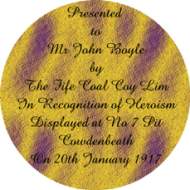
"At about 10.00 am on January 20th, 1917, while shaft widening operations were being carried out at No. 7 Pit, Cowdenbeath Colliery, nr. Dunfermline, Fife, part of the shaft collapsed. This threw a workman down to a scaffold about 90 feet below. Andrew Scott, Edward McCafferty and David Baird went down at once in a large bucket to try to save him as though the whole of the lower shaft was in a dangerous condition with debris falling and the likelihood of further collapse. They found the man alive, conscious, buried under about twelve feet of debris and pinned by falling timber. Shortly afterwards they were joined by George Shearer Christie and later by James Erskine. At one stage during the operation the bucket was being lowered with John Boyle and two other men one of whom was killed by a fresh fall which injured the other. Mr Boyle then drew the bucket into the side of the shaft until the fall was over and, after that, remained in charge of the rescue work under constant danger. Nine hours after the initial collapse they were all relieved by other men but the workman died later."
London Gazette, 17 July, 1917
(page 7125)
"On the 20th January, 1917, at about 10am., while operations were conducted for the widening of a shaft at the Cowdenbeath No. 7 Colliery, Fife, a portion of the side of the shaft collapsed, throwing a workman named Newton down the mine to a scaffold about 90 feet below. Scott, McCafferty and Baird at once descended in a large bucket or kettle to attempt a rescue. The whole of the shaft below the point at which the fall had occurred was in a highly dangerous condition: stones and rubbish were continually falling, and there was constant danger of a further collapse. Newton was found, alive and conscious, buried beneath about 12 feet of debris and pinned by some fallen timber. The men worked continuously from 10.45am. until 7pm. They were joined at 11am. by Christie, and at 1.30pm. by Erskine, both of whom remained at work with the others until 7pm. During the whole of this period all five men were in serious danger. At 12.45 Boyle descended in the kettle with two other men. While the kettle was descending a fall occurred killing one of his companions and injuring another. Boyle drew the kettle to the side of the shaft until the fall was over, and then took the kettle again to the surface. He subsequently remained in charge of the kettle, exposed to constant danger, until 7pm. At 7pm., after 9 hours continuous and highly dangerous labour, the rescue party was relieved by other men. Unfortunately, Newton died at 8.30pm.. Attempts to recover his body were then postponed until the shaft could be worked with greater safety."
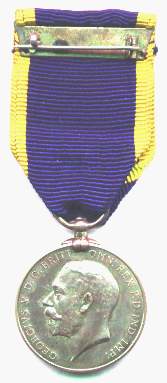
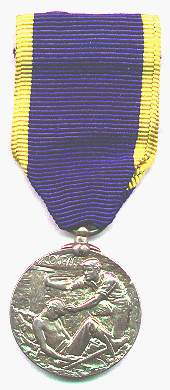
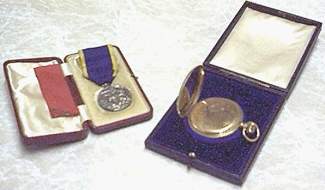
On Friday, 15th November, 2002, in Dunfermline, Owen Gormley, Lochgelly, a great-nephew of John Boyle, chargeman and rescue organiser at the Cowdenbeath No. 7 Pit accident on 20th January, 1917, met with Chris Sparling to display both the medal awarded by King George V and the engraved gold watch awarded by the Fife Coal Company. It was a great experience for Chris to briefly examine and handle these items of mining memorabilia presented to such a brave miner.
 |
 |
 |
 |
--------------------------------------------
"Dunfermline Press"
25 August, 1917
The work of reconstructing the shaft of No. 7 Colliery has been completed, and the management expect to have the pit in working order at an early date. The shaft is elliptical in shape, and is of a most up-to-date nature.
--------------------------------------------
"Dunfermline Press"
10 November, 1917
Robert Greenhill, repairer, 56 Holyrood Place, Dunfermline, had his right leg fractured below the knee by a fall of stone in the Diamond Seam of No. 7 Pit on Monday. He was removed to the Dunfermline and West Fife Hospital.
--------------------------------------------
"Dunfermline Press"
20 August, 1921
Robert Gray, Mungall Street, Lumphinnans, received a compound fracture of one of his legs by a piece of coal falling from the roof in No. 7 Pit, Cowdenbeath Colliery. He was removed to the Dunfermline and West Fife Hospital.
--------------------------------------------
"Dunfermline Press"
1 October, 1921
COLLIERY MANAGER'S DEATH.
Mr Geo. S. Christie, who was manager of No. 7 and No. 10 Pits, Cowdenbeath, till illness last year forced him to give up the appointment, died at his residence, Marchmont, Cowdenbeath, on Thursday morning. In earlier years, Mr Christie had charge of pits in the Kelty and Blairadam Collieries of the Fife Coal Company, and for fully two years he was manager of a colliery at New Cumnock, Ayrshire. ...
--------------------------------------------
"Dunfermline Press"
26 November, 1921
It is proposed to double-shift No. 10 Pit, Kirkford, and No. 11 Pit, Lumphinnans, a step that should absorb many of the unemployed. The back shift at No. 7 Pit is to be withdrawn.
--------------------------------------------
"Cowdenbeath & Lochgelly Times"
12 April, 1922
John Donaldson, surface foreman, No. 7 Pit, Cowdenbeath Colliery, was found lying on Friday morning under the pithead suffering from severe injuries to his head and with an arm broken. He had apparently fallen from the scaffold above. On being examined he was removed to the Dunfermline and West Fife Hospital, where he succumbed to his injuries that night. Deceased, who belonged to Dundee, is survived by his wife and a son.
--------------------------------------------
"Cowdenbeath & Lochgelly Times"
2 August, 1922
COLLIERY APPOINTMENTS
Mr John Alexander, oversman, No. 7 Pit,
Cowdenbeath, has been appointed to succeed Mr Robert Gillespie as
manager of Kirkford Colliery and No. 7 Pit.
Mr Andrew Scott, oversman, Kirkford Colliery,
has been transferred to a similar position at the Aitken Pit,
Kelty.
It is understood that the colliery managers in
the employment of the Fife Coal Coy., Ltd., have been asked to
submit to a very substantial reduction of their salaries, and that
in future, oversmen will have to pay house rent, and also for their
fire coal.
--------------------------------------------
"The Scotsman"
21 May, 1923
MINER FATALLY INJURED AT COWDENBEATH. - John Hainey (30), who resided at 30 Broad Street, Cowdenbeath, was buried beneath a fall of coal and stone in No. 7 Pit, Cowdenbeath, on Saturday, and, being seriously injured internally, he died on his way to hospital. He leaves a widow and three of a family.
--------------------------------------------
"Dunfermline Press"
26 May, 1923
ELECTRICITY AT THE PITS. - Electrical plant is supplanting steam engines for winding at the Cowdenbeath Collieries. At No. 9 Pit an electric winder has been introduced, and it is proposed to instal similar plant at No. 7 in the near future.
--------------------------------------------
"Dunfermline Press"
14 July, 1923
A social gathering was held in D.C.I. Tea-rooms on Saturday for the purpose of presenting Mr Gavin Dunn, oversman of No. 7 Colliery, Cowdenbeath, with an easy chair and silver tea-set on the occasion of his forthcoming marriage. ...
--------------------------------------------
"Dunfermline Press"
28 July, 1923
Under the Fatal Accidents Inquiry Act, an inquiry was held in the Sheriff Court, Dunfermline, on Thursday - before Sheriff Umpherston and a Jury - into the circumstances attending the death of a miner, John Hainey, lately residing at 30 Broad Street, Cowdenbeath. Hainey was killed in No. 7 Cowdenbeath Pit of the Fife Coal Company, Limited, by a stone falling upon him from the face. The stone fell on his stomach. A formal verdict was returned by the jury.
--------------------------------------------
"Dunfermline Press"
29 September, 1923
David Thomson, 17 years of age, son of Mrs Thomson, 86 Stenhouse
Street, Cowdenbeath, lost his life on Wednesday through being
crushed beneath a fall of stone at Hill's Mine in the splint
seam of No. 7 Pit, Cowdenbeath Colliery.
Thomson, along with Patrick Langan, Broad Street, had been
attending to the running of the hutches on the brae. On a race
of empties reaching the top some wooden bars in the tubs tilted
up, striking a girder, with the result that a huge mass of stone fell,
crushing Thomson underneath. Langan made every effort to
release the unfortunate young man, but as he was doing so
another fall of material occurred forcing him down the brae for
some distance. He shouted for assistance and the manager and
under-manager, who happened to be at the pit bottom not far distant,
came up. The stones were so big that they had to be broken, and
it was sometime before the body could be got out. Thomson had
died when the second fall took place. He was a promising youth,
and much sympathy has been extended to the relatives in their loss.
-----------------------------
"Dunfermline Press"
1 December, 1923
Under the Fatal Accidents Inquiry Act, an inquiry was held in the Sheriff Court, Dunfermline, on Thursday - before Sheriff Umpherston and a Jury - into the circumstances attending the death of David Thomson, drawer, lately residing at 86 Stenhouse Street, Cowdenbeath, from injuries received by a fall of material from the roof, in consequence of roof supports being knocked out by bars tied on to an ascending hutch. A formal verdict was returned by the jury.
--------------------------------------------
"Cowdenbeath & Lochgelly Times"
23 April, 1924
In the early hours of Thursday morning, Robert Curran (32), residing at 114 Main Street, Lumphinnans, lost his life in No. 7 Pit, Cowdenbeath, by being electrocuted. Curran was working in a machine run of the Little Splint Dook when the accident happened. The coal cutting machine had been removed from one run to another, and shortly after the electric current had been switched on Curran was electrocuted. The miners working along with him immediately went to his assistance, applying artificial respiration for fully an hour, but to no purpose. He leaves a widow and three children, for whom much sympathy is felt.
A somewhat similar accident occurred some months ago in Foulford Pit, when Peter Hogg, the eldest son of Bailie Hogg, was then electrocuted.
---------------------------
"Cowdenbeath & Lochgelly Times"
28 May, 1924
CARELESSNESS ALLEGED IN A PIT ACCIDENT
The accident which occurred at No. 7 Pit on 17th April, when Robert Curran, a machineman, whose home was at Lumphinnans, died from an electric shock while at work with a coal-cutting machine, was the subject of enquiry at Dunfermline on Thursday.
Evidence was given by Hugh Penman, colliery manager, Bowling Green Street, Cowdenbeath, who said that apparently Curran had been doing repair work to the machine of a slight character, while he was only entitled to operate the machine.
He was instructed to operate the machine, but to effect no repairs. Witness had issued instructions to all machinemen that under no circumstances were they to carry out repairs. If Curran had carried out these instructions there would have been no accident.
Mr W. J. Kirker (Miners' Reform Union) - You don't suggest for a moment that he was deliberately careless?
Witness - Yes, I would say he was careless.
John Laird, machineman, North End, Crossgates, said that he and Curran had been employed at the Little Splint Seam of No. 7 Pit. While the machine was being "flitted" it got out of control. Curran found the trailing cable had become separated from the plug. Witness said he would be better to send for an electrician, but instead of that Curran did something himself and replaced the plug. He said he would manage it himself. He instructed the witness to switch on the current. After that was done, Curran was in the act of setting the machine in motion when he got a shock which ultimately proved fatal.
In answer to further questions, witness stated that he had heard Curran being instructed by the manager to send for the electricians if anything happened with the electrical parts of the machine.
Sheriff Umpherston, addressing the jury, said he thought this was a clear case where the man was doing what he ought not to have been doing. He suggested that they should add to their formal verdict an expression of opinion that the accident was due to Curran attempting to repair a trailing cable contrary to instructions given to him, and to the General Regulations made under the Mines Act. The jury acquiesced.
-------------------------------------
"West Fife Echo"
August, 1924
COWDENBEATH MAN KILLED
Son an Eye-Witness of Accident
A mining fatality occurred at Cowdenbeath on Thursday night, the victim being Richard Smith, miner, 62 years of age, who resided at 23 Rose Street, Cowdenbeath. Smith was following his usual employment in the Diamond Seam of No. 7 Pit, Cowdenbeath, when he was caught under a heavy fall of stone. A sad feature was that the son of the victim was an eye-witness to the tragedy. His fellow-workers had him speedily removed, but while on their way to the surface he succumbed to his injuries. Deceased was well known, and much sympathy has been expressed with his widow and family.
--------------------------------------------
"Cowdenbeath & Lochgelly Times"
16 July, 1924
COWDENBEATH - MORE HOUSES
Wm. Kerr, pithead worker, No. 7 Pit, Cowdenbeath, who resides in the Kirkford district, received a severe injury to his eye while at work yesterday. Kerr was struck on the eye by a strand of wire, and after being attended to was taken to the Edinburgh Royal Infirmary.
--------------------------------------------
"Cowdenbeath & Lochgelly Times"
20 August, 1924
Mr Hugh Penman, manager of No. 7 Pit, Cowdenbeath, has been promoted to act in the same capacity at No. 1 Pit, Lumphinnans, in room of Mr W. Richardson, retired.
--------------------------------------------
"The Scotsman"
24 August, 1925
COWDENBEATH MINER KILLED. - Alexander Dunn, Park Street, Cowdenbeath, died in Dunfermline and West Fife Hospital on Saturday from head injuries sustained while at work at No. 7 Pit, Cowdenbeath, the previous day.
-----------------------
"Cowdenbeath & Lochgelly Times"
26 August, 1925
Alex. Dunn, who resides at Park Avenue, Cowdenbeath, met with a serious accident on Friday at No. 7 Colliery. Dunn was caught by a runaway hutch, and had his jawbone broken. He was removed to the Dunfermline and West Fife Hospital in a critical condition, where he died. He leaves a widow and four of a family.
--------------------------------------------
"Dunfermline Press"
25 December, 1926
Thomas Martin, Broad Street, Cowdenbeath, had his back injured by a fall of stone in No. 7 Pit, Cowdenbeath, on Wednesday evening. He was conveyed to the Dunfermline and West Fife Hospital.
--------------------------------------------
"Cowdenbeath Advertiser"
14 October, 1927
ACCIDENT
Robert Gear, Sligo Street, Lumphinnans, had his leg injured while engaged at work at No. 7 Colliery, Cowdenbeath. He was conveyed home in the ambulance.
--------------------------------------------
"Dunfermline Press"
1 September, 1928
Adam Smith, son of Mr Nicol Smith, Perth Road, was injured by a fall of stone in No. 7 Pit on Tuesday, and was conveyed home by ambulance.
--------------------------------------------
"Dunfermline Press"
7 September, 1929
John Devine, 55 Broad Street, had his leg broken in No. 7 Pit on Sunday through his foot being caught at a rail which caused him to trip and fall. William Ferguson, a member of the colliery ambulance team, attended to the injured man and successfully set the broken limb. Devine was afterwards removed to the Dunfermline and West Fife Hospital.
--------------------------------------------
"Dunfermline Press"
21 September, 1929
Mr William S. Peach, assistant to Mr William Spalding, mines agent, Kelty, has been appointed manager of No. 7 Colliery, Cowdenbeath, in succession to Mr James Crawford, who has been promoted to the management of Kinglassie Colliery.
--------------------------------------------
"Dunfermline Press"
26 October, 1929
PRESENTATION TO COLLIERY MANAGER. - Mr James Crawford, colliery manager, who has been transferred from No. 7 Colliery, Cowdenbeath, to Kinglassie, was met by a number of the employees of the former colliery in the D. C. I. Restaurant on Saturday and presented with a cabinet gramophone, together with a fruit service for Mrs Crawford, as tokens of respect. Mr Wm. E. Peach, colliery manager, presided, and Mr D. P. Campbell, engineer, made the presentation.
--------------------------------------------
"The Scotsman"
11 March, 1932
PIT FIRE AT COWDENBEATH
An outbreak of fire occurred yesterday in the Lochgelly splint section of Mossbeath Colliery, Cowdenbeath, belonging to the Fife Coal Company (Ltd.) The outbreak was caused by spontaneous combustion, and last night gases were being throw off to such an extent that it may be necessary to build up the affected section. As a result over 350 men have been thrown idle, the workers in No. 7 Pit, Cowdenbeath, which is connected to Mossbeath by an underground air passage, being also affected. The management of the colliery, assisted by agents, are taking every measure possible to extinguish the fire, while according to regulation the company's rescue brigade are standing by in case of emergency.
--------------------------------------------
"Dunfermline Press"
2 April, 1932
William Carruthers (22), repairer, 23 Broad Street, Cowdenbeath, was seriously injured as the result of an accident in No. 7 Colliery, Cowdenbeath, belonging to the Fife Coal Company, Limited, on Saturday. He had been on a haulage dook, and was found lying between the hutches of a loaded race, having evidently been caught between a hutch and the side of the roadway. He was removed to the Dunfermline and West Fife Hospital.
--------------------------------------------
"Dunfermline Press"
30 July, 1932
Under the Fatal Accidents Inquiry Act, an inquiry was held in the Sheriff Court, Dunfermline, on Thursday - before Sheriff Umpherston and a Jury - into the circumstances attending the death of George Mitchell, labourer, 103 Foulford Road, Cowdenbeath, who was electrocuted on 14 June in the electrical sub-station of No. 7 Colliery, Cowdenbeath, belonging to the Fife Coal Company, Limited, in course of his industrial employment. Those giving evidence included: Thomas Allan, winding engineman, 235 Perth Road, Cowdenbeath; William McLaren, pitheadman, 84 Bridge Street, Cowdenbeath; George Adams, transmission lines foreman, Bridgend, Kelty; Henry Walker Birnie, transmission linesman, 11 Wilson Street, Cowdenbeath; and Alexander Banks, transmission linesman, 69 Moss-side Road, Cowdenbeath. The jury returned a formal verdict.
--------------------------------------------
"Cowdenbeath Advertiser"
2 February, 1934
LOCAL MINER INJURED
John Baxter, East Row, Hill of Beath, met with an accident in No. 7 Pit, Cowdenbeath, on Monday. He sustained slight injuries and after examination at Dunfermline and West Fife Hospital was removed home.
--------------------------------------------
"Cowdenbeath Advertiser"
15 June, 1934
A Lumphinnans miner, John Smith, 26 Sligo Street, is at present lying in Dunfermline and West Fife Hospital as the result of injuries sustained in a mining accident which occurred in No. 7 Pit, Cowdenbeath, on Thursday.
Smith was employed at the coal-face when a large piece of coal gave way, displacing a girder. He was struck on the head and sustained a severe fracture to the skull. Following medical attention by Dr Young, sen., and Dr Veitch, he was removed to hospital, where he is now making progress towards recovery.
--------------------------------------------
"Dunfermline Press"
7 July, 1934
A Cowdenbeath man, John Cunning, miner, who resided at 3 Factory Road, was seriously injured in an accident which occurred in No. 7 Colliery, Cowdenbeath, on Wednesday evening. He was crushed by a derailed hutch. After being attended to by Dr Veitch he was removed to the Dunfermline and West Fife Hospital. He received severe injuries to the back.
--------------------------------------------
"Dunfermline Press"
28 July, 1934
Under the Fatal Accidents Inquiry Act, an inquiry was held in the Sheriff Court, Dunfermline, on Thursday - before Sheriff Umpherston and a Jury - into the circumstances attending the death of a miner named William Carruthers, lately residing at 23 Broad Street, Cowdenbeath, who died on 22 June 1934 in the Longmore Hospital, Edinburgh, as a result of injuries sustained by him on 26 March 1932 in No. 7 Pit, Cowdenbeath, by being crushed by a rake of hutches. Those giving evidence included: Adam Carruthers (67), 23 Broad Street, Cowdenbeath (father of deceased); David Smith Kennedy, oncost worker, 35 Church Street, Cowdenbeath; Robert Adamson, haulageman, 62 Woodland Place, Cowdenbeath; Hugh Moran, jun., oncost worker, 10 Pretoria Place, Cowdenbeath; and William Edward Skyrne Peach, colliery manager. A formal verdict was returned by the jury.
--------------------------------------------
"Dunfermline Press"
23 February, 1935
ALARMING ACCIDENT AT COWDENBEATH COLLIERY.
An unusual accident which might have had serious consequences occurred at No. 7 Colliery, Cowdenbeath, on Monday forenoon, when the large flywheel which operates the pit cage snapped and crashed to the ground, a distance of over sixty feet. No one was injured, but the men employed on the surface had a narrow escape, as the wheel, which fell on a vacant piece of ground at the pithead, was smashed to pieces as a result of the crash. The cage, which was winding coal at the time of the accident, became jammed in the shaft, and work was suspended at the colliery. Repair work was immediately commenced and was continued throughout the night, and the colliery resumed its usual operations on Wednesday morning.
--------------------------------------------
"Cowdenbeath Advertiser"
12 April, 1935
MINING ACCIDENT
William Ewings, a machineman, residing at 6 Pretoria Place, Kirkford, met with an accident in No. 7 Pit, Cowdenbeath, early on Tuesday morning.
He was following his usual employment in the Mynheer Section of the pit when a large piece of coal fell on his right leg. After medical attention he was removed to Dunfermline and West Fife Hospital where it was revealed on examination that the limb was fractured.
--------------------------------------------
"The Times"
24 July, 1935
NEW PITHEAD ERECTED AT COWDENBEATH
STEEL REPLACES WOOD
While all the Cowdenbeath miners have been on holiday this week, a band of forty workmen have been engaged day and night on the gigantic task of replacing the wooden pithead frame at No. 7 Pit, Cowdenbeath, with a steel frame. ... The old frame was erected in 1918, and, while most of the wood is still in first-class order, certain parts which were showing signs of decay rendered the big task necessary. The steel frame is 10 feet higher than the wooden erection and will be much more substantial in every respect. ...
--------------------------------------------
"Dunfermline Press"
17 August, 1935
As a result of an accident in the Fife Coal Company's No. 7 Colliery, Cowdenbeath, on Saturday, Louis Anderson, Engine House, High Street, Cowdenbeath, has suffered the loss of his left leg. Anderson was employed as a pan-shifter near the coal-cutting machine, and it is understood that he slipped on the pans and his trousers became entangled in the picks of the coal-cutter. His left leg was drawn into the machinery and although the current was switched off almost immediately, the limb was badly damaged. He was removed to the Dunfermline and West Fife Hospital, where it was found necessary to amputate the leg.
--------------------------------------------
"Dunfermline Press"
14 September, 1935
COWDENBEATH PITS.
CENTRALISATION SCHEME.
In an interview with a Dunfermline Press representative yesterday afternoon, Mr C. C. Reid, General Works Manager of the Fife Coal Company, Ltd., made an interesting announcement in connection with a scheme for centralisation which the Fife Coal Company will shortly carry into effect. He said they had now ready a scheme for centralising operations at the two Cowdenbeath pits, Mossbeath and No. 7 Collieries. No coal, it is proposed, will be raised in the near future at Mossbeath, and the whole of the output of that colliery will be taken to the surface of No. 7 Colliery, where extensive reconstruction in screening plant, etc., will take place.
--------------------------------------------
"Dunfermline Press"
15 August, 1936
MINING DEVELOPMENT AT COWDENBEATH.
CENTRALISATION OF THREE COLLIERIES.
A Dunfermline Press representative learned yesterday of an important mining development which is to take place at the Fife Coal Company's No. 7 Pit, Mossbeath and Kirkford Collieries, Cowdenbeath. A mine is being driven from No. 7 Pit to Mossbeath, and this will connect both collieries with Kirkford. It is expected that a new screening plant will be erected at No. 7 Pit, and the output of the three pits will be centralised there. The men employed at present in the different collieries will be taken underground at Kirkford.
PROPOSED PIT BATHS.
A campaign to persuade the Central Miners' Welfare Committee,
London, to provide the wherewithal for the provision of pithead baths at
the Fife Coal Co.'s No. 7 Colliery, Cowdenbeath, is about to be
embarked upon.
The suggestion arose at a meeting of the Colliery's Safety Committee
on Thursday evening, when it was agreed that in view of the working
changes which are to take place at the pit, every effort should be made
to organise the men with a view to having baths erected at the pithead. ...
Another consideration which the authorities may take into account is the
life of No. 7 Pit, from which it is believed, coal will be worked for the next
half century.
--------------------------------------------
"Dunfermline Press"
28 November, 1936
NEW SCREENING PLANT AT COWDENBEATH
COLLIERY.
As announced in these columns some time ago, new screening plant is to be erected at the Fife Coal Company's No. 7 Colliery, Cowdenbeath. The contract for the work, which will be commenced in the near future, has been secured by Messrs Dickson & Mann, colliery engineers, Bathgate.
--------------------------------------------
"Dunfermline Press"
2 January, 1937
COWDENBEATH COLLIERY
DEVELOPMENT.
The first stage of a big centralisation development at the Fife Coal Company's No. 7 and Mossbeath Collieries will take place early next week, when it is hoped that coal will be drawn from the new pit bottom at No. 7 Colliery.
--------------------------------------------
"Dunfermline Press"
9 January, 1937
PIT SAFETY RECORDS.
The year that has just closed again finds No. 7 Colliery, Cowdenbeath, at the head of the Fife Coal Company's Safety League with the highest number of manshifts per accident. This has been brought about by an enthusiastic Pit Safety Committee, backed up by the manager, Mr J. Miller, and an interested set of officials, who have gained the confidence of workers and brought about a great team spirit, all working for greater safety in the mine. ...
--------------------------------------------
"Dunfermline Press"
9 January, 1937
NEW RECORD IN DRIVING MINE.
Some important developments are taking place at the Fife Coal Company's
No. 7 Colliery, Cowdenbeath. This colliery is one of the oldest in the district, but
when all the changes are completed, which are on most modern lines, the colliery
will be able to deal with 1000 tons per day. To accomplish this a stone mine is being
driven from No. 7 into the Mossbeath coalfield.
When this mine is completed, all the Mossbeath coal will be drawn up the No. 7 shaft.
The first part of the new development - the making of a new pit bottom - was completed
and put into working operation on Monday morning. It is reckoned to be one of the finest
in the district, and will deal adequately with all demands likely to be made upon it.
Some time ago, the Myles Brothers surprised and interested the mining world by driving
a mine 13 feet by 9½ feet at a record speed of 23 yards per week. This took
place at Valleyfield Colliery - one of the Fife Coal Company's pits.
It was then considered a British record in stone mine driving. Now this has been
surpassed at No. 7 Colliery. The mine at present being driven into the Mossbeath
coalfield by the Myles Brothers is 13 feet by 9½ feet, circle girded, with manholes
complete.
The first 200 yards have been cut in eight weeks, or at the rate of 25 yards per week.
This work is under the personal supervision of A. V. Reis, B.Sc., Ph.D., agent.
Mr J. Miller, manager, has given every facility, and also his personal touch has
enabled this new record to be made.
--------------------------------------------
"Dunfermline Press"
23 January, 1937
SAFETY HATS FOR MINERS.
The value of safety hats for miners was emphasised on Tuesday as a result of an accident at No. 7 Colliery, Cowdenbeath, belonging to the Fife Coal Company. Angus Hughes (27), 255 Perth Road, Cowdenbeath, a fireman, was carrying out his duties in the Smith Mynheer Mine when he was struck on the head by a chain which broke. The blow smashed the man's safety hat, and rendered him unconscious. He received a slightly depressed fracture of the skull, and was removed to the Dunfermline and West Fife Hospital. It is believed that had he not been wearing a hat the injury would have been much more serious.
--------------------------------------------
"Dunfermline Press"
13 March, 1937
SAFETY IN MINES.
COWDENBEATH
COLLIERY'S DISTINCTION.
A complimentary dinner was given by the Fife Coal Company, Ltd., in the Central Works Canteen, Cowdenbeath, on Saturday, to No. 7 Colliery Safety Committee in recognition of their winning the safety diploma for the second year in succession. ...
--------------------------------------------
"Dunfermline Press"
3 July, 1937
MINING DEVELOPMENTS AT COWDENBEATH .
No. 7 PIT NOW ONE OF THE MOST UP-TO-DATE IN FIFE.
In recent years there has been the tendency to close old collieries as they
were not fit to compete in production and overhead cost with the more up-to-date
collieries. The facts seemed to be against the old collieries, due to old workings,
long haulage roads, etc. But the modern methods applied with a modern outlook
have brought about changes at the Fife Coal Company's No. 7 Pit undreamt
of by the miners in the Cowdenbeath district.
During the time when Dr W. Reid was agent at the colliery he decided that No. 7
was well-situated to deal with the coal in the Mossbeath and Kirkford area at
about 1000 tons per day, compared with an output at present of 330 to 350 tons.
He decided to bring the pit thoroughly up-to-date by building a new engine-house
and installing an electric winder capable of winding 1000 tons per day, also an
entirely new pithead to deal with that output. These are in the course of erection
at the present time.
Below ground a new pit bottom had to be made twenty feet above the old one.
This has been accomplished, the change over taking place without the loss of
one ton of coal. The new pit bottom is considered one of the finest in the district.
The biggest problem faced was the driving of a stone mine 880 yards long. The Myles'
Brothers, who have a life-time experience of mine-driving, were started on the job. In
less than a year they have made two small rising mines, 7 ft. by 6 ft., to the new
bottom, a mine connecting these two small mines, formed a new pit bottom, 16 ft.
by 12 ft., and a new haulage house, 14 ft. by 12 ft.
The driving of the big mine was started on 26th October 1936, and finished on 7th
June 1937 - working six days per week (14 days off on other work) - 30 weeks
actual time in the mine, cutting 798 yards during that period, finished with 12 ft.
by 8½ ft., circled girdered every 4 ft., complete with manholes at an
average cutting of 26 yards per week. Best week's work was one of 33 yards,
which is considered a record, and one of the best bits of stone mining work done in
Scotland, due no doubt to the team spirit and organisation in Myles' squad.
The efficiency of Mr P. Brown's survey department is well demonstrated in this
case, as the mine was put through exactly to an inch.
Mr J. Miller, manager, who has charge of the operations both above and below
ground, has still one big project to carry through, that is the changing of the rail
gauge from 20 ins. to 24 ins.; this will be carried out during the holiday week. All
that is required now is the installation of pithead baths to make the colliery one
of the most up-to-date in Fife.
These have been applied for, but it is likely to be some time yet before the Miners'
Welfare Committee will be able to give the necessary grant.
--------------------------------------------
"Dunfermline Press"
24 July, 1937
ALTERATIONS AT COWDENBEATH COLLIERY.
During the week 100 men have been employed effecting alterations at the Fife Coal Company's No. 7 Colliery, Cowdenbeath, in preparation for the linking up with Mossbeath area. New pulley wheels have been erected, and the gauge of all the surface and underground metals have been changed from 20 inches to 24 inches, while 150 new hutches from the Central Workshops, along with 100 hutches which have been altered to suit the new requirements, are ready to be put into operation when the pit resumes work on Monday.
--------------------------------------------
"Dunfermline Press"
20 November, 1937
DEVELOPMENTS AT COWDENBEATH COLLIERY.
The change-over from the old to the new screening plant and pithead at the Fife Coal Company's No. 7 Colliery was accomplished last weekend. The work commenced on the afternoon of Friday last week and was accomplished by 11 am on Sunday. The new plant has been built by Messrs Dickson & Mann, Bathgate, and incorporates several new ideas. ...
--------------------------------------------
"Dunfermline Press"
1 January, 1938
COWDENBEATH COLLIERY MISHAP.
CAGES FALL TO FOOT OF SHAFT.
Half an hour after the day-shift workers had been brought to the surface, an unusual
accident occurred at the Fife Coal Company's No. 7 Colliery on Saturday afternoon.
The cages were conveying coal from the pit bottom to the surface, when the engineman
felt a grip on the ascending cage while it was about 60 feet from the top. Suddenly the
rope broke and the cage, containing two full tubs of coal, crashed to the bottom of the pit.
The other cage, which was descending, also fell to the pit bottom, but was practically undamaged.
The ascending cage was smashed to pieces, but the guides, which were of steel, remained intact.
The rope which broke had been in use for just over two years, whereas the law permits a winding
rope to be used for three and a half years. The damage was cleared and winding resumed on
Sunday.
--------------------------------------------
"Dunfermline Press"
2 April, 1938
A single shift system is to be introduced shortly at the Fife Coal Company's No. 7 Colliery, Cowdenbeath. This will result in the whole of the output being raised on the dayshift. It is learned that the change will not result in any reduction in the number of employees at the colliery.
--------------------------------------------
"Dunfermline Press"
29 October, 1938
ELECTRIC SHOCK AT COWDENBEATH COLLIERY.
John Simpson (19), machineman, 163 Union Street, Cowdenbeath, was removed to
the Dunfermline and West Fife Hospital on Saturday afternoon suffering from a severe
electrical shock as a result of an unusual accident which occurred in the Fife Coal Company's
No. 7 Colliery, Cowdenbeath. He was employed in No. 10 run of the Dunfermline Splint section,
and had gone to procure a shovel which was lying with some other tools near an electric
cable when he was heard to cry out.
The current was immediately switched off and Simpson collapsed in an unconscious condition.
He was conveyed to the pithead by stretcher, and was examined by Dr Veitch. He regained
consciousness, but was suffering so badly from shock that he was removed to hospital. It is
presumed that a pick had pierced the electric cable carrying 500 volts, and had electrified
the tools which were lying nearby.
--------------------------------------------
"Dunfermline Press"
5 November, 1938
COWDENBEATH REDD BING.
The No. 7 Colliery redd bing, which is within fifty yards of Cowdenbeath High Street, is being rapidly demolished. ... It is expected that the bing will have completely "vanished" in two months' time.
--------------------------------------------
"Dunfermline Press"
12 November, 1938
OVERWINDING ACCIDENT AT COWDENBEATH.
MINERS' ALARMING EXPERIENCE.
SAFETY DEVICE OPERATES SUCCESSFULLY.
Shortly after two o'clock on Wednesday afternoon, an overwinding accident occurred at
the Fife Coal Company's No. 7 Colliery, Cowdenbeath, involving three men. They were James
Wotherspoon, Richmond Place, and Hamilton McKinlay, Hunter Street, both of Lochgelly, and
Charles Meldrum, Engine Row, Hill of Beath.
The first indication that anything was amiss was when the engineman at the colliery applied his
brakes as usual twenty-five fathoms from the end of the wind. The brakes failed to function, and
the ascending cage was carried up to the bell of the detaching hook equipment.
When the detaching hook attempted to pass through the bell which acts as a safety device, a
copper rivet was sheared, thus allowing the rope to travel free, the jaws of the hook thereby
opening and locking with the bell, and, as a result, holding the cage.
The descending cage travelled to the bottom of the shaft.
Wotherspoon and McKinlay, who were occupants of the ascending cage, had an alarming
experience. The former, whose left hip was badly bruised, was removed to the Dunfermline and
West Fife Hospital.
McKinlay, who sustained concussion, was taken home. Meldrum, who was in the descending
cage, which reached the bottom abruptly, suffered from shock.
--------------------------------------------
"Dunfermline Press"
25 March, 1939
COWDENBEATH PITHEAD BATHS.
A NOVEL SCHEME.
A ballot vote of the miners employed at the Fife Coal Company's No. 7 Colliery, Cowdenbeath, on the question of borrowing £8250 to build pithead baths, took place on Wednesday and the result was:- For, 343; against, 113. ...
--------------------------------------------
"Cowdenbeath Advertiser"
25 April, 1940
Mr W. Reid, an under-manager at Bowhill Colliery, has been appointed manager at No. 7 Colliery, Cowdenbeath, in succession to Mr H. Black, who has been appointed to a similar position at Valleyfield Colliery.
--------------------------------------------
"Dunfermline Press"
18 January, 1941
COWDENBEATH MAN'S SUDDEN DEATH.
Henry Bald, 35 Keir Street, Cowdenbeath, who was employed as a shunter at No. 7 Colliery, collapsed at his work on Thursday morning and died. Deceased, who was about 60 years of age, leaves a widow and grown-up family.
--------------------------------------------
"Dunfermline Press"
19 July, 1941
COWDENBEATH COLLIERY ACCIDENT.
Francis Jones, aged 19, colliery oncost worker, 40 Mungall Street, Lumphinnans, was seriously injured in No. 7 Colliery, Cowdenbeath, on Thursday. While working in the Dunfermline Splint section he received a fractured leg and a fractured pelvis. He was removed to Dunfermline and West Fife Hospital, where he is progressing satisfactorily.
--------------------------------------------
We are pleased to show here, from a June 1943 record of the Planning Dept., The Fife Coal Company, Central Offices, Cowdenbeath,
details of equipment and personnel required to obtain the maximum drivage in each of three stone drifts at Cowdenbeath No. 7 Colliery.
Stone Drifts
|
With thanks to George Hunter, Crossgates.
--------------------------------------------
"Dunfermline Press"
18 March, 1944
Under the Fatal Accidents Inquiry Act, an inquiry was held in the Sheriff Court, Dunfermline, on Thursday, - before Sheriff MacLean and a Jury - into the circumstances attending the death of James Maxwell McFarlane, colliery lamp cabin attendant, 154 Broad Street, Cowdenbeath, who received burning injuries to his right hand and arm in the lamp cabin of No. 7 Colliery, Cowdenbeath. McFarlane died on 4 February in Dunfermline and West Fife Hospital. Those giving evidence at the inquiry included:- Dr R. C. Milne, resident house surgeon, Dunfermline and West Fife Hospital; Robert Dunn, electrician, 24 Mungall Street, Cowdenbeath; and George Walls, electrician, Colville Terrace, Crossgates. The Sheriff recorded a formal verdict in accordance with the medical evidence.
--------------------------------------------
"Dunfermline Press"
25 March, 1944
Men on the backshift in No. 7 Pit, Cowdenbeath, struck work on Thursday. As a result, operations in the pit have been at a standstill since. The dispute is stated to have arisen over the question of arrears of wages under the Porter award.
--------------------------------------------
"Dunfermline Press"
12 May, 1945
Under the Fatal Accidents Inquiry Act, an inquiry was held in the Sheriff Court, Dunfermline, on Thursday - before Sheriff Hamilton and a Jury - into the circumstances attending the death of a miner named Robert Cunning, 48 King Street, Cowdenbeath, who died at his home on 25th March from intracerebral haemorrhage, and who, up to the day of his death, had been employed as a miner in No. 7 Colliery, Cowdenbeath. Those giving evidence included:- Mrs Janet Cunning, widow; Dr John Veitch, Cowdenbeath; and several employees of the colliery. A formal verdict in accordance with the medical evidence was returned.
--------------------------------------------
"Dunfermline Press"
10 November, 1945
Thomas Beveridge (42), packer, 40 Moss-side Road, Cowdenbeath, died on Tuesday in Dunfermline and West Fife Hospital from injuries he sustained as the result of being crushed by a fall of material in the Diamond section of No. 7 Pit, Cowdenbeath. Deceased, who was unconscious when removed to hospital, was unmarried.
-----------------------
"Dunfermline Press"
8 December, 1945
This issue reported briefly that a Fatal Accident Inquiry was held in Dunfermline Sheriff Court, on Thursday, before Sheriff Hamilton and a jury, into the death of Thomas Beveridge, miner, 40 Moss-side Road, Cowdenbeath, who died on 6 November in Dunfermline and West Fife Hospital from injuries received that day in No. 7 Colliery, Cowdenbeath, as the result of a roof fall. One witness at the inquiry was named as Peter Blair, colliery fireman, 29 Blamey Crescent, Cowdenbeath. A formal verdict was returned.
--------------------------------------------
"Dunfermline Press"
23 February, 1946
COWDENBEATH PIT FATALITY.
Thomas Cherrie (45), colliery fireman, 27 Thistle Street, Cowdenbeath, was killed last night in an accident in No. 7 Pit, Cowdenbeath. Cherrie was helping a packer in the five-foot seam when, without warning, there was a fall of material from the roof which completely buried him. Deceased leaves a widow and a family of three.
--------------------
"Dunfermline Press"
23 March, 1946
Under the Fatal Accidents Inquiry Act, an inquiry was held in the Sheriff Court, Dunfermline, on Thursday before Sheriff Hamilton into the circumstances attending the death of a miner named Thomas Cherrie (43), coal miner, 27 Thistle Street, Cowdenbeath, who was killed on 22nd February by a roof fall in the underground workings of No. 7 Colliery, Cowdenbeath, where he was employed as an underground fireman. Those giving evidence included William Adamson (64), packer, 10 Gordon Street, Cowdenbeath. A formal verdict was returned by the Sheriff.
--------------------------------------------
"Dunfermline Press"
2 August, 1947
SUDDEN DEATH
George Hogg, a stripper employed at No. 7 Colliery, Cowdenbeath, collapsed and died at the coal face on Monday morning. Deceased, who resided at 22 Thistle Street, Cowdenbeath, was working his first shift following the holiday break. He was forty-seven years of age and unmarried.
--------------------------------------------
"Cowdenbeath Advertiser & Kelty News"
22 October, 1948
Cowdenbeath Miner Killed
James Ferguson, 122 King Street, Cowdenbeath, was instantaneously killed as the result of an accident which took place in No. 7 Pit, Cowdenbeath, last Friday. He was caught by a heavy fall of redd.
Deceased, who was 60 years of age, is survived by his widow and a grown-up family.
--------------------------------------------
"Dunfermline Press"
14 May, 1949
COLLIERY FIREMAN'S DEATH
Distinguished Mining Career
A 71-year-old colliery fireman lost his life as the result of an accident
which occurred in No. 7 Colliery, Cowdenbeath, on Wednesday morning.
The victim was Arthur Morris, who resided at 11 Westburn Avenue,
Cowdenbeath. He was carrying through his usual duties of inspection in
the Glassee Section of the colliery when he was struck and knocked
down by a runaway hutch, death being instantaneous.
A conscientious workman, Mr Morris was one of the oldest men employed
underground in the West Fife area. He had a distinguished mining career
extending to fifty-eight years' service in South America, Australia,
New Zealand, and in this country. For over thirty years he held a first
class manager's certificate. As a mining student he had the distinction
of being runner-up to Mr C. Augustus Carlow, and he was a silver medallist in
an examination held in the original Fife Mining School which was situated
in Broad Street School, Cowdenbeath.
His first venture abroad was in 1906, when he accepted a position as a
mining engineer in South America, where he spent eight years. He returned
to Cowdenbeath for a short period, and emigrated to Australia in 1914.
From there he went to New Zealand and came back to Cowdenbeath in 1939.
In both Australia and New Zealand he held important managerial posts.
It was his intention to retire in 1939, but characteristic of the industrious nature
of the man, Mr Morris felt he wanted to make his contribution to Britain's
war effort and he accepted a subordinate position as colliery fireman.
Deceased, who was a native of Kingseat, took a keen interest in church
work, and was well-known in Masonic and bowling circles.
--------------------------------------------
"Dunfermline Press"
17 September, 1949
COWDENBEATH PIT FATALITY
One man was killed and another had a narrow escape by a heavy
roof fall which occurred in the Lochgelly Splint Section of No. 7 Colliery,
Cowdenbeath, on Monday night.
The victim was John Wyles, a mining developer, who resided at 32
Mossbank, Cowdenbeath. He was operating a coal-cutting machine
just prior to the accident. He was completely buried by the fall, and,
although fellow workmen immediately went to his assistance, he was
found to be dead when extricated.
Wyles was 46 years of age and belonged to a well-known Cowdenbeath
family. He is survived by his widow and a family of three daughters.
A 23-year-old Polish miner, Tadeusy Gajewski, who was employed in the
section, was also trapped by a fall. The lower part of his body was jammed
by the debris. He was speedily released, and, after attention, was removed
to Bridge of Earn Hospital, suffering from injuries to both legs below the
knees and from shock.
-----------------
"Dunfermline Press"
12 November, 1949
Mining Fatality
A formal verdict was also returned by the jury [at Dunfermline Sheriff Court on Wednesday] after an inquiry into the circumstances of the death of John Wyles, miner, 32 Mossbank, Cowdenbeath. They found that he died on 12th September at No. 7 Colliery, Cowdenbeath, from crush injury to his chest sustained by a fall from the roof.
--------------------------------------------
"Cowdenbeath Advertiser & Kelty News"
27 October, 1950
A 71-year-old Hill of Beath miner died suddenly following his employment in the Kirkford workings of No. 7 Pit, Cowdenbeath, last Friday. The veteran miner was employed as a belt attendant. He appeared to be in his usual health when he went on duty but he expired in a sitting position later in the morning. The discovery was made when he failed to answer a call from a fellow miner.
--------------------------------------------
"Dunfermline Press"
14 June, 1952
New Coal Workings May Affect Sewer
The National Coal Board have intimated to Cowdenbeath Town Council that they propose to work the seam of coal known as "Cowdenbeath No. 7 Swallowdrum" under and within forty yards of pipes and works belonging to the Town Council. ...
--------------------------------------------
"Dunfermline Press"
16 May, 1953
Glencraig Veteran Miner Keeps on Working at 82
Seventy years' service in the mining industry - and still more to come - is
the proud record of Mr Duncan Grant, of Glencraig, now in his 83rd year.
Mr Grant, who resides at 21 The Square, South Glencraig, is at present employed at
Cowdenbeath No. 7 Pit, where he works on constant nightshift on the underground
haulage. ... Son of a glazier, he began work in the Pannan [Panny?] Pit, long since
closed, at the age of 11. He went underground the first day, earning the princely
sum of 1s 4d per shift. Later he was employed in all grades of mining in collieries in the
Dysart area before moving to Donibristle, Lochore, Bowhill, Cardenden, and Dundonald.
At the turn of the century, Mr Grant migrated to the Lanarkshire coalfield, but within a couple
of years he was back in the "Kingdom", and has since done a "tour"
of most of the collieries in West Fife, including Moss-side, Hill of Beath, and the Gordon
and Dora. He has been employed at Cowdenbeath No. 7 Pit for the last 16 years. ...
--------------------------------------------
"Dunfermline Press"
21 August, 1954
One-Day Strike
A one-day strike involving 400 men was staged on Monday at No. 7 Pit, Cowdenbeath.
The stoppage was the result of a wages dispute in the Swallowdrum Section of the pit. It was
the first time since nationalisation in 1947, that there has been any loss of production at this
Cowdenbeath colliery as the result of a dispute.
The matter has now been referred to the Disputes Tribunal for settlement.
--------------------------------------------
"Dunfermline Press"
16 July, 1955
51 Years' Service in the Mines
Mr James Robb, 23 Keir Street, Cowdenbeath, has retired after 51 years' service in the mining industry. His retrial was marked by a presentation of a wallet of notes from the officials, staff, and workmen of No. 7 Colliery where he was employed as an oversman. The gift was handed over by Councillor William Beattie. ...
--------------------------------------------
"Dunfermline Press"
16 March, 1957
PIT ACCIDENT
An accident occurred on Monday forenoon, when Robert Adamson (42), 18 East Row, Hill of Beath, was crushed by a tube at No. 7 Pit bottom. He was removed to Bridge of Earn Hospital suffering from a fractured pelvis.
--------------------------------------------
"Dunfermline Press"
20 April, 1957
Cowdenbeath Pit Fatality
John Young (29), miner, 52 Mungall Street, Lumphinnans, was killed by a fall of stone in No. 7
Colliery, Cowdenbeath, on Thursday night.
The accident occurred in the Swallowdrum section of the pit. The low working made rescue work
difficult. Young was trapped for 40 minutes. When released, he was found to be dead. He leaves
a widow and three of a family.
--------------------------------------------
"Dunfermline Press"
19 October, 1957
Colliery Cashier's Retirement
Mr Theodore Westwood, 22 Bowling Green Street, Cowdenbeath, who recently retired from the position of cashier at No. 7 Colliery, has been made the recipient of a monetary gift from the officials, staff, and workmen at the colliery. ...
--------------------------------------------
"Dunfermline Press"
1 March, 1958
Pit Safety Diplomas Presented
West Fife Area's Achievement
At a dinner held in Cowdenbeath Miners' Welfare Institute last Friday evening, trophies and diplomas were presented to West Fife Area and Cowdenbeath No. 7 Colliery winners respectively of the national mine safety competition and the West Fife Safety League for 1957. ... Mr John Archibald, depute area production manager (planning), in proposing a comprehensive vote of thanks, announced that the runners-up in the competition had been Blairenbathie and Fordell, and two of the larger collieries, Minto and Kinglassie, had been placed third.
--------------------------------------------
"Dunfermline Press"
18 October, 1958
Three Men Gassed at Colliery
Three men were overcome by fumes early yesterday morning at Cowdenbeath No. 7 Colliery.
A statement issued from the N.C.B. headquarters at Cowdenbeath said that the accident was the result
of spontaneous heating in old workings in the Lochgelly Splint seam of the colliery. As a precautionary
measure, three rescue teams were called to the scene and the area medical officer was also summoned.
He attended to the three men. One of them, Martin McDonald (68), repairer, 8a Hunter Street, Lochgelly,
was taken to Dunfermline and West Fife Hospital and later he was transferred to the Northern Hospital.
The other two men, Matthew Blair (49), oversman, 93 Kirkland Gardens, Ballingry, and Hugh Shaw (47),
deputy, 20 Greenmount, Cowdenbeath, were sent home after treatment at the colliery.
Production at the colliery was not affected.
--------------------------------------------
"Cowdenbeath Advertiser"
31 October, 1958
The National Coal Board headquarters in Cowdenbeath confirmed that certain sections of local pits were closing. Sections of Lumphinnans Number XI Colliery were to close and the NUM were negotiating for the transfer of men to other pits as they would be redundant at Lumphinnans. It was also stated that negotiations were proceeding with union officials for the transfer of a small number of men from Cowdenbeath Number Seven pit which had been affected by an underground fire.
--------------------------------------------
"Dunfermline Press"
7 March, 1959
Miner's Proud Record
Veteran Cowdenbeath miner, Mr Peter Campbell (79), of 239 Foulford Road, has
retired after 66 years' service in the mining industry. Mr Campbell, who recently
celebrated his 79th birthday, has spent all these years underground.
A native of Kirkcaldy, he commenced work in the pits as a boy of 13 at Dunnikier Colliery
in 1893. The wages at that time was 2s per day. He went on to Bowhill and then
did contracting work at Donibristle, where he was employed for 22 years. He also
gave service at Aitken, Seafield, Lumphinnans No. XI, Mary, and Cowdenbeath Collieries.
He has been at Cowdenbeath No. 7 for 21 years.
Mr Campbell told a reporter: "If I had my time again, I'd go right back into the
pits. The miners are far better off nowadays than they were in my young days. We used
to walk miles to our work, put in a hard day, then walk back home again - and we got
very little for it. We were paid by what we dug - and a good weight was taken away
after the stones and small coal had been picked out.
"It wasn't very easy working at the face. We worked the coal with the
pick, and hard work it was. There are very few real miners nowadays compared
to the men fifty years ago."
It is Mr Campbell's proud boast that he has never drawn unemployment benefit.
He received a certificate from the National Coal Board for "loyal and efficient
services to the mining industry and the country" on the completion of 58 years'
service.
--------------------------------------------
"Dunfermline Press"
10 October, 1959
N.C.B. Official's New Post
Mr George Richardson, N.C.B. Group Manager for Cowdenbeath area, has been appointed to a similar position in West Ayr. On Wednesday he was honoured by the officials and workmen of the Cowdenbeath Group. Mr John F. Abbot, manager of Cowdenbeath No. 7 Colliery, presided. ...
--------------------------------------------
"Dunfermline Press"
14 November, 1959
Cowdenbeath Pit Is To Close
Cowdenbeath No. 7 is the only pit in West Fife included in the list of ten collieries
which the National Coal Board propose to close in 1960. It employs 372 men, and the
reason given for closure is "exhaustion." Balgonie Colliery, between Thornton
and Glenrothes, in the East Fife area, employing 415 men is also to be closed.
Although only two Fife pits are marked down for closure in the latest list, other collieries
in the county will be affected by the Coal Board's plans for the next year. Developments
at Valleyfield and Rothes will be curtailed. Pits likely to be single-shifted include Bowhill and
Glencraig. Pits whose sections now producing are likely to stop include Dundonald and
Lumphinnans. In two East Fife pits - Michael and Wellesley - manpower will be cut. ...
BURGH'S ONLY PIT
Cowdenbeath No. 7 is the only colliery actually within the burgh. The miners go down the
Kirkford shaft on the back road between Hill of Beath and Kelty, and the coal is brought up
No. 7 shaft - a familiar landmark at the back of Cowdenbeath F.C.'s Central Park.
Announcement of the proposed closure did not come as a surprise to the 372 men employed
at No. 7. The pit has been gradually reaching exhaustion stage, and was earmarked for
closure in the national plan five years ago. ...
--------------------------------------------
Part of a local newspaper report
displayed courtesy of George Hunter,
Crossgates.
29 January, 1960
The 'Happy Pit' Digs Coal For Last Time
It's The End Of An Epoch For Cowdenbeath
By JOHN MACLENNAN
The working life of Cowdenbeath No. 7 pit ends this afternoon when the day shift comes to the surface by the man winding shaft at Kirkford, on the airy heights above the town.
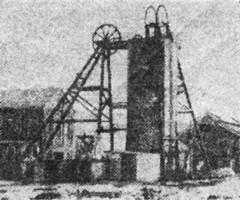 |
The last tub ever to be drawn from the pit will already have been brought out from the coal winding shaft in the valley below, hard by the railway and the football ground.
For generations these gaunt landmarks with their busy winding wheels have crystallised what seemed to be an inseparable bond between Cowdenbeath and coal. But now, almost incredibly that relationship is being broken.
Old miners will recite to you a long roll of pits that have vanished. Within the past year or two the Dora, the Jenny Gray, and Benarty pits have followed them into oblivion. And now No. 7 is to go, worked out after a life of 100 years - the last pit where coal was won in the heart of Cowdenbeath.
Other pits near the town will go on - but the end of No. 7 closes an epoch in which Cowdenbeath rose from the pit slag to become the capital of one of King Coal's richest domains.
 |
Mr John Abbot, colliery manager.
What happens now? The end of No. 7 doesn't mean the end of their mining careers for most of the 320 men employed there. All but those due for retirement are likely to be absorbed in other pits. Many of them have already been found jobs by the N.C.B. Some will be kept on for a while at No. 7, removing equipment which can be used elsewhere. Then they too will go to other jobs.
Jobs Nearby
The N.C.B.'s policy is to try to find jobs for the … (missing section) … if he could only get oncost work. But the N.C.B. are doing their best to avoid hardship for most - and this includes officials, like deputies, oversmen, and firemen, for whom every effort will be made to find similar employment.
Retiring Now
Mr Abbot himself has no resettlement problem. At 66 he is retiring after a lifetime in the pits. A native of Prestonpans, he started as a pit boy at 14 in Gore Pit, Midlothian. That was in 1908.
"The place I worked in was 14 in. high and I couldn't sleep for six weeks for thinking about it," he said, "but I got used to it."
The list of pits Mr Abbot has worked in since then is too long to print. It's the saga of one who has come up the hard way, learning by experience how to win the respect of men and get the best out of them. It means being tough when one need be. But it means too that your heart must be in the right place. And there have been moments when John Abbot has shown the warm humanity that lies beneath that rugged exterior.
There was the case of the old retired miner who brought a saw in under his coat to see if he could have it sharpened by the colliery joiner. Of course, he'd really no business to be there.
"The manager's no aboot, is he? " he asked Mr Abbot who happened to be in the joiner's shop at the time. "I hear he's a holy terror."
Like Village
Mr Abbot just winked at the joiner who took the hint and sharpened the saw.
"And what's your name? " asked the old man while he waited.
"I'm John Abbot. I worked alongside you … (missing section) … 40 years ago." …
 |
The shift is finished for Mr Charles Dunn, oversman (right), Mr Thomas Seath, deputy (centre); and Mr Robert Adamson, rope splicer.
--------------------------------------------
"Dunfermline Press"
30 January, 1960
Closing of No. 7 Colliery
Cowdenbeath No. 7 Colliery ceased production yesterday. In all 334 men are involved, and it
was officially stated from West Area Headquarters of the N.C.B. yesterday that, of the total, 214
men have been transferred to pits within the area where development is taking place. Ninety-one
men are being retained meantime to salvage machinery and maintain pumping operations.
Nineteen of the men are reported to be on long-term sickness, and six men, including the manager,
Mr John F. Abbot, are retiring. The remaining four men are stated to have refused to accept offers
or alternative employment.
--------------------------------------------
"Dunfermline Press"
6 February, 1960
"Up The Pit" For The Last Time
When Cowdenbeath No. 7 Colliery, originally sunk 75 years ago, ceased production last Friday
afternoon, among the last men to come to the surface were a father and son. They were William
Shepherd (43), and his 21-year-old son, John, both of 41 Stewart's Crescent, Lochgelly.
Mr Shepherd, sen., has been employed in the Cowdenbeath pit for the last 24 years, and [as] he
emerged from his last shift at No. 7, he said: "I really have no sentimental feelings about the
closure of No. 7, because to me all pits are the same underground." He added: "In fact I'm
quite pleased, for I'm being transferred to the Minto Colliery which is nearer my home."
Young John, who has been transferred to Valleyfield Colliery was equally realistic. He said: "I'm
pleased to get a chance of a fresh start in a new district, although it will mean a bit of travelling from home."
Mr John F. Abbot, who has been manager of the colliery for the last 11 years, is due to retire after 51 years'
service in the mining industry. He is remaining meantime with another 91 men to carry through salvage and
recovery work. Six other workmen are also laying down their tools. A total of 214 of the 334 men latterly
employed at the colliery have been transferred to other developing pits in West Fife.
James Hall, 3 Ewing Street, Cowdenbeath, another on the final production "tow" was more
critical of the closure. He declared: "I think many of the pit closures in Scotland might have been
avoided if the N.C.B. had shown more enterprise in the production of smokeless fuel and by-products from coal."
James Hodge (45), of 17 Maxwell Crescent, Cowdenbeath, another miner on the last cage to come to
the surface, said he was a bit sorry to see the old colliery go out of existence, for it would mean his
travelling out of the town for work in future.
Mr William Ewing, secretary of the Cowdenbeath branch of the N.U.M., who, with some others retained
for salvage, witnessed the production life of the colliery come to an end, told a reporter that it was quite
satisfactory from the Union's point of view that a number of the men had been placed locally, but
it was a matter of regret that many of the men were being transferred to pits west of the town,
consequently losing considerable wages in the process.
--------------------------------------------
"Dunfermline Press"
27 July, 1963
Former Colliery Manager
The death occurred at the weekend of Mr John F. Abbot, former manager of Cowdenbeath No. 7 Colliery, who was well known in mining circles in Fife and the Lothians. …
--------------------------------------------
