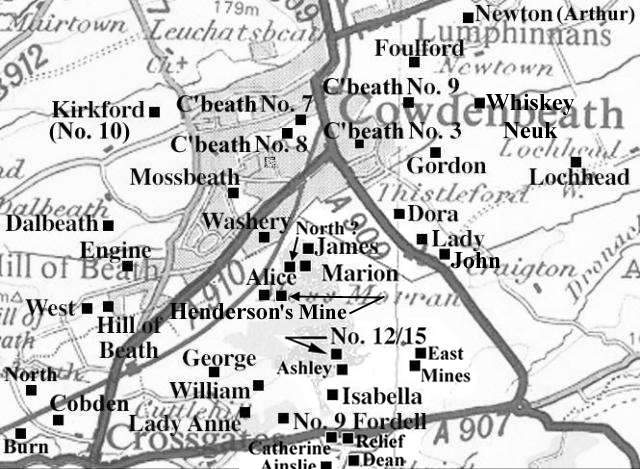
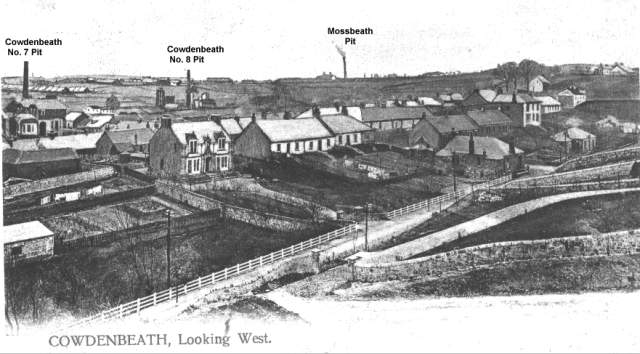
Initially working ironstone, the Cowdenbeath No. 8 shaft
was sunk about 200 yds. south-west of the No. 7 shaft but
soon ran into geological difficulties, including a general
thinning of the seams and a complete 'washout' of the
potentially valuable Five Foot coal.
Opened around 1869, it appears to have ceased coaling by 1882
when it then appears in records as a pumping pit.
| See entry Cowdenbeath Pits and Mines for a summary of mining activity in the area. |
 |
 |
| Pit opened: ca 1869 | Pit closed: 1882 (functioning as pumping pit) |
|---|---|
| Source Date of Information Supplied | |
| Manager / Under-Manager / Men underground / Men above ground / Coal seams worked / Shaft Details | |
| 1873 (Cowdenbeath Coal Co.) | |
| Henry Mungall
/ ------------ / --- / --- / 14 feet, Splint, Parrot /
D'cast (9 x 6) 540 ft. : U'cast (5 x 6) 540 ft.
Furnace ventilation. |
|
| 1874 (Cowdenbeath Coal Co.) | |
| William
Moodie / ------------ / 107 / 30 / 14 feet; Splint,
Parrot / D'cast (9 x 6) 540 ft./ (11 x 10) 430 ft. :
U'cast (6 x 5) 540 ft.
Furnace ventilation. |
|
| 1875 (Cowdenbeath Coal Co.) | |
| Richard
Nisbet / ------------ / 98 / 12 / 14 feet; Splint, Parrot
/ D'cast (9 x 6) 540 ft./ (11 x 10) 430 ft. :
U'cast (6 x 5) 540 ft.
Furnace ventilation. |
|
| 1876 (Cowdenbeath Coal Co.) | |
| Richard
Nisbet / ------------ / 105 / 30 / 14 feet; Splint,
Parrot
D'cast (11 x 10) 430 ft./ (9 x 6) 540 ft./ (11 x 10) 540 ft. : U'cast (6 x 5) 540 ft. / (10 x 5) 540 ft. Furnace ventilation. |
|
| 1877 (Cowdenbeath Coal Co.) | |
| William
Moodie / ------------ / 97 / 32 / 14 feet / D'cast (9
x 6) 540 ft. : U'cast (6 x 5) 540 ft.
Furnace ventilation. |
|
| 1878 (Cowdenbeath Coal Co.) | |
| William
Moodie / ------------ / 96 / 36 / Lochgelly Splint;
Parrot / D'cast (9 x 6) 540 ft. : U'cast (6 x 5)
540 ft.
Furnace ventilation. |
|
| 1879 (Cowdenbeath Coal Co.) | |
| William Moodie / ------------ / 89 / 25 / Lochgelly Splint; Parrot / D'cast (14 x 6) 540 ft. : U'cast ----- | |
| 1880 (Cowdenbeath Coal Co.) | |
| Davey Thomas
/ ------------ / 45 / 33 / Lochgelly Splint; Parrot /
D'cast (14 x 6) 540 ft. : U'cast -----
Fan ventilation. |
|
| 1881 (Cowdenbeath Coal Co.) | |
| Davey Thomas
/ ------------ / 43 / 29 / Lochgelly Splint and Parrot,
12 ft.
(not used as a downcast or upcast) |
|
| 1882 (Cowdenbeath Coal Co.) | |
| Davey Thomas / ------------ / --- / 4 / Pumping Pit | |
Information on coals worked at Cowdenbeath No. 8 Pit
(based on a report from 1934)
The Two Foot Coal here was 3 ft. 2 in. thick and only 2 fathoms above the Dunfermline Splint, the sandstone that normally separated these two seams having died out. When this pit was sunk at Cowdenbeath, no coal was found at the Five Feet position, while at the neighbouring No. 7 Pit, 5 ft. 1 in. of coal was cut. Glassee Coal was around 3 ft. to 4 ft. thick and the Lochgelly Splint and Parrot Coals were worked as a single seam from 9 ft. to 13 ft. thick.
Plans of Abandoned Seams & DatesNote: abandonment dates do not relate to individual pit closures but to the abandonment of seams which had ceased to be worked. Not worked for a period of time, it was quite normal for some coal seams to be re-opened for working at a later date or at a different location. |
|---|
| Plans of Abandoned Seams for Cowdenbeath No. 8 | Pits or Mines designated in Plans |
|---|---|
| COAL; Lochgelly Splint; Parrot. IRONSTONE (1850-74) | COWDENBEATH
Nos. 4, 5, 6, 7, 8, 9 and FOULFORD Nos. 1, 2, 3 |
| IRONSTONE (September, 1871) | COWDENBEATH
Nos. 4, 5, 6, 7, 8 and FOULFORD Nos. 1, 2, 3 |
| COAL; Lochgelly Splint; Parrot (1871) | COWDENBEATH
Nos. 2, 3, 8, 9 |
------------------------------------
"Dunfermline Saturday Press"
17 July, 1869
COWDENBEATH - FATAL ACCIDENT
On Thursday morning last, an accident occurred here, whereby a lad named James Robertson, aged eleven years, son of James Robertson, labourer, lost his life. It appears the deceased was at No. 8 Pit, occupied by the Forth Iron Company, with his brother's breakfast, and when on his way home by the waggon-road which leads from the said pit to the N. B. Railway, there were four waggons loaded with coals going from the pits to the railway. After three of the waggons had passed him, he seems to have got hold of the fourth one, and ran along with it for about one hundred yards, then stumbled and fell across the rails, when the two wheels of the last waggon passed over his right arm, his legs, and the lower part of the right side of his belly. Consequently, his right arm was nearly severed between the hand and the elbow, his right leg was much bruised, and his left thigh broken, with the lower parts of the belly inwardly bruised. The accident happened at 8.15 A. M., and the injuries he received were of so severe a nature that the boy died about one o'clock. Immediately after the accident, the unfortunate boy was attended to by Drs. Mungall, of Foulford, and Nielson, Lochgelly, but the services of these medical gentlemen were of no avail.
------------------------------------
"Dunfermline Saturday Press"
13 November, 1869
COWDENBEATH PIT ACCIDENT
On Tuesday last, an accident occurred in No. 8 Pit, belonging to the Forth Iron Co., whereby a man named James Innes, jnr., was somewhat severely injured. It appears that he had been engaged at his work, and was lying on his side, when a large quantity of coal and rubbish, weighing about 4 cwt., came suddenly away and buried him in the debris. Assistance was speedily procured and the poor fellow extricated from his perilous position. Fortunately, none of his bones were broken, although his body was considerably bruised about the back and right side. He was immediately conveyed home, where he was shortly afterwards attended to by Drs. Gellatly, of Lochgelly, and Mungall, of Foulford. The injuries are not considered to be of a serious nature.
------------------------------------
"The Scotsman"
21 August, 1871
MINES INSPECTION IN FIFE.
Dunfermline, August 18, 1871.
SIR, - In the year 1850 a law was passed in reference to the inspection of
mines and the ventilation of the same. In 1855 that law was further strengthened;
and again in 1860 - the first general rule, where the Acts lays it down that every mine
shall be so ventilated that the men will at all times be able to pass on the ways or roads;
work at the faces with safety. All the gases are to be "diluted and rendered harmless."
To see that this was always done, inspectors were appointed to inspect all the "coal mines
and ironstone wrought in connection with coal." Mr Moore is said to be "the inspector"
for the county of Fife. Let the sequel tell how far that gentleman enforces the rule that he ought to
see carried out for the safety of the working miners.
A number of months ago something went wrong with the ventilation of the No. 8 pit, Cowdenbeath
Colliery, belonging to Mr Smith Sligo, and managed, or mismanaged, as you will, by a Mr H. Mangal [sic -
Mungall]. (There are more Mangals managers in Fife.)
Frequently since the first defect in the ventilation have men been made prostrate by the effects of the
foul gases that the mine emits. The plan for correcting the ventilation is one that was in vogue
some forty years since - dashing water down the shaft; making a shift with the water for lack of brains
to ventilate the mine.
So late as the 11th curt., two youths, named Samuel McCormick and Robert Hunter, were so
enervated that they fell apparently lifeless for a time. Again on the 16th, a boy named Wm. Hutchison
was prostrated by the same baneful agency.
Though the mine is in that condition, and has been so for many months, no workman of the mine
has ever heard of the presence of that functionary the mines inspector.
I was informed last evening there were men often for a week that they could not get into the mine,
and there was one at least that had not got to work this very week for want of ventilation.
The want of ventilation to any mine in Scotland we hold to be little else than a crime. Mr Moore in his
published work on "Ventilation of Mines" says that, if 8000 feet of a pure air-current be
produced, any mine in Scotland will be freed from "noxious gases." In some of the larger
mines in England and Wales as much as 100,000 to 200,000 cubic feet of pure air is being produced.
Is not the defect in Cowdenbeath an outrage of the law, if not a crime? And who is responsible for this
state of things?
Mr Moore said before a Select Committee of the House of Commons, in effect, that the law was perfect,
and the inspectors were quite numerous enough, we would ask, is it inspection to allow boys of tender
years to be so injured as we have described?
In the name of suffering humanity, we would ask you to give this a place; and further, we would ask
all that have the feelings of parents, or are well-wishers to the young, to join us in demanding from the
Government an inquiry into the conduct of the man that would allow such a state of things to exist for
months; also, to demand from the Government an independent inquiry into the state of the whole of the
pits of this colliery. It is alleged that in one of the pits some time ago the men had to travel to their work
in the dark from the strength of the foul gas; and we have to ask the question, if there are now means
of escape by a second shaft to at least one of the pits?
Any examination now by the man that has allowed this state of things to be, would not be at all
satisfactory - in fact, it would be considered in the light of a farce. It is because of this we ask the public -
the M.P. for the county, Sir Robert Anstruther, included - to join the Fife miners in demanding a
full investigation into the present and past condition of the Cowdenbeath Colliery in so far as the
ventilation is concerned. - I am, &c.
ALEXANDER McDONALD,
President Miners' National Association.
------------------------------------
"Dunfermline Saturday Press"
15 June, 1872
PIT ACCIDENT
Yesterday, a boy about 13 years of age named William Waters, got his left leg broken by falling out of a hutch while it was in course of descent from the "wheel brae" in No. 8 Pit, Cowdenbeath Colliery. The boy was speedily attended by Dr. Mungall.
------------------------------------
"Dunfermline Saturday Press"
7 March, 1874
PIT ACCIDENT
On Saturday last, a miner, named James Traill, was preparing a blast in No. 8 Pit, Cowdenbeath Colliery, when he inadvertently allowed some of the powder to fall from the cartridge upon his lamp, and, in consequence, an explosion took place, the poor fellow having thereby got his face and arms scorched. William Armstrong, who was working near Traill, also got some scorching on his face and left arm.
------------------------------------
"Dunfermline Saturday Press"
5 June, 1875
PIT ACCIDENT
On Tuesday, a man named John Black sustained injuries of a rather serious nature while employed in No. 8 Pit, Cowdenbeath Colliery, by a lump of coal falling on him from the face at which he was working. Dr. Mungall attended the sufferer.
------------------------------------
"Dunfermline Saturday Press"
9 October, 1875
PIT ACCIDENT
On Thursday, while a man named William Bowman was employed in No. 8 Pit, Cowdenbeath Colliery, a large lump of coal fell on him from the roof, whereby he sustained injuries - chiefly spinal - of a serious nature. He was attended by Drs. Mungall and Blackhall.
------------------------------------

"Dunfermline Saturday Press"
18 September, 1880
FATAL ACCIDENT
On Saturday, Thomas Downie, labourer, Donibristle, while endeavouring to climb to the top of a shed at No. 8 Pit, Cowdenbeath Colliery, missed his footing somehow and fell to the ground. The injuries he received were so very serious that he died on Sunday afternoon. The deceased was 21 years of age and unmarried.
------------------------------------
"Dunfermline Saturday Press"
3 September, 1892
ACCIDENT TO A COLLIERY ENGINEER
Alexander Sinclair (36), engineer, Cowdenbeath, met with an accident on Thursday while engaged repairing a cylinder at No. 8 Pit, Cowdenbeath Colliery. Sinclair and another workman were removing the cover off a large cylinder by means of a crane when the tackle gave way, and the cover fell on Sinclair's left arm, crushing it severely at the elbow joint. The injured man was conveyed home and attended by Drs Craig and Kitchen, who ordered his removal to the Edinburgh Royal Infirmary.
------------------------------------
"Dunfermline Saturday Press"
9 September, 1882
FATAL ACCIDENT AT COWDENBEATH
On Friday morning last week, while James Borthwick,
labourer, Cowdenbeath, was engaged working at the filling of
a waggon on the siding at No. 8 Pit, Cowdenbeath, an engine,
with a number of waggons was shunted into the siding.
Borthwick failed to notice the coming train, and was knocked
over on the rails, with the result that the waggon he was
loading went over him and killed him instantaneously.
Deceased was 55 years of age, a native of Thornton, and
leaves a widow and family. Another workman named Alexander
Noble, who was working with Borthwick, was slightly
injured.
