Owners: Lochore and Capledrae Cannel Coal Co. Ltd.
Capledrae Colliery, lying to the east of Ballingry and a few hundred yards to the north of Capledrae farm, is believed to have been in production as early as 1837. At least two shafts are known to have been sunk at Capledrae Colliery which also operated mines. It would appear that serious fires at the colliery, just to the east of Ballingry, brought closure around 1889.
 |
 |
In the early days of this colliery, the miners were trying
to get extra holidays as they were having to work every day
except for Sundays and New Year's Day: so, on days that
they fixed as holidays, they refused to work.
Capledrae No. 3 was being sunk in 1875. Records also show
that the colliery had a steam winding-engine which was not a
general feature in Fife at this time. Capledrae mines worked
the 'gas coals' and were abandoned around 1889.
In the early 1920s, the Fife Coal Company acquired the
minerals of the lands of Capledrae and developed them from
the Mary Pit, Lochore.
The lands of Capledrae lay in the parishes of Portmoak and Auchterderran and it is interesting to read what was reported in the early Statistical Accounts for Portmoak.
Extract from the Statistical Account of Scotland - Portmoak Parish (1791)
"... Fuel is cheap and in great abundance. Peats are easily got in several places of it; and what is of more consequence, the coal pits of Lochow, Keltie and Lochgelly are in the immediate neighbourhood. ... "
Extract from the Statistical Account of Scotland - Portmoak Parish (1839)
"... The fuel chiefly used is coal, and a colliery has been lately commenced in the parish, but its practical effect is not yet known. ...."
| Colliery opened: 1837? | Colliery closed: 1889 |
|---|---|
| Source Date of Information Supplied | |
| Manager / Under- Manager / Men underground / Men above ground / Coal seams worked / Shaft Details | |
| 1841 Mr Thomas Goodall, manager. |
|
| 1856 (Messrs Aytoun) | |
| [From Dunfermline Register] | |
| 1857-59 (Anderson & Crombie, Contractors) | |
| [From Dunfermline Registers] | |
| 1861 Capeldrae & Balgreggie, Messrs Crombie & Anderson [1861 Parochial Register - Auchterderran COLLIERIES AND COALMASTERS.] |
|
| 1862 | |
| 30 Sept: Death of Mr James Crombie, coalmaster/joint-owner, in pit accident. | |
| 1868
(Messrs Anderson & Crombie [The county directory of Scotland]) |
|
| 1870-72 (Aytoun & Anderson) | |
| [From Dunfermline Registers] | |
| 1873 (Lochore and Capledrae Cannel Coal Co. Ltd.) | |
| Capledrae
Mine / William Waugh / ------------ / -- / -- / Capledrae
Cannel / D'cast (8 x 5) 460 ft. : U'cast (12 x 5)
180 ft.
Exhaust steam ventilation. |
|
| 1874 (Lochore and Capledrae Cannel Coal Co. Ltd.) | |
| Capledrae Mine / William Waugh / ------------ / 35 / 10 / Capledrae Cannel / D'cast (8 x 5) 460 ft. : U'cast (12 x 5) 180 ft. | |
| 1875 (Lochore and Capledrae Cannel Coal Co. Ltd.) | |
| Capledrae Mine / William Waugh / ------------ / 28 / 10 / Capledrae Cannel / D'cast (8 x 5) 460 ft. : U'cast (12 x 5) 180 ft. | |
| Capledrae No. 3 sinking. William Waugh / ---------- / 8 / 4 | |
| 1876 (Lochore and Capledrae Cannel Coal Co. Ltd.) | |
| Capledrae
Mine / William Waugh / ------------ / 27 / 9 / Capledrae
Cannel / D'cast (8 x 5) 460 ft. : U'cast (12 x
5)180 ft.
Fan ventilation. |
|
| Capledrae No.
3 / William Waugh / ---------- / 32 / 6 / Capledrae
Cannel / D'cast (6 x 6) : U'cast (8 x 6)
Natural ventilation. |
|
| 1877 (Lochore and Capledrae Cannel Coal Co. Ltd.) | |
| Capledrae
Mine / Duncan Ferguson / ------------ / 24 / 6 /
Capledrae Cannel / D'cast (8 x 5) 1380 ft. :
U'cast (12 x 5) 1380 ft.
Fan ventilation. |
|
| Capledrae No.
3 Mine / Duncan Ferguson / ---------- / 60 / 10 /
Capledrae Cannel / D'cast (8 x 6) 1146 ft. :
U'cast (6 x 6) 1032 ft.
Fan ventilation. |
|
| 1878 (Lochore and Capledrae Cannel Coal Co. Ltd.) | |
| Capledrae
Mine / Duncan Ferguson / ------------ / 42 / 9 /
Capledrae Cannel / D'cast (8 x 5) 1380 ft. :
U'cast (12 x 5) 1380 ft.
Fan ventilation. Fan 15' diam. |
|
| Capledrae No.
3 Mine / Duncan Ferguson / ---------- / 30 / 7 /
Capledrae Cannel / D'cast (8 x 6) 1146 ft. :
U'cast (6 x 6) 1146 ft.
Fan ventilation. Fan 15' diam. |
|
| 1879 (Lochore and Capledrae Cannel Coal Co. Ltd.) | |
| Capledrae Mine / Duncan Ferguson / ------------ / -- / -- / Capledrae Cannel | |
| Capledrae No. 3 / Duncan Ferguson / ---------- / 47 / 8 / Capledrae Cannel / D'cast (8 x 6) 1080 ft. : U'cast (6 x 6) 1146 ft. | |
| 1880 (Lochore and Capledrae Cannel Coal Co. Ltd.) | |
| Capledrae Mine / Duncan Ferguson / ------------ / 2 / 2 / Capledrae Cannel / U'cast (12 x 5) 1380 ft. | |
| Capledrae No.
3 / Duncan Ferguson / ---------- / 106 / 20 / Capledrae
Cannel / D'cast (8 x 6) 1680 ft.
Fan ventilation - 15' diam. fan. |
|
| 1881 (Lochore and Capledrae Cannel Coal Co. Ltd.) | |
| Capledrae Mine / Duncan Ferguson / ------------ / 2 / 1 / Parrot (Fan at this mine.) | |
| Capledrae No. 3 Mine / Duncan Ferguson / ---------- / 105 / 24 / Parrot / D'cast (7 x 6) 1680 ft. | |
| 1882 (Lochore and Capledrae Cannel Coal Co. Ltd.) | |
| Capledrae No. 1 Mine / Duncan Ferguson / ------------ / 2 / 2 / Capledrae Cannel (Fan at this - No. 1 - mine.) | |
| Capledrae No. 3 Mine / Duncan Ferguson / ---------- / 113 / 31 / Capledrae Cannel / D'cast (7 x 6) 1680 ft. | |
Plans of Abandoned Seams & DatesNote: abandonment dates do not relate to individual pit closures but to the abandonment of seams which had ceased to be worked. Not worked for a period of time, it was quite normal for some coal seams to be re-opened for working at a later date or at a different location. |
|---|
| Plans of Abandoned Seams for Capledrae | Pits or Mines designated in Plans |
|---|---|
| COAL; Gas (1862); Cherry (1888) | CAPLEDRAE AND KIRKNESS |
| COAL; Capledrae Gas | CAPLEDRAE |
| COAL; Capledrae Gas (February, 1889) | CAPLEDRAE |
| COAL; Gas (1896) | CAPLEDRAE |
Information on coals worked at, or near, Capledrae Colliery
The Two Foot Coal seam was worked here and the Glassee
Seam was cut here in a bore 357 fathoms from the surface
finding 8 ft. 1 in. coal including a soft parting.
The best development of Jersey Coals known in the district
was proved in the Capledrae diamond bore, where the Jerseys
and Swallowdrum contained more than 13 ft. coal.
Kelty Main Coal was also thick in the area of this pit,
reaching 10 ft. 8 in. between Inchgall Mill and Capledrae
Farm. Kelty Blackband Ironstone which lay a few fathoms above
the Kelty Main Coal was developed only in the north-east
where it was recorded in the diamond bore as a 1 ft. 1 in.
ironstone lying in fine-grained sediments. In the bore, where
the Little Splint Coal was cut at 231 fathoms, and 8 fathoms
above the Rough Coal, its thickness was 3 ft. 10 in.
A good development of Lochgelly Blackband Ironstone was cut
in the Capledrae bore but there was evidence that the greater
thickness here was very local.
------------------------------------------------------
"The Scotsman"
1 July, 1859
TO BE EXPOSED TO SALE BY PUBLIC ROUP,
THE ESTATE OF STRATHRUDDIE, in the Parish of Auchterderran, and
County of Fife. It extends to about 166 acres imperial, all arable, has a good Farmhouse
and Steading, and is let to one tenant. ... It is bounded on the north by Lochty Burn.
There is great reason to think that both Ironstone and Coal are in the Lands. The
Lands were recently surveyed and a Plan prepared.
The present rent will yield a return of fully 4 per cent. on the upset price, independent
of any return from Minerals. ...
------------------------------------------------------
"Dunfermline Press"
20 August, 1859
The "MINER'S SAFETY CAGE" - a platform used for raising and lowering men, and likewise coals and ironstone from a shaft or pit - is an invention by Robert Aytoun, Esq., of Capledrae, himself an extensive coal owner, who has bestowed much time and money in bringing the cage to its present satisfactory state.
Like many valuable discoveries, it is of the most simple construction. Those acquainted with mining terms, will understand us when we say, that the upper slides or shoes attached to the cage are so arranged that in the event of the rope or gearing giving way, a simple spring so tilts the slides or shoes that they immediately seize hold of the guide rods in the same manner as a person lays hold of boring rods with a key; and although the rope should come down upon the top of the cage, the effect is that it causes it to dig deeper into the guide rods, and thus becomes the more secure.
The cage may be seen in operation at Lochgelly Iron Works and Donibristle Colliery in this neighbourhood, and we have no hesitation in predicting that ere long it will be in general use. It was seen by thousands of people in the Highland Society's show-yard, where it attracted much attention; many of the miners themselves had an opportunity of seeing it there, and expressed their opinion that Government ought to enforce its adoption. We understand Mr. Aytoun has taken out a patent for this invention, but in order to encourage its general use, the price is almost nominal.
------------------------------------------------------

"Fifeshire Advertiser"
Saturday, 4 October, 1862
KINGLASSIE
Fatal Coal-Pit Accident.
On Tuesday morning while Mr. James Crombie was conversing with one of his workmen at the bottom of Capledrae coal-pit, he was instantly killed by a large stone weighing nearly a ton falling on his head. The deceased was married, and has left a family.
-------------------------------
Great-great-grandaughter visits Capledrae and Balgreggie pit locations
(August 2010)
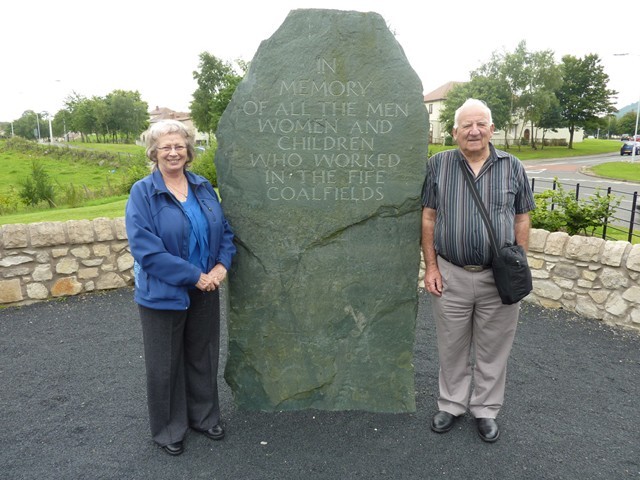
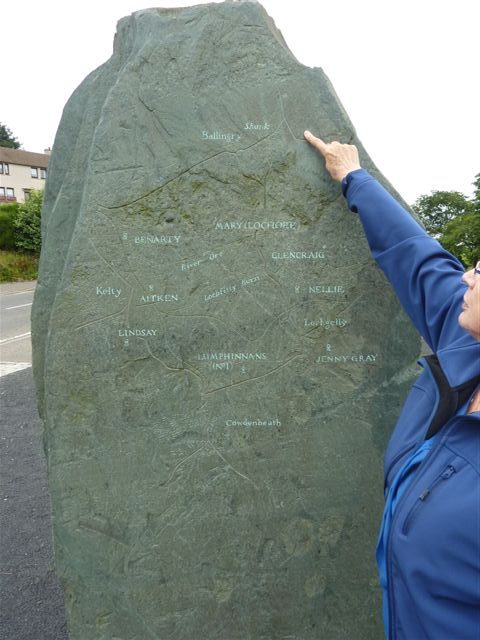
Glenyss Crombie O'Halloran, Te Kuiti, North Island, New Zealand, a great-great-granddaughter of the late Mr James Crombie, who was killed in his own pit (see above), having contacted webmaster, Chris Sparling, was able to visit the area in August, 2010, and find out the locations of the former Capledrae and Balgreggie pits formerly co-owned by her g-g-grandfather.
Below: (L): Glenyss and husband Jim at the Shank Memorial.
(R):
Glenyss indicating the location of the old Capledrae Colliery.
 |
 |
Visit Stories (Menu 2): Anecdotes and read of Glenyss' interesting family history researches and findings.
------------------------------------------------------
"Dunfermline Saturday Press"
6 July, 1867
CAPLEDRAE - EXCURSION TO PERTH
On Saturday last, the workmen employed at Capledrae
Colliery, along with their wives and sweethearts, visited the
"fair city". The day was all that could be desired.
After arriving in the city, young and old set themselves to
make the most of the time, and were soon scattered in every
direction.
After visiting all the principal places in and around Perth,
the company left, all delighted with the excursion. The
thanks of the company are due to Mr. James Allen, who at
intervals provided them with refreshments.
------------------------------------------------------
"Dunfermline Saturday Press"
6 August, 1870
PIC-NIC OUTING
On Saturday last, the workmen employed at Capledrae Colliery, along with their wives, had their annual pic-nic to Saline, "The paradise of Fife". Sunny Braes Farm (Mr. Anderson's) being reached in good time, refreshments were partaken of, when they started for the top of Saline Hill, which, at this season of the year, commands a prospect most extensive, and of richly varied hue. The day was rather warm for climbing a hill, but "a stout heart to a stey brae" overcame that, as well as other difficulties. After descending to the farm, a plentiful supply of tea and cake was provided for the company, and presided over by Mrs. Anderson, who did everything to make them happy. Homeward bound, they arrived all safe. Mr. Anderson deserves great praise for his liberality to his workmen, in providing such a treat, free of expense.
------------------------------------------------------
"The Scotsman"
24 June, 1872
THE LOCHORE AND CAPLEDRAE
CANNEL COAL COMPANY (LIMITED.)
CAPITAL £110,000, IN 11,000 SHARES OF £10 EACH.
SUBSCRIPTIONS are invited for the Share Capital of this Company.
Deposit £1 per Share on Application; £2 per Share on Allotment.
The remainder in future Calls of Amounts not larger than £2 each Call, and
at intervals of not less than Two Months.
Shareholders may stipulate in their Application for the Payment in full of their
Shares, and receive Interest at £5 per cent per annum on the amount paid in
advance of Calls.
DIRECTORS.
WILLIAM BINNEY, of Messrs William Guild & Company, Merchant,
Great St Helens, London, and Dalblair House, Ayr.
GEORGE GRAY, coalmaster, Leavenseat, Whitburn.
CHARLES JOPP, C.E., St Andrew Square, Edinburgh.
KENNETH MATHIESON, Contractor, Dunfermline.
JAMES McKELVIE, Cannel Coal Merchant, Edinburgh.
ROBERT B. SYMINGTON, Lochore Collieries, Dunfermline.
Solicitors.
Messrs HILL, REID, & DRUMMOND, W.S., Edinburgh.
Bankers - THE UNION BANK OF SCOTLAND, Glasgow, Edinburgh, and
Branches.
THE ALLIANCE BANK (LIMITED), London,
This Company is formed for the purpose of acquiring and more extensively
working the Cannel Coal and other Minerals in the lands of Lochore, Crosshill, and
Capledrae, in the county of Fife. The Cannel has for many years been wrought at
Capledrae, and is known to be one of the finest Cannels in Scotland. The same
seam was discovered at Lochore and Crosshill, and has now been opened up
and is being worked on these properties. At Lochore, another seam of Cannel
of equal quality, and a thick seam of Blackband Ironstone, have also been opened
up and are worked. All the workings have hitherto been restricted by the want of
railway accommodation, which it is part of the scheme to provide; and also, as
regards Lochore, by a desire to preserve the residential amenity of the estate.
Arrangements have been made for acquiring the estate of Lochore, with the Mining Plant,
&c., thereon, and for acquiring Leases for 31 years of the Cannel Coal in
Capledrae and Crosshill, with the mines and mining plant thereon. The workings at
Crosshill adjoin those of Lochore, and they will be carried on together. The Capledrae
workings are detached, but will be connected by the same railway. The whole can
be more advantageously worked as one undertaking, and competition in the selling
and labour markets avoided.
The extended demand over all parts of the world, and the increasing scarcity of first-class
Cannel, make the present a favourable opportunity for extensively opening up these
seams.
The Cannel seam at Capledrae is 42 inches thick, consisting of 30 inches of No. 1, or
fine Cannel, and 12 inches of a second quality. The No. 1 Cannel yields per ton 13,100
cubic feet of gas, of an illuminating power of 36 sperm candles; and No. 2 10,040 cubic
feet of 35 candle gas. At Lochore and Crosshill the same seam is 20 inches thick,
yielding in the present workings 10,700 cubic feet of 31 candle gas per ton.
The lower Cannel seam worked at Lochore is from 18 to 23 inches in thickness,
consisting of an upper band 13 to 15 inches thick, yielding 11,351 cubic feet of 37
candle gas, and a lower band of 5 to 8 inches thick, yielding 9000 cubic feet of 30 candle
gas.
These results show that the Coals rank with the first class Cannels of the country, and
the thickness of the seams far exceeds the average of Cannel Coal seams.
In Lochore the Blackband Ironstone seam now working is 3½ to 4½ feet thick.
It contains in the raw state 30 per cent of metallic iron. This is a mineral every year becoming
more valuable.
The Report annexed to the Prospectus, by Mr John R. Williamson, Mining Engineer, of
Edinburgh, and Mr A. Simpson, Mining Engineer, of Glasgow, gives a description of the
Mineral Field. They estimate that by opening up the fields in the manner proposed, an
annual output of the various Cannels will be got of 38,000 tons, and of Ironstone of
12,000 tons a-year, the profits of which they estimate at £19,900, after charging against
them the royalties applicable to the Minerals in Lochore, which will form a fund for redemption
of capital. From the quantities contained in the field as estimated by them from the workings
and bores, this output should be maintained for more than 20 years. It is probable that
subsequent operations in the lands will prove a much larger area. Part of the lands of
Lochore also contains the West of Fife Coal.
Mr McKelvie, who has been one of the largest dealers in Scottish Cannel Coals for over
a quarter of a century, considers the selling values adopted by Mr Williamson and Mr
Simpson, in their estimate, to be extremely moderate.
The lands of Lochore extend to about 850 acres, of which 120 acres consist of wood.
The net annual rental, exclusive of woodland and minerals, is over £1300, and the wood
is very valuable.
The Capital of the Company will be £110,000, to be applied:-
Less proposed to be borrowed on the security of Lochore Estate, say £35,000………………. 35,000 0 0
____________
£65,000 0 0
2. For further opening up the Mineral fields, and erecting Plant,
and constructing a Railway
from the North British Kinross-shire
Branch, and Capital for general purposes of the
Company
…........................................................................................................................
45,000 0 0
____________
£110,000 0 0
The Incorporation of the Company will admit of extending its operations to other fields if the Company
so resolve. The only agreement made by the Company is an agreement dated 20th June, 1872, between Robert
Brown Symington, Coalmaster, Dunfermline, on the one part, and George Gray, Coalmaster and Oil Manufacturer,
Leavenseat, on behalf of the Company, on the other part. This Agreement, and the Memorandum and Articles of
Association of the Company, are in the hands of the Solicitors.
The Company are chargeable with no fees for brokerage or legal charges, advertising, or printing, prior
to its formation, these being paid by the vendors.
A Report by Mr J. F. CURROR, Farmer and Land Valuator, Edinburgh, on the Lands of Lochore, and also a
report by Mr DAVID LANDALE, M.E., Edinburgh, on Lochore minerals, are also in the hands of the Solicitors.
Copies of the Prospectus, with forms of application, may be had from Messrs HILL, REID, & DRUMMOND,
W.S., Edinburgh, or from the Bankers.
------------------------------------------------------
"Dunfermline Saturday Press"
29 June, 1872
LOCHORE AND CAPLEDRAE CANNEL COAL COMPANY
The prospectus of this new company has now been issued, and we are glad to learn that the share capital is fully taken up. This must be very gratifying to the promoters of the scheme, as it is the object of the company to extend very considerably the mining operations at Lochore, Crosshill and Capledrae. The successful manner in which the undertaking has been launched augers well for the future commercial prosperity of this district.
------------------------------------------------------
"Dunfermline Saturday Press"
22 March, 1873
KELTY - NEW WORKS
The Lochore and Capledrae Cannel Coal Company (Limited) have begun to construct their mineral railway, which is to extend eastward from Kelty Station through the low-lying lands of Lochore and Crosshill estates for about 2½ miles. It has been contracted for by Mr. Kenneth McKenzie, who has had considerable experience in such undertakings.
The Fife Coal Company (Limited) have advertised for contractors to construct a mineral line they propose to make westward from Kelty for about 1½ miles to open out their minerals on the west portion of Blairadam estate. With these large works going on and the new pits and new houses that are being proceeded with at all the collieries in the district, there is every prospect of a season of high wages and plenty of employment for all kinds of work people.
------------------------------------
"Dunfermline Saturday Press"
19 December, 1874
CAPLEDRAE
The extensive operation of the Lochore Mining Company at Capledrae will be suspended in a few days to allow the erection of a new powerful engine, to overcome the water which has been troublesome in the pits here for some time. The heavier portions of the engine and the huge blocks of basement have been conveyed from Lochgelly with considerable difficulty. From the number of pits already opened at Lochore, in the immediate neighbourhood of the Shank of Navity, and at Capledrae, this company is likely to become the most extensive in Scotland.
------------------------------------
"Dunfermline Journal"
Saturday, October 20, 1877
THE LOCHORE AND CAPLEDRAE CANNEL COAL COMPANY (LIMITED)
The annual meeting of this Company was held on Tuesday in the Freemason's Hall, Edinburgh - Mr Henry Aitken, Falkirk, chairman of directors, presiding. The print of a correspondence was submitted between the Messrs Gibson-Craig, Dalziel, and Brodies, W.S., and the directors, in which the former, on behalf of the shareholders, asked the directors consent to a committee being named to investigate into the affairs of the Company and into the management of the present Board. The directors, it was stated, had not the least objection to any investigation by shareholders interested in the Company and were willing to take part in its management. The present members of the Board joined it some time after the formation of the Company owing to interests which they had in common with the other shareholders. They had given much labour gratuitously to the business of the Company.
The chairman assured the meeting that the directors sympathised
with the shareholders in the present position of the Company, and
he was also happy to say that the shareholders had shown, by the
number of proxies sent in, that they had every confidence in the
directors. Referring to the disappointments they had experienced at
Capledrae by the whin dykes which had been met with among the
parrot, he said they would just need to struggle over these
difficulties, and if the coal was again met with, he had no doubt
they would be able to pay a dividend. As to the suggested committee
of inquiry, it was stated in the correspondence that the committee
was proposed in no spirit of hostility to the directors, but simply
that the shareholders might get information. At the same time, the
directors simply said to the shareholders, "Appoint gentlemen
who will come on the Board and investigate the affairs of the
Company and then help us in the conduct of its affairs whatever the
issue is to be". He might mention that, with the report and
the correspondence before the shareholders, the directors had
received proxies representing 64,443 shares. The proxies returned
to Messrs Gibson-Craig represented 2505 shares. He moved the
approval, of the report.
Mr Samuel L. Mason, Leith, seconded the
motion.
Mr George Robertson, W.S., believed that the appointment of a
committee of investigation was imperatively called for, and that
something must be done if they were to save a small remnant of the
money they had invested in the concern. The chairman had stated the
terms on which the directors would agree to the appointment of a
committee; but he (Mr Robertson) did not think it right that such a
committee should be in any way mixed up with the management until
at least they had reported to the shareholders. What was the
position of the Company? They had had no dividend since its
commencement, and they had been told that their chance of one
depended on their finding some nugget of coal, independent of the
flaws which had hitherto been met with. He feared that was a small
chance. The share capital of this unfortunate concern was
£110,000. Of that sum £50,000 was paid for the estate of
Lochore, and £3700 for the lease of Capledrae, leaving
£46,000 of the £100,000 paid to the vendor which they had
never heard one bit about. He thought that in the history of the
Companies promotion money to the extent of £46,000 out of a
capital of £110,000 was unheard of. He could not assume that
it all went for promotion money, but hoped that part of it went to
make the coals workable. Then they had besides that the sum of
£35,000 for further opening up of mineral fields, and working
plant, constructing railway, &c., so that their capital was
really £145,000. From the accounts it would be observed that
the Company was now indebted a total sum of £183,000. Let them
look how the capital amount really stood. The loan and debenture
debt was £35,950; other debts were put down at £3554, and
the debt due to the bank at £34,000. Deducting £26,000
they were to receive for the railway from the North British Railway
Company that would leave them with debts amounting to £47,504.
Then what were the assets? - Minerals and stock, £9000; estate
of Lochore, say, £40,000; debts due to company, £3000 -
making their total assets £52,000. Deducting their liabilities
from that, there remained £4500 to meet a subscribed capital
of £110,000. That was a lamentable state of affairs, and one
that surely called for independent inquiry. Mr Robertson next went
into the revenue account, and contended that £4200 was a large
amount of wood to sell off 130 acres in five years, and that such
management must deteriorate the value of the estate. He also
objected to the sum put down under foresters wages and furnishings
(£276); and called attention to the amount entered under the
heading "allowance to secretary, auditors, clerks, &c.,
£290," he said he thought that when no dividend was being
paid, some consideration should be had for the shareholders in such
matters. When they were almost a bankrupt company, was it
necessary, he asked, that they should have such a staff of
managers, foresters, and secretaries as they had? In all the
circumstances he thought the section of shareholders with whom he
was acting were justified in demanding an independent
investigation. He moved the appointment of such a committee.
Mr J. A. Robertson, C. A., seconded the motion.
Mr John MacKay suggested that as there was so little difference between the directors and the section of the shareholders who were moving in this matter, the nominees of the latter party might, to save any apparent antagonism, consent to act as directors after the investigation had been made.
The chairman said the difficulty was that these gentlemen were the nominees of one section of the shareholders. The directors wished the whole Company to have a voice in the choice. With that view, he was prepared to submit was this: - "That it is expedient the Board, which consists of three directors, should now be increased to seven; and that this meeting now adjourn till the 5th November next for the purpose of electing these additional directors, the names of suitable persons to be sent to the secretary three days before the meeting; that the new members of the Board shall investigate the affairs of the Company, and make a report to the shareholders".
Mr John MacKay said he should second the resolution, as nothing could be fairer than the proposal it contained.
Mr George Robertson intimated that he should have withdrawn his amendment if he could have done so without being committed to the approval of the report.
The original motion and amendment were then put to the meeting, when the latter was negatived by 17 to 13 votes. The report was therefore adopted. A director and auditors having been appointed, the motion for adjournment was put and carried unanimously. A vote of thanks to the chairman, on the motion of Mr G. D. Laurie, terminated the proceedings.
------------------------------------
"Dunfermline Journal"
Saturday, November 10, 1877
LOCHORE AND CAPLEDRAE CANNEL COAL
COMPANY
An adjourned meeting of the shareholders of the Company was held on Monday at noon, in the Freemason's Hall, Edinburgh - Mr Henry Aitken, Falkirk, presiding. The purpose of the meeting was in terms of a resolution come to at the annual general meeting held on the 16th alt, to appoint four new directors, so as to increase the Board from three to seven members, and with a view to an investigation into the affairs of the Company and report to the shareholders. The chairman submitted on behalf of the Board of directors, that the following gentlemen be elected: - George Robertson, W.S., Edinburgh; James Thornton, Coalmaster, Crofthead; Alexander Nimmo, Westbank, Falkirk, and James McKelvie, Coal Merchant, Haymarket. Mr Mackay, chemist, George Street, in a communication to the secretary, recommended the names of James Laurie, 29 Royal Terrace; George Robertson, 17 Royal Circus; R. Scot-Skirving, Drummond Place; and John Walker, 1 Polworth Terrace. Mr Scot-Skirving gave it as his opinion that Mr Robertson would not take office along with the gentlemen proposed because his influence would simply be swamped by the directors own men. He himself declined to act as a director, simply because he knew nothing of mines or coal mining, and also because for five months of the year he was out of Edinburgh, and could not attend to the interests of the shareholders. It was commonly said outside, he remarked, that the reason why the directors had taken off John Walkers name and put on his own (Mr Skirving's) instead was that Mr Walker was too useful a man, and would take care that the shareholders knew all about the affairs of the Company. Mr Mackay, chemist, George Street, said that since the last meeting he had heard more about this Lochore Company than ever he heard before, although he had been a member since its commencement. He hoped that the results of the meeting would be satisfactory to the shareholders. He therefore proposed that with a view to the elucidation of those things and with a view to a settlement of what he was inclined to look upon as so many wild rumours, the gentlemen he had already named be elected as the new directors. The motion was seconded by Mr Robert Robertson. A somewhat warm discussion ensued between the directors on the one side and a number of the shareholders on the other. Mr Chas. Blair, said that if they did not give them the four there was not the slightest use of going forward one single step. If they could not get an investigation in one way they would see whether they could get it in another. Mr Walker contended that as the shareholders beside the directorate had £25,000 of stock represented by proxies, they ought to have one-third of the direction. If the directors were going to do what they professed as a thorough investigation, it should not be done in a stingy way. If they did not give a fair representation it was only balking the investigation - that was the simple English of it. Both parties being determined to press their nominees, a private conference between representatives of each was held, on the result of which Mr Mackay withdrew his motion, and proposed only two names - Mr James Laurie and Mr George Robertson, this being seconded by Mr Paul, and carried unanimously. The chairman then proposed two - Mr James Thornton and Mr Alexander Nimmo - these being carried against an amendment that Mr Walker and Mr Scot-Skirving be elected. The business was concluded with a vote of thanks to the chairman, proposed by Mr Scot-Skirving who remarked that he did not know whether the chairman conducted the business well or ill, but he was always a pleasant gentleman in the chair - not an easy matter in these hard times. He hoped the Company would see better days by-and-bye.
------------------------------------
"Dunfermline Journal"
Saturday, March 9, 1878
THE LOCHORE AND CAPLEDRAE CANNEL COAL
COMPANY (LIMITED)
(Report of Investigation Committee)
At the annual meeting of this Company held in October last it was, as may be remembered, resolved to increase the membership of the Board of directors from three to seven, and that after the new members of the Board had investigated into the affairs of the Company a report should be made to the shareholders. At a subsequent meeting of the Company four new directors were accordingly elected, and by them a report has now been prepared. This report states: -
"First - with regard to the formation of the Company and
capital - the prospectus, which was issued to the public in 1872,
bears that 'the only agreement made by the Company is a good
deal by volcanic eruptions. On the theory that the above hills were
up raised since the period of the coal formation, the regular lying
seams would be violently torn asunder, and mixed with a combination
of various metals or "trap-dykes." In fact the surface
itself in the district indicates clearly that there has been a
"whin battle" at some period or another, as large
boulders crop out amongst the soil in every field. The coalfields
of Scotland are all more or less traversed by these faults or
dykes, which in the most cases gives evidence of foreign matter
having been imported into the coal measures, and forming
separations by volcanic agency consisting of
greenstone porphyry. In almost every instance dykes destroy the
coal in point of contact, and masses of trap intercept the
minerals, which are burnt and wasted, the coal at a considerable
distance being inferior in quality. They, as a rule, run parallel
to each other, and are frequently of great extent, the strata being
tilted up so much that the coal may be found at the surface on the
one side of the "fault", while on the other it may be 100
yards in depth - thus the continuity of the seam at Capledrae is
very much broken, and has made the getting of a regular lying seam
of coal a work of great difficulty.
In fact, it is questionable as
yet whether the desired "coal haven" may be reached, as
the workmen after a period of over three years are still digging
into stone, exploring the unknown regions. A depth of fully 200
fathoms has now been pierced, which at the angle of 45 degrees
means that the men are working at a perpendicular depth of 400
yards. Just imagine for a moment the dangers the men at the foot of
this great hill must have while the hutches of rubbish are being
raised by the engine to the surface, as the rope may break or a
large fall of stones may hurl from the top to the bottom. Such is
the position of the men who are engaged in mines, and parties who
have such dangers to contend with ought to be remunerated
handsomely.
Still this in the meantime is not the case, and there
is just now little hope of a soon revival. The operations at this
Capledrae incline have been under the directorship of Mr H. Aitken,
managing director for the Company, while the more immediate
superintendence has been conducted by Mr John Ferguson, manager of
works.
Both men seem to understand their work thoroughly, and Mr
Aitken, who is also a mining engineer, has had large colliery
experience. His ability has been very much tried in the Capledrae
subject, however, and during the tedious three years that the
search for coal has been carried on with so much uncertainty,
several meeting of the shareholders and Board of directors have
taken place.
From the reports of these meetings it is apparent that
"fate" has been against the Company from their very
commencement, and the shares have dwindled beautifully down to a
merely nominal sum. To quote from Mr G. Robertson, W.S., at a
meeting of the directors in October last, he stated, "that
their debts amounted to £47,504, and their assets to
£52,000. Deducting their liabilities from that there remained
£4500 to meet a subscribed capital of £100,000. In fact,
he said the Company was almost bankrupt."
We only mention this
to show that the shareholders, if they should spend all, are
determined to prove the minerals - Some of the other directors have
been quite outspoken; and one could almost have imagined that the
concern, under such adverse circumstances as we have spoken of,
would, ere this, have been "played out."
Mr Aitken,
notwithstanding the obstacles raised by the other directors,
combined with the more serious obstacles daily cropping up at the
mines, has always, and even yet, holds out a ray of hope that
success will attend their efforts, and that they will yet be able
to pay a dividend. He is certainly a gentleman in every sense of
the word - enterprising and persevering - possessed of a
"not-to-be-beat" spirit.
From the Journal of the 10th
inst. we notice that the Company were advertising for 30 additional
hands, which is an indication that things are looking up. We hear
this week that the men working in the mine are now getting into
more regular formed strata, and that they are in the stone which is
supposed to immediately overly the coal. It is to be hoped, now
that so much money has been laid out, that a good remunerative seam
will be found, and that the directors of the Company will even yet,
at this late hour, have the pleasure of declaring a dividend to the
shareholders.
At present a good many of the houses are empty, and
as they are situated in a rural (although a lovely) district,
things have altogether a dull and deserted appearance. If the coal
is found, however, there is no doubt but a large number of the men
who left the colliery about two years ago will again return, and
will unveil the "hidden treasure," with a profit, we
trust, to all concerned.
In concluding the present article, perhaps
the following explanation as to what cannel or parrot coal is
composed of may be of interest to our readers: - Cannel coal, which
is applied to gas illumination, was first introduced into this
country in 1792, and practically applied in 1805 into the workshops
of Messrs Boulton & Watt, at Sohonear, Birmingham.
Illuminating
gas is chiefly composed of carburetted hydrogen - the density being
0.6 of that of air. The best bituminous coal yields something like
8000 cubic feet of gas per ton, while the quantity obtained from
cannel coal is from 10,000 to 12,000 cubic feet per ton. Gas is
drawn from the coal by the process of dry distillation.
------------------------------------
"Dunfermline Journal"
Saturday, August 24, 1878
MINING AT CAPLEDRAE AND LOCHORE
Gas Coal
The mines of Capledrae and Lochore have been known for a good
period of years to be productive of gas coal of a very fine
quality, notwithstanding that the strata in the district, in many
instances, is somewhat irregular. In the year 1872 (the beginning
of the coal famine period) the works changed hands - a number of
rather wealthy gentlemen having formed themselves into what is
known as the Lochore and Capledrae Cannel Coal Company.
A
prospectus being issued at a very auspicious time, £110,000 in
share capital was raised. The Company at once negotiated with Lady
Scott, proprietrix of Lochore grounds, and Mr R. B. Symington,
Dunfermline, proprietor of some of the works, for the buying of
Lochore estate, the leases of the minerals, with the whole
machinery, plant, and operations.
The lands of Lochore were bought
at a cost of £50,000, and leases of nearly all the minerals in
the district were affected - the stipulated agreement for the whole
transaction, including all charges for the formation of the Company
being £100,000.
Numerous mines were at once sunk in what was
considered to be the most advantageous places, the cost of which,
together with the workmen's houses, was about £37,000. A
railway branch was also conducted into the collieries from Kelty
station at a cost of £21,549 17s 8d, the N. B. Railway Company
having defrayed the most of the expenses for such.
Operations had
not proceeded far, however, in the Lochore mines, when numerous
obstructions were met with, the coal being thin and much distorted.
An unusual quantity of water had also to be contended with, which
could only be brought to the surface by heavy pumping machinery.
This latter fact need not be wondered at, seeing that the mines are
all situated near the base of Benarty Hill, consequently they could
only form tanks as it were, for the many springs with which the
hill is surrounded.
About 18 months ago, the lower section of what
is known as the Lochore Mines became entirely flooded with water,
and work there from that time to the present has been abandoned,
the water having now reached the mouth of the shafts. The fittings
of the pits are nearly all standing yet, and are, of course,
deteriorating in value every day, the machinery being rusty, while
the other fittings are crumbling down. Such a state of matters
cannot but present a disheartening appearance to those who are
concerned in the works, and people who are passing are apt to infer
that the capital has been laid out in a wrong quarter.
When the
Company was formed they obtained a lease of the minerals of
Capledrae, the buying of the whole of the plant at the old mine
there being included in the £100,000 already spoken of. To
prove the mineral, it was thought advisable that before sinking a
shaft, boring should be resorted to, and accordingly an English
Company was engaged, who proved the strata with a vertical diamond
drill bore worked with steam.
The coal was reached at a depth of
100 fathoms, was found to be of good workable thickness, and
considered a pretty fair quality. One very formidable barrier in
the way of sinking a shaft was the fact that from the bore it was
found that 30 fathoms of whin rock had to be sunk through. To
pierce a perpendicular shaft in such a hard substance seemed to be
considered impracticable at that time, although we believe it would
not be such a difficulty now, seeing that dynamite as a blasting
material has become so popular.
The manager of the Company rather
thought it advisable to start an incline in 1874 from the surface,
running with the vein of coal at an angle of 45 degrees, or to use
a hackneyed mining phrase - halfedge. Of course this incline was
intended from the first to be run until the basin of the coal was
reached, at which point it was expected that the "coveted
treasure" would rise on every side, thus making coals easy to
get.
In running this incline the vein of the coal has been often
lost, the workmen being intercepted with boulders of whin which
throw them entirely out of the coal position. Seeing that Benarty
and the Lomonds are situated in close proximity to the mines, the
strata may have been disturbed a good deal by volcanic eruptions. ...
[This report continued with much of the content of the
9 March newspaper article repeated.]
------------------------------------
"Dunfermline Journal"
Saturday, November 23, 1878
LOCHORE AND CAPLEDRAE CANNEL COAL COMPANY
(LIMITED)
The report of the directors of this Company, to be submitted to
the annual general meeting of the shareholders in Edinburgh on 29th
inst., has been issued. It states that the balance at the debit of
profit and loss account at the commencement of the financial year
was £2366 19s 9d. "The balance at its close was
£2755 19s 11d.
During the year there has been received on
account of capital £5000, of which £3809 18s 10d has been
spent in sinking and opening the mines to the Diamond Drill Bore
Field, further referred to below.
The cost of the Lochore line of
railway was taken over by the North British Railway Company as at
November 1878, but the discount on the railway bills, up to the
date on which they fell due, has been charged against the financial
year now ending. It amounts to £1250 14s 4d. No charge for
this source will fall on the Company in future.
The operations
during the year have been as follows:-
LOCHORE - Owing to the
state of the Company's funds and of the parrot coal market,
operations have been restricted on the Lochore estate to working a
little parrot from above the level of the water, which was done
with fair profit.
OLD MINE, CAPLEDRAE - The workings of this mine
have lately improved, and a small output is being got. To all
appearance there is a considerable quantity of coal to come still.
The cross-cut mine, mentioned in last years report, found the coal
of excellent quality, but disturbed by hitches and small wants. The
workings have been retarded owing to ventilation being insufficient
for the removal of the 'damp' from the extended workings.
For some considerable time a mine has been in progress which, when
completed, as it will be shortly, will communicate with the new
mine and render the ventilation all that can be desired. The coal
may then be opened up with greater freedom. It is pretty clear that
there are a considerable number of acres of the parrot coal in this
portion of the field.
NEW MINE, CAPLEDRAE - The object of this is
mainly to open out and work the Diamond Drill Field. The sinking of
the mine has been continued, until it has reached a depth of over
90 fathoms, measuring vertically. From the bottom of the dook,
mines have been driven. Within a few feet of where it was expected
the parrot should have been got, a bore was put down, and the coal
found in excellent thickness and quality. On the data furnished by
the bore it was thought that if the mine was continued for 20 or 30
feet the parrot would be reached in such a way as to command an
output. The position was so reached, and after passing through a
want the coal has been found, and is now being opened up.
A back
mine has also been driven to the north, and the parrot coal found
there also of good quality and thickness. A considerable quantity
of coal will now be got from these two points. The accounts show
that even the small quantity of coal worked has yielded profit
nearly equal to all charges, depreciation, and interests. This
gives some idea of the value of the undertaking should the cannel,
which has now been got by the new mine in the Diamond Drill Field,
turn out to be only moderately troubled. There is a very large
field there to work upon.
The Company's available capital for
new works is almost exhausted. If the Diamond Drill Field, upon the
operations in which the success of the Company so largely depends,
is to be fairly tried, it will be necessary to make provision for
some further expenditure on capital account, and to carry on an
extended business. The directors, therefore, consider it necessary
that a small amount of additional capital be raised to complete the
opening up of the Diamond Bore Field, and they recommend that a
preference stock should be created and issued to the shareholders
at such a rate of interest, and on such conditions, as may lead to
its acceptance.
A resolution will be submitted to the general
meeting accordingly. The directors suggest that the amount to be
raised be £5000, in shares of £5 each, having right from
the profits of each year to a preferential dividend at the rate of
10 per cent. per annum, and sharing with the other stock of the
Company any higher profits that may be earned; or that this sum be
raised by debenture stock, entitling the holder to an annual
payment of £10 for each £100 advanced to the Company.
In
calling the meeting, the directors have done so in terms admitting
of the shareholders attaching to the new shares or debenture stock
any conditions and rights they deem expedient.
Instructions have
been given to the manager of Lochore to allow inspection of the
mines and plans by shareholders interested in the undertaking.
Notice should be given of any intended visit, so as not to put the
manager to undue trouble. On application to the chairman (Mr
Aitken), an order for inspection will be given. The director to
retire at this time is Mr Mason. He is eligible for re-election.
The auditors, Messrs McAndrew & Blair, C.A., are also eligible
for re-election.
------------------------------------
"The Scotsman"
1 October, 1881
TO LET on Lease, for such term as may be agreed on, the COAL (other
than the CAPLEDRAE PARROT or GAS COAL) and BITUMINOUS SHALES, &c.,
as possessed by the CAPLEDRAE OIL and COAL COMPANY, lying in and under the
FARMS of WESTFIELD, BOGSIDE, and HARESTANES, forming part of the Estate of
CAPLEDRAE, in the Parish of Auchterderran and County of Fife. It is understood that
there is abundance of Coal in the Seams, and an arrangement might be come to with the
present Tenants to take over the existing Plant at valuation. Entry at Martinmas next.
For further information apply to Messrs GIBSON & SPEARS, Writers, Kirkcaldy; or
to Messrs J. & J. PATTEN, W.S., 67 Hanover Street, Edinburgh, by either of
whom offers will be received till 15th October next.
------------------------------------
"Dunfermline Saturday Press"
11 June, 1887
LOCHORE AND CAPLEDRAE CANNEL COAL CO.
The annual general meeting of the Lochore and Capledrae
Cannel Coal Company (Limited) was held at 5 St. Andrews
Square, Edinburgh, on Wednesday.
Mr. J. D. Lawrie presided and made a statement as to the
position of the Company, which the meeting considered
satisfactory.
He reported that the bore on Lochore was expected to reach
the coal soon. A dividend of 10 per cent., on Preference
stock was declared, and a balance of £285 carried
forward to credit of profit and loss account. The retiring
directors and auditors were re-elected.
------------------------------------
"The Scotsman"
22 June, 1888
SERIOUS FIRE AT A FIFE COLLIERY. - A fire of a very serious nature has
broken out in No. 3 pit of the Lochore and Capledrae Cannel Coal Company,
situated about three miles north from Lochgelly, on the borders of Fife and Kinross.
The pit is about 320 fathoms deep, and is said to supply one of the finest qualities
of parrot coal to be had in the country. The fire was first discovered about nine o'clock
on Wednesday night. Smoke had been observed in a part of the workings about two
hours previously, but no apprehensions seem to have been entertained as to what had
actually occurred until nine o'clock, at which time two men descended the
pumping mine for the purpose of drawing rails out of a disused level. The men were
surprised to find their lights suddenly extinguished, and speedily conjecturing that fire
had broken out in the pit, they signalled to the engineman, who had them drawn up in
a hutch without loss of time. Almost simultaneously with this discovery in the pumping
mine, about 24 men then employed in the drawing mine were apprised of the existence
of fire by the appearance of a slight volume of smoke. Fortunately, it was about the
usual hour for them stopping work, and without much difficulty they were all brought
to the surface in safety, although the last batch who reached the pit mouth were
somewhat overpowered. The alarm was immediately given, and the colliery officials
being promptly on the spot, a party was organised for the purpose of going down the
pit in order to ascertain what had actually taken place. About a dozen men, headed
by the manager and engineer, descended to the bottom of the drawing mine, and
going round to the pumping mine, they found fire raging among the blae and woodwork
at a distance of about 280 feet from the surface. At this point the roadway is, properly
speaking, nine feet wide, with a solid wooden pillar three feet thick on each side. The
full extent of the ravages of the fire could not be discovered in consequence of the
dense volumes of smoke rising from the burning material, but the men, being well
provided with buckets, and there being a plentiful supply of water at hand, they
commenced to deluge the seat of the flames. After about a quarter of an hour's
hard work, however, they were obliged to stay operations and make their way to the
surface with all promptitude, several of them being in a state of extreme exhaustion
inconsequence of the unhealthy state of the atmosphere. It being now considered
that it would be almost futile to attempt to extinguish the fire by this process, the
communication between the downcast and the upcast shafts - the latter being in
connection with an old pit - was cut off. This was done with the object of allowing
the men to get fresh air behind them, but it soon became apparent that this only
tended to fan the flames. Two other attempts were afterwards made to reach the
fire, but on each occasion the men who ventured down were forced to beat a
hasty retreat.
Early yesterday morning smoke was issuing in dense volumes
from both mines, and the officials decided to close the mouths of the pits, and
endeavour to drown the fire. The pumping engines were stopped, in order to allow
the water to rise from the bottom, and at the same time the Lochty Burn was diverted
into the workings. It will be a few days, however, before the water can reach the
part of the pit in which the fire originated, there being a distance of about forty fathoms
between it and the bottom. By the fire about 100 men are thrown idle, and this being
the only pit now worked by the Company, the unfortunate occurrence is naturally
regarded as a calamity in the village of Lochore. Singularly enough, however, the
Company only on Wednesday completed the purchase of the Benarty Colliery, a short
distance off, but it is not expected that many of the men thrown out of employment
can be taken on there. The extent of the damage cannot possibly be ascertained
until the fire is thoroughly extinguished, but fears are entertained that the pit will be
seriously wrecked.
------------------------------------
"The Scotsman"
23 June, 1888
THE FIRE AT A FIFE COLLIERY. - The fire which has broken out in No. 3 Pit of the Lochore and Capledrae Cannel Coal Company was still raging yesterday, its continuance being indicated by dense volumes of smoke rising from the pit-mouths, notwithstanding the fact that all the outlets have been covered over. It is calculated that it will be several days yet ere the water which is being allowed to accumulate in the mine will rise to the fire, which is fully 100 feet from the bottom.
------------------------------------
"Dunfermline Saturday Press"
23 June, 1888
ALARMING FIRE AT CAPLEDRAE COLLIERY
FIVE PONIES SUFFOCATED
NARROW ESCAPE OF WORKMEN
On Wednesday night, a fire of a very alarming nature was
discovered to have broken out at Capledrae Colliery. The
colliery belongs to the Lochore and Capledrae Cannel Coal
Company, and is situated about three miles north from
Lochgelly.
It consists of two day mines, which are only separated from
each other by a few yards, and which are driven into the
strata at an angle of forty-five degrees, a distance of
between three hundred and four hundred fathoms.
No.1 mine is used entirely for raising the material and the
men to the surface, while No. 2 is appropriated principally
for pumping purposes, and it was in the latter mine that the
fire broke out.
It seems that when the day shift men knocked off work in the
afternoon all was right, and that, as usual, some two dozen
men descended the shaft for the purpose of effecting several
road repairs, and performing other duties.
One of these men, at about seven o'clock in the evening,
observed smoke issuing from a part of the workings, but he
apparently did not consider the matter of so serious a nature
as to induce him to warn his companions of the occurrence.
Two hours later, two men descended the pumping mine, however
- their object being to draw rails out of a disused level -
and they were greatly surprised to find their lights
extinguished before they had got half-way into the workings.
Speedily conjecturing that fire had broken out in the pit,
they at once signalled to the engineman to be drawn to the
surface, and before many minutes were at an end they reached
the open air in a somewhat exhausted condition.
Almost simultaneously with this discovery in the pumping
mine, about 24 men then employed in the drawing mine were
apprised of the existence of fire by the appearance of a
slight volume of smoke.
Fortunately, it was about the usual hour for them stopping
work, and without much difficulty, they were all brought to
the surface in safety, although the last batch who reached
the pit mouth were somewhat overpowered.
The alarm was at once given, and the colliery officials
being promptly on the spot, a party was organised and
instructed to go down the pit and ascertain what had actually
occurred. About a dozen men, headed by the manager and
engineer, were lowered to the bottom of the drawing mine, and
made tracks for the pumping department.
Here, at a distance of about 280 fathoms from the surface,
they discovered fire raging fiercely among the blae and
wooden pillars. The roadway at this point is twelve feet in
width, but three feet of this distance is taken up on each
side by solid wooden pillars.
At first, in consequence of the dense volumes of smoke
arising from the burning material, it was quite beyond the
reach of possibility to discover the full extent of the
ravages of the fire but the men, being well provided with
buckets, and there being a plentiful supply of water at hand,
they commenced to deluge the seat of the flames.
After being so engaged for about a quarter of an hour, they
saw that their efforts to extinguish the flames by this
process were utterly futile. Indeed, so alarmingly did
matters become that the whole staff was obliged to stay
operations and beat a hasty retreat.
It was then thought advisable to cut off the communication
between the downcast and the upcast shafts - the latter being
in connection with an old pit. This was done with the object
of allowing the men to get fresh air from behind them, but it
soon became apparent that this only tended to fan the flames.
In the course of the night, other two unsuccessful attempts
were made, but the only result was that some of the men
narrowly escaped with their lives.
It was also found to be quite impossible to get near five
ponies which were stabled in the workings a considerable
distance from the bottom of the mines.
At six o'clock on Thursday morning, the manager of the
colliery came to the conclusion that there was no hope
whatever of a staff of men being able to extinguish the
burning, and he accordingly gave orders to stop the
ventilating fans and damp down the mines. The two pumping
engines were also stopped, and the Lochty Burn diverted into
the mines, so that the workings might be flooded.
It is not expected that the water will rise to the seat of
the fire within a week, and, judging from the dense volumes
of smoke which have been coming out of the mine during
Thursday and yesterday, it is evident that the damping-down
process has had little effect.
By the fire, about 100 men are thrown idle, and this being
the only pit now worked by the Company, the unfortunate
occurrence is naturally regarded as a calamity in the village
of Lochore.
Singularly enough, however, the Company only on Wednesday
completed the purchase of the Benarty Colliery, a short
distance off, but it is not expected that many of the men
thrown out of employment can be taken on there.
The extent of the damage cannot possibly be ascertained
until the fire is thoroughly extinguished, but fears are
entertained that the pit will be seriously wrecked.
The Capledrae Cannel Coal is among the finest gas coal
produced in Scotland.
... and a similar report from the Dunfermline Journal ...
"Dunfermline Journal"
Saturday, June 23, 1888.
DESTRUCTIVE FIRE AT CAPLEDRAE
COLLIERY.
FIVE PONIES SUFFOCATED
NARROW ESCAPE OF WORKMEN
A fire which threatens to completely wreck the Capledrae Colliery, Lochgelly, belonging to the Lochore and Capledrae Cannel Coal Company, broke out in one of the mines on Wednesday evening.
THE EXTENT OF THE COLLIERY.
The colliery nestles close to the foot of the Benarty Hill, and now only consists of two mines, which are separated from each other by a few yards, and which are driven into the strata, at an angle of 45 degrees, for a distance of between 300 and 400 fathoms. From the bottom of these mines the cannel coal workings branch off in every direction, the enterprise displayed in getting coal being such as is seldom undertaken at any colliery. The day mines are driven a width of 15 feet, but the actual roadways are only 9 feet, 3 feet on each side of the rails being taken up with solid pillars of wood - the most effectual means that can be adopted for maintaining the roof and sides of a trunk road. No. 1 mine is used entirely for raising the material and the men to and from the surface; while No. 2 is appropriated principally for pumping purposes, and it was in the latter mine where the fire was first discovered.
FIRST WARNING OF THE FIRE.
It appears that when the day shift men knocked off work in the afternoon of Wednesday everything was going on smoothly, and some 25 men descended for the purpose of doing road repairing and other duties between 2 and 3 o'clock. About 7 o'clock one of the men, who was doing duty at the bottom of the coal drawing mine, felt that the air was a little mixed with smoke, but matters had not by any means assumed a condition which gave the least cause for alarm. So work proceeded in the mine with the usual method - any little smoke which made its appearance at the spot where the bottomer was being quickly swept away by the strong current of air which came down the downcast or coal drawing mine.
THE SEAT OF THE FIRE.
Between 9 and 10 o'clock, however, two men named John Butters and Richard Beveridge descended the pumping mine for the purpose of getting a quantity of rails from a disused level. The men had not got far into the mine when they felt that the air was a good deal vitiated - the current of air in the pumping mine was never particularly strong - and they were surprised to find that their lights had gone out ere they had reached the level for which they were destined. Apprehending the danger of the position, the two men, without a second's delay, signalled to the engineman to draw them to the surface. They reached the open air in an exhausted state, and having slightly recovered, they at once raised the alarm. ...
A STAFF OF VOLUNTEERS DESCEND THE MINE.
At this stage Mr Ferguson, the manager, and a staff of ten stalwart volunteers elected, with water pails in hand, to descend the drawing or downcast mine, their intention being to find their way up the pumping department until the seat of the fire was reached. On reaching the bottom of the pumping mine the men found the air much contaminated with a smoke which indicated that wood was burning; but, nothing daunted, they without the least hesitation began
TO FACE THE ENEMY.
It can easily be imagined that a batch of men would experience a good deal of difficulty in scrambling up a mine with pails in hand, lying at an angle of 45 degrees; but the men toiled on, and at a spot 280 fathoms from the surface they found that the
WOODEN PILLARS AND ROOF CROSS BARS WERE IN A BLAZE.
At first sight it seemed as if after all the fates were with the men, for situated at a point near to the fire was one of the pumping engines delivery boxes, and here an ample supply of water could be obtained. Without any loss of time the pails were brought into requisition, but, alas, it soon became evident, so far as the volunteers were concerned, that
THE FIRE WAS UNQUENCHABLE.
A quarter of an hour's hard work ended only in smoke, and to save their lives the men were forced to beat a hasty retreat, and find their way to the surface. As was to be expected, every member of the staff was a good deal exhausted, and they had been a considerable time in the open air before they had fully recovered from the smoke. Once fully recovered, however, a desire was expressed to make another attempt to extinguish the flames, and for the
SECOND TIME THE VOLUNTEERS DESCENDED
and reached the seat of the fire. The second assault upon the enemy proved as futile as the first, and after the volunteers had sacrificed themselves to a most wonderful extent, they, to the relief of the people on the pithead, returned to the surface. After some experiments had been made by way of directing the air currents, it was agreed to make another - a final - attempt to extinguish the burning by getting at its roots, and for the
THIRD TIME THE LITTLE BAND DESCENDED.
Brave fellows, they could not have done more although many human
lives had been at stake, and as they descended they frequently
thought of the five ponies stabled at the point in the workings
where it would have been madness for any man to approach. At any
rate what could have been done with the animals although they had
been brought to the bottom of a mine of 350 fathoms which lies at
an angle of what is known locally as "half edge"?
So the
ponies were allowed to battle with their fate as best they could,
and the volunteers once more proceeded towards the burning. The
journey, however, again ended in failure, and the men found their
way to the surface, some of them so much exhausted that it was
evident that it would be wrong to attempt another descent. One of
the men in fact became unconscious on reaching the open air, and it
was some little time ere he had recovered sufficiently to indicate
that he had strength in him to throw off the effects of the
poisonous gas. Hence it was that at six o'clock in the morning
it was resolved to resort to the last expedient generally adopted
under such circumstances, namely - that of
DAMPING DOWN AND FLOODING THE MINES.
The ventilating fans were accordingly stopped and the mouths of the mines closed. This checked the air current at once, and must have been the last straw calculated to break the back of the five ponies if they really succeeded in struggling out an existence during the night, a thing which is exceedingly doubtful. The pumping engines were also stopped and the Lochty Burn diverted into the mines so that the whole workings might be flooded.
WHEN THE WATER MAY RISE.
The workings have been developed to such an extent that the empty waste about the mine is something enormous, and great as the growth of water is, it is not expected that the flooding can reach the seat of the fire within a week. If this calculation proves correct,
THE DAMAGE DONE TO THE MINE
will be something enormous. The roadway is bounded on each side by solid blocks of wood three feet in thickness, and as the wood becomes charred the roofs and sides of the workings must inevitably collapse. The great roof falls will certainly play great havoc among the pumping gear, so that everything points to an enormous expenditure before the works can be again set in motion. Indeed the draining and clearing of the roof falls will form a task which few coal companies would face.
100 MEN IDLE.
The fire is nothing short of a calamity for the district. One hundred men, who along with their families depend entirely upon the coal industry, have been thrown idle, and in those hard times they can ill afford to do without work. Fortunately the Capledrae Coy. purchased the adjoining colliery of Benarty this week, and it is hoped that at least a few of the men will find employment at the new works.
CONTINUOUS VOLUMES OF SMOKE.
Yesterday dense volumes of smoke continued to issue from the mouth of the mine - a fact which indicated that the damping down process had affected the fire but little. Here and there men stood in groups discussing the situation, and the general feeling seemed to be that the only course open was to make a raid on the collieries in the district, and try to obtain work. The officials of the colliery busied themselves at various kinds of work, but with the mouths of the mines closed, they could do little or nothing which was calculated to have the least effect upon the fire. Indeed, with the exception of making the damping down apparatus more tight, nothing was attempted, and it may be said that the extinguishing has been left to the flooding.
THE COST TO THE COMPANY.
Meantime it is quite impossible to estimate the damage which will be sustained by the company. The most experienced colliery worker can as yet have no idea of the ravages of the fire, and the sequel which is likely to follow in its train. All that can be said is that the company will suffer severely by the calamity.
THE LOSS TO THE MEN.
In addition to being deprived of work for sometime, the men are likely to lose their "graith". As a miner's tool chest in many instances means a considerable item, some of the Capledrae miners will certainly be a good deal handicapped in starting work at other collieries.
---------------------------------------
"Dunfermline Saturday Press"
7 July, 1888
THE FIRE AT CAPLEDRAE COLLIERY
The fire which broke out in the mines of the Lochore and
Capledrae Cannel Coal Company about a fortnight ago still
continues to burn.
The water has now reached the place where the fire was first
discovered, but during the fortnight that has elapsed since
the mine went on fire, the flames have shot upwards among the
workings in the pumping mine.
The closing of the mouths has, however, had the effect of
preventing the rapid spread of the fire, and it is not
expected that the ravages have been very extensive.
With the water rising at its present rate, it will be some
days before it can entirely drown out the fire. Several
attempts have been made to explore the workings, but parties
who went down were only able to stay a comparatively short
time in consequence of their becoming affected with the
noxious vapour, and it was found that the inlet of air which
was caused, only served to fan the flames.
It is the intention of the Company to resume operations as
soon as the fire is extinguished.
The parrot coal is still untouched, and it is believed that
it will not be affected by the burning, there being a solid
mass of freestone separating the coal from the seat of the
fire.
Meantime, there is a large stock of coal to meet orders,
these being from 15,000 to 20,000 tons lying at the pit
bank.
------------------------------------
"Dunfermline Journal"
Saturday, July 7,
1888
THE FIRE AT CAPLEDRAE COLLIERY
AN ATTEMPT TO GET INTO THE WORKS
Work is entirely suspended at Capledrae Colliery in consequence of the fire which broke out in one of the day mines on the 20th inst. The pumping engines were stopped and the pits dampened down when the fire broke out, and on Tuesday it was assumed that the workings would be flooded to a point above the spot where the burning was first discovered. The damping down apparatus was accordingly withdrawn, and under the command of the manager, Mr Ferguson, an exploring party ventured into the mine. They had not gone far, however, when dense volumes of smoke appeared, and the party had to beat a hasty retreat. On the men getting to the surface, the mines were again damped down.
THE FIRE EXTINGUISHED.
On Thursday, the damping apparatus was again withdrawn and the explorers succeeded, after the air had been a little rarefied, in getting down the mine to the point where the water had risen. They found that the burning had been completely extinguished, and that the water had risen to a spot considerably higher than the fire had touched. In consequence of this it was quite impossible to obtain the faintest idea of the damage done. The pumping engine of the old mine was set in motion, and every effort will be put forth to bring about a resumption of work in the section lying at a higher level than where the fire broke out. In consequence of the air being contaminated with black damp, the explorers did not penetrate far into the workings, but in the short journey they made they came upon two of the dead ponies. The creatures were frightfully charred, and gave evidence of having endured terrible suffering.
On the explorers getting to the surface, the pumping engine of the old mine was set agoing, and the new engine will be set in motion as soon as possible. Meantime, the first problem is to get air into the mines, and yesterday the preliminary steps were taken by way of commencing to make new air courses. Work will be resumed in the coal in the high level as soon as the ventilation has been restored. Meantime the Company are supplying orders from stock, and the men are engaged at neighbouring collieries.
------------------------------------
"Dunfermline Journal"
Saturday, February 2, 1889
THE LOCHORE AND CAPLEDRAE
COMPANY'S LEASE
In the Court of Session judgment was recently given in the
action by Robert Aytoun, C.E., and others, the trustees of the late
Mr James Aytoun, advocate, as heritable proprietors of Capledrae,
in Fifeshire, against the Lochore and Capledrae Cannel Coal
Company, Limited. This Company holds a 31 year lease, dated in July
1872, of the coal and minerals in the estate, with power to break
the lease at certain periods on six month's notice. The rent
was fixed at £1000 a year, "whether the Company works the
minerals or not," or, in the option of the proprietors,
certain lordships were exigible.
It was stated for the proprietors
that none of the breaks have been taken advantage of; but that,
notwithstanding, the Secretary of the Company wrote them on 20th
August last intimating that they intended shortly to stop work,
draw the rails and pipes, and allow the water to rise. They
accordingly sought interdict against this action on the part of the
Company on the ground that it was in contravention of the terms of
the lease. It was replied for the Company that their proposals are
warranted by the lease, and that nearly all of the coal let to them
is exhausted.
In the Bill Chamber Lord Kinnear passed the note for
the trial of the cause in the Court of Session, but he refused
interim interdict, that not being pressed for.
On the case being brought into the Court of Session, Lord
Trayner allowed a proof on a point raised in the pleas of the
parties. The complainers pleaded that the intimations contained in
the respondents' letters involved questions which were referred
to arbitration by the lease, and that the complainers were entitled
to have them so determined. To this the respondents replied that as
the complainers had consulted Mr George Hutton Geddes, M.E., and he
had given advice, he was disqualified. After proof on this point
Lord Trayner sustained the respondents' plea on the ground that
the arbiter had disqualified himself by acting as adviser for the
complainers.
He reserved judgment as to the merits until it should
be seen whether parties acquiesced.
Lord Fraser on Thursday found that the Company was under no
obligation to continue the workings longer than suited them.
------------------------------------
"Dunfermline Press"
3 February, 1962
Capledrae Will Disappear
Fife's smallest village - Capledrae - will disappear within the next fortnight when all the residents are
rehoused. Capledrae has only three blocks of cottages, six houses in each and they are of one, two and
three rooms. Not only is Capledrae the smallest village, but it must rank as the most forgotten place, too,
for it has no shop nor telephone and it is served by one bus a week, on a Saturday.
This village has seen a history of mining in its 58 years, for it was built to house the men who carted the
coal from the old mines around and the miners. Later, it stood beside the old shale mine, and, in recent years,
it has had close by - the largest opencast coal site in the county - Westfield, while, only 200 yards away, is
the huge Lurgi Gasification Plant.
For many weeks the tenants of the cottages have been moving to new council homes in Ballingry, Lochore
and Cardenden, and now only three tenants remain and they will be allocated homes within the next week.
------------------------------------
