Owner: John Henderson, Lessee
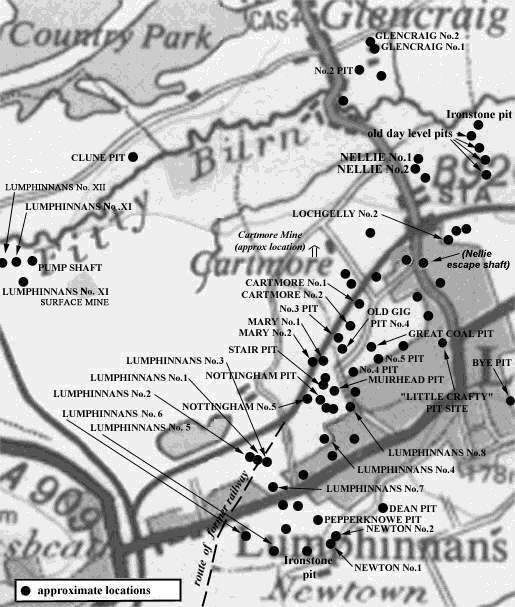
The Cartmore Nos. 1, 2 were two early Lochgelly pits (ca 1825) located a little over ¼ mile to the east of Wester Cartmore farm, to the north-west of Lochgelly, beyond the main railway line. Cartmore No. 1 Pit was a few hundred yards to the north of No. 2 Pit which is believed to have been sunk to the Fourteen Feet Coal at a depth of 20 fathoms.
 |
 |
------------------------------------
"The Scotsman"
4 March, 1826
COAL IN FIFE TO BE LET.
THE COAL in the LANDS of CARTMORE, situated within half a mile of
the village of Lochgelly, is to be LET, for such term of years as may
be agreed on. For particulars application may be made
to James Syme, overseer of the Kelty Coal.
Feb. 28, 1826.
------------------------------------
"The Scotsman"
14 November, 1829
LANDS IN FIFE FOR SALE.
... 2. The ESTATE of CARTMORE, in the same parish [Ballingry], extending to 216½ imperial acres, in old Grass, with Mansion House, &c., and seams of Coal, which have lately been wrought to a considerable extent. By Mr Wood's report, the value of the property, exclusive of the coal, is estimated at £6253 2s 5d, and the coal is valued by Messrs Geddes and Bald at £1500. Upset price £4500. ...
------------------------------------
"Fifeshire Journal"
14 December, 1833
COAL.
JOHN HENDERSON begs leave to intimate to his Friends and
the Public, that he has enlarged the weight of LOCHGELLY
and CARTMORE COAL, from 21 to 28 Stones per Load, which he
is still selling at the former low prices, viz:-
SPLINT GREAT -------------------- 10d, per Load
Do. CHEWS
------------------- 7½d, do. do.
PARROT GREAT ------------------- 10d,
do. do.
CHARCOAL ---------------------- 10½d. per Standard
Boll.
The Splint Coal for Durability, Cleanliness, and Economy, is surpassed by none in Scotland. It is most excellently adapted for Family purposes, Bakers, Brewers, and the generation of Steam, & c., being quite free from Sulphur, and never given to Clinker.
N.B. -- Carters will be furnished with Cards,
attested by the Hill Grieve, for shewing the quantity or
weight of coals to be delivered by them.
Lochgelly House, December 2, 1833.
| See also Lochgelly Pits and Mines
entry
for general colliery information. |
|---|
