Owners:
probably Beath and Blairadam Colliery Company
Fife Coal Company
Records reveal that coal had been worked around the Kelty
area from 1572, when Lord William Douglas of Loch Leven was
granted a Feu Charter to Kelty Heugh Colliery by the
Commendator of Dunfermline Monastery. Documents apparently
reveal the Colliery was old, having belonged to the Monastery
for many years. Kelty Heugh was in the then estate of
Cocklaw.
The Cocklaw area is just to the south-west corner of Kelty
village and several small working pits are known to have
still been in existence here during the mid-late nineteenth
century.
Opencast working of the Cocklaw area took place in the
twentieth century (see final note).
 |
 |
 |
 |
After 1856, into the later decades of the nineteenth century, the number of pits in and around Kelty mushroomed at an amazing rate.
Kelty Colliery (19th century report)
| Name of Coal | Thickness | Quality | Class | |||
|---|---|---|---|---|---|---|
| Main Coal | Roof Coal | > | 1 ft. 10 in. | > | Good | Bunker Coal |
| Good Coal | > | 4 ft. 8 in. | > | |||
| Jersey Coal | Coal | > | 2 ft. 6 in. | > | Good | Steam |
| Stone | > | 2 ft. 4 in. | > | |||
| Coal | > | 3 ft. 8 in. | > | |||
| Bank Coal (Lochgelly Splint) | 4 ft. 5 in. | Good | Steam and 2nd class
Household |
|||
| Dunfermline Splint Coal | 4 ft. 7 in. | Good | Best Household | |||
Several of the old Kelty coal pits in this north-west corner of Fife were owned by Beath and Blairadam Colliery Company and were purchased around 1872 by the then newly-formed Fife Coal Company. The principal manager of the Company, Mr. Charles Carlow, recognised that some of the coal seams being worked at some of the Kelty pits were of poor quality and that there was definite evidence that these coals were not doing the reputation of the Fife Coal Company any favours. In 1874, he made the decision to close all the Company coal pits in the Cocklaw area.
| At this stage of our research, we do not know if
the closures at Cocklaw included one pit, or several
pits, in the area.
M. Martin & Webmasters |
|---|
Information on coals worked at, or near, the Cocklaw Pit, Kelty
(based on reports from 1900-1934)
South of Cocklaw Farm, to the south-west of Kelty, the
Dunfermline Splint Coal seam was split by a sandstone bed
into an upper 2 ft. leaf and a lower 6 in. leaf. It was
underlain by about 18 fathoms of whinstone which appeared at
the surface in Whitehouse Wood and on Thornton Farm to the
south of Cocklaw. In the neighbourhood of Cocklaw Farm, the
Five Foot Coal was sooty near its pavement and it measured
about 4 ft. 9 in. thick, including a brown stone parting. At
the south end of the West Kelty coal-field, the Mynheer Coal
seam was rather thin measuring only 2ft. 5 in. at Cocklaw and
Keltyhill Farms.
The Dunfermline Splint was apparently almost exhausted from
the West Kelty field by 1900 and the coal seam was found to
be burnt to the east of Blackhall, and in a 'dook'
(an inclined roadway) south of Mossgreen, foul coal was also
encountered. Powerful dislocations were encountered in this
area. One ran in a north-westerly direction between Hilton
and Shiells and had a downthrow of 16 fathoms to the
south-west. Another, having a similar trend, increased
greatly in its amount of displacement as it went
south-eastwards, until it had a throw of 40 fathoms to the
south-west. Another important fault ran in a nearly east and
west direction from Netherton to Cocklaw, and threw down the
strata 25 fathoms to the south, thereby bringing the crops of
the coals back again further west.
The identities of the three old coal pits in the vicinity of
Blackhall and Mossgreen (see map) are not known at the
present time.
-----------------------------------------------
"The Scotsman"
Wednesday, 26th June, 1850.
This issue carried an announcement that the Estate of
Cocklaw, Kelty, including the lands of Lassodie, part of
Windyedge, and the superiority and feu-duties of the village
of Oakfield, Kelty, was up for sale; all belonging to the
sequestrated estate of Mr James Moodie, deceased.
Some information on the minerals on the estate was
provided:-
" ... There are Six or Seven Seams of COAL on the Lands of Lassodie, which Mr D. Landale, Mining Engineer, reports to be of considerable value, and there is also a Small Field of BLACKBAND IRONSTONE, which being associated with a thin wild Coal, could be wrought at a moderate expense. ... "
-----------------------------------------------
Cocklaw Opencast
A small area of Glassee Coal to the south-east of the
Cocklaw site (see above map) had been opencasted prior to
1945 but the area was extensively opencasted not long after
this when the overburden was removed to expose the Five Foot
Coal by the largest dragline excavator in use at the time.
The excavator was built by an American firm, the Monaghan
Engineering Company, which gave it its nickname MONA.
It had previously worked around the Capledrae area to the
east of Lochore and, instead of dismantling it for transport
to the Cocklaw site, it was decided to make it 'walk'
to work!
The machine was not mounted on caterpillar tracks like its
smaller predecessors, but moved forward on a sliding carriage
lifted, then lowered, by large surface area 'feet'
which were actuated by hydraulic jacks. The forward motion
was described as 'walking' but it was more like a
waddle!
A track was cleared in front of it and it 'walked'
along the side of Loch Ore, over the railway at Benarty,
through Blairadam park to its operating place at Cocklaw.
MONA was quite a celebrity and drew large crowds to
witness its progress to Cocklaw.
[Harry Adamson (Cowdenbeath) was on leave when he saw it
passing through Maryburgh.]
The timescale for this opencasting was around 1945 -1947;
then MONA 'walked' on to a larger opencast
site at Lassodie and Loch Fitty.
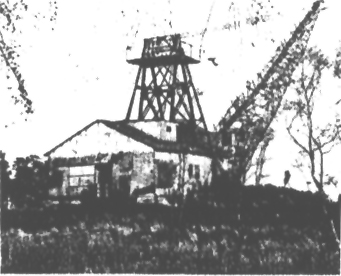 |
Mona, 360-ton mechanical navvy, a working girl at the Fife opencast sites, has been on the job for 5 years and when she moves from one site to another, she travels on her own big - 24 foot long - 'feet'.
