A large number of ironstone and coal workings are known to have operated in and around Cowdenbeath from early times.
Extract from the Statistical Account of Scotland - Beath Parish (1796)
"... There is only one coalliery in the parish at present, belonging to John Symes, Esq.; of Cartmore; several other seams of coal have been wrought formerly, and may still be wrought, as most of the ground seems to contain that mineral. ... "
Extract from the Statistical Account of Scotland - Beath Parish (1836)
"... At present there are three collieries in operation in the parish. ..."
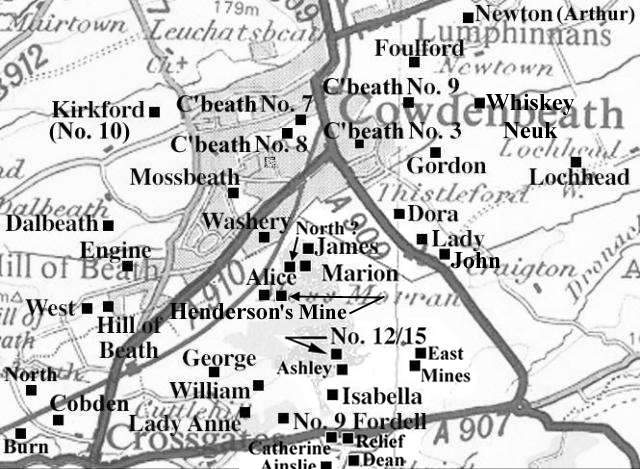
From research and records, we can indicate the existence of the following pits or mines close to this important mining town:
Cowdenbeath Nos. 1, 2, 3, 4, 5 , 6, 7, 8, 9, 10 (Kirkford); Mossbeath Nos. 1, 2; Foulford Nos. 1, 2, 3 (ironstone); Foulford Nos. 1, 2 (coal); Washing Sink No. 1; Blackdean No. 5; Pepperknow Nos. 4, 6; Dean; Wingate's
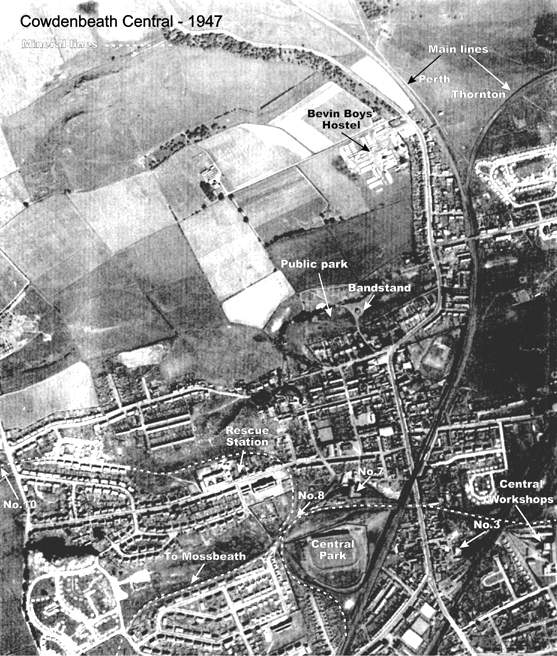
Many of these listed pits or mines are identified on maps or aerial views while some locations still require verification.
 |
 |
 |
 |
 |
 |
Early Coal Operations at Cowdenbeath
By 1840, the flourishing coal pits of Kelty, Lochgelly,
Donibristle, Fordell and Hill of Beath surrounded the small
town of Cowdenbeath. Within the area, which later became the
Burgh of Cowdenbeath, there was little mining activity.
Gibbon, of Hill of Beath, and the Symes, of Cartmore, had
opened small pits in the vicinity of Jubilee Park at the
southern border of the Burgh, and other small pits appear to
have been worked in the vicinity of Union Street.
However, the situation was about to change when (contrary to
earlier speculation) the Oakley Iron Company proved the area
was rich in iron and coal. The opening of the
Dunfermline-Thornton railway, via Cowdenbeath, in 1848,
enhanced the prospects for mining and pits were literally
sunk in every corner of the area, primarily for ironstone,
but when this became uneconomic around the late 1870s, for
coal alone.
Forth Iron Company took over Oakley Iron Company around 1860
then amalgamated with the Cowdenbeath Coal Company in 1872.
When the Fife Coal Company took them over in 1896, the
Cowdenbeath Coal Company's pits were listed as:
Lumphinnans Nos. 1, 2, 7, 11; Cowdenbeath Nos. 3, 7, 9;
Foulford No. 1 and Mossbeath.
We are fairly certain about the location of these and
subsequent pits. However, because of the acceleration in
activity, company name changes from 'Iron' to
'Coal', and mergers between 1850 and 1896, it is
difficult to positively identify the locations of the
Cowdenbeath Nos. 4, 5, and 6.
While we have a programme of ongoing research, we would be
grateful for information on the precise location of these
pits.
Such was the upsurge in mining activity that the population
of Cowdenbeath doubled (4,000 - 8,000) in the ten years
between 1890 and 1900 and gave rise to the nickname
'Chicago of Fife'.
| A range of information on a named pit or mine, including opening/closing dates, exact location, photographs of workings, details of shaft depths, descriptions of coal seams worked/abandoned, points of historical and/or social interest, etc., will be present in an individual index entry but general information pertaining to the colliery which is often difficult to allocate to an individual pit or mine, is reported in this general entry to which reference will be made from the individual index entries. |
|---|
| Source Date of Information (Owner) |
|---|
| Manager / Under-Manager / Men underground / Men above ground [Pit/Mine] / Coal seams worked |
| ca 1796 (John Symes, Cartmore) |
| 1832: July - (Wm. Thomson, Esq., Stevensonbeath) |
| ca 1836 (Gibbon, Hill of Beath; J. Symes, Cartmore) |
| A. S. Cunningham, of the Dunfermline Press, at a lecture delivered in the Co-operative Hall, Cowdenbeath, on 15th October, 1902, mentions the sinking of two shafts (exact locations not known) to the Blawlowan Coal near the White Threshes farm opposite Cowdenbeath Labour Club in the vicinity of Jubilee Park. The sinkings, accompanied by problems with water, were taken over by Gibbon who apparently worked a four-horse gin on the Gig pit which is believed to have employed around 22 miners. Parrot Coal and other seams are reported to have been identified in a bore at a Cowdenbeath inn. |
| 1840 (Francis Wright) - Cowdenbeath Colliery |
| 1842 (Francis Wright & Co.) - Cowdenbeath Colliery |
| [From Dunfermline Register] |
| 1850 (Oakley Iron Co.) - Cowdenbeath Colliery |
| 1851-1855 (Forth Iron Co.) - Cowdenbeath Colliery |
| James Ferrie,
Manager
[From Dunfermline Registers] |
| 1856-1859 (Forth Iron Co.) - Cowdenbeath Colliery |
| William Ferrie,
Manager
[From Dunfermline Registers] |
| 1861 (Forth Iron Co.) - Cowdenbeath Colliery |
| Mr James Ferrie,
manager, Forth Iron Works,
moved to take up a similar situation at Monklands Steel
and Iron Company. Mr Ferrie had been manager at the Forth Iron Works for the last 15 years. |
| 1867 (Forth Iron Co.) - Cowdenbeath Colliery |
| 31-year-lease of
Cowdenbeath coalfields to Archibald Smith-Sligo of
Inzievar -
lease expires Martinmas 1896 |
| 1869 (Forth Iron Co.) - Cowdenbeath Colliery |
| William Moodie, Manager |
| 1870 - 1895 (Cowdenbeath Coal Co. - formed 1870) |
| T. Drummond, Manager 1870 [From Dunfermline Register] |
| Henry Mungall, Manager 1870-73 |
| William Moodie,
Manager 1874-75
Departed post - March, 1875, to Townhill Colliery. Mr. Richard Nisbet, manager, 1875-77. W. Moodie returned March, 1877, to vacancy created by departure of Mr. Nisbet. W. Moodie departed post - July, 1880, to New Devon Colliery, Alloa. Sadly killed (56 years of age) in an accident at Furnace Bank Pit on 5 January, 1881. (Newspaper report available on request.) Thomas Moodie, eldest son of the late manager, certificated manager at Leven Colliery, considerately appointed manager at Furnace Bank Pit. |
| February, 1884: Mr. William Hynd, oversman, leaving to fill a similar situation at Fordell Colliery. |
| March, 1887: Mr. Henry Mungall nominated a member of the Council of the Mining Institute of Scotland. |
| 4 February, 1891:
Mr. Smith-Sligo, a partner in the Cowdenbeath Coal Co.,
died. He was also proprietor of the Inzievar estate to the west of Dunfermline. |
| 1893: David Anderson, manager. |
| 1896 (Fife Coal Co. - formed 1873 - merges with Cowdenbeath Coal Co.) |
| D. Anderson / ------------ / 638 / 195 [Cowdenbeath Colliery] |
| Gas, household, manufacturing and steam coals. |
| 1902 (Fife Coal Co.) |
| John Clark / ------------ / 614 / 240 [Cowdenbeath Colliery] |
| Gas, household, manufacturing and steam coals. |
| 1904 (Fife Coal Co.) |
| James Holmes / ------------ / 291 / 194 [Cowdenbeath Colliery not including No. 10] |
| Gas, household, manufacturing and steam coals. |
| W. E. Richardson / ------------ / 404 / 68 [Cowdenbeath No. 10] |
| 1905 (Fife Coal Co.) |
| James Holmes / ------------ / 247 / 173 [Cowdenbeath Colliery not including No. 10] |
| W. E. Richardson / ------------ / 350 / 66 [Cowdenbeath No. 10] |
| 1906 (Fife Coal Co.) |
| James Holmes, Manager |
| 1908 (Fife Coal Co.) |
| W. E. Richardson / ------------ / 258 / 61 [Cowdenbeath Colliery not including No. 10] |
| James Gavin, jnr. / ------------ / 532 / 97 [Cowdenbeath No. 10] |
| 1911 (Fife Coal Co.) |
| ---------- / ------------ / 280 / 51 [Cowdenbeath Colliery not including Nos. 7, 10] |
| ---------- / ------------ / 587 / 121 [Cowdenbeath Nos. 7, 10] |
| 1918 (Fife Coal Co.) |
| Andrew Scott [Foulford Pit] : David Scott [No. 9 Pit] / 289 / 82 [Cowdenbeath Colliery not including Nos. 7, 10] |
| George S. Christie / John Alexander / 347 / 147 [Cowdenbeath Nos. 7, 10] |
| 1920 (Fife Coal Co.) |
| ---------- / 361 / 111 [Cowdenbeath Colliery not including Nos. 7, 10] |
| ---------- / ---------- / 414 / 179 [Cowdenbeath Nos. 7, 10] |
| See individual Cowdenbeath/Foulford entries in Central Fife Index for specific pit information. |
| It would appear from
abandonment plan records that the nine numbered pits of
Cowdenbeath Colliery were in existence by around 1871.
Little information (other than location and the fatality
reported later) is available on Cowdenbeath No. 1 Pit
which may have ceased coaling by 1869.
Any information on Cowdenbeath No. 2 Pit, whose location is known, will also be made in this general entry. There is also little known about the Cowdenbeath Nos. 4, 5, 6 Pits which may have either been abandoned as being unprofitable soon after sinking or were simply ironstone pits which ceased operations when there was no longer demand for iron. The greater contributions of the Cowdenbeath Nos. 3, 7, 8, 9 and 10 to coal mining in this area are recorded in separate entries. |
Cowdenbeath Colliery (19th century report)
| Name of coal | Thickness | Quality | Class | |
|---|---|---|---|---|
| Lochgelly
Splint and Parrot Coal |
Foul | 2 ft. | not stated | - |
| Splint | 5 ft. | not stated | - | |
| Fire-clay | 1 ft. | not stated } | Household coal | |
| Coal | 9 in. | not stated } | ||
| Parrot | 2 ft. | not stated | Gas coal | |
| Coal | 1 ft. 3 in. | not stated | Household coal | |
| Mynheer Coal | 4 ft. 6 in. | not stated | Steam and household | |
| Five Foot Coal | 5 ft. | not stated | Steam and household | |
| Dunfermline Splint Coal | 5 ft. | not stated | Household coal | |
COAL SEAMS WORKED IN THE COWDENBEATH AREA
Note: Seam characteristics vary over the area and will be
dealt with in additional information under individual pit
listings.
[Table kindly prepared by Harry Adamson, Cowdenbeath.]
| GROUP | SEAM NAME | LOCAL NAME | QUALITY | AVERAGE
THICKNESS Ft |
AVERAGE
DEPTH Ft |
| BLAIRHALL | Cardenden Smithy | Poor | 2.0 | 114 | |
| Lochgelly
Black
Band Ironstone |
1.5 | 180 | |||
| Little Splint | Good | 3.0 | 204 | ||
| Rough | Poor | 6.0 | 228 | ||
| MAIN | Kelty Main | Fourteen Foot | Good | 7.0 | 348 |
| Upper Jersey | Diamond | Good | 3.0 | 378 | |
| Lower Jersey | Diamond | Fair | 5.0 | 408 | |
| Swallowdrum | Duddie Davie | Good | 3.0 | 438 | |
| Lochgelly
Splint
& Parrot |
Good | 12.0 | 510 | ||
| DUNFERMLINE | Glassee | Blawlowan | Good | 6.0 | 624 |
| Mynheer | Good | 5.0 | 684 | ||
| Jewel | Fair | 2.0 | 720 | ||
| Five Foot | Good | 5.0 | 750 | ||
| Two Foot | Wee | Good | 2.0 | 792 | |
| Dunfermline Splint | Good | 4.5 | 810 | ||
| Stink or Sulphur | Poor | 2.0 | 882 |
--------------------------------------
Cowdenbeath No. 2 Pit
| Source Date of Information Supplied | |
|---|---|
| Manager / Undermanager / Men underground / Men above ground / Coal seams worked / Shaft Details | |
| 1869 (Cowdenbeath Coal Co.) | |
| 1873 (Cowdenbeath Coal Co.) | |
| Henry Mungall / ---------- / --- / --- / Splint, 4 ft. 4 in.; 5 Feet, 5 ft. 6 in. / D/cast 480 ft. : U/cast 480 ft. | |
| 1874 (Cowdenbeath Coal Co.) | |
| William Moodie / ---------- / --- / --- / Splint, 4 ft. 4 in.; 5 Feet, 5 ft. 6 in. | |
| 1875 (Cowdenbeath Coal Co.) | |
| Richard Nisbet / ---------- / 78 / 20 / Splint, 4 ft. 4 in.; 5 Feet, 5 ft. 6 in. | |
| 1876 (Cowdenbeath Coal Co.) | |
| Richard Nisbet / ---------- / 71 / 20 / Splint, 4 ft. 4 in.; 5 Feet, 5 ft. 6 in. / D/cast ----- : U/cast 480 ft. | |
| 1877 (Cowdenbeath Coal Co.) | |
| William Moodie /
---------- / 98 / 27 / Splint, 4 ft. 4 in.; 5 Feet, 5 ft.
6 in. / D/cast 480 ft. : U/cast -----
Ventilation fan at No. 3 Pit. |
|
| 1878 (Cowdenbeath Coal Co.) | |
| William Moodie / ---------- / 83 / 20 / Splint, 4 ft. 4 in.; 5 Feet, 5 ft. 6 in. | |
| 1879 (Cowdenbeath Coal Co.) | |
| William Moodie / ---------- / 83 / 20 / Splint, 4 ft. 4 in.; 5 Feet, 5 ft. 6 in.; Mynheer | |
| 1880 (Cowdenbeath Coal Co.) | |
| Davey Thomas / ---------- / 78 / 22 / Splint, 4 ft. 4 in.; 5 Feet, 5 ft. 6 in.; Mynheer | |
| The Cowdenbeath No. 2 Pit appears to have closed March, 1881. | |
Plans of Abandoned Seams & DatesNote: abandonment dates do not relate to individual pit closures but to the abandonment of seams which had ceased to be worked. Not worked for a period of time, it was quite normal for some coal seams to be re-opened for working at a later date or at a different location. |
|---|
| Plans of Abandoned Seams for Cowdenbeath | Pits or Mines designated in Plans |
|---|---|
| COAL; Lochgelly Splint; Parrot.
IRONSTONE (1850-74) |
COWDENBEATH Nos. 4, 5, 6, 7, 8, 9
and FOULFORD Nos. 1, 2, 3 |
| COAL; Lochgelly Splint (24 March, 1859); Dunfermline Splint (15 April, 1876); Five Feet (October, 1876); Mynheer (23 March, 1881) | COWDENBEATH
No. 2 |
| IRONSTONE (September, 1871) | COWDENBEATH Nos. 4, 5, 6, 7, 8
and FOULFORD Nos. 1, 2, 3 |
| COAL; Fourteen Feet (1871) | COWDENBEATH
No. 3 |
| COAL; Lochgelly Splint; Parrot (1871) | COWDENBEATH
Nos. 2, 3, 8, 9 |
| COAL; Lochgelly Splint (8 November, 1867); Dunfermline Splint (10 July, 1892); Five Feet (12 October, 1893); Mynheer (27 January, 1897) | COWDENBEATH
No. 3 |
| COAL; Lochgelly Splint; Parrot (1896) | COWDENBEATH
No. 9 |
| COAL; Lochgelly Splint (August, 1903); Mynheer (31 July, 1906); Fourteen Feet (5 May, 1909); Glassee (2 February, 1911); Jewel (1 February, 1921); Dunfermline Splint (22 January, 1924); Five Feet (21 July, 1927) | COWDENBEATH No. 9 AND FOULFORD |
| COAL; Dunfermline Splint (August, 1907); Lochgelly Splint (May, 1913); Glassee (August, 1914); Five Feet (November, 1919); Wee (February, 1922); Mynheer (21 January, 1926) | COWDENBEATH
No. 7 |
| COAL; Dunfermline Splint (19 January, 1921); Lochgelly Splint (12 October, 1922) | COWDENBEATH
Kirkford No. 10 |
| COAL; Wee (November, 1923) | COWDENBEATH
No. 9 |
| COAL; Fourteen Feet (1924) | COWDENBEATH
No. 7 |
| COAL; Diamond; Swallowdrum (7 March, 1925) | COWDENBEATH
No. 9 |
| COAL; Main or Fourteen Feet; Diamond; Glassee; Mynheer; Jewel; Two Feet (18 August, 1927); Five Feet (19 December, 1927) | COWDENBEATH
No. 7; Kirkford No. 10; Mossbeath No. 1 |
--------------------------------------------
"The Scotsman"
28 July, 1832
COAL IN FIFE TO LET.
TO BE LET,
THE COALFIELD of COWDEN BEATH, for such number of years as may be agreed upon.
The Coalfield is of very considerable extent, and is known to be of good quality; the local
advantages are numerous, it lies alongside the great North Road, is distant from Burntisland
six miles, and from Kinross eight miles. The Coal is drained by a steam engine, and the
aggregate thickness of the seams is twenty-five feet.
Entry to the premises may be had immediately, or at Martinmas next.
Farther particulars may be learned from Wm. Thomson, Esq. of Stevensonbeath, the Proprietor,
near Blairadam Inn.
--------------------------------------------
"Dunfermline Monthly Advertiser"
1st August, 1836
COWDEN-BEATH COAL
Mr. Gibbon begs to announce that the
Cowdenbeath Colliery is now in full operation;
and as the COAL is satisfactorily ascertained to be of the
very best quality, he hopes to be favoured with a share of
public favour.
The Coal is well known to burn cheerfully, and to produce
good Coke, and not to clinker, or do injury to Furnace-bars;
it is quite free of Sulphur, and is in high estimation for
Breweries, Potteries, Distilleries, Bakers, &c.
Mr. Gibbon being determined to give every
encouragement to Buyers, has fixed the Price of the GREAT
COAL at Five Shillings per ton, and of the CHEWS at Three
Shillings and Ninepence per ton; and to those sending from a
distance, a Certificate of Weight will be sent to prevent
fraud.
Cowdenbeath Colliery, 1st August, 1836.
--------------------------------------------
In a letter to Mr John Watson, Esq., Edinburgh Gas Light Company, on 10 October, 1836, Mr Gibbon wrote:-
"As regards the proposed Security - nothing can be more
complete, independent of the recent valuable erections, the lease
includes Iron Stone, of which there is vast abundance and so excellent
in quality that the Carron Company have offered to pay a high price for
all that can be taken to Bank. Further the Lands also contains perhaps
the only good Smithy Coals in Scotland; and the Seams of Common
Coal - similar to Sir P. C. H. Durham's, are of the alternate thickness
of 9, 4, 5½ & 6½ feet. Hence as may readily be imagined
I would not dispose of my Lease for a large sum p annum; and consequently
that I would Scarcely jeopardize so valuable a certain (?) .... coming under
any engagement that the Stipulations of which I had the least doubt of
fulfilling. The agreements will be made with the Concurrence of my
Landlord, and, in order that I may shortly be governed in the negotiations
with other parties, it becomes necessary that this proposition be either
entertained or rejected as soon as possible being in Correspondence with
Gas Company in London.
I remain yours."
Robert
Gibbon
CowdenBeith Colliery.
[We are very grateful to Bill Cochrane, Canada, for the letter content.
Michael Martin & Webmasters.]
--------------------------------------------
"Dunfermline Monthly Advertiser"
3rd September, 1839
Cowdenbeath Colliery - THE New Seam of Cowdenbeath COAL is
now open. ...
The Cowdenbeath Coal Company confidently recommend this Coal
to Farmers and others laying in their winter store, as being
both economical and excellent for household purposes.
The Hill is close by the high road, near Cowdenbeath Inn.
24th August, 1839.
--------------------------------------------
"Fifeshire Journal"
17 September, 1840
BEATH
A SEAM OF COAL has just been discovered here, rented by Mr Wright of Edinburgh, which, for general purposes is said to be superior to any yet found in Scotland. It consists of alternate layers of splint and cherry of the very finest quality, together with a foot of parrot, or gas coal, on the bottom of the seam, which, for quality and yield, is not to be surpassed. Besides possessing the caking quality of the English coal, it has the free burning quality of the Scotch, is perfectly free from dust and sulphur, and has a very strong heat, rendering it useful for all domestic purposes.
--------------------------------------------
"The Scotsman"
25 February, 1843
LEASE OF COWDENBEATH COLLIERY.
FOR SALE.
THE BENEFIT of a LEASE, of which upwards of thirteen years
have yet to run, of VALUABLE SEAMS of COAL in the LANDS of
COWDENBEATH, County of Fife. The Lands are situated about six
miles from the Town of Dunfermline, and five miles from the Harbour of
Inverkeithing. The Soft Coal has been wrought to some extent; and,
according to the opinion of an experienced Engineer, a productive Seam
of Splint Coal will certainly be got at a moderate depth. A Railroad has been
commenced, which will pass through the Lands, and within a few yards of the
Workings, to the Harbour of Inverkeithing; and by this means the large profit,
at which it has been estimated the Coal could have been previously wrought,
will be greatly increased. Almost all the requisite Machinery, &c., is
already at the Works, and can be had at a valuation.
For farther particulars, apply to James Drew, writer, 15 Buchanan Street,
Glasgow, who will treat with intending purchasers.
Glasgow, 22d Feb. 1843.
--------------------------------------------
"Fifeshire Journal"
30 August, 1849
On Wednesday forenoon while Mr Begg, factor for
the Cowdenbeath and neighbouring collieries was superintending the
transit of the coal trucks, he was accidentally thrown down, and
his legs got under one of the trucks, which fractured them so
severely that he never rallied.
Professor Lizans was instantly sent for, by
express to Edinburgh, and arrived a few hours after the accident,
but we regret to say that before this Mr Begg was no more. We are
sorry to add that Mr Begg has left a family entirely orphans, Mrs
Begg having died some time ago.
--------------------------------------------
"Dunfermline Journal"
May, 1853
At the Cowdenbeath coal-pit, on Saturday week, a man named Michael Doran, whose duty was to put tubs upon the cages at the pit bottom, and to fasten them with a catch, and then to ring a bell at the pit head, which is done by means of a wire that runs from the pit head to the bottom (the ringing of the bell is to let the man in charge of the engine know when to put it in motion), was in the act of putting the tub into the cage, when, by some accident or other, the tub got off the rails, which occasioned delay. The engineer thinking the bell had rung, put the engine in motion, and lifted the cage before the hutch was properly fastened. The hutch fell out of the cage upon Doran, and cut and crushed him severely. He has since been attended by the Company's doctor, and is thought to be dangerously hurt.
--------------------------------------------

Beath - Colliery Accident at Cowdenbeath
29 November, 1853 : 5 lives lost.
Campbell's Fife Deaths: 1822 - 1854
The Colliery, where five men lost their lives when the rope broke and sent them down the shaft to their death that fateful day, was the property of the Forth Iron Company. The men killed are listed below:
1) Edward Shepherd.
2) David Miller, native of Coaltown of Balgonie.
3) James King, aged 19.
4) and 5) Two young brothers - unmarried men - named Campbell, natives of Baintown, near Kennoway.
The sources of this information appear to have been the " Fife Journal" December 1, 1853 and "Fifeshire Advertiser" and "Stratheden Advertiser" of 3 December, 1853.
| Note: In the present day, this would be listed as a disaster i.e. when five, or more, lives are lost. |
--------------------------------------------------
"DUNFERMLINE MONTHLY ADVERTISER"
July, 1858
On Thursday week, Francis Graham, a miner, while employed in one of the ironstone pits here, a portion of the roofing fell in upon him, and broke one of his legs. He still suffers under the effects of the accident.
--------------------------------------------------
Supplement: "Dunfermline Saturday
Press"
13 April, 1861
We learn that the Forth Iron Company have paid off the miners and others employed at two of their pits, the one a coal and the other an ironstone pit, in the locality. About 100 men will thus be thrown idle. The miners employed by the Lochgelly Company have also had their output reduced. They have been instructed not to work for more than 2s. per diem. Thus it will be seen that the prospects of trade in this locality are far from cheering.
--------------------------------------------------
"Dunfermline Saturday Press"
14 March, 1868
On Saturday morning, an accident, unfortunately attended
with fatal consequences, occurred on what is termed a "
wheel-brae", which leads from a siding east of
Cowdenbeath Station, a place between No. 1 and No. 2 of the
Cowdenbeath coal pits belonging to the Forth Iron Company.
The coals from these two pits are brought up from the
pitheads to the siding in waggons by ropes worked by means of
steam-power. Some waggons were fastened on Friday evening,
and were being brought up early on Saturday morning, when the
accident occurred.
A man named Robert Reid was at the time proceeding up the
"wheel-brae", and having noticed the rope moving,
he was crossing the line, when his feet were caught by the
rope and he fell. The engineman noticed the man, and
endeavoured to stop the train, but before that was effected
two waggons loaded with coal had passed over the man's
body, which was so fearfully mutilated, and the injuries
otherwise sustained were so serious, that death was
instantaneous.
Deceased has for some time back been a dealer in small
wares. It is supposed that he resided in the village of
Scotlandwell, parish of Portmoak, Kinross.
--------------------------------------------------
"Dunfermline Saturday Press"
11 September, 1869
On Wednesday morning an accident occurred in No. 2 Pit of
the Cowdenbeath Colliery Co., whereby a miner named Alexander
Hunter was so seriously injured that he died that same
evening. It appears that the poor man was engaged at his work
about seven o'clock in the morning, when a large stone
fell upon him from the roof, injuring him severely about the
back and lower parts of the body. He was immediately taken
home, where medical assistance was procured, but he never
rallied, and died about nine o'clock. Hunter was a
middle-aged man, and had a grown-up family. The cause of his
death is undergoing investigation by the police.
[Another source indicates that Hunter was 50 years of
age.]
--------------------------
"The Scotsman"
13 September, 1869
COWDENBEATH - FATAL PIT ACCIDENT.
An accident of a fatal nature occurred to a miner, named Alexander Hunter, in No. 2 Pit of Cowdenbeath Colliery, on Wednesday last. He was seated waiting until the road was cleared of rubbish to let him get on with his work, when a stone fell from the roof and struck another man standing by on the arm, and knocked the bonnet off his head. Hunter was immediately taken home, when medical assistance was procured; but he never rallied, and died about twelve hours after receiving the stroke. He was a middle-aged man and has a grown-up family. Drs Dewar and Mungall made a post-mortem examination of the body.
--------------------------------------------------
"Dunfermline Saturday Press"
12 February, 1870
On the morning of Wednesday last, while Joseph Dawson and Archibald Hodge, pit sinkers, were engaged in boring a piece of rock in No. 2 Pit of the Cowdenbeath colliery, an explosion took place whereby Dawson was severely injured, and Hogg had a narrow escape. It appears that they had charged this rock with gunpowder on Tuesday evening, but from some cause it did not explode, and after it being left all night, they considered there was no danger, and accordingly went to bore it out on Wednesday morning, and it is conjectured that the friction of the boring instrument caused the powder to explode. Dawson was much cut in the face near the right eye, and his left hand is so severely injured, that one of the fingers has since been amputated by Dr. Mungall, of Foulford. Hodge, although much stunned and shaken at the time, escaped with only a few bruises, and was able to resume his work on the following day, but Dawson still lies in a dangerous condition.
--------------------------------------------------
"Dunfermline Saturday Press"
3 September, 1870
On Thursday morning, while a brusher, named C. McLean, was engaged in No. 2 Pit, Cowdenbeath Colliery, a large stone measuring about nine feet long, and of considerable breadth, suddenly fell from the roof upon his back, and bruised him considerably. He was attended to by Dr. Mungall, and he is now progressing favourably.
--------------------------------------------------
"Dunfermline Saturday Press"
10 September, 1870
On Thursday forenoon, an accident occurred in the underground workings of No. 2 Pit, Cowdenbeath, to a miner named Robert Watters, sen. He was repairing the roof of a road near the coal face, when a large quantity of stones and rubbish came away and almost smothered him, whereby he was cut in the face and otherwise severely bruised about the body. He called out and got assistance when he was taken home and attended by Drs. Neilson, of Lochgelly, and Mungall, Foulford, who dressed his wounds.
--------------------------------------------------
"Dunfermline Saturday Press"
2 December, 1871
COWDENBEATH - NEW MINERAL FIELDS
The minerals on the extensive estate of Blairadam have been leased for working to Messrs. Adie & Sons of Langloan Iron Works, Airdrie. Boring operations are to be completed as soon as possible.
--------------------------------------------------
"Dunfermline Saturday Press"
2 March, 1872
LOCHGELLY - A NEW COMPANY
It is reported that the mineral fields situated in Cowdenbeath, and for many years wrought by the Lochgelly Iron Company, are about to change hands. The original partners being all dead some years ago, the works have been superintended by trustees, and a new company, on the limited liability principle, has been formed, with a view to taking a new lease of the minerals.
--------------------------------------------------
"Dunfermline Saturday Press"
22 June, 1872
A very serious accident happened on Thursday evening at one of the pits here, belonging to Cowdenbeath Coal Company. While the engineman was in the act of drawing a man from the bottom, the pulley wheel fell suddenly from its position, and struck against, and broke, one of the steam pipes. The steam in the whole of the boilers rushed out with a terrible noise, but strange to say the man in the pit was unhurt; and beyond the loss of the broken steam pipe little damage was done. It will take some time to set the pipe in going order again, and will in the meantime throw a number of miners idle for a few days. Considering the dangerous nature of the breakage, it is remarkable that so little harm was sustained. Had the pulley wheel - which is of the large size - fallen down the pit, the result would have been much more serious.
--------------------------------------------------
"Dunfermline Saturday Press"
20 July, 1872
COWDENBEATH - THE COAL TRADE
We are glad to state that the miners here have received an increase of wages amounting to 9d. per day. It is understood that the practice of advancing cash to workmen before the pay-day is to be abolished, and not before time. At Little Raith Colliery, there are 24 miners' houses in course of erection, on a good design - being arranged in blocks of four dwellings each, with wide openings between the blocks. The Cowdenbeath Coal Company are also erecting houses suitable for workmen; while Mr. Halley, of Shiresmill, is engaged in constructing about a dozen brick cottages of the same character.
--------------------------------------------------
"Dunfermline Saturday Press"
14 September, 1872
MARRIAGE
The occasion of the marriage of Henry Mungall, Esq., managing partner of the Cowdenbeath Colliery Company, Woodside House, with Miss Elder, only daughter of William Elder, Esq., chief magistrate of Leslie, which took place at her father's residence on Thursday, was celebrated with great joy at Cowdenbeath. ....
--------------------------------------------------
"Dunfermline Journal"
12 October, 1872
On Saturday last the workmen employed at Cowdenbeath Colliery gave their annual subscription towards the funds of the Royal Infirmary, Edinburgh, which amounted this year to £15, 10s 6d.
--------------------------------------------------
"Dunfermline Journal"
26 October, 1872
REDUCED PRICE OF COAL
COWDENBEATH COAL COMPANY beg to intimate, that on Monday 21st October, the following reduced prices for Coal will be charged at their Depot, Dunfermline Station:-
| Splint Household Coal, ............... | 17s 6d | per Ton |
| Five Feet Coal, ........................ | 17s 1d | " " |
| Chirls, .................................... | 14s 2d | " " |
| Small Coal, .............................. | 12s 1d | " " |
GEORGE MORRIS, Salesman.
--------------------------------------------------
"Dunfermline Saturday Press"
11 January, 1873
COWDENBEATH - MINERS
The whole of the pits here are idle, the workmen being on strike. The cause of the disagreement is connected with the Mines Regulation Act, which came into force on the 1st of this month. The Act allows the coalmasters two months to prepare special rules for their respective collieries, for the guidance and good discipline of the workmen, and provides that in the meantime the old special rules will remain in force. This delay is what the miners object to principally, and wish the new rules hung up at once. It is a pity for the parties immediately interested, as well as for the whole district and the trade of Fife, that such a trifle should cause the present unseemly disturbance.
[The ending of the strike on Wednesday 15th January was reported in the issue of 18 January, 1873.]
--------------------------------------------------
"Dunfermline Saturday Press"
25 January, 1873
On Monday last, a man named George Mitchell, an engine-keeper in the employment of Cowdenbeath Colliery Company, while in the discharge of his duty, missed his foot, and fell against a flywheel of the engine he had charge of. His arm was caught in the machinery and fearfully crushed before he could be rescued. The medical attendant for the works, Dr. Mungall, was soon procured, but could not think of interfering with the injured limb without sending the man to the Edinburgh Infirmary, where he was taken next morning. There is little chance of the arm being saved from amputation.
--------------------------------------------------
"Dunfermline Saturday Press"
6 September, 1873
Two fatal accidents have taken place this week in the district. On Wednesday evening, a man, named James Allan, was very suddenly deprived of life, at No. 2 Pit, Cowdenbeath Colliery. It appears that, between ten and eleven o'clock, he (along with other two men) was being drawn up the shaft, and when about twenty fathoms from the top he lost his balance (probably by letting go his hold of the side chains), and fell out of the cage to the bottom - a depth of about sixty fathoms. The body was brought to the top as quickly as possible, but (as in the foregoing [Henderson Pit] case) there is every reason to believe that the man was instantaneously killed. He has left a widow and three children.
--------------------------------------------------
"Dunfermline Saturday Press"
7 March, 1874
While a brusher, named James Henderson, was employed in No. 2 Pit, Cowdenbeath Colliery, on Saturday last, a large lump of blae fell from the roof of the pit, and struck him in such a manner that he sustained spinal and other injuries of a rather serious nature. He was attended by Dr. Mungall.
--------------------------------------------------
30 May, 1874
On Thursday morning, while James Baxter was employed in No. 2 Pit, Cowdenbeath Colliery, a lump of blae became detached from the roof and so caught him that he sustained fracture of the right leg, in addition to injuries about the face. He was attended by Dr. Mungall.
--------------------------------------------------
25 July, 1874
On Thursday, a brusher, named Andrew Black, got one of his feet severely crushed while employed in No. 2 Pit, Cowdenbeath Colliery, by a stone falling on it from the roof.
--------------------------------------------------
"Dunfermline Saturday Press"
27 March, 1875
COWDENBEATH - SUPPER AND PRESENTATION
On the evening of Thursday, the 18th inst., Mr. Wm. Moodie, underground manager, Cowdenbeath Colliery, was, on the occasion of his leaving for another situation, entertained to supper in Brunton's Hotel, by Henry Mungall, Esq., coalmaster ....
--------------------------------------------------
"Dunfermline Journal"
Saturday, 19 January, 1878
COWDENBEATH - FATAL ACCIDENT.
On Monday evening while Andrew Black, a servant in the employment of the Cowdenbeath Coal Company, was standing on the siding leading to the main line, a train of waggons, which was being shifted, passed over him. The accident was not observed by anyone till the mutilated body was got on the line. The deceased was upwards of 75 years of age.
Relatives have informed us that Andrew died in his own house at Cowdenbeath, the cause of death being described as follows: Fracture of the pelvis and laceration of the contents of the abdomen; and other injuries occasioned by his having been knocked down and run over by a coal train half an hour before death as certified by Dr Robert Mungall of Cowdenbeath who examined the body shortly after the occurrence.
--------------------------------------------------
"Dunfermline Saturday Press"
2 February, 1878
On Monday, while George Mitchell, engine-keeper, Foulford, Cowdenbeath, was cleaning his engine in one of the Cowdenbeath Colliery pits, he lost his balance and fell to the ground, a distance of six feet, and broke his left arm. Dr. Mungall attended the injured man.
--------------------------------------------------
"Dunfermline Saturday Press"
31 July, 1880
An accident occurred on Thursday in one of the pits belonging to the Cowdenbeath Coal Co. by which a man named Gibb had one of his legs broken. Dr. Nasmyth was sent for, who set the injured limb.
--------------------------------------------------
"Dunfermline Saturday Press"
17 February, 1883
This edition carries the news that Mr. Davie Thomas, manager, is leaving Cowdenbeath Colliery to fill a similar appointment in Yorkshire.
--------------------------------------------------
"Dunfermline Saturday Press"
4 October, 1884
Yesterday morning a remarkably sudden death occurred here. William Black, a miner, twenty years of age, had commenced work at six o'clock, and shortly afterwards became seriously ill - a blood-vessel having burst. He was promptly brought up the shaft, and was being conveyed home, but expired on the way. The deceased was a very respectable young man, and was the only support of his widowed mother, for whom much sympathy is felt in her sudden bereavement.
--------------------------------------------------
"Dunfermline Saturday Press"
19 January, 1889
We learn that Mr. James Mungall, J. P. Glasgow, one of the partners of the Cowdenbeath Coal Company, has been appointed by the Home Secretary to the Board of Examination, under the Coal Mines Regulation Act, 1887.
--------------------------------------------------
"Dunfermline Saturday Press"
2 March, 1889
Michael Reilly, a platelayer, was killed at Cowdenbeath Colliery, yesterday. He had been engaged in mining repairs on a waggon road near the coal-washing machine, when a loaded waggon approached him and knocked him down. His body was thrown across the rails, and the vehicle passed over one of his legs, causing such injuries that the man died in a few minutes afterwards.
--------------------------------------------------
"Dunfermline Saturday Press"
28 September, 1889
On Saturday last an accident of a serious nature happened to a young lad named Andrew White, whereby he had one of his arms fractured and sustained serious injury to the head. It appears that White, who is an apprentice blacksmith with the Cowdenbeath Coal Company, had been engaged cleaning rubbish from the ceiling of the shop where he was employed. Through some mistake he had lost his footing, and fell to the floor - a distance of 12 or 14 feet.
--------------------------------------------------
"Dunfermline Saturday Press"
13 August, 1892
THE COWDENBEATH COAL COMPANY, LIMITED
The Cowdenbeath and Lumphinnans Collieries are henceforth
to be carried on by the New Company known as - The
Cowdenbeath Coal Company, Limited. As referred last week,
these works were thrown in the market to the public to be
taken up by £10 shares, with the result that by Friday
when the share list closed, the money was offered four times
over. Moneyed men were rushing after shares from all parts of
the country, thinking no doubt that they could invest their
capital and derive a profit such as the old Company realised
for the past three years.
The old Company announced in their prospectus that their
average profit for the last three years was £45,825,
8s., and as so many would-be shareholders have come forward,
many of them must be rejected. The new Company are to begin
shortly to sink shafts on the Moss-side ground, a little to
the west of Cowdenbeath, and on the north side of the burgh.
A new field is to be opened up, known as Leuchatsbeath.
Proving and experimenting on these places is to be gone into,
and should they turn out favourable, the district will be in
course of time one of the busiest coal centres in the
county.
--------------------------------------------------
"Dunfermline Saturday Press"
25 March, 1893
FIFE MINERS' IDLE DAY
The employers at Cowdenbeath are doing their level best to
break up the men's fixed fortnightly holiday. These
fixtures have been tacitly recognised by the Fife coalowners
and acted upon. During the dull trade the men have relaxed
their hold on the idle day a little, and have occasionally
worked to suit the employers.
Last week, however, they stuck to their fixed idle day, with
the result that on the following morning, they were all sent
home for not working the previous day.
--------------------------------------------------
"The Scotsman"
9 May, 1893
A carriage accident occurred near Cowdenbeath on Sunday, by which Mr Henry Mungall, managing director of the Cowdenbeath Coal Company, and Chief Magistrate of Cowdenbeath, was severely injured, having been rendered unconscious.
--------------------------------------------------
"Dunfermline Saturday Press"
24 February, 1894
John Allan, a miner, was conveyed to the Edinburgh Royal Infirmary on Thursday, suffering from fractured ribs and severe internal injuries, caused by part of the roof of the pit in which he was working falling upon him.
--------------------------------------------------
"Cowdenbeath & Lochgelly Times & Advertiser"
16 January, 1895
ACCIDENT. - On Wednesday forenoon a young man named Andrew Dow met with a serious accident. Dow was employed as a joiner by the Cowdenbeath Coal Company, and was engaged dressing wood with the planing machine, when his left hand got entangled with the plane and cut off four fingers.
His fellow-workmen at once came to his assistance and took him to his father's house where he had medical attention.
--------------------------------------------------
"Dunfermline Saturday Press"
14 September, 1895
DISPUTE AT COWDENBEATH COLLIERY
OVER 100 MEN DISMISSED
A somewhat serious dispute has occurred at
Cowdenbeath Colliery. During the dull trade there was no fixed
fortnightly idle day, but some weeks ago, when work became brisk,
the men resolved that the Thursday of each alternate week should be
observed. The managing partner refuses, however, to recognise the
men's right to fix the holiday, and yesterday matters reached a
crisis.
Three of the pits were thrown idle on a day
earlier in the week, but, despite this, upwards of a hundred men
refused to go down on Thursday. When they arrived at the pitheads
yesterday morning they were prevented from entering the cages, and,
after the men who had worked on Thursday had been lowered, notices
were posted, intimating that the services of those who had deserted
the employment would be no further required, and that their tools
would be sent to the pit bank on application being made to the
oversman, and that those who were occupying colliery houses would
receive their wages on houses being vacated.
A mass meeting of the men employed at the
colliery, together with those who had been dismissed, was held at
Cowdenbeath last night. It was resolved that there should be a
complete stoppage of work today, and that a deputation of the men
should wait upon the Managing Director of the Company, and ask for
the re-instatement of the men who have been dismissed. A mass
meeting will afterwards be held to consider the reply, and decide
as to what action should be taken in the event of the Company
refusing to re-engage the men. Unless the men dismissed are taken
back by the Company, the dispute may assume a serious aspect. The
miners hold that they are entitled to have a fixed idle day; and
unless some settlement is arrived at, the whole of the men may be
advised to lodge their warnings.
--------------------------------------------------
"Dunfermline Saturday Press"
21 September, 1895
COWDENBEATH DISPUTE
This edition carried the news that a resolution to the dispute involving the 800 men at the Cowdenbeath pits had been reached on Friday night last week. Conditions offered were accepted and there was, accordingly, a general resumption of work on Monday morning.
--------------------------------------------------
"Dunfermline Saturday Press"
14 November, 1896
At an extraordinary general meeting of the Cowdenbeath Coal Company, Limited, at Cowdenbeath on Monday, the resolutions for the amalgamation of that Company with the Fife Coal Company, Limited, were unanimously adopted.
--------------------------------------------------
"Dunfermline Saturday Press"
8 May, 1897
FIFE MINERS' IDLE DAY
The miners in Cowdenbeath who had worked less than eleven days the other fortnight, and were consequently served with notices, requesting them to pay 8s. for each day off work, received a second notice from Fife Coal Company the other day, requesting them to make payment not later than today (Saturday).
--------------------------------------------------
"Dunfermline Press"
19 March, 1898
George Durham, 61 years of age, labourer, Cowdenbeath, was run down by a pug-engine, at Cowdenbeath Colliery yesterday. He was engaged emptying a waggon at an old coal-washer, and happened to step on another line of rails without noticing the approach of the pug-engine. Before he could get out of the way, he was knocked down, and the wheels of the engine passed over his legs, both of which were almost severed from the body. The unfortunate man was removed to the Dunfermline Cottage Hospital, where he died within half-an-hour after his admission.
[The issue of 9 April carried a full Report on the Fatal Accident Inquiry held on Tuesday in Dunfermline Sheriff Court into this death which occurred on 18 March, 1898, at an old coal-washer to the east of Cowdenbeath Station. Among those giving evidence were David Anderson, manager, Cowdenbeath Colliery; William Renton, above-ground manager, Cowdenbeath Colliery; Andrew Dickson, labourer, Union Street, Cowdenbeath; and, William Paterson, High Street, Cowdenbeath. The Sheriff suggested the following verdict which was accepted by the Jury:- "That the deceased was engaged in shunting operations at the old coal washer at Cowdenbeath Colliery on 18th March; that he was run over by a locomotive engine, both his legs being severed from his body; and that he died from the said injuries in the Cottage Hospital the same day."]
--------------------------------------------------
"Dunfermline Press"
7 January, 1899
Mr William Skinner, engineer, Cowdenbeath Colliery, has been presented with a handsome clock and a gold brooch for his wife on the occasion of his leaving for the post at the Fife and Kinross Colliery.
--------------------------------------------------
"Dunfermline Press"
28 April, 1900
It is stated that there is a likelihood of Provost Mungall severing his connection with the Fife Coal Company. The Provost was managing director of Cowdenbeath Coal Company previous to the amalgamation of that Company with the Fife Coal Company. On the amalgamation he obtained a place on the directorate of the Fife Coal Co., and continued manager of the Cowdenbeath Colliery. The Provost is a gentleman of outstanding business ability, and although he intends taking up residence in Edinburgh it is hoped he will continue his connection with the public bodies in Cowdenbeath.
--------------------------------------------------
"Dunfermline Press"
19 July, 1902
David Fowlis, forty-four years of age, labourer, Union Street, Cowdenbeath, met with his death on Tuesday at the workshops at Cowdenbeath Colliery. He was carrying planks from the waggon lye to the workshops, and while he was in the act of crossing the rails between two waggons an engine engaged in shunting operations came up and pushed the waggons together. Fowlis was caught between the buffers and severely crushed. On the waggons being separated the unfortunate man fell to the ground unconscious. He died the same night from the effect of his injuries.
-------------
"Dunfermline Press"
2 August, 1902
This issue carried the Report of the Fatal Accident Inquiry before Sheriff Gillespie and a Jury in Dunfermline Sheriff Court on Monday into the death of David Fowlis at Cowdenbeath. Those giving evidence included:- John Clark, manager of Cowdenbeath Collieries; William Speed, engine driver, Foulford Street, Cowdenbeath; Robert Gold, waggon shunter, Broad Street, Cowdenbeath; Robert Strachan, School Street, Cowdenbeath; James McClusky and James Smith, labourers, Lumphinnans Lodging-House. A formal verdict was returned.
--------------------------------------
"Dunfermline Press"
27 September, 1902
This issue carried a Report of the Fatal Accident Inquiry held before Sheriff Gillespie and a Jury in Dunfermline Sheriff Court on Thursday, into the death of George Roden, waggon shunter, Lumphinnans, who died 14th August, following an accident at a Cowdenbeath Colliery on Saturday 13th August. Those giving evidence included William Paterson, engine driver, Cowdenbeath; Patrick Kilcoin, waggon greaser, Dunfermline; John Stewart, truck repairer, Union Street, Cowdenbeath; Michael Roden, Grainger Street, Lochgelly (brother of deceased); David Robertson, fireman, Dundee; and Marcus Munro, engine driver, Dundee. A formal verdict was returned.
--------------------------------------------
"Dunfermline Press"
Saturday, 17 January, 1903
This issue carried news of Mr David Anderson (68), retired colliery manager, who died at his residence at Foulford Street, Cowdenbeath, on Sunday morning. Mr Anderson had been manager at the Little Raith Colliery for a period of four years following which he was 19 years manager at Cowdenbeath Colliery. He had retired from that position 18 months ago. Shortly after his retirement, the Donibristle Disaster took place.
--------------------------------------------
"Lochgelly & Cowdenbeath Times & Advertiser"
4 May, 1904
The chief engineer of Cowdenbeath Colliery, J. S. Brown, was presented with gifts on leaving for a similar situation in the west Country. Peter Sinclair, head blacksmith, presided, and J. Stark, boiler maker, and J. Adamson, blacksmith, made the presentations to Mr & Mrs Brown.
--------------------------------------------
"Dunfermline Press"
21 May, 1904
Mr Clark, manager of the Cowdenbeath collieries, who is leaving the employment of the Fife Coal Company, was met in the Masonic Arms on Saturday night by a large company and made the recipient of handsome presents. ...
--------------------------------------------
"Dunfermline Press"
21 May, 1904
On Tuesday, a fatality occurred at one of the coal mines near Cowdenbeath, the victim being Jas. Davie, a labourer, who resided at Glasswork Street, Kirkcaldy. Davie, who had been out of work, left home on Monday in quest for employment. He secured work at one of the colliery lyes at Cowdenbeath, but had been working for only a few hours when the accident befell him. At the time he was standing on the rails, and, failing to observe the approach of a pug engine, he was knocked down and mutilated in a shocking manner, both his legs being broken. He was removed to Kirkcaldy Infirmary in an ambulance van, but shortly after his admission he expired in great agony. Deceased was thirty-two years of age, and leaves a widow.
---------------------------------------------------
"Dunfermline Press"
21 January, 1905
On Tuesday afternoon a colliery shunter named Flynn was removed in the ambulance van from Cowdenbeath to Dunfermline Cottage Hospital suffering from serious injuries. At the hospital he was examined by Dr Dow and Dr Fleming, who ascertained that he had sustained a compound fracture of one of his legs. So badly crushes was the limb that it was found necessary to amputate it.
---------------------------------------------------
"Dunfermline Press"
22 April, 1905
This issue carried the news that Mr Andrew Adamson, pit wright, was leaving the Cowdenbeath Colliery to fill a similar position under the Lochgelly Iron & Coal Company.
---------------------------------------------------
"Dunfermline Press"
2 June, 1906
COWDENBEATH - PIT ACCIDENT
Robert Reekie, a young lad residing in Park Street, had his leg accidentally broken in the pit on Tuesday.
---------------------------------------------------
H. M. Inspector of Mines Report 1907
Mr. Robert McLaren's Report
Fatal Accident at Cowdenbeath, Fife
Owner: Fife Coal Co., Ltd.
9 May, 1907
Robert Frail, 19, Drawer. The roof fell and threw out some timber, and deceased was injured and subsequently died. The timber was not properly set, and roof would not in all likelihood have fallen if the timber had been put up as it ought to have been.
--------------------------------------
H. M. Inspector of Mines Report 1907
Mr. Robert McLaren's Report
Fatal Accident at Cowdenbeath, Fife
Owner: Fife Coal Co., Ltd.
3 April, 1907
James Dougary, 45, Miner. Deceased worked on the back shift, in a level of a seam being opened out mid-way in the shaft. There were no gates to fence the opening, but a bar was placed across during the fore shift, when no one was in the seam, and the bar was taken off when the back shift commenced and left off during the whole time the shift was at work. At stopping time deceased came from the face with a loaded tub, and evidently thinking the cage was there pushed it into the open shaft, and he and it were precipitated to the bottom a distance of 67 fathoms.
--------------------------------------------------
"Dunfermline Press"
22 February, 1908
The workmen of Cowdenbeath Colliery and others acted rightly in subscribing so liberally towards the presentation to Mr James Whyte, engine-keeper, who has been connected with the mining life of the town for half a century. ... Mr Henry Rowan, general manager of the Fife Coal Company presided. In opening the proceedings, he said he found pleasure in being present to meet Mr Whyte on the occasion of his retirement after fifty years' faithful service at Cowdenbeath with the Forth Iron Company, the Cowdenbeath Coal Company, and the Fife Coal Company. ...
--------------------------------------------------
"Dunfermline Press"
3 July, 1909
George Gibb, a brusher, living at Alley Place, Dunfermline, was admitted to the Dunfermline and West of Fife Hospital on Monday, suffering from severe injuries received early in the day while at work in a pit in the Cowdenbeath district. Engaged with others in driving a stone mine, he ignited a shot. He left the place for the prescribed period, but the shot did not explode. On his returning the charge went off, and he was severely injured about the face, chest, and arms.
--------------------------------------------------
"Dunfermline Press"
20 August, 1910
COWDENBEATH PIT ACCIDENT
Masomino Forte (28), assistant bottomer, residing at Campbell's Buildings, Lumphinnans, has been admitted to the West Fife Hospital, suffering from fracture of both legs below the knees. He had been in the act of pushing a hutch on to the cage when other vehicles came forward, jamming him.
--------------------------------------------------
"Dunfermline Press"
24 September, 1910
COWDENBEATH MINERS KILLED IN AMERICA.
TRAGIC DEATH OF TWO BROTHERS.
This issue carried a full report on news received of a sad catastrophe at Eccles, West Virginia, USA, in which two brothers, Alexander and David Adamson, sons of Mr Adam Adamson, North Road, Cowdenbeath, lost their lives. The two young men left the town only recently for Bay City, Michigan, with a view of bettering their positions. ...
--------------------------------------------------
"Dunfermline Press"
28 January, 1911
James Carruthers, a young pitworker, residing at 29 School Street, Cowdenbeath, was fatally injured at the Old Station, Cowdenbeath, early on Wednesday morning. He had been stepping forward to enter one of the carriages of the miners' train when he accidentally fell between the engine and the platform as the train was drawing up. His skull was fractured. He was removed to the Dunfermline and West Fife Hospital, where later in the day he succumbed to his injuries.
--------------------------------------------------
"The Scotsman"
11 March, 1912
... With the exception of some cases of coal stealing at Hill of Beath, the behaviour of the strikers in the Cowdenbeath district, where many thousands of them live, has been good. Coal is being filled off three bings at Cowdenbeath, and about 1000 tons are being dispatched daily to Aberdeen and Glasgow. ...
--------------------------------------------------
"The Scotsman"
1 April, 1921
POSSIBILITY OF PIT FLOODING
AT COWDENBEATH
The position of affairs in Cowdenbeath last night assumed a serious aspect, such
action being adopted as has never been taken in any previous mining dispute in the
county, and unless a settlement is come to speedily the mining industry in the county
will suffer to a great extent.
This has been brought about by the local branch of the Scottish Enginekeepers' and
Boiler Firemen's Association, who, after holding a meeting, intimated that their instructions
were to stop work this morning at six o'clock. This intimation was conveyed to the
colliery officials, who at once made arrangements for the withdrawal of the pit ponies from
the different collieries, and in nearly all the collieries in West Fife this was carried out last
night. Besides the enginemen and boiler firemen, all repair men have been withdrawn,
and unless their duties are taken up by others the pits will be flooded and great damage
done. Some of the pits are very wet, and 24 hours of non-pumping will have a detrimental
effect on the plants and workings. This is the first occasion in the history of the Fife
mining industry on which such drastic action has been resorted to.
At certain collieries meetings were held between the general officials, including clerks
and the colliery management, when the clerks were asked if, in the case of the repair
men and enginemen being withdrawn, they would fill the positions to ensure the safety of the
pits. The clerks at once got into communication with their Union in Glasgow, and later stated
that, being members of a Trade Union, they could not perform any duties other than their own.
Offers of assistance from men accustomed to engines and boilers will be welcomed by the
colliery owners.
[See also History pages - Menu 3.]
--------------------------------------------------
"Dunfermline Press"
10 September, 1921
Mr Wm. Aird, who has been head engineer for the Fife Coal Company at Cowdenbeath for a number of years, has received an appointment under the United Collieries Company, which necessitates his removal to Shotts. Mr Aird has done much important work for the Fife Coal Company at their various West Fife collieries, and will be of great service to his new Company.
--------------------------------------------------
"Dunfermline Press"
22 October, 1921
Mr William Aird, for twelve years foreman engineer of the Fife Coal Company's Cowdenbeath pits, was last night met by a large company in the Masonic Hall, Cowdenbeath, and presented with a display cabinet by his co-workers and a pocket wallet of Treasury notes by other friends, on the occasion of his departure to take up an appointment under the United Collieries. ...
--------------------------------------------------
"Dunfermline Press"
31 March, 1923
A miner named Joseph White, residing at Waverley Cottages, Lochore, died suddenly on Monday morning shortly after returning home from work. Deceased was employed on the night shift in a Cowdenbeath pit, and had just arrived home from work when he expired sitting at the fireside.
--------------------------------------------------
"Dunfermline Press"
26 May, 1923
ELECTRICITY AT THE PITS. - Electrical plant is supplanting steam engines for winding at the Cowdenbeath Collieries. At No. 9 Pit an electric winder has been introduced, and it is proposed to instal similar plant at No. 7 in the near future.
--------------------------------------------------
"Cowdenbeath & Lochgelly Times"
2 January, 1924
Cowdenbeath in 1923
A Reminiscence Commentary on the Year's Events
... Work at the collieries has, on the whole,
been fairly steady. The wages of miners, however, have
fluctuated. As is usually the case in mining areas, there
have been a number of fatal accidents - promising lives having been
cut short by falls from the roof, and other causes.
That there is a future for the mining industry
in Cowdenbeath is apparent by the erection of large and up-to-date
workshops by the Fife Coal Co., Ltd., to the east of the burgh, in
Jubilee Park. Not only have workshops been erected, but it is
understood that new offices, and a number of houses, are also to be
built there.
In the Kirkford district the Company has
embarked on an extensive housing scheme, which should considerably
relieve the housing shortage. ...
--------------------------------------------------
"Cowdenbeath & Lochgelly Times"
16 January, 1924
THE RAILWAY STRIKE - IDLE PITS
Several of the pits in Cowdenbeath district were idle yesterday (Tuesday) owing to a shortage of waggons, one effect of the railway strike presumably.
--------------------------------------------------
"Cowdenbeath & Lochgelly Times"
30 April, 1924
COWDENBEATH LEVEL CROSSING
SEVENTY YEARS OLD
A LITTLE BIT OF HISTORY
A Court of Session decision forty-one years ago in connection with the level crossing in High Street, Cowdenbeath, is interesting just now in view of the controversy raised by the proposal to abolish it.
In April, 1855, the Road Trustees of the Great North Road entered into an agreement with the Forth Iron Company, who were then lessees of the minerals in the estate of Cowdenbeath, to construct the railway across the road, and for this privilege the county were to pay the trustees £20 per year.
A HORSE RAILWAY
The level crossing at first constructed was a horse railway, but steam was ultimately introduced. In view of the fact that danger might arise to the public, the Company and the Road Trustees, in 1868, entered into an agreement for its regulation.
LIMITED TO MINERAL TRAFFIC
The line was to be solely used for mineral traffic to and from the pits, and "shall continue to be used so long as the Trustees think that the public safety is not thereby endangered, or the public put to greater inconvenience."
The Cowdenbeath Coal Company, in 1870, succeeded the Forth Iron Company as lessees of the Cowdenbeath minerals, and became bound to fulfil that Company's obligations in regard to the level crossing, of which they made use.
IN THE COURT OF SESSION
Tolls were abolished in 1878, and the Cowdenbeath Coal Company, as lessees of the Cowdenbeath minerals at that time, paid assessments of fully £70 per annum. The Company declined to pay the £20 stipulated in the agreement of 1855 (£20 a year), and the matter was taken to the Court of Session where it was decided that the Cowdenbeath Coal Company were bound to pay to the County Road Trustees of Fife the annual sum of £20 stipulated for in the agreement between the Great North Road Trustees and the Forth Iron Company, in addition to the annual road rate or assessment leviable from them under the Roads and Bridges (Scotland) Act, 1878.
--------------------------------------------------
"Dunfermline Press"
30 May, 1931
SHORT-TIME AT FIFE COLLIERIES.
BACK SHIFT SUSPENDED AT COWDENBEATH.
We understand that short-time working is to be carried into fuller
effect in the pits surrounding Cowdenbeath.
It is proposed to do away with the back shift, and coal will only be
drawn on one eight-hour shift in the twenty-four hours. This step
is believed to be the only alternative to the probable closing of several
collieries. ...
--------------------------------------------------
"Dunfermline Press"
27 April, 1935
DEATH OF MR SMITH-SLIGO OF INZIEVAR.
One of the most highly-respected members of the community of West
Fife, in the person of Mr Archibald Dominic Smith-Sligo of Inzievar, passed
away at a late hour on Tuesday evening. ... Mr Smith-Sligo was in his 75th year. ...
Like his late father, Mr Smith-Sligo took a great interest in the mining industry.
He was Chairman of the Cowdenbeath Coal Co., Ltd., from the date of its inception
in 1892 until 1896, when the collieries were amalgamated with the Fife Coal Co.
At the amalgamation Mr Smith-Sligo was appointed a director of the Fife Coal
Company, and this position he filled to the date of his death to the satisfaction
of his co-directors and the shareholders.
Inzievar is incorporated with the estate of Oakley. On the Oakley estate,
Mr John Sligo, W. S., and his partner, Mr Buchanan, founded the Forth Iron
Works in 1845. As many as seven blast furnaces were erected, and hundreds
of workers were employed. It was ultimately found that the ironstone lay in
pockets in the district and the continuity of operations was frequently broken by faults.
The management had, therefore, to resort to the transporting of raw material by rail from
counties outside Fife. This meant a big increase in costs, and the late Mr Smith-Sligo's
father had no alternative but to suspend operations in 1869. Since that year work has
been practically confined in the Oakley district to coal working.
--------------------------------------------------
